Towards Multi-Stream Question Answering Using Answer Validation
Alberto Téllez-Valero, Manuel Montes-y-Gómez, Luis Villaseñor-Pineda Laboratorio de Tecnologías del Lenguaje
Instituto Nacional de Astrofísica, Óptica y Electrónica
Luis Enrrique Erro no. 1, Sta. María Tonantzintla, Pue.; 72840; Mexico E-mail: {albertotellezv,mmontesg,villasen}@inaoep.mx
Anselmo Peñas-Padilla
Depto. Lenguajes y Sistemas Informáticos Universidad Nacional de Educación a Distancia Juan del Rosal, 16; 28040 Madrid; Spain E-mail: [email protected]
Keywords:question answering, information fusion, answer validation, textual entailment
Received:January 29, 2009
Motivated by the continuous growth of the Web in the number of sites and users, several search engines at-tempt to extend their traditional functionality by incorporating question answering (QA) facilities. This ex-tension seems natural but it is not straightforward since current QA systems still achieve poor performance rates for languages other than English. Based on the fact that retrieval effectiveness has been previously improved by combining evidence from multiple search engines, in this paper we propose a method that al-lows taking advantage of the outputs of several QA systems. This method is based on an answer validation approach that decides about the correctness of answers based on their entailment with a support text, and therefore, that reduces the influence of the answer redundancies and the system confidences. Experimental results on Spanish are encouraging; evaluated over a set of 190 questions from the CLEF 2006 collection, our method responded correctly 63% of the questions, outperforming the best QA participating system (53%) by a relative increase of 19%. In addition, when they were considered five answers per question, our method could obtain the correct answer for 73% of the questions. In this case, it outperformed traditional multi-stream techniques by generating a better ranking of the set of answers presented to the users. Povzetek: Metoda temelji na kombiniranju odgovorov veˇc sistemov za QA.
1 Introduction
In the last two decades the discipline of Automatic Text Processing has showed an impressive progress. It has found itself at the center of the information revolution triggered by the emergence of Internet. In particular, the research in information retrieval (IR) has led to a new generation of tools and products for searching and navigating the Web. The major examples of these tools are search engines such as Google1and Yahoo2. This kind of tools allows users to specify their information needs by short queries (expressed by a set of keywords), and responds to them with a ranked list of documents.
At present, fostered by diverse evaluation forums (TREC3, CLEF4, and NTCIIR5), there are important ef-forts to extend the functionality of existing search engines.
1http://www.google.com 2http://www.yahoo.com
3The Text REtrieval Conference. http://trec.nist.gov/
4The Cross Language Evaluation Forum.
http://www.clef-campaign.org/
5The NTCIR Project. http://research.nii.ac.jp/ntcir/
Some of these efforts are directed towards the develop-ment of question answering (QA) systems, which are a new kind of retrieval tools capable of answering concrete ques-tions. Examples of pioneering Web-based QA systems are START6and DFKI7.
Regardless of all these efforts, the presence of QA sys-tems in the Web is still too small compared with traditional search engines. One of the reasons of this situation is that QA technology, in contrast to traditional IR methods, is not equally mature for all languages. For instance, in the TREC 2004, the best QA system for English achieved an accuracy of 77% for factoid questions8 (Voorhees, 2004), whereas, two years later in the CLEF 2006, the best QA system for Spanish could only obtain an accuracy of 55% for the same kind of questions (Magnini et al, 2006). Taking into ac-count that Spanish is the third language with more pres-ence in the Web9, and that it is the second language used
6http://start.csail.mit.edu 7http://experimental-quetal.dfki.de
8Questions that asks for short, fact-based answers such as the name of
a person or location, the date of an event, the value of something, etc.
for searching it (de Sousa, 2007), these results clearly show the necessity of improving current accuracy of Spanish QA systems.
Recently, an alternative approach known as a multi-stream QA has emerged. In this approach the idea is to combine the output of different QA systems (streams) in order to obtain a better answer accuracy. This is an ideal so-lution due to the evidence that a perfect combination of the correct answers from several Spanish QA systems could improve by 31.5% the best individual result (Vallin et al, 2005).
In line with these efforts, in this paper we propose a new multi-stream approach for QA. Different to most previous methods, the proposed approach is specially suited to work with poor performance QA systems, representing the real situation in most non-English languages. In particular, it is based on an answer validation method that decides about the correctness of answers based on their entailment with a given support text. In this way the method does not rely on the stream’s confidences, nor depend on the redundancy of the answers across the systems.
Our experimental results in a set of 190 questions from the CLEF 2006 collection demonstrate the appropriateness of the proposed method for combining the output of sev-eral (including poor performance) QA systems. It could correctly respond 63% of the questions, outperforming the best QA participating system (53%) by a relative increase of 19%. In addition, when we considered a set of five swers per question, our method could obtain the correct an-swer for 73% of the questions. In this case, it outperformed other multi-stream techniques by generating a better rank-ing of the set of answers presented to the users. This last characteristic is of great relevance for Web applications, where users hope to get the requested information as direct as possible.
The rest of the paper is organized as follows. Section 2 organizes the previous work in multi-stream QA. Section 3 and 4 describe our proposal for a multi-stream QA method based on an answer validation approach. Then, Section 5 presents the evaluation results of the proposed method in a set of 190 questions in Spanish language. Finally, Section 6 exposes our conclusions and outlines some future work directions.
2 Related work
Typically, QA systems consist of a single processing stream that performs three components in a sequential fashion: question analysis, document/passage retrieval, and answer selection (see e.g., (Hovy et al, 2000)). In this single-stream approach a kind of information combination is of-ten performed within its last component. The goal of the answer selection component is to evaluate multiple candi-date answers in order to choose from them the most likely answer for the question. There are several approaches for
http://www.internetworldstats.com/stats7.htm
answer selection, ranging from those based on lexical over-laps and answer redundancies (see e.g., (Xu et al, 2002)) to those based on knowledge intensive methods (see e.g., (Moldovan et al, 2007)).
Recently, an alternative approach known as a multi-stream QA has emerged. In this approach the idea is to combine different QA strategies in order to increase the number of correctly answered questions. Mainly, multi-stream QA systems are of two types: internal and external. Internal multi-stream systemsuse more than one stream (in this case, more than one strategy) at each particular component. For instance, Pizzato and Mollá-Aliod (2005) describes a QA architecture that uses several document re-trieval methods, and Chu-Carroll et al (2003) presents a QA system that applies two different methods at each system component.
On the other hand, external multi-stream systems di-rectly combine the output of different QA systems. They employ different strategies to take advantage of the infor-mation coming from several streams. Following we de-scribe the main strategies used in external multi-stream QA systems. It is important to mention that most of these strategies are adaptations of well-known information fu-sion techniques from IR. Based on this fact, we propose or-ganizing them into five general categories taking into con-sideration some ideas proposed elsewhere (Diamond, 1996; Vogt and Cottrell, 1999).
Skimming Approach. The answers retrieved by different streams are interleaved according to their original ranks. In other words, this method takes one answer in turn from each individual QA system and alternates them in order to construct the final combined answer list. This approach has two main variants. In the first one, that we calledNaïve Skimming Approach, the streams are selected randomly. Whereas, in the second variant, which we called Ordered Skimming Approach, streams are ordered by their general confidence. In other words, QA systems are ordered by their global answer accuracy estimated from a reference question set. Some examples of QA systems that use this approach are described in (Clarke et al, 2002) and (Jijkoun and de Rijke, 2004).
Chorus Approach. This approach relies on the answer redundancies. Basically, it ranks the answers in accordance to their repetition across different streams. Some systems based on this approach are described in (de Chalendar et al, 2002), (Burger et al, 2002), (Jijkoun and de Rijke, 2004), (Roussinov et al, 2005), and (Rotaru and Litman, 2005).
Dark Horse Approach. This approach can be considered as an extension of the Ordered Skimming Approach. It also considers the confidence of streams, however, in this case, these confidences are computed separately for each differ-ent answer type. That is, using this approach, a QA system will have different confidence values associated to factoid, definition and list questions. A QA system based on this strategy is described in (Jijkoun and de Rijke, 2004).
ranks the answers based on the number of Web pages con-taining the answer terms along with the question terms. It was proposed by Magnini et al (2001), and subsequently it was also evaluated in (Jijkoun and de Rijke, 2004).
Answer Validation Approach. In this approach the de-cision about the correctness of an answer is based on its entailment with a given support text. This way of answer selection not only allows assuring the rightness of answers but also their consistency with the snippets that will be showed to the users. This approach was suggested by Peñas et al (2007), and has been implemented by Glöckner et al (2007)10.
In addition, it has also been used a combination of differ-ent approaches. For instance, Jijkoun and de Rijke (2004) describes a QA architecture that combines a chorus-based method with the dark horse approach. Its evaluation results indicate that thishybrid approachoutperformed the results obtained by systems based on one single multi-stream strat-egy11.
In this paper we propose a new multi-stream QA method based on the answer validation approach. We decide using this approach because it does not consider any confidence about the input streams as well as it does not exclusively depend on the answer redundancies. These characteristics make this approach very appropriate for working with poor performance QA systems such as those currently available for most languages except for English.
Our method distinguishes from existing answer-validation multi-stream methods (Glöckner, 2006; Tatu et al, 2006) in the following two concerns. First, it is the only one specially suited for Spanish, and second, whereas the other two methods are based on a deep semantic ysis of texts, ours is only based on a lexical-syntactic anal-ysis of documents. We consider this last difference very important for constructing Web applications since it makes our method more easily portable across languages.
In particular, the proposed answer validation method is based on a supervised learning approach that considers a combination of two kinds of attributes. On the one hand, some attributes that indicate the compatibility between the question and the answer, and on the other hand, some at-tributes that allow evaluating the textual entailment be-tween the question-answer pair and the given support text. The first kind of attributes has been previously used in tra-ditional single-stream QA systems (e.g., (Vicedo, 2001)), whereas the second group of attributes is commonly used by answer validation (AV) and textual entailment recog-nition (RTE) systems (e.g., (Kozareva et al, 2006; Jijkoun and de Rijke, 2005)). In this case, our method not only considers attributes that indicate the overlap between the question-answer pair and the support text, but also includes some attributes that evaluates the non-overlapped informa-tion. In some sense, these new attributes allow analyzing
10(Harabagiu and Hickl, 2006) also describes an answer validation
ap-proach for multi-stream QA; nevertheless, it is an internal apap-proach.
11They compared their hybrid method against all other approaches
ex-cept the answer validation.
the situations where exists a high overlap but not necessar-ily an entailment relation between these two elements.
The following section describes in detail the proposed method.
3 A multi-stream QA system based
on answer validation
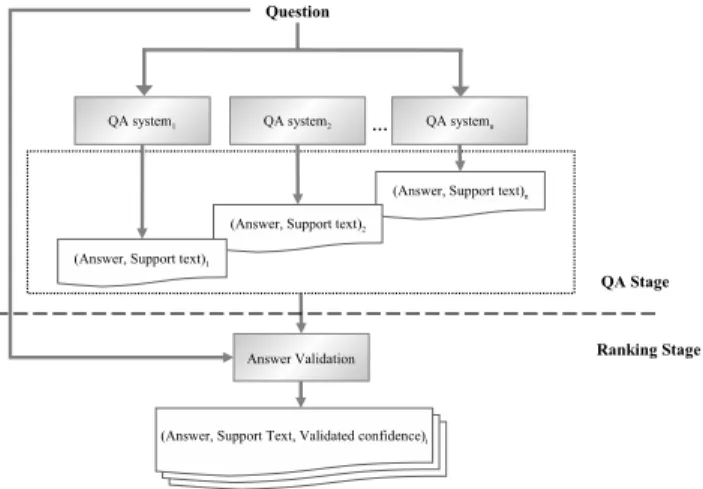
Figure 1 shows the general scheme of the proposed exter-nal multi-stream QA System. It uses ananswer validation moduleto superficially combine the outputs (answers) from several streams (QA systems).
Figure 1: Multi-stream QA System based on Answer Vali-dation
Mainly, the proposed multi-stream QA system consists of two main stages. In the first stage (called QA stage), several different QA systems extract — in parallel — a can-didate answer and its corresponding support text for a given question. Then, in the second stage (called ranking stage), an answer validation module evaluates — one by one — the candidate answers and assigns them a confidence value from 0 to 1. A confidence value equal to 0 indicates that the answer is totally rejected, whereas a confidence equal to 1 indicates that the answer is completely accepted. At the end, answers are ranked in line with their confidence values.
The following section describes in detail the answer vali-dation method. This method is an extension of our previous work described in Téllez-Valero et al (2007). In particular, it includes a novel set of attributes for answer validation which allow to increase our previous results by 14% as well as to outperform all results reported in the 2006 Spanish Answer Validation Exercise (Peñas et al, 2006).
4 The answer validation module
the candidate answer. In other words, it helps to determine if the specified answer is correct and if it can be deduced from the given support text.
Our answer validation module is mainly based on the idea of recognizing the textual entailment (RTE) between the support text (T) and an affirmative sentence (H) called hypothesis, created from the combination of the question and the answer. The entailment between the pair (T, H) occurs when the meaning of H can be inferred from the meaning ofT(Dagan et al, 2005).
The returned confidence value is generated by means a supervised learning approach that considers three main processes: preprocessing, attribute extraction and answer classification. The following sections describe each one of these processes.
4.1 Preprocessing
The objective of this process is to extract the main content elements from the question, answer and support text, which will be subsequently used for deciding about the correct-ness of the answer. This process considers two basic tasks: on the one hand, the identification of the main constituents from the question-answer pair, and on the other hand, the detection of the core fragment of the support text as well as the consequent elimination of the unnecessary information.
4.1.1 Constituent identification
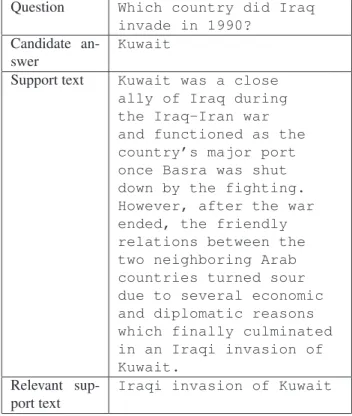
We detect three basic constituents from the questions: its main action, the action actors, and if exist, the action re-striction. As an example, consider the question in Table 1. In this case, the action is represented by the verbinvade, its actors are the syntagmsWhich countryandIraq, and the action restriction is described by the propositional syntagmain 1990.
In order to detect the question constituents we firstly ap-ply a shallow parsing to the given question. Then, from the resulting syntactic tree (Qparsed), we construct a new
repre-sentation of the question (calledQ’) by detecting and tag-ging the following elements:
1. The action constituent. It corresponds to the syntagm inQparsedthat includes the main verb.
2. The restriction constituent. It is represented by the prepositional syntagm inQparsedhaving at least one
ex-plicit time expression (e.g.,in 1990), or including a preposition such asafterorbefore.
3. The actors constituents. These constituents are formed by the rest of the elements in Qparsed. It is
commonly divided in two parts. The first one, hence-forth calledhidden actor constituent, corresponds to the syntagm that includes the interrogative word and it is generally located at the left of the action constituent. The second part, which we call thevisible actor con-stituent, is formed by the rest of the syntagms, gener-ally located at the right of the action constituent.
Question Which country did Iraq invade in 1990?
Candidate an-swer
Kuwait
Support text Kuwait was a close ally of Iraq during the Iraq-Iran war and functioned as the country’s major port once Basra was shut down by the fighting. However, after the war ended, the friendly relations between the two neighboring Arab countries turned sour due to several economic and diplomatic reasons which finally culminated in an Iraqi invasion of Kuwait.
Relevant sup-port text
Iraqi invasion of Kuwait
Table 1: Example of excessive text to accept or reject an answer
Finally, we also consider ananswer constituent, which is simply the lemmatized candidate answer (denoted byA’).
4.1.2 Support text’s core fragment detection
Commonly, the support text is a short paragraph — of max-imum 700 bytes according to CLEF evaluations — which provides the context necessary to support the correctness of a given answer. However, in many cases, it contains more information than required, damaging the performance of RTE methods based on lexical-syntactic overlaps. For in-stance, the example of Table 1 shows that only the last sen-tence (a smaller text fragment) is useful for validating the given answer, whereas the rest of the text only contribute to produce an irrelevant overlap.
In order to reduce the support text to the minimum useful text fragment we proceed as follows:
– First, we apply a shallow parsing to the support text, obtaining the syntactic tree (Sparsed).
– Second, we match the content terms (nouns, verbs, adjectives and adverbs) from question constituents against the terms fromSparsed. In order to capture the
morphological inflections of words we compare them using the Levenshtein edition distance12. Mainly, we
12The Levenshtein edition distance has been previously used in other
consider that two different words are equal if its dis-tance value is greater than 0.6.
– Third, based on the number of matched terms, we align the question constituents with the syntagms from the support text.
– Forth, we match the answer constituent against the syntactic tree (Sparsed). The idea is to find all
occur-rences of the answer in the given support text.
– Fifth, we determine the minimum context of the an-swer in the support text that contains all matched syn-tagms. This minimum context (represented by a se-quence of words around the answer) is what we call the core fragment. In the case that the support text includes several occurrences of the answer, we select the one with the smallest context.
Applying the procedure described above we determine that the core fragment of the support text showed at Table 1 isin an Iraqi invasion of Kuwait
4.2 Attribute extraction
This stage gathers a set of processes that allow extracting several attributes from the question, the answer and the sup-port text. These attributes can be categorized in two differ-ent groups: the attributes that indicate the relation between the question and the answer, and the attributes that mea-sure the entailment relation between the question-answer pair and the support text.
The following sections describe both kinds of attributes and explain the way they are calculated fromQ’,A’andT’.
4.2.1 Attributes about the question-answer relation
Question characteristics
We consider three different attributes from the question: the question category (factoid or definition), the expected answer type (date, quantity, name or other), and the type of question restriction (date, period, event, or none).
The question category and the expected answer type are determined using a set of simple lexical patterns. Some of these patterns are showed below. It can be observed that each of them includes information about the question cate-gory and the expected answer type.
What is[whatever]→DEFINITION-OTHER
Who is[whatever]→DEFINITION-PERSON
How many[whatever]→FACTOID-QUANTITY
When[whatever]→FACTOID-DATE
On the other hand, the value of the question restriction (date, period, event or none) depends on the form of the restriction constituent. If this constituent contains only one time expression, then this value is set to “date”. In the case the restriction constituent includes two time expressions, it is set to “period”. If the restriction constituent does not
include any time expression, then the question restriction is defined as “event”. Finally, when the question does not have any restriction constituent, the value of the question restriction is set to “none”.
Question-answer compatibility
This attribute indicates if the question and answer types are compatible. The idea of this attribute is to cap-ture the situation where the semantic class of the evalu-ated answer does not correspond to the expected answer type. For instance, having the answeryesterdayfor the questionHow many inhabitants are there in Longyearbyen?.
This is a binary attribute: it is equal to 1 when the answer corresponds to the expected answer type, and it is equal to 0 if this correspondence does not exist.
Answer redundancy
Taking into account the idea of “considering candidates as allies rather than competitors” (Dalmas and Webber, 2007), we decided to include an attribute related to the occurrence of the answers across streams.
Different from the Chorus Method (refer to Section 2) that directly uses the frequency of occurrence of the an-swers across streams, the proposed attribute indicates the average similarity of the candidate answer with the rest of stream answers (it takes values from 0 to 1).
In order to deal with the great language variability and also with the presence of some typing errors, we decide using the Levenshtein edition distance to measure the sim-ilarity between answers. Using this strategy, the answerX
contributes to the redundancy rate of the answerYand vice versa.
4.2.2 Attributes related to the textual entailment recognition
The attributes of this category are of two main types:(i) at-tributes that measure the overlap between the support text and the hypothesis (an affirmative sentence formed by com-bining the question and the answer); and(ii)attributes that denote the differences between these two components.
It is important to explain that, different from other RTE methods, we do not use the complete support text, instead we only use its core fragment T’. On the other hand, we neither need to construct an hypothesis text, instead we use as hypothesis the set of question-answer constituents (the union ofQ’andA’, which we callH’).
Overlap characteristics
things, as well as dates and quantities). In total we generate 10 different overlap attributes.
Non-overlap characteristics
These attributes indicate the number of non-overlapped terms from the core fragment of the support text, that is, the number of terms fromT’that are not present inH’.
Similar to the previous kind of attributes, for this case we also compute the non-overlap for each type of content term (nouns, verbs, adjectives and adverbs) as well as for each type of named entity (names of persons, places, orga-nizations, and other things, as well as dates and quantities). In total we generate 10 different non-overlap attributes.
4.2.3 Answer classification
This final process generates the answer validation decision by means of a supervised learning approach. In particular, it applies a boosting ensemble formed by ten decision tree classifiers13.
The constructed classifier decides whether to accept or reject the candidate answer based on the twenty-five at-tributes described in the previous section. In addition, it also generates a validation confidence (β) that indicates how reliable is the given answer in accordance to the sup-port text.
5 Experimental results
5.1 Experimental setup
5.1.1 Training and test data
As we describe in section 3, the core component of the proposed multi-stream QA method is the answer validation module, which relies on asupervised learningapproach.
In order to train this module we used the SPARTE cor-pus. This corpus was build from the Spanish corpora used at CLEF for evaluating QA systems from 2003 to 2005. It contains 2962 training instances represented by the tuple (hquestioni,hansweri,hsupport-texti,hentailment-valuei), where hentailment-valuei is a binary variable indicating whether the support text entails or not the question-answer pair.
One important fact about this corpus is that it is very un-balanced: 77% of the training instances are negative (their entailment value is FALSE), whereas just 695 instances (the rest 23%) correspond to positive entailment examples. On the other hand, for evaluating the proposed method, we used a set of 190 questions and the answers from 17 dif-ferent QA systems (i.e., 17 difdif-ferent streams). In total, we considered 2286 candidate answers with their correspond-ing support texts.
13We used the Weka implementations for the AdaBoot and ADTree
algorithms (Witten and Frank, 1999).
The used test set gathers the outputs from all QA systems participating at the QA track of CLEF 2006 (Magnini et al, 2006), and it was employed at the first Spanish Answer Validation Exercise (Peñas et al, 2006).
5.1.2 Evaluation measure
The evaluation measure most commonly used in QA is the accuracy, i.e., the percentage of correctly answered ques-tions. Following the CLEF evaluation criteria, this measure is calculated as the fraction of correct answers and correct nil-answers14with respect to the total number of questions (see formula 1).
Accuracy= |right_answers|+|right_nil’s| |questions| (1)
In particular, in our experiments we used an evaluation measure calledaccuracy@N, which basically indicates the accuracy of a QA system when considering N candidate answers for each question. In this case, an answer is evalu-ated as correct if it occurs in the list ofNcandidate answers, independently of its position.
5.1.3 Results from the input streams
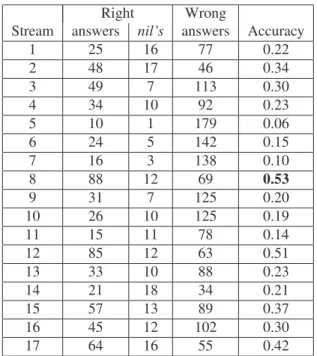
Table 2 shows some data from the input streams. It mainly presents their number of right and wrong answers as well as their accuracy for each different type of question. From this table, it is noticeable that most QA systems (streams) have a very poor performance level, having an average accuracy of 26%.
5.2 Experiments
5.2.1 First experiment: general evaluation of the proposed method
The objective of an external multi-stream QA method is to combine the responses from different QA systems in order to increase the final answer accuracy. In other words, its goal is to obtain a better result than that from the best input stream.
In a first experiment, we attempted to evaluate the ful-fillment of this objective. We compared the results ob-tained by our method with the accuracy from thebest input stream(53%). In addition, we also compared our method against other multi-stream approaches (refer to Section 2). In particular, we implemented some methods from these approaches based on the following criteria:
– The Naïve Skimming Method. In this case, streams maintain the order showed in Table 2.
14Nil questions do not have an answer in the target document collection,
Right Wrong
Stream answers nil’s answers Accuracy
1 25 16 77 0.22
2 48 17 46 0.34
3 49 7 113 0.30
4 34 10 92 0.23
5 10 1 179 0.06
6 24 5 142 0.15
7 16 3 138 0.10
8 88 12 69 0.53
9 31 7 125 0.20
10 26 10 125 0.19
11 15 11 78 0.14
12 85 12 63 0.51
13 33 10 88 0.23
14 21 18 34 0.21
15 57 13 89 0.37
16 45 12 102 0.30
17 64 16 55 0.42
Table 2: Results from the input streams
– The Ordered Skimming Method. It ranks the answers in accordance to the stream’s overall accuracies (refer to the last column of Table 2).
– The Chorus Method. It ranks the answers based on their repetitions across different streams.
– The Dark Horse Method. It uses the factoid accura-cies to rank answers corresponding to factoid ques-tions and the definition accuracies for ranking the an-swers for definition questions (refer to the antepenul-timate and penulantepenul-timate columns of Table 2.
– The Web Chorus Method. It ranks the answers based on the number of Web pages that contain the terms of the question (without the question word) along with the terms of the answer.
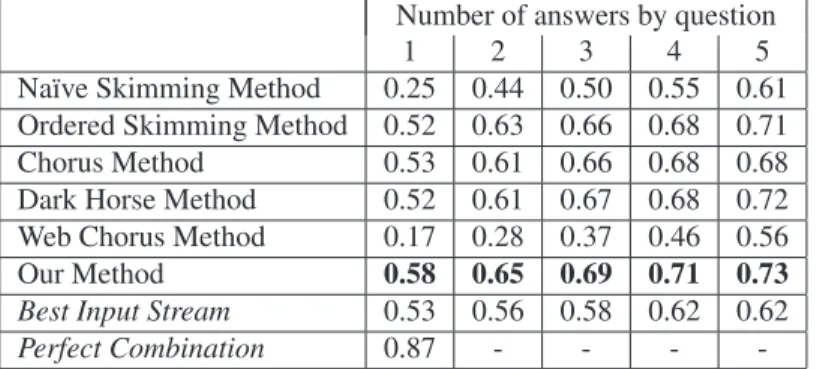
Table 3 shows the results from the first experiment. This table also includes the accuracy corresponding to aperfect combinationof the correct answers from all streams (87%). This value indicates the maximum reachable accuracy for a multi-stream approach in this data set.
The results from this first experiment show that our method was the only multi-stream approach that could im-prove the result from the best input stream; it responded correctly 58% of the questions outperforming the best in-dividual result (53%) by a relative increase of 9%. Consid-ering a list of five candidate answers (which is the typical configuration of existing online QA systems) our method outperformed the accuracy from the best input stream by 11%, a relative improvement of 18%.
The methods that rank answers based on the stream con-fidences, namely the Ordered Skimming Method and the
Dark Horse Method, also obtained relevant results. How-ever, it is necessary to mention that – in our implementa-tions – these methods made use of aperfect estimationof these confidences15. For that reason, and given that in a real scenario it is practically impossible to obtain these perfect estimations, we consider that our proposal is more robust than these two methods.
The results from Table 3 also give evidence that the pres-ence of several deficient streams (which generate a lot of incorrect answers) seriously affects the performance of the Naïve Skimming Method. This phenomenon also had an important effect over the Chorus Method, which normally is reported as one of the best multi-stream approaches.
Finally, it is important to comment that we attribute the poor results achieved by the Web Chorus Method to the quantity of online information for Spanish (which it is con-siderably less than that for English). In order to obtain bet-ter results it is necessary to apply some question/answer expansions, using for instance synonyms and hyperonyms.
5.2.2 Second experiment: the impact of rejecting less reliable answers
Taking into account that the accuracy of QA systems not only depends on the number of correctly answered ques-tions, but also on the number of correctlyunanswerednil questions, we decided to modify the basic multi-stream methods (including ours) in order to allow them rejecting some answers. The idea was to incorporate some filtering conditions that obligate the methods to eliminate the less reliable answers. In the cases that no answer could satisfy these conditions, the answer was set to nil. Following we describe the modifications incorporated to each one of the methods.
– Ordered Skimming Method*. It only considers an-swers from the best five streams (i.e., it only returns answers coming from the streams with the five high-est global accuracies).
– Chorus Method*. It only considers answers recom-mended by two or more streams.
– Dark Horse Method*. It only returns answers com-ing from the best five streams for each question type. In this case there were selected the best five streams for answering factoid questions and the best five for answering definition questions.
– Our Method*. It only returns answers with a valida-tion confidence greater than 0.5.
Table 4 shows the results from this second experiment. It is interesting to notice that all methods improved their results when they rejected some answers. The explanation of this behavior is that with these modifications all methods
15The confidences were calculated directly from the test set (refer to
Number of answers by question
1 2 3 4 5
Naïve Skimming Method 0.25 0.44 0.50 0.55 0.61 Ordered Skimming Method 0.52 0.63 0.66 0.68 0.71 Chorus Method 0.53 0.61 0.66 0.68 0.68 Dark Horse Method 0.52 0.61 0.67 0.68 0.72 Web Chorus Method 0.17 0.28 0.37 0.46 0.56
Our Method 0.58 0.65 0.69 0.71 0.73
Best Input Stream 0.53 0.56 0.58 0.62 0.62
Perfect Combination 0.87 - - -
-Table 3: Results from the first experiment: general evaluation of the proposed method
could answer some nil questions. In particular, our method correctly respond 63% of the questions outperforming the best input stream by a relative increase of 19%.
This experiment also helped to reveal another important characteristic of our method. It could correctly reject sev-eral answers without using any information about the con-fidence of streams and without considering any restriction on the answer frequencies.
5.2.3 Third experiment: combination of our method with other approaches
In (Jijkoun and de Rijke, 2004), Jijkoun and de Rijke de-scribe a multi-stream QA architecture that combines the Chorus and the Dark Horse Methods. Its evaluation results indicate that this combination outperformed the results ob-tained by other systems based on one single multi-stream strategy16.
Motivated by this result, we designed a third experi-ment which considered the combination of our method with other confidence-based methods, in particular, the Dark Horse Method and the Ordered Skimming Method. The combination of our method with these two other ap-proaches was performed as follows. In a first stage, our method selected a set of candidate answers, then, in a sec-ond stage, a confidence-based method ordered the candi-date answers in accordance to their own ranking criteria17. Table 5 shows the results from the combination of these methods. On the one hand, these results confirm the con-clusions of Jijkoun and de Rijke since they also indicate that the combination of methods outperformed the results obtained by individual approaches. On the other hand, and most important, these results demonstrate the competence of our method since they show that its individual result out-performed that from the combination of the Chorus Method with the Dark Horse Method (stated by Jijkoun and de Ri-jke as the best configuration for a multi-stream QA system).
16In their experiments, as mentioned in Section 2, they did not consider
the answer validation approach.
17Given that we use the same implementations for the confidence-based
methods that those described in the first experiment, in this case we also used a perfect estimation of the streams confidences.
6 Conclusions and future work
In this paper we proposed a new external multi-stream QA method. This method is founded on the idea of combining the output of different QA systems (streams) in order to obtain a better answer accuracy.
The proposed method is based on an answer validation approach. This way, it decides about the correctness of the answers based on their entailment with a support text, and does not exclusively rely on answer redundancies nor on the stream confidences. In addition, this method only con-siders lexical-syntactic information and does not make use of a deep semantic analysis of texts. All these features to-gether make our method appropriate for dealing with poor performance QA systems which represent the current state for most non-English languages. In particular, we have evaluated our method in Spanish, where current average answer accuracy is of 26% (please refer to Table 2).
The core component of the proposed multi-stream method is the answer validation module. This module ap-plies a supervised approach for recognizing the textual en-tailment. It mainly uses a set of attributes that capture some simple relations among the question, the answer and the given supported text. In particular, it considers some novel attributes that characterize: (i)the compatibility between question and answer types;(ii)the redundancy of answers across streams; and (iii)the overlap (as well as the non-overlap) between the question-answer pair and the support text. At this point, it is important to comment that an eval-uation of the proposed attributes during the development phase — using the information gain algorithm — showed us that the non-overlap and answer-redundancy attributes were the most discriminative.
From the evaluation results achieved on a test set of 190 Spanish questions from the CLEF-2006 QA collection, we could observe the following:
– The proposed method significantly enhanced the ac-curacy from the best individual stream. It correctly responded to 63% of the questions, outperforming the best QA participating system (53%) by a relative in-crease of 19%.
re-Number of answers by question
1 2 3 4 5
Ordered Skimming Method* 0.55 0.66 0.69 0.70 0.71 Chorus Method* 0.58 0.64 0.67 0.67 0.67 Dark Horse Method* 0.55 0.64 0.68 0.69 0.69
Our Method* 0.63 0.69 0.72 0.73 0.73
Best input stream 0.53 0.56 0.58 0.62 0.62
Perfect Combination 0.87 - - -
-Table 4: Results from the second experiment: the impact of rejecting less reliable answers
Number of answers by question
1 2 3 4 5
Chorus Method* + Ordered Skimming Method 0.63 0.65 0.66 0.67 0.67 Chorus Method* + Dark Horse Method 0.62 0.65 0.66 0.67 0.67 Our Method* + Ordered Skimming Method 0.64 0.71 0.72 0.73 0.73
Our Method* + Dark Horse Method 0.63 0.69 0.72 0.73 0.73
Best Input Stream 0.53 0.56 0.58 0.62 0.62
Perfect Combination 0.87 - - -
-Table 5: Results from the third experiment: combination of our method with other approaches
dundancy of answers across streams, it turned out to be less sensible to their low frequency than other ap-proaches. For instance, it outperformed the Chorus Method by 5%.
– The proposed method allowed to significantly reduce the number of wrong answers presented to the user. In relation to this aspect, our method was especially ade-quate to deal with nil questions. It correctly responded 65% of the nil questions, outperforming the best input stream by a relative increase of 8%.
– The combination of our method with the Dark Horse approach only produced a slightly improvement of 1%. This fact indicates that our method does not re-quire knowing the input stream confidences.
Finally, it is clear that any improvement in the answer validation module will directly impact the performance of the proposed multi-stream method. Hence, our future work will be mainly focused on enhancing this module by: (i) considering some new features in the entailment recogni-tion process, (ii) including a process for treatment of tem-poral restrictions, and (iii) using Wordnet in order to con-sider synonyms and hyperonyms for computing the term and structure overlaps.
Acknowledgement
This work was done under partial support of Conacyt (scholarship 171610). We also thank CLEF organizers for the provided resources.
References
Burger JD, Ferro L, Greiff WR, Henderson JC, Mardis S, Morgan A, Light M (2002) MITRE’s qanda at TREC-11. In: TREC
Chu-Carroll J, Czuba K, Prager JM, Ittycheriah A (2003) In question answering, two heads are better than one. In: HLT-NAACL
Clarke CLA, Cormack GV, Kemkes G, Laszlo M, Lynam TR, Terra EL, Tilker PL (2002) Statistical selection of exact answers (multitext experiments for TREC 2002). In: TREC
Dagan I, Glickman O, Magnini B (2005) The PASCAL recognising textual entailment challenge. In: Quiñonero J, Dagan I, Magnini B, d’Alché Buc F (eds) MLCW, Springer, Lecture Notes in Computer Science, vol 3944, pp 177–190
Dalmas T, Webber BL (2007) Answer comparison in au-tomated question answering. J Applied Logic 5(1):104– 120
de Chalendar G, Dalmas T, Elkateb-Gara F, Ferret O, Grau B, Hurault-Plantet M, Illouz G, Monceaux L, Robba I, Vilnat A (2002) The question answering system QALC at LIMSI, experiments in using web and wordnet. In: TREC
Diamond T (1996) Information retrieval using dynamic ev-idence combination, PhD Dissertation Proposal, School of Information Studies, Syracuse University
Glöckner I (2006) Answer validation through robust logical inference. In: Peters et al (2007), pp 518–521
Glöckner I, Sven H, Johannes L (2007) Logical valida-tion, answer merging and witness selection - a case study in multi-stream question answering. In: RIAO 2007, Large-Scale Semantic Access to Content, Pitts-burgh, USA
Harabagiu SM, Hickl A (2006) Methods for using tex-tual entailment in open-domain question answering. In: ACL, The Association for Computer Linguistics Hovy EH, Gerber L, Hermjakob U, Junk M, Lin CY (2000)
Question answering in webclopedia. In: TREC
Jijkoun V, de Rijke M (2004) Answer selection in a multi-stream open domain question answering system. In: Mc-Donald S, Tait J (eds) ECIR, Springer, Lecture Notes in Computer Science, vol 2997, pp 99–111
Jijkoun V, de Rijke M (2005) Recognizing textual entail-ment: Is word similarity enough? In: Candela JQ, Da-gan I, Magnini B, d’Alché Buc F (eds) MLCW, Springer, Lecture Notes in Computer Science, vol 3944, pp 449– 460
Kozareva Z, Vázquez S, Montoyo A (2006) University of alicante at qa@clef2006: Answer validation exercise. In: Peters et al (2007), pp 522–525
Magnini B, Negri M, Prevete R, Tanev H (2001) Is it the right answer?: exploiting web redundancy for answer validation. In: ACL, The Association for Computational Linguistics, Morristown, NJ, USA, pp 425–432
Magnini B, Giampiccolo D, Forner P, Ayache C, Jijkoun V, Osenova P, Peñas A, Rocha P, Sacaleanu B, Sut-cliffe RFE (2006) Overview of the clef 2006 multilin-gual question answering track. In: Peters et al (2007), pp 223–256
Moldovan DI, Clark C, Harabagiu SM, Hodges D (2007) Cogex: A semantically and contextually enriched logic prover for question answering. J Applied Logic 5(1):49– 69
Peñas A, Rodrigo Á, Sama V, Verdejo F (2006) Overview of the answer validation exercise 2006. In: Peters et al (2007), pp 257–264
Peñas A, Rodrigo Á, Sama V, Verdejo F (2007) Testing the reasoning for question answering validation. Jour-nal of Logic and Computation (3), DOI 10.1093/logcom/ exm072
Peters C, Clough P, Gey FC, Karlgren J, Magnini B, Oard DW, de Rijke M, Stempfhuber M (eds) (2007) Evalua-tion of Multilingual and Multi-modal InformaEvalua-tion Re-trieval, 7th Workshop of the Cross-Language Evalua-tion Forum, CLEF 2006, Alicante, Spain, September
20-22, 2006, Revised Selected Papers, LNCS, vol 4730, Springer
Pizzato LAS, Mollá-Aliod D (2005) Extracting exact an-swers using a meta question answering system. In: Proceedings of the Australasian Language Technology Workshop, Sydney, Australia, pp 105–112
Rodrigo Á, Peñas A, Herrera J, Verdejo F (2006) The ef-fect of entity recognition on answer validation. In: Peters et al (2007), pp 483–489
Rotaru M, Litman DJ (2005) Improving question answer-ing for readanswer-ing comprehension tests by combinanswer-ing mul-tiple systems. In: Proceedings of the American Associa-tion for Artificial Intelligence (AAAI) 2005 Workshop on Question Answering in Restricted Domains, Pitts-burgh, PA.
Roussinov D, Chau M, Filatova E, Robles-Flores JA (2005) Building on redundancy: Factoid question answering, robust retrieval and the “other”. In: Proceedings of the Thirteenth Text REtreival Conference (TREC 2005), pp 15–18
Tatu M, Iles B, Moldovan DI (2006) Automatic answer val-idation using cogex. In: Peters et al (2007), pp 494–501 Téllez-Valero A, Montes-y-Gómez M, Villaseñor-Pineda L
(2007) A supervised learning approach to spanish an-swer validation. In: Peters C, Jijkoun V, Mandl T, Müller H, Oard DW, Peñas A, Petras V, Santos D (eds) CLEF, Springer, Lecture Notes in Computer Science, vol 5152, pp 391–394
Vallin A, Magnini B, Giampiccolo D, Aunimo L, Ayache C, Osenova P, Peñas A, de Rijke M, Sacaleanu B, San-tos D, Sutcliffe RFE (2005) Overview of the clef 2005 multilingual question answering track. In: Peters C, Gey FC, Gonzalo J, Müller H, Jones GJF, Kluck M, Magnini B, de Rijke M (eds) CLEF, Springer, LNCS, vol 4022, pp 307–331
Vicedo JL (2001) Using semantics for paragraph selection in question answering systems. In: SPIRE, pp 220–227 Vogt CC, Cottrell GW (1999) Fusion via a linear
combina-tion of scores. Informacombina-tion Retrieval 1(3):151–173 Voorhees EM (2004) Overview of the TREC 2004 question
answering track. In: Proceedings of the Thirteenth Text REtreival Conference (TREC 2004), pp 52–62
Witten IH, Frank E (1999) Data Mining: Practical Machine Learning Tools and Techniques with Java Implementa-tions. Morgan Kaufmann