EUROPEAN JOURNAL OF PURE AND APPLIED MATHEMATICS Vol. 8, No. 2, 2015, 185-200
ISSN 1307-5543 – www.ejpam.com
New Type of Strongly Continuous Functions In topological Spaces
Via
δ
−
β
-Open Sets
Alaa Mahmood Farhan
1,2, Xiao-Song Yang
11School of Mathematics and Statistics, Huazhong University of Science and Technology, Hongshan
Area, Wuhan city, Hubei province, China
2Department of Mathematics, Anbar University, College of Education for Pure Sciences, Al-Ramadi
city, Iraq, P.O.Box: (55 Ramadi)
Abstract. In this paper we introduce and investigate a new class of strong continuous functions called stronglyθ −δ−β-continuous functions by using two new strong forms of δ−β-open sets called δ−β-regular sets andδ−βθ-open sets. This class is a generalization of both stronglyθ-e-continuous
functions and strongly θ−β-continuous functions. Several new characterizations and fundamental properties concerning stronglyθ−δ−β-continuous functions are obtained. Furthermore, the relation-ships between stronglyθ−δ−β-continuous functions and other well-known types of strong continuity are also discussed.
2010 Mathematics Subject Classifications: 54C05,54C08,54C10
Key Words and Phrases: δ−β-open sets,δ−βθ-closed sets,δ−β-regular sets, stronglyθ−δ−β -continuity
1. Introduction
The notion of continuity is an important concept in general topology as well as all branches of mathematics and quantum physics of course its strong forms are important, too. Recently, strong continuity of functions in topological spaces has been introduced and investigated by many mathematicians and quantum physicists. Furthermore, generalized open and closed sets are, as well-known, the most important notions in both pure and applied mathematics.The notion of continuity by involving these notions is the subject-matter of topology which has penetrated in the whole body of science. In the course of time, mathematicians realized that it is very useful to generalize the notions of open and closed sets and accordingly the notion of continuity. In 1980, Noiri[37]introduced the notion of strongθ-continuity which is stronger than δ-continuity [37]. Some properties of strongly θ-continuous functions are studied by Long and Herrington[32]. Recently, five generalizations of strongθ-continuity are obtained
Email addresses:[email protected](A. Jumaili),[email protected] (X. Yang)
by Jafari and Noiri[29], Noiri [38], Noiri and Popa[39], Park[42]and Murad ÄOzkoc and GÄulhan Aslim[41]. The purpose of the present paper is to introduce and investigate a new class of strong continuous functions called stronglyθ−δ−β-continuous functions and give several characterizations and fundamental properties concerning stronglyθ−δ−β-continuous functions by usingδ−β-open sets due to by Erdal Ekici[9]and E. Hatir and T. Noiri[27]. Also we discussed the relationships between stronglyθ−δ−β-continuous functions and other well-known types of strong continuity.
2. Preliminaries
Throughout this paper,(X,T)and(Y,T∗)(or simplyX andY) mean topological spaces on which no separation axioms are assumed unless explicitly stated. For any subsetAofX, The closure and interior ofAare denoted by Cl(A) and Int(A), respectively. We recall the following definitions, which will be used often throughout this paper.
A subset Aof a space (X,T) is called δ-open[48] if for each x ∈ Athere exists a regular open set V such that x ∈ V ⊂ A. The δ-interior of A is the union of all regular open sets contained in A and is denoted by I ntδ(A). The subset A is calledδ-open[48]if A= I ntδ(A). A point x∈X is called aδ-cluster points of A[48]ifATI nt(C l(V))6=φfor each open set V containing x. The set of allδ-cluster points of A is called theδ-closure of A and is denoted by
C lδ(A).I f A=C lδ(A)), then A is said to be δ-closed[48]. The complement ofδ-closed set is
said to beδ-open set.
A subset A of a space X is calledδ−β-open[27]ore∗-open[9], ifA⊂C l(I nt(δ−C l(A))), the complement of aδ−β-open set is calledδ−β-closed. The intersection of allδ−β-closed sets containing A is called theδ−β-closure of A[27]and is denoted byδ−β-Cl(A). The union of allδ−β-open sets of X contained in A is called theδ−β-interior[27]of A and is denoted by δ−β-Int(A). The family of allδ−β-open (resp. δ−β-closed) subsets of X containing a point
x ∈X is denoted byδ−βΣ(X,x) (resp. δ−βC(X, x)), the family of allδ−β-open (resp. δ−β-closed) sets in X are denoted byδ−βΣ(X,T)(resp. δ−βC(X, T)). A subset A is said to be regular open (resp. regular closed) if A=Int(Cl(A)) (resp. A=Cl(Int(A))).
A subset A of X is called semiopen[31](resp. α-open[36], preopen[33], b-open[2], semi-preopen[1](orβ-open[11]), e-open[8]) ifA⊂C l(I nt(A))(resp.A⊂I nt(C l(I nt(A))),
A⊂I nt(C l(A)),A⊂I nt(C l(A))SC l(I nt(A)),A⊂C l(I nt(C l(A))),
A ⊂ C l(δ− I nt(A))SI nt(δ−C l(A)), and the complement of a semiopen (resp. α-open, preopen, b-open, semi-preopen, e-open) set are called semiclosed (resp. α-closed, preclosed, b-closed, semi-preclosed, e-closed ).
Remark 1. Since the notion ofδ−β-open sets and the notion of e∗-open sets are same, we will use the termδ−β-open sets instead of e∗-open sets.
Remark 2. Erdal Ekici[8] shows that the notions of e-open set and b-open set and the notions of e-open set andβ-open set and the notions of e-open set and semiopen set are independent, see example (2.6)[8].
a) δ−β-Cl(A)=ASI nt(C l(δ−I nt(A)));
b) δ−β-Int(A)=ATC l(I nt(δ−β−C l(A)));
c) A isδ−β-closed if and only if A=δ−β-Cl(A);
d) δ−β-Cl(A) isδ−β-closed;
e) X\δ−β-Cl(A)=δ−β-Int(X\A);
f) x∈δ−β−C l(A)if ATU6=φfor everyδ−β-open set U containing x.
Remark 3. From above definitions we have the following diagram in which the converses of implications need not be true, see the examples in[8, 9, 28].
Figure 1: The relationships among some well-known generalized open sets in topological spaces
3. Strong Forms of
δ
−
β
-Open Sets
In this section we introduce two new strong forms ofδ−β-open sets, calledδ−β-regular sets and δ−βθ-open sets. By using these sets we introduce a several characterizations of
δ−β-open sets and their properties.
Definition 1. A subset A of a topological space X isδ−β-regular if it isδ−β-open andδ−β -closed. The family of allδ−β-regular subsets of X containing a point x∈X is denoted by
δ−βR(X, x), the family of allδ−β-regular sets in X denoted byδ−βR(X, T).
Definition 2. A point x of X is called aδ−βθ-cluster point of A if δ−β−C l(U)TA6=φfor every U ∈δ−βΣ(X,x). The set of allδ−βθ-cluster points of A is calledδ−βθ-closure of A and is denoted byδ−β-Clθ(A). A subset A is said to beδ−βθ-closed if A=δ−β-Clθ(A). The complement of aδ−βθ-closed set is said to beδ−βθ-open.
Remark 4. The union of twoδ−βθ-closed sets is not necessarilyδ−βθ-closed as Shown by the following example:
Example 1. Let X={1, 2, 3}, Define a topology T={φ,X,{1},{2},{1, 2}}on X. The subsets{1}
Remark 5. It can be easily shown that δ−β-regular⇒δ−βθ-open ⇒δ−β-open. But the converses are not necessarily true as shown by the following examples:
Example 2. Let X = {1, 2, 3}, Define a topology T= {φ,X,{1},{2},{1, 2}} on X. The subsets {1, 2}isδ−βθ-open in X but notδ−β-regular.
Example 3. Let X={1, 2, 3, 4, 5}, Define a topology T={φ,X,{1},{3},{1, 3},{3, 4{1, 3, 4}}on X.then The subsets{1}isδ−β-open in X but notδ−βθ-open.
The following interesting results will play an important role in the sequel. Theorem 1. The following properties hold for a subset A of a topological space(X,T):
a) A∈δ−βΣ(X,T)if and only ifδ−β-Cl(A)∈δ−βR(X,T); b) A∈δ−βC(X,T)if and only ifδ−β-Int(A)∈δ−βR(X,T).
Proof. a). (Necessity) LetA∈δ−βΣ(X,T),Then we have A⊂ C l(I nt(δ−C l(A)))and henceδ−β−C l(A)⊂δ−β−C l[C l(I nt(δ−C l(A)))] =C l(I nt(δ−C l(A))). Since
A⊂δ−β−C l(A), we haveδ−β−C l(A)⊂C l(I nt(δ−C l(δ−β−C l(A)))). This shows that δ−β-Cl(A) is aδ−β-open set. On the other hand,δ−β-Cl(A) is always anδ−β-closed set. Thereforeδ−β−C l(A)∈δ−βR(X,T).
(Sufficiency). Letδ−β−C l(A)∈δ−βR(X,T). Then we have
A⊂δ−β−C l(A)⊂C l(I nt(δ−C l(δ−β−C l(A))))⊂C l(I nt(δ−C l(δ−C l(A)))) =C l(I nt(δ−C l(A))).
Hence we haveA⊂C l(I nt(δ−C l(A))), There forA∈δ−βΣ(X,T). b). This Proof is follows from a) and Lemma (1).
Theorem 2. For a subset A of a topological space X; the following are equivalent: a) A∈δ−βR(X,T);
b) A=δ−β−C l(δ−β−I nt(A));
c) A=δ−β−I nt(δ−β−C l(A)).
Proof. The proofs of the implications(a)⇒(b)and(a)⇒(c)are obvious thus omitted. (b)⇒(a)sinceδ−β-Cl(A) isδ−β-closed, then by Theorem (1) we have
δ−β-Int(δ−β−C l(A))∈δ−βR(X,T)andA∈δ−βR(X,T).
(c)⇒(a)Sinceδ−β-Int(A) isδ−β-open, then by Theorem (1) we have δ−β−C l(δ−β−I nt(A))∈δ−βR(X,T)andA∈δ−βR(X,T).
Theorem 3. For each subset A of a topological space (X, T), we have:
δ−β−C lθ(A) =T{V :A⊂V and V isδ−βθ −cl osed}
Proof. We prove only the first equality since the other is similarly proved. First, suppose that x∈/δ−β−C lθ(A). Then there existsV ∈δ−βΣ(X,x)such that
δ−β−C l(V)TA=φ. By Theorem 1,X\δ−β-Cl(V) isδ−β-regular and hence
X\δ−β–Cl(V) is anδ−βθ-closed set containing A and x ∈/X\δ−β−C l(V). Therefore, we
have x∈/T{V :A⊂V and V isδ−βθ −cl osed}.
Conversely, suppose thatx ∈/T{V :A⊂V and V isδ−βθ−cl osed}. There exists anδ−βθ -closed set V such thatA⊂V andx ∈/V . There existsU∈δ−βΣ(X,T)such that
x ∈U ⊂δ−β−C l(U)⊂X\V. Therefore, we have
δ−β−C l(U)TA⊂δ−β−C l(U)TV =φ. This shows that x∈/δ−β−C lθ(A).
Theorem 4. Let A and B be any two subsets of a topological space (X,T). Then the following properties hold:
a) x∈δ−β−C lθ(A)if and only if UTA6=φ; for each U∈δ−βR(X,x), b) If A⊂B; thenδ−β−C lθ(A)⊂δ−β−C lθ(B),
c) δ−β−C lθ(δ−β−C lθ(A)) =δ−β−C lθ(A),
d) If Aλ isδ−βθ-closed in X for eachλ∈∆; then
T
λ∈∆Aλisδ−βθ-closed in X.
Proof. The proofs of properties (a) and (b) are obvious, thus omitted. (c) Generally we haveδ−β−C lθ(δ−β−C lθ(A))⊃δ−β−C lθ(A). Suppose that x∈/δ−β−C lθ(A). There
existsU∈δ−βR(X,x)such thatUTA=φ. SinceU∈δ−βR(X,T); we have δ−β−C lθ(A)
T
U =φ. This shows that x ∈/ δ−β−C lθ(δ−β−C lθ(A)). Therefore, we
obtainδ−β−C lθ(δ−β−C lθ(A))⊂δ−β−C lθ(A).
(d) Let Aλ isδ−βθ −cl osed in X for each λ∈∆. For eachλ ∈∆. Aλ =δ−β−C lθ(Aλ). Henceδ−β−C lθ(
T
λ∈∆Aλ)⊂
T
λ∈∆δ−β−C lθ(Aλ) =
T
λ∈∆Aλ⊂δ−β−C lθ(
T
λ∈∆Aλ).
Therefore, we obtain: δ−β−C lθ(
T
λ∈∆Aλ)=
T
λ∈∆Aλ. This shows that
T
λ∈∆Aλ isδ−βθ-closed in X.
Corollary 1. Let A and Aλ(λ∈∆) be any subsets of topological space(X,T). Then the following properties hold:
a) A isδ−βθ-open in X if and only if for each x∈A there exists U∈δ−βR(X,x)Such that x ∈U ⊂A,
b) δ−β−C lθ(A)isδ−βθ-closed andδ−β−I ntθ(A)isδ−βθ-open,
c) If Aλ isδ−βθ-open in X for eachλ∈∆, then
S
λ∈∆Aλisδ−βθ-open in X.
Theorem 5. For a subset A of a space X, the following properties hold: a) If A∈δ−βΣ(X,T), Thenδ−βC l(A) =δ−β−C lθ(A),
Proof. (a) Generally we have δ−β −C l(B) ⊂ δ−β−C lθ(B) for every subset B of X.
LetA∈δ−βΣ(X,T). Suppose that x ∈/ δ−β−C l(A).Then there existsU ∈δ−βΣ(X,x) such that UTA=φ. SinceA∈δ−βΣ(X,T), we have δ−β−C l(U)TA=φ. This shows that x ∈/ δ−β−C lθ(A). Therefore, we obtain δ−β −C lθ(A) ⊂ δ−β −C l(A). Hence
δ−β−C l(A) =δ−β−C lθ(A).
(b) LetA∈δ−βR(X,T). ThenA∈δ−βΣ(X,T)and by (a),A=δ−β−C l(A) =δ−β−C lθ(A).
Therefore, A isδ−βθ-closed. Since X\A∈δ−βR(X,T), by the argument above. We have X\Aisδ−βθ-closed and hence A isδ−βθ-open. The converse is obvious
4. Characterizations of Strongly
δ
−
β
-Continuous Functions
In this section, we introduce some characterizations and basic properties concerning strongly θ−δ−β-continuous functions.
Definition 3. A function f :(X,T)→(Y,T∗)is said to be stronglyθ−δ−β-continuous (briefly, st. θ −δ−β.c.) if for each x ∈ X and each open set V of Y containing f (x), there exists an
δ−β-open set U of X containing x, such that f (δ−β−C l(U))⊂V .
Theorem 6. For a function f :(X,T)→(Y,T∗), the following are equivalent: a) f is stronglyθ−δ−β-continuous,
b) For each x ∈X and each open set V of Y containing f (x), there exists U ∈δ−βR(X,x)
such that f(U)⊂V ,
c) f−1(V)isδ−βθ-open in X for each open set V of Y,
d) f−1(F)isδ−βθ-closed in X for each closed set F of Y,
e) f(δ−β−C lθ(A))⊂C l(f(A))for each subset A of X,
f) δ−β−C lθ(f−1(B))⊂ f−1(C l(B))for each subset B of Y.
Proof. (a)⇒(b). It follows directly from Theorem (1).
(b)⇒(c). Let V be any open set of Y and x ∈ f−1(V). There exists U ∈δ−βR(X,x) such that f(U) ⊂ V. Therefore, we have x ∈U ⊂ f−1(V). Hence by Corollary (1)(a), f−1(V)is δ−βθ-open in X.
(c)⇒(d). This is obvious thus omitted.
(d)⇒(e). Let A be any open set of X. sinceC l(f(A)) is closed in Y, by (d) f−1(C l(f(A)))is δ−βθ-closed and we have,
δ−β−C lθ(A))⊂δ−β−C lθ(f−1(f(A)))⊂δ−β−C lθ(f−1(C l(f(A)))) = f−1(C l(f(A))).
There for, we obtain f(δ−β−C lθ(A))⊂C l(f(A)). (e)⇒(f). Let B be any subset of Y. By (e), we obtain
haveδ−β−C lθ(f−1(Y\V))⊂ f−1(C l(Y\V)) = f−1(Y\V). Therefore, f−1(Y\V)isδ−βθ -closed in X and f−1(V)is anδ−βθ-open set containing x. There existsU∈δ−βΣ(X,x)such thatδ−β−C l(U)⊂ f−1(V)and hence f(δ−β−C l(U))⊂V. This shows that f is strongly θ−δ−β-continuous.
Definition 4([9, 27]). A function f :(X,T)→(Y,T∗)is said to beδ−β-continuous if f−1(A)
isδ−β-open in X for every A∈T∗.
Theorem 7. Let Y be a regular space. Then f :(X,T)→(Y,T∗)is stronglyθ−δ−β-continuous if and only if f isδ−β-continuous.
Proof. Let x∈X and V an open set of Y containing f(x). Since Y is regular, there exists an open set H such that f(x)∈H⊂C l(H)⊂V. If f isδ−β-continuous, there exists
U ∈ δ−βΣ(X,x) such that f(U) ⊂ H. We shall show that f(δ−β −C l(U)) ⊂ C l(H). Suppose that y ∈/ C l(H). There exists an open set W containing y such that WTH = φ. Since f isδ−β-continuous, Then f−1(W)∈δ−βΣ(X,T)and f−1(W)TU =φ. and hence
f−1(W)Tδ−β−C l(U) =φ. Therefore, we obtainWTf(δ−β−C l(U)) =φand
y ∈/ f(δ−β−C l(U)). Consequently, we have f(δ−β−C l(U))⊂C l(H)⊂V. The converse is obvious.
Definition 5. A space X is said to beδ−β-regular if for each closed set F ⊂ X and each point x ∈X\F , there exist disjointδ−β-open sets U and V such that x∈U and F⊂V .
Lemma 2. For a space X the following are equivalent: a) X isδ−β-regular,
b) For each point x∈X and for each open set U of X containing x, there Exists V ∈δ−βΣ(X,T)
such that x∈V ⊂δ−β−C l(V)⊂U,
c) For each subset A of X and each closed set F such that ATF=φ. There exist disjoint U,V ∈δ−βΣ(X,T)such that ATU6=φ. and F⊂V ,
d) For each closed set F of X, F=T{δ−β−C l(V):F⊂V,V ∈δ−βΣ(X,T)}.
Theorem 8. A continuous function f :(X,T)→(Y,T∗)is stronglyθ−δ−β-continuous if and only if X isδ−β-regular.
Proof. (Necessity). Let f : X → X be the identity function. Then f is continuous and stronglyθ−δ−β-continuous by our hypothesis. For any open set U of X and any pointx ∈U, we have f(x) = x ∈U and there exists V ∈δ−βΣ(X,x)such that f(δ−β−C l(V)) ⊂ U. Therefore, we havex∈V ⊂δ−β−C l(V)⊂U. It follows from Lemma 2 that X isδ−β-regular. (Sufficiency). Suppose that f :X →Y is continuous and X isδ−β-regular. For anyx∈X and open set V containing f(x), f−1(V)is an open set containing x. Since X isδ−β-regular, then there existsU∈δ−βΣ(X,T)such thatx ∈U⊂δ−β−C l(U)⊂ f−1(V). Therefore, we have
Theorem 9. Let f :X →Y be a function andg :X →X ×Y be the graph function of f. Then, the following properties are hold:
a) If gis stronglyθ −δ−β-continuous, then f is stronglyθ −δ−β-continuous. And X is
δ−β-regular.
b) If f is stronglyθ−δ−β-continuous, and X isδ−β-regular, then g is stronglyθ−δ−β -continuous.
Proof. (a). Suppose that g is strongly θ −δ−β-continuous. First, we show that f is strongly θ −δ−β-continuous. Let x ∈ X and V an open set of Y containing f(x). Then
X×V is an open set ofX×Y containing g(x). Since g is stronglyθ−δ−β-continuous, then there exists U ∈δ−βΣ(X,x)such that g(δ−β−C l(U)) ⊂ X ×V. Therefore, we obtain,
f(δ−β−C l(U))⊂V. Next, we show that X isδ−β-regular. Let U be any open set of X and
x ∈U. Since g(x)∈U×Y andU×Y is an open inX×Y, Then there existsW∈δ−βΣ(X,x) such that g(δ−β−C l(W))⊂U×Y. Therefore we obtain x ∈W ⊂δ−β−C l(W)⊂ U and hence X isδ−β-regular.
(b). Let x ∈X and H an open set ofX ×Y containing g(x). There exists open setsU1 ⊂ X andV ⊂Y such that g(x) = (x,f(x))∈U1×V ⊂H. since f is stronglyθ−δ−β-continuous, There existsU2∈δ−βΣ(X,x)such that f(δ−β−C l(U2))⊂V. since X isδ−β-regular and
U1
T
U2∈δ−βΣ(X,x), so there existsU ∈δ−βΣ(X,x)such that
x ∈U ⊂δ−β−C l(U)⊂U1TU2. Therefore we obtain
g(δ−β−C l(U)) ⊂ U1× f(δ−β−C l(U2)) ⊂ U1×V ⊂ H. This show that g is strongly θ−δ−β-continuous.
5. Comparisons and Examples
In this section, we investigate the relationships between strongly θ −δ−β-continuous function and other well-known types of strong continuity.
Definition 6. A function f :(X,T)→(Y,T∗)is said to be:
a) Stronglyθ-continuous[37] if for each x ∈X and each open set V of Y Containing f(x), there exists an open set U of X containing x such that f(C l(U))⊂V ;
b) Strongly θ-semicontinuous [29] if for each x ∈ X and each open set V of Y Containing f(x), there exists a semi-open set U of X containing x such that f(sC l(U))⊂V ;
c) Stronglyθ-precontinuous[38]if for each x∈X and each open set V of Y Containing f(x), there exists a preopen set U of X containing x such that f(pC l(U))⊂V ;
d) Stronglyθ−β-continuous[39]if for each x∈X and each open set V of Y Containing f(x), there exists a semi-preopen set U of X containing x such that, f(βC l(U))⊂V ;
f) Strongly b-continuous[10]if for each x ∈X and each open set V of Y Containing f(x), there exists U∈BO(X,x)such that f(U)⊂V ;
g) Stronglyθ-e-continuous[41]if for each x ∈X and each open set V of Y Containing f(x), there exists an e-open set U of X containing x such that f(e−C l(U))⊂V .
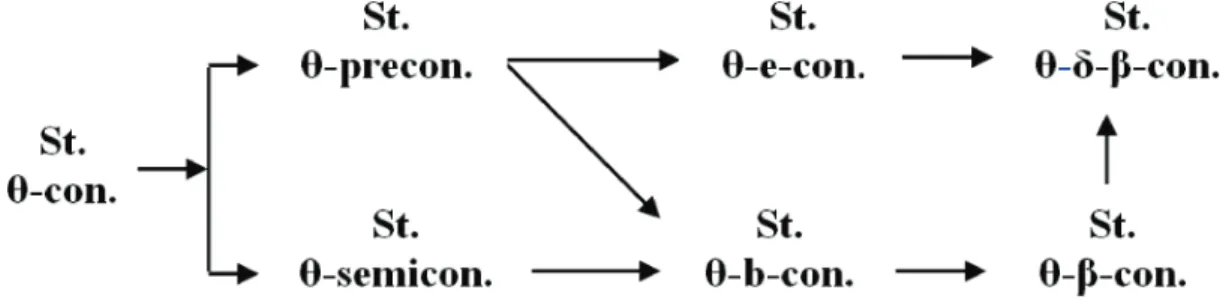
Remark 6. From Definitions 3 and 6 we have the following diagram.
However the converses are not true in general by Examples (4.4, 4.5, 4.6, 4.7, 4.8) of [42] and
(4.2, 4.3, 4.4, 4.5)[41]and the following examples.
Figure 2: The relationships between strongly ÎÿâĹŠÎťâŊΚ-continuous functions and other known types of strong continuity
Example 4. Let X ={1, 2, 3, 4, 5}, Define a topology T={φ,X,{1},{3},{1, 3},{3, 4},{1, 3, 4}}
on X and a topology T∗ = {φ,X,{4}}on Y. Then the identity function f : X → Y is strongly
θ−δ−β-continuous but not stronglyθ-b-continuous.
Example 5. Let X ={1, 2, 3, 4, 5}, Define a topology T={φ,X,{1},{3},{1, 3},{3, 4},{1, 3, 4}}
on X and a topology T∗={φ,X,{2, 3, 4}}on Y.Then the identity function f :X →Y is strongly
θ−b-continuous but not stronglyθ-e-continuous.
Example 6. Let T be the usual topology for R and T∗ ={[0, 1]S(1, 2)TQ} where Q denotes the set of rational numbers. Then the identity function f :(R,T)→(R,T∗)is stronglyθ−δ−β -continuous but neither stronglyθ-precontinuous nor stronglyθ-semicontinuous.
Example 7. Let X ={1, 2, 3, 4}, Define T ={φ,X,{1},{3},{1, 2},{1, 3},{1, 2, 3},{1, 3, 4}}on X and a topology T∗ = {φ,X,{2, 4}} on Y.Then the identity function f : (X,T) → (X,T∗) is stronglyθ−δ−β-continuous but neither stronglyθ-e-continuous nor stronglyθ−β-continuous.
Recall that a space X is said to be submaximal[45]if each dense subset of X is open in X. It is shown in[45]that a space X is submaximal if and only if every preopen set of X is open. A space X is said to be extremally disconnected[3]if the closure of each open set of X is open. Note that an extremally disconnected space is exactly the space where every semiopen set is α-open
a) f is stronglyθ-continuous;
b) f is stronglyθ-semicontinuous;
c) f is stronglyθ-precontinuous;
d) f is stronglyθ-b-continuous;
e) f is stronglyθ-e-continuous;
f) f is stronglyθ−β-continuous;
g) f is stronglyθ−δ−β-continuous.
Proof. it follows from the fact that if X is submaximal extremally disconnected, then open set, preopen set, semiopen set, b-open set, e-open set, semipreopen set andθ−β-open set are equivalent.
Theorem 11. Let f :(X,T)→(Y,T∗)andg :(Y,T∗)→(Z,T∗∗)be a functions. If f is strongly
θ−δ−β-continuous. And g is continuous, then the composition functiongo f :(X,T)→(Z,T∗∗)
is stronglyθ−δ−β-continuous.
Proof. This proof follows directly from Theorem 6.
6. Strongly
θ
−
δ
−
β
-continuous Functions and Separation Axioms
Definition 7([7, 28]). A space X is said to beδ−β−T2 if for each pair of distinct points x and y in X, there exist U∈δ−βΣ(X,x)and V ∈δ−βΣ(X,y)such that UTV =φ.
Lemma 3. A space X isδ−β−T2if and only if for each pair of distinct points x and y in X, there exist U∈δ−βΣ(X,x)and V ∈δ−βΣ(X,y)such thatδ−β−C l(U)Tδ−β−C l(V) =φ.
Theorem 12. If a function f :(X,T)→(Y,T∗)is (st. θ−δ−β.c.) injection and Y is T0, then
X isδ−β−T2.
Proof. For any distinct points x and y of X, by hypothesis f(x) 6= f(y)and there exists either an open set V containing f(x)not containing f(y)or an open set H containing f(y) not containing f(x). If the first case holds, then there exists U ∈ δ−βΣ(X,x) such that
f(δ−β−C l(U))⊂V. Thus, we obtain f(y)∈/ f(δ−β−C l(U))and hence
X \δ−β−C l(U)∈δ−βΣ(X,y). If the second case holds, then we obtain a similar result. Thus, X isδ−β−T2.
Proof. It is clear thatf(x)6= f(y)for each(x,y)∈/A. Since Y is Hausdorff, there exist open sets V and H of Y containing f(x)and f(y), respectively, such thatVTH=φ. Since f is (st. θ−δ−β.c). There existU∈δ−βΣ(X,x)andW ∈δ−βΣ(X,y)such thatf(δ−β−C l(U))⊂V
and f(δ−β−C l(W))⊂ H. Set D= f(δ−β−C l(U))× f(δ−β−C l(W)). It follows that (x,y)∈D∈δ−βR(X ×X) andDTA= φ. This meansδ−β−C lθ(A) ⊂Aand thus, A is δ−βθ-closed inX×X.
Recall that for a function f :X →Y, the subset{(x,f(x)):x ∈X}ofX×Y is called the graph of f and is denoted byG(f).
Definition 8. The graph G(f)of a function f :X →Y is said to be stronglyδ−β-closed if for each(x,y)∈(X×Y)\G(f); there exist U∈δ−βΣ(X,x)and an open set V in Y containing y such that(δ−β−C l(U)×V)TG(f) =φ.
Lemma 4. The graph G(f)of a function f : X →Y is strongly δ−β-closed if and only if for each(x,y)∈(X×Y)\G(f), there exist U∈δ−βΣ(X,x)and an open set V in Y containing y such that f(δ−β−C l(U))TV =φ.
Theorem 14. If f : X → Y is (st. θ −δ−β.c.) and Y is Hausdorff, then G(f) is strongly
δ−β-closed in X×Y .
Proof. It is clear that f(x)6= y for each(x,y)∈(X×Y)\G(f). Since Y is Hausdorff, there exist open sets V and H in Y containing f(x)and y, respectively, such thatVTH =φ. Since
f is (st. θ−δ−β.c.), There exist U ∈δ−βΣ(X,x)such that f(δ−β−C l(U))⊂V. Thus,
f(δ−β−C l(U))TH =φand then by Lemma(4),G(f) is stronglyδ−β-closed inX×Y.
7. Covering Properties
Definition 9. A space X is said to be:
a) δ−β-closed if every cover of X byδ−β-open sets has a finite subcover whose preclosures cover X,
b) Countablyδ−β-closed if every countable cover of X byδ−β-open sets has a Finite subcover whose preclosures cover X.
A subset K of a space X is said to beδ−β-closed relative to X if for every cover{Vλ:λ∈∆}of K byδ−β-open sets of X, there exists a finite subset∆0 of∆such that
K⊂S{δ−β−C l(Vλ):λ∈∆0}.
Theorem 15. If f :X→Y is (st. θ−δ−β.c.) and K isδ−β-closed relative to X, then, f(K) is a compact set of Y.
Proof. Suppose that f :X →Y is (st. θ−δ−β.c.) and K isδ−β-closed relative to X, Let
such that f(x)∈Vλ(x). Since f is (st. θ−δ−β.c.), there existsUx ∈δ−βΣ(X,x)such that
f(δ−β−C l(Ux))⊂Vλ(x). The family{Ux :x∈K}is a cover of K byδ−β-open sets of X and hence there exists a finite subsetK0 of K such thatK⊂
S
x∈koδ−β−C l(Ux). Therefore, we
obtain f(K)⊂Sx∈k
oVα(x). This shows that f(K) is compact.
Corollary 2. Let f :X →Y is (st. θ−δ−β.c.) surjection. Then the following Properties hold: a) If X isδ−β-closed, then Y is compact,
b) If X is countablyδ−β-closed, then Y is countably compact.
Theorem 16. If a function f :X →Y has a stronglyδ−β-closed graph, then f(K) is closed in Y for each subset K which isδ−β-closed relative to X.
Proof. Let K beδ−β-closed relative to X and y ∈ Y \ f(K). Then for each x ∈ K we have(x,y)∈/ G(f)and by Lemma 4 there existUx ∈δ−βΣ(X,x)and an open set Vx of Y containing y such that f(δ−β−C l(Ux))TVx =φ. The family {Ux : x ∈K}is a cover of K byδ−β-open sets of X. Since K isδ−β-closed relative to X, there exists a finite subsetK0of K such thatK⊂S{δ−β−C l(Ux):x∈K0}.
PutV =T{Vx :x ∈K0}. Then V is an open set containing y and
f(K)TV ⊂[Sx∈k
o f(δ−β−C l(Ux))]
T
V ⊂Sx∈k
o[f(δ−β−C l(Ux))
T
Vx] =φ. Therefore, we have y ∈/C l(f(K))and hence f(K)is closed in Y.
Theorem 17. Let X be a submaximal extremally disconnected space. If a function f :X →Y has a stronglyδ−β-closed graph, then f−1(K)isθ-closed in X for each compact set K of Y.
Proof. Let K be a compact set of Y and x ∈/ f−1(K). Then for each y∈K we have
(x,y)∈/G(f)and by Lemma 4 there existUy ∈δ−βΣ(X,x)and an open setVyof Y containing y such that f(δ−β−C l(Uy))
T
Vy =φ. The family{Vy : y ∈K}is an open cover of K and
there exists a finite subsetK0 of K such thatK⊂Sy∈k
oVy. Since X is submaximal extremally
disconnected, therefor eachUy is open in X andδ−β−C l(Uy) =C l(Uy). SetU =
T
y∈koUy,
then U is an open set containing x and
f(C l(U))TK⊂Sx∈k
o[f(C l(U))
T
Vy]⊂Sx∈k
o[f(δ−β−C l(Uy))
T
Vy] =φ.
so, we have C l(U)Tf−1(K) = φ and hence x ∈/ C lθ(f−1(K)). This shows that f−1(K) is
θ-closed in X.
Corollary 3. Let X be a submaximal extremally disconnected space and Y be a compact Hausdorff space. For a function f :X→Y , the following properties are equivalent:
a) f is (st.θ−δ−β.c.);
b) G(f)is stronglyδ−β-closed in X×Y ;
c) f is stronglyθ-continuous;
e) f isδ−β-continuous.
Proof. (a)⇒(b). It follows directly from Theorem 14.
(b)⇒(c). It follows directly from Theorem 17. (c)⇒(d)⇒(e). These are clear. (e)⇒(a). Since Y is regular, it follows from Theorem 7.
8. Conclusion
Topology as a field of mathematics is concerned with all questions directly or indirectly related to continuity. Therefore, generalization of continuity is one of the most important sub-jects in topology. One of the most important subsub-jects in studying topology and physics is conti-nuity, has been researched and investigated by many mathematicians and quantum physicists. [4–6, 17, 22, 40, 43, 44]from the different points of views. Relation of topology and physics have been appeared in[17, 18, 26, 47], El-Naschie in[13, 17, 26]have indicate that topology plays a significant role in quantum physics, high energy physics and superstring theory. One can observe the influence made in the realms of applied research by general topological spaces, properties and structures. In digital topology, information systems, particle physic[30], com-putational topology for geometric design and molecular design[35], Furthermore, Rosen and Peters[46]have used topology in computer-aided geometric design and engineering design. Also since El-Naschie has shown that the notion of fuzzy topology have very important appli-cations in quantum particle physics especially in related to both string theory andǫ∞theory. Thus we study a new class of strong continuity which may have very important applications in quantum particle physics, theoretical Physics, particularly in connections with string theory andǫ∞ theory[12, 14–16, 19–21, 23–25, 34, 47]. Also the fuzzy topological version of the concepts and results introduced in this paper are very important.
ACKNOWLEDGEMENTS I would like to express my sincere gratitude to the referees for their valuable suggestions and comments which improved the paper and I am thankful to profes-sor. Dr. E. Ekici (Turkey) for sending many of his papers as soon as I had requested and Dr. Mohammed Lutf (Yemen) for help.
References
[1] D. Andrijevic. Semipreopen sets. Matematicki Vesnik, 38(1):24–32, 1986. [2] D. Andrijevic. On b-open sets. Matematicki Vesnik, 48:59–64, 1996. [3] N. Bourbaki. Elements of Mathematics: General Topology. Hermann, 1966.
[4] M. Caldas, S. Jafari, T. Noiri, and R. K. Saraf. Weak and strong forms of α-irresolute maps. Chaos, Solitons and Fractals, 24(1):223–228, 2005.
[6] E. Ekici. On almostπgp-continuous functions.Chaos, Solitons and Fractals, 32(5):1935– 1944, 2007.
[7] E. Ekici. New forms of contra-continuity. Carpathian Journal of Mathematics, 24(1):37– 45, 2008.
[8] E. Ekici. On e-open sets, dp*-sets and dpe*-sets and decompositions of continuity. Ara-bian Journal for Science and Engineering, 33(24):269–282, 2008.
[9] E. Ekici. On e*-open sets and (d,s)*-sets. Mathematica Moravica, 13(1):29–36, 2009. [10] A. A. El-Atik. A study of some types of mappings on topological spaces. PhD thesis, Masters
Thesis, Faculty of Science, Tanta University, Tanta, Egypt, 1997.
[11] M. E. A. EL-Monsef, S. N. EL-Deeb, and R. A. Mahmoud. β-open sets andβ-continuous mapping. Bulletin of the Faculty of Science Assiut University, 12(1):77–90, 1983.
[12] M. S. EL-Naschie. Fredholm operators and the wave-particle duality in cantorian space.
Chaos, Solitons and Fractals, 9(6):975–978, 1998.
[13] M. S. EL-Naschie. On the uncertainty of cantorian geometry and the two-slit experiment.
Chaos, Solitons and Fractals, 9(3):517–529, 1998.
[14] M. S. EL-Naschie. Superstrings, knots, and noncommutative geometry in space. Interna-tional journal of theoretical physics, 37(12):2935–2951, 1998.
[15] M. S. EL-Naschie. On a class of general theories for high energy particle physics. Chaos, Solitons and Fractals, 14(4):649–668, 2002.
[16] M. S. EL-Naschie. Complex vacuum fluctuation as a chaotic limit set of any kleinian group transformation and the mass spectrum of high energy particle physics via spontaneous self-organization. Chaos, Solitons and Fractals, 17(4):631–638, 2003.
[17] M. S. EL-Naschie. Quantum gravity, clifford algebras, fuzzy set theory and the funda-mental constants of nature. Chaos, Solitons and Fractals, 20(3):437–450, 2004.
[18] M. S. EL-Naschie. The symplictic vacuum, exotic quasi particles and gravitational instan-ton. Chaos, Solitons and Fractals, 22(1):1–11, 2004.
[19] M. S. EL-Naschie. A few hints and some theorems about witten’s m-theory and t-duality.
Chaos, Solitons and Fractals, 25(3):545–548, 2005.
[20] M. S. EL-Naschie. On a fuzzy kähler-like manifold which is consistent with the two slit experiment. International Journal of Nonlinear Sciences and Numerical Simulation, 6(2):95–98, 2005.
[22] M. S. EL-Naschie. Topics in the mathematical physics of e-infinity theory. Chaos, Solitons and Fractals, 30(3):656–663, 2006.
[23] M. S. EL-Naschie. On the topological ground state of e-infinity spacetime and the super string connection. Chaos, Solitons and Fractals, 32(2):468–470, 2007.
[24] M. S. EL-Naschie. Probability set particles. International Journal of Nonlinear Sciences and Numerical Simulation, 8(1):117–120, 2007.
[25] M. S. EL-Naschie. Su(5) grand unification in a transfinite form. Chaos, Solitons and Fractals, 32(2):370–374, 2007.
[26] M. S. EL-Naschie, O. E. Rossler, and G. Oed. information and diffusion in quantum physics. Chaos, Solitons and Fractals, 7(5):Special Issue, 1996.
[27] E. Hatir and T. Noiri. Decompositions of continuity and complete continuity. Acta Math-ematica Hungarica, 113(4):281–287, 2006.
[28] E. Hatir and T. Noiri. On δ−β-continuous functions. Chaos, Solitons and Fractals, 42(1):205–211, 2009.
[29] S. Jafari and T. Noiri. On stronglyθ-semi-continuous functions. Indian Journal of Pure and Applied Mathematics, 29(1):1195–1201, 1998.
[30] G. Landi. An introduction to noncommutative spaces and their geometry. Lecture notes in physics, New York, Springer, 1997.
[31] N. Levine. Semi-open sets and semi-continuity in topological spaces. American Mathe-matical Monthly, 70(1):36–41, 1963.
[32] P. E. Long and L. L. Herrington. Strongly θ-continuous functions. Journal of the Korean Mathematical Society, 18(1):21–28, 1981/82.
[33] A. S. Mashhour, M. E. Abd-ELMonsef, and S. N. EL-Deeb. On pre-continuous and weak pre continuous mappings. Proceedings of the Mathematical and Physical Society of Egypt, 53:47–53, 1982.
[34] R. D. Mauldin and S. C. Williams. Random recursive constructions: asymptotic geo-metric and topological properties. Transactions of the American Mathematical Society, 295(1):325–346, 1986.
[35] E. L. F. Moore and T. J. Peters. Computational topology for geometric design and molec-ular design. Mathematics for Industry: Challenges and Frontiers. SIAM, pages 125–137, 2005.
[37] T. Noiri. On δ-continuous functions. Journal of the Korean Mathematical Society, 16(2):161–166, 1979/80.
[38] T. Noiri. Strongly θ-precontinuous functions. Acta Mathematica Hungarica, 90(4):307– 316, 2001.
[39] T. Noiri and V. Popa. Strongly θ-β-continuous functions. Journal of pure mathematics, 19:31–39, 2002.
[40] T. Noiri and V. Popa. Faintly m-continuous functions. Chaos, Solitons and Fractals, 19(5):1147–1159, 2004.
[41] M. Özkoç and G. Aslim. On strongly θ-e-continuous functions. Bulletin of the Korean Mathematical Society, 47(5):1025–1036, 2010.
[42] J. H. Park. Stronglyθ-b-continuous functions.Acta Mathematica Hungarica, 110(4):347– 359, 2006.
[43] J. H. Park, S. W. Bae, and Y. B. Park. Almost stronglyθ-precontinuous functions. Chaos, Solitons and Fractals, 28(1):32–41, 2006.
[44] J. H. Park and J. K. Park. On πgp-continuous functions in topological spaces. Chaos, Solitons and Fractals, 20(3):467–477, 2004.
[45] I. L. Reilly and M. K. Vamanamurthy. On some questions concerning preopen sets. Kyung-pook Mathematical Journal, 30(1):87–93, 1990.
[46] D. W. Rosen and T. J. Peters. The role of topology in engineering design research.Research in Engineering Design, 8(2):81–98, 1996.
[47] K. Svozil. Quantum field theory on fractal space-time: a new regularisation method.
Journal of Physics A: Mathematical and General, 20(12):3861–3875, 1987.