The Islamic World Science Citation Center: A New Scientometrics System for Evaluating Research Performance in OIC Region
J. Mehrad, Ph.D. M. Naseri, M.A. Regional Information Center for Regional Information Center for Science and Technology Science and Technology Email: [email protected] Corresponding Author: [email protected]
Abstract
This article deals with the establishment of the Islamic World Science Citation Center (ISC) as the first citation system in the Islamic countries. It attempts to describe the mapping of ISC the way it has been established. At the time being, ISC has begun to evaluate the research performance of the Islamic countries. The required research journals from the Islamic countries are being collected and processed in different subsystems of ISC. The languages used by ISC, at present, include Farsi (Persian), Arabic and English.
Keywords: Islamic world Science Citation Center, Research Performance, Research Journals, ISC.
Introduction
Citation analysis is the examination of the frequency, patterns and graphs of citations in articles and books. It uses citations in scholarly works to establish links to other works or other researches. It is one of the most widely used methods of Bibliometrics (Richard, 2004).
Along with peer review, it has over the past three decades been increasingly used to judge and quantify the importance of scientists and scientific research. Citation analysis is also the machinery behind journal “impact factors” –figures of merit that researchers take note of when deciding which journal to submit their work to so that it is read as widely as possible. Indeed, the output from citation studies is often the only way that non-specialists in governments and funding bodies – or even those in different scientific disciplines – can judge the importance of a piece of scientific research.
Researchers do a citation analysis for several reasons:
• To find out how much impact a particular article has had, by showing which other
authors based some work upon it or cited it as an example within their own papers.
• To determine more about a field or topic by reading the papers that cite a seminal work
in that area.
• To find out how much impact a particular author has had by looking at his/her total
The basic idea or assumption behind citation analysis is that influential works or scientists are cited more often than others. In this sense, citations reflect the relative impact and utility of a work, author, department, or journal’s publications within their larger scientific domains. Because the quality, validity and reliability of citation-based research and evaluation are highly dependent on the accuracy and comprehensiveness of the data used, it is imperative that appropriate citation sources and data collection methods are utilized. The use of inaccurate or incomplete data risks underestimating the impact of a scientist, department, university, journal, or nation’s research output that may otherwise be deemed good by established standards.
Until recently, ISI (currently Thomsons Scientific) has been known as the only Institute evaluating the research performance of countries on the basis of citation studies. Then, SCOPUS a subsidiary of ELSEVIER, did also start in this regard and is now considered as one of the serious rivals of ISI. Moreover, Google Scholar is another scientometrics tool which evaluates research output based on the scientometrics criteria. Parallel to the citation analysis activities of these institutes, some countries like China, have also taken steps to set up their national scientometrics tools and have gained considerable achievements in this regard.
On the one hand, ISI and Scopus productions are internationally considered as powerful scientometrics tools, but on the other, because of the ISI and Scopus bias towards English language, most of the scientific productions written in the national languages of non-English language countries do not have any opportunities to enter ISI or Scopus databases and in turn, will be kept out of the world scientists’ sight. Therefore, Regional Information Center for Science and Technology (RICeST) has begun implementing scientometrics tools similar to those of citation systems in order to be able to evaluate the research performance of the Islamic world scientists and provide the grounds for implementing the Islamic world scientific network.
Regional Information Center for Science and Technology
The Regional Information Center for Science and Technology is located in Shiraz, the center of Fars Province, Southwest of Iran.
RICeST was established in 1991 under an agreement reached between Iran’s Ministry of Science, Research and Technology and the Third World Academy of Science. It was meant to act as the regional1 center for reference, study and bibliographical information and other services in relation to both scientific and technological matters.
being organized so that the most effective use can be made of cataloging and indexing facilities and the document delivery services continue to be developed as a service to complement local, national and regional collections.
The funds at RICeST are employed to assist users, processors and disseminators of information to plan and develop their own operations with greater confidence and with a clear understanding of the possibilities for cooperation at the national and regional level.
Historical Background and Importance of ISC
Extending from Mauritania to Indonesia, the Muslim world occupies the middle belt of the globe and assumes a position of extreme strategic importance.
A number of Islamic countries abound in natural wealth, others have greater potential of manpower and yet there are few which possess a relatively higher level of standards in education and research. These differences can foster the quality of close friendship and cooperation between these countries, especially when there is an identity of purpose, similarity of views, agreement in order of priorities, parallelism in the social and situational behavior and above all, common faith and destiny. The hybridization of these elements can yield astonishing results in the creation of cooperative agreements and joint venture for quality training and research in the area of information collaboration.
Figure 1. The percentage of research journals in Islamic countries.
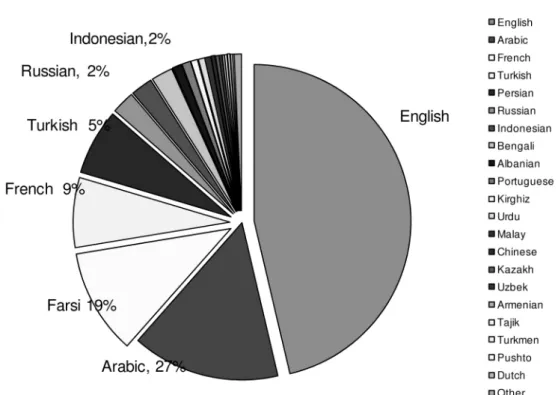
Figure 2 provides a language-based analysis of the scientific journals in the Islamic countries. The main languages of these journals are as follows:
Figure 2. The languages of the journals published by Islamic countries
Studies done on the frequency of the publication of these research journals show that more than 50% of the scientific journals are well qualified to be included in ISC (Figure 3).
weekly 15%
m onthly 20%
6 times a year 3% quarterly
30% 3 tim es a year
3% semi-annually
9%
irregular 10%
Other 10%
weekly
monthly
6 times a year
quarterly
3 times a year
semi-annually
irregular
Other
Figure 3. The distribution of journals published by Islamic countries based on their
frequency of publications
Islamic countries should consider international indicators to be able to enter to the world class universities and other ranking systems based on international standards. To achieve this purpose, ISC is to process the Islamic countries research journals published in different languages (Mehrad & Maghsoodi, 2006). ISC mainly aims to evaluate institutes, countries, researchers and publications of the Islamic countries published in their national and native languages. ISC began its work on Persian journals at RICeST in 2001 released its products in 2004. After ISC was accepted at 9th ISESCO General Assembly, Rabat, Morocco, RICeST studied for the Arabic and English journals published by universities and higher education centers of Islamic countries in order to consider them for inserting in ISC.
ISESCO has officially approved ISC and its implementation by Iran twice namely in the 9th General Assembly of Islamic Countries’ Ministers of Education, Rabat, Morocco, 2007 and the 4th meeting of the Islamic countries’ Higher Education Ministers in October, 2008 in Baku, Azerbaijan.
At the same time, the Supreme Council for Cultural Revolution of Iran as the highest authority for policy making in science and technology compiled the policy plan of ISC in April 2008. This authority did also formally introduce RICeST as the responsible organization for implementing ISC in Iran and other Islamic countries2.
Approval of ISC by ISESCO and appointing its policy plan by the Supreme Council for Cultural Revolution highlighted the mission of RICeST on assessing research performance of the Islamic countries.
Although RICeST acts at regional level and consequently its collection consists of most of the published materials in the Islamic countries at this time, RICeST deliberately began the collection building of journals of 57 Islamic countries suitable to be indexed in ISC.
For being successful in ISC, the cooperation of the Islamic countries with ISC is of utmost importance. ISC is aware that preparing journals from Islamic countries is a hard task, because the journals are produced in national languages rarely distributed world-wide. Iran, has greatly invested on ISC. This investment includes both human and financial resources.
There are relatively useful structures in the Islamic countries. ISC will help the structures to be developed. In this way, suitable grounds for the globalization of universities and research centers of the Islamic countries will be provided.
Now, there exist very few numbers of universities in the Islamic countries included in the world ranking from which we can mention Turkey, Egypt and Malaysia. Taking into consideration the research performance of the Islamic countries’ universities based on the international criteria, will provide suitable grounds which make us expect more and more universities of the Islamic countries to be included in the world university rankings, like QS World University Ranking and Academic Ranking of World Universities.
ISC and Scopus in Netherlands and Iran which resulted in agreement on the MOU between ISC and Scopus3. Materializing this MOU will lead to the following results:
• Integration of ISC into Scirus, Elsevier’s global scientific search engine covering 300
million scientific web pages from government, academic agencies, research institutes, institutional repositories. ISC’s content will become part of Elsevier’s scientific web which will provide visibility of ISC around the world for searches.
● If ISC is to be indexed in Scirus, the presentation of ISC’s content will be displayed under a distinct tab available on Scopus. This will allow researchers to search global scientific core literature in Scopus and ISC content in a single search.
● To enable article cited by links from Scopus (via web-cites) to ISC environment. ● To enable article cited by links from ISC environment to citing articles in Scopus ● Elsevier would become a member of ISC’s Advisory International
Committee for the Islamic countries in an effort to explore new ideas and policies for collaboration in the advancement of science world- wide.
Implementation Methodology
ISC selects research journals among those published by universities and research centers of the Islamic world. This selection criterion has been approved and is now being implemented on most of the Islamic countries4.
Based on these Regulations, hundreds of scientific journals from the Islamic counties in Farsi, Arabic, English and French have been acquired in ISC. ISC continuously keeps interactions with its dealers and directs them to prepare scientific journals based on the aforementioned criteria from 2000 on.
ISC began to work in 2001. Since then, about 1352 journals were chosen as the first batch of source journals in which the shares occupied by Basic Science, Engineering and Technology, Medicine as well as Agriculture and Humanities, Arts and Social Sciences out of the numerous journals published in the Islamic countries.
Table 1
Distribution of Source Journals in ISC by Subject.
Subjects Category Journal Titles (%) Basic Sciences 114 8/4
Engineering and Technology 198 14/6
Medicine 254 18/7
Agriculture 137 10
Arts and Humanities 649 48
Total 1352 100
The impact of ISC upon Islamic countries scientific community
ISC experts not only build and maintain this database but also have made some justifiable modifications including provision of full text papers of articles in Arabic, English and Farsi which differs from its counterparts such as ISI and Scopus. ISC experts have exerted the enormous impact upon development of scientific information system through its various products.
Prompted by ISC evaluation of universities and research institutes, more and more organizations introduce incentives to encourage scientists to publish more papers in influential journals. Some higher education authorities in Iran and in the region like Malaysia remarked once and again that ISC has provided a solid foundation in the establishment of scientific journals, scientists, and researchers’ views, in assessing universities and research centers and in comparing universities with each other. To be specific through ISC, more and more scientists in Iran and other Islamic countries have been increasingly aware of the importance to publish in domestic journals, so as to enhance effective scholarly exchange and establish themselves among the community. As a result, their papers productivity has been improved a great deal.
In short, ISC’s capabilities can be summarized as following. Islamic countries can use these capabilities for their research progress and scientific development:
1. ISC is implemented on the internet and it is easily available to all the Islamic countries5.
2. In ISC in addition to ranking of journals and evaluating research performance of the Islamic countries (countries, universities and research centers, Journals and Scientists), all journals are provided in full text and ISC acts as a scientific network of OIC member countries. ISC makes available the scientific journals of the Islamic countries as an integrated system to the universities and research institutes.
journals articles in full-text format, ISC’s Alert system is for notifying the amount of citations received, and the Conference subsystem shows the highly cited conferences in ISC.
4. All subsystems in ISC are now operative in English, Arabic and Farsi languages and the French language section will be established soon.
Conclusion
Many scientometrics researches are based on analysis of data extracted from the ISI and Scopus databases. These databases are no doubt very useful and powerful for evaluating research performance from an international perspective: international trend of research activities, position at the international research front and international research collaboration.
However, for the assessment of research activities or for science policy making from a national or OIC region perspective, they can not be sufficient. We need our own citation databases with a good coverage of the Islamic countries’ journals with no language bias. Regional Information Center for Science and Technology in 2001started to construct the citation databases for the Islamic countries called ISC, and released its services from January 2004.
At present, ISC databases provide access to current and retrospective bibliographic information and cited references found in approximately 1352 titles of the Islamic countries scientific journals covering engineering, science, agriculture, medicine and humanities’ disciplines.
The cooperation between ISC and SCOPUS shows that construction of non-English citation databases reflecting scientific activities in each Islamic country or geographic area to developed countries is of utmost importance.
In this paper, we described the implementation process of the ISC. Based on the citation data extracted from ISC products, we can analyze the relationships among Ummah’s academic institutions, which have been located from South-East Asia to North Africa.
No doubt, ISC should become a very useful and indispensable bibliometrics tool for the Islamic countries’ scholarly community and is expected to play an important role in research evaluation and science policy making in the Islamic world as well.
Endnotes
1. Region stands for countries in the Middle East, Central Asia, Indian Sub-Continent, countries located in the west of Caspian Sea and North Africa.
2. ISC policy plans was approved by the Supreme Council for Cultural Revolution in ISC’s 623rd meeting dated April 29, 2008 (1378/2/10).
For more information regarding the policy plan see www.isc.gov.ir/isce.htm 3. The MOU between ISC and SCOPUS was signed by Mr .Niels Weertman from
of the Ministry of Science, Research and Technology, Tehran, Iran in May 11, 2009.
4 .These regulations were approved by the ISC Steering Council in Jan, 2009. Office of Minister of Science, Research and Technology, Tehran, Iran. For more information about regulations, see www.isc.gov.ir/ policies/index3.pdf
5. ISC is accessible through www.isc.gov.ir
References
Meho Lokman, I. (2007). The rise and rise of citation analysis. Physics Worlds, 20 (1), 32-36. Mehrad, J. & Maghsoodi, R. (2006). Persian Journals’ citation reports. Studies in Education
and Psychology, 7 (1), 275-233.
Richard, E. R. (2004). Foundations of library and information science (2nd ed.). New York: Neal-Schuman. Retrieved from http:/en.wikipedia.org/wiki/Citation_analysis
Ulrich International Periodical Directory, (July, 2006). Bowker, R. R.