The University of North Carolina at.Chapel Hill is in the
design phase for a replacement power plant incorporating two
circulating fluidized combustion (CFC) boilers. CFC is
state-of-the-art technology for combined control of sulfur
dioxide and nitrogen oxide emissions which are precursors to
acid precipitation. The trend toward requiring the removal
of contaminants from the waste gas stream results in
transfer of these pollutants to the solid waste stream.
The primary goal of this study was to provide the Vice
Chancellor for Business and Finance of the University of
North Carolina the alternatives for management of. ash to be
produced by the replacement power plant. This study
satisfies Conditions 9 and 10 set forth in the Special Use
Permit issued to the University by the Town of Chapel Hill
for the development of this project.
Current and potential technological alternatives for the
management of coal ash were surveyed in the technical
literature and by conducting informal interviews with
experts. The advantages and disadvantages of each
alternative, including economic, technological and
environmental considerations were discussed.specifically, from the new Circulating Fluidized Combustion
(CFC) type of FBC technology are identified and discussed.
A preliminary assessment is made based on data from similar
plants of the environmental safety of ash from the new plant
using the criteria of toxicity, leachability and
corrosivity. Current and anticipated state and federal
regulations regarding power plant ash are reviewed at
length.
Three general approaches to ash management are discussed
that fit into an integrated program. The first approach is
to identify alternatives for ultimate disposal of the ash.
A number of scenarios are presented for various ash disposal
options. The second approach is to reduce the amount of
waste to be managed. This will require modeling economic
conditions and making appropriate decisions to achieve the
lowest feasible level of ash production. The third and
final approach is to divert ash from disposal into a
resource channel. This approach requires a balance of
research, development, and capital against incentives of
profits as well as saved disposal costs.
ASH MANAGEMENT ALTERNATIVES: UNC-CH POWER PLANT
CONTENTS
page
ABSTRACT...i
BACKGROUND...1
REGULATORY CLIMATE...6
FLUIDIZED BED TECHNOLOGY...9
ASH CHARACTERISTICS...12
ASH MANAGEMENT ALTERNATIVES...19
MODE I: DISPOSAL...20
MODE II: REDUCTION...41
MODE III: RECLAMATION...52
MARKETING ARRANGEMENTS...67
CONCLUSIONS...69
RECOMMENDATIONS...73
The University of North Carolina at Chapel Hill is currently
in the design phase for the construction of a replacement
boiler and cogeneration facility at the University power
plant. The project design incorporates two circulating
fluidized combustion (CFC) boilers, each capable of
producing 250,000 pounds per hour of steam at 1300 psig and
900°F.
The site for the replacement facility is on property
currently controlled by the University and housing the
existing power plant. Special constraints imposed upon ash
handling methodologies are a reflection of the surrounding
area land use, which is primarily residential. This
necessitates the use of dust control measures for all stages
of ash handling.The existing UNC - CH power plant is generating
city's municipal waste water sludge.
The university is currently a major user of local disposal
facilities, with ash from the existing power plant
comprising 25% of the University's total solid waste and 5%
of the total waste stream going to the landfill.
The replacement power plant will, upon start-up in 1990,
produce about 26,000 tons of ash the first year (about four
times as much ash as is currently produced). Ash volume from the facility is expected to increase each year
throughout the expected life of the plant to a maximum
annual ash production of about 52,000 tons by 2009 (figure 1). The bottom ash and fly ash will be removed by a
pneumatic ash collection system and are intended to be stored in a common silo prior to ultimate disposal (CRS Sirrine, Inc., 1985).
Chapel Hill, Orange County, and University Officials are
evaluating the implications of this significant increase in
ASH PRODUCTION
BO
T—I---1---1—T—J---1---1—J—i—T---1—T---1---1—I—I—I---1---1 I---r eBe7eti090Dio 929ie^9£'0B£)7*:'e<'9 0122.^557©%
Prior to construction of the replacement facility, the
reguirements stipulate that the facility be designed such
that all handling of coal, limestone and ash is done "within
enclosed structures"(Town of Chapel Hill, 1986).
The University was granted the Special Use Permit (Town of
Chapel Hill, Book 592, Page 362) on 23 June 1986 for the
development of the university replacement power plant with
attached special terms and conditions (Town of Chapel Hill,
1986). Condition 9 of the special use permit requires "that
alternative methods of disposal (other than landfilling)
for the spent lime/ash mixture be investigated and a report
submitted to the Manager outlining the advantages and
disadvantages of each alternative." Condition 10 requires
that the leachability, corrosivity and toxicity of ash from
a pilot or similar plant be determined. Results of these
studies are to be reported to the Town Manager prior to
issuance of the Zoning Compliance Permit for the project.
These conditions are the basis for the current study.
CURRENT STUDY
The primary goal of this study is to provide the Vice
Chancellor for Business and Finance of the University of
North Carolina with a report on the alternatives for
Chapel Hill for the development of this project.
The objectives of this study are to:
(1) survey current and potential technological
alternatives for the management of coal ash;
(2) identify and discuss characteristics that
influence the handling of ash from a fluidized bed
combustion (FBC) power plant, and more
specifically, from the new Circulating Fluidized
Combustion (CFC) type of FBC technology;
(3) discuss the advantages and disadvantages of each
alternative, including economic, technological and
environmental considerations;
(4) develop an information base and communication
network for more detailed study of those
alternatives meriting such.
(5) make a preliminary assessment of the environmental
safety of ash from the new plant using the
criteria of toxicity, leachability and
The primary factor affecting feasibility of alternative
methods of ash disposal is the regulatory climate which
determines which disposal methods will be permitted at all
and how much they will cost to design and operate. These
regulations are currently in a state of flux, and any
alternatives favorably presented in this report and
subsequently selected as alternatives of choice may be
subject to modification in the future if more stringent
regulations are put into effect. Following is a summary of
current major laws and regulations applicable to the
management of coal ash:
The activation of Clean Air Legislation has led to controls
on emissions, including particles and noxious gases
responsible for health problems and environmental
degradation. The result of this cleansing of the waste gas
stream from combustion processes is notably cleaner air, but
also tons of material (up to 95% of the solids previously
allowed to leave the stack) being retained in electrostatic
and mechanical precipitators, bag houses, flue gas
desulfurization (FGD) systems, and fluidized bed combustion
released when coal is combusted and collecting them for dry
disposal can result in direct pollution of ground and/or
surface waters if the resultant solids are not disposed of
properly. This transfer of waste from one medium to another
(in this case from the air to the land) can be referred to
as cross-media pollutant transfer or intermedia pollution.
These materials must now be managed as solid wastes.
The Resource Conservation and Recovery Act (RCRA) exhibited
a clear consciousness of problems in intermedia pollution
wherein it credits the Clean Air Act and other laws dealing
with public health and the environment for the creation of
"greater amounts of solid waste (in the form of sludges and
other pollution treatment residues) ...." An objective of
the act is to promote "...solid waste management, resource
recovery and resource conservation systems which preserve
and enhance the quality of air, water and land
resources...." RCRA further gives a directive to EPA to
integrate the Act with other laws dealing with environmental
protection (Entman, 1980).
advocated that regulations of these waste streams would discourage use of coal and innovative use of coal ash as a
resource. EPA is in the process of collecting data for
making this ruling on waste classification of ash which will likely be proposed to EPA decisionmakers by the end of 1987
(Adler, 1987). It does not seem likely that ash will be classified as hazardous (Subtitle C under RCRA), but there is some indication that it will be treated as a special
class of industrial waste requiring some special handling.
RCRA assigns control of coal ash (and other high volume utility waste) to states as non-hazardous (Strauss, 1987). As increased information is gathered, there exists the
potential for classification of this waste such that it may
need more specialized management. CFC ash is currently managed as a non-hazardous waste, with the burden of determining whether or not it possesses Resource
Conservation and Recovery Act (RCRA) Subtitle C
characteristics resting on individual plant owner/operator.
North Carolina requires separate disposal operations
(monofill) for high volume generators of coal combustion
residues (Dover, 1987) and anticipates banning ash from
Fluidized bed combustion (FBC) is currently receiving a
great deal of research and development attention, especially by the Tennessee Valley Authority (TVA), Electric Power
Research Institute (EPRI) and The Department of Energy
(DOE), as a state-of-the-art technology for combined control of pollution by sulfur dioxide and nitrogen oxides
(Princiotta, 1985).
In the FBC process, crushed limestone, the sorbent for
sulfur, is blown into the combustion chamber with pulverized coal. Combustion proceeds under conditions determined by
the air supply and temperature which allow for the
suspension of the coal - lime mixture such that it behaves much like a fluid. The process is one of the recent
technological answers to the demand being placed on coal burning power generation facilities for reduction of emission of pollutants which are precursors to acid
precipitation - sulfur dioxide (SO2) and nitrogen oxides
(NOjj) . Injected limestone in the FBC process decreases
sulfur emissions directly by the absorption of sulfur
Limestone eventually loses its absorptive capacity and is removed from the bottom of the boiler for disposal with the bottom ash, resulting in as much as a quadrupling in the amount of solid waste that needs to be disposed of. FBC has clear advantages over earlier technologies employing wet scrubbing techniques, in that less energy is used and the resultant waste is more stable for surface disposal. The ash resulting from FBC can be handled as a non-hazardous waste (Princiotta, 1985), and if properly managed, dry FBC
ash is less likely to contribute to water pollution than ash from conventional plants.
Circulating Fluidized Combustion (CFC) technology is a type of fluidized bed combustion in which solids (fuel and
limestone) circulate through the combustion chamber and
cyclone until the particles become light enough to escape as
fly ash trapped in fabric filters. CFC technology has been developed to more effectively remove pollutants from the waste gas stream before leaving the combustion chamber. In
addition to gaseous emissions reductions, CFC allows for
more efficient combustion and reduction in particulate
emissions through the recycling of particles, including
uncombusted carbon, from the cyclone back into the combustor
Figure 2
CIRCULATING FLUIDIZED COMBUSTION
HOT
CYCLONE
STACK COMBUSTOR
BARHOUSE
Combustion Air 64,041.6 ACFM « 80° F Coal 25,112 f/m
Limestone 3.900 l/HR
Flue GdS - 107,000 ACFM B 305° F; 5200 Ibs/hr Particulate entering baghouse;
99.69!E collection efficiency
107,000 ACFM B 305 F; particulate emissions to atmosphere Bottom Ash Hopper Ash Discharge - 975 Ibs/hr
Air Heater Hopoer Ash Discharge - 325 Ibs/hr ' Baqhouse Hooper Ash Discharge - 5,183.8^ Ibs/hr
ASH CHARACTERISTICS
Ash produced by the CFC process differs in important ways
from ash produced by other types of combustion technology. A
large body of technical literature is being developed
currently on performance and operational characteristics
which influence composition of the ash and options for its
management. Differences in physical and chemical
composition result in different considerations for
determining what management alternatives might be
environmentally acceptable or economically viable. Such
characteristics may reduce the attractiveness of currently
acceptable management alternatives for ash generated by
other combustion processes, while at the same time may
enhance or open up new options.
Chemical and physical characteristics of coal combustion
residues require understanding, as they bear significantly
on the management and marketing options. Ash, being the
product of high temperature combustion is uniform in its
physical structure, though ashes generated by different
processes have different characteristics. For example, fly
ash is different from bottom ash and ash from fluidized bed
processes. Characteristics of FBC ash relevant to disposal
options are superior to conventional power plant wastes making the ash more suitable for landfilling and surface applications (Gleick, 1980).
Important properties of ash which would help in determining
the suitability of the specific ash for various disposal and marketing options and predicting its behavior under various
situations include 1) moisture content 2) ash particle tension, 3) density 4) pozzolanic behavior, or how the
alumina and silica of the ash mixture react readily with
water to form hydrated compounds (Villaume and Ripp, 1986), and 5) proctor density, or compressibility. Chemical
composition of the ash must be taken into consideration where management methodology allows for runoff or leaching
into surface or groundwaters.
CONDITION 10 of the Special Use Permit issued by the Town of Chapel Hill asks that appropriate tests "be conducted on the lime/ash mixture from a pilot or similar plant and the
results submitted to the [town] manager...." In the event that the ash is considered to be hazardous, an alternative to landfilling the ash must be approved by the town."
For purposes of classification of waste as hazardous or non-hazardous based on toxicity, EPA has developed a procedure
(EP Toxicity - Federal Register, May 19, 1980) intended to simulate precipitation trickling through a landfill for
sample. Levels of toxic substances present in the leachate
(fluid collected after percolating through the sample) are
determined analytically and compared to EPA criteria
pollutants (Table I) applicable to power plant residues.
Until EPA makes an industry wide determination of the
classification of power plant residues, it will be necessary
for each plant to show that its ash is non-hazardous based
on these criteria. Such determination cannot, for obvious
reasons, be made for the UNC plant until the plant is
actually in operation and ash is being produced.
Toxicity
Very few CFC plants are in existence or operating in this
country. A pilot plant in San Diego, CA operated by
Pyropower, Inc., the manufacturer of the boiler for the
University Power Plant, offers test burns in its facility
for the purposes of providing data on the combustion of the
fuel and ash composition from a sample load of coal and
limestone taken from the mines under contract to the
interested party. This theoretically provides the plant
operator some idea of what to expect under similar
conditions in the same type of boiler with the same coal and
the same limestone. Their charge for this service is
$20,000 to $25,000 per day of the burn (Brown, 1987). To go
to such an expense to get test burn data was determined to
be cost ineffective due to the likelihood that such a burn,
representative of ash from the UNC Plant due to a number of
variables, including:
1. Coal composition - can vary drastically in the
metals content from shipment to shipment even
within the same coal seam, and certainly, from
mine to mine.
2. Limestone composition - like the coal, can vary
from shipment to shipment and from mine to mine in
absorptive properties which can influence the
metals concentration in the ash.
3. Operating conditions - efficiency of the burn, air
velocities, coal and limestone feed rates can all
effect the metals concentration of the ash.
One alternative to a test burn is to examine sample analyses
from a similar facility which burns similar coal with
similar limestone and to project from this data to draw some
assumptions about the replacement plant. Data provided
courtesy of Central Soya, Inc which operates a Pyropower
plant in Chatanooga, Tennessee similar to the one purchased
by UNC, indicates that the ash from their plant is not
of technology is not likely to produce EP toxic ash.
Similar testing will have to be conducted at UNC after the
plant is in operation.
TABLE I
EP TOXICITY OF ASH FROM PYROPOWER CFC PLANT
(Concentration in mg/L)
Parameter
pH Adjusted
18-00057
<.0.001
pH NOT Adjusted
18-00057
<.0.001
pH Adjusted Stoneman
lO.OOl
pH NOT Adjusted
Stoneman
<0.001
Mininum Concentration for Characteristic of
EP Toxicity
Arsenic 5.0
(D004)*
Barium 0.11 0.10 3.74 0.28 100.0 (0005)*
Cadmium <.0.005 <.0.005 0.023 <.0.005 1.0 (D006)*
Chromium
<_0.03
<.0.03
0.05<p.03
5.0 (D007)*Lead
j^0.05
<.0.06 0.20<_0.06
5.0 (D008)*Mercury
£0.0005
<.0.0005<p.0005
<.0.0005 0.2 (0009)*Selenium
£0.002
<p.002 <.0.002 10.002 1.0 (DOlO)*Silver <0.007 <0.007 0.043 <0.007 5.0 (DOll)*
*EPA Hazardous Waste Number
Leachability
The absorptive properties of limestone that make it
desirable for use in removing pollutants in the combustion
process also enhance the binding and concentration of metals
within the ash/limestone mixture. The alkaline nature and
resultant buffering capabilities of the lime would tend to
bind the metals more completely, and largely prevent their
leaching into the groundwater in as high a concentration as
would be expected in conventional power plant ash. This is
partly owing to the fact that these metals are not as
soluble, and therefore, not as leachable in the alkaline
environment as they are in the more acidic environment of
conventional coal ash. In addition, FBC ash tends to set up
harder if it is moistened prior to disposal, and therefore
to bind the metals more completely within the matrix of the
cement-like mixture.Corrosivity
Another characteristic which would require a waste to be
managed as a hazardous waste, and that applies to ash from
some power plants (particularly conventional plants), is
corrosivity. RCRA defines corrosive materials as having a
pH less than 2 or greater than 12.5, or being able to
corrode steel at a rate of greater than one fourth inch per
year. Conventional power plant ash is acidic to the extent
of being able to corrode steel, but not likely at the rate
assures that the ash will not be hazardous on the basis of corrosivity, since the process involves the injection of large amounts of limestone which naturally buffers acidity released by coal combustion to a level expected to be well within the acceptable range. Again, final verification will
ASH MANAGEMENT ALTERNATIVES
Management options were identified through this study as an
attempt to encourage UNC to incorporate the most innovative
ash management practices feasible under expected conditions.
Three general approaches should be integrated into a program
for management of ash. The first approach is to identify
alternatives for ultimate disposal of the ash (MODE I). This involves keeping abreast with regulations and
identifying a suitable depository for the ash under whatever
set of circumstances present themselves. The second approach is to reduce the amount of waste to be managed
(MODE II). This will require modeling of economic
conditions and making appropriate decisions to achieve the
lowest feasible level of ash production. The third and final approach is to divert ash from disposal into a
resource channel (MODE III). This will involve a balance of
research, development, and capital directed against the
MODE I: DISPOSAL OF ASH
Independent of avenues through which UNC may be able to
reduce or market its power plant residues, it is necessary
to have provisions for assured disposal options for the
total volume of ash to be produced at the replacement power
plant. Whether it is managed contractually by an
independent firm, or placed in a dedicated landfill, the ash
must have some place to go. A first line consideration to
assure this is determining the total volume of ash expected to be produced and the amount of fill void required to
manage it acceptably.
The plant is expected to produce 26,000 tons of ash in the
first year, with an average annual increase of about 5 %
per year through the twentieth year of the plant's design
usefulness. The total mass of ash to be produced through
the life of the plant is estimated at 767,000 tons. The
estimated density of the ash is 50 lbs/ ft"^. (-800 kg/m^) .
At this uncompacted density, approximately 700 acre-feet
(-869,000 m"^) of landfill volume would be required to handle
the worst case scenario of all the ash requiring secure
landfill management.
Ash compacts to some degree simply by gravity and the weight
of the overburden. Ash which is moistened to 15% moisture,
however, occupies only about 50% of its original volume (Villaume, 1987). Optimally compacted, then, the UNC power
acre-feet (~435,000 m"^) . These estimates do not take into
account any cover volume which might be taken up by periodically required earthen cover for dust (fugitive
emissions) control. Such cover can be largely foregone if
ash is moistened properly and compacted allowing it to harden (Leming, 1987; Labuz, et al., 1986; Rose, 1987).
WET SLUICING
At many coal fired power plants, settling basins are used for wet disposal by sluicing the ash in a slurry to the disposal site. In such cases the water drawn off the settled ash - the supernatant - receives the necessary treatment and is discharged to nearby surface waters. However, this technology is neither feasible of desirable for the UNC facility. Wet sluicing of ash requires
completely different handling and disposal technology and
nearby settling basins sufficient to handle the amount of
ash produced. Groundwater protection measures including
liners and groundwater monitoring are also required in most cases. The resultant settling basins are physically
unstable and environmentally unacceptable relative to any of
the other land disposal methods mentioned here. Trends in
recent years have been toward dry disposal of the ash, owing
partly to increasing stringency in discharge standards and
emphasis on more conservative land use practices (Labuz, et
The University has, upon occasion, sent ash to the Chapel Hill landfill in a slurry state (Heflin, 1987). Landfilling
of ash in a slurry, not to be confused with the moistening
of ash to 15 % moisture after it has been placed in a
landfill, is contrary to RCRA ban of liquids from landfills, and causes a number of serious problems. Ash slurry has too much water content to be compactable by usual methods, and causes ponding in the landfill which can result in
undesirable illegal and potentially hazardous leachate
formation. Disposing of ash slurry in a landfill is not an acceptable practice.
LANDFILL
Physical and chemical characteristics indicate that dry ash,
particularly that from FBC plants with the relatively high free calcium content associated with it, if at optimal moisture content and mechanically compacted, is physically
stable in a landfill, either as a sole component waste
stream or as a stabilizing agent for other less stable
waste. These characteristics impart to CFC ash a potential value in a landfill as replacing all or part of the cover
material. Chapel Hill is currently studying the feasibility
of using ash for mounding over existing landfilled waste
(Heflin, 1987). This practice would have the benefit of increasing landfill capacity and providing a low
revegetated and assist in diversion of rainfall off the site, hence decreasing the potential for leachate formation.
The potential for leaching of toxics (selenium, iron, etc)
may prompt the federal government or the states to regard
all general purpose disposal landfills as potentially
hazardous to the environment - a determination that would
result in requirements for increased testing, protective
linings, and groundwater monitoring (Strauss, 1987). Such a decision would have a major impact on Chapel Hill solid
waste disposal options as a whole, not only ash disposal.
The primary net effect, especially on large volume users
such as the University, will likely be a significant increase in disposal costs (tipping fees). A number of scenarios are presented in the following for various ash disposal options.
SCENARIO I: MUNICIPAL LANDFILLS, if allowed to continue to
receive residues from small power plants such as the
University's replacement plant, will do so under conditions
of increasing stringency in regulations concerning those
landfills. Anticipated groundwater protection standards
will force even non-hazardous solid waste (Subtitle D under
RCRA) facilities to include impervious liners, leachate
collection and treatment systems and groundwater monitoring
Figure 3
C10UND WATfR
MONITORING
CLOSED LANDFILL
i^
LiMR
C«OuSD WAT IP
Under this scenario, tipping fees of $5.00 per ton will be a thing of the past. In order to develop new landfill
capacity and manage new solid waste programs, municipalities
such as Chapel Hill will have to increase either general
fund subsidies or landfill tipping fees. Under this scenario, the University can conservatively estimate its disposal costs at $10.00 to 25.00 per ton of ash to be
landfilled by 1991, the projected start-up date. It is
impossible at this time to reliably predict what the cost actually will be at start-up or what it might be by the time
the plant has aged ten or twenty years. Even assuming a per
tonnage tipping fee of only $10 by the start-up of the plant, a modest rate increase of 5% per year and ash
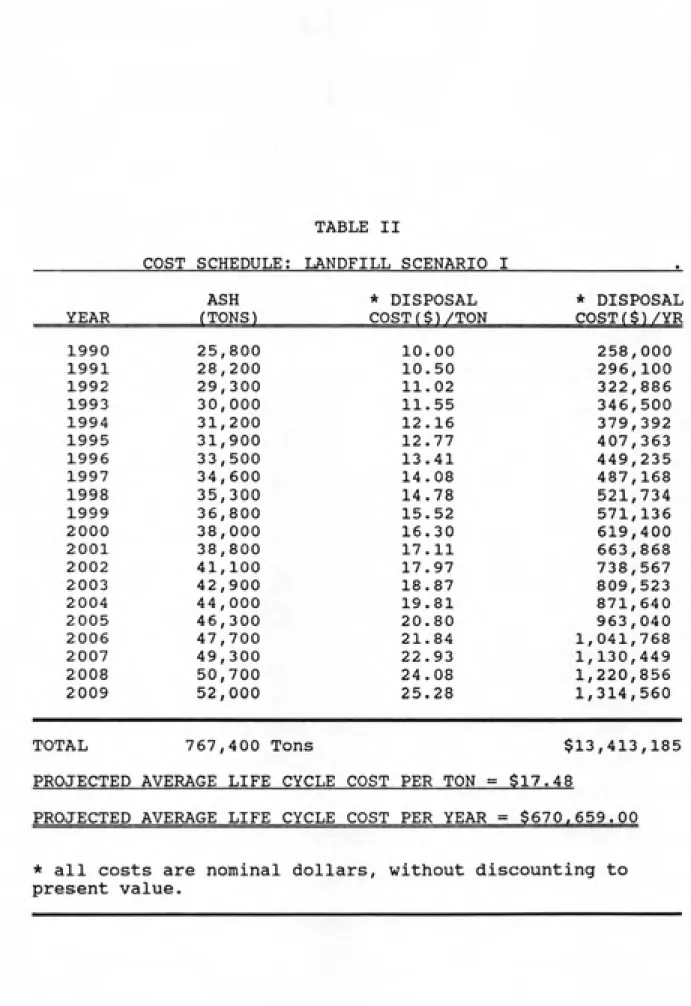
COST SCHEDULE:
TABLE II
LANDFILL SCENARIO I
ASH * DISPOSAL * DISPOSAL
YEAR fTONS) COSTf$1/TON COSTfS^/YR
1990 25,800 10.00 258,000
1991 28,200 10.50 296,100
1992 29,300 11.02 322,886
1993 30,000 11.55 346,500
1994 31,200 12.16 379,392
1995 31,900 12.77 407,363
1996 33,500 13.41 449,235
1997 34,600 14.08 487,168
1998 35,300 14.78 521,734
1999 36,800 15.52 571,136
2000 38,000 16.30 619,400
2001 38,800 17.11 663,868
2002 41,100 17.97 738,567
2003 42,900 18.87 809,523
2004 44,000 19.81 871,640
2005 46,300 20.80 963,040
2006 47,700 21.84 1,041,768
2007 49,300 22.93 1,130,449
2008 50,700 24.08 1,220,856
2009 52,000 25.28 1,314,560
TOTAL 767,400 Tons $13,413,185
PROJECTED AVERAGE LIFE CYCLE COST PER TON = $17.48
PROJECTED AVERAGE LIFE CYCLE COST PER YEAR = $670.659.00
The validity of the above schedule is based on a number of
assumptions, none of which is guaranteed. First, it is assumed that the full cost of managing the waste is not
transferred to the University but that tipping fees continue to attempt to recover only operating costs. Under this
assumption, some of the hidden costs such as amortization
and capital outlay are subsidized (Heflin, 1987). An example of what this difference might mean is the case of New Hanover County, North Carolina which charges $22.50 per ton for tipping fees, but the estimated actual cost of
landfilling is about $35.00 per ton (Dover, 1987). This represents a 36 % subsidy of disposal costs over user
charges.
Second, this schedule is calculated with the assumption that business at the Chapel Hill landfill will go on as usual.
However, it is estimated that by 1991 waste will begin going
to the new site, located south of the existing site off of Eubanks Road. By this time, it is realistic to predict that regulations will require the new landfill to be constructed with a liner, leachate collection and treatment system and groundwater monitoring wells (Figure 3). This will be
up-front capital expenditures which will have to be recovered
in some manner. Costs for the liner itself can be upwards
A third assumption is that projections of the total solid
waste picture in Chapel Hill, Carrboro, and Orange County
are an indication of real conditions. A significantly lower
volume waste stream than that which is projected and planned
for would likely necessitate higher user charges to cover
operating costs (Heflin, 1987).
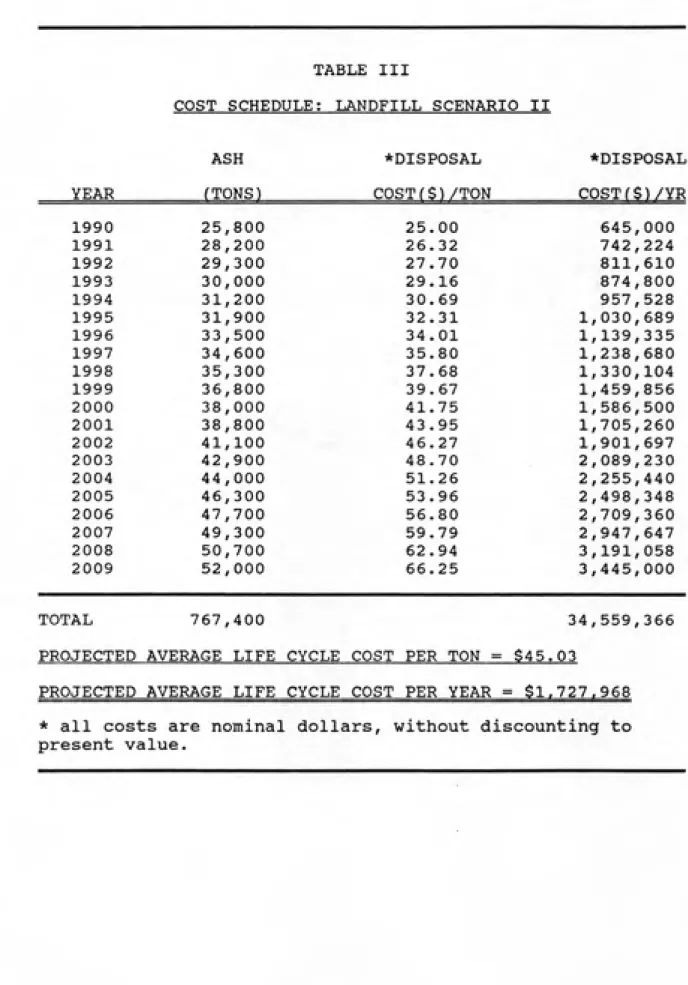
SCENARIO II; The second scenario cost schedule (Table III)
is a modest estimate of a more realistic set of
circumstances. This schedule uses $25.00 per ton as a first year estimated tipping fee with a 5% per year increase
throughout the life of the plant. Though these estimates
are still nowhere near the worst case (California power
plant operators are currently paying as much as $58 per ton for disposal rights in local landfills) and might not even sufficiently cover expenses of the liner, it will at least give a picture which begins to recognize unpaid costs (which would be real if the University were required to landfill
TABLE III
COST SCHEDULE; LANDFILL SCENARIO II
ASH YEAR (TONS) DISPOSAL DISPOSAL OSTr$)/TON COSTf$)/YR 25.00 645,000 26.32 742,224 27.70 811,610 29.16 874,800 30.69 957,528 32.31 1,030,689 34.01 1,139,335 35.80 1,238,680 37.68 1,330,104 39.67 1,459,856 41.75 1,586,500 43.95 1,705,260 46.27 1,901,697 48.70 2,089,230 51.26 2,255,440 53.96 2,498,348 56.80 2,709,360 59.79 2,947,647 62.94 3,191,058 66.25 3,445,000 1990 25,800 1991 28,200 1992 29,300 1993 30,000 1994 31,200 1995 31,900 1996 33,500 1997 34,600 1998 35,300 1999 36,800 2000 38,000 2001 38,800 2002 41,100 2003 42,900 2004 44,000 2005 46,300 2006 47,700 2007 49,300 2008 50,700 2009 52,000
TOTAL 767,400 34,559,366
PROJECTED AVERAGE LIFE CYCLE COST PER TON = $45.03
PROJECTED AVERAGE LIFE CYCLE COST PER YEAR = $1.727.968
SCENARIO III COOPERATIVE DEDICATED LANDFILL fMONOFILL) facilities are those that are designed for and accept only one type of waste. Monofilling of power plant residues is common practice in the utility industry, where in the face of uncertainty, internally imposed controls are stricter than currently required by regulation as an attempt to avoid expensive retrofitting (which could involve digging up a waste pile to install a liner under it). The possibility of UNC entering into a cooperative arrangement with a nearby utilities company to "piggyback" the relatively low volume UNC residue stream for disposal at their facilities was met with firm negatives.
There is a tendency for states to adopt solid waste management criteria adopted by EPA (40 CFR 257, Sep 13,
1979), requiring location, design, and operation with
minimal undesirable discharges. Location of a landfill site is governed by ground and surface water conditions, geology, soil, topographic features, economic and social factors. Some states (eg, Tennessee) are anticipating the upgrading of solid waste management regulations under RCRA and are writing regulations which involve classification of
components of the non-hazardous solid waste stream and
segregation of these components for final disposition which
matches the need (Victory, 1987).
These actions tend to confirm the predictions by EPA Office
that ash will be regulated as a hazardous waste (due largely
to the volume of residues produced in the combustion of fossil fuels in this country), it is quite realistic to anticipate that regulations will require handling ash as a special class of industrial waste, and may ban it from municipal solid waste landfills. Disposal of ash in a
monofill facility would likely be under design standards
similar to those listed under scenario I (ie, liner,
leachate collection and treatment system, and groundwater
monitoring). One option being studied by Chapel Hill to anticipate this change is a separate monofill cell within the landfill to accept ash.
SCENARIO IV LANDFILLING IN A MONOFILL under the conditions
of an independent venture by the University will bring the
hidden costs and subsidies to the surface so that the full
cost of all phases from siting through operation and closure would be figured into the schedule. Considering the
factors, it would be reasonable to predict that the cost to
the University would be double what is seen in Scenario II. The capital commitment to construct and operate a facility for these purposes could also have the deleterious effect of providing an incentive to send all the residue to the
A number of other variables do come into play under this scenario which have forced at least one group of analysts to
drop it from consideration as a viable alternative (Norman,
1987). For the University to operate its own dedicated
landfill would require going through the siting and
permitting process. Siting of any type of landfill is
meeting sharply increasing opposition by local citizens.
There is a significant backlog of peirmit applications
waiting for action at the Solid and Hazardous Waste
Management Branch. It is certainly possible that even if
the University started the process today, there would still
not be a suitable, approved site ready for receiving wastes
upon startup of the plant. Economy of scale would probably
increase the per ton cost of landfilling over cooperatively
utilized facilities of similar design. Liability for the
site would necessarily be shouldered by the University. An
important concern is the impracticality and obstacles
barring the University from going into landfill business on
its own.
SCENARIO V; CONTRACTING TO A PRIVATE WASTE DISPOSAL FIRM
for disposing of the ash under monofill conditions would
have associated costs higher than if the University carried
out the operation internally. The most obvious increase in
costs would be the profit margin under which the firm
Scenario III schedule plus 10 % profit. No such firm has been identified through the course of this study.
SCENARIO VI: HAZARDOUS WASTE LANDFILLS could potentially become the required receptor of power plant residue. This would hinge on the determination by EPA to classify these wastes in general as hazardous, or alternately, for the
state Solid and Hazardous Waste Branch to decide to regulate
the waste as hazardous. Such a determination on the federal
level does not seem likely owing largely to the lack of consistent data to confirm that it poses a threat to
groundwater through leaching of the metals, but perhaps more
influential is the pressure being applied by lobbyists for
the utility industry to discourage it. A regulation in North Carolina requiring ash to be managed as hazardous is prohibited under the Hardison Amendment if EPA makes a determination that it is non-hazardous, unless the North Carolina General Assembly were to require such a regulation
by legislation, which also seems unlikely.
SCENARIO VII; RETURN TO MINE SITE is an option that is
receiving considerable attention by waste management authorities, power plant operators and mining operators. The Surface Mine Control and Reclamation Act (SMCRA)
to their original character^ Coal ash has been used with success in a number of different operations, from
experimental to emergency in nature. There are several basic approaches to this type of management, based on the role the ash is playing:
1. Mine stabilization is required under SMCRA where
the existence of tunnels, shafts, voids and depressions poses an imminent hazard. Ash has been mixed with cement and injected into deep mines to successfully stabilize the area
(Daughtery, 1987). Mine sites qualified for this
remedial action are prioritized from state
inventories on a case by case basis. The last
site identified under this program in North
Carolina is currently in design phase. This option is limited to opportunities available and
handled on a contractual basis.
2. Mine fire extinguishing has incorporated the use
of ash. This is limited to emergency situations
and would be a useful recruitment of ash were the
opportunity to present itself.
3. Acid mine tailings neutralization has been
accomplished employing ash as a neutralizing
agent. FBC ash would be particularly amenable to
this type of remedial activity for which
Pennsylvania employed the use of about 26,000 tons
of ash (predicted first year ash production from
UNC plant) to neutralize acidic mine wastes or
spoils (Daughtery, 1987).
4. Surface mine reclamation plans are required of
operators under SMCRA. Ash is currently
considered suitable for filling the depression,
improving the soil texture, and water bearing
capacity, and for stabilization of the soil if
mixed in the right proportions. This last
approach, when put in the context of returning the
ash to the coal mine of origin seems to have some
promise as an ash management alternative with
benefits to both the mine operator and the power
plant operator, and is discussed further in the
following.
Returning ash to the mine site has been looked at actively
by a number of coal suppliers, power plant operators and
consultants. This approach, involving active mining
operations, is being permitted and practiced in a number of
states, including Iowa, Virginia, West Virginia, California,
and Pennsylvania. (Rasmussen, 1987; Huiser, 1987; Sears,
1987; Demirel, 1987; Norman, 1987; Desko, 1987).
alternative as the primary management approach (Norman,
1987; Rasmussen, 1987).
Coal suppliers to UNC have indicated a willingness to
provide this service to UNC. The rates they would charge
vary from no charge (Desko, 1987) to $1.00 per ton for
disposal, provided that coal was also being purchased from
the firm. Under best case conditions, the cost to the
University will be only the cost of transporting the ash to
the site. If the mode of transportation chosen for the ash
matched that utilized for the coal, there would be the added
benefit of preventing a dead haul back (truck or train car
returning to point of origin empty) which is often rewarded
by reduced rates over delivery, especially by truck (Desko,
1987; Lisk, 1987).
There are two circumstances peculiar to the UNC facility
that might pose a problem in opting to return the ash to the
mine of the coal supplier. First is the problem of
transportation of the ash to the mine site. Trucking seems
to be the most economical means for returning ash to the
locations where contracted coal is commonly mined, mostly
because it presents fewer handling problems at the mine site
(Sears, 1987; Desko, 1987). Ash is currently trucked away
from the power plant site, however, the daily delivery of
coal so as to obtain reduced rates on return transport of
impact of the power plant. This may be more of a nuisance
than would be tolerated. The neighborhood location of the
plant and the fact that coal unloading facilities are geared
for rail tend to induce inelasticity into what the University might pay for rail transport of the ash.
Rail transport has been the method of choice for delivering
the coal to the plant, but has significant handling problems
associated with utilizing it for the ash. Coal suppliers
have indicated that they are not set up to unload rail cars
full of ash at the mine site. While one representative
indicated that they might be willing to construct the
necessary equipment, both highly recommended trucking as
being far easier. One coal firm indicated they would charge
$1 to $3 per ton handling fee at the mine site for rail car
unloading but none for truck. Of primary concern to the
rail companies are the problems associated with preventing
fugitive emissions from the cars losing ash to the wind, the
problem of ash getting damp, and hence difficult to remove
from the car, and the problem of contamination of the coal
with the ash.
These problems can be remedied by a number of options,
varying widely in complexity and cost. The cars carrying
the ash could either have removable covers, or separate
empty, enclosed hopper cars could be brought in for the ash
equipment is another possibility which is being considered
by a consultant to a power plant in California (Norman,
1987). One of their options includes specially designed ash
containers that fit into the coal cars and are returned onthe train after use loaded with coal. Cranes on site at
both the power plant and the mine site lift and maneuver the
containers into position for ash loading and unloading.
Though this solves the problems of handling, the expense is
large and in the judgment of one rail official is not
warranted by the volume of ash to be handled at UNC (Heath,
1987).
Additionally, rail transport of ash carries a higher price
than over the road transport, due in part to the rail
transport industry practice of assigning higher percentages
of fixed costs in rates formulae for commodities of high
density and relatively few options for transport (Levin and
Stram, 1981; Gilbert, 1987). Rail offers very little
discount on a backhaul of ash compared to the rate for coal,
while one truck line stated a willingness to provide a free
backhaul of the ash to the mine site if they were
transporting the coal. The economics of transportation
deserves further attention as it relates to this option with
the resulting data being at least in part applicable to
thereby eliminating all trucks in the neighborhood with the
exception of those hauling ash away from the plant. This
would be feasible if it were done on University property and
arrangements made with the rail line serving the spur of
track.
The second peculiarity that may hinder the employment of
back-to-the-mine disposal is the UNC practice of awarding
contracts for purchase of coal. Short term coal contracts
are awarded to the most competitive bidder, resulting in the
potential for supplier switching from one year to the next,
and hence, the loss of incentive by the supplier willing to
supply the service of disposal. A solution to this problem
could be found in awarding longer term contracts to
establish a relationship with the supplier/ash handler. A
more attractive alternative to accomplish the same end would
be to send out requests for bids for the joint supply of
coal and disposal services. If the provision for disposal
were linked to the contract for supplying coal in this
manner, it would ensure that an arrangement for handling the
ash would not be lost to a pennies-per-ton lower bid for
delivered coal.Regulatory uncertainty surrounding the classification of
willing operator to short-term contracts at best (Sears,
1987). Operators are showing varying degrees of willingness
to provide this service, reflected in the price they would
charge. Some of the coal companies have had some experience
providing mine site disposal to customers.
SCENARIO VIII: SOIL STABILIZATION for the purpose of
providing a sub-base under structures appears to be a
suitable, beneficial land based option for bottom ash,
provided the ash is not going to be used within protected
watersheds or near wetlands or drinking water supplies.
Properly prepared ash from FBC will likely provide
substantial support for most types of structures, including
roads, buildings, and airports. Ash mixed with water and
sand and compacted will achieve up to 2000 psi load bearing
strength (Leming, 1987). This option may not be available
if the ash does not meet ASTM specifications for the
intended use, or if the ash were determined to be hazardous.
This option will likely provide sporadic channeling for
MODE II: REDUCTION OF ASH
The volatility of regulatory conditions which influence
directly or indirectly the disposal of ash prohibits
predicting with any reliability the costs which will be
incurred under any disposal option. Costs for disposal of
each ton of ash will be higher in the future, regardless of
the approach taken. Reduction of ash volume has obvious
benefits in saved handling, transportation, and disposal
costs. Policy-level decisions will have varying degrees of
impact on the volume of ash produced by the plant.
ENERGY IMPORTING
From the standpoint of this study, the most extreme ash
reduction option for the University would be to eliminate
the ash altogether. This can be viewed as one of the
alternatives through opting to eliminate the project from
further consideration. This option is not realistic at this
phase in the project, and is not likely preferable in any
case if examined more closely. For the sake of argument it
will be included in the discussion here and receive cursory
analysis.
cost is dependent upon its availability and rates set by the
supplier. Immediately it becomes obvious that though this
eliminates the ash disposal problem for the University it
does little if anything toward addressing the overlying
issue of solid waste in general, in that it is simply a
transfer of waste and costs with the additional factor of
lost efficiency in transmission and less optimal matching of
energy types to end use (for instance, purchasing extra
electricity to run air conditioners rather than
co-generating steam at the UNC plant which could serve the same
cooling functions with less net energy input).
Figure 4
Electric Power Cost — CFC Boiler
University Of North Carolina
CosiTb x^^SM
Purchase
\ ^^$20.BM/YR Average
Cost
E3.3M/YR
Cost To Generate
I—I—I—I—I—I
Purchased = 43.3C/KWH $66 9M'YR ^12.4t/KWH
Average = 30.9/KWH
Generated = 7.7t
-I—I—I—I—I—I—I—I—!—I—I—I—I—1—I—I—I—r
B3 &4 B5 86 87 86 89 90 91 9? 93 94 95 96 97 96 99 00 01 02 03 04 05 06 07 06 09
FUEL SWITCHING
Switching from coal to another type of fuel could have the
effect of significantly reducing the ash load to a degree
dependent on the fuel switched to. Switching to oil or
natural gas would virtually eliminate the solid waste
residuals.The main drawbacks of switching to either of these as
primary fuels are the much higher cost of acquiring the fuel
and instability of prices of these fuels, and even their
availability at required volumes under some circumstances.
By the mid 1990's 50 to 60 percent of our oil could come
from foreign sources, with so much uncertainty involved that
predictions are meaningless. Current activity in the
Persian Gulf may be responsible for natural gas price
increases of as much as 30 percent, according to some energy
analysts. One obstruction to the use of natural gas that
would need to be overcome is the delivery of gas to the
plant site. A new pipeline would have to be constructed
before gas could be brought to the plant in sufficient
quantities. The opportunity cost of designing and
constructing a state-of-the-art coal combustion plant that
does not get utilized, relative abundances of available
It has been stated policy of the Federal Energy
Administration and the Federal Power Commission that "no new
oil or natural gas fired base power plants can be
constructed." A Bill introduced before the House of
Representatives (National Energy Act, H.R. 8444, 95th
Congress, 1st session, 1977) and President Carter in his
National Energy Plan stated that "by 1990 no new or existing
utility will be permitted to burn natural gas and that no
new electric power plant shall use natural gas or petroleum
as a primary energy source...."(Bernknopf, 1985). These
policies reflect the perceived importance of utilizing coal
in national security considerations, as well as the
intention to reserve the less abundant oil and gas for uses
for which coal is not suitable, such as refining and chemical manufacture.
COAL SWITCHING
The coal this plant was designed to burn is high ash/high
sulfur eastern coal with fly ash typically being composed of
quartz (Si02), hematite (Fe203), gypsum (CaS04.2H20), and
magnetite (Fe304) (Hanson and Helmke, 1979). Another option
would be the use of coal from other sources (primarily
western reserves) with characteristically lower ash and
lower sulfur content. Western coal fly ash is typically
composed of quartz , hematite , mullite (3A1203.2Si02),
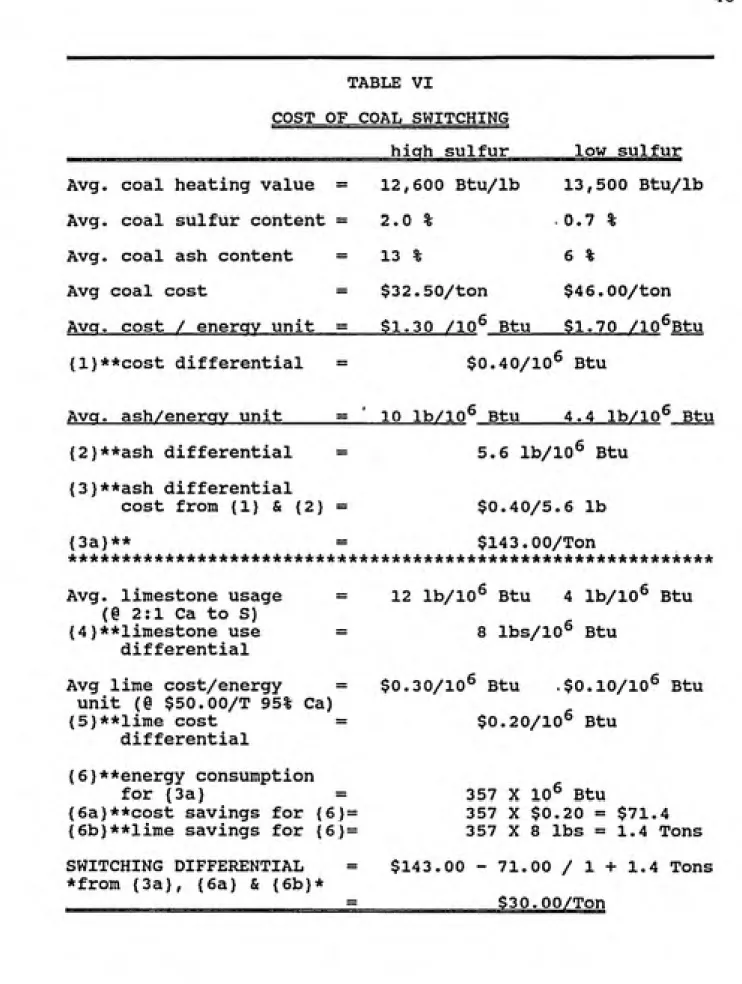
thenardite (NaS04). Coals with the characteristics listed in Table VI are assumed for purposes of comparison.
Switching from high ash/high sulfur coal to lower ash/lower sulfur content coal would have the effect of reducing the
volume of ash to be managed both directly and indirectly,
through lower ash production and lower limestone demand
because of more calcium and less sulfur in the coal
(Villaume and Ripp, 1986). The cost of reducing ash produced in the boiler by switching to lower ash content coal has been calculated using the model coals with the characteristics and cost differential of $13.50 per ton, as
TABLE VI
COST OF COAL SWITCHING
high sulfur low sulfur Avg. coal heating value
Avg. coal sulfur content
Avg. coal ash content
Avg coal cost
Avg. cost / energy unit
12,600 Btu/lb 2.0 % 13 % $32.50/ton 13,500 Btu/lb 0.7 % 6 % $46.00/ton
$1.30 /lO^ Btu $1.70 /lO^Btu
(l}**cost differential
$0.40/10^ Btu
Avg. ash/energy unit 10 lb/10^ Btu
{2}**ash differential
{3}**ash differential
cost from (1} & {2} =
4.4 lb/10^ Btu
5.6 lb/10° Btu
$0.40/5.6 lb
{3a)** = $143.00/Ton
********************************ie**********ie*********is******
Avg. limestone usage =
(@ 2:1 Ca to S)
(4)**limestone use = differential
Avg lime cost/energy = unit (@ $50.00/T 95% Ca)
(5)**lime cost = differential
{6)**energy consumption
for {3a)
{6a)**cost savings for {6)= {6b)**lime savings for {6)=
SWITCHING DIFFERENTIAL
*from {3a), {6a) & {6b)*
12 lb/10^ Btu 4 lb/10^ Btu
8 lbs/10^ Btu
$0.30/10^ Btu $0.10/10^ Btu
$0.20/10^ Btu
357 X 10° Btu
357 X $0.20 = $71.4
357 X 8 lbs =1.4 Tons $143.00 - 71.00 / 1 + 1.4 Tons
Burning the amount of model coals required to obtain a one
ton differential of ash would result in a cost differential
of $143.00, and given the characteristics of the model coal, a passive decrease of 1.4 tons of solid waste is obtained
through lower limestone demand of the lower ash coal. At a
limestone cost of $50.00 per ton, this nets a savings of
$70.00 bringing the overall cost to reduce 2.4 tons of residue to $73.00 or $30.14 per ton of residue reduced. This value ($30.14) is taken to be the cost per ton of
reducing ash through switching from the high ash to low ash
coal. The same types of calculations could be performed for
any available coal type at its current market value. This cost increase for burning low ash low sulfur coal over the cost of the high ash/high sulfur coal is due in part to the higher transport distances associated with the low sulfur coal, most of which is mined in western states (Figure 5). However, this low ash, low sulfur coal is also higher in price due to market imperfections caused by the number of consumers switching to this type of coal in order to comply
with sulfur emissions standards in the clean air act. This
demand for high quality "compliance" coal has led to prices
higher than would be observed under truly competitive
Figure 5
THE LARGEST RESOURCES OF LOW-SULFUR COAL
ARE IN THE WEST
OVER 0.7% SULFUR
OVER 0.7% SULFUR lowsulfur;::
LOW SULFUR
(from National Commission on Materials and Policy, 1973)
FBC is a technological advancement that has as one of its primary developmental incentives, the ability to meet clean air requirements without having to rely on burning low
sulfur coal, and hence, can operate efficiently at over 90 % free of regulated emissions while burning any conveniently located fuel on the market. This speaks to the problem of curbing sulfur deposition without fueling the income
distribution controversy.
The question of whether switching coal types is a feasible alternative for reducing the volume of ash requiring
disposal is dependent on market conditions for coal as well as compares with the cost to landfill. Under current
monitoring the cost differential between the coal types, and
comparing the cost to reduce ash at those market prices to
the cost of disposing of ash by the best alternative, it can
easily be determined if switching to low ash coal is
economical. From the calculations in Table VI it can be
assumed that if market conditions for coal are stable,
switching to the coal type identified would not be a viable
option unless the best alternative for managing the ash
carried a price of $96.50 or higher. Under current
practices of landfilling the ash at $5.00 per ton, the low
ash coal would have to dip to $33.10 for switching to make
sense economically. This type of analysis could be carried
out on all available fuels with the result being a quick and
easy index of cost effectiveness in reduction of ash through
fuel switching.SORBENT REGENERATION
A considerable portion of the residue from a CFC boiler is
comprised of the limestone used as a sorbent for removing
sulfur dioxide (S02)..The limestone is typically removed
from the boiler after its sorbent capacity has been spent,
or used up, however, regeneration of sorbent for FBC units
has been shown to be feasible on a pilot scale, minimizing
both the need for new sorbent for S02 removal and decreasing
the spent sorbent disposal problem. The regeneration
to remove the S02 from the limestone sorbent (MITRE Corp.,
1979). The general reaction is:
Ca8o4 + H2 ---> CaO + H20 + S02 or
CaS04 + CO ---> CaO + C02 + S02
The operation is done in the bed by increasing bed
temperature to about 1200o F while reducing the excess air
to allow the bed to go to reducing conditions. The
limestone is limited to only a few recycles, but one pilot
plant was able to reduce the limestone input by a factor of
about four during a continuous operating period of 5 days.
More durable sorbents may be able to be developed.
ENERGY CONSERVATION
The amount of ash produced is directly proportional to the
quantity of coal combusted in the boiler (assuming constant
boiler and coal types), which in turn is directly
proportional to the energy demand on the system and the
efficiency with which that system supplies the energy
demanded. Many operation and maintenance factors affect
system efficiency. The incorporation of the usual
screw-type ash cooler into the plant is but an example of the
potential for gaining a calculable efficiency through
recapturing some of the heat of combustion which would be
lost to the environment under current design (Johnson, et
UNC has already undertaken some measures to conserve energy
including the incorporation of a new chiller plant,
computerized automation of energy management, and the
replacement power plant itself. Beyond these large scale
measures, the cost of a university-wide energy conservation
and efficiency program may pay for itself many times over
through the life of the plant both directly through savings
in fuel and indirectly by reducing maintenance of the
system, and by reducing the amount of ash requiring disposal
and hence the cost, both monetarily and environmentally.
Programs such as an energy education program to develop
awareness of the benefits of conserving energy, and a
uniform energy accounting system to be established in every
building to identify the most and least efficient buildings
(Garrett, et al., 1976) are just a few examples of the many
little things which can lead to reduced energy consumption,
and hence, less ash production. A one time expense per
building per energy saving tactic results in long term
reduced demand by that building, and therefore, less by way
of a continuing commitment.
Energy saved through investments in energy conservative
measures and replacing inefficient equipment with new
efficient equipment which is readily available, often costs
less than producing that amount of energy which was saved.
Examples of such investments include replacing older
one third as much electricity to do the same work and
replacing inefficient incandescent light bulbs with new
compact fluorescent bulbs. One program estimated the
potential to save up to 80 percent of lighting energy in
office buildings through conservative measures (Reisner,
1987).
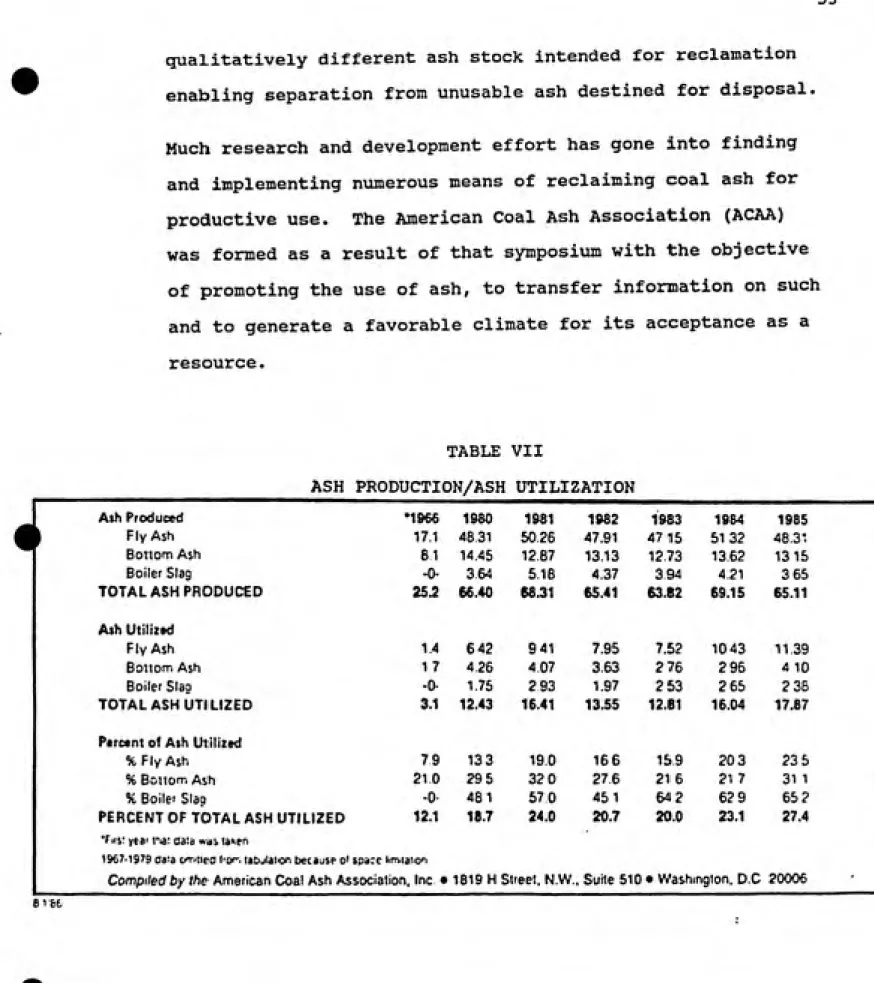
MODE III: RECLAMATION OF ASH
Since the first Ash Utilization Symposium, held in March
1967 and sponsored by the Edison Electric Institute (EEI),
National Coal Association (NCA) and the U.S. Bureau of
Mines, the percentage of total ash produced which is
utilized instead of disposed of with no utilization has
increased from 7.9 (1966) to 23.5 (1985) percent for fly ash
and 21.0 (1966) to 31.1 (1985) percent for bottom ash (ACCA,
1986; see Table VII) These figures show that fly ash
realizes three times the reclamation potential as bottom
ash. Additionally, the applications are far more numerous
for fly ash than for bottom ash. The mixing of fly ash with
bottom ash changes the characteristics of the resultant
mixture sufficiently to eliminate many of the potential uses
for either had they been maintained separately. Even
applications suitable for mixtures are not as valuable or as
widespread if there is no control over the mixture ratios or
consistency. These considerations can only be met where
qualitatively different ash stock intended for reclamation
enabling separation from unusable ash destined for disposal.
Much research and development effort has gone into finding
and implementing numerous means of reclaiming coal ash for
productive use. The American Coal Ash Association (ACAA)
was formed as a result of that symposium with the objective
of promoting the use of ash, to transfer information on such
and to generate a favorable climate for its acceptance as a
resource.
TABLE VII
ASH PRODUCTION/ASH UTILIZATION
1 A>h Produwd M966
1980 1981 1982 1983 1984 1985% Fly Ash 17.1 4831 60 26 47.91 47 15 5132 48.31
Bonom Ash 61 14.45 12.87 13.13 1273 1362 1315
Boiler Slag -O- 364 5 18 4.37 394 4.21 3 65
TOTAL ASH PRODUCED 25J 66.40 68.31 65.41 63.82 69.15 65.11 Ash Utilizad
Fly Ash 1.4 642 941 7,95 7.52 1043 1139
Bottorr, Ash 17 4 26 4 07 3.63 2 76 2 96 4 10
Boiler Slag -0- 175 293 1.97 2 53 2 65 2 3B
TOTAL ASH UTILIZED 31 12.43 16.41 13.55 12.81 16.04 17.87 P«mnt of Ath Utilized
% Fly Ash 79 13 3 19 0 166 159 20 3 23 5
%BonDrr, Ash 21.0 295 32 0 276 216 21 7 31 1
% Boiler Slap -0- 481 570 45 1 642 62 9 65?
PERCENT OF TOTAL ASH UTILIZED 12.1 «.7 24.0 20.7 20.0 23.1 27.4
•fits' yea' t^8: daia wdi la^en
1967-1979 oaia ci'^-'iieo t-or^' tatijiation becajse oi spare iim.taiion
Compiled by the American Goal Ash Association, Inc • 1819 H Street. N W Suite 510• Washngton, DC 20006
Even with the availability of recovered fly ash, rallying by
interest groups, and increased knowledge of its performance,
there is no market for ash unless there is a use. Prices
that can be expected from sale of ash depend on the
economics of the material resources it is replacing, state
of technology, and the attitude of the government and public
towards recycling of waste (National Commission on Materials
Policy, 1973). In many areas there may be market saturation
from competing ash producers resulting in low prices or even
no receptor for the ash at all. In any event, there is a
realizable direct benefit in donating the ash to a willing
receptor, particularly one who is willing to haul it away
free of charge.
The Federal Government has taken the initiative to encourage
the use of ash from coal combustion as a resource. A rule
of the Federal Highway Administration (Federal Register,
January 28, 1983) that went into effect in 1986 has had a
marked effect on the acceptance of ash in highway
construction. All states now have revised specifications in
place to allow its use, with one state (Alabama) actually
requiring its use (Vandenberg, 1987). Additional incentive
was keyed into this year's Highway Bill passed by Congress
which attaches a 5 % bonus in highway assistance funds for
use of fly ash in concrete.
affects concrete mixtures in a number of beneficial ways.
Of primary consideration is the reaction between fly ash
(and other pozzolanic materials) and the lime of hydration
(calcium hydroxide) in portland cement mixtures resulting in
increased strength as the concrete cures (Boles, 1987;
Hatfield, 1987).
Pozzolanic character is a chemical property of fly ash of
great interest to researchers and of extreme importance in
determining the suitability of ash as structural material.
Pozzolanic (lime-base) reactions in ash are the result of
water coming in contact with the ash and reacting with the
alumina and silica to form insoluble compounds. Ash from
FBC has enhanced pozzolanic characteristics due to the
presence of higher concentrations of unreacted or free
Calcium, input as limestone for absorption (Leming, 1987).
The chemical reactions involved in this process occur on the
surface of the ash, and hence the pozzolanic activity of the
ash increases with increased surface area to volume ratios