COMPETITIVE INTELLIGENCE SCHOLARLY MATERIAL IN BUSINESS AND LIBRARY SCIENCE DATABASES
by
Marisa L. Ramirez
A Master’s paper submitted to the faculty of the School of Information and Library Science of the University of North Carolina at Chapel Hill
in partial fulfillment of the requirements for the degree of Master of Science in
Library Science.
Chapel Hill, North Carolina April, 2005
Approved by:
ABSTRACT
Marisa L. Ramirez. A Comparative Study of Bibliometric Characteristics of Competitive Intelligence Scholarly Material in Business and Library Science Databases. A Master’s paper for the M.S. in L.S. degree. April, 2005. 54 pages. Advisor: Deborah Barreau.
This study identifies and examines bibliometric characteristics that differentiate Competitive Intelligence scholarly literature found in the ABI/Inform Complete and Library and Information Science Abstracts (LISA) databases from January 1975 to December 2004.
The term “competitive intelligence” is the most popular term to use when searching for CI scholarly materials. The journal distribution for both databases follows Bradford’s law of scatter, but there is little overlap between the core journals and core authors identified in ABI/Inform and LISA, indicating the need for multiple searches across databases. The erratic growth patterns and inconsistent subject indexing point to database collection inconsistencies. Overall, ABI/Inform yielded more articles relating to the field of competitive intelligence than LISA.
Headings:
Environmental scanning Bibliographic databases
Abstracting and indexing services - Evaluation Business literature - Evaluation
CONTENTS
LIST OF TABLES... 2
LIST OF FIGURES ... 2
ACKNOWLEDGMENTS ... 3
Introduction... 4
The Problem... 5
Purposes of the Study... 6
Background ... 8
Method ... 19
Results... 28
Discussion ... 46
Conclusion ... 50
LIST OF TABLES
Table 1 Characteristics of scientific knowledge and of scientific communities at different
stages of the logistic curve (Crane 1972)... 11
Table 2 Articles Retrieved From ABI/Inform and LISA Using Selected Terminology... 28
Table 3 Authors with four or more CI articles... 36
Table 4 Number of Authors that Co-authored CI articles... 37
Table 5 Number of scholarly CI Articles, by number of single and co-authored articles 37 Table 6 Journals with five or more CI Articles Retrieved from ABI/Inform ... 38
Table 7 Journals with five or more CI Articles Retrieved from LISA ... 39
Table 8 Language Characteristics of CI Literature Retrieved from LISA... 40
Table 9 Overlap of CI retrieved results from ABI/Inform and LISA ... 42
Table 10 Subject descriptors for overlapping CI records from ABI/Inform and LISA.... 43
LIST OF FIGURES Figure 1 Characteristics of scientific knowledge and of scientific communities at different stages of the logistic curve ... 11
Figure 2 Forms of Organizational External Information Gathering ... 21
Figure 3 ABI/Inform Terminology Retrieval Results by Year... 31
Figure 4 LISA Terminology Retrieval Results by Year ... 32
Figure 5 Combined ABI/Inform and LISA Terminology Results by Year ... 33
Figure 6 Author productivity, based on articles retrieved from ABI Inform... 35
Figure 7 Author productivity, based on articles retrieved from LISA... 35
ACKNOWLEDGMENTS
A COMPARATIVE STUDY OF BIBLIOMETRIC CHARACTERISTICS OF COMPETITIVE INTELLIGENCE SCHOLARLY MATERIAL IN BUSINESS AND
LIBRARY SCIENCE DATABASES Introduction
Competitive intelligence is known by many names: market intelligence, business intelligence, environmental scanning, and issues management (Choo 1998). For the purposes of this study, the phrase “competitive intelligence” (CI) will be used to refer to this group of concepts. Competitive intelligence is a cross-disciplinary field drawing on its origin in military intelligence, marketing and business, as well as the social sciences and humanities (Powell 1993). Because CI employs a wide range of disciplines, a CI practitioner must likewise have a diverse set of skills and knowledge. In fact, the ideal CI professional is a person with a joint degree in business and library science (Powell 1993). Because library science and business are integral to the education of future CI
practitioners, it would follow that the scholarly activity in each of these fields would reflect recent interest and use of CI research and literature.
related databases like ABI/Inform. These findings provide a cursory analysis of the literature and reveal little about more specific bibliometric attributes of CI literature.
With the increased interest in CI in the past decade and CI’s relevance to the library, business and other fields, an updated study of CI literature is long overdue. Examining the bibliometric characteristics of CI literature will not only contribute to the myriad of disciplines upon which CI draws, but will also provide valuable insight into its own development as an emerging field.
There are many benefits to using bibliometrics to study the growth of the CI literature. The purpose of bibliometrics “is to shed light on the process of written communications and the nature and course of a discipline, by means of counting and analyzing the various facets of written communication” (Pritchard, 1969). Librarians and information professionals benefit most from the practical application of bibliometric data, especially since this information is useful in bibliographic control, database evaluation, and collection development. By determining core authors, core journals and CI literature growth and size, criteria are established on which to base decisions on database
evaluation and journal selection, retention or cancellation. Examining the bibliometric characteristics of CI literature will reveal the structure and impact of CI and will clarify CI’s place within the literature of the LIS and business fields.
The Problem
Bibliometric studies are like a mirror: they give researchers a chance to glimpse the reflection of many facets of a research area (Sellen 1993). The scarcity of
coupled with the increased attention to competitive information gathering signals the need and importance of conducting a bibliometric analysis on this topic. With the ever-increasing interest in competitive intelligence, and the clear relationship CI has to the field of library and information science (LIS), it is important that a bibliometric study be conducted to more fully understand the development of the CI discipline and the related implications on the business and library science bodies of work.
Although business journals and scholarly articles frequently cover CI topics, in-depth authorship patterns surrounding this body of work has not been explored.
Furthermore, no study has explored the CI discipline and the bibliometric characteristics related to LIS, further necessitating research on library literature as it relates to CI. In researching the bibliometric characteristics of competitive intelligence literature in business and library science databases, this research seeks to answer:
What bibliometric characteristics differentiate CI literature taken from business and library science databases?
In answering this question, prolific authors, core journals, and overlap between databases will be examined to understand fundamental differences.
Purposes of the Study
The purpose of this study is to better understand the nature of published
Background
The dissemination of ideas and the formation and growth of scholarly communities have been the subject of much study, and are particularly relevant to examining the emerging field of competitive intelligence within the context of the more established fields of business and library and information science.
Kuhn (1962) studied the emergence and development of new areas of research, which he termed “paradigms”, and the communities that contributed to the creation and growth of these paradigms. The emergence of a new paradigm is marked by a
galvanizing event, a “discovery”, that provides insight into a previously theoretical or speculative field. As a set of theories converge to form the foundation of research and assumptions in a field, a paradigm is created. Competing paradigms, formed on similar theories attempting to solve similar problems, vie for a common audience of researchers, but the ultimate triumph of a paradigm is dependent upon the success it resolves – or has the future potential to resolve – puzzles within the field. The realization of this potential, termed “normal science”, is not only characterized by further support for the foundational theories on which the field is based, but it is also distinguished by the creation of
additional research that furthers the growth of the field. As research flourishes, anomalies in the paradigm emerge, calling into question the efficacy of the paradigm. These
Scholarly writings reflect the changes that take place within a paradigm. In the pre-paradigm period, scholars explain and justify each of the theories and principles on which they base their research in a common textbook fashion for all to understand. However, as the paradigm forms, the founding theories become a set of shared
assumptions on which scholars can base new research. Instead of having to explain the set of assumptions to a general audience, as in a textbook, the scholar is now free to address articles to colleagues in the field, examining specific aspects of the paradigm. Once paradigm reaches the “normal science” phase, the range of research becomes limited, forcing researchers to focus their efforts “upon a small range of relatively esoteric problems… to investigate some part of nature in a detail and depth that would otherwise be unimaginable” (Kuhn 1962). The formation of specialized literature provides evidence of an emerging paradigm. “In the sciences…the formation of specialized journals, the foundation of specialists’ societies, and the claim for a special place in the curriculum have usually been associated with a group’s first reception of a single paradigm” (Kuhn 1962, p. 8).
The changes in paradigms effect the structure of the research communities, especially as the emergence of new paradigms attract the next generation’s practitioners and convert existing researchers, leaving the old paradigm and its research to dwindle and decline. The new paradigm even has the potential to become a discipline in its own right, especially if it is successful in transferring the research into a professional discipline.
The structure of research communities was the subject of Derek Price’s
of “invisible colleges” - a set of informal communication networks between scholars with common research interests from differing institutions and geographic locations (Price 1963; Price 1970).He also discusses the academic practice of citing, which is the acknowledgement of an author of previous work on which current ideas and research are influenced or based. A citation is an expression of a social relationship between two or more academicians, and thus an indication of an invisible college as “authors [are] known to each other as warm bodies rather than as labels on literature.” (Price 1970)
The papers generated by an invisible college reveal the relationships between authors, and on broader terms, the characteristics of and relationships between invisible colleges. Once these papers are filed in literature databases, the indexing tools themselves are an unobtrusive yet effective means to studying the literature, revealing much about the scientists as well as the invisible colleges in which they play a part.
Building on work by Kuhn and Price, Diana Crane’s work focuses on scholarly communities and the growth of knowledge and the dissemination of ideas (Crane 1972). As she defines it, invisible colleges are scholarly communities not bound by geography or brick-and-mortar buildings, but are formed from social circles that are based on a shared set of interests and research goals. Crane links the diffusion of ideas within these
discovered and research is exhausted within the paradigm, the social interaction within the field declines and new authors are less likely to enter the field. The growth of
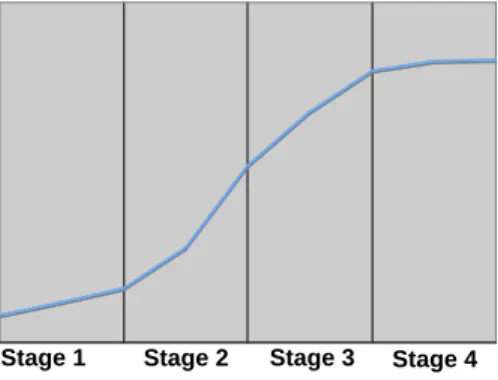
scholarly activity levels off, with research activity occurring only in specialized areas of the field. The following chart by Crane (Crane 1972) shows the development of scholarly communities and scientific knowledge.
Figure 1 Characteristics of scientific knowledge and of scientific communities at different stages of the logistic curve
Table 1 Characteristics of scientific knowledge and of scientific communities at different stages of the logistic curve (Crane 1972)
To illustrate the emergence of a new paradigm and the resulting growth of literature, Crane examines the fields of mathematics and rural sociology and applies bibliometric methods to understand the social dynamics that characterize the invisible colleges encompassing each discipline. In scrutinizing comprehensive bibliographies of
Stage 1 Stage 2 Stage 3 Stage 4
Solution of Major Problems
Exhaustion Characteristics of
Knowledge
Paradigm Appears Normal Science
Anomalies Appear Crisis Increasing Specialization Decline in Membership Characteristics of Scientific Communities
Little or no social organization
Groups of Collaborators and Invisible College
Increasing Controversy
each field, she is able to map the social connections within each of the fields to draw conclusions about the growth of the field. Crane observes that “when two paradigms are applied to the same research area, followers of the two paradigms can avoid confrontation and develop as if they belonged to two different research areas, each of which goes through stages of logistic growth, and contains solidarity groups and invisible colleges” (Crane 1972). As the research area gains importance, cross-disciplinary activity is more likely to occur, whereby information and ideas flow without limitations to and from the discipline. Interdisciplinary research facilitates this process of “cross-fertilization” exchange of ideas.
Building on Crane’s ideas, Chubin studies scientific literature on specialties to understand the relationships and boundaries of specific bodies of work. After examining specialized bibliographies, he finds that an interaction between disciplines exists, which gives research more of a fuzzy –rather than fixed – boundary. This interaction provides complementary viewpoints on a shared set of research problems, serving as a conduit for collaboration and innovation.
In examining the field of competitive intelligence (CI), this current study seeks to understand the interaction between the “paradigms” of business and library science, particularly in the emerging field of competitive intelligence. CI is germane to both areas, but the interplay between these two areas is unknown, and the characteristics of the emerging CI paradigm are not understood. Following Crane’s example, bibliometrics will be used to understand the emergence, growth and relationships between CI in the
Bibliometrics can provide insight into the emergence of new disciplines, and the differences and commonalities between established disciplines, like that of library science and business. Bibliometrics is the quantitative measure or statistical study of a group of related documents (simply referred to as “literature”) used to describe and monitor its growth and change (Nicholas and Ritchie 1978). Descriptive bibliometrics is used to provide a snapshot of the features that define literature, and is concerned with providing information on the following:
• Bodies responsible for the creation or transmission of the work
• Form of the work (e.g. journal, monograph)
• Subject and language characteristics of the literature • Timing and frequency of the information
• Amount of information
• Geographic Origin
The information recorded for descriptive bibliometrics can help determine subject interrelationships and establish the relevance (and thus the desirability) of journals or articles to a particular discipline. Descriptive bibliometrics also supplies data from which trends, developments and other information on the structure of scholarly communication can be derived (Nicholas and Ritchie 1978).
ABI/Inform, an online database that provides indexing and abstracts of journal articles, is a secondary service that provides information on “business conditions, trends, management techniques, corporate strategies, and industry-specific topics
worldwide”(ProQuest 2005). In contrast, LISA (Library and Information Science Abstracts) is an online database that indexes and abstracts scholarly journal articles on topics related to technology, information and library science fields. Clearly the focus of these two online secondary services is distinct. However, if a significant overlap were present, it would indicate that both disciplines find value in the same type of research. With such distinct fields, this would be a discovery that would establish a tangible link between disciplines.
In discussing database overlap, there are many studies conducted with the intention to improve collection development practices or to increase the efficacy of database searches. Many of these studies are concerned with searching on an established topic within a group of related databases whose collections have a likelihood of having overlap. In a study by Miller (1981), three environmental databases were searched using the same search terminology and it was determined that the three databases had low overlap, indicating that the databases provided complimentary information but concluded that one must search all three databases for a comprehensive search on the topic.
Ernest et al. (1988) compared ERIC, LISA and Library Literature databases for information currency and overlap. Library Literature provided the most current
information, ERIC provided both core library journals as well as related but not
coverage. However, only a modest degree of overlap was discovered between the three databases.
ERIC, Library Literature and LISA were also the subject of a bibliometric study by Nicholls (1989), who was interested in studying the characteristics of the growing body of literature on laserdiscs. These databases were selected as the most likely sources of information relating to the application of laserdiscs in libraries. Searches were
performed using thirty different synonyms for laserdisc in the title, descriptor and identifier fields. While the overall size of the literature was small, it was expected to grow. While displaying a Bradfordian distribution among journals, the rate of overlap was also low, indicating the need for multiple searches across different databases.
In examining databases, Gluck (1990) proposed two algorithmic approaches to understand traditional overlap. Recognizing that the mathematical formulas provide limited insight into database overlap, there is a call for further research in overlap analysis and database evaluation, especially in understanding trend analysis in various secondary sources.
Yerkey and Glogowski (1990) studied the scatter of library and information science information (LIS) topics across non-LIS databases to understand the
Walker (1990) conducted an investigation in humanities databases, and Yonker et al. (1990) in scientific databases to determine the overlaps of different subjects within the respective fields. It was determined that with varying levels of overlap, it was best to use a variety of databases to ensure comprehensive retrieval of relevant documents, and that selective subject indexing by databases precluded relevant materials from databases.
Mychko-Megrin (1991) examined the scope and coverage of medical literature in seven major bibliographic and indexing services to understand overlap and geographic distribution of the serial titles. In studying 7,281 articles and book titles, it was found that there was a high level of overlap between databases, with most articles emanating from Western Europe and the United States.
More recently, Hood and Wilson (2003) studied database overlap related to the topic of “fuzzy set theory”. It was found that 63% of the records relevant to the topic were unique to only one database, and that the number of unique records for each database followed a Bradford-type distribution.
A study by Walker (1994) provides the basis for characterizing the body of competitive intelligence (CI) literature. After determining synonyms used to describe competitive intelligence, Walker conducted a brief study on the coverage of CI in the business database ABI/Inform to understand which terms appear in the subject fields of the database records and if these terms overlap in terms of article retrieval. It was found that there was very little overlap among terms, and that the terms “competitive
intelligence” and “environmental scanning” were by far the most used terms in the subject fields. A total of 590 non-duplicated articles were retrieved for this study, a relatively small sample size.
While CI literature in books provided valuable information on summarizing and evaluating CI practices, journal articles were found to be superior in currency. CI had a very small core of journals and was very scattered throughout the literature. The majority of the periodicals had articles about competitive intelligence and environmental scanning.
In terms of authorship, more than 90% of the authors wrote fewer than two articles each, and a very small minority of authors wrote more than three articles. This exaggerated version of Lotka’s law (small proportion of highly productive authors) is perhaps indicative of the practice-oriented nature of the literature. Most CI articles were not jointly authored, with the exception of articles on environmental scanning.
decision-making practices, processes, function and information impact. While much of the literature is focused on the “how to” aspect of the practice, a glut of redundant material has added little value to develop the paradigm. Because CI is interdisciplinary by nature, it borrows from many different sources including analytical techniques from the business (including economics, marketing and management), and the library and information science fields.
Method
Bibliometric characteristics of the competitive intelligence database records were studied in business and library and information science databases. A total of two
databases were selected, with ABI/Inform Complete representing the body of business literature and Library and Information Science Abstracts (LISA) representing the body of literature for Information and Library Science. ABI/Inform was selected, because it was used in a previous study on competitive intelligence literature (Walker 1994) and is useful in providing current business-related bibliographic findings. LISA was selected over Library Literature for this study because LISA indexes more national and
international periodicals (450 periodicals vs. Library Literature’s 298 periodicals) and covers a wider array of publication dates (LISA indexes articles starting in 1969 vs. Library Literature indexes articles starting in 1984).
The previous study by Walker (1994) investigated bibliometric characteristics of CI full text documents indexed in ABI/Inform from January 1987 to June 1994. The study found evidence that “competitive intelligence” was favored over “competitor intelligence”, indicating the latter’s fall from usage. There was little overlap between the terms, with the exception of the retrieved sets of “business intelligence” “competitive intelligence” and “competitor intelligence”, indicating that several different searches were necessary to locate relevant information. A brief analysis of journals concluded that business journals held the most CI literature. Authors typically wrote only one
practice-oriented nature of the articles.
Using the previous study as a guide for this current research, a search was conducted from 1975 to 2004 in ABI/Inform Complete and LISA to update Walker’s findings, and to draw some conclusions about the characteristics of the competitive intelligence paradigm and the invisible college surrounding it.
The year 1975 was chosen as a starting point, as ABI/Inform did not index articles before 1971. LISA provided predetermined a set of options in the date range [i.e. 1969, 1970, 1975, etc], but did not allow for queries for articles in the years between 1970 and 1975. As a result, the year 1975 was selected as a beginning date to provide consistency on which to base a comparison of results.
From previous CI research and literature, specific search terms were identified and evaluated. The terms “competitor intelligence”, “competitive intelligence”, “business intelligence”, “issues management” and “environmental scanning” were selected not only because they are more focused on competitive and strategic issues, but also because they are terms defined in previous CI research (Walker 1994; Choo 2002, p.86; Fleisher 2003).
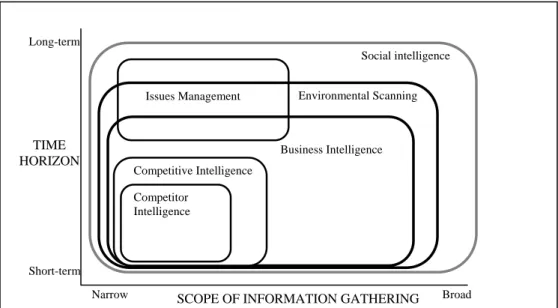
information, transforming isolated data into strategic and actionable knowledge on competitor strengths, limitations, performance and position (Choo 2002). Business intelligence encompasses both competitor and competitive intelligence, and is used to understand the current competitive environment especially in regard to risk assessment and potential future mergers and acquisitions. Environmental scanning, broader still, refers to capturing information and identifying trends of the larger external environment to strategically manage and plan the organization’s future (Auster and Choo 1996). Issues management, a related topic originating from public relations, “involves the identification of potential issues that may affect the organization and its commitment of resources strategically to influence the course of those issues” (Choo 2002, p.87). Figure 2 shows the scope and overlap of each of these terms.
Figure 2 Forms of Organizational External Information Gathering (Choo 2002, p. 88)
Social intelligence
Environmental Scanning
Business Intelligence Competitive Intelligence
Competitor Intelligence
Issues Management Long-term
Short-term
Narrow Broad SCOPE OF INFORMATION GATHERING
The Library of Congress Subject Headings (2004) was also consulted to identify additional terms included within the competitive intelligence paradigm.
“Competitor intelligence” and “competitive intelligence” were not recognized as formal LCSH headings, but instead “business intelligence” was the established term. Broader, narrower and related LCSH terms of “business intelligence” were not used for this study as these terms introduced concepts of information acquisition using unlawful methods, quite unrelated to the typical practices associated with competitive intelligence.
“Environmental scanning” was not an established term in LCSH. Broader and related terms of the established heading “issues management” were also excluded from this study, as the terms incorporated ideas of social responsibility, which fall outside of the boundaries of this study.
After identifying “competitor intelligence,” “competitive intelligence,” “business intelligence,” “issues management,” and “environmental scanning” as search terms for this study, a search was conducted in both ABI/Inform Complete and LISA in the citation and abstract of the database records. A spot check of the results was conducted to quickly determine if the search needed to be refined. If the records were determined to be
Once the search results were downloaded as text files, the files were imported into EndNote, a bibliographic database tool, for later examination. A separate EndNote library was created for each of the terms for each of the databases. After examining and recording the results independently, the database information was merged into two large Endnote library files – one file for ABI and one file for LISA. Duplicated records were identified and removed from each of the database files. Characteristics for each database were gleaned from these two files. A third comprehensive Endnote library was created, and the results from ABI and LISA were then imported and compared for overlap. The following information was collected for the current study:
(a) Authorship
Information on the author(s) and number of authors per article was recorded to reveal the most prolific authors of CI literature. The data was examined and compared to the reverse J-shaped distribution as described by Lotka’s law.
(b) Article Title
The article titles were recorded, as this information provided insight into the original language of the article, especially if the article was translated. The title also provides information on the usage of the CI search terms.
(c) Journal Name
The periodical or journal name was recorded to determine which journals published the most CI articles. The data was examined and compared to the reverse J-shaped distribution as described by Bradford’s law.
(d) Language of article
research is most active. The collection of this data is dependent upon the level of descriptive information provided by the database. ABI/Inform did not include this information in the records, so article titles were examined to see if there was evidence of translated articles. LISA did include language information for the database records. (e) Subject content of documents
Main descriptors appearing in the subject fields of the database records were recorded to understand the overall focus of CI research and establish the nature of the CI paradigm.
(f) Date published
Publication date is helpful in determining the production of articles throughout the period of study. The annual output of CI articles provided information on publication trends. By analyzing the number of publications at several time intervals, the growth of the body of literature was determined.
The location of search terms was also noted, as some of the search terms were not indexed as descriptors by the database. Yet these same terms, when used to search the complete record, retrieved documents with matching information in the title and/or abstract.
Information on authorship was used to test Lotka’s law. Lotka’s law states that the number of authors to n publications (p) in a specific population is 1/n2 of the number of authors who have produced only one publication. That is, a minority of authors produce the majority of literature in any given field. In tallying the authorship results,
will receive 0.5 credit for publishing an article with another person, 0.333 credit for two additional authors, and so on. Lotka’s law is useful for determining the relative significance of an author based on her or his production of information in a given field. If each scholarly article incrementally testifies to the quality of the author, then it follows that an author with numerous scholarly publications is a top contributor, and thus a high caliber author, in the field.
In terms of collecting scholarly material, each database provided the option to limit searches to scholarly or peer-reviewed publications. ABI/Inform defined scholarly material as publications that are “authored by academics for a target audience that is mainly academic, [whose] format isn’t usually a glossy magazine, and it is published by a recognized society with academic goals” (ProQuest 2005). ABI/Inform considered a publication to be peer-reviewed if “its articles go through an official editorial process that involves review and approval by the author’s peers” (ProQuest 2005). Trade publications were excluded from the search results because while they may have a peer-review
process, they were not filtered as “peer-reviewed” in ABI/Inform. For the purposes of this study, the search results for ABI/Inform included scholarly material and peer-reviewed journals.
Periodical information was used to test Bradford’s law. Bradford’s law states that a small number of journals produce a large amount of literature in any given field. A Bradford analysis involves identifying articles and listing in rank order the journals containing articles. Plotting the results should produce a reverse J-shaped curve. This information will be useful, as it will help determine the core journals in the CI field.
The original language of the article was determined by examining the article title and language fields contained in the database record. All records retrieved documents in English; however, some of these articles were originally penned in a foreign language and later translated to English. For the purposes of this study, it was assumed that each record was originally written in English, unless indicated otherwise. Citations and full database records in LISA contained information pertaining to the original language of the article, which also proved helpful to gathering this information. However, the language information was not provided in ABI/Inform Complete, so while individual article titles were examined for indications of foreign language translation, the language data for ABI/Inform was incomplete.
The language of CI literature is interesting to examine as the Japanese and
Europeans have been shown to be savvier with business intelligence information (Powell 1993). By collecting information on the original language of the articles, the prevalence of foreign CI research can be determined and implications can be drawn about foreign influence in the field.
established subject headings in ABI/Inform and LISA, the search results from the abstract and title were also examined.
The publication year of the CI literature was studied to understand the expansion of this field. The growth of literature can be determined by analyzing the body of
literature at specific time intervals. The CI article publication dates were organized by year and plotted on a chart showing the cumulative items over a period of almost three decades. The resulting graph indicates the overall growth of the CI literature. This is useful in studying the history of the CI discipline to understand the rates of contribution and expected change within this field (Boyce, Meadow et al. 1994).
Results
A total of 1,247 (1,176 non-duplicated records) were retrieved from ABI/Inform and a total of 509 (459 non-duplicated records) were retrieved from LISA. Both datasets retrieved scholarly materials (articles from peer-reviewed journals and scholarly
publications) for the period of January 1975 to December 2004. The results were analyzed and the findings are summarized in the following pages.
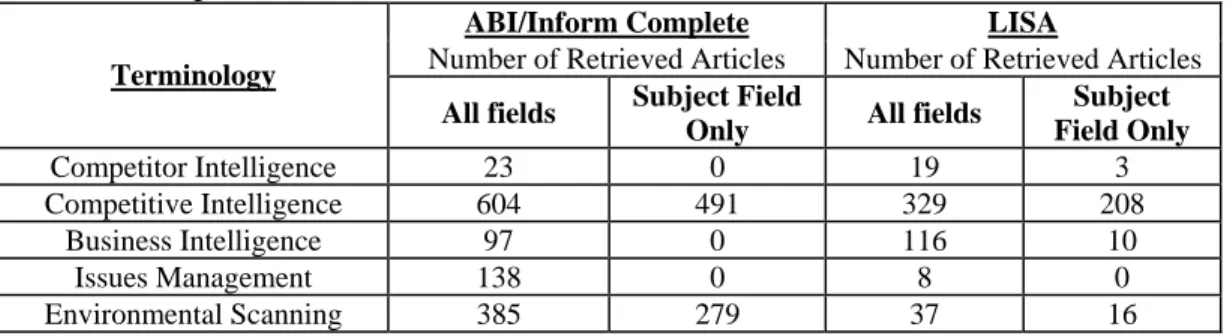
Subject descriptors were recorded to understand the focus of CI research and establish the nature of the CI paradigm. The table below summarizes the findings of this research. Some of the articles included several CI terms in the abstract and subject
descriptor fields, and thus appeared in several different datasets. These duplicated records were included in these results.
Table 2 Articles Retrieved From ABI/Inform and LISA Using Selected Terminology (Includes duplicated records)
ABI/Inform Complete LISA
Number of Retrieved Articles Number of Retrieved Articles Terminology
All fields Subject Field
Only All fields
Subject Field Only
Competitor Intelligence 23 0 19 3
Competitive Intelligence 604 491 329 208
Business Intelligence 97 0 116 10
Issues Management 138 0 8 0
Environmental Scanning 385 279 37 16
ABI/Inform only indexed articles using “environmental scanning” and “competitive intelligence” as subject descriptors, indicating that these two terms are established concepts within the business database. Nonetheless, using the same
terminology to search the title, abstract and subject descriptor fields collectively yielded many additional records, suggesting that the database subject index might not retrieve all records pertaining to a topic. These additional records were examined and it was found that “business forecasts”, “business plans”, “decision-making”, “forecasting”, “market planning”, “market research”, “organizational development”, “risk assessment”,
“strategic management” and “strategic planning” were common keywords shared by both competitive intelligence and environmental scanning research.
“Competitive intelligence”, “environmental scanning” and “issues management” retrieved the most ABI/Inform records when searching all fields, while “business
intelligence” and “competitor intelligence” retrieved the least number of records. A discussion about the patterns and growth of terminology usage is discussed later in this section.
The search term results for LISA shows that all CI terms except “issues management” were established indexing terms for the subject descriptor field. After examining the descriptors for the “issues management” records, it was found that the articles were indexed using “public affairs”, “public policy” and “public relations” as descriptors. Overall, “competitive intelligence” retrieved the most results while “issues management” retrieved the least.
documents if used as a keyword (collectively searching title, abstract and subject descriptor fields) than used to search in the subject descriptor field. This suggests that more articles are relevant to “business intelligence” than are actually indexed.
Interestingly, the following keywords were used to describe these additional business intelligence records: “business information”, “data mining”, “decision making”, “information warfare”, “intelligence data”, “knowledge management”, “market
research”, and “strategic information systems”.
The following charts (Figures 3, 4, and 5) illustrate the usage of these terms over time. The data used for these charts include results from searches in the title, abstract and subject descriptor fields. Displaying the retrieval results of each search term by year helps to identify trends in term usage. As was previously noted, “business intelligence” and “competitor intelligence” retrieved the smallest number of records in ABI/Inform. The usage of “business intelligence” recently increased from 1998 to 2004, while “competitor intelligence” failed to experience any significant increases over the course of the study. This suggests that “business intelligence” has recently come into favor while “competitor intelligence” never gained widespread acceptance within the ABI/Inform indexed articles. This same trend is supported by similar evidence from LISA, as “business intelligence” experienced a noticeable increase in usage in the latter part of the 1990s, becoming the second most popular term behind “competitive
31
Figure 3 ABI/Inform Terminology Retrieval Results by Year
ABI/Inform Terminology Retrieval Results by Year
0 10 20 30 40 50 60 70 80 90 100
1975 1976 1977 1978 1979 1980 1981 1982 1983 1984 1985 1986 1987 1988 1989 1990 1991 1992 1993 1994 1995 1996 1997 1998 1999 2000 2001 2002 2003 2004
Year
Competitor Intelligence
Competitive Intelligence
Business Intelligence
Issues Management
32
Figure 4 LISA Terminology Retrieval Results by Year
LISA Terminology Retrieval Results by Year
0 10 20 30 40 50 60
1975 1976 1977 1978 1979 1980 1981 1982 1983 1984 1985 1986 1987 1988 1989 1990 1991 1992 1993 1994 1995 1996 1997 1998 1999 2000 2001 2002 2003 2004
Year
Competitor Intelligence
Competitive Intelligence
Business Intelligence
Issues Management
33
Figure 5 Combined ABI/Inform and LISA Terminology Results by Year
Combined ABI/Inform and LISA Terminology Retrieval Results by Year
0 20 40 60 80 100 120 140
1975 1976 1977 1978 1979 1980 1981 1982 1983 1984 1985 1986 1987 1988 1989 1990 1991 1992 1993 1994 1995 1996 1997 1998 1999 2000 2001 2002 2003 2004
Year
Competitor Intelligence
Competitive Intelligence
Business Intelligence
Issues Management
When looking at the combined results of terminology use (Figure 5), it is again evident that “competitive intelligence” is by far the most popular term, while the usages of other terms appear to fluctuate with no clear “breakaway” second best.
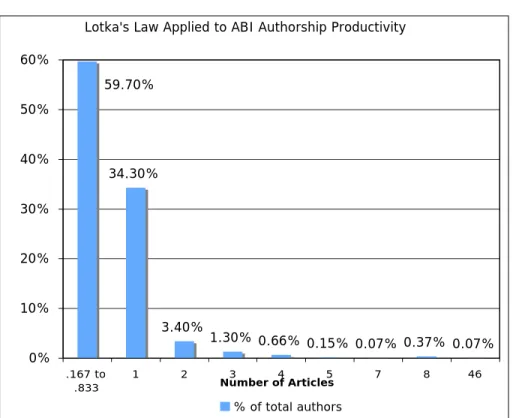
The authorship characteristics of CI articles retrieved in ABI/Inform and LISA were compared against the patterns that follow Lotka’s law, which states that most authors contribute a small number of articles to a particular discipline over time, while very few authors are prolific. Based on an analysis of the data collected, authorship patterns from ABI closely follow Lotka’s law, forming an reverse J-shaped curve.
Interestingly, LISA’s authorship patterns did not follow the reverse J-shaped Lotka distribution as closely as ABI, since LISA’s distribution droops at the beginning. There were more authors that published one article than authors that received fractional credit for their contributions to the field. Nonetheless, the difference is slight. As the number of authors decreases the frequency of articles increases, following the general Lotka distribution.
Lotka's Law Applied to ABI Authorship Productivity
34.30%
3.40%
1.30% 0.66% 0.15% 0.07% 0.37% 0.07% 59.70% 0% 10% 20% 30% 40% 50% 60% .167 to .833
1 2 3 4 5 7 8 46
Number of Articles
% of total authors
Figure 6 Author productivity, based on articles retrieved from ABI Inform (From January 1975 to December 2004)
Lotka's Law Applied to LISA Authorship Productivity
5.40%
1.30% 0.65% 1.08% 0.22% 46.10% 45.30% 0% 10% 20% 30% 40% 50% 60% .167 to
.833 1 2Number of Articles3 4 5 10.5
% of total authors
The following charts provide details on specific authors that have made significant contributions to the CI field, according to the number of articles produced within the field. Authors publishing four or more articles in the CI field were included, and results are broken out by database.
Table 3 Authors with four or more CI articles
(As retrieved from ABI/Inform and LISA for the period January 1975 to December 2004. Co-authorship represented proportionately.)
ABI/Inform Complete LISA
Author Number of articles* Author Number of articles*
McGonagle, John J. 46.0 Ojala, Marydee 10.5
Herring, Jan P. 8.7 Choo, C. W. 5.5
Simon, Neil J. 8.5 Miller, J. P. 5.0
Sawka, Kenneth A. 8.2 Quint, B. 5.0
Prior, Vernon 8.0 Silva, E. Orozco 5.0 Sawyer, Deborah C. 8.0 Weiss, Arthur 5.0 Prescott, John E. 7.8 Ferchaud, B. 4.3 Miller, Stephen H. 5.0 Gordon-Till, Jonathan 4.0 Ogunmokun, Gabriel O. 5.0 Soloman, M. 4.0 Ansoff, H. Igor 4.5 6 authors Between 3.0 and 3.833 Fuld, Leonard M. 4.5 25 authors Between 2.0 and 2.833 Gilad, Benjamin 4.3 214 authors Between 1.0 and 1.833 Ehrlich, Craig P. 4.0 210 authors Fewer than 1 Ettorre, Barbara 4.0
Nolan, John A., III 4.0 Powell, Timothy 4.0
Trim, Peter 4.0
Vibert, Conor 4.0 17 authors Between 3.0 and 3.833 46 authors Between 2.0 and 2.833 468 authors Between 1.0 and 1.833 814 authors Fewer than 1
*Figures exclude duplicate articles
journals that are indexed. The articles that appeared in both databases had relevant information to both management and information topics and appeared in journals that were indexed by both databases like the Journal for the American Society of Information Science, Information Processing and Management, or Information Management Journal.
Co-authorship was another aspect of this bibliometric study. In examining a comprehensive list of all the authors whose CI articles appeared in ABI/Inform and LISA, it was found that authors of CI articles pulled in both ABI and LISA were likely to partner with other authors to publish (Table 4).
Table 4 Number of Authors that Co-authored CI articles
(As retrieved from ABI/Inform Complete and LISA for the period January 1975 to December 2004)
# Authors Who Co-authored Total Authors % Total that Co-author
ABI/Inform 913 1363 67%
LISA 245 464 53%
However, in examining the CI articles in each of the databases and the authorship patterns within the context of these articles, the majority of the articles were published by a single author (Table 5). A higher percentage of single-authored CI articles were found in LISA than those found in ABI/Inform. While there are active researchers in the CI field, it is evident that most of the research is independent.
Table 5 Number of scholarly CI Articles, by number of single and co-authored articles (As retrieved from ABI/Inform Complete and LISA for the period January 1975 to December 2004)
Number of Single
Authored Articles % Total
Number of
Co-Authored Articles % Total
ABI/Inform (1176* Total) 681 58% 495 42%
LISA (459* Total) 300 65% 159 35%
The following tables illustrate the characteristics of journal productivity for CI articles found in ABI/Inform and LISA. Bradford’s law of scatter states that in any given discipline, a small number of journals account for a large portion of the total publications in that area. This is useful in identifying core journals within a scholarly discipline. Table 6 Journals with five or more CI Articles Retrieved from ABI/Inform
(For the period January 1975 to December 2004)
RANK Journal Name
Number of Articles Retrieved
% of all ABI Articles
1 Competitive Intelligence Review 318 27.0%
2 Long Range Planning 50 4.2%
3 Journal of Business Strategy 29 2.5%
4 Marketing Intelligence & Planning 22 1.9%
5 Planning Review 19 1.6%
6 Strategic Management Journal 18 1.5%
7 Business Horizons 17 1.4%
8 Journal of Public Affairs 17 1.4%
9 Management Review 16 1.4%
10 Journal of Business Ethics 14 1.2%
11 Academy of Management Journal 11 0.9%
12 Journal of the American Planning Association 11 0.9% 13 International Journal of Contemporary Hospitality Management 11 0.9%
14 Managerial Planning 11 0.9%
15 California Management Review 10 0.8%
16 Environmental Manager 10 0.8%
17 Research Technology Management 10 0.8%
18 Information Management Journal 9 0.8%
19 International Journal of Technology Management 9 0.8%
20 Journal of Small Business Management 9 0.8%
21 Strategic Finance 9 0.8%
22 Harvard Business Review 8 0.7%
23 Industrial Marketing Management 8 0.7%
24 Journal of Management 8 0.7%
25 Management International Review 8 0.7%
26 Public Relations Review 8 0.7%
27 S.A.M. Advanced Management Journal 8 0.7%
28 Strategic Change 8 0.7%
29 American Demographics 7 0.6%
30 Journal of Consumer Marketing 7 0.6%
31 Journal of Environmental Planning and Management 7 0.6%
32 Business and Society 6 0.5%
33 Corporate Communications 6 0.5%
34 HR. Human Resource Planning 6 0.5%
35 International Journal of Information Management 6 0.5% 36 Journal of Business & Industrial Marketing 6 0.5%
37 Journal of Business Research 6 0.5%
38 Journal of Information Science 6 0.5%
39 Journal of Management Case Studies 6 0.5%
40 The Journal of Management Development 6 0.5%
41 Management Decision 6 0.5%
42 The Academy of Management Review 5 0.4%
43 American Bankers Association Banking Journal 5 0.4%
44 Decision Support Systems 5 0.4%
45 Human Relations 5 0.4%
46 International Journal of Management 5 0.4%
47 The Journal of Product Innovation Management 5 0.4%
48 MIS Quarterly 5 0.4%
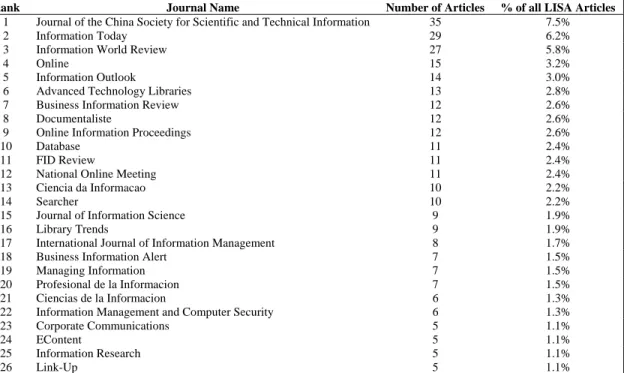
Table 7 Journals with five or more CI Articles Retrieved from LISA (For the period January 1975 to December 2004)
Rank Journal Name Number of Articles % of all LISA Articles 1 Journal of the China Society for Scientific and Technical Information 35 7.5%
2 Information Today 29 6.2%
3 Information World Review 27 5.8%
4 Online 15 3.2%
5 Information Outlook 14 3.0%
6 Advanced Technology Libraries 13 2.8%
7 Business Information Review 12 2.6%
8 Documentaliste 12 2.6%
9 Online Information Proceedings 12 2.6%
10 Database 11 2.4%
11 FID Review 11 2.4%
12 National Online Meeting 11 2.4%
13 Ciencia da Informacao 10 2.2%
14 Searcher 10 2.2%
15 Journal of Information Science 9 1.9%
16 Library Trends 9 1.9%
17 International Journal of Information Management 8 1.7%
18 Business Information Alert 7 1.5%
19 Managing Information 7 1.5%
20 Profesional de la Informacion 7 1.5%
21 Ciencias de la Informacion 6 1.3%
22 Information Management and Computer Security 6 1.3%
23 Corporate Communications 5 1.1%
24 EContent 5 1.1%
25 Information Research 5 1.1%
26 Link-Up 5 1.1%
There is little overlap between the core CI journals within ABI/Inform and LISA, as there are but three core journals that they have in common: International Journal of Information Management, Corporate Communications and the Journal of Information Science.
The language characteristics LISA’s CI articles were easily attained and the results have been summarized below.
Table 8 Language Characteristics of CI Literature Retrieved from LISA (From January 1975 to December 2004)
Of all the documents retrieved in LISA, 19% of the articles were originally written in a foreign language. The majority of foreign language articles pertained to “competitive intelligence” and “business intelligence”. Thirty-four percent of the foreign language articles were written in Chinese, with French (15%), Spanish (15%) and
Portuguese (14%) articles also contributing a significantly to field. While the vast
majority of articles retrieved from LISA were originally penned in English, it is apparent that the competitive intelligence field is also receiving attention from Asian and European countries.
ABI/Inform did not provide language indexing information in the retrieved CI records but did provide location information if a “geographical area or location figures prominently in the text” (ProQuest, 2005). After brief consideration, this information was deemed not useful because it did not provide insight into the origin of the article. For instance, an English-language article written about Chinese CI would be categorized by ABI as “China” in the location field, which does not accurately reflect the article’s country of origin.
Subject/Terms AfrikaansChineseCzechDutchFrenchGermanHebrewItalianJapanesePortugeseRussianSlovakSpanishSwedish Total #
foreig languag
article
Competitor Intelligence 0 0 0 0 0 0 0 0 0 0 0 0 0 0 0
Competitive Intelligence0 33 2 4 13 2 0 1 1 12 0 0 11 1 80
Business Intelligence 0 0 0 3 2 0 2 0 2 2 1 1 4 0 17
Issues Management 0 0 0 0 0 0 0 0 0 0 0 0 0 0 0
Environ Scanning 1 0 0 0 0 0 0 0 0 0 0 0 0 0 1
41
Figure 8 Growth of CI Literature in LISA and ABI/Inform Complete (1975 to 2004)
Growth of CI Literature in LISA and ABI/Inform Complete
Databases
0 20 40 60 80 100 120 140 160 180
1975 1976 1977 1978 1979 1980 1981 1982 1983 1984 1985 1986 1987 1988 1989 1990 1991 1992 1993 1994 1995 1996 1997 1998 1999 2000 2001 2002 2003 2004 Year
LISA
ABI
The titles of the ABI/Inform results were also examined for clues indicating original language information. However, the article titles provided little insight so the foreign language characteristics of ABI/Inform results were undetermined.
Data pertaining to the growth of the CI body of literature was collected in both ABI and LISA from January 1975 and December 2004. When the results are displayed in a graph, typically the distribution for document growth within an abstract and indexing database follows either a linear or exponential distribution (Wolfram 2003). Figure 8 shows the growth patterns of CI literature for ABI/Inform, LISA, and CI literature from both databases. The document growth patterns do not follow either distribution but instead are erratic, with steep climbs followed by sudden declines in literature from year to year. Because the growth of the CI literature does not strictly follow an exponential or linear growth pattern, it could be an indication that the databases are not keeping up with the document growth and have selectively indexed documents (Wolfram, 2003). It is also possible that fewer articles are being written on this topic.
Database overlap was the final aspect examined in this study. In comparing retrieval results, little overlap between databases was found. In fact, only 15 articles appeared in the results from both databases. The findings are presented in the table below.
Table 9 Overlap of CI retrieved results from ABI/Inform and LISA (From January 1975 to December 2004)
Total Non-Duplicated Records Total Overlapped Records Total Unique records % of records unique to this database
ABI 1176 15 1161 98.7%
The results indicate a high percentage of unique CI records to both databases. Of ABI’s non-duplicated results, 98.7% of the records were unique to ABI. Similarly, 96.7% of the retrieved results from LISA were unique.
The subject descriptors of these 15 overlapping records were examined, and although the majority of the overlapping records shared indexing terms, the differences between the files were interesting.
Table 10 Subject descriptors for overlapping CI records from ABI/Inform and LISA (From January 1975 to December 2004; Shading indicates shared subject indexing terms)
Subject Descriptors
Article ABI/Inform LISA
1 Environmental scanning Environmental scanning External analysis Information work Internal analysis Business information
Advantages Management information systems Strategic planning Competitive intelligence Guidelines
2 Upper management Information work Telecommunications industry Business information
Studies Decision making
Publishing industry Managers Environmental scanning Companies
Canada
3 Studies Management information systems Information retrieval Environmental scanning
Environmental scanning Managers
Decision making Canada
Chief executive officers Surveys
4 Competitive intelligence Online information retrieval World Wide Web Business information Studies Competitive intelligence
Social research Strategic information systems Social psychology World Wide Web
5 Studies Information work
Information processing Business information Comparative analysis Terminology Methods
6 Studies Information communication Strategic management Companies
Communication UK
Environmental protection Rhone-Poulenc Agriculture, UK 7 Data mining Computer applications
Customer information files Expert systems
Algorithms Knowledge representation Consumer behavior Data mining
Software
8 Studies Information work
Computer security Business information Information technology Competitive intelligence
Competitive intelligence Theft prevention
9 Knowledge management Information work Information technology Business information
Competitive intelligence Competitive intelligence Studies Current awareness services
Data analysis SDI
Information professionals Person to person communication
Users Intranets
Electronic mail
Use statistics
Information professionals
Role
Organizations
Surveys
Literature reviews
10 Competitive intelligence Information work
Advantages Business information
Market research
Companies
Competitive intelligence 11 Competitive intelligence Information technology
Intellectual property Technology transfer
Theft Law
Industrial espionage USA Information technology
12 Strategic planning Records management
Methods Strategic planning
Leadership Software
Records management Tools
13 Studies Information work
Models Business information
Intelligence gathering Competitive intelligence Models
Qualitative systems dynamics 14 Internal public relations Information communication
Roles Companies
Methods Studies Communication
15 Public relations Information communication Strategic planning Public affairs
Corporate culture Companies
Australia
The ABI/Inform subject descriptors were focused on business concepts and methodologies (“leadership”, “industrial espionage”), business roles of information users (“Chief Executive Officer”, “upper management”) and information processing and consumption (“internal analysis”, “data analysis”, “consumer information files”). In contrast, the descriptors used in LISA were focused on information theory and
information uses and purposes (“current awareness services”, “information
communication”), and specific information types (“business information”). Unlike ABI/Inform, LISA’s subject descriptors often included relevant country names like “UK”, “Australia”, and “USA”. The indexing of country names is consistent with LISA’s international focus. While ABI/Inform Global covers “over 350 English-language titles from outside the U.S.” (ProQuest, 2005) and provides geographic indexing, the
Discussion
The findings from this study provide insight not only into the key differences, but also fundamental similarities, of CI literature taken from ABI/Inform and LISA.
The results from both ABI/Inform and LISA indicate that “competitive
intelligence” is indeed the most commonly used term to refer to this body of literature. “Business intelligence” had a boost in usage, starting in the late-1990s, indicating an increased popularity and interest in the topic.
More results were returned by searching in the title, abstract and subject fields than searching only in the subject descriptor field, indicating that many relevant documents are not adequately indexed by these services. When searching the title, abstract and subject fields, ABI/Inform results increased 62% and LISA results increased 115%, suggesting that subject-indexing is not comprehensive and is not equally applied to all relevant materials. Based on this evidence, future searches for CI articles should not solely rely on the subject-indexing feature of either database. Because LISA indexes more articles on “business intelligence” than ABI/Inform, and a large percentage of ABI/Inform’s results relate to “environmental scanning”, it is obvious that each database has certain specializations within the CI field.
growth of CI literature in LISA increased significantly in 1999, signaling an increased awareness and relevance to library science field.
Not surprisingly, the authorship patterns follow Lotka’s reverse J-shaped distribution, even though the results from LISA show a slight aberration in the curve. There is a greater number of prolific CI authors and core journals in ABI/Inform than in LISA, providing evidence that the business field has a greater interest in and has
published more research on CI. Because ABI/Inform and LISA do not share common CI core authors or core journals, it appears that the two CI paradigms have developed independently of each other. Perhaps as Diana Crane suggested, until the field receives increased attention and importance, significant cross-disciplinary activity will not likely occur.
While ABI/Inform did not provide information on language, the results from LISA indicate that there is international interest in CI. This study indicates that CI articles are published mainly in English, but this is probably because the indexing services, and the majority of the sources that they selectively index, are in English. The most numerous foreign language articles are in Chinese, French, Spanish and Portuguese, suggesting a global active interest in CI.
and LISA is similar, a third possibility exists. It may be that the overall CI literature, after experiencing exponential growth, hit a “ceiling”, causing the growth pattern to oscillate wildly (Price, 1963). The trends in these two databases may be a result of the overall erratic CI growth pattern. Further study on the growth of the complete body of CI literature needs to be studied.
There are some shortcomings to this research that warrant mention. Using an indexing and abstracting database can skew results, as there is a selective process in collecting articles and journals for inclusion in a database. The characteristics of such database literature do not necessarily reflect the natural characteristics of the CI field as a whole.
The CI terminology and literature growth trends are subject to database indexing inconsistencies and flawed article collection practices. The characteristics of CI literature in ABI/Inform and LISA may not reflect the overall popularity or usage of a term and may not provide an accurate account of CI paradigm growth. Using subject descriptors to determine terminology usage trends would be a serious mistake, as “traditional
classifications, because of their often rigid structures and their resistance to change, often reflect outdated concepts of a subject’s boundaries” (Nicholas and Ritchie, 1978, p. 32)
journals that provide the most CI articles. Additionally, the database definitions of “scholarly” and “peer-reviewed” publications were inconsistent, and returned some articles from journals that were not peer-reviewed nor considered scholarly by researchers.
The language characteristics indicate the most common languages used for CI dissemination in LISA. The language information does not provide insight into the author’s country of origin.
Note that the overlap results only relate to the similarities between the databases. If CI research in business and library literature were to be examined overall, a different level of overlap would likely emerge.
Conclusion
CI is clearly an emerging paradigm: there are journals pertaining directly to CI, there is growth in research, and there is even a professional organization devoted to the practice of CI. However, based on the current findings, it does not appear that the “invisible college” surrounding CI researchers bridges the gap between library science and business fields. The CI literature shares few common core author and journal characteristics and there is little collaboration across the CI literature. Truly, this study provides evidence of two independently developing paradigms – one within library science, the other in business – whose followers have avoided collaboration between invisible colleges. While this may be effective in the short-term pursuit of research interests, the cross-fertilization of ideas and interdisciplinary cooperation will be the only hope for long-term growth of CI research.
If we assume Crane’s diffusion of ideas concept to be true, whereby the adoption of ideas is marked by a concomitant growth in scholarly literature, the inconsistent levels of CI research and growth indicate an equally uneven adoption of ideas. The interplay between library science and business as they pertain to CI is very limited, especially since there is little overlap between databases. While both fields find value in CI and have contributed to CI research, it is evident that these two fields do not share a common set of core research or researchers.
collects articles in a field, the generalized characteristics of those articles can be
described as artificial at best. For the purposes of this study, databases provided a timely, cost-effective and relatively simple way to gather information and resources related to information resources in the library and business fields.
While taking into account the inherent flaws of this study, the results can be used to develop core collections of CI resources. The list of core journals and key authors would be very useful for collection development purposes, as it becomes increasingly costly to purchase published research. The core journal and author lists can also help in database evaluation, as these lists provide criteria on which to assess the coverage of CI in a database.
This current study has identified bibliometric characteristics that differentiate CI research taken from library science and business databases, but further investigation is required to get a more complete picture of the growth, authorship and publication
patterns, interdisciplinary collaboration, and other related CI bibliometric characteristics. Citation research provides more insight into the diffusion of ideas across disciplines, and presents a way to determine the obsolescence and impact of authors, authors’ articles and journals on CI. Citation analysis reveals the interlacing between disciplines, and shows the true boundaries of, and interaction between, invisible colleges. The current findings, coupled with proposed future research, will enable a deeper understanding of the
REFERENCES
(2004). Library of Congress Subject Headings. Washington, DC, Library of Congress Cataloging Distribution Service.
Auster, E. and C. W. Choo (1996). How Senior Managers Acquire and Use Information in Environmental Scanning. Managing Information for the Competitive Edge. E. Auster and C. W. Choo. New York, Neal-Schuman Publishers, Inc.: 253-273.
Bergeron, P., & Hiller, C.A. (2002). "Competitive intelligence." Annual Review of Information Science and Technology 36: 353-390.
Boyce, B. R., C. T. Meadow, et al. (1994). Measurement in information science. San diego, CA, Academic Press.
Choo, C. W. (1998). Information management for the intelligent organization: the art of scanning the environment. Medford, NJ, American Society for Information Science. Choo, C. W. (2002). Information management for the intelligent organization: the art of scanning the environment. Medford, NJ, Information Today, Inc.
Crane, D. (1972). Invisible Colleges. Chicago, University of Chicago Press. CSA Illumina (2005). CSA: Library & Information Science Abstracts. 2005.
Dedijer, S. and N. Jéquier, Eds. (1987). Intelligence for Economic Development: An Inquiry into the Role of the Knowledge Industry. Oxford, UK, Berg.
Ernest, D. J., Lange, H.R., & Herring, D. (1988). "An online comparison of three library science databases." RQ 28(2): 185-195.
Fleisher, C. S. (2003). Should the field be called "competitive intelligence" or something else? Controversies in Competitive intelligence: the enduring issues. C. S. Fleisher and D. L. Blenkhorn. Westport, Connecticut, Praeger Publishers.
Gluck, M. (1990). "A review of journal coverage overlap with an extension to the definition of overlap." Journal of the American Society for Information Science 41(1): 43-60.
Kuhn, T. S. (1962). The structure of scientific revolutions. Chicago, University of Chicago Press.
Miller, B. (1981). "Overlap among environmental databases." Online Review 5(5): 403-404.
Mychko-Megrin, A. Y. (1991). "A comparison of biomedical databases." Bulletin of the Medical Library Association 79(3): 302-308.
Nicholas, D. and M. Ritchie (1978). Literature and Bibliometrics. Hamden, Connecticut, Linnet Books.
Nicholls, P. T. (1989). "Bibliometrics of the laserdisc applications literature." Laserdisk Professional 2(5): 106-110.
Porter, M. E. (1980). Competitive strategy: techniques for analyzing industries and competitors. New York, Free Press.
Powell, T. W. (1993). Analyzing your competition, its management, products, industry and markets. New York, Find/SVP.
Price, D. J. (1963). Little Science, Big Science. New York, Columbia University Press. Price, D. J. (1970). Citation measures of hard science, soft science, technology, and nonscience. Communication among scientists and engineers. C. E. Nelson and D. K. Pollock. Lexington, Massachusetts, Heath Lexington Books: 3-22.
Pritchard, A. (1969). “Statistical bibliography or bibliometrics?” Journal of Documentation 25(4): 348-349.
ProQuest (2005). ProQuest: ABI/Inform. 2005.
Sellen, M. K. (1993). Bibliometrics: An annotated bibliography, 1970-1990. New York, GK Hall & Co.
Walker, G. (1990). "Searching the humanities: Subject overlap and search vocabulary." Database 13(5): 37-47.
Walker, T. D. (1994). "The literature of competitive intelligence." Library Trends 43(2): 271-284.
Yerkey, N., & Glogowski, M. (1990). "Scatter of library and information science
topics among bibliographic databases." Journal of the American Society for Information Science 41(4): 245-253.