2009. 35 pages. Advisor: Jane Greenberg.
The modern public library seeks to foster literacy and education, and forge lasting
relationships with members of its community. Readers' advisory service is a popular way to meet this goal. Web 2.0 is playing an increasingly important role in online library services. This study is a content analysis of a sample of 84 public library websites in North Carolina to determine the current level of use of Web 2.0 for readers' advisory. The results show that 65 public library websites in North Carolina offer readers' advisory services online; 7 of those websites are using Web 2.0 technologies to provide readers' advisory services online. The author concludes that these seven sites are good examples of how to implement Web 2.0 for readers' advisory. Other North Carolina public libraries can learn from these websites, though further research is needed to gain the perspectives of users.
Headings:
Reader guidance
by
Christina T. Winston
A Master’s paper submitted to the faculty of the School of Information and Library Science of the University of North Carolina at Chapel Hill
in partial fulfillment of the requirements for the degree of Master of Science in
LibraryScience.
Chapel Hill, North Carolina April 2009
Approved by
Introduction
The modern public library seeks to foster literacy and education, and forge lasting relationships with members of its community. Readers' advisory service is an important part of achieving these goals. The enthusiasm for and focus on reading inherent in readers' advisory service promotes literacy and education. The interaction between librarians and community members in a readers' advisory interview builds and strengthens relationships (Saricks, 2005). It is important to study readers' advisory services, both from a service provider perspective and from a user perspective so that libraries can continue to develop and enhance the level of service they provide. Recently, libraries have begun to offer services online, including readers' advisory. In particular, more libraries are adopting Web 2.0 technologies for their diverse capabilities (Kroski, 2008).
having users contribute and feel that they are part of the larger vision and goals of the institutions they support. It is important to study these technologies and capabilities because through them, libraries can find tools to enhance their services.
The purpose of this paper is to demonstrate, through a descriptive study, the need for North Carolina public libraries, and indeed public libraries in general, to take
advantage of Web 2.0 technologies for readers' advisory services. The questions this research attempts to answer are:
• To what extent are public library websites in North Carolina using Web 2.0
technologies?
• What types of Web 2.0 technologies are public library websites in North Carolina
using?
• To what extent do public library websites in North Carolina provide readers'
advisory services online?
• Are public library websites in North Carolina using Web 2.0 technologies to
provide readers' advisory services online? • How are the websites advertising these services?
What is Readers' Advisory service?
Readers' advisory service (RA) is usually characterized as a leisure reading recommendation service, though it is also used for continuing education, and typically takes place in a public library (Saricks, 2005). RA has gone through several evolutions during the last century. While authors on the subject may disagree about the
chronological breakdown of its different eras (Saricks, 2005; Dilevko & Magowan, 2007), there is a general consensus about how the nature of RA has evolved. First, the service began in urban public libraries, providing structured reading lists to patrons based on extensive interviews that took place separate from regular library services. Over time, demand increased and the scale of the service expanded concurrently with an increasing focus on adult education. Some libraries had trouble meeting the demand for
personalized reading lists and thereafter, the service continued in this manner with varied success. In the latter part of the 20th century, RA took a turn towards leisure reading and tools became available to aid librarians in producing recommendations. Guides for librarians, such as Rosenberg's Genreflecting: a Guide to Reading Interests in Genre Fiction (1982), have been very influential on practicing advisors.
reader advisors in the field, as well as still providing access to thousands of titles in genre fiction. There was also an e-mail discussion list started in 1995 called Fiction-L, based out of the Morton Grove Public Library in Illinois (Saricks, 2005, p. 19). This discussion list is not limited to fiction or even to adult reading interests, but caters to readers of nonfiction and young readers as well. It also serves as a reference resource for tools and frequently encountered issues. Since these initial forays into online RA, many databases, online services, and websites are now dedicated solely to guiding readers to their next good book (Morton Grove Public Library, 2008). Modern readers' advisory services are the result of a mixture of efforts by librarians and users, and with a variety of print and electronic tools. Therefore, it seems reasonable to suggest that Web 2.0 technology could be a valuable set of tools for librarians to diversify their readers' advisory services.
What is Web 2.0?
There are many different types of Web 2.0 applications that libraries use.
Literature Review
Much of the literature on readers' advisory service has been descriptive in nature. Authors typically define it and its general best practices, and attempt to prescribe
methods and procedures for the successful implementation of an RA program. This literature review will focus on those articles which tend towards describing specific tools and media for RA. The latest discussion of RA tools deals with the application of Web 2.0.
The literature on Web 2.0 is steadily increasing and empirical research tends to focus on tools and implementation. Here, I will discuss studies which examine the use of these types of technologies in different library settings: academic libraries; school
libraries; and, finally, public libraries. The final portion of the literature review will bring RA and Web 2.0 together and present studies which have demonstrated the efficacy of this new technology for this specific aspect of public library service.
This literature review will establish the importance of examining public libraries as peer institutions of each other and of other types of libraries, and the need for
discovering in what ways libraries are taking advantage of new knowledge in the library and information science field. The literature will reveal Web 2.0 as a valuable
Readers' Advisory Media and Tools
In the years following Rosenberg's Genreflecting, there was a proliferation of publishing similar types of resources for tackling different genres of fiction and
nonfiction. The vast majority of these were in print. Since there were so many, it became difficult to know which resources to use for the best result. Therefore, in 2004, the Collection Development and Evaluation Section (CODES) Readers' Advisory Committee of the Reference and User Services Association ( RUSA) published a list of
recommended tools for readers' advisory. RUSA is a division of the American Library Association, and so has some degree of authority in determining the best resources for librarians. In this publication, the Committee provides an annotated bibliography of what it believes to be the most salient materials for librarians to collect and consult in the performance of RA service. The report begins with a description of core materials, works deemed essential to the task of RA. It goes on to provide an annotated bibliography for works related to book discussion, characters, specific genres of fiction, and young adult fiction that should also be used for RA and be part of a good RA collection. Finally, there is another bibliography with more specific titles suggested for enhancing the collection in each of the same areas (RUSA, 2004).
While the Committee does mention a few of the larger comprehensive resources as being also available online, such as Fiction Catalog from H.W. Wilson publishing and
Trott's 2005 article “Advising Readers Online” is a review of media and tools for RA service that were newly available on the Web at the time. Trott talks about how RA service to that point had been mostly passive attempts by librarians to categorize and describe reading materials in annotations and reviews. Incorporation of RA into digital reference services has been slow to be realized due to academic libraries being the primary origins of virtual reference, and academic libraries lacking a focus on RA.
Virtual reference tools enable more active methods for RA service. Specifically, Trott mentions e-mail and chat readers' advisory as the primary and most effective methods. He also cites several advantages of hosting RA services online in addition to, or even instead of, in-person. First, the work of generating responses can be distributed as in a consortium, thus spreading the workload to those most knowledgeable and decreasing the response time to the patron. Further, the fact that e-mail is asynchronous removes the pressure of providing an immediate response, as would be necessary in person, and allows librarians to fully consider each request. The fact that live chats are synchronous can be a disadvantage in this regard, but a redeeming quality is its
anonymity. Finally, librarians can track statistics much easier online to judge use and popularity of services. These statistics are invaluable, as they can reveal which services should be augmented and which might need to be discontinued (Trott, 2005).
suggests that: readers may not want to come to librarians for help; not all librarians are equipped or trained to help with RA; interviews are insufficient modes of getting information from the patron; time limitations do not allow for high quality service; RA resources are not necessarily easy to use, either for librarians or users; and, interviews are not sufficiently documented or followed up to ensure patron satisfaction. Hollands posits that all of these deficiencies can be alleviated to some degree with form-based readers' advisory. This is a process whereby users will fill out a form with the necessary information needed in order for librarians to provide top quality RA service. Hollands outlines the principle items needed on a form, as well as advises on implementation (2006). Forms can be administered on paper or online. Interestingly, Hollands notes a trend of “two to three online submissions for every paper submission” (2006, p.210). Users at the Williamsburg Regional Library have expressed a deep satisfaction with the form-based RA service there and would recommend it to others (Hollands, 2006).
Web 2.0 in Libraries
The library and information science literature is extensive in the area of virtual reference services, such as chat and email reference. Web 2.0 literature is also extensive. Despite these trends, literature specifically addressing Web 2.0 applications in libraries is relatively new and limited. This new research focuses primarily on the application and use of technologies in particular settings.
Linh (2008) conducted a study of Australasian university libraries to discover how they are using Web 2.0 technologies. The author determined that out of 47 total
technologies at the time of the study in December 2007. The author then used a content analysis approach to examine the 32 websites. The researcher wanted to determine: what Web 2.0 technologies are in use; what are the purposes of the applications; and what are the features of the applications in use. Linh found that only RSS, blogs, instant messages (IMs), and podcasts were in use. Of these technologies, RSS was by far the most
popular, with 64% of the libraries using it (2008, p. 641). Further, Linh found that the primary purposes of RSS and blogs are news and events or new title lists; IMs are primarily used for virtual chat reference services; and podcasts are primarily used for tutorials and how-to videos for library services.
Overall, Linh's research demonstrates that academic libraries in Australia and New Zealand are successfully implementing Web 2.0 technologies. However, there is definitely room for expansion and improvement of those services. Universities often must deal with diverse communities and Web 2.0 is one way to provide multiple access points to a library's services. More research in this area will continue to provide evidence for the efficacy of Web 2.0 in academic library settings.
significant correlations for all of the measures (importance, motivation, capacity, threat, challenge and Web 2.0 use). In the analysis, Aharony states“The more the librarians are motivated, the more they think Web 2.0 is important, and the more they feel capable to handle Web 2.0. The more they use it, the more they perceive Web 2.0 as challenging instead of threatening” (2009, p.32). These results appear applicable across the different types of libraries, but it is clear that no matter the environment, personality traits and attitudes towards technology have a major impact on the adoption of Web 2.0. Aharony's findings provide evidence that using Web 2.0 technology in libraries should not be seen as an obstacle. Rather, new technologies can be the impetus for change.
and finally, provides valuable metrics through which they can evaluate the quality of service. This last point is particularly important because prior to library services going online in some form, libraries and librarians had a hard time pinpointing areas in which services were lacking, and evaluations were based on subjective impressions of those providing the service, whereas now they have the ability to look at objective data and statistics to make informed decisions.
Web 2.0 Applications for Readers' Advisory
It is useful to examine the benefits of providing a user-centered service like readers' advisory and using technology in a library as in the case of promoting Web 2.0. Research now needs to focus more on the practical applications of both of these and use some of the data being gathered to conduct evaluations. If the studies mentioned above are any indication, it is clear that public libraries should be implementing Web 2.0, and specifically for RA. A key question that emerges from these findings is what are public libraries actually doing? To address this question, the next section examines two libraries that are implementing Web 2.0 for readers' advisory.
to increase interaction. The site uses blogs to provide alerts and updates on new titles, and commenting to invite patron participation within the library catalog and throughout various other locations. Further, BookSpace allows users of the site to create
personalized pages with their customized lists and updates. Hennepin County Library demonstrates a recent successful endeavor to build upon patron and library staff needs using Web 2.0 for RA services (Peterson & McGlinn, 2008).
In the July-September 2007 issue of Virginia Libraries, Zellers of the
Williamsburg Regional Library reports on the new use of a blog for readers' advisory service. Zellers points out that implementing Web 2.0 tools like blogs require much less work than creating web pages by programming code. Librarians can use reviews and reading lists they have already compiled to create blog entries, and then enhance them by linking them to other relevant information like catalog entries or descriptive tags that link like items together. In this brief article, Zellers emphasizes the importance the Web 2.0 format has for reaching remote users of the library's webpage, whether they are within the library's constituency or far outside of it. Advantages for the library of using blogs for RA include easier, faster updates online and the potential for increased circulation of its materials. Advantages for users of the library include multiple access points and the possibility to interact with library staff.
Wyatt reports in a November 2007 article that the Williamsburg Regional Library has found that Web 2.0 is reinventing annotations, an older, traditional method of
that many librarians simply did not have the time to do this and it impacted their ability to provide a quality RA service. Web 2.0 makes this much easier by allowing librarians and users to label books with appropriate terms to describe their various characteristics, by linking catalog records to other pertinent information about a book, and by qualitatively judging a books merit on a subjective scale. In Web 2.0 applications, these manifest in things like tagging, comments, and reviews (p. 32). Further, Wyatt illustrates that using social tools link the library's community back to its members, but also to the larger Internet user community. Indeed, research by Asselin and Doiron (2008) provides evidence that younger generations are now growing up using Web 2.0 and will demand its use in services they attempt to use.
Clearly, some public libraries are early adopters of new technologies and have had success. As a result, the same institutions appear frequently in the literature. Given the lack of empirical, scholarly research on the topic of RA in public libraries, these
Research Questions
The goal of this paper is to explore the state of the art of using Web 2.0 for readers' advisory service and contribute to ongoing scholarship in these areas. This research seeks to answer five specific questions about public library websites in North Carolina:
• Research Question 1. To what extent are public library websites in North Carolina
using Web 2.0 technologies?
• Research Question 2. What types of Web 2.0 technologies are public library
websites in North Carolina using?
• Research Question 3. To what extent do public library websites in North Carolina
provide readers' advisory services online?
• Research Question 4. Are public library websites in North Carolina using Web 2.0
technologies to provide readers' advisory services online?
• Research Question 5. How are the websites advertising these services?
Method
In order to examine these questions, I employed the method of content analysis. Babbie (2007) says that content analysis is “the study of recorded human
communications” (p.320). It is an unobtrusive form of research that involves examining the records and cultural artifacts that people produce rather than the thoughts and
observations of humans themselves. This currently includes websites and webpages. Therefore, a content analysis approach was suitable for describing what is happening on the websites of North Carolina's public libraries.
I obtained a list of public libraries with websites from the State Library of North Carolina (2009). After visiting each site to test for stability, I added others that I found and removed those which were duplicates. The total sample of websites examined was 84 (see Appendix A for the list of libraries and websites). Adapting Nguyen's instrument (2008, p. 635) in which questions were gridded with binary yes or no responses, I created a spreadsheet in which to record the answers to these questions for each site:
• Does the site use Web 2.0 technologies in general?
• Does the site offer online Readers' Advisory services?
• Does the site use Web 2.0 technologies in offering online RA services?
Findings and Discussion
This section reports the results of the study for each of the five questions in the Research Questions section. It provides for a contextual discussion of the results as they relate to each question.
Research Question 1. To what extent are public library websites in North Carolina using Web 2.0 technologies?
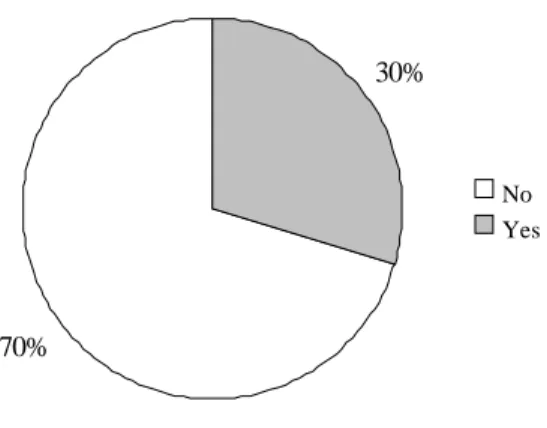
The examination revealed that out of 84 North Carolina public library websites, only 25 sites (30%) are using any kind of Web 2.0 technology. This means that a large portion (59 sites or 70%) of North Carolina public library websites are not using any Web
2.0 applications (see Figure 1). 70%
30%
No Yes
Figure 1. Does the site use Web 2.0 technologies in general?
Research Question 2. What types of Web 2.0 technologies are public library websites in North Carolina using?
Of the 25 library websites using Web 2.0, there are 16 (64%) using RSS feeds for subscriptions to calendar events, new title lists, and other services. Just under half, (11, 44%) are using blogs, either alone or in conjunction with RSS, for news and events announcements. Many of these sites use RSS as a way to offer subscriptions to blog postings, so these occurrences often overlap.
Research Question 3. To what extent do public libraries in North Carolina provide readers' advisory services online?
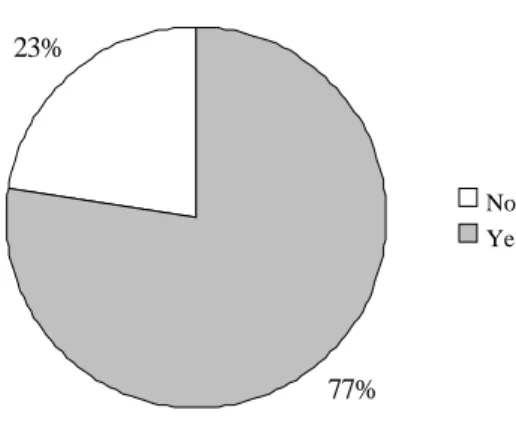
While many of the libraries' websites examined have not yet adopted Web 2.0 technologies for varied use, a majority of them do offer readers' advisory services online. A majority of these websites (65 out of 84, or 77%) are offering RA online in some way
(see Figure 2).
23%
77%
No Yes
Figure 2. Does the site offer online Readers' Advisory services?
to NextReads newsletters which is a service of NoveList, 8 subscribe to Online Book Clubs, and 5 subscribe to BookNews. There are several sites with lists and
recommendations from library staff, either instead of or in conjunction with these subscriptions.
Research Question 4. Are public library websites in North Carolina using Web 2.0 technologies to provide readers' advisory services online?
Only seven library websites are using Web 2.0 technologies as additional tools to provide RA services online. While these seven sites demonstrate an enthusiasm for embracing and implementing innovations by offering robust and varied RA services, it is clear that other North Carolina public libraries are going to be slower to adopt them. This trend is well-established for emerging technologies – early adopters will test the
functionality and limitations of new tools, then if the tools are deemed useful or valuable more people and organizations will begin to implement them. The peer institutions of these 7 libraries might benefit in the future from following their examples on using Web 2.0. Reasons for not adopting the tools are not clear and are outside the scope of these findings. However, as the literature suggests, they will greatly enhance services the libraries already offer, and even allow libraries to offer new services.
Research Question 5. How are the websites advertising these services?
appears to be a strong, positive correlation between the robustness of a site's advertising and the level of RA service provided online. In other words, those sites that have dedicated pages and make them very visible from the homepage seem to offer a wider variety of services. More research is needed to articulate the nature of this relationship.
Within the state of North Carolina, public libraries need to make more of an effort to have substantive online presences. Moreover, they need to be offering readers'
advisory services online in order to reach more than just the community members who walk into the physical locations. As the literature suggests, Web 2.0 can provide simple tools to facilitate the transition to providing widely accessible, high quality service.
several labels, which are also links to other similar items, and invite audience participation. This is by far a more interactive, holistic approach to RA service.
Another site employing these methods is Wake County Public Libraries (WCPL). Home to the capital city of Raleigh and about 794,000 residents (U.S. Census Bureau, 2007), Wake County has a public library system with 19 branches. Part of their mission is “to promote the love of reading” and two priorities toward meeting that goal are “recreational reading” and “bridging the technology gap” (Wake County Government, 2009). WCPL has clearly made concerted efforts to meet these priorities and goals. If you look at the WCPL homepage, there is a large button for “Reading” (see Appendix B, Image 4). This button links to a page full of RA resources; it offers the expected lists and links and advertises subscriptions to NoveList and BookNews. Additionally, however, it offers Web 2.0 tools such as blogs for book clubs and podcasts for book talks. Avid readers will also be pleased to see a button advertising “Custom Book Lists,” whereby one can fill out a profile and a librarian from WCPL will create a list of titles based on those criteria (see Appendix B, Image 5). Beyond that, if users conduct a catalog search for a resource and click on an item to see its record, there will be a list of titles on the sidebar similar to that resource. Tags are pulled into the catalog from the social cataloging website LibraryThing (see Appendix B, Image 6).
technologies and expanding services to the Web can reach a wider audience.
Importance of the Study
Readers' advisory services and Web 2.0 are important to study for several reasons. First, it is useful to study public libraries and their services because they are vital sources of information and entertainment. They are also part of the infrastructure and backbone that make communities function. Public libraries also function as meeting and gathering places, which foster a sense of community. Next, we need to study readers' advisory because of the increasingly important role it is playing in service to community members. Finally, Web 2.0 is important to study because it has various implications for the future of how people use the Internet. It has been demonstrated to facilitate a more interactive, rather than passive, readers' advisory service. Further research would provide even more evidence to support its adoption.
Limitations of this Study and Possibilities for Future Research
Summary and Conclusion
This research shows that a few public libraries in North Carolina are beginning to adopt Web 2.0 tools for providing readers' advisory service. While these efforts are a good start, more needs to be done to promote these tools and services. More libraries need to focus on creating an online presence and offering readers' advisory services online. Web 2.0 tools can make the process of creating websites less cumbersome for library staff and provide ease of use for library patrons.
The library and information science literature is rich with studies dealing with the use of technology in academic and school libraries, which more recently includes Web 2.0. Yet, there is an increasing need for empirical and scholarly research regarding public libraries. Research is what is needed to provide evidence and make solid cases for how a library should function. This study attempts to contribute to the growing body of
literature on readers' advisory, public libraries, and Web 2.0.
References
About NoveList. (2009). Retrieved March 11, 2009, from http://www.ebscohost.com/ novelist/default.php?id=10
Aharony, N. (2009). Web 2.0 use by librarians. Library & Information Science Research, 31(1), 29-37.
Asselin, M. & Doiron, R. (2008). Towards a transformative pedagogy for school libraries 2.0. School Libraries Worldwide, 14(2), 1-18.
Babbie, E. (2007). The practice of social research (11th ed.). Belmont, CA: Wadsworth. Collection Development and Evaluation Section (CODES) Readers' Advisory
Committee. (2004). Recommended readers' advisor tools. Reference & User Services Quarterly, 43(4), 294-305.
Curran, K., Murray, M., Norrby, D.S., & Christian, M. (2006). Involving the user through Library 2.0. New Review of Information Networking, 12(1-2), 47-59. Dilevko, J. & Magowan, C.F.C. (2007). Readers' advisory service in North American public libraries, 1870-2005. Jefferson, NC: McFarland & Company Publishers, Inc.
Hollands, N. (2006). Improving the model for interactive readers' advisory service.
Reference & User Services Quarterly, 45(3), 205-212.
Kroski, E. (2008). Web 2.0 for librarians and information professionals. New York: Neal-Schuman Publishers, Inc.
Linh, N.C. (2008). A survey of the application of Web 2.0 in Australasian university libraries. Library Hi Tech, 26(4), 630-653.
Needleman, M. (2007). Web 2.0/Lib 2.0: What is it, if it's anything at all? Serials Review, 33(3), 202-203.
O'Reilly, T. (2005). What is Web 2.0?: Design patterns and business models for the next generation of software. Retrieved, March 11, 2009, from http://www.oreillynet. com/pub/a/oreilly/tim/news/2005/09/30/what-is-web-20.html
Peterson, G. & McGlinn, S.H. (2008). Building a community of readers: BookSpace.
Computers in Libraries, 28(4), 6-11, 52.
Saricks, J.G. (2005). Readers' advisory service in the public library (3rd ed.). Chicago: American Library Association.
State Library of North Carolina. (2009). North Carolina public libraries on the web.
Retrieved February 12, 2009 from http://statelibrary.dcr.state.nc.us/ library/publib.html
Trott, B. (2005). Advising readers online: A look at internet-based reading
recommendation services. Reference & User Services Quarterly, 44(3), 210-215. U.S. Census Bureau. (2007). American Community Survey 2005-2007. Washington, DC:
U.S. Census Bureau.
Wake County Government. (2009). About our libraries. Retrieved March 19, 2009 from http://www.wakegov.com/libraries/about/default.htm
Wyatt, N. (2007). 2.0 for readers. Library Journal, 132(18), 30-33.
Appendices Appendix A
List of libraries and websites
1. Alamance County Public Libraries - http://www.alamancelibraries.org/ 2. Albemarle Regional Library - http://www.arlnc.org/
3. Alexander County Library - http://www.alexanderlibrary.org/ 4. Appalachian Regional Library - http://www.arlibrary.org
5. Avery-Mitchell-Yancey Regional Library - http://www.amyregionallibrary.org/ 6. Beaufort-Hyde-Martin Regional Library - http://tlc.library.net/BHM/
7. Bladen County Public Library - http://www.youseemore.com/bladen/ 8. Bogue Banks Public Library - http://carteret.cpclib.org/bb/bb.htm 9. Brunswick County Libraries - http://library.brunsco.net/
10. Buncombe County Public Libraries -
http://www.buncombecounty.org/governing/depts/Library/ 11. Burke County Public Library - http://www.bcpls.org
12. Cabarrus County Public Library - http://www.cabarruscounty.us/library/ 13. Caldwell County Public Library - http://www.ccpl.us/
14. Carteret County Public Library - http://carteret.cpclib.org/
15. Catawba County Library System - http://www.catawbacountync.gov/library/ 16. Chapel Hill Public Library - http://www.chapelhillpubliclibrary.org/
17. Chatham County Libraries - http://www.chathamnc.org/Index.aspx?page=126 18. Cleveland County Library - http://www.ccml.org
19. Columbus County Public Library -
http://www.columbusco.org/dotnetnuke_2/library/ LibraryHome/tabid/404/Default.aspx
20. Corolla Library - http://www.earlibrary.org/corolla/index.html 21. Craven-Pamlico-Carteret Regional Library System -
http://newbern.cpclib.org/nbccpl/cpcrl.html
22. Cumberland County Public Library & Information Center - http://www.cumberland.lib.nc.us
23. Currituck Library - http://www.earlibrary.org/currituck/index.html 24. Davidson County Public Library -
http://www.co.davidson.nc.us/community/PublicLibraryCatalog.aspx 25. Davie County Public Library - http://www.library.daviecounty.org/ 26. Duplin County Library - http://www.youseemore.com/Duplin/ 27. Durham County Library - http://www.durhamcountylibrary.org
28. East Albemarle Regional Library System - http://www.youseemore.com/earl/ 29. Edgecombe County Memorial Library - http://www.edgecombelibrary.org
30. Farmville Public Library - http://www.farmville-nc.com/departments_library.htm 31. Fontana Regional Library - http://www.fontanalib.org
32. Forsyth County Public Library - http://www.forsyth.cc/library/ 33. Franklin County Library - http://fcnclibrary.wordpress.com/
36. Guilford County - Greensboro Public Library - http://www.greensboro-nc.gov/departments/Library/
37. Halifax County Library - http://www.halifaxnc.com/library.cfm 38. Harnett County Public Library - http://www.harnett.org/library/ 39. Haywood County Public Library - http://www.haywoodlibrary.org/ 40. Henderson County Public Library - http://www.henderson.lib.nc.us 41. Hickory Public Library - http://www.hickorygov.com/library
42. High Point Public Library - http://www.highpointpubliclibrary.com/
43. Hyconeechee Regional Library - http://www.co.orange.nc.us/library/hyconeechee/ 44. Iredell County Public Library - http://www.iredell.lib.nc.us/
45. Johnston - Public Library of Johnston County & Smithfield - http://www.pljcs.org/
46. Kings Mountain - Jacob S. Mauney Memorial Library - http://www.mauneylibrary.org/
47. Lee County Library - http://www.leecountync.gov/departments/library/main-library.html
48. Madison County Public Library - http://madisoncountylibrary.org/
49. McDowell County Public Library - http://www.mcdowellpubliclibrary.org/ 50. Mecklenburg - Public Library of Charlotte & Mecklenburg County -
http://www.plcmc.org/
51. Mooresville Public Library - http://www.ci.mooresville.nc.us/library/ 52. Nantahala Regional Library - http://www.youseemore.com/nantahala/
53. Nash/Edgecombe County - Braswell Memorial Library - http://www.braswell-library.org
54. Nashville - Harold D. Cooley Library - http://www.townofnashville.com/library.html
55. Neuse Regional Library - http://www.neuselibrary.org
56. New Bern-Craven Public Library - http://newbern.cpclib.org/index.htm 57. New Hanover County Public Library -
http://www.nhcgov.com/AgnAndDpt/LIBR/Pages/DeptInfo.aspx 58. Northwestern Regional Library - http://www.nwrl.org
59. Onslow County Public Library - http://www.co.onslow.nc.us/library/ 60. Pamlico County Public Library - http://newbern.cpclib.org/pamlico/ 61. Pender County Public Library - http://www.youseemore.com/PenderPL/ 62. Pettigrew Regional Library - http://www.pettigrewlibraries.org/
63. Pitt County - Sheppard Memorial Library - http://www.sheppardlibrary.org 64. Polk County Public Library - http://publib.polknc.org
65. Randolph County Public Library - http://www.randolphlibrary.org
66. Roanoke Rapids Public Library - http://www.youseemore.com/RoanokeRapids/ 67. Robeson County Public Library - http://www.robesoncountylibrary.com
68. Rockingham County Public Library - http://www.rcpl.org 69. Rowan Public Library - http://www.rowanpubliclibrary.org/ 70. Rutherford County Library -
http://www.rutherfordcountync.gov/dept/library/Main.php 71. Sampson-Clinton Public Library System -
72. Sandhill Regional Library System - http://www.srls.info/
73. Scotland County Memorial Library - http://www.scotlandcolibrary.com/ 74. Southern Pines Public Library - http://www.sppl.net/Library/
75. Stanly County Public Library - http://www.stanlycountylibrary.org/index.html 76. Transylvania County Library - http://www.transylvania.lib.nc.us
77. Union County Public Library - http://www.union.lib.nc.us
78. Vance County - H. Leslie Perry Memorial Library - http://www.perrylibrary.org/ 79. Wake County Public Libraries - http://www.wakegov.com/county/libraries/ 80. Warren County Memorial Library - http://www.wcplnc.org/
81. Washington - George H. & Laura E. Brown Library - http://www.ci.washington.nc.us/library.aspx?rId=582 82. Wayne County Public Library - http://www.wcpl.org
Appendix B Library web pages
Image 2. Greensboro Public Library Readers' Advisory Desk Bookmarks
Image 4. Wake County Public Libraries homepage.