Sarah E. Cristy. Teen Spaces, Teen Librarians, and Circulation: An Exploration of Measures of Public Library Services to Young Adults. A Master’s Paper for the M.S. in L.S. degree. April, 2012. 40 pages. Advisor: Brian Sturm
Best practices guidelines for young adult services agree that public libraries should provide teens with a separate room to house teen materials, and that each library should have a professional MLS librarian who specializes in teen services. A sample of five local public libraries was examined through observation and collection of circulation statistics to see whether the presence of a physical teen space and a qualified young adult librarian had an impact on the circulation of young adult materials in public libraries. Results showed little impact of these two factors on young adult circulation. There was, however, a strong relationship between the presence of a qualified young adult librarian and the existence of a separate teen room.
Headings:
Libraries -- Circulation analysis Young adults’ libraries
by Sarah E. Cristy
A Master’s paper submitted to the faculty of the School of Information and Library Science of the University of North Carolina at Chapel Hill
in partial fulfillment of the requirements for the degree of Master of Science in
Library Science.
Chapel Hill, North Carolina April 2012
Approved by
Table of Contents
Introduction………..2
Literature Review……….4
Research Questions………14
Methodology………..16
Results………20
Discussion and Conclusion………30
Future Research……….35
Introduction
A major concern for librarians serving young adults today is this: how do we get teens into the library, and how can we get them to stay? The library profession has
wrestled with these questions for decades. Librarians have conducted studies to determine what teens want in a library, and have striven to fulfill those desires. Public libraries now provide popular fiction and graphic novels that teens want to read, plan programs that focus on teens’ interests, offer resources that support teen’ developmental and
educational needs, and hire librarians who are experts in serving this age group.
However, these services alone may not be enough to increase young adults’ use of public
libraries.
In a 1998 article in American Libraries, Anthony Bernier lamented that “public
libraries give more space to restrooms than to young adults,” despite the fact that young people “constitute nearly 25% of today’s library patrons” (p. 52). He argued that an organization’s spatial design reveals that institution’s values and priorities, and that a lack
of space for teenagers within a library marginalizes young people and implies that they are unwelcome (Bernier 1998). In the decade since Bernier wrote those words, teen space design has been a hot topic in the library profession. Some libraries have redesigned their spaces and improved their teen areas to comply with the guidelines that have been
are often shelved in areas primarily designed for other users: either in the children’s
room, with the picture books for preschoolers, or in the adult collection, tucked into an out-of-the-way corner. Neither of these two scenarios is ideal for serving the unique needs of teenagers, who are not yet adults but who have moved beyond childhood and resent being perceived as children.
Literature Review
This study is built on four areas of research: (1) teen services in public libraries; (2) design of library buildings and spaces, including specific spaces for children and young adults; (3) recommendations for young adult librarians; and (4) circulation studies in libraries.
Teen Services in Public Libraries
Over the past two decades, teen services have increasingly been recognized as a distinct area of service in public libraries. An American Library Association-sponsored poll found that 78 percent of children ages 8 to 18 have public library cards, and that 56 percent report visiting the public library (or its website) once a month or more (Harris Interactive, 2007). This kind of data shows that teenagers are using public libraries – but the question remains, are libraries meeting the needs of this user group? Experts in young adult services have studied the needs of teenagers and offered guidelines for best
practices.
Denise Agosto’s teen library use survey (2007) found that teens use libraries for
many different (and personal) reasons, which can be thematically grouped into three main roles of public libraries: “(1) the Library as Information Gateway, (2) the Library as
Social Interaction/Entertainment Space, and (3) the Library As Beneficial Physical Environment” (p. 58). Interestingly, two of these three themes focus on the library as a
and a safe place to go (p. 59-60). Agosto concludes that since teenagers use the library for its atmosphere and environment as much as they do for accessing information, public libraries should offer more services and programs targeted to teens that meet these social interaction needs. Most relevant to this study, she suggests designating a “separate Teen Room … where YAs can play music, play … games, hold library club meetings, or browse teen magazines without disturbing patrons in other parts of the library” (p. 61).
The Young Adult Library Services Association (YALSA), a division of the American Library Association, has published several guidebooks for library services to young adults. In New Directions for Library Service to Young Adults (2002), Patrick Jones declares that the true goal of services for teens in libraries is not to benefit the library, but to foster healthy youth development and to help teens grow into “lifelong learners and competent, caring adults” (p. 5). This focus on the outcomes, not just the services, means that public libraries must look to improve the quality, not just the
number, of materials and programs for young adults. And above all, these guidelines state that librarians should work with the teenagers they are serving and put the teens’ needs above the libraries’ desires. Jones lays out twelve goals of library service to young adults, including “provide for the unique needs of young adults as part of the library’s general services,” “develop unique collections of resources for young adults,” “treat young adults with respect and provide quality customer service,” and, importantly for this research study, “set aside space(s) for young adults for their own use” (p. 16).
The more recent Young Adults Deserve the Best (2011) expands on YALSA’s “Competencies for Librarians Serving Youth” statement, which outlines the skills,
with teens. This guidebook offers specific strategies and suggestions for action by librarians to improve teen services and “make teen services an integral part of the library and the community” (Flowers, 2011, p. viii). Under the competency area of
Administration, YALSA states, among other goals, that the librarian will “develop a strategic plan for library service with young adults based on their unique needs” and “develop physical facilities dedicated to the achievement of young adult service goals”
(p. 37). Flowers emphasizes that the physical facilities dedicated to young adult services should consist of a separate room or space just for teens. In support of these guidelines that all recommend teen spaces, the above-mentioned Harris Poll also found that when asked to respond to the question “I would use my local public library more often if…,” 26% of young people 8 to 18 selected the answer “there was a space just for teens.” This
demonstrates that providing a well-designed teen space is not just a recommendation of best practice in teen services, but something that teens themselves desire.
Design of Library Buildings & Spaces
Literature on the design of libraries emphasizes a trend toward recognizing the library as a physical space rather than merely as a warehouse for collections. Thomas Sens, architect at BHDP Architecture, a firm specializing in academic and workplace design, has identified “12 Major Trends in Library Design” that focus on the changing needs of modern college and university students. Chief among these trends is to “envision the library as place” (Sens, 2009). Sens notes that the key functions of libraries today are
future in mind; in particular, he suggests utilizing moveable furniture and temporary wall partitions, which “serve not only the long-term function of space but also short-term
needs for flexible work environments. When students are allowed to reconfigure their work environment, they will find ways to create the most conducive environment for collaboration and optimal learning” (Sens, 2009).
Sens’ “Trends” focuses on the world of academia, but the needs of college
students are not so different from the needs of middle and high school students, who also require collaborative, flexible space. Architect Richard D’Amato indicates that
communal spaces are at the heart of modern public library design, adding “interactive
kiosks, group-based children and teen centers, flexible community rooms, and technology centers” (qtd in Sullivan & Horwitz-Bennett, 2010). Architect Elliott Felix argues that because information is accessible from many places other than libraries, “the value of a
library is now in the kinds of experiences it creates for its users by integrating space, support services, and technology” (qtd in Sullivan & Horwitz-Bennett, 2010). Sullivan & Horwitz-Bennett also note that user comfort is a priority in design, since “people will come and stay much longer if it is a comfortable and pleasing environment” (2010). Thus
it is asserted by those who design libraries that the environment of the library,
particularly the design of the physical space, is an important factor in how patrons use libraries.
library should be designed to explicitly support the library’s main purpose and the needs of is community. Speaking of youth services specifically, Khan asserts that “young children should not have to walk through adult spaces to enter the children’s area … or to use common facilities… [and] within a children’s space, school-age young people should
not have to walk through a pre-school area to reach their own materials and services” (2009, p. 119-120). Dewe (2006) also takes note of special accommodations to be made for “children and young people” within the larger public library building, noting that different age groups have “different demands … as regards library materials and ambiance” (p. 307). He adds that “catering for young people or teenagers within the library building is a major challenge,” and encourages public libraries to create special,
separate areas specifically for teenage patrons.
Teen Spaces
Recognizing the unique needs of young adults, the American Library Association not only includes guidelines for designing children’s and young adult facilities within general works on library design, but also offers resources that focus entirely on ideal design of spaces for children’s and teen services. Feinberg and Keller’s Designing Space
for Children and Teens (2010) offers a comprehensive guide that covers topics from architecture to interior design, with the goal of helping library and design professionals “improve the quality of services for young people in libraries” (p. ix). This book notes
that “the role of design in creating youth environments in libraries extends to identifying and defining the importance of children and teens in the greater context of the services”
as does the placement of the teen area in relation to other library spaces. Feinberg and Keller suggest that the teen space should be closer to the adult areas in order to “foster access to information” and serve as “an open door to intellectual freedom” (p. 75); this also serves the practical goal of “protecting” younger children from the noise and activity of teenagers. Above all, both the children’s and teen spaces should be physically and
visually accessible, and they should be laid out in ways that encourage both interaction and quiet study (Feinberg & Keller, 2010).
The Checklist of Library Building Design Considerations (Sannwald, 2009) provides explicit lists of requirements and suggestions for designing any type of library. Regarding young adult spaces, the book asks librarians to consider questions such as “Is
the location of the young adult area easily determined when one enters the library? Is the young adult section separate from other areas in the library? Is the space closer to the adult section than to the children’s section?” and, perhaps most importantly, “Is the space
slightly secluded, giving the appearance of privacy, while still allowing some
supervision” (p. 69-70). These questions give the options of “yes” “no” and “N/A” as answers, but it is strongly implied that “yes” is the ideal answer and that a response of “no” indicates that the library should make adjustments. Thus, the ALA’s Checklist
indirectly asserts that teens should be given their own space within the library, separate from both the children’s and adult sections, in which they may feel some sense of privacy
through partial seclusion.
near a highly trafficked path in the library. Most importantly, it should not be located next to the children’s department. Many young adolescents are just beginning to establish their own identity and resent being perceived as children” (2000, p. 31). Vaillancourt
further advises that the young adult area should have clearly defined boundaries, “either by using bookshelves and other furnishings to form ‘walls’ or by creating the space in an enclosed room” (2000, p. 31). Lesley A. Boon (2003) also asserts that adolescents “need
a space that is obviously their own” (p. 154). She notes some practical considerations in designing library spaces for teenagers, including traffic flow considerations, accessibility, need for visual supervision, noise levels, color, furnishings, and flexibility (2003, p. 155-156).
Overall, experts agree that a teen area in a public library “should be its own separate space and the heart of teen activity” (Bolan, 2009, p. 10). Kimberly Bolan asserts that a teen space should reflect the concept of “library as place,” and that it should
allow teens to explore and establish their identities and individuality (2009, p. 11). Anthony Bernier writes that “young people should be considered part of the civic
community and … libraries should express this value in the design of their public spaces”
by providing a separate YA space for both the YA collection and for young adults to feel welcome (2009, p. 33). And Sondra Vandermark states that an effectively designed young adult space is an environment for “encouraging teens to develop the habit of
experts conclude that the best way to meet the basic library needs – and developmental needs – of teenagers is through a well-designed young adult space that is distinctly their own.
Young Adult Librarians
The professional literature on young adult services also emphasizes the need for dedicated young adult librarians at every public library. Among the twelve goals of library service to young adults listed by Patrick Jones in YALSA’s New Directions for Library Service to Young Adults (2002), the second one states that libraries will “employ young adult specialists or certified school library media specialists, and train staff
members, volunteers, youth participants, and others to serve young adults” (p. 16). YALSA expanded on this principle with a White Paper titled “The Benefits of Including Dedicated Young Adult Librarians on Staff at the Public Library,” which asserts that “librarians especially trained to work with young adults are age level specialists who
understand that teens have unique needs and have been trained especially to work with this particular population” (Caplan 2009). This white paper explains that teens are
developmentally different from children and adults, and thus have different “behaviors, interests, and informational and social needs” that only a specially-trained librarian can
address. Caplan furthermore cites the 2007 Harris Poll conducted by YALSA, which found that one in five teens said they would use their library more if “there was a librarian just for teens.” Thus, having a specialized young adult librarian not only meets
library science, as is generally recommended for those working with children and adults in a public library.
Circulation Statistics as Measures of Library Use
Joseph R. Matthews defines output measures as “counts that measure volume of activity”, measures that indicate “the degree to which the library and its services are being utilized” (2004 p. 2). Matthews’ Measuring for Results lists annual circulation
statistics as a common output measure for public libraries; they can be used both a measure of services and a measure of collection use. Matthews cautions that output measures generally have “no clear innate or implied value … without context” (p. 86), that circulation data itself may primarily be influenced by demographics over which the library has little control. However, these are commonly collected and widely used measures of library service.
Focusing specifically on public library services to young adults, Virginia Walter’s
1995 manual Output Measures and More: Planning and evaluating public library
services for young adults lists “circulation of young adult materials per young adult” as a type of materials use measure for the young adult collection (p. 52). She suggests finding annual circulation data from the records of an automated circulation system. Materials use measures are thus considered an important aspect of library services to young adults.
Patrick Jones’ New Directions for Library Service to Young Adults (2002)
includes a detailed checklist of recommended strategies for providing quality library services to young adults; relevant to this study is the one that reads “Develops methods
original] (p. 61). One method of collection analysis is a study of circulation of library materials.
Circulation studies conducted in other library venues have yielded interesting results that suggest ways to improve practice. Karen Gavigan, Shana Privesh, and Gail Dickinson investigated whether school library scheduling had any impact on circulation statistics at a sample of elementary school libraries in North Carolina and Virginia. They compared school media centers that had fixed schedules (a traditional model employed by most school) to those with flexible schedules (the style recommended by best
practices guidelines for school media centers), and found that “there was a significant and
Research Questions
This study explores the current status of young adult services in public library through the lens of circulation of young adult materials. The study sought to determine whether there was a relationship between a public library’s design of the young adult
area, its youth services staff qualifications, and its circulation of young adult materials. The following questions guided my research:
1. “Does having a teen space that is truly a separate room correlate to increased circulation of teen materials from that library or branch?” For the purposes of this study, “teen materials” are defined as any library materials (books, audiovisual, etc.) that have been categorized and labeled as “YA” (for “young adult”) in the automated library system. “Teen space” is defined as the area of the library that has been set aside for teen
patrons and where teen materials are shelved. A teen room will have at least 3 walls that separate it from the rest of the library; if the space is made distinct merely by
arrangement of shelving units and furniture, then it is not a “teen room” but merely a “teen space.”
2. “Does the presence of a professional, master’s-degree-holding Young Adult
Librarian at this branch and overseeing the teen materials and teen space correlate to higher circulation of teen materials at a library?” This question will be analyzed on a sliding scale, whether the librarian in charge has specialized knowledge of and responsibility for Young Adult services, as a “Young Adult Librarian,” or whether
whether the librarian has completed their Master’s in Library Science, is working toward
Methodology
Qualitative Methods
This study was conducted using qualitative research methods for data collection and data analysis. Qualitative research is commonly used in the social sciences in order to examine and understand real-world phenomena (Yin, 2011). According to Peter
Liebscher, it is ideal for research of phenomena that “are complex, are social in nature, and do not lend themselves to quantification” (qtd in Powell & Connaway, 2004, p. 59).
There are many types of research design that fall under the umbrella term of qualitative research. This study was conducted using methods from a type of applied research called evaluative research, which is carried out in real-world settings. In particular, the study falls into the category of performance measurement, which is used in the library and information science field to determine what has been accomplished by specific programs and services; it focuses on “indicators of library output and effectiveness … [and] the impact of the library on the community” (Powell & Connaway, 2004, p. 55).
Data Collection
space and resources to accommodate a teen area. Library systems were selected based on proximity to the researcher, within a range of 50 miles, to accommodate personal
observation and assessment.
Non-participant field observation was selected as the chosen method for data collection on teen space design. Direct observation, “in which the observer is only there to observe” (Wildemuth, 2009, p. 190), was selected rather than more people-centered
methods (such as surveys or interviews) based on the idea that design style would be apparent visually and immediately, and could be classified more reliably by an impartial outsider (this researcher).
Data collection at each library took place over a single day, with an estimated two hours required at each location. Because observations focused on physical spaces rather than user interaction, it was not deemed necessary to standardize the day of the week or time of the observation period; it was only necessary to ensure that all aspects of the physical teen space were available for observation at the time of the visit.
During each evaluation, extensive field notes were completed, recording the location of the teen space relative to other library sections, how the space is designated as being for teens, how accessible it seems to be, and general design layout of the space. Each teen space was then classified according to a spectrum of design types, ranging from “completely separate room” to “portion of shelving areas.” As stated previously,
Circulation data was gathered through personal interaction with library staff at each selected location. After observation and evaluation of teen spaces, I arranged to talk briefly to the staff member in charge of managing the teen space. From that librarian, I requested statistics on the size of the young adult collection at that library or branch, circulation of all young adult materials over the past calendar year (January-December 2011), and total circulation at the library for that same period. At this time, I also asked each librarian to provide their level of education and length of experience in the
profession.
Data on the legal service population of each library studied was collected from the 2009-2010 Annual Statistical Report on public libraries published by the State Library for this Southeastern state, the most recent publicly-available information. This data was supplemented by information from the 2010 United States Census.
Data Analysis
Each library’s teen space was analyzed during observation and classified along a
spectrum of design types, ranging from “completely separate room” to “defined area” to “portion of shelving areas.”
Each librarian’s professional experience was classified as either possessing a Master’s in Library Science or not; this data was then compared to type of teen space and
the circulation statistics.
circulation, the circulation of young adult materials per capita, and the turnover rate (circulation per materials held) of each young adult collection.
Results
The results of my study are described below. In order to preserve anonymity, each library has been assigned a letter, according to their order on the spectrum of teen space design; the library with the most separate and defined teen room is thus Library A, the next most-defined space is Library B, and so on. What follows is a description of each library’s teen space, the experience and qualifications of the associated librarian, and the
statistics collected for each library.
Teen Spaces and Librarian Qualifications
Library A
Library A’s teen space can be classified as a separate teen room. All teen
materials are housed in an enclosed room on the second floor, which is fairly easy to locate.
Library A is the main branch of a county library system, located in a small,
historic, downtown area. From the main entrance on the north side of the library building, a patron would walk in and see the Circulation desk directly in front. Also clearly visible is the Children’s Room to the left, and a staircase just to the right of the circulation desk.
occupying the center of the room, is a two-sided information desk with staff work areas (visible behind glass walls) in the middle. One side of this information desk faces southward, toward the adult fiction shelves and computers; the other side faces the adult nonfiction and reference shelves on the northern end. As one walks around the
information desk, facing the eastern side of the library building, is a separate room with two available doors; this room is labeled “Teen Center” on a panel with the room’s number. Next to each door is a printed sign that reads, “The library reserves this space for
teenagers in grades 6th-12th, or ages 11-19, only. Thank you for your cooperation.” Thus it is clearly marked as being a space for teenage patrons.
Inside this room are all of the library’s young adult materials, arranged on 5 rows
of shelving, plus tables and chairs arranged for group and private seating, and two computers. The majority of the shelves hold young adult fiction; the rest of the space contains YA nonfiction and biographies, graphic novels, audiobooks, and magazines. Though the room is entirely enclosed, two of the four walls contain large clear-glass windows, so that anyone inside the room is visible to staff at the information desk, as well as to other patrons on the second floor. Thus, privacy is minimal, but supervision of the space is possible.
The Teen Center at Library A is overseen by a single Young Adult Librarian. This librarian has a master’s degree in library science and has worked in her current position
for 2.5 years. Library B
Library B’s teen space can be classified as a separate room; it is located on the
Library B is a three-story building in a busy, urban downtown area; it is the main branch of a large county library system serving a mostly urban population. The main entrance to the building is slightly below street level, facing a parking lot. Entering the building, one passes through a set of sliding doors into a long lobby, then through a second set of doors into the library itself. Immediately in front is a staircase to the upper floors; to the left of the staircase is a doorway to a brightly lit space with a sign saying Children’s Room. To the right of the staircase is an open space that looks like a hallway;
at the end of that hallway, visible from the lobby entrance, is a sign on the wall reading “Teen Spot.” As one approaches this teen area, one passes private study rooms along the
left-hand wall, and a small café area with tables and vending machines on the right. The Teen Spot occupies the back half of this long room, consisting of shelving in an alcove, and scattered seating in the center of the room. Another sign on one of the shelves reads “Seating area for teens grades 7-12,” indicating that this space is meant to be reserved for
teenage patrons.
The Teen Spot contains all of Library B’s young adult materials; the shelves here hold a large collection labeled “teen fiction,” as well as YA nonfiction, graphic novels,
and audiobooks. The furniture in this room includes three square tables with chairs, and four armchairs. This teen area is completely separated from the nearby Children’s Room
by a thick wall with a doorway (that passes under the central staircase), and no other library materials are kept in this room.
space. This librarian has a master’s degree in library science; she has worked as a professional librarian for five years, and in this current position for five months. Library C
Library C’s teen space can be classified as a distinct space but not a separate
room. All teen materials are shelved in that section of the library, which is clearly marked.
Library C is a large regional branch of a country library system, located near shopping centers and some residential areas. From the main entrance to the library, a patron would pass through double doors, and see a book display immediately in front of them. A glance to the left shows the children’s area and audiovisual materials. A glance
to the right shows an information desk, and signs indicating adult areas farther on. Clear signs overhead inform patrons which section is which: “Adults” over a computer cluster, “Nonfiction” over a set of shelves, “Fiction” over more shelves. Walking down the
right-hand hallway toward the adult sections, a sign becomes visible in the farthest corner on the right, reading “Teens.” This area is a distinct alcove, occupying the back corner of
this end of the library. It is set off from the rest of the adult sections by the open walkway on the left, and a short wall separates it from a café-like seating area.
This teen space contains the library’s young adult materials: fiction, nonfiction,
Library C’s teen area is overseen by a Teen/Adult Services Librarian who has a master’s degree in library science, has worked as a professional librarian for 10 years,
and has worked at this library for 2 years. Library D
Library D’s teen space can be classified as a separate space, but not a room. All
teen materials are shelved in that small section of the library, which is somewhat difficult to locate.
Library D is the central branch of a large, urban library system; it is located in the busy downtown area, near to other cultural institutions and office buildings. Entering the library through the main doors, a patron would immediately see a large, round lobby, with sculpture in the middle and two curved information desks around the edges of the room. Directly ahead is a staircase to the second floor; ahead and slightly to the right is a colorful entrance to the children’s room. The rest of the library’s first floor materials are
to the left of the lobby; walking in that direction, one can see a colorful pillar in the center of a computer cluster, bounded by shelves that contain library materials labeled as young adult. This section, then, is the teen area, though there is no clear signage that designates it as such. The teen space occupies a small corner of the main room, with the library’s front windows and an interior wall serving as two sides of the space.
This area is more of a teen section than a teen space, since it is primarily designed to hold Library D’s young adult materials. On the shelves that separate the space from the
library’s front windows, beginning in the corner of this teen area, and extending into a
larger open seating area for all library patrons.
Library D does not have a staff member who directly oversees this teen area. Ultimate responsibility for young adult materials at Library D lies with the library system’s Youth Services Coordinator, a professional librarian with a master’s degree in
library science who has worked for this library system for over ten years. Library E
Library E’s teen space can be classified as a section of the library, an area that is
distinct but not truly separate from the rest of the library.
Library E is the main branch of a primarily rural county library system, located in an open pastoral area near to residential properties and just outside a small city’s
downtown. Entering the long and narrow one-story building, a patron would first see a large, round, centrally placed circulation and information desk. In the center of the library there is a decorative fireplace and display shelving. To the right is the children’s area, with a youth services desk at the front to mark the boundary of the space. To the left of the central fireplace, extending toward the far end of the building, are rows of shelving containing the majority of the library’s materials. Between shelves for general
audiovisual materials and adult fiction, is a section of shelving labeled “Teen Collection.”
Library E’s teen space is overseen by the library’s sole Children’s Librarian, who
has held this position for two years; this librarian is currently enrolled in a library science master’s program, but has not yet earned a degree.
Circulation and Other Statistics
Library A
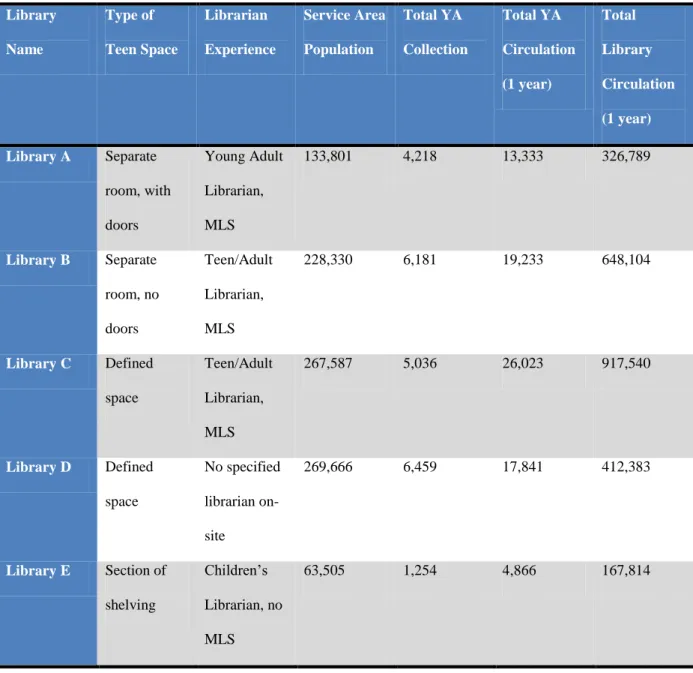
Library A serves a total population of 133,801 in their legal service area (U.S. Census Bureau, 2010). Library A’s young adult collection contains 4,218 items; this
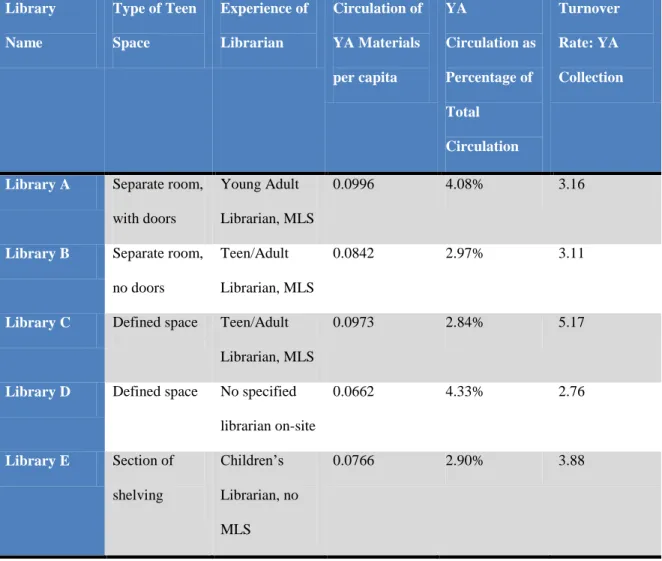
collection has a circulation count of 13,333 for the one year period between February 15, 2011 and February 15, 2012. With an overall library circulation of 326,789 in the same period, young adult materials account for 4.08% of the total circulation of materials from Library A for a single year. The turnover rate of the YA collection at Library A is 3.16. Circulation of young adult materials per capita over the last year was 0.0996.
Library B
Library B’s service population is 228,330 (U.S. Census, 2010). Library B has a
circulation count of 19,233 for all 6,181 young adult materials from their branch from January to December 2011. With a total branch circulation of 648,104 for the same calendar year, the percentage of Library B’s circulation that is young adult materials is
2.97%. The turnover rate for this YA collection is 3.11, and the circulation of young adult materials per capita was 0.0842.
Library C
materials labeled as YA from January to December, 2011. Library C’s total overall
circulation for the 2011 calendar year was 917,540; the percentage of their circulation that is young adult materials is 2.84%. Their circulation of young adult materials per person is 0.0972, and their turnover rate for the YA collection is 5.17.
Library D
Library D’s legal service population is 269,666 (U.S. Census, 2010). Library D has a total circulation count of 17,841 for their branch’s 6,459 young adult materials over
the 2011 calendar year (January to December). With a total circulation from this branch of 412,383 for the same year, young adult materials make up 4.33% of circulation at Library D. The turnover rate of their young adult collection is 2.76. Library D’s
circulation of YA materials per capita is 0.0662. Library E
Library E serves a population of 63,505 (U.S. Census, 2010), and their young adult collection is comprised of 1,254 items. Library E has a total circulation count of 4,866 for all young adult materials for one year, from February 27 2011 to February 27 2012. Total circulation of all materials from Library E was 167,814 for that same period. The percentage of Library E’s circulation that is young adult materials for that year was 2.9%, and the turnover rate of their YA collection was 3.88. Library E’s circulation of
Table 1. Data Collected Library Name Type of Teen Space Librarian Experience Service Area Population Total YA Collection Total YA Circulation (1 year) Total Library Circulation (1 year)
Library A Separate
room, with
doors
Young Adult
Librarian,
MLS
133,801 4,218 13,333 326,789
Library B Separate
room, no
doors
Teen/Adult
Librarian,
MLS
228,330 6,181 19,233 648,104
Library C Defined
space
Teen/Adult
Librarian,
MLS
267,587 5,036 26,023 917,540
Library D Defined
space
No specified
librarian
on-site
269,666 6,459 17,841 412,383
Library E Section of
shelving
Children’s
Librarian, no
MLS
Table 2. Data Calculations
Library
Name
Type of Teen
Space Experience of Librarian Circulation of YA Materials per capita YA Circulation as Percentage of Total Circulation Turnover Rate: YA Collection
Library A Separate room,
with doors
Young Adult
Librarian, MLS
0.0996 4.08% 3.16
Library B Separate room,
no doors
Teen/Adult
Librarian, MLS
0.0842 2.97% 3.11
Library C Defined space Teen/Adult
Librarian, MLS
0.0973 2.84% 5.17
Library D Defined space No specified
librarian on-site
0.0662 4.33% 2.76
Library E Section of
shelving
Children’s
Librarian, no
MLS
Discussion and Conclusion
I had expected to find a range of types of teen spaces in my observation of North Carolina public libraries, and that was indeed the case. Two of the libraries that I studied had true teen rooms (Libraries A and B), where all teen materials were kept in a space that was separated from the rest of the library by at least three (3) walls. Two other libraries (Libraries C and D) had teen spaces that were distinct sections of the library, set apart in a corner and thus bounded by two (2) walls. The last library’s teen area (Library
E) was the least distinct space, set off slightly by the arrangement of shelving, but predominantly a part of the rest of the adult fiction shelves.
I had also expected to find a range in the experience of each teen area’s
supervisory librarian, and this was somewhat the case. Three libraries (Libraries A, B, and C) had librarians with master’s degrees in library science; of those, only one (Library
A) was truly a specialized Young Adult librarian, while the other two (Libraries B and C) were called Teen/Adult Librarian, indicating that teen services is only a component of their job description. One library (Library E) had no specialist in teen services at the entire library; rather, they had one librarian overseeing all youth materials, from birth to 18 years, who did not have a master’s degree. And one library (Library D) had no
specific staff member assigned to oversee the teen space at their branch.
There was a positive relationship between type of teen space and professional expertise of librarians; that is, the libraries with true teen rooms had professional
space spectrum had only a paraprofessional librarian whose primary focus was children’s services. This may mean that a dedicated teen librarian is more likely to advocate for a true teen space at her library; or, it may show that a library administration that supports having a teen space is more likely to hire a specifically teen librarian to supervise it. I think it is more likely that the type of librarian influences the type of space, at least in the five libraries I studied. Several of these library branches were constructed or redesigned within the past few years; the libraries with dedicated young adult services staff
(Libraries A, B, and C) were the ones that had the most defined teen spaces, while the library without a teen librarian had the least defined teen space.
The three libraries with teen librarians who have a master’s degree in library
science – Libraries A, B, and C – all displayed greater circulation of young adult materials per capita: 0.0996 [0.10], 0.0842 [0.08], and 0.0972 [0.10], respectively. This could indicate that the presence of a professionally trained young adult librarian has a positive impact on the circulation of young adult materials in a community. However, I have only collected information about the total population that each library serves, rather than information about the number of young adults in that area, since that is a far more complicated number to determine. Therefore, the circulation per capita calculation does not indicate how well the young adult collection circulates among the teens for whom those materials have been intended. Still, it appears that among my small sample of public libraries, having an MLS young adult librarian and a separate teen room, even a distinct teen space, correlates positively with greater circulation of teen materials.
libraries with the highest percentage of young adult circulation were Library D, at 4.33%, and Library A, with 4.08%. Here, the library with the greatest percentage (Library D) did not have a true teen room, but only a separate space, and did not have a teen librarian on-site to oversee it. The next highest percentage was seen at the library with the most separated teen room and the most specialized young adult librarian. The other three libraries all had young adult circulation at just below 3% of total circulation, with very little difference between them.
There are many possible explanations for the lack of a relationship seen here. One factor is that this calculation is dependent upon the rate of circulation of all materials at each public library, including those for children and adults; this may vary widely at a library due to a variety of factors not studied here. For example, if a certain library had a particularly outstanding collection of children’s materials, or very popular children’s programming, that could cause the circulation of children’s books to increase, both in
total number of checkouts and as a percentage of the overall library circulation; this would then necessarily decrease the percentage that young adult materials comprise in the total circulation from that library.
had to go into the accompanying teen space to get them. Additionally, teen materials may also be checked out by those who are not teens – adults, or children instead; so there is not an exact correlation between those who use a teen space and those who use the materials shelved there.
Still, if something similar were a strong factor in increasing the circulation of young adult materials, this study might have found it. However, among the five, diverse public libraries that I examined, the percentage of young adult circulation did not seem to correspond to type of teen space or experience of librarian.
The turnover rate of young adult materials at the five libraries I studied also did not seem to correspond to type of teen space or librarian qualifications. This number, of course, is highly dependent upon the overall size of a collection, and a library with a larger collection may actually be disadvantaged by this measure of a library’s output.
Thus, my study revealed that the smallest library – Library E, with the smallest service area population and the smallest young adult collection – had the second highest turnover rate over the past year, at 3.88 circulations per item (estimated). The highest turnover rate found, 5.17 circulations per item, was at Library C, since it had the highest number of total YA circulation of all the libraries, but only the third highest collection size. As noted above, young adult materials belonging to one branch of a library system can be checked out by patrons who do not physically visit that branch; therefore, the high turnover rate of Library C’s YA collection may be accounted for by factors other than the quality of the collection, the quality of the teen space there, or the qualifications of Library C’s teen
Overall, this study did not find a clear trend linking possession of a true teen room or the presence of a specially-trained teen librarian to higher circulation of young adult materials, even viewed through varying lenses. The most interesting pattern revealed was the link between the separateness of a library’s teen space to the experience and
qualifications of the librarian there; the libraries that had professional young adult librarians with master’s degrees and a specific focus on teen services also had the most
distinct teen rooms or spaces. These libraries saw greater circulation of teen materials per capita than the others studied, but not a higher turnover rate or percentage of total
Future Research
This study was limited by several factors, including location of the researcher and the time frame of the study. These limitations prevented this study from producing generalizable results. Future research could expand the study to include a greater overall number of libraries, both within the same Southeastern state or in multiple states. A future study could then control for varying sizes of library, varying budgetary resources and sizes of population in library service areas.
This study could also be expanded to look at changes over time in each library’s
circulation statistics, since this study only looked at data for one previous year. Future research could also take into account the specific young adult population at the libraries studied, to try to narrow the focus to the actual teen population served.
Despite the lack of conclusive trends found by this particular study, I think this area of research is an interesting one that could be explored both more widely and more deeply in the future. And despite not finding evidence that following best practices recommendations for teen space design leads to greater circulation of teen materials, I believe that investigating the relationship between the profession’s recommendations and
References
Agosto, D. (2007). Why do teens use libraries?: Results of a public library use survey.
Public Libraries, 46(3), 55-62. Retrieved from Library Literature & Information Science Full Text.
Bernier, A. (1998). On my mind: Young adult spaces. American Libraries, 29(9), 52. Retrieved from Academic Search Premier, EBSCOhost.
Bernier, A. (2009). A Space for myself to go: Early patterns in small YA spaces. Public Libraries, 48(5), 33-47. Retrieved from Library Literature & Information Science Full Text.
Bolan, K. (2009). Teen spaces: The step-by-step library makeover (2nd ed.). Chicago: American Library Association.
Boon, L. A. (2003). Designing library space for children and adolescents. In G. B. McCabe and J. R. Kennedy (Eds.), Planning the modern public library building
(pp. 151-159). Westport, CT: Libraries Unlimited.
Caplan, A. (2009, January). The benefits of including dedicated young adult librarians on staff in the public library: A white paper. Retrieved from
http://www.ala.org/yalsa/guidelines/whitepapers/yastaff.
Feinberg, S., & Keller, J. R. (2010). Designing space for children and teens in libraries and public places. Chicago: American Library Association.
Gavigan, K., Pribesh, S., & Dickinson, G. (2010). Fixed or flexible schedule? Schedule impacts and school library circulation. Library & Information Science Research,
32(2), 131-137.
Harris Interactive (2007). American Library Association Youth and Library Use Study. Retrieved from http://www.ala.org/ala/mgrps/divs/yalsa/HarrisYouthPoll.pdf. Jones, P., & Waddle, L. L. (2002). New directions for library service to young adults.
Chicago: American Library Association.
Khan, A. (2009). Better by design: An introduction to planning and designing a new library building. London: Facet Publishing.
Matthews, J. R. (2004). Measuring for results: The dimensions of public library effectiveness. Westport, CT: Libraries Unlimited.
Powell, R. R., & Connaway, L. S. (2004). Basic research methods for librarians (4th ed.). Westport, CT: Libraries Unlimited.
Sannwald, W. W. (2009). Checklist of library building design considerations (5th ed.). Chicago: American Library Association.
Sens, T. (2009). 12 Major trends in library design. Building Design & Construction,
50(12). Retrieved May 22, 2011, from http://www.bdcnetwork.com/article/12-major-trends-library-design.
Sullivan, C. C., & Horwitz-Bennett, B. (2010). The evolving library. Building Design & Construction, 51(3). Retrieved from Academic OneFile.
Vaillancourt, R. J. (2000). Bare bones young adult services: Tips for public library generalists. Chicago: American Library Association.
Vandermark, S. (2003). Using teen patrons as a resource in planning young adult spaces in public libraries. In G. B. McCabe and J. R. Kennedy (Eds.), Planning the modern public library building (pp. 161-169). Westport, CT: Libraries Unlimited. Walter, V.A. (1995) Output measures and more: Planning and evaluating public library
services for young adults. Chicago: American Library Association. Wildemuth, B. M. (2009). Direct observation. In Barbara M. Wildemuth (Ed.),
Applications of Social Science Research Methods to Questions in Information and
Library Science (pp. 189-198). Westport, CT: Libraries Unlimited.