The Use of Metadiscourse: An Analysis of Interactive and Interactional Markers in English
Short Stories as a Type of Literary Genre
Dunya A. AlJazrawi, Zeena A. AlJazrawi* Kingdom University, Kingdom of Bahrain
Corresponding Author: Zeena A. AlJazrawi, E-mail: [email protected]
ABSTRACT
The present study investigated the frequency and type of metadiscourse markers in short stories as a kind of literary genre and how these markers are used by short story writers to produce persuasive texts. It is a pioneering study, since very few studies in the literature tackled literary genre and no study involved analyzing short stories. The corpus of 88,940 words consisted of 18 short story texts written by the three famous American authors Edgar Allan Poe, Mark Twain and Raymond Carver. To analyze this corpus, Hyland’s (2005) comprehensive model of metadiscourse was used. Results of the study indicated that metadiscourse markers are employed by short story writers to produce coherent texts and to make their stories persuasive. These results agreed with those of previous studies that involved literary texts indicating that metadiscourse markers are
used frequently in such texts. The study findings proved that short stories are considered as
persuasive texts not only due to non-linguistic factors, such as transportation, but also due to a
linguistic one, namely, the use of metadiscourse markers. This finding is the most significant one,
since it refutes the opinion that short stories are persuasive texts solely due to transportation and other similar factors.
Key words: Metadiscourse, Short Stories, Persuasive, Literary Genre
INTRODUCTION
Metadiscourse is a cover term for words that writers or speakers use for the purpose of indicating the direction and purpose of a text. The term was first used by Harris in 1959 to refer to a way of understanding language in use. In this sense, metadiscourse represents the attempts of the writ-er or speakwrit-er to guide the pwrit-erception of the text receivwrit-er (Hyland, 2005: 3). In other words, metadiscourse enables the writer to “guide, direct and inform” the reader in the way he (the writer or speaker) wants the reader or hearer to respond to the text content. Consequently, it is an important category not only for creating a text, but also for reading it (Crismore, 1989: 64). Adel (2006: 2) argues that meta-discourse refers to “linguistic items that indicate the exis-tence in the text of either the writer and reader (or speaker and hearer) through reference to the text organization or by using other ways to comment on the text. Other writ-ers broadened the concept of metadiscourse through the inclusion of various discoursal features like hedges, con-nectives and various forms of text commentary to indicate how writers and speakers influence their interlocutor’s per-ception of their texts through their intrusion into them (cf. Williams, 1981; Vande Kopple, 1985 and Crismore, 1989). The most comprehensive definition of metadiscourse is that of Hyland (2005: 14) according to which metadiscourse is
Published by Australian International Academic Centre PTY.LTD.
Copyright (c) the author(s). This is an open access article under CC BY license (https://creativecommons.org/licenses/by/4.0/) http://dx.doi.org/10.7575/aiac.ijalel.v.8n.3p.66
“an umbrella term, used to include an apparently heteroge-neous array of cohesive and interpersonal features which help relate a text to its context”. It is a term that covers “self- reflective expressions”, as he calls them, whose function is to “negotiate interactional meaning in a text” in order to help the writer (or speaker) to convey a point of view, and “engage with readers as members of a particular community (Hyland, 2005: 37).
Thus, metadiscourse is based on the idea that communi-cation involves the personalities, attitudes and assumptions of its participants, and is not merely an exchange of infor-mation. Crismore et al. (1993: 40) state that metadiscourse enables readers and listeners to “organize, interpret and eval-uate the information given”. Whereas Crismore’s definition puts emphasis on the role of metadiscourse in conveying ideas or information, that of Williams (2007: 65) puts em-phasis on the role of metadiacourse in referring to the writers and readers in that, according to Williams (2007: 65), meta-discourse is “the language that writers use to refer not to the substance of their ideas, but to themselves, their readers, or their writings.”
Problem Statement
The use of metadiscourse features has been investigated by many researchers in different types of genres (academ-ARTICLE INFO
Article history
Received: January 10, 2019 Accepted: March 19, 2019 Published: May 31, 2019 Volume: 8 Issue: 3 Advance access: April 2019
ic writing, medical writing, advertising, etc.). However, not much attention has been given to the investigation of the use of metadiscourse markers in literary genres and the role of metadiscourse markers in persuading the read-ers of literary texts, if any, a task which the present study has set itself to perform through investigating the use of metadiscourse markers in English short stories as a kind of literary text. This is interesting, since studies have proved that persuasion in fictional narratives is achieved through transportation which is based on the idea that when read-ers read fictional narratives, they are transformed into that world and they start a mental journey into it and that the degree of transportation depends on a number of fac-tors (cf. Persuasion through Fictional Narratives below). However, if it is proved that metadiscourse markers are used by writers of short stories, then it can be argued that persuasion in fictional narratives is achieved not only by transformation, but also through the use of metadiscourse markers.
As a genre, the short story exhibits a number of recog-nizable features or characteristics which are central to it, and which are used in different ways and with different variables by each author and each age (Pasco, 1991: 407).
Concerning the origin of the short story, Pasco (1991: 408) states that we cannot be sure about any place of birth or time, but we all agree that its source goes back to the earliest days of civilization. In other words, the writing of short stories has started rather early.
A short story is “a short, literary prose fiction” (Pasco, 1991: 411). The word fiction is a cover term for both narra-tive and descripnarra-tive stories, and a key feature in stories is that they should be done artistically (Pasco, 1991: 413). In oth-er words, the creation of short stories should be “artistically fashioned, with the apparent intension of making something beautiful” (Pasco, 1991: 414). Other features of a short story are that it is single, general and should communicate a world (Pasco, 1991: 418-420).
Objectives and Questions of the Study This study aims at:
1. Investigating the types of metadiscourse markers used in the analyzed short stories as a kind of literary genre 2. Identifying the frequency of each type of markers in the
corpus
3. Discovering how short story writers manage to make their stories persuasive
4. Relating the results of this study to those of other studies which involved literary and other texts
In other words, the present study tries to find answers to the following questions:
1. What are the types of metadiscourse markers used in the short stories analyzed?
2. What is the frequency of each type of markers used? 3. How do short story writers manage to make their stories
persuasive?
4. How are the results of this study related to those of other studies which involved literary and other texts?
LITERATURE REVIEW Approaches to Metadiscourse
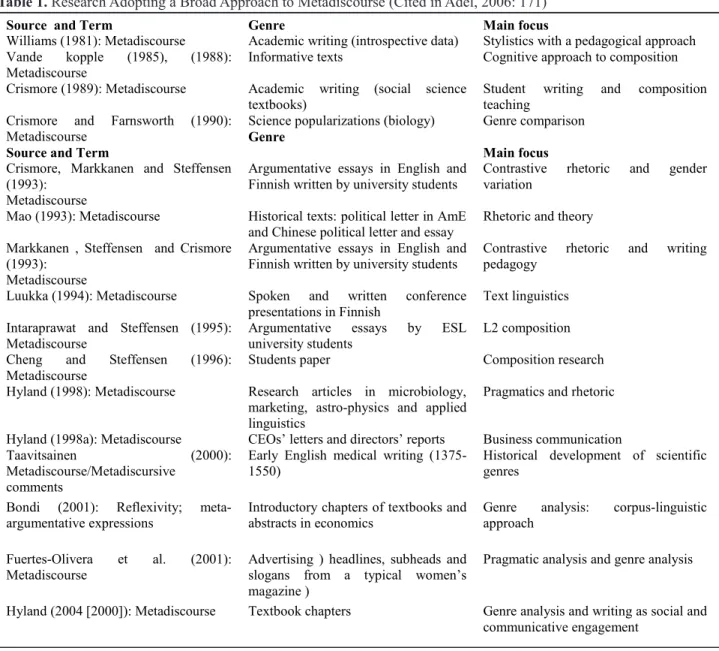
The notion of metadiscourse has been tackled by many researchers. However, the approach to handling metadis-course in these studies differs. Mauranen (1993) identifies two approaches to metadiscourse, namely, the ‘integrative approach’ and the ‘non- integrative approach’. Using these terms, previous studies about metadiscourse can be divided into two groups. The first group involves studies that fol-lowed the integrative approach, whereas the second involves studies that followed the non- integrative approach. Studies that employed the integrative approach, or as Adel 2006 calls the ‘broad approach’, are listed in Table 1 below (as cited in Adel, 2006: 171). In this approach to metadiscourse, the emphasis is on the relationship between the addresser and the addressee rather than on the text itself.
On the other hand, in the non- integrative approach to metadiscourse, or as Adel (2006) calls the ‘narrow ap-proach’, the emphasis is on the text itself. Thus, the main concern of this approach is the writer/speaker and not the relationship between the addresser and the addressee.
Studies that employed the narrow approach to meta-discourse are listed in Table 2 below (as cited in Adel, 2006: 178).
Previous Studies
Mostafavi and tajalli’s (2012) study
In this study, the two researchers analyzed literary and med-ical texts to investigate whether there are any significant dif-ferences between those types of texts as far as the frequency and type of metadiscourse markers are concerned. The re-searches selected 30 literary and medical journal articles and analyzed 90 paragraphs, 45 from each type. The model used for analyzing the data was Vande Kopple’s (1985) taxono-my. The analysis yielded that literary and medical texts differ significantly in the amount and type of metadiscourse mark-ers with literary texts using those markmark-ers more frequently than medical ones. In addition, the study proved that, in both types of texts, the textual functions of metadiscourse were more frequent than the interpersonal ones.
Sadeghi and esmaili’s (2012) study
Table 1. Research Adopting a Broad Approach to Metadiscourse (Cited in Adel, 2006: 171)
Source and Term Genre Main focus
Williams (1981): Metadiscourse Academic writing (introspective data) Stylistics with a pedagogical approach Vande kopple (1985), (1988):
Metadiscourse Informative texts Cognitive approach to composition Crismore (1989): Metadiscourse Academic writing (social science
textbooks) Student writing and composition teaching Crismore and Farnsworth (1990):
Metadiscourse
Source and Term
Science popularizations (biology)
Genre Genre comparison
Main focus
Crismore, Markkanen and Steffensen (1993):
Metadiscourse
Argumentative essays in English and
Finnish written by university students Contrastive rhetoric and gender variation
Mao (1993): Metadiscourse Historical texts: political letter in AmE
and Chinese political letter and essay Rhetoric and theory Markkanen , Steffensen and Crismore
(1993): Metadiscourse
Argumentative essays in English and
Finnish written by university students Contrastive rhetoric and writing pedagogy
Luukka (1994): Metadiscourse Spoken and written conference
presentations in Finnish Text linguistics Intaraprawat and Steffensen (1995):
Metadiscourse Argumentative essays by ESL university students L2 composition Cheng and Steffensen (1996):
Metadiscourse Students paper Composition research
Hyland (1998): Metadiscourse Research articles in microbiology, marketing, astro-physics and applied linguistics
Pragmatics and rhetoric
Hyland (1998a): Metadiscourse CEOs’ letters and directors’ reports Business communication Taavitsainen (2000):
Metadiscourse/Metadiscursive comments
Early English medical writing
(1375-1550) Historical development of scientific genres
Bondi (2001): Reflexivity;
meta-argumentative expressions Introductory chapters of textbooks and abstracts in economics Genre analysis: corpus-linguistic approach
Fuertes-Olivera et al. (2001):
Metadiscourse Advertising ) headlines, subheads and slogans from a typical women’s magazine )
Pragmatic analysis and genre analysis
Hyland (2004 [2000]): Metadiscourse Textbook chapters Genre analysis and writing as social and communicative engagement
difference between the original and the simplified novels as far as the frequency of metadiscourse resources is concerned implying that writers of both texts, the original and the sim-plified, did their best to present coherent texts.
Ahangari and kazemi’s (2014) study
In this study, the two researchers investigated the use of metadiscourse elements in the novel ‘Alice in Wonderland’ to check how Lewis Carroll made use of Hyland’s (2005) metadiscourse markers to produce a persuasive and impres-sive story. The analysis revealed that there were no mean-ingful differences between the frequencies of interactive and interactional metadiscourse markers. However, the study proved to have pedagogical implications for teaching En-glish literature. It was found out that all types of metadis-course items are used more frequently in literary texts than in other genres (Ahangari and Kazemi, 2014: 17).
PERSUASION
Although Miller (1980 as cited in Halmari and Virtanen, 2005:3) believes that all language use can be considered as persuasive, Halmari and Virtanen (2005:3) restrict the mean-ing of persuasion to “all lmean-inguistic behavior that attempts to either change the thinking or behavior of an audience, or to
strengthen its beliefs, should the audience already agree”. The two authors believe that the audience whether being visible or invisible, actual or implied interlocutors or on-lookers play an important role in the process of persuasion. They adopt the view that this process of persuasion is influ-enced by the situational and sociocultural context in which it occurs and which it helps to formulate in important ways (2005: 3-4).
Halamari and Virtanen (2005: 4) argue that although genres appear, continue, change and fade through time, since they are connected with time and culture (Swales, 1990: 34- 37 as cited in Halamari and Virtanen, 2005), the study of persuasion will always be meaningful, because it is a basic part of human interaction, and that learning more about persuasion means learning more about human nature.
Persuasion and genre are related to each other through their communicative purpose in that “genres can be more or less persuasive; persuasion, a communicative purpose, finds its realization through various genres”, (Halamari and Vir-tanen, 2005: 11).
Persuasion through Fictional Narratives
Persuasion through fiction is achieved through the inclusion of fact- related information in fictional narratives. Such in-formation may result in changing the readers’ real- world beliefs significantly. According to the models of persuasion through fiction, (e.g. Gerrig, 1993; Green and Borck, 2000 as cited in Appel and Richter, 2007) these effects are the result of the readers being psychologically transported into the world of fictional narrative (Appel and Richter, 2007: 2). Such models also suggest that the persuasive effects of fic-tional narratives are constant and tend to increase over time.
Thus, persuasion through fictional narratives may have a sleeper effect (Hovland, Lumsdaine and Sheffield, 1949 as cited in Appel and Richter, 2007).
In literature, there is a distinction between fictional and non-fictional texts. Fictional texts are not supposed to con-tain information about the real world. However, they pro-vide readers with information that could be applied to the real world (cf. Eco, 1994 as cited in Appel and Richter, 2007: 113). A number of studies were able to prove that the fictional narrative does have short- term persuasive effects (see Green, Garst and Brock, 2004 as cited in Appel and Richter, 2007: 114). In their study, Appel and Richter inves-tigated whether or not fictional narratives have long- term effects through altering the readers’ beliefs in the long- term. The two authors believe that if the sleeper effect is proved by experiments, this would make the fictional narrative as an effective means of changing our view of the world, and it will prove that the fictional narrative has a more persuasive effect than the non- fictional narrative which proved to have short- lived persuasive effect that decrease quickly by time (see Cook and Flay, 1978; Pratkanis, Greenwald, Leippe and Baumgardner, 1988 as cited in Appel and Richter, 2007).
In their nature, fictional narratives are different from po-litical speeches, advertisements and editorials which contin-ued to be and are still the focus of persuasion research. In them, persuasion is achieved through the use of arguments that are used to persuade the recipient that the factual claims are true, or that the political and ethical claims are appropri-ate. Fictional narratives, on the other hand, are stories about imaginary characters in an imaginary world. They do not contain arguments and are usually written for the purpose of entertainment rather than persuasion (cf. Bryant and Miron, 2002 as cited in Appel and Richter, 2007: 116). Fictional narrative usually contain a plot and a number of elements (e.g. setting, event, attempt, reaction and consequence, cf. Rumelhart, 1975 as cited in Appel and Richter, 2007).
It is argued by some researchers (Gerrig and Prentice, 1991; Prentice et al., 1997 as cited in Appel and Richter, 2007: 117) that fictional narratives may have a strong influ-ence on the readers’ beliefs, and that this influinflu-ence is the re-sult of some kinds of processes which characterize this type of genre (cf. Green, 2004; Green and Brock, 2000; Slater and Rouner 2002 as cited in Appel and Richter, 2007).
2004; Green and Brock, 2000 as cited in Appel and Richter, 2007: 117).
Thus, it is clear from the above discussion that persua-sion in fictional narratives is achieved through what is called transformation. In other words, fictional narratives may have strong as well as continuous persuasive effects and that these effects increase overtime leading to an absolute sleeper effect (Hovland et al., 1949 as cited in Appel and Richter, 2007).
The important question concerning persuasion in fiction-al narratives has to do with whether the influence of fiction on the recipients’ beliefs continues and increase overtime or it declines with time. Well- known models of persuasion, namely, the Elaboration Likelihood Model (ELM, Petty and Cacioppo, 1986; Petty and Wegener, 1999 as cited in Appel and Richter, 2007: 115) and the Heuristic- Systematic Mod-el (HSM), Chaiken, Liberman and Eagly, 1989; Chen and Chaiken, 1999 as cited in Appel and Richter, 2007) suggest that the effect of persuasion through fiction tends to decrease overtime. Those models are based on the idea that for the effect of the persuasive message to continue, it has to be pro-cessed in an elaborative or systematic way, and that when the recipient thinks about the content of the message, this will help him/her to form other more beliefs which will function later to support the new beliefs acquired from the message.
The results of Appel and Richter’s study proved that readers of fictional narratives are mentally transported into the fictional world of the narrative. Thus, their results are not in line with the ELM and HSM models of persuasion. It was proved that persuasion through narratives depends on processes other than those involved in persuasion through rhetoric texts.
The Appeals of Persuasion
The success or failure of persuasion, according to Aristot-le (as cited in Garsten, 2006: 131, and in Larson, 2010: 20) depends on, three types of artistic and inartistic proof. The three appeals of persuasion are the rational (logos), the affec-tive (pathos) and the credible (ethos). Persuaders make use of logical or rational appeals (logos). In this respect, listen-ers would come to believe something, because they followed and accepted an argument. Persuaders also use emotional appeals (pathos), and in this sense, listeners would come to believe something, because they were moved by an emotion. In addition, persuasion depends on the speaker’s credibility (ethos). In this sense, listeners would come to believe some-thing, because they trusted the judgement and goodwill of the speaker (Larson, 2010: 20).
Writers or speakers use various strategies and language devices to persuade their readers. One of those strategies is metadiscourse. According to Hyland (2005: 63), metadis-course is a rhetorical strategy through which persuasion can be achieved. He (2005: 63) believes that “metadiscourse con-tributes to the rational, credible and affective appeals which have characterized persuasive discourse since the time of an-cient Greece”. When investigating the metadiscourse mark-ers found in the genre of company annual reports, Hyland (2005) identified transition, frame markers, endophoric markers and code glosses as the metadiscourse markers of
the rational appeal, engagement markers, attitude markers, hedges and pronoun references as the metadiscourse mark-ers of the affective appeal and hedges, boostmark-ers, engagement markers and evidentials as the metadiscourse markers of the credibility appeal.
METHODOLOGY Model of Analysis
Metadiscourse markers have been classified differently by many researchers such as Meyer (1975 as cited in Cris-more, 1983: 9-10), Williams (1981 as cited in CrisCris-more, 1983: 7-8), Williams (1982 as cited in Crismore, 1983: 10-11), Crismore (1983), Vande Kopple (1985), Crismore et al. (1993) and Hyland (2005).
The present research follows the integrative approach to metadiscourse. This is so, since this approach does not only focus on the text organization, but rather takes into consid-eration the relationship between speaker/writer and listener/ reader. According to this approach, texts indicate the com-municative interaction between speakers/writers and listen-ers/readers. Usually, people, through their speech or writing, want to negotiate some scenarios, and want to influence their listeners or readers. These matters fall within the scope of this study which aims at investigating the persuasive role of metadiscourse markers in fictional narratives.
Thus, the present research will follow Hyland’s (2005) model of metadiscourse, since it is the most comprehensive model, and since it considers metadiscourse as interpersonal rather than separating the textual and the interpersonal func-tions as is the case in much of the metadiscourse literature. This model also takes into consideration the addressors’ knowledge, experiences and needs revealing an addressor’s understanding of an audience and their expectations. The model is based on the notion of interaction which is based on the link between text and context. Texts usually involve interactions between the addressor and the addressees. The text is viewed as an engagement that is both social and com-municative. It provides us with a way of understanding how we present ourselves in a text to succeed in accomplishing our intensions (Hyland, 2005: 14).
Hyland’s (2005) Classification
writ-er’s personality or ‘voice’. The addressers involve the ad-dressees in the text through their arguments, they influence them, direct their attention at something and lead them to interpretations (Hyland, 2005: 52). Since they involve the addressees in the argument, these markers are considered as evaluative and engaging (2005: 54). Interactional markers include ‘hedges’, ‘boosters’, ‘engagement markers’, ‘atti-tude markers’ and ‘self- mention’.
The following Table 3 shows Hyland’s (2005) model of Metadiscourse:
Data Analysis
Materials
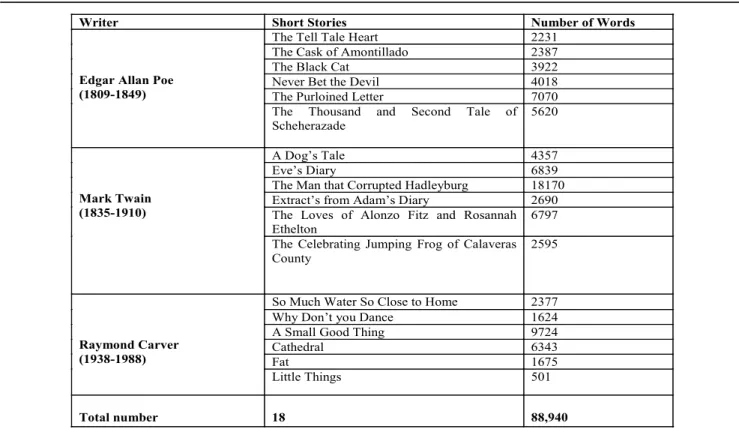
The data for this research consists of 18 short stories written by three famous and influential American short story writers who belong to successive periods of time extending from 1809 till 1988, namely, Edgar Allan Poe (1809-1849), Mark Twain (1835-1910) and Raymond Carver (1938-1988). For each writer, six short stories of different lengths were ana-lyzed. The length of the analyzed stories ranges from 501 words to 18,170 as shown in Table 4 below:
Table 3. Hyland’s (2005) Classification of MDMs
Category Function Examples
Interactive Assists in guiding the reader
through the text Resources
Transitional Indicates relations between main
clauses In addition, but, thus
Frame markers Discourse acts, stages and sequences Finally, my purpose Endophoric markers Indicates information in other part of
the text As noted above,
Evidentials Indicates information in other
sources Crawford states
Code glosses Elaborates definitions of words and
phrases Namely, such as, e.g.
Interactional Involves the reader in the text Resources
Hedges Withhold commitment and open
dialogue Might, perhaps, possible
Boosters Indicates certainty or close dialogues In fact, definitely Attitude markers Express writer’s attitude to
proposition Arguably, unfortunately
Self-mentions Explicit reference to the author I, we, my, me, our Engagement markers Explicitly builds relationships with
reader You can see that, note,
Table 4. Description of the Analyzed Data
Number of Words Short Stories
Writer
2231 The Tell Tale Heart
Edgar Allan Poe (1809-1849)
2387 The Cask of Amontillado
3922 The Black Cat
4018 Never Bet the Devil
7070 The Purloined Letter
5620 The Thousand and Second Tale of Scheherazade
4357 A Dog’s Tale
Mark Twain (1835-1910)
6839 Eve’s Diary
18170 The Man that Corrupted Hadleyburg
2690 Extract’s from Adam’s Diary
6797 The Loves of Alonzo Fitz and Rosannah Ethelton
2595 The Celebrating Jumping Frog of Calaveras County
2377 So Much Water So Close to Home
Raymond Carver (1938-1988)
1624 Why Don’t you Dance
9724 A Small Good Thing
6343 Cathedral
1675 Fat
501 Little Things
88,940 18
The choice of these short stories is based on a number of criteria the first of which is that they are written by three of the most famous short story writers, the second is that these texts are among the most popular ones, and the third is that they are available online.
Procedures of data analysis
This study aims at identifying the metadiscourse markers used in short stories as a type of literary genre. To achieve this, the data was analyzed using Hyland’s (2005) taxonomy to identify the frequency and type of metadiscourse mark-ers to give an overview of the situation of those markmark-ers in the literary genre of short stories. The distribution of each category in the corpus will be presented, and their commu-nicative functions will be discussed. To achieve the aim of the study, the whole eighteen texts will be considered as con-stituting the corpus of the study which consists of 88,940 words.
RESULTS AND DISCUSSION
The Overall Frequency of Metadiscourse Markers As was mentioned earlier, the total number of texts analyzed is eighteen short stories written by three of the most well-known American short story writers (cf. Table 4 above).
The analysis revealed that the total number of metadis-course markers in the corpus is 6,749 as shown in Table 5 below:
The above Table provides the answers to questions No. 1 and No. 2 of the research concerning the types of metadis-course markers used in the corpus and their frequency. As is clear from the table, in the corpus of 88, 940 words the total number of metadiscourse markers is 6,749. This indicates that the percentage of metadiscourse markers in the corpus is 7.5% which means that for every 100 words in the corpus, 7 words are used with a metadiscursive function and for ev-ery 1000 words, 75 words are used metadiscoursally.
As far as the distribution of interactive and interaction-al metadiscourse markers across the aninteraction-alyzed texts is con-cerned, it was found out that the interactional markers are used a little more than the interactive ones with 3,463 in-stances (51.32%) and 3,286 inin-stances (48.68%) respectively. To find out an answer to question No. 4 of the research which is about how the results of the present study are related to those of other studies which involved literary and other texts, an investigation has been carried out of such studies. This investigation revealed that previous research on meta-discourse markers proved that in written meta-discourses, writers rely more on interactive metadiscourse markers (cf. Hyland and Tse, 2004 and Khedri, 2014), whereas in spoken
dis-courses, speakers rely more on interactional metadiscouse markers (cf. Rui and Xin, 2009; Cavalieri, 2011; Adel, 2012; Yipei and Lingling, 2013; Malmstrom, 2014; Lee and Sub-tirelu, 2015; Mahmood and Kasim, 2019). When the results of this study are compared to those of previous research, we find that they are a little bit different although the difference is not that significant. Although this study involved analyzing written texts, the frequency and percentage of interactional markers identified are a little higher than those of the inter-active markers. This is due to the difference in the type of texts and genre (cf. Adel, 2012: 93). In the previous research which involved written texts, the texts analyzed were aca-demic texts which are different from literary texts. Hyland and Tse’s (2004) study investigated metadiscourse markers in postgraduate dissertations and Khedri’s (2014) study in-volved the analysis of experimental research articles. Literary texts are different from academic texts in that in literary texts not all of the interactive metadiscourse markers are used. For example, Evidentials and Endophoric Markers which are two of the interactive markers are characteristics of academic dis-course. To cite an example, in Hyland and Tse’s (2004) study, out of the 239.8 instances of interactive markers 64.1 were instances of Evidentials and 23.4 instances were Endophoric Markers. It is worth mentioning that in the present study, 0 instances of these two markers were identified in the corpus and this justifies why the frequency of interactive markers is less than the frequency of interactional markers (cf. Inter-active Markers below). This justifies why the results of this study which involved written texts are a little bit different from those of other studies which also involved written texts as far as the distribution of interactive and interactional mark-ers is concerned. The reason behind this is that the types of written texts involved are different and thus, the frequency of markers relied upon by writers are different. This fact is supported by the results of Yazdani and Salehi (2016) study which involved investigating the use of metadiscourse mark-ers in English and Pmark-ersian online headlines. It was found out that interactional markers are used more frequently than in-teractive ones due to the same reason mentioned above.
It is worth mentioning that when the results of this study are compared to previous research which tackled literary dis-course, they are similar in one way or another. Three studies analyzed literary discourse, the first of which is that of Mo-stafavi and Tajalli (2012) which analyzed metadiscoursal markers in medical and literary texts by using Vande Kopple’s taxonomy (1985). The second is that of Sadeghi and Esmaili (2012) which analyzed two novels “Whuthering Heights” and “ Tess of the D’Urberbilles” in their original forms and their simplified versions by using Hyland and Tse’s (2004) model to see whether there are significant differences between the orig-inal novels and their simplified versions concerning the use of
Table 5. Frequency and Percentage of Metadiscourse Markers in the Corpus
Percentage Frequency
Type of Markers
48.68% 3,286
Interactive Markers
51.32% 3,463
Interactional Markers
100% 6,749
metadiscourse resources. In the first study, it was found out that there was a significant difference in the amount and type of metadiscoursal markers in medical and literary texts, and that in both types of texts the textual functions of metadiscourse were more frequent than the interpersonal ones. In the second, it was found out that there was no significant difference con-cerning the use of metadiscourse markers in the original and simplified versions of the novels analyzed. In these two stud-ies, although the models used to analyze the data are different from the one used in the current study which makes it difficult to compare their results with those of the current one, their re-sults are similar to those of the present study in that metadis-course markers are employed frequently by writers of literary texts. One point of difference between Mostafavi and Tajalli (2012)’s study and the present study is that, in their study tex-tual metadiscourse functions were used more frequently than the interpersonal ones, whereas in the present study interac-tional metadiscourse markers were used a little more than the interactive ones. This difference could be attributed to the dif-ference in the models used for analysis in the two studies. The only study that involved analyzing a literary text, namely, the novel “Alice in Wonderland” using the same model used in the current study which is that of Hyland (2005) is Ahangari and Kazemi’s (2014) study. According to this study, the fre-quency mean for interactive metadiscourse is 407.75 and that for interactional metadiscourse is 579.25 which means that the writer relies more on interactional metadiscourse markers than on interactive metadiscourse markers. The researchers applied the T-test on the means of metadiscourse markers identified, and the results proved that there was no meaningful differences between those two types of markers. It is interesting to note that these results are similar to those identified in the current research in that here also interactional markers are employed more than interactive markers and that the difference between them is not that important. Thus, this indicates that short story writers manage to make their stories persuasive through the use of metadiscourse markers and that short stories as literary texts are persuasive due to linguistic factors (metadiscourse mark-ers) and not only non-linguistic factors (transportation). This provides an answer to question No. 3 of the research which deals with the way by which short story writers manage to make their stories persuasive.
Interactive Markers
As was mentioned earlier and displayed in Table 5 above, the number of instances of interactive markers is 3,286. This number is divided unevenly among three of the interactive markers, namely, Transitions, Frame Markers and Code Glosses as shown in Table 6 below:
It is evident from the Table above that the most frequent-ly used marker of the interactive ones is Transitions which occurred 2,985 times in the corpus forming 88.10% of the total number of interactive markers. It is worth mention-ing that in almost all the metadiscourse studies whether in-volving spoken or written texts, Transitions is the highest in terms of occurrence among the other interactive markers. This also applies to the studies which analyzed literary texts, namely, those of Ahangari and Kazemi (2014) and Mosta-favi and Tajalli (2012). This could be due to the fact that by relying heavily on Transitions, writers of literary texts want their texts to be cohesive and their readers to understand the links between ideas. Also, through the use of transitions which perform the function of connecting steps in an argu-ment, writers of short stories manage to persuade their read-ers through the rational appeal (logos).
Transition markers are divided into Addition, Compar-ison and Consequence in terms of function. The most fre-quently used subcategory of Transition Markers is that of Addition realized mostly through the use of “and”. The sec-ond subcategory in terms of frequency is that of Comparison realized mainly through the use of “but”, and the least sub-category is that of Consequence realized through the use of “thus”.
The following are examples of Transitions used in the data:
1. I close my eyes and hold on to the sink.
2. I at once offered to purchase it of the landlord; but this person made no claim to it.
3. By experiment I know that wood swims, and dry leaves, and feathers, and plenty of other things; therefore by all that cumulative evidence you know that a rock will swim;…
The second most frequently used marker of the interac-tive ones as Table 6 above shows is Frame Markers. Those markers occur 381 times in the corpus forming 11.60% of the total use of interactive markers. The function of those markers is to sequence arguments in the text, but not events in time. This is why they are used by the short story writers, since they contribute to making the discourse clear to readers and to persuade readers through the rational appeal (logos). The Frame Marker “then” is the most frequently used one among the other markers followed by “first”. Other Frame Markers that appeared in the corpus are: “next”, “now” and “finally”.
The following are examples from the data:
1. First I drew a box that looked like a hose. It could have been the house I lived in…
2. Finally, I hit upon what I considered a far better expedi-ent than either of these.
Table 6. The Frequency and Percentage of Interactive Markers
Percentage of Markers Number of Markers
Types of Markers
88.10% 2,895
Transitions
11.60% 381
Frame Markers
0.30% 10
Code Glosses
0% 0
Endophoric Markers
0% 0
Evidentials
100% 3,286
3. Upon the whole I made sure that he would clear it. And
then what if he did not?
4. And now was I indeed wretched beyond the wretched-ness of mere Humanity.
The least frequently used interactive marker is Code Glosses. They occurred as is shown in Table 6 above only 10 times in the data forming 0.30% of the total use of inter-active markers. They function to make the reader understand the writer’s intended meaning through providing additional information by means of explanation, elaboration and re-phrasing. In addition, through their use, writers manage to persuade their readers by means of the rational appeal (lo-gos) through which readers are made to believe something by following and accepting an argument. “For example” is the highest in terms of occurrence in the corpus followed by “in other words”, and finally comes “namely”.
The following are examples from the data:
1. A single grain of gimlet-dust, for example, would have been obvious as an apple.
2. For example, an errant simpleton is his opponent, and holding up his closed hand…
3. You will now understand what I meant in suggesting that, had the purloined letter been hidden anywhere within the limits of the Perfect’s examination- in other words, had the principle of its concealment been comprehend-ed with the principles of the Perfect-its discovery would have been a matter altogether beyond question.
It is worth mentioning that no instances of Endophoric Markers and Evidentials were identified in the corpus. The function of Endophoric Markers is to refer to previous or subsequent parts of the text with the aim of supporting the reader’s comprehension of a text, whereas the function of Ev-identials is to cite ideas from another source which could be a reference to a reliable source in some genres. In academic writing, they function to support arguments through reference to a related literature (Hyland, 2005). Thus, it is obvious that Endophoric Markers and Evidentials are mainly characteris-tics of academic discourse and other types of genres. How-ever, this does not mean that they do not function in literary genre. For example, in Ahangari and Kazemi’s (2014) study which involved analyzing a novel only two instances of En-dophoric Markers were identified and there were no instances of Evidentials. Thus, they do sometimes exist in literary texts, but in a very limited way as is the case in novels.
Interactional Markers
As was mentioned earlier and displayed in Table 5, inter-actional markers were used 3,463 times in the data forming
51.32% of the total number of metadiscourse markers. As shown in Table 7 below, Self-mention is the most frequent-ly used interactional marker with 2,176 instances forming 63% of the total number of those markers achieved main-ly through the use of (I, me, we and mine). Self-mention indicates the presence of the authors in their texts through the use of first person pronouns and possessive adjectives to express their attitudes towards their arguments, community and readers (Hyland, 2005).Through this, writers manage to create persuasion in their texts by stimulating an ethos. In this sense, persuasion is achieved through the writer’s cred-ibility and readers are convinced in something, since they trust the writer’s judgement and goodwill. Writers of short stories either tell the story themselves or through one of the characters in the story which is usually the main character. Thus, the writer expresses his attitude towards somebody or something either directly being the storyteller or indirectly through one of the characters.
The following are examples from the data:
1. My husband eats with a good appetite. But I don’t think he’s really hungry.
2. We were five miles from the car.
3. We continued our route in search of the Amontillado. The second most frequently used interactional marker is Hedges. The total number of Hedges instances in the data as the above table shows is 907 forming 26% of the total use of interactional markers. Writers employ expressions such as the modals (may/might, can/could and would) to express opinions rather than facts and indicate that a statement is based on their reasoning and not on a certain knowledge. In addition to the modals, Epistemic verbs such as (seem and suppose) and Epistemic adverbs such as (probably and whatever) also appeared in the corpus. The use of Hedges can achieve persuasive purposes, since, through their use, writers are trying to influence their readers to convince them to adopt their points of view or opinions or the way they think or behave (cf. Halmari and Vritanen, 2005).
The following are examples from the data:
1. He was gone to Brixton, and might not return before morning.
2. Perhaps you will be good enough to explain to the house why you rise.
3. “Luchresi cannot tell Amontillado from Sherry.” The third interactional marker in terms of frequency, as shown in Table 7 above, is Boosters. They occur 206 times in the corpus forming 6% of the total number of interactional markers. Boosters are used by writers in order to reflect their certainty about what they say and they, together with Hedg-es, indicate the writers’ commitment to their texts and their
Table 7. The Frequency and Percentage of Interactional Markers
Percentage of Markers Number of Markers
Types of Markers
26% 907
Hedges
6% 206
Boosters
0.09% 3
Attitude Markers
4.9% 171
Engagement Markers
63% 2,176
Self-mention
100% 3,463
respect to their readers. Instances of (clearly, demonstrate, believe and find) have been identified in the corpus in ad-dition to many other expressions which indicate certainty. Boosters like Hedges are used by writers in order to achieve persuasive purposes through using assured declarations. In this case, persuasion is achieved through the credibility ap-peal (ethos).
The following are examples from the data:
1. I can only demonstrate that one or the other is a fake, and let a person take his choice.
2. “It is clearly inferred,” replied the Perfect.
3. These orders were sufficient, I well knew, to ensure their immediate disappearance, one and all, as soon as my back was turned.
Engagement Markers occurred 171 times in the corpus forming 4.9% of the total number of interactional markers. Writers use those markers for the purpose of engaging their readers in the text through talking to them explicitly by the use of pronouns such as (you, we, our, remember, etc.), questions and directives. The most frequently used of the Engagement Markers in the data are directives, namely, ob-ligation modals (should, must and have to).
The following are examples from the data: 1. If he were plain, I should love him. 2. “Please,” I say, “I have to go.”
3. “I- - I don’t think It would have done for you to - - to - - One mustn’t - - er - - public opinion - - one has to be so careful - - so”
Attitude Markers are the least in terms of frequency in that, as Table 7 above shows, they appeared only three times in the corpus forming 0.09% of the total number of interac-tional markers. Through the use of those markers, writers express surprise, importance, agreement, obligation, etc. rather than being concerned with whether the information is reliable, true or related. They can manage to persuade their readers by the use of those markers through influencing the readers’ emotions by means of the emotional appeal (pa-thos).They are realized by attitude verbs (prefer), sentence adverbs (unfortunately) and adjectives (zero instances).
The following are examples from the data:
1. If you prefer to conduct the inquiry privately, do so. 2. “But if you prefer a public inquiry, then publish this
present writing in the local paper…”
3. These fellows are unfortunately a hidden meaning in the Antediluvians.
CONCLUSION
The present study aimed at investigating the frequency and distribution of metadiscourse markers in short stories as a kind of literary genre. Specifically, it aimed at identifying the fre-quency of each type of markers, discovering how short story writers manage to make their stories persuasive and relating its result to those of other studies which involve literary and oth-er texts. Results of the analysis revealed that writoth-ers of short stories use such markers in their stories to produce cohesive and coherent texts. In addition, they employ these markers to make their stories persuasive, since metadiscourse markers form one of the strategies to produce persuasive discourse.
The slight difference in the frequency and percentage of the two types of metadiscourse markers, namely, the inter-active and the interactional indicates that they are almost of equal importance in literary texts, and that this little differ-ence is due to the type of text and genre. In addition, the difference in the distribution of the interactive and interac-tional markers in this study which involved literary texts when compared to previous studies which involved academ-ic texts is due to the same reason mentioned above, since some of the interactive markers are more characteristics of academic rather than literary texts. On the other hand, the fact that the results of this study agree with those of previ-ous studies that analyzed literary texts indicates that meta-discourse markers occur frequently in literary texts, and that both of the interactive and interactional markers play an im-portant role in such texts.
Short story writers use interactive markers to produce coherent texts and to let their readers understand their in-tended meaning. They also manage, through the use of those markers, to persuade their readers through utilizing rational appeals (logos).
On the other hand, interactional markers are used by short story writers to express their attitudes, opinions and commit-ment to their texts. Also, they use them for the purpose of engaging their readers in the text. The ultimate goal behind this is to make their texts persuasive, and consequently to persuade their readers of their opinions and attitudes through the use of the credibility appeal (ethos) and the affective ap-peal (pathos).
The most important conclusion in this study is that per-suasion in short stories is achieved through the use of meta-discourse markers which constitute one of the strategies used by persuaders to persuade their audience. This finding is very interesting, since previous studies about persuasion in fictional narratives attributed the persuasion effects of such texts to non- linguistic factors such as transportation, because, according to those studies, fictional narratives are different in their nature from political speeches, editorials and advertisements in which persuasion is achieved through the use of arguments (cf. Persuasion through Fictional Nar-ratives above). Consequently, those studies proved that per-suasion through narratives depends on processes other than those involved in persuasion through rhetoric texts.
However, throughout the results of the present study, one can conclude that persuasion in fictional narratives is attributed not only to non-linguistic factors such as transpor-tation, but also to linguistic ones, namely, the use of metadis-course markers by short stories writers.
REFERENCES
Ädel, A. (2006). Metadiscourse in L1 and L2 English. Am-sterdam: John Benjamins Publishing Co.
Ädel, A. (2012). “What I want you to Remember…”: Au-dience Orientation in Monologic Academic Discourse. English Text Construction. 5(1). 101-127.
English Literature. 3(3). 10-18. https://doi.org/10.7575/ aiac.ijalel.v.3n.3p.10
Appel, M. & Richter, T. (2007). Persuasive Effects of Fic-tional Narratives Increase Over Time. Media Psycholo-gy. 10(1). 113-134.
Backlund, I. (1998). Metatext in Professional Writing: A Contrastive Study of English, German and Swedish.
Texts in European Writing Communities 3. Uppsala: Uppsala Universitet.
Bondi, M. (2001). Small corpora and language variation: Reflexivity across genres. In M. Ghadessy, A. Henry, & R. L. Roseberry (Eds.), Small corpus studies and ELT. Studies in corpus linguistics 5. Amsterdam & Philadel-phia: John Benjamins Publishing Co.
Bryant, J., & Miron, D. (2002). Entertainment as media ef-fect. In J. Bryant and D. Zillmann (Eds.), Media effects: advances in theory and research (pp. 437-461). Mah-wah, NJ: Erlbaum.
Bunton, D. (1999). The Use of Higher Level Metatext in PhD Theses. English for Specific Purposes. 18. 41–56. https://doi.org/10.1016/S0889-4906(98)00022-2
Cavalieri, S. (2011). The roll of metadiscourse in counsel’s questions. In L. Cheng (Ed.), Exploring classroom dis-course: The language of power and control (PP. 79-110). Routledge.
Chaiken, S., Liberman, A., & Eagly, A.H. (1989). Heu-ristic and systematic information processing within and beyond the persuasion context. In J.S. Uleman & J.A. Bargh, (Eds.), Unintended thought (pp. 212-252). New York: Guilford.
Chen, S., & Chaiken, S. (1999). The heuristic-systematic model in its broader context. In S. Chaiken & Y Trope (Eds.), Dual-process theories in social psychology (pp. 73-96). New York: Guilford.
Cheng, X. & Steffensen, M. S. (1996). Metadiscourse: A Technique for Improving Student Writing. Research in the Teaching of English. 30(2). 149-181.
Cook, T.D., & Flay, B.R. (1978). The persistence of ex-perimentally induced attitude change. In L. Berkowitz (Ed.), Advances in experimental social psychology 11 (pp. 1-57). New York: Academic Press.
Crismore, A. (1983). Metadiscourse: What it is and how it is used in school and non-school social science texts.
Illinois: the National Institute of Education
Crismore, A. (1989). Talking with readers: Metadiscourse as rhetorical act. New York: Peter Lang. https://books. google.com/books?id=BXsFAQAAIAAJ
Crismore, A., Markkanen, R. & Steffensen, M.S. (1993). Metadiscourse in Persuasive Writing: A Study of Texts Written by American and Finnish University Students. Written Communication. 10(1). 39-71. https://doi. org/10.1177/0741088393010001002
Dahl, T. (2004). Textual Metadiscourse in Research Ar-ticles: A Marker of National Culture or of Academic Discipline? Journal of Pragmatics. 36(10). 1807–1825. https://doi.org/10.1016/j.pragma.2004.05.004
Eco, U. (1994). Six walks in the fictional woods. Cambridge: Harvard University Press.
Fuertes-Olivera, P. A., Velasco-Sacristán, M., Arribas-Baño, A. & Samaniego-Fernández, E. (2001). Persuasion and Advertising English: Metadiscourse in Slogans and Headlines. Journal of Pragmatics. 33(8). 1291–1307. Gerrig, R.J. (1993). Experiencing narrative worlds: On the
psychological activities of reading. New Haven, CT: Yale University Press.
Gerrig, R.J. & Prentice, D.A. (1991). The Representation of Fictional Information. Psychological Science. 2(5). 336-340. https://doi.org/10.1111/j.1467-9280.1991. tb00162.x
Green, M.C, & Brock, T.C. (2000). The Role of Transporta-tion in the Persuasiveness of Public Narratives. Journal of Personality and Social Psychology. 79(5). 701-721 Green, M.C, Garst, J., & Brock, T.C. (2004). The power of
fiction: Determinants and Boundaries. In L.J. Shrum (Ed.) Blurring the lines: The psychology of entertain-ment media(pp. 161-176). Mahwah, NJ: Erlbaum. Harris, Z. S. (1959). The Transformational Model of
Lan-guage Structure. Anthropological Linguistics. 1(1). 27-29.
Hovland, C.I., Lumsdaine, A.A., & Sheffield, F.D. (1949). Experiments on mass communication. Princeton, NJ: Princeton University Press.
Hyland, K. (1998). Exploring Corporate Rhetoric: Meta-discourse in the CEO’s Letter. Journal of Busi-ness Communication. 35(2). 224–245. https://doi. org/10.1177/002194369803500203
Hyland, K. (2004). Disciplinary discourses: Social Inter-actions in academic writing.Ann Arbor, MI: Michigan University Press.
Hyland, K. (2005). Metadiscourse: Exploring interaction in writing. London: Continuum. https://books.google.com/ books?id=kyztT1czUfMC
Hyland, K. & Tse, p. (2004). Metadiscourse in Academic Writing: A reappraisal. Applied Linguistics. 25(2). 290-177. https://doi.org/10.1093/applin/25.2.156
Garsten, B. (2006). Saving persuasion: A defense of rhetoric and judgment. Cambridge: Harvard University Press. Intaraprawat, P. & Margaret S. (1995). The Use of
Meta-discourse in Good and Poor ESL Essays. Journal of Second Language Writing. 4(3). 253–272. https://doi. org/10.1016/1060-3743(95)90012-8
Khedri, Mohsen (2014). A Cross- Disciplinary Explanation of Metadiscourse in Experimental Research Articles. Unpub-lished PhD thesis, Universiti Putra Malaysia, Malaysia. Larson, C. (2010). Persuasion: reception and responsibility.
Belmont: Wadsworth, Cengage Learning.
Lee, J.J. & Subtirelu, N.C. (2015). Metadiscourse in the Classroom: A Comparative Analysis of EPA Lessons and University Lectures. English for Specific Purposes. 37 (1). 52-62. https://doi.org/10.1016/j.esp.2014.06.005 Luukka, M. (1994). Metadiscourse in academic texts. In
Mahmood, I. I., & Kasim, Z. M. (2019). Interpersonal Meta-discursive Features in Contemporary Islamic Friday Sermon. 3L: The Southeast Asian Journal of English Language Studies. 25(1): 85 – 99.
Malmstrom, H. (2014). Engaging the Congregation: The Place of Metadiscourse in Contemporary Preach-ing. Applied Linguistics. 37(4). 561-582. https://doi. org/10.1093/applin/amu052
Mao, L. M. (1993). I Conclude Not: Toward a Pragmatic Ac-count of Metadiscourse. Rhetoric Review. 11(2). 265-289. https://doi.org/10.1080/07350199309389006
Markkanen, R., M. Steffensen, & A. Crismore (1993). Quan-titative Contrastive Study of Metadiscourse: Problems in Design and Analysis of Data. Papers and Studies in Contrastive Linguistic. 28. 137–152.
Mauranen, A. (1993). Cultural differences in academic rhet-oric: A textlinguistic study. Frankfurt am Main: Peter Lang.
Mauranen, A. (1993a). Contrastive ESP Rhetoric: Metatext in Finnish-English Economics Texts. English for Specif-ic Purposes. 12(1). 3–22. https://doi.org/10.1016/0889-4906(93)90024-I
Meyer, B. J. F. (1975). The organization of prose and its ef-fects on memory. Amsterdam: North-Holland.
Miller, G. R. (1980). On being persuaded: Some basic dis-tinctions. In M. E. Roloff and G. R. Miller (Eds.), Per-suasion: new directions and theory and research (Sage annual reviews of communication research, 8, (PP. 11-28). Beverly Hills, CA: Sage.
Mostafavi, M. & Tajalli, G. (2012). Metadiscoursal Markers in Medical and Literary Texts. International Journal of English Linguistics. 2(3). 64.
Pasco, A. H. (1991). On Defining Short Stories. New Liter-ary History. 22(2). 407-422.
Petty, R.E. & Cacioppo, J.T. (1986). Communication and persuasion. Central and peripheral Routes to Attitude Change. New York: Springer.
Petty, R.E. & Wegener, D.T. (1999). The elaboration like-lihood model: Current status and controversies. In S. Chaiken & Y. Trope (Eds.), Dual-process theories in so-cial psychology (pp. 41-72). New York: Guilford.
Pratkanis, A.R., Greenwald, A.G., Leippe, M.R., & Baumgardner, M.H. (1988). In Search of Reliable Per-suasion Effects: III. The Sleeper Effect is Dead: Long Live the Sleeper Effect. Journal of Personality and So-cial Psychology. 54(2). 203-218.
Prentice, D.A., Gerrig, R.J., & Bailis, D.S. (1997). What Readers Bring to the Processing of Fictional Texts. Psy-chonomic Bulletin and Review. 4(3). 416-420. https:// doi.org/10.3758/BF03210803
Kong, R. and Xin, X. (2009). Empirical Study on Metadis-course in Chinese EFL Learner’s Oral Communication. CELEA Journal. 32(1). 52-64.
Rumelhart D.E. (1975). “Notes on a schema for stories.” In D.G. Bobrow & A. Collins (Eds.), Representation and understanding: Studies in cognitive science (pp. 211-236). New York: Academic Press.
Sadeghi, K. & Esmaili, S. (2012). Frequency of Textual Metadiscourse Resources (MTRs) in Two Original and Simplified Novels. Journal of Language Teaching and Research. 3(4). 647- 652.
Schiffrin, Deborah (1980). Metatalk: Organizational and Evaluative Brackets in Discourse”. Sociological Inqui-ry: Language and Social Interaction. 50(3-4). 199–236. https://doi.org/10.1111/j.1475-682X.1980.tb00021.x Slater, M. D., & Rouner, D. (2002).
Entertain-ment- Education and Elaboration- Likelihood: Un-derstanding the Processing of Narrative Persuasion. Communication Theory. 12(2). 173-191. https://doi. org/10.1111/j.1468-2885.2002.tb00265.x
Swales, J. (1990). Genre analysis: English in academic and research settings. Cambridge University Press.
Taavitsainen, I. (2000). Metadiscursive practices and the evolution of early English Medical Writing 1375– 1550.” In J. M. Kirk (Ed.), Corpora galore: Analyses and techniques in describing English(pp. 191–207). Papers from the nineteenth international conference on English language research on computerized corpora (ICAME 1998). Amsterdam and Atlanta: Rodopi.
Telenius, J. (1994). Guiding the reader: The use of metatext in master’s theses written in English. Helsinki: Helsinki School of Economics and Business Administration. Thompson, S. E. (2003). Text-Structuring Metadiscourse,
Intonation and the Signalling of Organisation in Ac-ademic Lectures”. Journal of English for AcAc-ademic Purposes. 2(1). 5–20. https://doi.org/10.1016/S1475-1585(02)00036-X
Valero-Garcés, C. (1996). Contrastive Rhetoric: Metatext in Spanish-English Economics Texts”. English for Spe-cific Purposes. 15(4). 279–294. https://doi.org/10.1016/ S0889-4906(96)00013-0
Vande Kopple, W. J. (1985). Some Exploratory Discourse on Metadiscourse. College Composition and Communica-tion. 36(1). 82-93.
Williams, J. (1981). Style: Ten lessons in clarity and grace. Glen-view, Ill.: Scott, Foresman & Company.
Williams, J. (1982). Personal Communication. In Crismore, Avon (1983) Metadiscourse: What It Is and How It Is Used in School and Non-School Social Science Texts. Illinois: the National Institute of Education
Williams, J. (2007). Style: Ten lessons in clarity and grace.
New York: Pearson-Longman.