ORIGINAL INVESTIGATION
Association between insulin receptor
substrate-1 polymorphisms and high platelet
reactivity with clopidogrel therapy in coronary
artery disease patients with type 2 diabetes
mellitus
Dingyu Zhang, Xiaolin Zhang, Dan Liu, Tengfei Liu, Wenzhi Cai, Chenghui Yan and Yaling Han
*Abstract
Background: The mechanisms leading to the high on-treatment platelet reactivity in diabetes patients are not fully elucidated. The genetic factors may be associated with the diminished antiplatelet efficacy of dual antiplatelet therapy. We investigated the possible association between insulin receptor substrate-1 (IRS-1) polymorphisms and high platelet reactivity in coronary artery disease (CAD) patients with type 2 diabetes mellitus (T2DM).
Methods: A total of 674 CAD patients with T2DM were enrolled in this study. Platelet aggregation and platelet activa-tion were assessed with light transmission aggregometry and flow cytometry analysis, respectively. Participants were divided into high platelet reactivity (HPR) group and non-HPR group according to their maximal platelet aggregation. Genotypes were identified by polymerase chain reaction and direct sequencing of genomic DNA. The association between IRS-1 genetic variants and platelet function was assessed.
Results: There were 233 participants in the HPR group and 441 participants in the non-HPR group. G allele frequen-cies of rs13431554 were 27.7 % for the HPR group and 18.6 % for the non-HPR group (p < 0.001). Adenosine diphos-phate and arachidonic acid induced platelet aggregation were significantly higher in G allele carriers compared with non-carriers (56.8 ± 16.2 vs 52.0 ± 17.9 %, p < 0.01, 28.9 ± 18.6 vs 25.2 ± 17.8 %, p < 0.01, respectively). We observed that P-selectin expression and PAC-1 binding were higher in G allele carriers compared with non-carriers (40.8 ± 12.4 vs 36.2 ± 13.8, p = 0.01; 43.7 ± 15.9 vs 38.7 ± 19.9, p = 0.03, respectively).
Conclusion: The G allele of rs13431554 in the IRS-1 gene was associated with a hyperreactive platelet phenotype in the CAD patients with T2DM.
Keywords: Insulin receptor substrate-1, Single nucleotide polymorphism, High platelet reactivity, Clopidogrel, Coronary artery disease, Type 2 diabetes mellitus
© 2016 Zhang et al. This article is distributed under the terms of the Creative Commons Attribution 4.0 International License (http://creativecommons.org/licenses/by/4.0/), which permits unrestricted use, distribution, and reproduction in any medium, provided you give appropriate credit to the original author(s) and the source, provide a link to the Creative Commons license, and indicate if changes were made. The Creative Commons Public Domain Dedication waiver (http://creativecommons.org/ publicdomain/zero/1.0/) applies to the data made available in this article, unless otherwise stated.
Background
Dual-antiplatelet therapy with aspirin and clopidogrel is the cornerstone of treatment for patients with cardiovas-cular disease [1]. Low response to antiplatelet therapy, characterized as high platelet reactivity (HPR), has been
recognized as correlating with adverse events after acute coronary syndromes and percutaneous coronary inter-vention [2, 3]. The increased prevalence of low platelet inhibition following clopidogrel treatment and twofold to fourfold increased risk of cardiovascular disease were found in diabetes mellitus (DM) patients compared with non-DM patients [4–9]. Furthermore, platelet dysfunc-tion in DM patients contributes to stent thrombosis and adverse events following percutaneous coronary
Open Access
*Correspondence: [email protected]
intervention [10]. The mechanisms leading to the HPR of DM patients are not fully elucidated. Marin F, et al. dem-onstrated that single nucleotide polymorphisms (SNPs) were able to explain the variability in antiplatelet agents inefficacy [11]. Whether this may explain the heterogene-ity of dual-antiplatelet therapy response in type 2 diabe-tes mellitus (T2DM) patients remains unexplored.
Several factors including up-regulation of platelet-sign-aling pathways have been involved in this interindividual response heterogeneity. Insulin inhibits platelet reactiv-ity in the healthy individuals but not T2DM patients [4, 12]. T2DM patients have a loss of responsiveness to insu-lin that leads to increased platelet reactivity and reduced response to antiplatelet agents [11]. The loss of insulin signaling to Ca2+ regulating mechanisms in DM plate-lets was accompanied by abnormal signaling initiated by insulin receptor substrate-1 (IRS-1). IRS-1, as a ligand of insulin receptor tyrosine kinase, is central to the insu-lin signal transduction pathway [13]. Studies by Ferreira et al. suggested that insulin may cause platelet inhibition by activating IRS-1, which initiates the association with the Giα subunit coupled to the P2Y12 receptor [4]. Angio-lillo et al. reported that the C allele of rs956115 in IRS-1 was associated with a hyperreactive platelet phenotype in Caucasian T2DM patients [14]. However, the associa-tions are not reproduced across other ethnic populaassocia-tions. Whether there is other SNP in IRS-1 related to HPR in coronary artery disease (CAD) and T2DM patients remains to be elucidated.
The aim of this study was to investigate the relation-ship between the IRS-1 polymorphism and hyperreactive platelet phenotype in CAD patients with T2DM.
Methods Study population
Patients with T2DM were eligible for the study if they were between 18 and 75 years, had undergone percuta-neous coronary interventions (PCI), and been receiving standard dual antiplatelet therapy with aspirin (100 mg/ day) and clopidogrel (75 mg/day) for at least 30 days. Patients treated with insulin and/or oral hypoglycemic medications for at least 1 month were enrolled. T2DM was defined according to the World Health Organiza-tion Report [15]. Exclusion criteria were as follows: a history of myocardial infarction fewer than 6 months prior to enrollment in the study; allergy/intolerance to aspirin or clopidogrel; impaired glucose tolerance or T2DM without pharmacological treatment, gestational diabetes, or transient hyperglycemia; use of oral antico-agulants, and antiplatelet agents other than aspirin and clopidogrel; recent treatment with a glycoprotein IIb/IIIa antagonist; using of proton pump inhibitors; end-stage renal or hepatic disease; treatment with fibrin-specific
fibrinolytic therapy <24 h or non-fibrin-specific fibrino-lytic therapy <48 h prior to randomization; presence of active internal bleeding or history of ischemic or hemor-rhagic stroke in 6 months; platelet count <100 × 109/L; hematocrit <25 %; creatinine levels >2.5 mg/dl; hepatic disease (hepatic enzymes twice the upper normal limit) Furthermore, to determine whether or not the findings were specific to patients with DM, a pharmacodynam-ics assessment was also extended to a cohort of CAD patients without DM. They also received standard dual antiplatelet therapy with aspirin and clopidogrel for at least 1 month after elective PCI with the stent implanta-tion (Addiimplanta-tional file 1: Figure S1).
This study confirmed to the ethical guidelines of the Helsinki declaration. The ethics approvals were obtained from Shenyang Northern Hospital ethics committee and all patients gave their informed written consents.
Genotyping and haplotype analyses
Genomic DNA samples were extracted from peripheral blood lymphocytes of patients using TIANamp Blood DNA kits (Tiangen Biotech CO., LTD. Beijing, China). DNA concentration and quality were assessed using absorbance spectrophotometry and agarose gel electro-phoresis, respectively. The selection of IRS-1 tag SNP was performed with GEVALT 2.0 software (GEnotype Visual-ization and Algorithmic Tool) [16, 17]. The SNP genotype data for China (CHB) population were downloaded from HapMap Project Browser, submitting a 100-kilobase pair region as a query, with a minor allele frequency cutoff of 0.05 and linkage disequilibrium (LD) measure r2 thresh-old of 0.8. LD blocks were determined according to the gerbil algorithm [16]. Haplotype frequency was deter-mined by means of the algorithms implemented in the GEVALT software, using 0.05 as the frequency thresh-old to define common haplotypes. The specific primers were designed by primer 5.0 software (see Additional file 1: Table S1). Genotypes were identified by polymerase chain reaction (PCR) and direct sequencing of genomic DNA.
Platelet function analysis
1 mmol/L AA was added, and aggregation was recorded for 10 min. Results were expressed as a percentage of maximal light transmission from platelet-poor plasma obtained from the same patient. The cutoff value of HPR was defined as the upper quartile of MPA.
Platelet activation was determined by assessing platelet surface expression of activated glycoprotein (GP) IIb/IIIa and P-selectin as previously described [21]. A four-color flow cytometry (FACSCalibur, Becton–Dickinson BD, USA) was used for the assessment. 50 μl whole blood was stimulated in vitro with 5 μmol/L ADP before staining. The GPIIb/IIIa activation and P-selectin expression were assessed using fluorescein isothiocyanate-conjugated PAC-1 (PAC1-FITC) and phycoerythrin-conjugated anti-CD62P (CD62P-PE, Becton–Dickinson BD, USA). Whole blood was stained with an antibody mixture con-taining PAC1-FITC, CD62P-PE and PerCP peridinin chlorophyll protein-conjugated anti-CD61 (CD61-PerCP, Becton–Dickinson BD, USA) monoclonal antibodies and incubated for 20 min in the dark at room temperature. After incubation, 300 μL of 0.5 % PBS-buffered para-formaldehyde was added for fixation. Samples were ana-lyzed within 2 h by flow cytometry. Platelet activation was expressed as the percentage of platelets positive for antibody binding.
Statistical analysis
Continuous variables were presented as mean ± stand-ard deviation. Categorical variables were presented as frequencies and percentages. They were used that Student’s t test for normally distributed variables and Mann–Whitney U test for non-normally distributed vari-ables. χ2 test or Fisher exact test was used for categorical variables, as appropriate. Differences in allele and geno-type frequencies between groups were analyzed using the χ2 test. P values were corrected for multiple comparisons for eight SNPs using the Bonferroni adjustment method, which changed the required significance level from <0.05 to <0.00625 (0.05 divided by eight). The χ2 test was used to determine whether individual polymorphisms were at Hardy–Weinberg equilibrium. Results with a two-tailed p value < 0.05 was considered statistically significant. Linkage disequilibrium (LD) analysis between each pair of SNP was assessed using GEVALT 2.0 software. The power of the sample size was calculated using QUANTO 1.2.4 software. Statistical analysis was performed using SPSS version 19.0 software.
Results
Baseline characteristics and platelet reactivity
Genotyping and platelet function analysis were per-formed in a total of 674 patients. Adenosine diphosphate (ADP)—induced maximum platelet aggregation was
53.8 ± 17.4 % for the 674 patients. The fourth quartile of maximum platelet aggregation was 65.8–86.5 %. HPR was defined as the 75th percentile of ADP-induced platelet aggregation (ADP-induced platelet aggregation >65.8 %). There were 233 patients with HPR and 441 patients with-out HPR. Baseline demographics, clinical characteristics, and laboratory data of the study populations were listed in Table 1. There were no significant differences between the HPR and non-HPR groups for all variables. In the DM population, AA-induced platelet aggregation was 44.3 ± 22.1 vs 22.9 ± 13.6 % in the HPR and non-HPR groups, respectively (p < 0.0001).
Genotyping distribution of IRS1
We identified eight tag SNPs including one in the exon (rs1801278), one in the 3′ untranslated regions (3′ UTR) (rs13431554), three in the introns (rs2288586, rs1078533, 10205923) and three in the upstream and downstream regions(rs956115, rs1896832, rs2251692) of the IRS-1 gene. Information of the selected tagSNP was shown in Additional file 1: Table S2. Genotype distributions were
Table 1 Baseline demographic data and clinical character-istics of the study population
Data are expressed as mean ± SD, or n (%)
BMI body mass index; LDL-C low density lipoprotein cholesterol; HDL-C high density lipoprotein cholesterol; HbA1C hemoglobin A1C; MI myocardial infarction; ACEI angiotensin converting enzyme inhibitors; ARB angiotensin II receptor blockers
Variable HPR (n = 233) Non-HPR (n = 441) p
Age, y 61.7 ± 9.3 62.0 ± 9.1 0.65 Males, n (%) 141 (60.5) 287 (65.1) 0.27 Smoking, n (%) 104 (44.6) 204 (46.3) 0.69 Hypertension, n (%) 169 (72.5) 292 (66.2) 0.09 BMI (kg/m2) 26.1 ± 3.4 25.9 ± 4.0 0.62
Triglycerides (mmol/L) 2.4 ± 1.8 2.3 ± 1.8 0.23 Total cholesterol (mmol/L) 4.2 ± 1.3 4.1 ± 1.1 0.12 LDL-C (mmol/L) 2.3 ± 0.9 2.2 ± 0.8 0.53 HDL-C (mmol/L) 1.1 ± 0.4 1.2 ± 0.4 0.85 HbA1C (%) 7.3 ± 1.1 7.4 ± 1.3 0.59 Hyperlipidemia, n (%) 127 (54.5) 223 (50.6) 0.33 Insulin-treated diabetes,
n (%) 61 (26.2) 97 (22.0) 0.22 Previous MI, n (%) 48 (20.6) 102 (23.1) 0.45 Previous stroke, n (%) 27 (11.6) 36 (8.2) 0.15 Chronic renal dysfunction,
n (%) 23 (9.9) 52 (11.8) 0.52 Essential medicine, n (%)
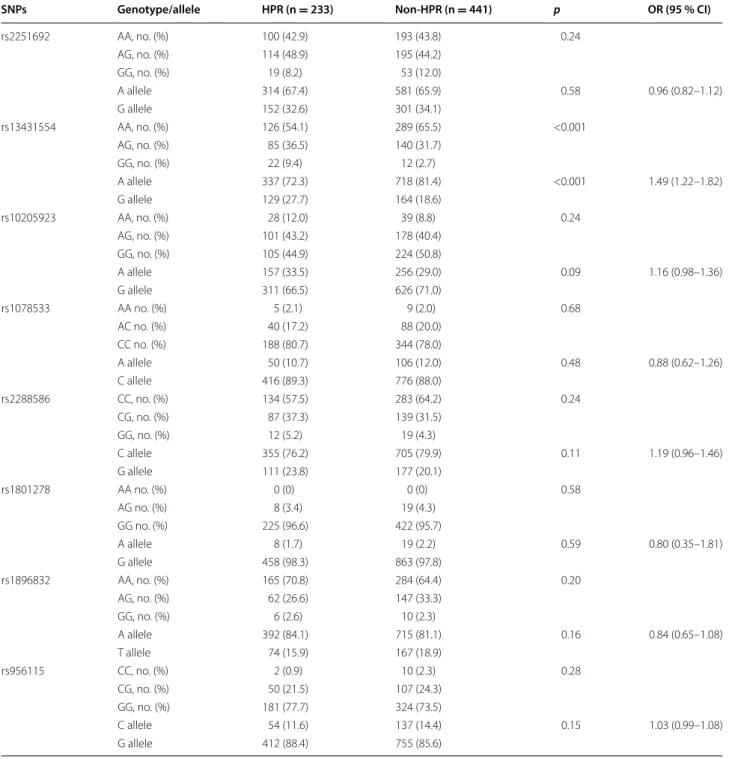
all in Hardy–Weinberg equilibrium. The genotype and allele frequencies of the eight SNPs between the HPR and non-HPR groups were summarized in Table 2. Geno-type distribution of rs13431554 was significantly differ-ent between the HPR and non-HPR groups (p < 0.001), which remained statistically significant after apply-ing Bonferroni correction. The frequencies of AA, AG,
and GG genotypes of rs13431554 in the HPR and non-HPR groups were 54.1, 36.5, 9.4, and 65.5, 31.7, 2.7 %, respectively. The G allele frequency of rs13431554 was significantly higher in the HPR group compared with the non-HPR group (27.7 vs 18.6 %, p < 0.001, odd ratio = 1.49, 95 % confidence interval = 1.22–1.82). There were no significant differences in allele frequencies
Table 2 Genotypes and allele frequencies of IRS-1 polymorphisms in primary participants
SNPs Genotype/allele HPR (n = 233) Non-HPR (n = 441) p OR (95 % CI)
rs2251692 AA, no. (%) 100 (42.9) 193 (43.8) 0.24 AG, no. (%) 114 (48.9) 195 (44.2)
GG, no. (%) 19 (8.2) 53 (12.0)
A allele 314 (67.4) 581 (65.9) 0.58 0.96 (0.82–1.12) G allele 152 (32.6) 301 (34.1)
rs13431554 AA, no. (%) 126 (54.1) 289 (65.5) <0.001 AG, no. (%) 85 (36.5) 140 (31.7)
GG, no. (%) 22 (9.4) 12 (2.7)
A allele 337 (72.3) 718 (81.4) <0.001 1.49 (1.22–1.82) G allele 129 (27.7) 164 (18.6)
rs10205923 AA, no. (%) 28 (12.0) 39 (8.8) 0.24 AG, no. (%) 101 (43.2) 178 (40.4)
GG, no. (%) 105 (44.9) 224 (50.8)
A allele 157 (33.5) 256 (29.0) 0.09 1.16 (0.98–1.36) G allele 311 (66.5) 626 (71.0)
rs1078533 AA no. (%) 5 (2.1) 9 (2.0) 0.68 AC no. (%) 40 (17.2) 88 (20.0)
CC no. (%) 188 (80.7) 344 (78.0)
A allele 50 (10.7) 106 (12.0) 0.48 0.88 (0.62–1.26) C allele 416 (89.3) 776 (88.0)
rs2288586 CC, no. (%) 134 (57.5) 283 (64.2) 0.24 CG, no. (%) 87 (37.3) 139 (31.5)
GG, no. (%) 12 (5.2) 19 (4.3)
C allele 355 (76.2) 705 (79.9) 0.11 1.19 (0.96–1.46) G allele 111 (23.8) 177 (20.1)
rs1801278 AA no. (%) 0 (0) 0 (0) 0.58 AG no. (%) 8 (3.4) 19 (4.3)
GG no. (%) 225 (96.6) 422 (95.7)
A allele 8 (1.7) 19 (2.2) 0.59 0.80 (0.35–1.81) G allele 458 (98.3) 863 (97.8)
rs1896832 AA, no. (%) 165 (70.8) 284 (64.4) 0.20 AG, no. (%) 62 (26.6) 147 (33.3)
GG, no. (%) 6 (2.6) 10 (2.3)
A allele 392 (84.1) 715 (81.1) 0.16 0.84 (0.65–1.08) T allele 74 (15.9) 167 (18.9)
rs956115 CC, no. (%) 2 (0.9) 10 (2.3) 0.28 CG, no. (%) 50 (21.5) 107 (24.3)
GG, no. (%) 181 (77.7) 324 (73.5)
or genotype distributions among the remaining seven SNPs between the HPR and non-HPR patients.
In the cohort of CAD patients without DM, the fre-quencies of AA, AG and GG genotypes of rs13431554 in the HPR and non-HPR groups were 68.8, 22.9,8.3, and 63.6, 30.7, 5.7 % respectively, (p = 0.52). We found that there were no significant differences in genotype and allele frequencies between the HPR and non-HPR group in non-DM patients (Additional file 1: Table S3).
Rs13431554 polymorphism and platelet activity
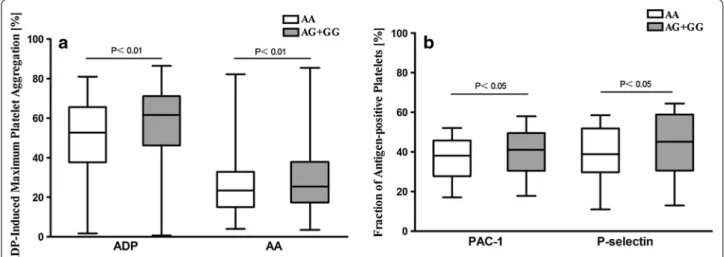
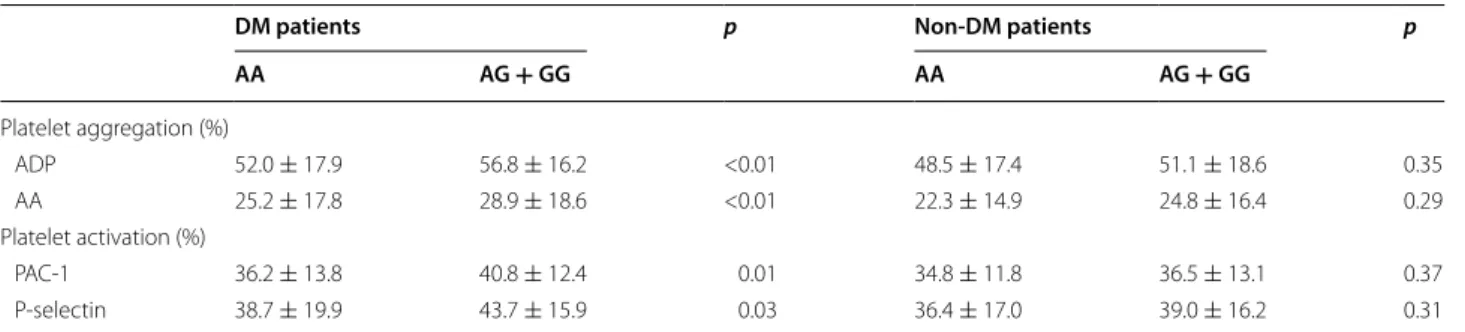
Because of the low occurrence of patients with the GG genotype, the G allele carriers (AG + GG) were ascribed to a single group. Individuals who carried the G allele had higher platelet aggregation compared with non-carriers (Fig. 1a; Table 3) no matter with the ADP-or AA-induced platelet aggregation (56.8 ± 16.2 vs 52.0 ± 17.9 %, p < 0.01 for ADP; 28.9 ± 18.6 vs 25.2 ± 17.8 %, p < 0.01 for AA).
Platelet surface expression of activated glycopro-tein IIb/IIIa and P-selectin were assessed to confirm the association between platelet activation and the alleles of rs13431554. P-selectin expression and glyco-protein IIb/IIIa activation on the platelet surface were increased in the rs13431554 G allele carriers (40.8 ± 12.4 vs 36.2 ± 13.8 %, p = 0.01 for PAC-1; 43.7 ± 15.9 vs 38.7 ± 19.9 %, p = 0.03 for P-selectin) (Fig. 1b; Table 3).
In the external validation cohort of patients with-out DM, the ADP-induced platelet aggregations were 48.5 ± 17.4 and 51.1 ± 18.6 % (p = 0.35), and AA-induced platelet aggregations were 22.3 ± 14.9 and 24.8 ± 16.4 % (p = 0.29) between G allele carriers and non-carriers. There was no significant difference between the rs13431554 G genotype and platelet activation in
non-DM patients (34.8 ± 11.8 vs 36.5 ± 13.1 %, p = 0.37 for PAC-1; 36.4 ± 17.0 vs 39.0 ± 16.2 %, p = 0.31 for P-selectin) (Table 3).
IRS-1 haplotypes analysis
LD analysis of the eight SNPs revealed three LD blocks, as defined according to the gerbil algorithm (see Addi-tional file 1: Table S4). Three haplotype LD blocks were identified for the IRS-1 gene region: block-1 (rs2251692-rs13431554-rs10205923-rs1078533); block-2 (rs2288586-rs1801278); and block-3 (rs1896832-rs956115) (Fig. 2a). Haplotype frequencies were shown in Fig. 2b.
We investigated the associations between haplotype LD block frequencies and high platelet activity. There was no significant association among the three blocks with any of the phenotypes investigated, even though haplo-type block-1 (AGAC) frequency exactly corresponded to the G allele of rs13431554.
Discussion
In healthy subjects, platelets are inhibited by insulin leading to reduced Ca2+ mobilization and aggregate formation [8]. Studies have demonstrated that platelet hyperactivity in T2DM is likely to be caused by a defect in the mechanisms through which insulin interferes with signaling by the P2Y12 receptor. After binding with its receptor, insulin activates IRS-1 through tyrosine phos-phorylation, which initiates the association with the Giα-subunit. Then, Giα activity is inhibited and impairs suppression of adenylyl cyclase through P2Y12. Patients with T2DM are at particularly risk for restenosis and repeat the revascularization procedures because of the increased platelet activation and the reduced platelet inhibition by antiplatelet agents [22–25].
This study suggested that IRS-1 polymorphism has an effect on platelet response to dual-antiplatelet therapy in CAD patients with T2DM. The eight SNPs of IRS-1 gene were examined to study the association between the pol-ymorphisms and the hyperreactive platelet phenotype. We found that the G allele of IRS-1 rs13431554 poly-morphism was significant associated with high platelet
activity. The variant is located in the 3′UTR region of IRS-1, which is more important for mRNA stability, localization, and translational efficiency.
It has been reported that the binding affinity between miRNA and its target mRNA may be changed by SNP located at miRNA target sites [26]. SNP variant may lead to the degradation of mRNA and the inhibition of mRNA translation into protein [27]. Based on our bio-informatics analysis using the microRNA.org database [28], has-miR-23 and has-miR-130 which binding to the sequence surrounding the variant site were identified. These bioinformatics forecasts indicated that rs13431554 may affect the binding affinity between IRS-1 mRNA and miRNAs, which may alter the expression of IRS-1 gene. It is reasonable to suggest that rs13431554 might influence miRNA biogenesis and function, also contribute to plate-let activity. Further functional evaluations are needed to confirm this hypothesis.
The heterogeneity of antiplatelet drug efficacy is known to vary according to the genetic background. Cytochrome P450 (CYP) polymorphism correlates with the dimin-ished antiplatelet efficacy of clopidogrel and the high risk for adverse cardiovascular events following stent implantation [29–32]. The impact of CYP2C19 polymor-phism on platelet reactivity to clopidogrel seems to be more significant in non-DM patients compared with DM patients [33]. Precise clinical phenotypes and functional characterizations of gene variants are currently lacking. An early study reported that T2DM patients with the C allele of the rs956115 marker of the IRS-1 gene have a hyperreactive platelet phenotype and increased risk of major adverse cardiac events [14]. However, this result was not observed in our study. Possible explanation for these divergent results may lie in the ethnic differences in genetic backgrounds. The rs956115 polymorphism is located in the 5′region of the IRS-1 gene which doesn’t affect amino acid coding and protein function. The rs13431554 polymorphism is located in in the 3′region of the IRS-1 gene, and may be more important to the
Table 3 Platelet function profiles according to rs13431554 genotype in study population
Data are expressed as mean ± SD of percentages of platelet aggregation or percentages of positive platelets
ADP adenosine diphosphate; AA arachidonic acid
DM patients p Non-DM patients p
AA AG + GG AA AG + GG
Platelet aggregation (%)
ADP 52.0 ± 17.9 56.8 ± 16.2 <0.01 48.5 ± 17.4 51.1 ± 18.6 0.35 AA 25.2 ± 17.8 28.9 ± 18.6 <0.01 22.3 ± 14.9 24.8 ± 16.4 0.29 Platelet activation (%)
PAC-1 36.2 ± 13.8 40.8 ± 12.4 0.01 34.8 ± 11.8 36.5 ± 13.1 0.37 P-selectin 38.7 ± 19.9 43.7 ± 15.9 0.03 36.4 ± 17.0 39.0 ± 16.2 0.31
Fig. 2 Linkage disequilibrium plot for SNPs in the IRS-1 gene. Linkage disequilibrium between markers was measured by pairwise D’ as calculated from the sample of individuals studied. a Linkage disequi-librium blocks were identified as suggested by the gerbil algorithm.
Color support for D’ estimation as reported in the computer program
Haploview (Barrett JC et al., 2005). White D’ <1 and LOD <2; shades
function of IRS-1. We found that the outcomes were special to DM patients because there was no significant association between IRS-1 polymorphism and platelet activity in non-DM cohort. We did not find the associa-tion between the haplotype LD blocks and high platelet activity phenotypes in our study.
Glycemic control has an effect on platelet reactivity in diabetic patients. Previous study showed that a reduc-tion in HbA1c level was associated with a reducreduc-tion in blood thrombogenicity. Grzegorz Gajos et al. demon-strated that fasting glycemia <4.5 mmol/L was associated with enhanced thrombin formation in T2DM patients, especially when strict glycemic control was achieved (HbA1c <6.0 %) [34]. Patients in our study had got a good glycemic control and limited variability in HbA1C levels, so the level of HbA1C didn’t affect our study results.
More strategies are being studied to overcome increased platelet reactivity in DM patients. Previous study showed that using a loading dose of clopidogrel rather than small daily doses was not sufficient for ade-quately overcoming increased platelet reactivity in DM patients, highlighting the need for more effective anti-platelet drugs for such patients [35]. And, novel P2Y12 receptor blockers such as prasugrel and ticagrelor were found that they were superiors in terms of pharmaco-dynamics and pharmacokinetic effects than clopidogrel [36–38]. Recent randomized studies also demonstrated that ticagrelor was superior to prasugrel for reducing platelet reactivity in subjects with diabetes [39].
This is the first study to evaluate the association between IRS-1 polymorphism and high on-treatment platelet reactivity in a population of Chinese CAD patients with DM. Identification of susceptible genes that contribute to the declining platelet response may facilitate prediction, prevention, and development of improved antiplatelet treatments.
Study limitations
There is a lack of standardization identification of opti-mal cutoff values for defining the HPR [40]. Standard-ized definitions of defining individual responsiveness to clopidogrel should be used in further experiments. We assessed platelet reactivity in vitro, that can’t fully rep-resent platelet phenotype in circulating condition. The mechanisms of the rs13431554 variant contributing to the poor response to clopidogrel in T2DM patients remain speculative. Further functional evaluations with larger sample sizes are needed to confirm our findings. Different geographical and ethnic backgrounds of the study participants may affect the results of any asso-ciation study. Therefore, more patients of different geo-graphical areas and ethnicities should be included to confirm our conclusions in the further studies.
Conclusions
Variant rs13431554 in the IRS-1 gene is associated with a hyperreactive platelet phenotype and a sub-optimal response to antiplatelet drug in CAD patients with T2DM. There is an association between the G allele of rs13431554 and the increased platelet aggregation and activity. Fur-ther validations using larger sample sizes of diverse ethnic populations and functional evaluations are warranted.
Abbreviations
HPR: high platelet reactivity; DM: diabetes mellitus; T2DM: type 2 diabetes mellitus; IRS-1: insulin receptor substrate-1; SNP: single nucleotide polymor-phisms; CAD: coronary artery disease; PCI: percutaneous coronary interven-tions; LD: linkage disequilibrium; MPA: maximal platelet aggregation; PRP: platelet-rich plasma; ADP: adenosine diphosphate; AA: arachidonic acid.
Authors’ contributions
All authors have made substantial contributions. ZD performed the statistical analysis and drafted the manuscript. ZD, LD carried out the molecular genetic studies. ZD, LT, CW contributed to data acquisition. HY, ZX, YC conceived of the study, and participated in its design and critically revised the manuscript. All authors read and approved the final manuscript.
Acknowledgements
This work was supported by the National Research Key Project of the Twelfth Five-Year Plan of Republic of China (No. 2011BAI11B07), Major High-tech Clinical Army Projects (No. 2010GXJS001), the National Young Science Founda-tion of China (81100135) and key Project of NaFounda-tional 12th Five-Year Research Program of China (2012ZX09303016-002), National Basic Research Program of China (973 Program 2012CB517804).
Competing interests
The authors declare that they have no competing interests.
Received: 28 October 2015 Accepted: 3 March 2016
References
1. Chirumamilla AP, Maehara A, Mintz GS, Mehran R, Kanwal S, Weisz G, et al. High platelet reactivity on clopidogrel therapy correlates with increased coronary atherosclerosis and calcification: a volumetric intravascu-lar ultrasound study. JACC Cardiovascuintravascu-lar Imaging. 2012;5(5):540–9. doi:10.1016/j.jcmg.2011.12.019.
2. Bliden KP, DiChiara J, Tantry US, Bassi AK, Chaganti SK, Gurbel PA. Increased risk in patients with high platelet aggregation receiving chronic clopidogrel therapy undergoing percutaneous coronary inter-vention: is the current antiplatelet therapy adequate? J Am Coll Cardiol. 2007;49(6):657–66. doi:10.1016/j.jacc.2006.10.050.
3. Gurbel PA, Becker RC, Mann KG, Steinhubl SR, Michelson AD. Platelet function monitoring in patients with coronary artery disease. J Am Coll Cardiol. 2007;50(19):1822–34. doi:10.1016/j.jacc.2007.07.051.
Additional file
4. Ferreira IA, Mocking AI, Feijge MA, Gorter G, van Haeften TW, Heemskerk JW, et al. Platelet inhibition by insulin is absent in type 2 diabetes mel-litus. Arterioscler Thromb Vasc Biol. 2006;26(2):417–22. doi:10.1161/01. ATV.0000199519.37089.a0.
5. Kannel WB, McGee DL. Diabetes and glucose tolerance as risk factors for car-diovascular disease: the Framingham study. Diabetes Care. 1979;2(2):120–6. 6. Stamler J, Vaccaro O, Neaton JD, Wentworth D. Diabetes, other risk factors,
and 12-yr cardiovascular mortality for men screened in the multiple risk factor intervention trial. Diabetes Care. 1993;16(2):434–44.
7. Angiolillo DJ, Fernandez-Ortiz A, Bernardo E, Ramirez C, Sabate M, Jimenez-Quevedo P, et al. Platelet function profiles in patients with type 2 diabetes and coronary artery disease on combined aspirin and clopi-dogrel treatment. Diabetes. 2005;54(8):2430–5.
8. Angiolillo DJ, Bernardo E, Ramirez C, Costa MA, Sabate M, Jimenez-Quevedo P, et al. Insulin therapy is associated with platelet dysfunction in patients with type 2 diabetes mellitus on dual oral antiplatelet treatment. J Am Coll Cardiol. 2006;48(2):298–304. doi:10.1016/j.jacc.2006.03.038. 9. Angiolillo DJ. Antiplatelet therapy in diabetes: efficacy and limitations
of current treatment strategies and future directions. Diabetes Care. 2009;32(4):531–40. doi:10.2337/dc08-2064.
10. Vivas D, Garcia-Rubira JC, Bernardo E, Angiolillo DJ, Martin P, Calle A, et al. Effect of an optimized treatment with insulin on platelet reactivity after discharge in patients with an acute coronary syndrome and hyperglyce-mia. Rev Esp Cardiol. 2013;. doi:10.1016/j.recesp.2013.05.021.
11. Marin F, Gonzalez-Conejero R, Capranzano P, Bass TA, Roldan V, Angiolillo DJ. Pharmacogenetics in cardiovascular antithrombotic therapy. J Am Coll Cardiol. 2009;54(12):1041–57. doi:10.1016/j.jacc.2009.04.084. 12. Gerrits AJ, Koekman CA, van Haeften TW, Akkerman JW. Platelet tissue
factor synthesis in type 2 diabetic patients is resistant to inhibition by insulin. Diabetes. 2010;59(6):1487–95. doi:10.2337/db09-1008. 13. Feng X, Tucker KL, Parnell LD, Shen J, Lee YC, Ordovas JM, et al.
Insu-lin receptor substrate 1 (IRS1) variants confer risk of diabetes in the boston puerto rican health study. Asia Pac J Clin Nutr. 2013;22(1):150–9. doi:10.6133/apjcn.2013.22.1.09.
14. Angiolillo DJ, Bernardo E, Zanoni M, Vivas D, Capranzano P, Malerba G, et al. Impact of insulin receptor substrate-1 genotypes on platelet reactivity and cardiovascular outcomes in patients with type 2 diabetes mellitus and coronary artery disease. J Am Coll Cardiol. 2011;58(1):30–9. doi:10.1016/j.jacc.2011.02.040.
15. Alberti KG, Zimmet PZ. Definition, diagnosis and classifica-tion of diabetes mellitus and its complicaclassifica-tions. Part 1: diagno-sis and classification of diabetes mellitus provisional report of a WHO consultation. Diabet Med. 1998;15(7):539–53. doi:10.1002/ (SICI)1096-9136(199807)15:7<539:AID-DIA668>3.0.CO;2-S.
16. Davidovich O, Kimmel G, Shamir R. GEVALT: an integrated software tool for genotype analysis. BMC Bioinformatics. 2007;8:36. doi:10.1186/1471-2105-8-36. 17. Halperin E, Kimmel G, Shamir R. Tag SNP selection in genotype data
for maximizing SNP prediction accuracy. Bioinformatics. 2005;21(Suppl 1):i195–203. doi:10.1093/bioinformatics/bti1021.
18. Angiolillo DJ, Shoemaker SB, Desai B, Yuan H, Charlton RK, Bernardo E, et al. Randomized comparison of a high clopidogrel maintenance dose in patients with diabetes mellitus and coronary artery disease: results of the optimizing antiplatelet therapy in diabetes mellitus (OPTIMUS) study. Cir-culation. 2007;115(6):708–16. doi:10.1161/CIRCULATIONAHA.106.667741. 19. Angiolillo DJ, Capranzano P, Goto S, Aslam M, Desai B, Charlton RK, et al. A
randomized study assessing the impact of cilostazol on platelet function profiles in patients with diabetes mellitus and coronary artery disease on dual antiplatelet therapy: results of the OPTIMUS-2 study. Eur Heart J. 2008;29(18):2202–11. doi:10.1093/eurheartj/ehn287.
20. Angiolillo DJ, Badimon JJ, Saucedo JF, Frelinger AL, Michelson AD, Jakubowski JA, et al. A pharmacodynamic comparison of prasugrel vs. high-dose clopi-dogrel in patients with type 2 diabetes mellitus and coronary artery disease: results of the optimizing anti-platelet therapy in diabetes mellitus (OPTI-MUS)-3 trial. Eur Heart J. 2011;32(7):838–46. doi:10.1093/eurheartj/ehq494. 21. Angiolillo DJ, Bernardo E, Sabate M, Jimenez-Quevedo P, Costa MA,
Pala-zuelos J, et al. Impact of platelet reactivity on cardiovascular outcomes in patients with type 2 diabetes mellitus and coronary artery disease. J Am Coll Cardiol. 2007;50(16):1541–7. doi:10.1016/j.jacc.2007.05.049. 22. Sethi SS, Akl EG, Farkouh ME. Diabetes mellitus and acute coronary
syndrome: lessons from randomized clinical trials. Curr DiabRep. 2012;12(3):294–304. doi:10.1007/s11892-012-0272-9.
23. Andersson C, Lyngbaek S, Nguyen CD, Nielsen M, Gislason GH, Kober L, et al. Association of clopidogrel treatment with risk of mortality and cardiovascular events following myocardial infarction in patients with and without diabetes. JAMA. 2012;308(9):882–9. doi:10.1001/2012. jama.10779.
24. Sakata K, Waseda K, Kume T, Otake H, Nakatani D, Yock PG, et al. Impact of diabetes mellitus on vessel response in the drug-eluting stent era: pooled volumetric intravascular ultrasound analyses. Circ Cardiovasc Interv. 2012;5(6):763–71. doi:10.1161/CIRCINTERVENTIONS.111.962878. 25. Ferreira IA, Eybrechts KL, Mocking AI, Kroner C, Akkerman JW. IRS-1
mediates inhibition of Ca2+ mobilization by insulin via the inhibi-tory G-protein Gi. J Biol Chem. 2004;279(5):3254–64. doi:10.1074/jbc. M305474200.
26. Liu ME, Liao YC, Lin RT, Wang YS, Hsi E, Lin HF, et al. A functional polymorphism of PON1 interferes with microRNA binding to increase the risk of ischemic stroke and carotid atherosclerosis. Atherosclerosis. 2013;228(1):161–7. doi:10.1016/j.atherosclerosis.2013.01.036. 27. Medina PP, Slack FJ. microRNAs and cancer: an overview. Cell Cycle.
2008;7(16):2485–92.
28. MicroRNA.org-targets and expression. http://www.microrna.org/micro-rna/home.do. Accessed 6 Jan 2015.
29. Yamamoto K, Hokimoto S, Chitose T, Morita K, Ono T, Kaikita K, et al. Impact of CYP2C19 polymorphism on residual platelet reactivity in patients with coronary heart disease during antiplatelet therapy. J Car-diol. 2011;57(2):194–201. doi:10.1016/j.jjcc.2010.10.007.
30. Simon T, Verstuyft C, Mary-Krause M, Quteineh L, Drouet E, Meneveau N, et al. Genetic determinants of response to clopidogrel and cardiovascular events. N Engl J Med. 2009;360(4):363–75. doi:10.1056/NEJMoa0808227. 31. Collet JP, Hulot JS, Pena A, Villard E, Esteve JB, Silvain J, et al. Cytochrome P450 2C19 polymorphism in young patients treated with clopidogrel after myocardial infarction: a cohort study. Lancet. 2009;373(9660):309– 17. doi:10.1016/S0140-6736(08)61845-0.
32. Trenk D, Hochholzer W, Fromm MF, Chialda LE, Pahl A, Valina CM, et al. Cytochrome P450 2C19 681G > A polymorphism and high on-clopi-dogrel platelet reactivity associated with adverse 1-year clinical outcome of elective percutaneous coronary intervention with drug-eluting or bare-metal stents. J Am Coll Cardiol. 2008;51(20):1925–34. doi:10.1016/j. jacc.2007.12.056.
33. Mizobe M, Hokimoto S, Akasaka T, Arima Y, Kaikita K, Morita K, et al. Impact of CYP2C19 polymorphism on clinical outcome following coro-nary stenting is more important in non-diabetic than diabetic patients. Thromb Res. 2014;134(1):72–7. doi:10.1016/j.thromres.2014.04.020. 34. Gajos G, Konieczynska M, Zalewski J, Undas A. Low fasting glucose is
associated with enhanced thrombin generation and unfavorable fibrin clot properties in type 2 diabetic patients with high cardiovascular risk. Cardiovasc Diabetol. 2015;14:44. doi:10.1186/s12933-015-0207-2. 35. Schuette C, Steffens D, Witkowski M, Stellbaum C, Bobbert P, Schultheiss
HP, et al. The effect of clopidogrel on platelet activity in patients with and without type-2 diabetes mellitus: a comparative study. Cardiovasc Diabetol. 2015;14:15. doi:10.1186/s12933-015-0182-7.
36. Wiviott SD, Braunwald E, McCabe CH, Montalescot G, Ruzyllo W, Gottlieb S, et al. Prasugrel versus clopidogrel in patients with acute coronary syndromes. N Engl J Med. 2007;357(20):2001–15. doi:10.1056/ NEJMoa0706482.
37. Wallentin L, Becker RC, Budaj A, Cannon CP, Emanuelsson H, Held C, et al. Ticagrelor versus clopidogrel in patients with acute coronary syndromes. N Engl J Med. 2009;361(11):1045–57. doi:10.1056/NEJMoa0904327. 38. Sardella G, Calcagno S, Mancone M, Lucisano L, Pennacchi M, Stio RE,
et al. Comparison of therapy with Ticagrelor, Prasugrel or high Clopi-dogrel dose in PCI patients with high on treatment platelet reactivity and genotype variation. TRIPLETE RESET trial. Int J Cardiol. 2015;194:60–2. doi:10.1016/j.ijcard.2015.05.085.
39. Alexopoulos D, Vogiatzi C, Stavrou K, Vlassopoulou N, Perperis A, Pentara I, et al. Diabetes mellitus and platelet reactivity in patients under prasugrel or ticagrelor treatment: an observational study. Cardiovasc Diabetol. 2015;14:68. doi:10.1186/s12933-015-0232-1.