International Journal of Emerging Technology and Advanced Engineering
Website: www.ijetae.com (ISSN 2250-2459, ISO 9001:2008 Certified Journal, Volume 9, Issue 10, October 2019)
132
Anomaly Detection Model Based on SVM & XGBoost to
Detect Network Intrusions
Vishal Kumar
1, Ashish Chaturvedi
2, Rachna Dubey
3 1M.tech Scholar,
2Asst. Professor,
3Professor, Dept. of CSE, LNCTE, Bhopal, India
Abstract— There are rapidly increasing attacks on computers creates a problem for network administration to prevent the computer from these attacks. There are many traditional intrusion detection systems (IDS) is present but they are unable to prevent computer system completely. The need to secure networks has increased as the number of people connecting to the network are increasing rapidly and using networks for storing or accessing critical information. In this paper we have assessed and compared various machine learning algorithm and then propose a system based on the best performing algorithm. In this we proposed an XGBoost learning technique which is an combining diverse set of learners (individual models) together to improvise on the stability and predictive power of the model.
Keywords— Network security, Intrusion Detection system, data mining algorithm, machine learning techniques, Anomaly detection, SVM, XGBoost.
I. INTRODUCTION
With the advancement in the technology, millions of people are now connected with each other through one or other form of network where they share lots of important data. Hence the need of security to safeguard data integrity and confidentiality is increased rapidly. Although effort have been made to secure data transmission but at the same time, attack technique for breaching the network continued to evolve. Thus it leads to the need of such a system which can adapt with this ever changing attack techniques. In this paper, we have purposed a system which is based on machine learning. Our aim is to find the based suitable machine learning algorithm which can predict the type of network attack with highest accuracy and then develop a system which uses this algorithm to detect network intrusion. The algorithms which we have compared are SVM and XGBoost model. The dataset used for training the model is KDD 99 dataset. The reason why we have used machine learning is the flexibility that it provides to the system for example, if any new type of attack is developed in future the system can be trained for predicting that attack. There are a few types of intrusion detection system out of which ours is a knowledge based intrusion detection system which is also known as the anomaly based system.
It registers the anomalies and in future predicts such malicious network to send out an alert. This way the network can disconnect to the such a connection and then have only secured connections.
NSL-KDD Dataset
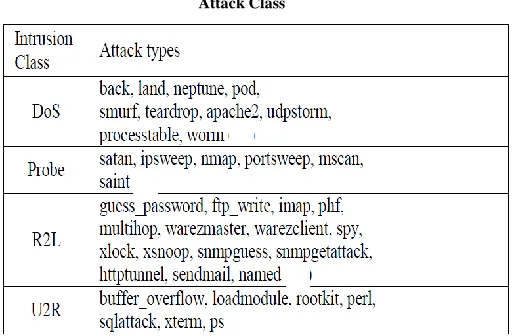
[image:1.612.323.579.526.694.2]The data used in this study is the NSL-KDD Cup 1999 dataset. The NSL-KDD is the proposed dataset in several studies as a solution to the problem in the KDD Cup 1999 dataset (KDD-99) [12]. The KDD-99 dataset is over 15 years old [5], but is still commonly used in research on the area of intrusion detection systems due to the lack of datasets available to the public and accessible freely. Some of the problems that exist in the KDD-99 dataset have now been addressed in NSL-KDD including deletion of redundant data and re-proportion of datasets [12]. NSL-KDD does not include redundant data on NSL-KDD-99 which may affect the performance of learning algorithms while the re-proportion of KDD-99 enables NSL-KDD in the process of evaluating various learning algorithms. The NSL-KDD dataset has 42 attributes, which consists of 41 input attributes and 1 target attribute. Furthermore the types of attacks are grouped into four categories of intrusion classes namely DoS, Probe, U2R and R2L. Table I shows classes and members (attack type) for each class.
International Journal of Emerging Technology and Advanced Engineering
Website: www.ijetae.com (ISSN 2250-2459, ISO 9001:2008 Certified Journal, Volume 9, Issue 10, October 2019)
133
II. LITERATURE REVIEW
According to [1], software package outlined networking could be a construct projected to interchange ancient networks by separating management plane and information plane. It makes the network additional programmable and manageable. As there's one purpose of management of the network, it's additional liable to intrusion. the thought is to coach the network controller by machine learning algorithms to let it create the intelligent choices mechanically. during this paper, we've mentioned our approach to form software package outlined networking safer from varied malicious attacks by creating it capable of police work and preventing such attacks.
In [2] IDS area unit outlined as a software package utility that detects system activities for risky movements and generates experiences to management. associate degree Intrusion Detection System is security counter step to acknowledge set of intrusion that compromises the acquaintance, availableness, and integrity of information sources [1]. The teams area unit victimisation IDS with aim to spot issues with security policies and documenting existing threats.
In [3] we have a tendency to gift the results of our experiments to judge the performance of police work differing types of attacks (e.g., IDS, Malware, and Shellcode). we have a tendency to analyze the popularity performance by applying the Random Forest rule to the varied datasets that area unit made from the Kyoto 2006+ dataset, that is that the latest network packet information collected for developing Intrusion Detection Systems. we have a tendency to conclude with discussions and future analysis comes.
III. PROBLEM DEFINITION
With the rapid development of information technology in the past two decades. Computer networks are widely used by industry, business and various fields of the human life. Therefore, building reliable networks is a very important task for IT administrators. On the other hand, the rapid development of information technology produced several challenges to build reliable networks which is a very difficult task. There are many types of attacks threatening the availability, integrity and confidentiality of computer networks. The Denial of service attack (DOS), probe, R2L and U2R are considered as of the most common harmful attacks.
IV. PROPOSED WORK
In this paper, we proposed an network IDS based on XGBoost algorithm classifier. These classifier enhances the attack detection accuracy and it very efficient in distinguishing network traffic is attack or normal.
Figure-1 Proposed Model
MACHINE LEARNING
One of the most challenges for IDSs is to make effective behaviour models or patterns to tell apart traditional behaviours from abnormal behaviours by observant collected audit information. to resolve this drawback, earlier IDSs sometimes place confidence in security consultants to analyse the audit information and construct intrusion detection rules manually. Since the quantity of audit information, will increase vary quick, it's become a long, tedious and even not possible work for human consultants to analyse and extract attack signatures or detection rules from dynamic, immense volumes of audit information. conjointly the detection rules created by human consultants area unit sometimes supported fastened options or signatures of existing attacks, therefore it'll be terribly tough for these rules to observe malformed or perhaps utterly new attacks.
International Journal of Emerging Technology and Advanced Engineering
Website: www.ijetae.com (ISSN 2250-2459, ISO 9001:2008 Certified Journal, Volume 9, Issue 10, October 2019)
134
By creating use of knowledge mining algorithms, reconciling intrusion detection models are often mechanically created supported labelled or untagged audit information.A methodology for intrusion detection is projected that involves a attribute choice method for choice of relevant attributes and there on applying a classifier for classifying network information to 2 categories : normal categories and attack categories.
V. EXPERIMENTAL ANALYSIS
[image:3.612.327.565.127.517.2]The dataset taken from the Kdd99 is a huge dataset and the one that we have used in our research. Our aim is to not only to find the best algorithm suited for the intrusion detection but also to implement it using the programming language R. In this we proposed an XGBoost learning algorithm for detecting intrusion. The first process of applying learning is to pre-process the data. For which we prepare an R scripts to add the names of the columns and to group the data of the attacks according to five classes (DoS, Probe, U2R, R2l, normal).
Table 2. Number of Samples
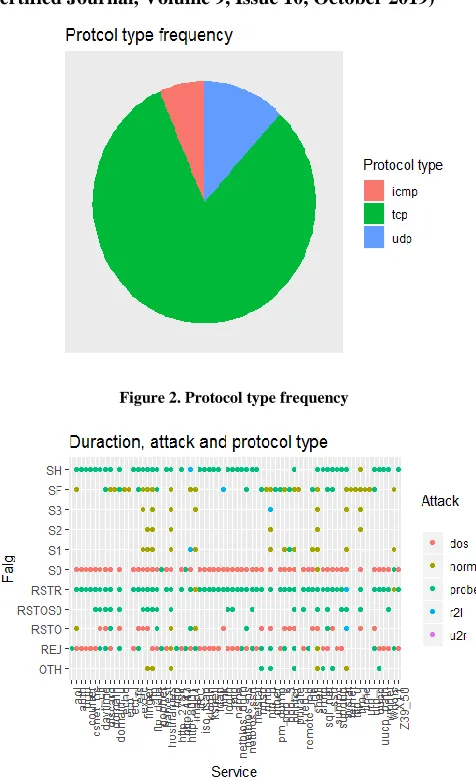
Then we have to remove the redundant rows from the dataset. Then our next step is to see whether there are any missing values and then to remove those corresponding rows too. After the dataset preparation and pre-processing we can do exploratory data analysis in which we can explore the data by visualizing to better understand the data. Figure 2 shows the protocol which having high frequency of attacks, and figure 3 shows the correlation between duration, attacks and protocol types.
Figure 2. Protocol type frequency
Figure 3. Correlation between duration, attack and protocol type.
[image:3.612.48.299.396.547.2]International Journal of Emerging Technology and Advanced Engineering
Website: www.ijetae.com (ISSN 2250-2459, ISO 9001:2008 Certified Journal, Volume 9, Issue 10, October 2019)
[image:4.612.55.584.136.699.2]135
Figure 4. Confusion Matrix and Statistics of SVM model
In this SVM is gives 93.8% of overall accuracy but the accuracy is given by single classifier. In proposed we can introduce XGBoost learning in machine learning in which they combine the decisions from multiple models to improve the overall performance. Ensembling is the art of combining diverse set of learners (individual models) together to improvise on the stability and predictive power of the model. In the above example, the way we combine all the predictions together. We can build a model based on XGBoost learning and trained the model and the testing result are shown in figure 5.
Figure 5. Confusion Matrix and Statistics of XGBoost model
Performance Measure
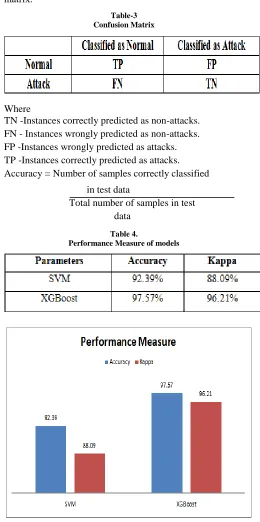
[image:4.612.320.580.169.691.2]We used accuracy, which are derived using confusion matrix.
Table-3 Confusion Matrix
Where
TN -Instances correctly predicted as non-attacks. FN - Instances wrongly predicted as non-attacks. FP -Instances wrongly predicted as attacks. TP -Instances correctly predicted as attacks.
Accuracy = Number of samples correctly classified
in test data
Total number of samples in test data
Table 4.
[image:4.612.49.293.507.711.2]Performance Measure of models
International Journal of Emerging Technology and Advanced Engineering
Website: www.ijetae.com (ISSN 2250-2459, ISO 9001:2008 Certified Journal, Volume 9, Issue 10, October 2019)
[image:5.612.49.297.182.503.2]136
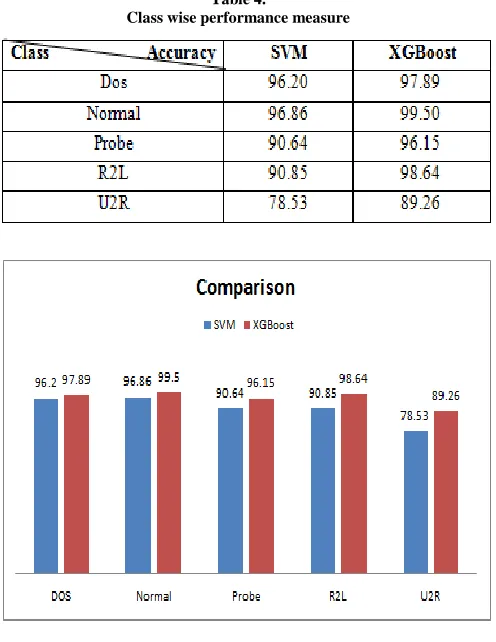
In these we can also compute the performance on the basis of class wise, Table shows the accuracy based on different class.Table 4.
[image:5.612.321.565.195.613.2]Class wise performance measure
Figure 7. Class wise comparison
VI. CONCLUSION
Traditional IDS suffer from different problems that limit their effectiveness and efficiency. In contrast machine learning techniques are promising approaches for intrusion detection. Classification of Intrusion Detection System (IDS) with NSL-KDD99 dataset applies classification technique of SVM and XGBoost Learning method.
After testing the results of different classification results we can say that XGBoost learning classifiers gives better performance in terms of accuracy as compared to SVM Classifier.
REFERENCES
[1] Goyal, Abhilash, Gupta, Divyansh, " Intrusion Detection and Prevention in Software Defined Networking" in 2018 IEEE . [2] Rohit Kumar Singh Gautam, Er.Amit Doegar, " An Ensemble
Approach for Intrusion Detection System Using Machine Learning Algorithms " in IEEE 2018.
[3] Kinam Park, Youngrok Song, Yun-Gyung Cheong, " Classification of Attack Types for Intrusion Detection Systems using a Machine Learning Algorithm" in IEEE 2018.
[4] Mohamed Ali Ahmed, Yasir Abdelgader Mohamed, "Enhancing Intrusion Detection Using Statistical Functions" in 2018 International Conference on Computer, Control, Electrical, and Electronics Engineering (ICCCEEE), IEEE.
[5] Rafath Samrin, D Vasumathi, "Review on Anomaly based Network Intrusion Detection System" in IEEE, 2017.
[6] R.Ravinder Reddy Dr.Y Ramadevi Dr.K.V.N Sunitha , "Effective Discriminant Function for Intrusion Detection Using SVM " in IEEE, 2016.
[7] Ming Zhang, Boyi Xu, Jie Gong ―An Anomaly Detection Model based on One-class SVM to Detect Network Intrusions‖ in IEEE 2015.
[8] Gong Shang-fu,Zhao Chun-lan." Intrusion Detection System Based on Classification" in 2012 IEEE.
[9] N. G¨ornitz, M. Braun, and M. Kloft, ―Hidden markov anomaly detection,‖ in International Conference on Machine Learning, pp. 1833–1842, 2015.
[10] B. Sch¨olkopf, J. C. Platt, J. Shawe-Taylor, A. J. Smola, and R. C. Williamson, ―Estimating the support of a high-dimensional distribution,‖ Neural computation, vol. 13, no. 7, pp. 1443–1471, 2001.
[11] D. M. Tax and R. P. Duin, ―Support vector data description,‖ Machine learning, vol. 54, no. 1, pp. 45–66, 2004.
[12] S. D. Bay, D. F. Kibler, M. J. Pazzani, and P. Smyth, ―The uci kdd archive of large data sets for data mining research and experimentation,‖ SIGKDD Explorations, vol. 2, p. 81, 2000. [13] S. Menard, Applied logistic regression analysis, vol. 106. SAGE
publications, 2018.
[14] J. R. Quinlan, ―Induction of decision trees,‖ Machine learning, vol. 1, no. 1, pp. 81–106, 1986.