AUSTRALIAN JOURNAL OF BASIC AND
Open Access Journal
Published BY AENSI Publication
© 2016 AENSI Publisher All rights reserved
This work is licensed under the Creative Commons Attribution International License
http://creativecommons.org/licenses/by/4.0/
To Cite This Article: R. Arun Chakravarthy and DR. S. Palaniswami Efficiency With Load Balanced In Wireless Sensor Networks
Improved Bat Algorithm Based Effective Stable Routing For Energy
Efficiency With Load Balanced In Wireless Sensor Networks
1R. Arun Chakravarthy and 2DR. S. Palaniswami
1Research Scholar, Anna University, Chennai
2Principal, Government College of Engineering, Bodinayakanur
Address For Correspondence:
R. Arun Chakravarthy, Research Scholar, Anna University, Chennai
A R T I C L E I N F O Article history: Received 3 March 2016 Accepted 2 May 2016 published 26 May 2016
Keywords:
wireless sensor network,clustering,
energy efficiency, load balance,
optimum routing, bat algorithm.
Advances in electronics and communications enable cheap sensors to be deployed on a large scale and in harsh environments, wherever sensors need to operate unattended in an
communicate over fallible wireless channels with reliable delivery is crucial. These character
protocols difficult (Al-Karaki, J. and E. Kamal, 2004 Many studies are done in WSN
these design goals are typically orthogonal to each other. robust to high link failure rate. During
categories: local load-balancing (Yu, Y., global load-balancing (Chen, M., et al., 2006)
balancing, respectively. To evaluate the performance of load balancing, the time till the primary node in the WSN drains its battery power and dies.
AUSTRALIAN JOURNAL OF BASIC AND
APPLIED SCIENCES
ISSN:1991-8178 EISSN: 2309-8414 Journal home page: www.ajbasweb.com
© 2016 AENSI Publisher All rights reserved
This work is licensed under the Creative Commons Attribution International License (CC BY).
http://creativecommons.org/licenses/by/4.0/
R. Arun Chakravarthy and DR. S. Palaniswami., Improved Bat Algorithm Based Effective Stable Routing For Energy Efficiency With Load Balanced In Wireless Sensor Networks. Aust. J. Basic & Appl. Sci., 10(8): 260-270, 2016
Improved Bat Algorithm Based Effective Stable Routing For Energy
Efficiency With Load Balanced In Wireless Sensor Networks
Palaniswami
Anna University, Chennai
Principal, Government College of Engineering, Bodinayakanur
Research Scholar, Anna University, Chennai
A B S T R A C T
Clustering sensor nodes around many less-energy constrained cluster heads has been considered as an effective means that to attain scalability and robustness of the large scale Wireless Sensor Networks (WSNs). However, if some gateways or cluster heads are overloaded with a large variety of sensor nodes, they will die quickly and as a result the network life time is less. So, to increase the lifetime of the network, it's imperative to balance the load of the gateways. It’s also equally necessary to reduce average communication energy of the sensor nodes within their clusters. In this work, an Improved Energy-efficiency with Load Balanced Clustering (IELBC) hierarchy routing protocol is proposed for equalization the load with energy efficiency in cluster wireless sensor networks. Initially, clustering formulates possible hierarchical routing in which methods are recorded between cluster-heads rather than nodes. In proposed method, the most reliable and stable node chooseas cluster-head looking on five criteria i.e. position, mobility, distance, density distribution, and residual energy of the node. It additionally uses a multi agent based routing algorithm to make load balanced routes between source and destination in networks. The optimum routing with stable manner is carried out by Improved Bat algorithm (IBA). A threshold value was used to decide if intermediate node was overloaded, variable and dynamical along with nodes interface queue length around the backward path. The proposed routing protocol chooses an optimum path with low energy usage. The performance results show that the proposed scheme is effective to balance the load with energy efficiency, throughput and packet delivery ratio compared than existing algorithm.
INTRODUCTION
Advances in electronics and communications enable cheap sensors to be deployed on a large scale and in harsh environments, wherever sensors need to operate unattended in an autonomous manner. As sensor nodes communicate over fallible wireless channels with reliable, energy-efficient andbattery power
delivery is crucial. These character-istics of wireless device networks (WSNs) create the design of routing Karaki, J. and E. Kamal, 2004).
WSNs based on theload balancing, energy-efficiency and reliability. However, these design goals are typically orthogonal to each other. For instance, most of the load balancing schemes isn't During this paper, the existing load balancing schemes are classified into two
Yu, Y., et al., 2001; Dai, H. and R. Han, 2003; Gao, J. and L
et al., 2006). These are referred as hop-by-hop balancing and end evaluate the performance of load balancing, it defined the “lifetime” of a WSN as the time till the primary node in the WSN drains its battery power and dies.
Improved Bat Algorithm Based Effective Stable Routing For Energy , 2016
Improved Bat Algorithm Based Effective Stable Routing For Energy
Efficiency With Load Balanced In Wireless Sensor Networks
energy constrained cluster heads has been an effective means that to attain scalability and robustness of the large scale Wireless Sensor Networks (WSNs). However, if some gateways or cluster heads are overloaded with a large variety of sensor nodes, they will die quickly and as a result rk life time is less. So, to increase the lifetime of the network, it's imperative to balance the load of the gateways. It’s also equally necessary to reduce average communication energy of the sensor nodes within their clusters. In this work, an efficiency with Load Balanced Clustering (IELBC) hierarchy routing protocol is proposed for equalization the load with energy efficiency in cluster wireless sensor networks. Initially, clustering formulates possible hierarchical routing in which heads rather than nodes. In proposed method, the head looking on five criteria i.e. position, mobility, distance, density distribution, and residual energy of the node. It itionally uses a multi agent based routing algorithm to make load balanced routes between source and destination in networks. The optimum routing with stable manner is carried out by Improved Bat algorithm (IBA). A threshold value was used to decide if ermediate node was overloaded, variable and dynamical along with nodes interface queue length around the backward path. The proposed routing protocol chooses an optimum path with low energy usage. The performance results show that the proposed fective to balance the load with energy efficiency, throughput and packet
Advances in electronics and communications enable cheap sensors to be deployed on a large scale and in autonomous manner. As sensor nodes battery power information ) create the design of routing
Load balancing is actually one of the solutions for increasing the potency of the network life timeand real time applications. The load balancing algorithms are designed primarily to distribute equally the load on nodes as well as increase their utilization while minimizing the total task execution time. This issue has been of substantial interest in the network analysis community when it involves wired (Rauthan, J.S., S Mishra, 2012) and wireless (Vanaja, K. and R. Umarani, 2012) networks. It aims to ensure that no node is under loaded or overloaded. It's at setting up a uniform load on all nodes. Then, it's expanded in order to require into consideration new environments and new applications (large scale applications, multimedia applications, etc.,).
To reduce packet losses due to frequent link failures in (Yu, Y., et al., 2001; Chen, M., et al., 2006), a forwarding node additionally uses various or backup nodes bydevelopmental multiple backup next hop nodes in advance. If the first next hop node fails, the Medium Access Control (MAC) layer is notcapable to distribute a packet to this inaccessible primary node. When many retransmissionsmake an attempt, the MAC layer merely drops the packet and notifies the network layer of the transmission failure. In this routing protocol, a backup next hop selects and then hands the same packet (stored in the cache) down to the MAC layer. If the backup next hop also dies means these retransmissions are replicated. Once the node failure rate is high, trying multiple backup nodes along with information caching severely will increase the delay, reduces the effective obtainable bandwidth, and wastes energy for unessential transmissions. Nevertheless, the above operation is generally used in traditional routing protocols for sensor and ad hoc networks [2, 5], that operate within the three following two-step manner: 1) choose consecutive hop node first based on a Neighbor Information Table (NIT), 2) forward packet to the chosen node until a predetermined number of transmissions fail. It's referred to as a “transmitter-oriented” approach.
In this paper, an improved hierarchy routing is proposed, that facilitates energy efficiency with load balancing and reliable information dissemination in WSNs. Presence of an unstable and non-reliable Cluster-Head (CH) degrades the performance of the network since cluster-heads is take main active in routing messages between a source destination pair. Initially, proposed algorithm chooses the most reliable and stable node as cluster-head for reduces routing overheads. It additionally uses a multi agent based routing algorithm to make load balanced routes between source and destination in networks. The optimum routing with stable manner is carried out by IBA. It improves the network throughput and packet delivery ratio. The experimental results show that the proposed scheme isattainedwell good performance results compared than existing scheme. The rest of this paper is organized as follows: Section 2 presents the many works done and related to the load balancing issue and energy efficiency with routing algorithms, in Section 3, the proposed approach and its details are presented. The simulation environment and the simulation results interpretation are presented in Sections 4 and the paper concluded in section 5.
Related Work:
In this section, load balancing, energy efficiency and reliable routing techniques has been mentioned. Jin Wang et al., (2011) worked on the problem of hotspot, since this problem can't be addressed under several routing because of energy reduction of sensor nodes. Here, a Ring-based Energy Aware Routing (REAR) algorithm proposed for WSN that can achieve energy balancing and energy efficiency for all sensor network nodes. It considers the hop number as well as the distance with the residual energy of subsequent hop node throughout routing.
J´anos et al., (2011) developed a mechanism for best scheduling to forward packets in WSN, wherever information gathering is completed by cluster and cluster head with an already outlined Quality of Service. Here, the proposed solutions for scheduling were developed by combinatorial optimisation, as well as by quadratic programming strategies. Here, the scheduling of forwarding packet is satisfied the problem of separate quadratic optimisation,and then the optimisation is wanted by a Hopfield Neural Network yielding the solution in polynomial time. The scheduling that is given by Hopfield Neural Network indeed guarantees uniform packet loss chance for the entire nodes and saves the cluster head energy. During this method, the longevity of the network can be improved and raised.
Rauthan et al., (2012) represented WSN and to distribute the energy throughout, information load of the sensor nodes should be properly balanced. Cluster algorithms could lead to some clusters that have more members than different clusters in the network and uneven cluster sizes harmfullydamage the load balancing in the network. Here, improved a cluster algorithm proposed for load balancing in clusters generation and WSNs competence is measured by the overall distance between nodes to the base station and quantity of data that has been transfer.
Zhao dynasty et al., (2012) proposed the self organized tree based energy balance routing to enhance the energy efficiency and radio interference to preserve the global property. GSTEB- General Self-Organized Tree-Based Energy-Balance routing protocol builds a routing tree employing a process where, for every round, Base Station assigns a root node and broadcasts this choice to all sensor nodes. Afterwards, every node selects its parent by considering only itself and its neighbour’s information, so creating a dynamic protocol.
Francesco et al., (2011) an adaptation and cross-layer framework developed for reliable and energy efficient information collection in WSNs based on the IEEE 802.15.4/zigbee standards. The framework concerned energyaware adaptation module that captured the application’s reliability requirements and goal was to reduce the energy consumption. It supported each single-hop and multi-hop networking scenarios. Latency was terribly high because of non convenience of best route found in multi-hop communication. Moreover, in this scheme, energy was spent for only transmission and not for retransmission. Location based methodology was adopted in this scheme however a lot of energy was spent for reliable routing.
Juan Capella et al., (2011) Energy-Efficient scalable Wireless sensor networks explored a proposed architecture with a new routing protocol to produce higher scalability, reliability, readying properties and energy reduction, it is used in Historical Building monitoring. Novel node sensors designed for monitoring picket masterpieces and historical buildings, to perform an early detection of pests, were given. These sensors have shown extremely satisfactory lead to the detection of termites and low power consumption. There was no best route found during this scheme.
Yuping Dong et al., (2011) proposed an energy efficient routing algorithm for WSN. In this algorithm, they divided the sensor nodes into many scheduling sets and let them work alternatively. In this method, the sensors didn't have to be active all the time that saved plenty of energy. Once selecting subsequent sensor to forward the data to, here, the distance from the each base station to the sensor and its current energy state is considered, so that the network power consumption are going to be distributed among the sensors. Once the network didn't have enough sensors that had sufficient energy to run, it automatically generated new scheduling sets. Scheduling was adopted here for all the routes however no best route was demonstrated due to lack of energy.
El Ghazi et al., (2014) an improved ant colony optimisation routing (ACO) proposed for WSN. Here, an enhanced ant colony is employed to optimize the node power consumption and prolongs network period. The ACO improved approach in enhanced an approach based on ACO in which the probability of choosing next hop neighbour has been determined by using two heuristic functions. The primary one is expounded to the amount of the pheromone that inversely proportional to hop count and also depends on residual energy of neighbour nodes.
Ren et al., (2011) proposed a TADR- Traffic Aware Dynamic Routing algorithm to route the packets around the congestion areas and scatter excessive packets on multiple paths consisting of idle or unloaded nodes. During this algorithm, a hybrid potential field is built in terms of depth and the normalized queue length. Then the depth field creates a backbone to forward packets toward the sink. After that, the queue length field is employed to prevent the packet from planning to the potential congestion area. Though, TADR algorithm doesn't consider two essential problems that considered as a drawback.
Nevertheless, the previous study of seb shows that it's some drawbacks since some problems are not considered. The primary is that the packet buffer capability of sensor nodes. As described above, this may increase the packet loss and packet retransmission that inevitably affects the network potency. Secondly, the dynamic behaviour of the wireless link quality over time and area where, the path quality is decided as a function of hop count. This can easily lead to the use of low-quality links, and lead to unreliable routs (Baoshu, X. and W. Hui, 2010). Finally, calculating the weight of nodes in such algorithm was supported the assumption that the surroundings events distributed uniformly. This could be inefficient when the environment events distributed non-uniformly.
A load balanced cluster approach (Zhang, H., et al., 2011), uses comprehensive weight price composed of distance between the head and the member and the residual energy to enhance cluster member selection. It additionally uses optimisation threshold price to avoid load imbalance. The algorithm considers load equalization for making balanced cluster. A novel load balancing scheduling algorithm for WSNs (Laszlo, E., et al., 2011) uses best scheduling algorithm for packet forwarding that determines the slot for sending the packets for the nodes. The algorithm provides uniform packet loss likelihood for the entire nodes. It uses balanced value objective function for optimum programming.
Proposed Methodology:
In this section, the proposed IELBC hierarchy routing has been discussed.And then optimum routing also explained in given below subsection.
System model:
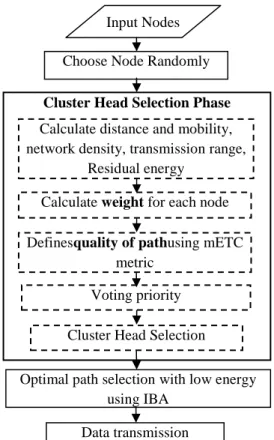
Fig. 1: overall performance of proposed system
The overall performance of proposed system is illustrated in fig 1. It shows the cluster based communication and cluster formation. In this clustering, the cluster head is selected based on the five criteria. The path link quality is calculated using modified Expected Transmission Count (mETC) metric. Then, the optimal path is selected by IBA. It improves the optimum routing throughput. Finally, the data is transmitted.
Cluster head selection:
This sub section introduces the different parameters used for cluster head election by focusing on behaviour level metric.
The ID value is allotted to each and every node in the network and the ID values along with the information about the nodes are broadcasts to its neighbours. It creates the neighbourhood table based on the broadcast value. The weight value of each node is calculated based on the factors such as transmission range of the neighbourhood nodes, distance between the nodes, mobility of the node, and the residual energy.
Let consideredn (t), i = 0,1,2,3, . . . N − 1, where N →number of nodes, n (t) →position vector of node i at time t.The distance from node to at time t is given below
d (t) = | n (t) – n (t) | (1)
Where d (t) →
The transmission range is thus calculated by using the given below formula
= !"( #/ %)* &' ( ) ( + (2)
Where #→ desired node degree, %→current node degree, the coverage area equals the area covered by the cluster.
#= , + 1, , = & . ∗ (0, 1) (3)
Cluster Head Selection Phase
Input Nodes
Choose Node Randomly
Calculate distance and mobility, network density, transmission range,
Residual energy
Definesquality of pathusing mETC metric
Cluster Head Selection Calculate weight for each node
Voting priority
Optimal path selection with low energy using IBA
d (C, N) =2∑ (16478 4− 04)5 (4)
C=cluster head, N-node. The total energy 9: consumed
9:( 4, ) = ; 49 + 4<=>
5, ≤ @
49 + 4<AB 5, > @D (5)
Where E= !FGH
FIJ, 9 →energy consumed to transmit or receive 1 bit message, <=>→amplification
coefficient of free-space signal, <AB→ multi-path fading signal amplification coefficient, → represents the distance between transmitter and receiver, 4→ is the bit amount of sending information.
Mobility or stability is a very important factor in deciding the clusterheads. So as to avoid frequent clusterhead changes, it's fascinating to elect a clusterhead that doesn't move very quickly. Ifthe clusterhead moves quickly means the nodes possiblyremoved from the clusterhead and as a result, areaffiliation happens. It will increase computation and process, that isn't a fascinating feature. The duration of the link will improve the steadiness of the cluster. Every link’s stability is recognized by m ETCmetric.
The Expected Transmission Count (ETC) metric is projected in (Draves, R., et al., 2004). It's an improved version of the Hop Count metric that takes into consideration both the length of the routing path (the range of hops) and the level of packet loss along the trail. The ETC metric is outlined as the expected/required range of transmissions/retransmissions within the network layer that's necessary for packets to be successfully transmitted by a wireless link. The ETC metric is calculated consecutively in every intermediate node severally for every link that belongs to the trail. The trail metric is calculated as a total of all ETC metrics determined in sequent nodes of the network. In mETC, a modification to the ETC metric that takes into thought, besides the quality ETC parameters, changeableness of link parameters in time
K9 0 = exp"μOPQσQ+
(6)
Where the parameters μ and σ is return respectively the worth of the common packet loss and the variance of packet loss ratio. Characteristics of the link changeableness in time provide an opportunity to require advantage of the mETX metric directly for the mapping of the transmission quality in the network layer and in the application layer.
The node first checks the transmission range of the neighbourhood nodes, and then if the neighbourhood is in transmission range it broadcast the ID alongside the other information to the neighbourhood nodes. The target function of every node is calculated its own weight
R = S T(UV) + W T(∆0) + Y T(Z) − [T "\]
\^+ , 0 ≤ S, W, Y, [ ≤ 1 (7)
Where S, W, Y, [ are coefficients, Z → times that the node has been a CH so far, 9:→residual or total energy, 9@→ initial energy, UV → mean distance to neighbors and ∆0 → optimum deviation.
MD can be calculated as follows:
UV =∑bHcdP_`(4,a)
eH (8)
Where f → nodes’ ID, 1>→ number of neighbors, Vg → distance vector, Vg ( , ) → distance between the nodes and
h0 can be calculated as follows:
h0 = |1>− 1@| (9)
Where, 1>→number of neighbors and 1@→ is optimum number of the neighbors.
1@= ij&&((1) (10)
1 = k
1 × 1A V > V 8
08× 1A V 8> V > V 5
05× 1A V 5> V > V m
0m× 1A V m> V
D,
0 < 0m< 05< 08< 1
nodes to only form smaller clusters. This enables load balancing. In this step, every node calculates its own weight and broadcasts it consecutive. Currently every node adds a column to its table and writes the weight of every neighbour in it as Table 1.
Table 1: Primary nodes’ information from the network topology
Neighbors ID Distance (m) Weight
1 32 0.56 W1
2 57 4.41 W2
⋮ ⋮ ⋮ ⋮
M 4 3.1 Wm
Then every node creates a priority list from its neighbors based on their weight. At the moment they broadcast a message containing the selection list (Vote-Message) and vote the most effective nodes. In different words, the Vote-Message may be a list of nodes’ ids that are sorted based on their weight. When finishing the election, the node that has the foremost number of votes, is chosen because the CH and introduces itself by sending a message (CH-Message).
Each node calculates its weight and broadcasts it sporadically during a hello message to all nodes in its transmission range. Once a node receives the weights of its 1-hop neighbours, it push (PS) them within the potential CH set, that pull (PL) all potential cluster-heads. Wherever the node with bigger weight would be elective a CH and also the other nodes become members. At this part the nodes are thought-about as strong node members and communicate directly with the CH. A node tries progressively to succeed in a CH using the least} amount of energy. By specifying the distance to its neighbors, a node can it will verify whether or not it's higher to remain a robust node as first-level member or become an h-level, where h is the number of hops from the CH to itself. Then the weakest nodes are set as second-level members and communicate with strongest nodes. The strong and weak nodes are fixed as based on energy, transmission and density of nodes. That node has less battery power compare than CH and sensible transmission, density means node considered as strong node. And other nodes are weak nodes. The proposed IELBC hierarchy protocol additionally considers node status and link condition, and mETC, to evaluate the stability of CH. The mETC represents the potential of a candidate for persistent transmission to a particular neighboring node. A large mETC worth and high weight indicates a high possibility of becoming a Cluster head.
IELBC hierarchy protocol avoids the fixed cluster head scheme, with periodic replacement to balance the node energy consumption. The cluster is stable for a while until the method of reelecting cluster head is triggered in (p). In proposed scheme, the cluster head gathers the load of all member nodes, and then selects the node with highest weight as the next head node. It decreased the communication costs. The reelecting of cluster head occurs in the previous cluster, therefore the broadcast of temporary head and the corresponding responses of all the k-hops neighbors are unnecessary.
Routing in cluster structure:
In this routing, the optimal path is selected based on the cluster head and node minimum distance and minimum energy consumption of nodes. The optimal minimum energy of path is improving the proposed throughput, and it is attained by IBA.
Improved Bat Algorithm (IBA)
Bat Algorithm (BA) is powerful algorithm at exploitation but has some insufficiency at exploration [22], thus it can easily get trapped in local minimum on most of the multimodal test functions. In order to overcome this problem of standard BA, velocity updating modifications are applied to improve exploration and exploitation capability of BA.
A. Initialization of Bat Population
Initial population is randomly generated from real-valued vectors with dimension and number of bats, by taking into account lower and upper boundaries.
x = xq r + rand (0,1)uxqvw − xq r x (11)
Where i = 1, 2, … n, j = 1, 2, … . d, xq r and xqvw are lower and upper boundaries for dimension j respectively.
B. Update Process of Adaptive Frequency Modification Velocity and Solution
A randomly generated frequency value is consigned as a result in BA and this frequency value will have same effect to all measurements of such solution. The differences amid the measurements of a solution have no sense at this point. This structure reduces local search performance of algorithm. However, in IBA, each measurement of a solution is assigned a frequency from fq r to fqvw separately.
range = max(diff) − min(diff) (13)
f = fq r+2(q r(~ ••)€q r ~ ••( ))•vr‚ƒ Q∗ (fqvw− fq r) (14)
Initially, distances is evaluated between solution i and global best solution for all dimensions, and then closest and farthest dimensions of solution i are allocated fmin and fmax correspondingly and finally the frequencies of other dimensions vary in the range of fq r and fqvw with respect to their distances. Note that, the step size of a solution always depends on frequency. Velocity formulation must be updated as follows:
v… = v…€8+ ux… − x∗xf (15)
IBAT for optimal path selection:
In this section, optimal path is selected using Bat Algorithm. Here, each bat’s position in the search space encodes the number of nodes that it represents. Algorithm 1 presents in details the proposed technique. The first loop in Lines 1−7 initializes the population of bats. The bats’ position is then initialized with randomly chosen binary values, which corresponds whether a node will be have minimum energy or not to compose the new node information. Furthermore, the loudness A and the rate of pulse emission r are updated if a new solution has been accepted. While once a bat has found its prey the loudness usually decreases, the rate pulse emission increases (Equations 5 and 6). In regard to imin and imax values, proposed method have used fq r= 0 and fqvw = 1. Finally, the output vector T(optimal path) with the minimum energy node is generated and returned by the algorithm.
Algorithm 1:optimal path selection through IBA:
INPUT: Population size K, number of nodes , number of iterations , loudness ‡, pulse emission rate (, ˆ, S and Y values.
OUTPUT: optimal path with the minimum energy nodeT
Objective function: f(x), x = (x8, … . x~)t Initialize bat population(possible paths)‰4and velocity v i = 1, 2 , . . n
Define pulse frequency f at xi Initialize pulse rate r and loudness A
while (t <
K ‰ KŠK ŠK‹ ( &i ( & )
To generate new solutions by adjusting frequency, and updating velocities and location/solutions.
F (rand>r)
To choose a solution among the best solutions
Generate a local solution around the selected best
solution end if
if (rand<A and f(x ) < i(x∗)) Accept new solutions
Increase r, reduce A end if
Ranks the bats and find current best x∗ end while
Display results
After optimal path selection, the data is transmitted through this path from source node S to destination node D.
RESULTS AND DISCUSSION
NS2.34 simulator. TheBackend language of NS2.34 is C++ and front end is Tool command language (Tcl). The performance is measured by network parameters such as energy consumption, throughput, message delivery ratio, network lifetime, delay and load balancing factor.
Energy consumption:
The average energy consumed by each node through the specified simulation time and it is expressed in Joules (J).
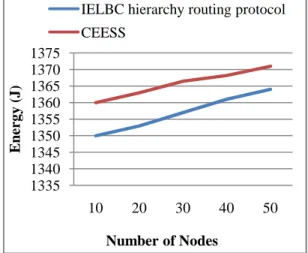
Fig . 2: comparison of Energy consumption vs. Number of Nodes
Fig 2 shows that the graphical representation of energy consumption for different number of nodes in WSN. The IELBC hierarchy routing protocol has low energy consumption when compared with the existing system CEESS. Because the proposed cluster formation has achieved maximum load distribution.
Lifetime Evaluation:
Fig 3 shows the lifetime of the proposedIELBC hierarchy routing protocol and existing CEESS. In this figure, both two schemes lifetime is decreases when to increasesthe node number. As the number of nodes in the WSN increases, the load of the storage node in CEESS and that of the nodes energy consumption is high. It is noted that the lifetime of the WSN in IELBC hierarchy protocol does not change too much as the node number increases. Because, the data effective time is small, almost all the queries meet the desired event data in the IELBC. So, IELBC has high network life time.
Fig. 3: comparison of Network lifetime vs. Number of Nodes
Delay Evaluation:
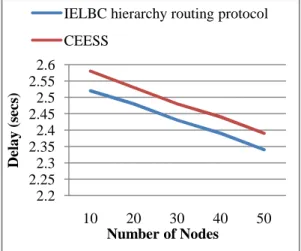
Fig 4 shows graphical representation of average delay of data storage in CEESS and proposed IELBC hierarchy routing protocol. It is obvious that the average delay of IELBC hierarchy protocol is much less than that in CEESS. In IELBC, the event data routing is easier than existing routing protocol. Besides, there are
1335 1340 1345 1350 1355 1360 1365 1370 1375
10 20 30 40 50
E
n
er
g
y
(
J
)
Number of Nodes
IELBC hierarchy routing protocol
CEESS
905 910 915 920 925 930 935
10 20 30 40 50
L
if
eT
im
e(
se
cs
)
Number of Nodes
IELBC hierarchy routing protocol
many nodes located in the IELBChierarchy protocol, and they just need to store the data generated by themselves close by, which can greatly decrease the average delay of data storage and retrieval.
Fig. 4: Comparison of Delay vs. Number of Nodes
Throughput Evaluation:
Fig 5 shows the throughput comparison of the proposed IELBC hierarchy routing protocol and the existing CEESS. It illustrated the proposed protocol attains higher throughput when compared with the existing algorithm. Because, the likelihood to meet the desired event data in a short hop count is very high in such a way.
Fig. 5: Comparison of throughput vs. Number of Nodes
Packet Delivery Ratio (PDR) Evaluation:
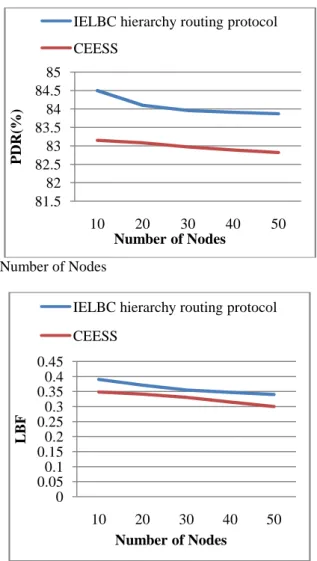
Fig 6 shows the comparison PDR of the proposed IELBC hierarchy routing protocol approach and the existing CEESS. PDR is defined as the ratio of total messages transmitted to total messages received at the destination. In CEESS, some of the messages may drop due to congestion and buffer overflow at the clusterheads, this results in the drop of PDF whereas IELBC hierarchy protocol performed load balancing and this improves PDR.
Load balancing factor:
Load balancing factor is defined asŒ•T = Ž
∑•cdP|(ac€•)D|Q
A higher value of LBFsignifies animproved load distribution, and thenit is inclined to infinity for a perfectly balanced system. The existing CEESS has non-uniform distribution of the load on the clusterheads. Proposed work distributes the load uniformly and an improved load balancing factor is showed in fig7.
2.2 2.25 2.3 2.35 2.4 2.45 2.5 2.55 2.6
10 20 30 40 50
D
el
a
y
(
se
cs
)
Number of Nodes
IELBC hierarchy routing protocol
CEESS
605 610 615 620 625 630 635 640
10 20 30 40 50
D
el
a
y
(
se
cs
)
Number of Nodes
IELBC hierarchy routing protocol
Fig. 6: Comparison of PDR vs. Number of Nodes
Fig. 7: Load balancing factor Vs Number of Nodes
Conclusion:
This research paper presented an Improved Energy-efficiency with Load Balanced Clustering (IELBC) hierarchy routing protocol is proposed for balancing the load with energy efficiency in cluster WSNs. The cluster head selection is based on voting and priority ideas. Proposed scheme chooses the mainly reliable and steady node as cluster-head depending on five criteria i.e. position, mobility, distance, density distribution, and residual energy of the node.It also uses a multi agent based routing algorithm generated load balanced routes between source and destination nodes. The optimal routing with stable manner is carried out by Improved Bat Algorithm (IBA). Uniform distribution of the load on the selected clusterheads can improve the performance in terms of PDR, throughput, delay and lifetime and energy consumption. In future research, concentrate on balancing the network load by adopting the cluster-based algorithms and optimizing the location of cluster head.
REFERENCES
Al-Karaki, J. and E. Kamal, 2004. “Routing techniques in wireless sensor networks: a survey,”IEEE Personal Communications, 11(6): 6-28.
Yu, Y., R. Govindan, D. Estrin, 2001. Geographical and Energy Aware Routing. UCLA ComputerScience Department Technical Report UCLA/CSD-TR-01-0023.
Dai, H. and R. Han, 2003. “A node-centric load balancing algorithm for WSNs,” In Proceedingsof IEEE GLOBECOM, 1: 548-552.
Gao, J. and L. Zhang, 2004. “Load balancing shortest path routing in wireless networks,” Proc.IEEE INFOCOM, 2: 1098-1107.
Chen, M., T. Kwon and Y. Choi, 2006. “Energy-efficient differentiated directed diffusion forreal-time traffic in wireless sensor networks,” Elsevier Computer Communications, 29(2): 231-245.
Jin Wang, Tinghuai Ma and Jinsung Cho, 2011 “An Energy Efficient and Load Balancing Routing Algorithm for Wireless Sensor Networks”, ComSIS 8(4).
81.5 82 82.5 83 83.5 84 84.5 85
10 20 30 40 50
P
D
R
(%)
Number of Nodes
IELBC hierarchy routing protocol
CEESS
0 0.05 0.1 0.15 0.2 0.25 0.3 0.35 0.4 0.45
10 20 30 40 50
L
B
F
Number of Nodes
IELBC hierarchy routing protocol
J´anos Levendovszky, K´alm´an Tornai, Gergely Trepl´an, Andr´as Ol´ah, 2011. “Novel load balancing algorithms ensuring uniform packet loss probabilities for WSN” , 978-1-4244-8331-0/11/$26.00.
Rauthan, J.S., S Mishra, 2012. “An Improved Approach in Clustering Algorithm for Load Balancing in Wireless Sensor Networks”, ISSN: 2278 – 1323, International Journal of Advanced Research in Computer Engineering & Technology, 1(5).
Vanaja, K. and R. Umarani, 2012. An Adaptive Fault Tolerant Multipath Routing Protocol for Wireless Ad Hoc Networks.European Journal of Scientific Research, ISSN 1450-216X. 79(2): 180-190.
Tapiwa, M., Chiwewe and Gerhard P. Hancke, 2012. A Distributed Topology Control Technique for Low Interference and Energy Efficiency in Wireless Sensor Networks. IEEE Transactions on Industrial Informatics, 8(1): 11-19.
Francesco, M.D., G. Anastasi, M. Conti, S.K. Das and V. Neri, 2011. Reliability and energy-efficiency in IEEE 802.15. 4/ZigBee sensor networks: an adaptive and cross-layer approach.Selected Areas in Communications, IEEE Journal, 29(8): 1508-1524.
Juan V Capella, Angel Perles, Alberto Bonastre & Juan J Serrano, 2011. ‘Historical Building Monitoring Using an Energy-Efficient Scalable Wireless Sensor Network Architecture’, Sensors, pp: 10074-10093.
Yuping Dong, Hwa Chang, Zhongjian Zou and Sai Tang, 2011. ‘An Energy Conserving Routing Algorithm for Wireless Sensor Networks’, International Journal of Future Generation Communication and Networking, 4(1): 39-54.
El Ghazi, A., B. Ahiod and A. Ouaarab, 2014. “Improved Ant Colony Optimization Routing Protocol for Wireless Sensor Networks,” in P. G. Noubir and M. Raynal (Eds.): NETYS, pp: 246-256.
Ren, F., S.K. Das and C. Lin, 2011. “Traffic-Aware Dynamic Routing to Alleviate Congestion in Wireless Sensor Networks,” IEEE Transactions on Parallel and Distributed Systems, 22(9).
Baoshu, X. and W. Hui, 2010. “A reliability transmission routing metric algorithm for wireless sensor network”, In Proceedings of the IEEE International Conference E-Health Networking, Digital Ecosystems and Technologies (EDT), 1: 454-457.
Zhang, H., L. Li, X. Yan, X. Li, 2011. “A Load Balancing Clustering Algorithm of WSN for Data Gathering”, 978-1-4577-0536-6/11.
Laszlo, E., K. Tornai, G. Treplan and J. Levendovszky, 2011. “Novel Load Balancing Scheduling Algo. For Wireless Sensor Networks”, CTRQ 2011 : The Fourth International Conference on Communication Theory, Reliability, and Quality of Service IARIA.
Nam, C.S., Y.S. Han and D.R. Shin, 2011. Multihop Routing Based on Optimization of the number of cluster heads in Wireless Sensor Networks, Sensors, 11: 2875-2884; doi:10.3390/s110302875.
Nurhayati, S.H., Choi and K.O. Lee, 2011. “A cluster Based Energy Efficient Location Routing Protocol in Wireless Sensor Networks”, International Journal of Computers And Communications, 5: 2.
Draves, R., J. Padhye, B. Zill, 2004. Routing in multi-radio, multi-hop wireless mesh networks. In Proceedings of the 10th annual international conference on Mobile computing and networking, pp: 114-128.
Wang, G. and L. Guo, 2013. “A Novel Hybrid Bat Algorithm with Harmony Search for Global Numerical Optimization,” Journal of Applied Mathematics, pp: 21.