RESEARCH ARTICLE
ACID: a free tool for drug repurposing using
consensus inverse docking strategy
Fan Wang
1,2†, Feng‑Xu Wu
1,2†, Cheng‑Zhang Li
1,2, Chen‑Yang Jia
1,2, Sun‑Wen Su
1,2, Ge‑Fei Hao
3*and Guang‑Fu Yang
1,2,4*Abstract
Drug repurposing offers a promising alternative to dramatically shorten the process of traditional de novo develop‑ ment of a drug. These efforts leverage the fact that a single molecule can act on multiple targets and could be ben‑ eficial to indications where the additional targets are relevant. Hence, extensive research efforts have been directed toward developing drug based computational approaches. However, many drug based approaches are known to incur low successful rates, due to incomplete modeling of drug‑target interactions. There are also many technical limitations to transform theoretical computational models into practical use. Drug based approaches may, thus, still face challenges for drug repurposing task. Upon this challenge, we developed a consensus inverse docking (CID) workflow, which has a ~ 10% enhancement in success rate compared with current best method. Besides, an easily accessible web server named auto in silico consensus inverse docking (ACID) was designed based on this workflow (http://chemy ang.ccnu.edu.cn/ccb/serve r/ACID).
Keywords: ACID, Web server, Drug repurposing, Consensus inverse docking
© The Author(s) 2019. This article is distributed under the terms of the Creative Commons Attribution 4.0 International License (http://creat iveco mmons .org/licen ses/by/4.0/), which permits unrestricted use, distribution, and reproduction in any medium, provided you give appropriate credit to the original author(s) and the source, provide a link to the Creative Commons license, and indicate if changes were made. The Creative Commons Public Domain Dedication waiver (http://creativecommons.org/ publicdomain/zero/1.0/) applies to the data made available in this article, unless otherwise stated.
Introduction
In recent years, the productivity challenge facing the pharmaceutical industry has become particularly diffi‑ cult to overcome [1]. By many estimates, the number of new molecular entity approved to market per billion US dollars spent on (research and development) R&D has halved roughly every one decade, falling around 80‑fold in inflation‑adjusted terms [2]. To increase drug‑dis‑ covery productivity, more and more attention has been paid to exploring the relationship between drug and disease, which can advance our knowledge of molecular mechanism of disease indication and lead to new strat‑ egies to treat productivity challenge [3, 4]. Nevertheless,
traditional strategies which typically oriented on a search for a novel therapeutic compound combined with dis‑ covery of a new therapeutic target are time consuming, expensive and risky because of the necessity for multiple experimental and clinical validation [5].
Drug repurposing/repositioning/rescue, the application of an existing drug to a new disease indication, is a prom‑ ising approach to address the ‘productivity gap’, especially the demand of rapid clinical impact at a lower cost by the ‘starting‑from‑scratch’ drug development [6]. Compared with brand new drug discovery for a given disease indica‑ tion, this method has several advantages. First, due to the existing drug has already been proved to be sufficiently safe in humans, the safety risk of clinical failure is much lower at least from a safety point of view. Second, due to the safety assessment and most of formulation task have already been completed, the development cycle should be largely reduced. Third, the investment is always less [7]. These advantages have made the development of repur‑ posed drugs into a task of low risk investments with faster and higher returns. Hence, Drug repurposing is drowning widespread attention from the pharmaceutical industry, government agencies and academic institutes,
Open Access
*Correspondence: [email protected]; [email protected] †Fan Wang and Feng‑Xu Wu co‑first authors.
1 Key Laboratory of Pesticide & Chemical Biology, Ministry of Education, College of Chemistry, Central China Normal University, Wuhan 430079, People’s Republic of China
3 State Key Laboratory Breeding Base of Green Pesticide and Agricultural Bioengineering, Key Laboratory of Green Pesticide and Agricultural Bioengineering, Ministry of Education, Research and Development Center for Fine Chemicals, Guizhou University, Guiyang 550025, People’s Republic of China
such as ‘Discovering New Therapeutic Uses for Existing Molecules Plan’ by NIH (USA). However, drug repurpos‑ ing is vastly more complicated than typically imagined and to date there has not been a systematic approach to identify repurposing opportunities.
In order to reduce the number of “wet” experiments and thereby reduce cost, extensive research efforts have been directed toward developing computational (virtual or in silico) approaches, which have been proved extremely valu‑ able in identifying potential opportunities in these fields. Of the several techniques for generating computational repo‑ sitioning hypotheses, inverse/reverse docking, involved docking an existing drug in the potential binding cavities of a set of clinically relevant disease targets, is proving to be a powerful tool for drug repositioning [8, 9]. Inverse docking is ‘one ligand‑many targets’ scenario, representing a struc‑ ture‑based computational strategy. Different with the con‑ ventional drug virtual screening, inverse virtual screening was performed for a small‑molecule against a large collec‑ tion of binding‑sites of clinically relevant macromolecular targets. The top‑ranking targets based on the binding com‑ plementarity (shape and electrostatics) with the drug are likely to result in potential drug repositioning. Hence, effi‑ cient tools were developed for inverse docking, for example, INVDOCK [10], TarFisDock [11], PDTD [12], and idTar‑ get [13]. Moreover, successful drug repurposing examples along with these tools are steadily grows, such as sildenafil and thalidomide [14]. Since the basic philosophy behind reverse docking is the same with docking and the critical parameters of the docking programs were always optimized based on some of the specific ligand and target systems, the performance in docking pose search itself and scoring of the docked poses may, thus, still face challenges for reverse docking methods. Up to date, many studies have proved that the consensus strategy that combining several types of docking algorithm can achieve higher success rates in pose prediction than single docking algorithm [15]. Hence, devel‑ opment of consensus inverse docking algorithms to address the inherent difficulties involved in the molecular docking, is extremely valuable in identifying potential opportunities of drug repurposing [9]. In addition, due to that almost all current docking tools are designed for ‘one ligand‑many targets’ scenario, the usability of tools for inverse virtual screening task is occasionally restricted by code‑writing dependencies and tedious operation steps, which bring challenges for non‑expert users. Therefore, there is still a strong demand for a new free server of inverse docking.
Hence, we developed a computational protocol by combining the results of several dissimilar types of free docking method into a consensus inverse docking (CID) scheme. Here, we selected AutoDock Vina, LEDOCK, PLANTS, and PSOVina for binding pose search as they represent significantly different docking methodologies
(i.e., different conformational search algorithm, different global and local optimizers, and different scoring func‑ tions) and have employed different collections of crystal complexes and binding data to calibrate their optimiza‑ tion algorithms. In addition, we used Molecular Mechan‑ ics/Poisson–Boltzmann Surface Area (MM/PBSA) and X‑SCORE for final binding energy calculation as they are more rigorous than the intrinsic scoring function in principle. The intention was to investigate whether inte‑ gration of these to develop a consensus strategy to the inverse docking problem would result in improvements in posing accuracy and prediction of binding modes. Besides, in order to significantly reduce user time for data gathering and multi‑step analysis for drug repurposing task, an comprehensive web platform named Auto in sil‑ ico consensus inverse docking (ACID) (http://chemy ang. ccnu.edu.cn/ccb/serve r/ACID) with a user‑friendly inter‑ face was also designed for an easy evaluation and appli‑ cation of this strategy, which consists of the following three tools: (i) an automated consensus inverse docking workflow program, (ii) a compound database containing 2086 approved drugs with original therapeutic informa‑ tion, (iii) a known target database containing 831 protein structures from PDB covering 30 therapeutic areas.
Methods
Selection of test set
The PDB‑bind database is a large collection of protein− ligand crystal complexes with associated experimentally determined binding data [16]. A total of 16,151 protein– ligand entries are contained in the PDB‑bind database. In all protein–ligand entries, there are 4463 entries with good quality structural and binding data. The experimen‑ tal resolution of any chosen crystal structure should be lower than 3.0 Å, because adopting structures with poor resolution may generate false predicted conformations [17]. No NMR‑solved structures were selected in our benchmark dataset. Any complexes with ligands contain‑ ing off‑standard atom types (like Si or Be) were rejected. Finally, we only chose complexes with a single drug like molecule bound in the active site. Hence, a subset con‑ tains 195 complex structures of these have been selected as the “core set”, aiming to provide high‑quality com‑ plexes that represents a broad cross‑section of the data‑ base. This is of appropriate size for evaluation studies of docking and scoring performance [18].
Preparation of structures for inverse docking
hydrogen atoms under the protonation state simulated to pH = 7.0. The AMBER ff14SB [19] force field were adopted for charge assignment. The MOL2 format representation of each receptor was prepared by SPORES tool in Plants software package. The Autodock Tools 1.5.4 utility pre‑ pare_receptor4.py was used to assign Gasteiger charges to atoms. The Autodock Tools utility prepare_ligand4.py was used to assign Gasteiger charges and rotatable bonds. The input grid files were prepared by dms and sphgen_cpp tools of DOCK software package.
Selection of docking softwares
Seven docking softwares were carefully evaluated to build consensus strategy, including AUTODOCK [20], VINA [21], DOCK [22], PLANTS [23], PSOVINA [24], LEDOCK (http://www.lepha r.com) and GOLD [25]. This selection covers a wide variety of conformation search algorithm and scoring function (Additional file 1: Table S1), thus repre‑ senting an abundant source for optimizing the consensus protocol. The docking calculation was performed on the prepared dataset of 195 receptors and ligands by using these seven docking softwares based on default param‑ eters. The box within the surrounding 12.5 Å of the bound ligand was defined as active site. 100 conformations for each ligand versus its corresponding active site were pro‑ duced by each software. The one with highest score were selected as the final pose.
Binding free energy calculation
Before binding free energy calculation, the Sander module in Amber16 [26] program was used to perform the three‑ step optimization of the ligand‑receptor complex. Firstly, only waters, ions and hydrogens were allowed to move. Secondly, the backbone atoms of the protein were fixed while others were allowed to move. Thirdly, all the atoms of the system were free to move. In the three optimization process, 2000 steps steepest descent method followed by 2000 steps conjugated gradient method were used for each ligand‑receptor binding system. Finally, the binding free enegy (ΔGbind) is calculated by using the MM/PBSA [27, 28] and X‑score methods [29, 30].
As for the X‑score method, it is assumed that the over‑ all binding free energy in a protein‑ligand binding process can be divided into several terms (shown in Eq. 1) [31]. Here, ΔGvdw represents the van der Waals interaction between the receptor and the ligand; ΔGH‑bond represents the hydrogen bonding between the receptor and the ligand; ΔGdeformation represents the deformation effect; ΔGhydrophobic represents the hydrophobic effect; ΔG0 represents a regres‑ sion constant. ΔGbind value between the receptor and ligand could be calculated simply by the X‑score software package.
In the MM/PBSA method [32], the free energy of the receptor/protein‑inhibitor binding, ∆Gbind, is obtained from the difference between the free energies of the receptor/protein‑ligand complex (Gcpx) and the unbound receptor/protein (Grec) and ligand (Glig). The binding free energy (ΔGbind) was evaluated as a sum of the changes in the binding energy (ΔEbind), solva‑ tion entropy (−TΔSsol), and conformational entropy (−TΔSconf) (shown in Eq. 2) [33]. Where ∆Ebind is interaction energies between a ligand and a protein, which were computed using the Sander modules of the Amber16 program. The entropy contribution to the binding free energy (−T∆S) was obtained by using a local program developed in our own laboratory [33].
Server implementation
As shown in Additional file 1: Figure S1, ACID web server mainly consists of three parts: Model (M), View (V) and Controller(C). Model is an object, which can provide a series of convenient APIs to access data‑ base. View represents the web service available for users. Controller is a Perl script program to control the whole consensus inverse docking protocol. A dedi‑ cated Linux machine in the high‑performance com‑ puter cluster is used to run ACID web server. PHP (version 5.6), Apache (version 2.0.51), HTML5 and Javascript are used in the web application to provide online web service. The web server was established in the ‘Linux + Apache + MySQL + PHP + Javascript’ framework. The web interface is written in JavaScript using the React.js (input page, output page, and dataset visualization) and Ember.js (results and analysis pages) frameworks. The server side is written as a Python Cor‑ nice Web Framework with a GO component for rapid searching. A Torque management system is used to queue submitted jobs. The database which stores cor‑ responding messages and results of each task is imple‑ mented by using MySQL (version 5.1.73). Results are stored for one month before deletion. The JSmol inter‑ active molecular viewer plugin (http://www.jmol.org/) is applied in structure visualization. Firefox or Chrome explorer is recommended for browsing the server. Com‑ puter Screen with resolution higher than 1440 × 900 is recommended for displaying the web pages.
(1) Gbind=Gvdw+GH−bond+Gdeformation
+Ghydrophobic+G0
Results and discussion
Consensus inverse docking strategy
Consensus strategy may have relatively higher pose pre‑ diction performance than single docking software [34]. Hence, to select suitable docking methods to construct consensus inverse docking protocol, conformation pre‑ diction performance of these softwares was carefully evaluated. The final pose of each software was selected according to docking score. The RMSD value between each pose and its original conformation in complex crystal were calculated. If the RMSD < 2.0 Å, the cor‑ responding pose prediction was success. The testing results are shown in Additional file 1: Figure S2. In our benchmark, GOLD software with GoldScore showed a slightly higher accuracy 66%. Taking the commercial copyright restriction into account, four academically free softwares, including VINA (63%), PLANTS (62%), PSOVINA (64%), and LEDOCK (64%) were selected to construct the consensus inverse docking method.
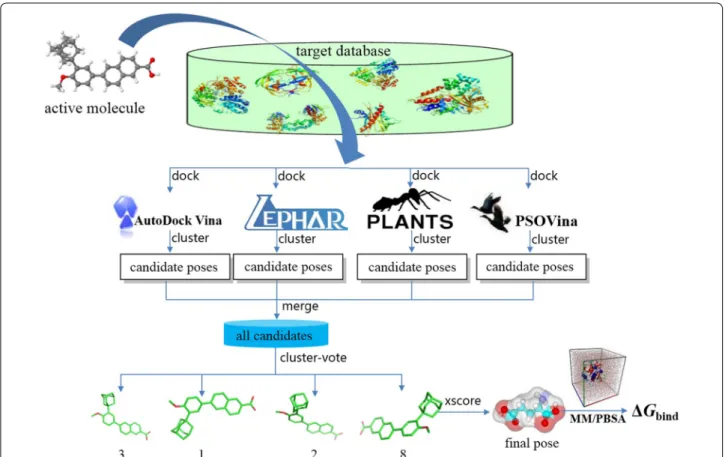
The consensus strategy can simulate a real‑life voting process, because a wide range of voting processes can effectively avoid mistakes in decisions. Hence, a well‑ designed conformational cluster‑vote strategy was opti‑ mized by using these four softwares (shown in Fig. 1). The
detailed process of CID is like the following: First, initial 3D conformations of the given active molecule was gen‑ erated and optimized by using MMFF94 force field [35]. Secondly, the optimized conformation was docked into the active site of each protein and four subsets of dock‑ ing conformations were produced, which contain the poses independently predicted by a certain docking pro‑ gram. Third, the conformational clustering is performed in each conformational group. We calculate the RMSD value between each pose and create a similarity matrix in a conformational group. The conformations with RMSD value lower than 2.0 Å can be considered as the same conformational cluster. The vote value of each conforma‑ tional cluster is equal to the pose number in this cluster. The conformation with best score can be used as a repre‑ sentative of this conformational cluster. Finally, the num‑ ber of conformational cluster of each individual docking method could be obtained.
A set of representative conformations from each dock‑ ing algorithm were selected to efficiently inspect different guided search algorithms for correct conformation of a protein–ligand complex. The representative conforma‑ tion of each conformational cluster from the four dock‑ ing methods was used to make up a new conformational
ensemble, and then the same clustering method is per‑ formed to select the strongly binding conformations. The number of conformation is the number of votes. For example, if a conformation cluster from LEDOCK was also predicted by PSOVina, Vina, and PLANTS, that has the RMSD value lower than the threshold value of 2.0 Å, such a conformation cluster is qualified as 4 votes. The higher the vote number, the higher the support rate of the conformational cluster. In the case of vote dataset, the highest quality predicted conformation cluster has 4 votes. However, if there are two or more top clusters have the same votes, the pose number obtained by each dock‑ ing method will be taken into account to judge. Finally, the highest vote conformational cluster was used to per‑ form binding affinity calculation with X‑score and MM/ PBSA methods [29, 30].
Performance and comparison with existing tools
A collection of target structures with the information of approved therapeutic drugs and potential ligand bind‑ ing cavities is the prerequisite of drug repurposing. Since this database is used to search the probable binding pro‑ teins for existing drugs by using inverse docking, it only contains the proteins with 3D structures. The target pro‑ teins were selected from several online databases such as DrugBank [36], Uniprot [37], and PDB [38]. In order to integrate with consensus inverse docking protocol, drug target structure database should be constructed to store each protein in both PDB format and mol2 format with basic information, including docking parameters and active site information. Finally, we collected a database of experimentally confirmed 831 drug targets and 2086 drug compounds. To evaluate the performance of CID protocol, the screening was performed on the 831 experi‑ mentally confirmed drug targets and 51 out of the 2086 collected commercial drugs were selected to compose a test set according to the two criterias. (1) The cocrystal structures of the drug and its targets should be available. (2) The drugs in the test set should have a wide represen‑ tation of the whole commercial drug dataset. The ligand flexibility, which can be assessed by the number of rotat‑ able bond, can have a major impact on the performance of docking method. According to number of rotatable bonds, the distribution of whole commercial drug data‑ set and 51 sampled drugs were quite similar (shown in Additional file 1: Figure S3), which demonstrated that our testing samples have a wide representation.
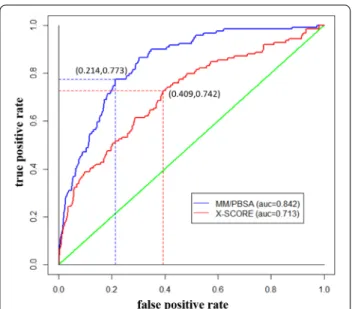
To analyze of the performance of the prediction, we performed the receiver operating curve (ROC) analysis [39], which is a graphical plot to illustrate the diagnostic ability of a binary classifier system. According to its dis‑ crimination threshold, the area under the ROC (AUC) values can be used to evaluate the ability to distinguish
between target and non‑target. The known targets of each drug were considered as positive samples, the other proteins in our screening dataset were considered as negative set. Although it does not eliminate the possi‑ bility that some of them may interact with these drugs, the number of this kinds of protein is less. In our per‑ formance test, ROC analysis was used to compare the performance of the prediction between MM/PBSA and Xscore. The AUC was computed based on the follow‑ ing: If the true targets are ranked in the top 10%, it was considered as true positive. If the true targets are ranked out side of the top 10%, it was considered as false nega‑ tive. If the non‑targets are ranked in the top 10%, it was considered as false positive. If the non‑targets are ranked out side of the top 10%, it was considered as true nega‑ tive. Figure 2 shows the ROC curves and the AUC, which is used to assess the discriminative performance of MM/ PBSA (AUC = 0.842) and XScore (AUC = 0.713). It shows that MM/PBSA outperforms XScore in our per‑ formance test, which could be due to the nature of the general applicability and the universal physical scale of the energy calculation methods [40]. In addition, we also retain a higher false positive rate for MM/PBSA (21.4%) and Xscore (40.9%). It may probably due to that the num‑ ber of negative sample is much larger, hence even a low error rate of negative samples may cause many false posi‑ tive predictions.
The binding free energies calculated by MM/PBSA method were further analyzed to examine the bind‑ ing of a variety of proteins to drug (listed in Additional file 1: Table S2). The “TRUE” value under “2%, 5%, and
10%” column means that the known targets of the test‑ ing drug are identified in the top 2%, 5%, and 10% of the corresponding results. While “FALSE” means the known targets are identified out of the top 10%. As shown in Additional file 1: Table S3, 35 assessed drugs showed significant enrichment of their known targets in the top 10%. In addition, 18 assessed drugs were identified in the top 2%. Therefore, the top 2%, top 5% and top 10% predic‑ tion success rate were 35.29%, 52.94% and 68.63% respec‑ tively. Taking the tricyclic antidepressants Amitriptyline as an example, 9 known targets out of 11 extracted from literatures and other databases was identified in top 10%. 5J03 appeared among top 11% ranked proteins. 4PMP is a false negative as it did not appear among the 100 best ranked structures.
In order to evaluate if there is an improvement, the con‑ formation prediction performance of CID protocol was compared with individual docking method. According
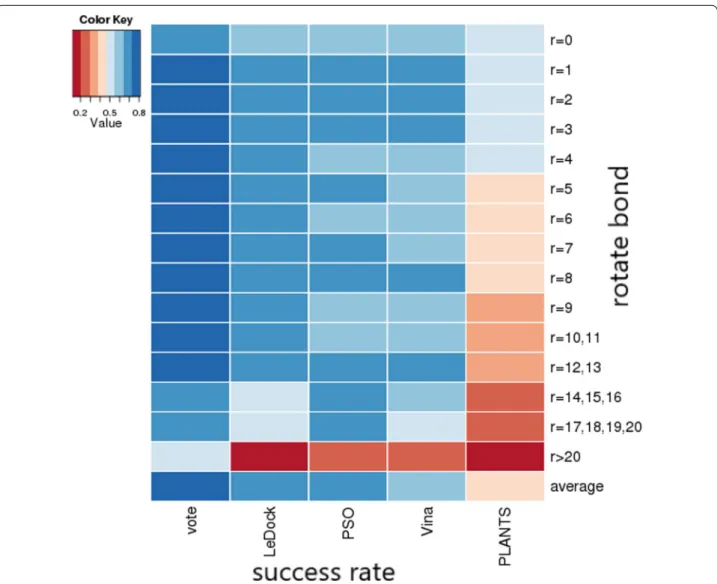
to the criterion of top 10%, CID protocol showed signifi‑ cant higher pose prediction performance (74.4%), which is around 10% improvement in comparison with the best result obtained from LEDOCK (64%). The prediction performance of other individual docking method is 64% (PSOVina), 63% (Vina), 42% (PLANTS), which are statis‑ tically analyzed according to the successfully predicted drugs of 30 in LEDOCK, 30 in PSOVina、29 in Vina, 20 in PLANTS. In addition, it is important to evaluate that if the docking accuracy can be improved on ligands with more rotatable bonds. The novel CID protocol showed a higher successful rate in a wider range of rotatable bonds compared with any individual docking method. The dis‑ tribution of the docking results according to the number of rotatable bonds are shown in Fig. 3. Therefore, it was proved that CID protocol may have relatively higher pre‑ diction performance than these single docking methods.
Meanwhile, we also compared the prediction perfor‑ mance of ACID with other drug repurposing prediction tools. Due to the different requirement in drug repurpos‑ ing study, there was not a uniform standard or a same dataset to evaluate drug repurposing prediction perfor‑ mance. Hence, we use several criterion like AUC and TOP as indicators to evaluate the predictive performance of these studies. Compared with other drug repurpos‑ ing prediction tools, the AUC indicator of ACID is 0.84, which is a little lower than idTarget. But the sample set of ACID is 51 drugs and 91 known targets, which much larger than idTarget and TarFisDock. In addition, ACID can find 62 known targets in Top 2%, 76 known targets in Top 5%, and 91 known targets in Top 10%, which is bet‑ ter than TarFisDock. Compared with similarity compari‑ son based approaches, the prediction accuracy of ACID are still dominant. However, due to the nature of struc‑ tural comparison between small molecules, the similar‑ ity comparison based approaches may offer advantages such as faster computations and a larger tested sam‑ ple number. While, docking based approaches includes three dimentional structures, structural optimization, conformational search, and binding energy calculation, which would obviously increase the computational cost. Thus the test sample set is much smaller than similarity
approach. However, they can potentially identify novel targets for the drug which may be relevant for its mecha‑ nism of action or side effect profile. Based on the above analysis, we can infer that ACID keeps better or compar‑ ative predictive ability compared with similar tools. The detailed methods, sample sets, and accuracy of compari‑ son were summarized in Table 1 [10, 11, 13, 41–44].
Server usage and case study
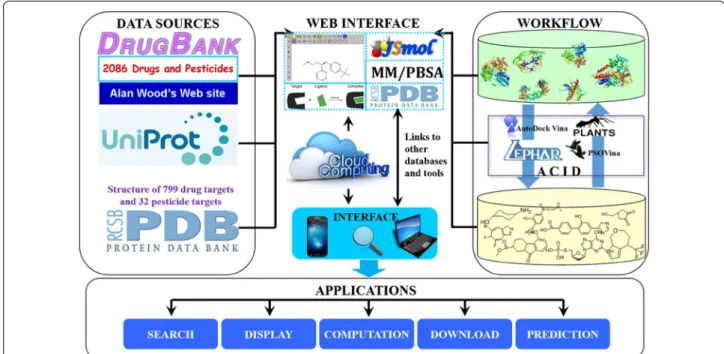
In order to make online consensus inverse docking avail‑ able, we build a public web server ACID. The bench‑ scientists can take advantage of the consensus inverse docking method. Data collection, integration, web inter‑ face, and applications of ACID were shown in Fig. 4. One can search a commercial drug automatically by entering keywords in the keyword search box, such as drug name, CAS no or InChI key. As shown in Fig. 5, the drug repur‑ posing tasks can be submitted either by uploading or drawing molecule in the JSME plugin. Then, each ligand was converted into the Simplified Molecular Input Line Entry Specification (SMILES) representation by OpenBa‑ bel [45] tools (http://openb abel.sourc eforg e.net/). The 3D input of each ligand was produced from its SMILES using Corina (http://www.mol‑net.de) [46]. In addition, the user need to customize target list from target database.
Table 1 Several drug repurposing tools compared with ACID
a The sample set is number of positive/negative interactions for the similarity comparison based approaches, and is number of drugs/known targets/decoys for
docking algorithm based approaches
b The AUC (Area Under Curve) is used to represent the prediction performance in the references cited, the closer the AUC value is to 1, the better the prediction
performance is
c The TOP is the percentage of the top 2%/5%/10% candidates identified by the tools (except INVDOCK) to represent the prediction performance in the references
cited, the higher the value of the TOP, the better the performance
d For HitPick, a sensitivity of 60.94%, a specificity of 99.99% and a precision of 92.11% is indicated in the references cited, normally, we can infer that the AUC of this
tool is smaller than 0.61
e For INVDOCK, the TOP is the percentage of candidates identified by the tool, but the top percentage isn’t indicated in the references cited, the maximum value 50 is
indicated
Name Method Sample seta Prediction performance Date of last update Refs.
AUC b TOP(2%/5%/10%)c
Similarity comparison based approaches
ChemMapper 3D similarity approach 216/7069 0.7 – Dec 2016 [25]
ChemProt 3.0 2D similarity approach 248/1700 0.827 – Jan 2015 [26]
HitPick 1NN similarity search
approach 3430/3116926 0.61
d – May 2013 [27]
SwissTarget‑prediction Combination of 2D and 3D
similarity approach 346/1730 0.87 – Apr 2014 [28]
Docking algorithm based approaches
idTarget Divide and conquer based
docking approach 1/3/1161, 1/4/1161 0.89, 0.91 – Aug 2015 [13]
INVDOCK Inverse docking approach 2/23/2700 – 50%e May 2001 [10]
TarFisDock Reverse docking approach 1/10/37, ··· 1/12/371 – 33%/33%/58%,
30%/20%/50% Aug 2014 [11]
ACID Consensus inverse docking
Fig. 4 Schematic diagram describing data collection, integration, web interface, and applications of ACID web server
An ID number is generated for the submitted job. The user can use the ID to check the status of the job on this web server. The binding models (in PDB format) of the molecule bound with the candidate targets can be down‑ loaded through the “Download” hyperlink or browsed after clicking the “Show” hyperlink.
To evaluate the usage of the ACID web server, two examples are presented here. First, we show a test case using Citalopram as the query structure to find its poten‑ tial target proteins via ACID server. Table S3 gives the results of predicted binding affinities. The protein tar‑ get of Citalopram, namely sodium‑dependent serotonin transporter (Rank 1, top 2%) as validated in the scien‑ tific report [47] are identified by ACID. Interestingly, the binding pose of Citalopram against sodium‑dependent serotonin transporter with the rmsd of 0.98 Å compared to the crystal pose, indicating the reliability of this server. Another example shows that not only the intended tar‑ gets could be identified by ACID, but also other proteins, leading to ‘off‑target’ effects, which may have pharmaco‑ logical consequences for drug repurposing. Amitriptyline is a classic medicine with multiple targets. The primary use is to treat a number of mental illnesses. It is particu‑ larly noteworthy that a very novel Amitriptyline repur‑ posing is for treatment of triple‑negative breast cancer by targeting on Poly (ADP‑ribose) polymerase‑1 (PARP1) [48], which is also predicted in the top 10% (rank 59) by ACID server. In addition, other uses include preven‑ tion of migraines, treatment of neuropathic pain such as fibromyalgia and postherpetic neuralgia.
Conclusion
At the end of block‑buster era for drug discovery, drug repurposing is a promising approach to address the ‘pro‑ ductivity gap’ that the global pharmaceutical giants are currently facing, which will improve the drug‑discovery productivity. Inverse docking is proving to be a powerful tool for drug repurposing, which involves docking a drug in the potential binding cavities of a set of clinically rele‑ vant macromolecular targets. The critical issues related to inverse docking part are the prediction of correct binding pose and the estimation of some measure of the binding affinity. We have evaluated of several docking methods for inverse docking applications since the effectiveness of these methods in multiple target identification is unclear. A con‑ sensus inverse docking protocol was developed, which has a ~ 10% enhancement in success rate compared with the best single docking algorithm. Finally, an comprehensive web platform with a user‑friendly interface was designed based on this protocol for drug repurposing to significantly reduce user time for data gathering and multi‑step analysis without human intervention, which consists of the follow‑ ing three tools: (i) an automated consensus inverse docking
workflow program, (ii) a compound database containing 2086 approved drugs with original therapeutic informa‑ tion, (iii) a known target database containing 831 protein structures from PDB covering 30 therapeutic areas. Differ‑ entiated with other tools, ACID outperforms other stan‑ dalone algorithm in a better accuracy and more efficient way in summary.
Supplementary information
Supplementary information accompanies this paper at https ://doi. org/10.1186/s1332 1‑019‑0394‑z.
Additional file 1. Additional tables and figures.
Abbreviations
ADP‑ribose: adenosine diphosphate ribose; AUC : area under the ROC curve; CAS: chemical abstracts service; CID: consensus inverse docking; JSME: JavaScript Molecule Editor; InChI: international chemical identifier; MM/PBSA: molecular mechanics/Poisson–Boltzmann surface are; NIH: The National Insti‑ tutes of Health; PDB: protein data bank; NMR: nuclear magnetic resonance; PDTD: potential drug target database; RMSD: root‑mean‑square deviation; ROC: receiver operating characteristic curve; SMILES: simplified molecular input line entry specification.
Acknowledgements
The authors thank Prof. C. Y. Hu from University of Hawaii for advice during the writing.
Authors’ contributions
G‑FH and G‑FY initiated the consensus inverse docking study. FW, C‑ZL, and S‑WS developed the protocol of consensus inverse docking. FW and F‑XW tested the performance described in the paper. FW and C‑ZL developed the server and performed the analyses. FW, F‑XW, and C‑YJ set up the server. G‑FH, G‑FY, and FW wrote the manuscript. All authors read and approved the final manuscript.
Funding
This research was supported in part by the National Key R&D Program (2017YFD0200501), the National Natural Science Foundation of China (Nos. 21772059, 91853127, and 31960548).
Availability of data and materials
All source code is available under open licenses on GitHub repository: https :// githu b.com/fwang ccnu/ACID. All datasets of this study can be downloaded under open licenses from the download page of the free web server http:// chemy ang.ccnu.edu.cn/ccb/serve r/ACID.
Competing interests
The authors declare that they have no competing interests.
Author details
1 Key Laboratory of Pesticide & Chemical Biology, Ministry of Education, Col‑ lege of Chemistry, Central China Normal University, Wuhan 430079, People’s Republic of China. 2 International Joint Research Center for Intelligent Biosen‑ sor Technology and Health, Central China Normal University, Wuhan 430079, China. 3 State Key Laboratory Breeding Base of Green Pesticide and Agri‑ cultural Bioengineering, Key Laboratory of Green Pesticide and Agricultural Bioengineering, Ministry of Education, Research and Development Center for Fine Chemicals, Guizhou University, Guiyang 550025, People’s Republic of China. 4 Collaborative Innovation Center of Chemical Science and Engineer‑ ing, Tianjing 300072, People’s Republic of China.
References
1. Shih HP, Zhang XD, Aronov AM (2018) Drug discovery effectiveness from the standpoint of therapeutic mechanisms and indications. Nat Rev Drug Discov 17:19–33
2. Scannell JW, Blanckley A, Boldon H, Warrington B (2012) Diagnosing the decline in pharmaceutical R&D efficiency. Nat Rev Drug Discov 11:191–200
3. Anighoro A, Bajorath J, Rastelli G (2014) Polypharmacology: challenges and opportunities in drug discovery. J Med Chem 57:7874–7887 4. Santos R, Ursu O, Gaulton A, Bento AP, Donadi RS, Bologa CG, Karlsson A,
Al‑Lazikani B, Hersey A, Oprea TI, Overington JP (2017) A comprehensive map of molecular drug targets. Nat Rev Drug Discov 16:19–34 5. Dudley JT, Deshpande T, Butte AJ (2011) Exploiting drug‑disease relation‑
ships for computational drug repositioning. Brief Bioinform 12:303–311 6. Corsello SM, Bittker JA, Liu Z, Gould J, McCarren P, Hirschman JE, Johnston
SE, Vrcic A, Wong B, Khan M et al (2017) The drug repurposing hub: a next‑generation drug library and information resource. Nat Med 23:405–408
7. Pushpakom S, Iorio F, Eyers PA, Escott KJ, Hopper S, Wells A, Doig A, Guil‑ liams T, Latimer J, McNamee C et al (2018) Drug repurposing: progress, challenges and recommendations. Nat Rev Drug Discov 18:41–58 8. Kharkar PS, Warrier S, Gaud RS (2014) Reverse docking: a powerful tool for
drug repositioning and drug rescue. Futur Med Chem 6:333–342 9. Lee A, Lee K, Kim D (2016) Using reverse docking for target identification
and its applications for drug discovery. Expert Opin Drug Dis 11:707–715 10. Chen YZ, Zhi DG (2001) Ligand‑protein inverse docking and its potential use in the computer search of protein targets of a small molecule. Pro‑ teins 43:217–226
11. Zhang H, Li H, Jiang H, Shen J, Chen K, Yang K, Yu K, Kang L, Zhu W, Luo X et al (2006) TarFisDock: a web server for identifying drug targets with docking approach. Nucleic Acids Res 34:W219–W224
12. Gao Z, Li H, Zhang H, Liu X, Kang L, Luo X, Zhu W, Chen K, Wang X, Jiang H (2008) PDTD: a web‑accessible protein database for drug target identi‑ fication. BMC Bioinf 9:104–111
13. Wang JC, Chu PY, Chen CM, Lin JH (2012) idTarget: a web server for iden‑ tifying protein targets of small chemical molecules with robust scoring functions and a divide‑and‑conquer docking approach. Nucleic Acids Res 40:W393–W399
14. Liu Z, Fang H, Reagan K, Xu X, Mendrick DL, Slikker W, Tong W (2013) In silico drug repositioning—what we need to know. Drug Discov Today 18:110–115
15. Plewczynski D, Łażniewski M, Grotthuss MV, Rychlewski L, Ginalski K (2011) VoteDock: consensus docking method for prediction of protein– ligand interactions. J Comput Chem 32:568–581
16. Wang R, Fang X, Lu Y, Wang S (2004) The PDBbind database: collection of binding affinities for protein–ligand complexes with known three‑dimen‑ sional structures. J Med Chem 47:2977–2980
17. Jones G, Willett P, Glen RC, Leach AR, Taylor R (1997) Development and validation of a genetic algorithm for flexible docking. J Mol Biol 267:727–748
18. Li Y, Liu Z, Li J, Han L, Liu J, Zhao Z, Wang R (2014) Comparative assess‑ ment of scoring functions on an updated benchmark: 1. Compilation of the test set. J Chem Inf Model 54:1700–1716
19. Maier JA, Martinez C, Kasavajhala K, Wickstrom L, Hauser KE, Simmerling C (2015) ff14SB: improving the accuracy of protein side chain and back‑ bone parameters from ff99SB. J Chem Theory Comput 11:3696–3713 20. Garrett MM, Ruth H (2009) Software news and updates AutoDock4 and
AutoDockTools4: automated docking with selective receptor flexibility. J Comput Chem 30:2785–2791
21. Trott O, Olson AJ (2010) Software news and UPDATE AutoDock Vina: improving the speed and accuracy of docking with a new scoring function, efficient optimization, and multithreading. J Comput Chem 31:455–461
22. Allen WJ, Balius TE, Mukherjee S, Brozell SR, Moustakas DT, Lang PT, Case DA, Kuntz ID, Rizzo RC (2015) DOCK 6: impact of new features and current docking performance. J Comput Chem 36:1132–1156 23. Korb O, Stutzle T, Exner TE (2009) Empirical scoring functions for
advanced protein‑ligand docking with plants. J Chem Inf Model 49:84–96
24. Ng MCK, Fong S, Siu SWI (2015) PSOVina: the hybrid particle swarm optimization algorithm for protein‑ligand docking. J Bioinf Comput Biol 13:1–18
25. Verdonk ML, Cole JC, Hartshorn MJ, Murray CW, Taylor RD (2003) Improved protein‑ligand docking using GOLD. Proteins 52:609–623 26. Case DA (2016) Kollman PA Amber 2016. University of California, San
Francisco
27. Sun H, Li Y, Tian S, Xu L, Hou T (2014) Assessing the performance of MM/PBSA and MM/GBSA methods. 4. Accuracies of MM/PBSA and MM/GBSA methodologies evaluated by various simulation protocols using PDBbind data set. Phys Chem Chem Phys 16:16719–16729 28. Chen F, Liu H, Sun H, Pan P, Li Y, Li D, Hou T (2016) Assessing the
performance of the MM/PBSA and MM/GBSA methods. 6. Capability to predict protein‑protein binding free energies and re‑rank binding poses generated by protein–protein docking. Phys Chem Chem Phys 18:22129–22139
29. Wang R, Lai L, Wang S (2002) Further development and validation of empirical scoring functions for structure‑based binding affinity predic‑ tion. J Comput Aided Mol Des 16:11–26
30. Cristian OP, Jaime RM (2007) Comparative evaluation of MMPBSA and XSCORE to compute binding free energy in XIAP‑peptide complexes. J Chem Inf Model 47:134–142
31. Wang R, Lu Y, Wang S (2003) Comparative evaluation of 11 scoring functions for molecular docking. J Med Chem 46:2287–2303 32. Hou TJ, Wang JM, Li YY, Wang W (2011) Assessing the performance
of the molecular mechanics/poisson boltzmann surface area and molecular mechanics/generalized born surface area methods. II. The accuracy of ranking poses generated from docking. J Comput Chem 32:866–877
33. Hao GF, Zhu XL, Ji FQ, Zhang L, Yang GF, Zhan CG (2009) Understanding the mechanism of drug resistance due to a codon deletion in protopor‑ phyrinogen oxidase through computational modeling. J Phys Chem B 113:4865–4875
34. Paul N, Rognan D (2002) ConsDock: a new program for the consensus analysis of protein–ligand interactions. Proteins 47:521–533
35. Halgren TA (1996) Merck molecular force field. I. Basis, form, scope, param‑ eterization, and performance of MMFF94. J Comput Chem 17:490–519 36. Wishart DS, Feunang YD, Guo AC, Lo EJ, Marcu A, Grant JR, Sajed T, John‑
son D, Li C, Sayeeda Z et al (2018) DrugBank 5.0: a major update to the DrugBank database for 2018. Nucleic Acids Res 46:D1074–D1082 37. Wu CH, Apweiler R, Bairoch A, Natale DA, Barker WC, Boeckmann B, Ferro
S, Gasteiger E, Huang HZ, Lopez R et al (2006) The universal protein resource (UniProt): an expanding universe of protein information. Nucleic Acids Res 34:D187–D191
38. Berman H, Henrick K, Nakamura H, Markley JL (2007) The worldwide protein data bank (wwPDB): ensuring a single, uniform archive of PDB data. Nucleic Acids Res 35:D301–D303
39. Sing T, Sander O, Beerenwinkel N, Lengauer T (2005) ROCR: visualizing classifier performance in R. Bioinformatics 21:3940–3941
40. Wang JC, Lin JH, Chen CM, Perryman AL, Olson AJ (2011) Robust scoring functions for protein–ligand interactions with quantum chemical charge models. J Chem Inf Model 51:2528–2537
41. Liu XF, Ouyang SS, Yu BA, Liu YB, Huang K, Gong JY, Zheng SY, Li ZH, Li HL, Jiang HL (2010) PharmMapper server: a web server for potential drug target identification using pharmacophore mapping approach. Nucleic Acids Res 38:W609–W614
42. Kringelum J, Kjaerulff SK, Brunak S, Lund O, Oprea TI, Taboureau O (2016) ChemProt‑3.0: a global chemical biology diseases mapping. Datab J Biol Datab Curation 2016:1–7
43. Liu XP, Vogt I, Haque T, Campillos M (2013) HitPick: a web server for hit identification and target prediction of chemical screenings. Bioinformat‑ ics 29:1910–1912
44. Gfeller D, Grosdidier A, Wirth M, Daina A, Michielin O, Zoete V (2014) Swis‑ sTargetPrediction: a web server for target prediction of bioactive small molecules. Nucleic Acids Res 42:W32–W38
•fast, convenient online submission
•
thorough peer review by experienced researchers in your field
• rapid publication on acceptance
• support for research data, including large and complex data types
•
gold Open Access which fosters wider collaboration and increased citations maximum visibility for your research: over 100M website views per year
•
At BMC, research is always in progress.
Learn more biomedcentral.com/submissions
Ready to submit your research? Choose BMC and benefit from:
46. Sadowski J, Schwab CH, Gasteiger J (2003) 3D structure generation and conformational searching. Computational medicinal chemistry and drug discovery. Dekker Inc, New York, pp 2151–2212
47. Plenge P, Wiborg O (2005) High‑ and low‑affinity binding of S‑citalopram to the human serotonin transporter mutated at 20 putatively important amino acid positions. Neurosci Lett 383:203–208
48. Fu L, Wang S, Wang X, Wang P, Zheng Y, Yao D, Guo M, Zhang L, Ouyang L (2016) Crystal structure‑based discovery of a novel synthesized PARP1
inhibitor (OL‑1) with apoptosis‑inducing mechanisms in triple‑negative breast cancer. Sci Rep 6:3–18
Publisher’s Note