DIVISION OF LABOR STANDARDS ENFORCEMENT MARCH 2013
WHICH IWC ORDER?
Classifications
2
This pamphlet is intended as a guide in determining the
classifications of businesses and occupations under the Industrial
Welfare Commission Orders.
These guidelines and classifications of employees are general in
nature and the existence of specific facts and circumstances of
the employment relationship and operations of a particular
employer may require a different determination of proper
classification that the general one set forth herein.
As new types of businesses and occupations are constantly coming
into existence, there undoubtedly are businesses and occupations
that have not been included herein. Additionally, as industry
practices and business structures evolve, circumstances may dictate
the change in classification of a particular occupation from one
wage order to another wage order.
Employers are advised that while courts may find this pamphlet to
be useful in determining the classification of business and
occupations under the Industrial Welfare Commission Orders,
courts are not required to follow the classifications of occupations
listed herein and that compliance with the guidelines suggested
herein do not establish a “safe harbor” for classifying an employee
within a particular wage order.
3
TABLE OF CONTENTS
Page
CLASSIFICATION OF EMPLOYEES: INDUSTRY OR OCCUPATION ORDER? ... 4
SEPARATE UNITS OF MULTI-PURPOSE COMPANIES ... 5
INCIDENTAL HOUSEKEEPING ACTIVITIES ... 5
CLASSIFICATION OF CROPS AND ACTIVITIES UNDER IWC ORDERS 8, 13 and 14 ... 6
EXEMPT EMPLOYEES/OCCUPATIONS ... 10
IWC ORDER COVERAGE ... 12
Order 1 – MANUFACTURING INDUSTRY ... 12
Order 2 – PERSONAL SERVICE INDUSTRY ... 14
Order 3 – CANNING, FREEZING, AND PRESERVING INDUSTRY ... 14
Order 4 – PROFESSIONAL, TECHNICAL, CLERICAL, MECHANICAL and SIMILAR OCCUPATIONS ... 15
Order 5 – PUBLIC HOUSEKEEPING INDUSTRY ... 18
Order 6 – LAUNDRY, LINEN SUPPLY, DRY CLEANING AND DYEING INDUSTRY ... 20
Order 7 – MERCANTILE INDUSTRY ... 21
Order 8 – INDUSTRIES HANDLING PRODUCTS AFTER HARVEST ... 22
Order 9 – TRANSPORTATION INDUSTRY ... 23
Order 10 – AMUSEMENT AND RECREATION INDUSTRY ... 24
Order 11 – BROADCASTING INDUSTRY ... 25
Order 12 – MOTION PICTURE INDUSTRY ... 26
Order 13 – INDUSTRIES PREPARING AGRICULTURAL PRODUCTS FOR MARKET, on the FARM ... 27
Order 14 - AGRICULTURAL OCCUPATIONS ... 28
Order 15 – HOUSEHOLD OCCUPATIONS ... 30
Order 16 – OCCUPATIONS in the CONSTRUCTION, DRILING, LOGGING and MINING INDUSTRIES .... 30
Order 17 – MISCELLANEOUS EMPLOYEES ... 33
4
CLASSIFICATION OF EMPLOYEES: INDUSTRY OR OCCUPATION ORDER?
In order to determine which Industrial Welfare Commission (IWC) Order applies to an employer
or a business, it is first necessary to determine if a business is covered by an industry order. An
industry order (IWC Orders 1, 2, 3, 5, 6, 7, 8, 9, 10, 11, 12, and 13) regulates wages, hours and
working conditions in specific industries. An order is an industry order if the title of the order
contains the word “industry.” Otherwise, the order is an occupational order (IWC Orders 4, 14,
15, 16 and 17). Wage, hour and working condition regulations contained in an occupational
order only apply when a business is not covered by an industry order.
Examples of IWC Orders, industry or occupational?
1.
IWC Order 1 (manufacturing industry) applies to an office assistant employed by a
company that builds automobiles because the company is covered by an industry order.
2.
IWC Order 4 (an occupational order) applies to an office assistant employed in a law firm
because a law firm is not covered by an industry order.
3.
IWC Order 5 (public housekeeping industry) applies to a nurse employed by a hospital
because a hospital is covered by an industry order.
4.
IWC Order 4 (an occupational order) applies to a nurse employed by a doctor’s office
because a doctor’s office is not covered by an industry order.
5.
IWC Order 7 (mercantile industry) applies to a bookkeeper in a retail store operation
because retail stores are covered by an industry order.
6.
IWC Order 4 (an occupational order) applies to a bookkeeper in an accounting firm
because and accounting firm is not covered by an industry order.
Note: It is very important that you first determine if a business is covered by any industry order.
If not, you must look to one of the occupational orders for coverage. Please refer to the index of
businesses and occupations for examples of proper application.
A business is classified according to the main purpose of the business except in IWC Order 5
(see section below on Incidental Housekeeping Activities). Large businesses may conduct a
variety of operations and it may appear initially that different industry orders could apply.
However, when those operations are part of the main business, only one order will apply.
Example:
A business’s main purpose is operating a warehouse and incidental thereto employs a
separate sales staff to sell goods. IWC Order 9 covers this operation even though sales are
covered under IWC Order 7 because the main purpose of the business is to operate a
warehouse.
5
SEPARATE UNITS OF MULTI-PURPOSE COMPANIES
Distinct operations in multi-purpose businesses may be covered by different industry orders if
they are operated for different business purposes, and the management is separately organized at
all levels.
Example:
A retail department store (IWC Order 7) owns a restaurant (IWC Order 5) that is located on
the department store premises but is operated as a separate corporate entity. These businesses
are covered by different industry orders because they are operated for different business
purposes, and the management is separately organized at all levels.
Please note that problems in determining correct order coverage occur when businesses are of a
mixed nature. They are best resolved by making a broad assessment of the principal purpose of
the business. This does not mean auditing receipts to compare income from sales and service,
but determining the nature of the business by simple observation and common sense.
INCIDENTAL HOUSEKEEPING ACTIVITIES
IWC Order 5 does not limit coverage to businesses whose main purpose is providing meals,
housing, or maintenance services whether operated as a primary business or when incidental to
other operations in an establishment not covered by an industry order.
Examples:
IWC Order 1 covers a factory that operates a cafeteria. IWC Order 5 does not cover it.
IWC Order 5 covers a private school which is not covered by an industry order and which
provides dormitories or dining facilities.
Where a concessionaire contracts to operate lodging or dining facilities, IWC Order 5 covers
the concessionaire’s business, but the rest of the enterprise (school or factory) is classified
otherwise.
6
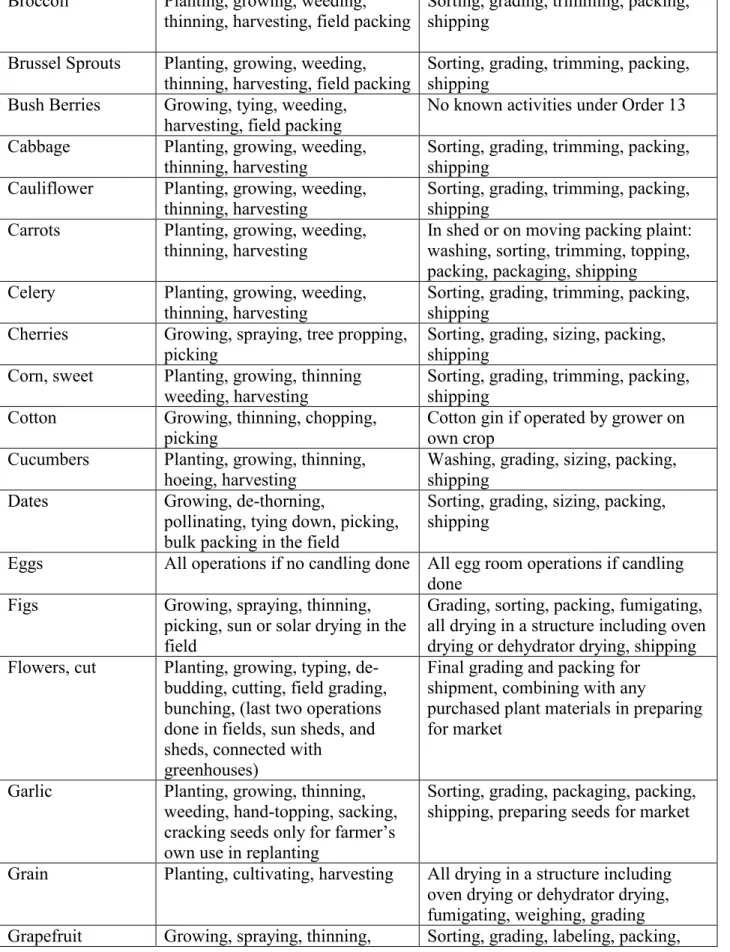
CLASSIFICATION OF CROPS AND ACTIVITIES UNDER IWC ORDERS 8, 13, and 14
Agricultural occupations covered by Order 14 are related to the maintenance of soil, buildings
and machinery which constitute the basic farm facilities, and to the cultivation and handling of
farm commodities up through harvest, including field packing and transportation to the place of
first processing or distribution.
Not all employees of farm employers are covered by Order 14. If the grower has a packing or
processing operation in a permanently fixed structure or moving packing plant, the packing or
processing operations workers would fall under Wage Order 13.
A.
Activities under Order 13 must be performed:
1.
On the farmer’s own crop
2.
In a permanent structure or on a moving packing plant (lettuce, carrots, dry onions)
3.
In preparation for market (i.e. distribution)
B.
Order 8 applies to similar operations on the farm if they include:
1.
Handling any agricultural products, other than the grower’s own after harvest or
2.
Any packing of a purchased crop or
3.
Cooperative warehousing, cooling, grading, sorting, packing, ginning, etc., or
4.
Preparing any product for distribution except for the farmer’s own product.
Commodity
Order 14
Order 13
Almonds
Growing, spraying, knocking,
gathering, sun or solar drying in
the field
Hulling, shelling, sorting, grading,
processing, packing, all drying in a
structure including oven drying or
dehydrator drying, fumigating,
shipping
Apples
Growing, spraying, tree propping,
thinning, picking
Washing, sorting, grading, fumigating,
Packing, shipping
Apricots
Growing, spraying, thinning,
picking, hand cutting, spreading,
sun or solar drying in the field
Sorting, grading, moisturizing, all
drying in a structure including oven
drying or dehydrator drying, packing,
packaging, shipping
Artichokes
Planting, growing, weeding,
thinning, picking, field packing
Washing, sorting, grading, trimming,
packing, shipping
Asparagus
Planting, growing, weeding,
thinning, harvesting, field packing
Washing, sorting, grading, trimming,
packing, shipping
Avocados
Growing, spraying, tree propping,
picking
Washing, sorting, grading, packing,
shipping
Beans (dry)
Planting, growing, weeding,
harvesting
Shelling, washing, sorting, grading,
packing, shipping, packaging
Beans (snap)
Planting, growing, weeding,
7
Broccoli
Planting, growing, weeding,
thinning, harvesting, field packing
Sorting, grading, trimming, packing,
shipping
Brussel Sprouts
Planting, growing, weeding,
thinning, harvesting, field packing
Sorting, grading, trimming, packing,
shipping
Bush Berries
Growing, tying, weeding,
harvesting, field packing
No known activities under Order 13
Cabbage
Planting, growing, weeding,
thinning, harvesting
Sorting, grading, trimming, packing,
shipping
Cauliflower
Planting, growing, weeding,
thinning, harvesting
Sorting, grading, trimming, packing,
shipping
Carrots
Planting, growing, weeding,
thinning, harvesting
In shed or on moving packing plaint:
washing, sorting, trimming, topping,
packing, packaging, shipping
Celery
Planting, growing, weeding,
thinning, harvesting
Sorting, grading, trimming, packing,
shipping
Cherries
Growing, spraying, tree propping,
picking
Sorting, grading, sizing, packing,
shipping
Corn, sweet
Planting, growing, thinning
weeding, harvesting
Sorting, grading, trimming, packing,
shipping
Cotton
Growing, thinning, chopping,
picking
Cotton gin if operated by grower on
own crop
Cucumbers
Planting, growing, thinning,
hoeing, harvesting
Washing, grading, sizing, packing,
shipping
Dates
Growing, de-thorning,
pollinating, tying down, picking,
bulk packing in the field
Sorting, grading, sizing, packing,
shipping
Eggs
All operations if no candling done All egg room operations if candling
done
Figs
Growing, spraying, thinning,
picking, sun or solar drying in the
field
Grading, sorting, packing, fumigating,
all drying in a structure including oven
drying or dehydrator drying, shipping
Flowers, cut
Planting, growing, typing,
de-budding, cutting, field grading,
bunching, (last two operations
done in fields, sun sheds, and
sheds, connected with
greenhouses)
Final grading and packing for
shipment, combining with any
purchased plant materials in preparing
for market
Garlic
Planting, growing, thinning,
weeding, hand-topping, sacking,
cracking seeds only for farmer’s
own use in replanting
Sorting, grading, packaging, packing,
shipping, preparing seeds for market
Grain
Planting, cultivating, harvesting
All drying in a structure including
oven drying or dehydrator drying,
fumigating, weighing, grading
Grapefruit
Growing, spraying, thinning,
Sorting, grading, labeling, packing,
8
picking
shipping
Grapes, table
Growing, thinning, girdling,
pruning, typing, picking,
pick-packing (field)
Sorting, trimming, packing,
fumigating, labeling, shipping
Grapes, wine
Growing, thinning, girdling,
pruning, typing, picking,
pick-packing (field)
Wine production – all activities or
Order 8 if grapes used are not grown
“on the farm”
Hay
Planting, growing, cutting,
stacking, bailing
No known activities under Order 13
Honey
Removing from hive and cone,
rendering (rendering can be last
operation in field or first
operation in shed)
Rendering, heating, bottling, labeling,
cooling, whipping, place in cartons,
packing for shipment
Hops
Planting, growing, stringing,
weaving, separating, sun or solar
drying in the field, bulk bailing
Recompressing or any processing and
packaging after bulk bailing
Lemons
Growing, spraying, thinning,
picking
Sorting, grading, labeling, packing,
shipping
Lettuce
Planting, growing, hoeing,
harvesting, field packing
In shed or on moving packing plant:
sorting, trimming, packing, shipping
Melons
Planting, capping, hoeing,
picking, cutting
Sorting, sizing, labeling, packing,
shipping
Milk
Feeding and care of livestock,
milking
Cooling, separating, pasteurizing
Nectarines
Growing, spraying, thinning,
picking, hand-cutting, spreading,
sun or solar field drying
Sorting, grading, moisturizing, all
drying in a structure including oven
drying or dehydrator drying, packing,
packaging, shipping
Nursery
Products
Cuttings
Planting, growing, tying, cutting,
rooting
Grading and packing, rooted cuttings
for shipment
Olives
Growing, spraying, thinning,
picking
Curing, processing
Onions, dry
Growing, weeding, thinning,
harvesting, hand-topping, sacking
In shed or on moving packing plant:
sorting, trimming, (processing, if for
frozen pack), packing, packaging,
sacking, shipping
Onions, green
Growing, weeding, thinning,
harvesting
Washing, sorting, trimming, bunching,
packing, shipping
Oranges
Growing, spraying, picking
Sorting, grading, washing, labeling,
packing, shipping
Peaches
Growing, spraying, thinning,
picking, hand-cutting, spreading,
sun or solar field drying
Sorting, grading, moisturizing, all
drying in a structure including oven
drying or dehydrator drying, packing,
packaging, shipping
9
Pears
Growing, spraying, tree-propping,
picking, hand-cutting, spreading,
sun or solar field drying
Sorting, grading, moisturizing, all
drying in a structure including oven
drying or dehydrator drying,
packaging, shipping
Peas
Planting, growing, hoeing,
picking, field packing
Washing, sorting, trimming, packing,
shipping
Peppers
Planting, growing, picking,
thinning, field packing
Washing, waxing, packing, shipping
Plants
Planting, growing, tying, potting
and repotting, transporting to
market
Seasonal, fancy or decorative potting
Plums
Growing, spraying, thinning,
picking
Sorting, grading, packing, shipping
Pomegranates
Growing, spraying, thinning,
picking
Sorting, grading, packing, labeling,
shipping
Potatoes
Planting, growing, weeding,
harvesting, sacking
Washing, sorting, sacking
Potatoes, seed
Planting, growing, weeding,
harvesting, sacking
Sorting and cutting for seed, sacking
Prunes
Growing, spraying, thinning,
picking, sun or solar field drying
Sorting, grading, moisturizing all
drying in a structure including oven
drying or dehydrator drying,
fumigating, packing, packaging,
shipping
Raisins
Growing, girdling, pruning,
harvesting, sun or solar field
drying
Sorting, grading, moisturizing, all
drying in a structure including oven
drying or dehydrator drying,
fumigating, packing, packaging,
shipping
Rice
Planting, growing, harvesting
No known activities under Order 13
Strawberries
Planting, growing, weeding,
thinning, picking, boxing
Sorting, grading, packing, labeling,
shipping
Strawberry
Plants
Planting, growing, weeding
Trimming, inspecting, packaging,
packing, shipping
Tangerines
Growing, spraying, picking
Washing, sorting, packing, shipping
Tomatoes
Planting, growing, weeding,
thinning, harvesting, field packing
Washing, sorting, packing, shipping
Tomatoes,
Canning
Sorting on harvesting machine
No known activities under Order 13
Vegetables,
Misc.
Planting, growing, weeding,
thinning, harvesting, field packing
Washing, sorting, trimming, packing,
shipping
Walnuts
Growing, spraying, knocking,
gathering, sun or solar field
drying
Hulling, shelling, sorting, processing,
packing, all drying in a structure
including oven drying or dehydrator
drying, fumigating, shipping
10
EXEMPT EMPLOYEES/OCCUPATIONS
These employees/occupations are exempt from specified sections of the Industrial Welfare
Commission Orders. They are
not exempt from provisions of the Labor Code. Exempt
occupations must meet the criteria stated in Section 1, Applicability and/or Section 2,
Definitions, of the applicable IWC Orders. Each order must be reviewed carefully.
Accountants
Exempt from Sections 3-12, orders 1-13, 15, and 16
Actors, professional
ONLY
Sections 1, 2, 4, 10 and 20 of Orders 10, 11, and
12 are applicable; exempt from all other provisions of
Orders 10, 11, and 12
Administrative, executive,
professional employees
Exempt from Sections 3-12, Orders 1-13, 15, and 16
Architects
Exempt from Sections 3-12, Orders 1-13, 15, and 16
Attendants, personal
ONLY
Sections 1, 2, 4, 10 and 15 of Order 15 are
applicable; exempt from all other provisions of Order 15
Attorneys
Exempt from Sections 3-12, Orders 1-13, 15, and 16
Baby sitters (under 18 years, sitting
for child of employer in employer’s
home)
Exempt from Order 15
Carnival (traveling) operators
(full-time)
ONLY
Sections 1, 2, 4, 10 and 20 of Order 10 are
applicable; exempt from all other provisions of Order 10
Certified Public Accountants
Exempt from Sections 3-12, Orders 1-13, 15, and 16
Dentists
Exempt from Sections 3-12, Orders 1-13, 15, and 16
Doctors
Exempt from Sections 3-12, Orders 1-13, 15, and 16
Engineers
Exempt from Sections 3-12, Orders 1-13, 15, and 16
Government Employees
ONLY
Sections 1, 2, 4, 10, and 20 of all Orders are
applicable, with one exception: Irrigation District
employees are covered under the provisions of Order 14
Inside Salespersons
Exempt from Subsections 3(A), (B) and (C) of Orders 4
and 7, if earnings equal more than 1 ½ times the
minimum wage and if more than ½ of employees
compensation represents commissions
Individuals participating in a national
service program
Exempt from all Orders
Employees engaged in work that is
primarily intellectual, managerial, or
creative in nature
Exempt from Order 14 if employee exercises discretion
and independent judgment, and remuneration is not less
than two times the monthly State minimum wage for
full-time employment
Irrigators
Exempt from Subsection 3(A) or Order 14 if more than
½ of week’s working time is spent as an irrigator
Lawyers
Exempt from Sections 3-12, Orders 1-13, 15, and 16
Nurse, student
ONLY
Section 1, 2, 4, 10, and 20 of Order 5 are
applicable to student nurses of a bona fide nursing
school, exempt from all other provisions of Order 5
Minor baby sitters (under 18, sitting
Exempt from Order 15
11
for child of employer in employer’s
home
Oculists
Exempt from Sections 3-12, Orders 1-13, 15, and 16
Operators, full-time, employed by
traveling carnivals
ONLY
applicable; exempt from all other provisions of Order 10
Sections 1, 2, 4, 10 and 20 of Order 10 are
Optometrists
Exempt from Sections 3-12, Orders 1-13, 15, and 16
Outside Salespersons
Exempt from all Orders (also Labor Code section 1171)
Parent, spouse, child or legally
adopted child of the employer
Exempt from all Orders
Personal attendants
ONLY
Sections 1, 2, 4, 10 and 15 of Order 15 are
applicable; exempt from all other provisions of Order 15
Professional actors
ONLY
Sections 1, 2, 4, 10 and 20 of Orders 10, 11, and
12 are applicable; exempt from all other provisions of
Orders 10, 11, and 12
Salespersons, outside
Exempt from all Orders (also Labor Code section 1171)
Salespersons, inside
Exempt from Subsections 3(A), (B) and (C) of Orders 4
and 7, if earnings equal more than 1 ½ times the
minimum wage and if more than ½ of employees
compensation represents commissions
Sheepherders
Exempt from Sections 3, 4(A)-(D), 5, 6, 9, 11, 12, and
13 of Order 14. Entire Order is applicable to any
workweek during which a sheepherder employee is
engaged in any non-sheep herding agricultural or other
work
Students in schools of beauty culture
offering beauty care to the public for
a fee
Exempt from Order 2
Student nurses
ONLY
Section 1, 2, 4, 10, and 20 of Order 5 are
applicable to student nurses of a bona fide nursing
school, exempt from all other provisions of Order 5
12
IWC ORDER COVERAGE
Order 1 – MANUFACTURING INDUSTRY
Definition, Section 2 (H)
“Manufacturing Industry” means any industry, business, or establishment operated for the
purpose of preparing, producing, making, altering, repairing, finishing, processing,
inspecting, handling, assembling, wrapping, bottling, or packaging goods, articles, or
commodities, in whole or in part; EXCEPT when such activities are covered by Order in
the : Canning, Preserving, and Freezing Industry; Industries Handling Products After
Harvest; Industries Preparing Agricultural Products for Market, on the Farm; or Motion
Picture Industry.
Aircraft and aircraft parts, manufacturing Apparel products, manufacturing Assembly (any manufacturing) Automobile manufacturing Auto-wrecking (non-retail) Blueprinting
Book and magazine publishers Cement
Ceramics
Coating lumber products
Communications equipment, manufacturing Concrete
Copy making services Dental laboratories
Developing, printing or editing of film (except in motion picture industry, see Order 12) Electronic products, manufacturing
Film processing (except in motion picture industry, see Order 12) Food manufacture (secondary processing)
Food processing
Baby formulas (except canned fruits, etc., see Order 3) Bakeries (non-retail)
Bottling (soft drinks) Breweries
Candy
Cane sugar refining (of purchased raw sugar or syrup) Citrus by-products
Cottonseed oil
Dehydrated soups and mixes Ice cream (beyond first processing) Margarine
Meat
Pet foods, dry Pizza manufacturing
Potato and corn chip manufacturing
Preparing fruit and vegetables for restaurants, bakeries, etc. Salad oil
Soft drinks, bottling Tortilla manufacturing Yeast
13
Galvanizing
Garment manufacturing Iron works
Laboratories, dental and optical Lumber products
Machinery, metal products Magazine and book publishers Meat processing
Metal fabrication
Metal products, machinery Microfilm services Needle trades Oil refining Optical laboratories Paper products Photocopy services Plastic products
Pre-fabricated housing (except on-site installation, see Order 16)
Public/private utilities, electrical only (for telephone, natural gas and water, utilities see Order 4) Publishing
Records, tapes and compact disks (reproduction for wholesale)
Recycling processing plants that alter/transform material (for non-processing recycling centers, see Order 4) Refineries, Oil
Refineries, sugar Repacking bulk products
Reweaving (except by laundries/dry cleaners, see Order 6) Rubber manufacturing
Sawmills
Sheet metal shops
Shipbuilding (except repair, see Order 9) Shoe manufacturing and repair
Steel smelters/plants Sugar refineries Taxidermy
Textile products, manufacturing
Utilities, public/private, electrical only (for telephone, natural gas and water, utilities see Order 4) Wastewater treatment facilities
14
Order 2 – PERSONAL SERVICE INDUSTRY
Definition, Section 2 (J)
“Personal Service Industry” means any industry, business or establishment operated for
the purpose of rendering, directly or indirectly, any service, operation or process used or
useful in the care, cleansing or beautification of the body, skin, nails, or hair, or in the
enhancement of personal appearance or health, including but not limited to, beauty
salons, schools of beauty culture offering beauty care to the public for a fee, barber shops,
bath and massage parlors, physical conditioning, weight control salons, health clubs, and
mortuaries.
Barbershops Bath parlors Beauty shops
Body building gymnasium, facility Funeral parlors
Gymnasiums, body building Health clubs
Massage parlors Mortuaries
Physical conditioning centers
Schools of beauty culture offering beauty care to the public for a fee (students are exempt) Sun tanning parlors
Weight control salons
Order 3 – CANNING, FREEZING, AND PRESERVING INDUSTRY
Definition, Section 2(B)
“Canning, Freezing, and Preserving Industry” means any industry, business or
establishment operated for the purpose of canning soups, or of cooking, canning, curing,
freezing, pickling, salting, bottling, preserving, or otherwise processing any fruits or
vegetables, seafood, meat, poultry, or rabbit product, when the purpose of such
processing is the preservation of the product and includes all operations incidental
thereto.
Canned pet food
Canned soups, stews, hash, etc.
Canning: fish, fruit, meat, poultry, rabbit, vegetables Fish; canning, freezing
Freezing: fish, fruit, meat, poultry, rabbit, vegetables Fruit; canning, freezing
Fruit jellies and preserves Hash, canned
Juice concentrates Meat: canning, freezing Pet foods, canned Poultry: canning, freezing Rabbit: canning, freezing Vegetables: canning, freezing
15
Order 4 – PROFESSIONAL, TECHNICAL, CLERICAL, MECHANICAL and SIMILAR
OCCUPATIONS
Definition, Section 2(O)
“Professional, Technical, Clerical, Mechanical and Similar Occupations” includes
professional, semiprofessional, managerial, supervisory, laboratory, research, technical,
clerical, office work, and mechanical occupations. Said occupations shall include, but not
be limited to, the following: accountants; agents; appraisers; artists; attendants;
audio-visual technicians; bookkeepers; bundlers; billposters; canvassers; carriers; cashiers;
checkers; clerks; collectors; communications and sound technicians; compilers; copy
holders; copy readers; copy writers; computer programmers and operators; demonstrators
and display representatives; dispatchers; distributors; door-keepers; drafters; elevator
operators; estimators; editors; graphic arts technicians; guards; guides; hosts; inspectors;
installers; instructors; interviewers; investigators; librarians; laboratory workers; machine
operators; mechanics; mailers; messengers; medical and dental technicians and
technologists; models; nurses; packagers; photographers; porters and cleaners; process
servers; printers; proof readers; sales persons and sales agents; secretaries; sign erectors;
sign painters; social workers; solicitors; statisticians; stenographers; teachers; telephone,
radio-telephone, telegraph and call-out operators; tellers; ticket agents; tracers; typists;
vehicle operators; x-ray technicians; their assistants and other related occupations listed
as professional, semiprofessional, technical, clerical, mechanical, and kindred
occupations.
Use of the asterisk (*) in the following list indicates Order 4, an occupational order, covers
the named and related occupations
only when they are not covered by an industry order.
They type of business determines the industry order.
*Accountants Accounting firms Advertising agencies *Agents
*Agronomist
Animal care services, no overnight shelter or feeding provided (see Order 5, when overnight shelter or feeding are provided) *Appraisers
Architectural offices *Artists
Associations, business (Chamber of Commerce, retailers’ associations, etc.) Athletic agents
*Attendants Attorney offices
*Audio-visual technicians Banks
*Billposters
Boats, office and support personnel *Bookkeeper
*Bundlers
Business Associations (Chamber of Commerce, retailers’ associations, etc.) Business services
Cable TV service and installation *Call-out operators
*Canvassers *Carriers *Cashiers
16
CemeteriesCharitable agencies (non-profit) *Checkers
Checkrooms Churches
*Cleaners and porters *Clerks
Collection agencies *Collectors
Colleges, private, no board or lodging
Commercial fishing boats, office and support personnel
Commercial photography (except in motion picture industry, see Order 12) Communications firms
*Communications technicians *Compilers
*Computer operators, programmers Construction, office and support personnel Contractors, office and support personnel *Copyholders
*Copyreaders *Copywriters Credit agencies Credit unions
Crop dusting, office and support personnel Dance schools, studios
Day care centers, no board or lodging provided *Demonstrators
Dental offices
*Dental technicians and technologists
Detective agencies, protective and investigative Direct mail advertising and service
*Display representatives *Dispatchers
Doctors’ offices *Drafters *Drivers (vehicle) Dumps/landfills *Editors
*Elevator operators Employment agencies Engineering firms *Estimators
Farm clerical and technical personnel when not covered by Order 14 or industry order Farm labor contractors
Finance companies
Fishing boats (commercial) office and support personnel Geophysical exploration
*Graphic arts technicians *Guards
*Guides
Hazardous materials cleanup and handling when contractor’s license not required (when contractor’s license required, see Order 16)
*Horticulturist *Hosts, hostesses *Inspectors
*Installers when contractor’s license not required (when contractor’s license required, see Order 16)
*Instructors Insurance companies Internet service providers *Interviewers
*Investigators Investment houses
17
Laboratories (independent research, testing, etc.)*Laboratory workers
Labor contractors (office and support personnel) Labor unions
Landfills/dumps Legal firms *Librarians Libraries Loan offices
Logging, office and support personnel *Machine operator
*Mailers *Mechanics
Medical clinics (apart from hospitals) *Medical technicians and technologists Mining, office and support personnel *Models
Nonprofit organizations (charitable, social agencies) *Nurses
Oculist offices *Packagers
Painting contractors, office and support personnel *Photographers
Photography, commercial *Porters and cleaners Portrait studios *Printers
Private schools, universities, colleges, no board or lodging provided (when board or lodging are provided, see Order 5) *Process servers
Professional offices (architects, attorneys, doctors, dentists, engineers) *Programmers, computer
*Proofreaders Protective agencies
Public/private utilities, water, natural gas, telephone (for electrical utilities, see Order 1) Public works, office and support personnel
*Radiotelephone operators
Real estate offices (brokerage only; see also Order 5) Recycling centers, non-processing
Repossession agencies Research and development *Sales agents
*Salespersons Savings and loan
Schools, private, no board or lodging provided (when board or lodging are provided, see Order 5) *Secretaries
*Security guards Security guard service Shopping services *Sign erectors *Sign painters Social agencies *Social workers *Solicitors *Sound technicians *Statisticians *Stenographers Stock brokerage firms Talent agents Tax Consultants *Teachers
*Telegraph operators
Telephone/Telegraph companies (includes cell/wireless phone service) Telephone answering service
18
*Telephone operators*Tellers
Temporary employment agencies *Ticket agents
*Tracers Travel agencies *Truck drivers *Typists
Universities, private, no board or lodging provided (when board or lodging are provided, see Order 5) *Vehicle operators
Veterinary service, no overnight shelter or feeding provided (when overnight shelter or feeding are provided, see Order 5) Water and oil well drilling and servicing firms, office and support personnel
*X-ray technicians
Use of the asterisk (*) in the following list indicates Order 4, an occupational order, covers
the named and related occupations
only when they are not covered by an industry order.
They type of business determines the industry order.
Order 5 – PUBLIC HOUSEKEEPING INDUSTRY
Definition, Section 2(P)
“Public Housekeeping Industry” means any industry, business, or establishment, which
provides meals, housing, or maintenance, services whether operated as a primary business
or when incidental to other operations in an establishment not covered by an industry
order of the Commission, and includes, but is not limited to the following:
(1)
Restaurants, nightclubs, taverns, bars, cocktail lounges, lunch counters, cafeterias,
boarding houses, clubs, and all similar establishments where food in either solid or
liquid form is prepared and served to be consumed on the premises;
(2)
Catering, banquet, box lunch service, and similar establishments, which prepare food
for consumption on or off the premises;
(3)
Hotel, motels, apartment houses, rooming houses, camps, clubs, trailer parks, office
or loft buildings, and similar establishments offering rental of living, business or
commercial quarters;
(4)
Hospitals, sanitariums, rest homes, child nurseries, child care institutions, homes for
the aged, and similar establishments offering board or lodging in additional to
medical, surgical, nursing, convalescent, aged or child care.
(5)
Private schools, colleges, or universities, and similar establishments which provide
board or lodging in addition to educational facilities;
(6)
Establishments contracting for development, maintenance or cleaning of grounds;
maintenance or cleaning of facilities and/or quarters of commercial units and living
units; and
(7)
Establishments providing veterinary or other animal care services.
Animal care services with overnight shelter or feeding (when no overnight shelter or feeding are19
Animal sanctuaries/shelters with overnight shelter or feeding (when no overnight shelter or Feeding are provided, see Order 4)
Apartment houses
Bakeries, with tables for patrons’ use Banquet service
Bars
Boarding and care homes for the aged Boarding houses
Box lunch services Cafeterias
Camps, day Camps, organized Catering service Childcare institutions Child nurseries
Cleaning of facilities, grounds, commercial units, living units Cocktail lounges
Colleges, private with board or lodging Commissaries
Convalescent hospitals Cookhouses in lumber camps Day camps
Day care centers that provide board or lodging Development of grounds
Donut shops, with tables for patrons’ use (if no tables are provided for patrons’ use, see Order 7) Drinking places
Dude ranch Eating-places
Farm labor camps with board or lodging Fraternity houses
Homes for the aged
Hospitals, including convalescent Hotels
Ice cream store, with tables for patrons’ use Janitorial service
Landscaping (except initial earth moving and cement work, see Order 16) Loft or office buildings
Logging camps with board or lodging Lunch counters
Lunch wagons
Maintenance of grounds, facilities, quarters of commercial units and living units
Mini-storage not connected with transportation firm (if connected with a transportation firm, see Order 9) Motels
Nightclubs, if food or drink is served incidental to main business of offering entertainment (if main business is serving food or drink, See Order 10)
Nurseries, child
Office and loft buildings Organized camps Pest control Pre-schools
Property management
Real estate offices, if business includes property management Restaurants
Rest homes Sanitariums
School, private, with board or lodging Sewer/septic cleaning
20
Sorority houses
Stables, with board and care
Storage, mini, not connected with transportation firm (if connected with a transportation firm, see Order 9) Taverns
Termite control Trailer parks Tree service firms
Universities, private, with board or lodging
Veterinary service that provides overnight shelter or feeding
Note: Order 5 covers all classifications of employees in an Order 5 business, such as a hospital,
whether they assist patients, clean rooms, do laundry, drive, keep books, etc. This is also true of
other industry orders.
Order 6 – LAUNDRY, LINEN SUPPLY, DRY CLEANING AND DYEING INDUSTRY
Definition, Section 2(H)
“Laundry, Linen Supply, Dry Cleaning and Dyeing Industry” means any industry,
business or establishment operated for the purpose of washing, ironing, cleaning,
refreshing, restoring, pressing, dyeing, storing, fumigating, mothproofing, or other
processes incidental thereto, on articles of fabrics of any kind, including but not limited to
clothing, hats, drapery, rugs, curtains, linens, household furnishings, textiles, furs, or
leather goods; and includes self-service laundries, self-service dry cleaning
establishments, and the collection, distribution, storage, sale or resale at retail or
wholesale of the foregoing services.
Carpet cleaning service, including in-home
Diaper service, if laundering included (if laundered elsewhere, see Order 7) Drapery cleaning service, including in-home
Dry cleaning, including self-service Dyeing plants
Laundries, including self-service Laundromats
Linen supply, if laundering included
Rental of uniforms, if laundering/cleaning included (if laundering/cleaning not included, see Order 7) Self-service laundries/dry cleaners
21
Order 7 – MERCANTILE INDUSTRY
Definition, Section 2(H)
“Mercantile Industry” means any industry, business, or establishment operated for the
purpose of purchasing, selling or distributing goods or commodities at wholesale or retail;
or for the purpose of renting goods or commodities.
Antique Stores, retail/wholesale Auction houses
Bakeries, retail, if no tables for patrons’ use (if bakery has tables for patrons’ use, see Order 5) Building materials, retail/wholesale
Commodity agents and brokers Commodity rentals
Costume rental
Diaper service, if laundered elsewhere (if laundering included, see Order 6)
Donut shops, if no tables for patrons’ use (if shop has tables for patrons’ use, see Order 5) Equipment rentals (except vehicles, see Order 9)
Flea markets
Florists, retail/wholesale
Gas stations (with or without car washes or garages) Hardware stores, retail/wholesale
Ice cream stores, if no tables are provided for patrons’ use Import-export, retail/wholesale
Irrigation systems (sales)
Linen supply, if laundering not included (if laundering included, see Order 6) Mail order houses, retail/wholesale
Nurseries, horticultural (main purpose selling) Optician (except manufacturer, see Order 1) Rental of commodities and goods
Rental of equipment (except vehicles, see Order 9)
Rental of uniforms, if laundering/cleaning not included (if laundering included, see Order 6) Retail stores
Rummage sales Solar equipment (sales) Telephone soliciting Thrift shops
Uniform rentals, if laundering/cleaning not included (if laundering included, see Order 6) Wholesale houses
Note: A retail store operating incidentally as part of another business; such as a gift shop operated by a hotel or hospital, is covered by the industry order applicable to the main business, i.e., the hotel or hospital (Order 5). A retail store operating on the premises of another business where the retail store is neither owned nor operated by the other business is covered y the industry order applicable to its type of business, which in this example, a retail store, is Order 7. A separate establishment under a distinctly separate organization, such as a telephone equipment store under the sales division of a telephone company, would be under Order 7, and not under Order 4, the order applicable to the telephone company. Each such situation must be analyzed on a case-by-case basis, as it depends upon the particular facts of the situation.
22
Order 8 – INDUSTRIES HANDLING PRODUCTS AFTER HARVEST
Definition, Section 2(H)
“Industries Handling Products After Harvest” means any industry, business or
establishment operated for the purpose of grading, sorting, cleaning, drying, cooling,
icing, dehydrating, cracking, shelling, candling, separating, slaughtering, picking,
plucking, shucking, pasteurizing, fermenting, ripening, molding, or otherwise preparing
any agricultural, horticultural, egg, poultry, meat, seafood, rabbit, or dairy product for
distribution, and includes all the operations incidental thereto.
Beet sugar mills
Citrus and deciduous fruit packing
Cooperatives (farmers’) for warehousing, grading, packing, cooling, etc. Cotton gins
Dairies (which process milk commercially) Deciduous and citrus fruit packing
Dried fruit processing Drying vegetables and fruit Egg candling and packing
Egg processing (washing, grading and bulk packing any eggs other than farmer’s own) Feed mills (commercial)
Fresh vegetable and fruit packing Fruit drying
Fruit (fresh) packing
Ice cream (made from whole milk as first processing) Meat slaughtering (commercial packing house)
Moving packing plant (operator brings rig into field, works on farmer’s crop on same basis as a commercial packing house)
Nut hulling, cracking, shelling, sorting and hauling Olive oil
Packing fresh vegetables and fruit
Packing plant, moving (operator brings rig into field, works on farmer’s crop on same basis as a commercial packing house)
Potato grading, sorting and bagging
Poultry processing, commercial packing house Rice drying (commercial)
Sausage making (at point of first processing) Slaughtering meat (commercial packing house) Sugar (beet) mills
Sugar or syrup directly from sugar cane Vegetable drying
Vegetables (fresh) packing
Note: A grower who processes the product of any other employer is engaged in a “commercial” operation. Most of the operations listed here if done by the grower on his or her own crop would be under Order 13, but the grinding and mixing of feed exclusively for the employer’s own use would be part of the care of farm animals under Order 14, even if done mechanically in a separate building (the grower’s own “feed mill”). All beet sugar mill operations are under Order 8, but cane sugar refining from purchased raw sugar or syrup (typical of the industry in California) is under Order 1. The production of sugar or syrup directly from sugar cane would be under Order 8. A firm in the business of making sausage or cold cuts from purchased cuts of meat would be manufacturing under Order 1.
23
Order 9 – TRANSPORTATION INDUSTRY
Definition, Section 2(N)
“Transportation Industry” means any industry, business or establishment operated for the
purpose of conveying persons or property from one place to another whether by rail,
highway, air or water, and all operations and services in connection therewith; and also
includes storing or warehousing of goods or property, and the repairing, parking, rental,
maintenance, or cleaning of vehicles.
Airlines
Ambulance service Armored car service Boat rentals Boats, cruise, ferry Bus lines
Buses, tour Car loading Car rentals
Car washes, when not in retail business Courier service
Cruise boats
Express and parcel delivery companies Ferryboats
Garages, repair (except when operated by vehicle dealer or gas station, see Order 7) Garages, storage
Garbage collectors Limousine service
Logging trucks, commercial (for on-site logging, see Order 16)
Maintenance of vehicles, e.g., garages, car washes, etc., if not connected with gas station or vehicle dealer (if connected with gas station or vehicle dealer, See Order 7)
Mini-storage connected with a transportation firm (if not connected with a transportation firm, see Order 5) Moving and storage warehousing (of commodities moved)
Parcel delivery service Parking lots
Railways
Rental of vehicles (cars, trucks, boats, ships, airplanes)
Repairs to vehicles (except when operated by vehicle dealer or gas station, see Order 7) Ship rental
Ship repair Stevedoring
Storage and moving warehouse (of commodities moved) Storage garages
Taxi service, including water taxis Tire aligning and balancing companies Tour buses, companies
Tow companies
Transportation companies
Trucking, including commercial trucking of farm products Truck rental
Vehicle rental, including boats and ships
Vehicle repairs (except when operated by vehicle dealer or gas station, see Order 7) Warehousing and storage (of commodities moved)
24
Note: Many kinds of industries employ people to operate and maintain vehicles and warehouses; transportation companies under Order 9 have that as their main purpose. A hotel employee who drives a van is under Order 5; a mechanic employed by a retail chain is under Order 7; a mini-storage facility not connected with a transportation firm is under Order 5; the building of vehicles, including ships, is under Order 1; a farm employee who delivers farm products to the first point of distribution is under Order 14, but a trucking company which is in the business of trucking mostly farm products is under Order 9; employees who balance and align tires are under Order 9, if their employer is in the business of providing that service but under Order 7 if their employer is basically in the business of selling tires.
Order 10 – AMUSEMENT AND RECREATION INDUSTRY
Definition, Section 2(A)
“Amusement and Recreation Industry” means any industry, business or establishment
operated for the purpose of furnishing entertainment or recreation to the public, including
but not limited to theaters, dance halls, bowling alleys, billiard parlors, skating rinks,
riding academies, race tracks, amusement parks, athletic fields, swimming pools,
gymnasiums, gold courses, tennis courts, carnivals, and wired music studios.
Academies, riding Amusement parks
Arena/auditoriums (multipurpose) Aquariums
Athletic fields Ballooning Billiard parlors Bingo parlors, games
Boating, golf, tennis, etc., clubs Boats, charter fishing
Botanical Gardens Bowling alleys Card rooms Carnivals Casinos
Charter fishing boats
Clubs; golf, tennis, boating, etc. (also see Order 5) Dance halls
Fishing: charter boats, party boats, recreational fishing lakes Game rooms
Golf courses
Golf, tennis, boating, etc., clubs
Gymnasiums, spectator or participatory sports Ice skating rinks
Music festival, opera and symphony organizations Music groups and orchestras
Nightclubs, entertainment is primary purpose (if food or drink is served other than incidentally, see Order 5) Opera, symphony and music festival organizations
Orchestras and other music groups Penny arcades
Racetracks Racing stables
Riding academies, stables Rodeos
25
Ski facilities Ski lifts
Stables, riding academies (primarily recreational), racing Swimming pools
Symphony, music festival and opera organizations Tennis courts
Theaters
Theatrical companies Wired music studios Zoos
Note: The gymnasiums under Order 10 are those used primarily for spectator or participatory sports and are different from the establishments offering bodybuilding or weight control facilities under Order 2. Musicians may be employed directly by restaurants or hotels under Order 5; by symphony or opera organizations under Order 10; or, in a group which shares receipts, by a leader who can hire or fire them and command more than an equal share of the fees paid for the group’s services under Order 10. Food service may be provided incidentally by a firm whose main business is offering entertainment, as in a theater, bowling alley, nightclub or golf club without affecting the classification under Order 10. But a golf club with a public dining room not operated by the golf club (separate ownership or leased from the golf club) is operating a restaurant, and the restaurant employees are covered under the provisions of Order 5.
Order 11 – BROADCASTING INDUSTRY
Definition, Section 2(B)
“Broadcasting Industry” means any industry, business or establishment operated for the
purpose of broadcasting or taping and broadcasting programs through the medium of
radio or television.
Broadcasting and taping (sound or video) Radio broadcasting
TV broadcasting
Note: The production of motion pictures on videotapes for a purpose other than broadcasting usually falls under Order 12 (see note following Order 12). If the company both tapes and broadcasts, as in a TV news show, the taping is under Order 11, but if the broadcaster contracts with another firm for the production of a video tape, the taping is an Order 12 operation. Most cable TV companies are in the business primarily for the purpose of selling and providing a communications service and are under Order 4.
26
Order 12 – MOTION PICTURE INDUSTRY
Definition, Section 2(K)
“Motion Picture Industry” mean any industry, business or establishment operated for the
purpose of motion picture or television film production, or primarily allied with theatrical
or television, motion picture productions, including but not limited to motion pictures for
entertainment, commercial, religious or educational purposes, whether made by film,
tape, or otherwise.
Advertising films, production of Casting bureaus, motion picture industry Commercial motion picture production
Distribution of motion pictures to theaters or television Educational motion pictures, production and distribution Film, developing and printing, motion picture production Film libraries, motion picture production
Film production, television Films, advertising, production of
Libraries, film, motion picture production Motion picture production, casting bureaus
Motion picture production, theatrical and non-theatrical (commercial, education, religious, etc.) Motion picture, distribution to theaters and television
Non-theatrical motion picture production (commercial, education, religious, etc.) Property or wardrobe rental, motion picture production
Religious motion picture production
Rental of property, wardrobe, motion picture production Television advertising films (production)
Television film production
Theatrical motion picture production TV advertising films (production) TV film production
Video production companies producing tapes for industrial, training, or other purposes (but if reproducing the tapes, see Order 1)
Wardrobe or property rental, motion picture industry
Note: A firm producing motion picture programs on videotape for corporate customers would be under Order 12, even if it made and distributed copies; but a firm whose main business is to reproduce tapes (i.e., manufacture them) for wholesale and retail trade would be under Order 1. If video production is incidental to the employer’s main business (i.e., a function of the promotional office of an industrial or financial corporation) the order covering the main business would apply.
27
Order 13 –
INDUSTRIES PREPARING AGRICULTURAL PRODUCTS FOR
MARKET, ON THE FARM
Definition, Section 2(H)
“Industries Preparing Agricultural Products for Market, on the Farm” means any
operation performed in a permanently fixed structure or establishment on the farm or on a
moving packing plant on the farm for the purpose of preparing agricultural, horticultural,
egg, poultry, meat, seafood, rabbit, or dairy products for market when such operations are
done on the premises owned or operated by the same employer who produced the
products referred to herein and includes all operations incidental thereto.
Agricultural commodities, packing and processing, on grower’s own land and crops Dairies (which process own products on farm)
Egg processing and packing for distribution (if it includes candling) Meat slaughtering (when done on grower’s own product)
Moving packing plant, processing grower’s own crop on grower’s own land Nut hulling, cracking, shelling, sorting and hauling
Packing and processing agricultural commodities on grower’s own land and crops Packing plant (moving) processing grower’s own crop on grower’s own land Packing shed (permanent) processing grower’s own crop on grower’s own land Poultry processing, when done on grower’s own product
Slaughtering meat (when done on grower’s own land and product)
Note: If the grower’s packing or processing operation handles the product of any other employer, even “a little for a neighbor”, it is a commercial operation under Order 8. Conversely, almost everything done under Order 8 is an Order 13 operation when performed only on the farm employer’s own crop or animal product, but there are rare exceptions; rice drying, for example, is Order 14 or Order 8. If an employee is working under Order 13 and 14, the applicable order for overtime purposes would relate to the activity in which the person was engaged at the time of the overtime was worked.
28
Order 14 – AGRICULTURAL OCCUPATIONS
Definition, Section 2(D)
“Employed in an agricultural occupation”, means any of the following described
occupations:
(1)
The preparation, care, and treatment of farm land, pipeline, or ditches, including
leveling for agricultural purposes, plowing, disking, and fertilizing the soil;
(2)
The sowing and planting of any agricultural or horticultural commodity;
(3)
The care of any agricultural or horticultural commodity, as used in this subdivision,
“care” includes, but is not limited to, cultivation, irrigation, weed control, thinning,
heating, pruning, or tying, fumigating, spraying, and dusting;
(4)
The harvesting of any agricultural or horticultural commodity, including but not
limited to, picking, threshing, mowing, knocking off, field chopping, bunching,
baling, balling, field packing, and placing in field containers or in the vehicle in which
the commodity will be hauled, and transportation on the farm or to a place of first
processing or distribution;
(5)
The assembly and storage of any agricultural or horticultural commodity, including
but not limited to, loading, road siding, banking, stacking, binding, and piling;
(6)
The raising, feeding and management of livestock, fur bearing animals, poultry, fish,
mollusks, and insects, including but not limited to herding, housing, hatching,
milking, shearing, handling eggs, and extracting honey;
(7)
The harvesting of fish, as defined by Section 45 of the Fish and Game Code, for
commercial sale;
(8)
The conservation, improvement or maintenance of such farm and its tools and
equipment;
Agricultural workers Agronomist
Apiary Bee hives
Chemical application (on-site agriculture) Chicken debeaking
Cowboy/Cowgirl
Crop dusting (on-site activities) Dairies (no processing except cooling) Egg handling (if no candling is done) Farm laborers
Fish hatcheries
29
Hatcheries, commercial Hatcheries, fish Hives, bee Irrigation districts Irrigators
Milk tester (employed by agricultural employer) Nurseries, horticultural (primarily a growing operation) Oyster farms
Ranch hands Shepherds
Tomato and grain harvesting machines Tree farms (growing but not logging) Trout farms, hatcheries
Wranglers
Note: Order 14 occupations generally include all growing occupations up through harvesting, including field packing, loading on trucks, and delivery by farm employees to the point of first processing or distribution (if a farmer has a packing plant, employees who transport products to any point off the farm are under Order 13). Employees directly engaged in the on-farm application of chemicals by a commercial agricultural service are under Order 14, but other employees of a company which is also in the business of selling chemicals are under Order 7; if the firm only contracts to apply the grower’s materials or facilitates obtaining chemicals only incidentally, its non-farm employees are under the applicable occupation or industry order.
If during a workday/workweek an employee is working under both Order 13
and 14, the
applicable order for overtime purposes would relate to the activity in which the person was
engaged at the time the overtime was worked.
If the nature of the farm is the growing of timber, including Christmas trees, for commercial
purposes and the harvesting requires a timber operator’s license pursuant to California Public
Resources Code §§4571, 4586, the logging is covered under Order 16.
30
Order 15 – HOUSEHOLD OCCUPATIONS
Definition, Section 2(I)
“Household Occupations” means all services related to the care of persons or
maintenance of a private household or its premises by an employee of a private
householder. Said occupations shall include, but not be limited to, the following: butlers,
chauffeurs, companions, cooks, day workers, gardeners, graduate nurses, grooms, house
cleaners, housekeepers, maids, practical nurses, tutors, valets, and other similar
occupations.
Persons employed in such occupations by any employer other than the private householder are
covered by some other order.
Note: Personal attendants are only covered by Sections 1, 2, 4, 10 and 15 or Order 15. A personal attendant includes babysitters and means “any person employed by a private householder or by any third party employer recognized in the health care industry to work in a private household, to supervise, feed, or dress a child or person who by reason of advanced age, physical disability or mental deficiency needs supervision. The status of “personal attendant” shall not apply when no significant amount of work other than the foregoing is required. The phrase “no significant amount of work other than the foregoing” in the definition means not more than twenty percent (20%) of the work time. Usually, such “other work” involves housekeeping duties such as making beds, preparing meals, washing clothes, and other similar services. It should be noted that practical nurses and companions are explicitly covered by Order 15 and may not be exempted as personal attendants even though many of their duties are the same. Any worker who regularly gives medication or takes temperatures or pulse or respiratory rate, regardless of the amount of time such duties take, falls within some classification of nurse, licensed or unlicensed.
Order 16 -
OCCUPATIONS IN THE CONSTRUCTION, DRILLING, LOGGING AND
MINING INDUSTRIES
Definition, Section 2(C)
“Construction occupations” mean all job classifications associated with construction,
including, but not limited to, work involving alteration, demolition, building, excavation,
renovation, remodeling, maintenance, improvement and repair work by the California
Business and Professions Code, Division 3, Chapter 9, §§7025
et seq., and any other
similar, or related occupations or trades.
Bricklayers/tenders Carpenters
Carpet installers Cement masons
Drywall installer/finisher Electricians
Flag person Framers Glaziers
Hazardous material cleanup and handling (when contractor’s license required) Hod carriers
Iron workers
31
Landscape installers
Marble/granite/slate installer/finisher (natural or synthetic) Mechanics (equipment)
Operating engineers Painters
Plasterers Plumbers Roofers
Sheet metal workers Slurry seal workers Steel erectors
Stonemason and tenders Surveyors
Teamsters (when working on-site) Telecommunication workers Tile setters and finishers Welders
Order 16 covers the preceding listed crafts when the worker is participating in on-site
construction activities. However, there may be situations where a worker is covered under
another industry order if he or she is involved in fabrication (manufacturing industry).
Definition, Section 2(E)
“Drilling occupations” mean all job classifications associated with the exploration or
extraction of oil, gas, or water resources work, including but not limited to, the
installation, establishment, reworking, maintenance or repair of wells and pumps by
boring, drilling, excavating, casting, cementing and cleaning for the extraction or
conveyance of fluids such as water, steam, gases, or petroleum.
Derrickman (Derrick person) Driller
Electrician Field mechanic Floor hand – motorman Floor hand (roughneck) Lubeman (Lube person) Mechanic
Operator Pipe racker Reservoir engineer Reliability specialist
Rig operator (sometimes referred to as “head well puller”) Rig supervisor
Roughneck (Floor hand) Tool-pusher
Welder Well puller