Available online throug
ISSN 2229 – 5046
COMPLETE SYNCRONIZATION
OF THE PHOTOGRAVITATIONAL RESTRICTED THREE BODY PROBLEM
WHEN BIGGER PRIMARY IS OBLATE SPHEROID AND SMALLER PRIMARY IS ELLIPSOID
MOHD. ARIF*
Zakir Husain Delhi College (Delhi University),
Department. of Mathematics New Delhi 2, India.
(Received On: 23-03-18; Revised & Accepted On: 16-04-18)
ABSTRACT.
I
n this article we have investigated the complete synchronization behavior of the planar restricted three body problemby taking into consideration the bigger primary is an oblate spheroids and source of radiation and smaller is ellipsoid evolving from deferent initial conditions using active control technique based on the Lyapunov-stability theory and Routh-Hurwitz criteria. Numerical simulations are performed to plot time series analysis graphs of the master system and the slave system which further illustrate the effectiveness of the proposed control techniques.
Key words: Space dynamics, restricted three body problem, complete synchronization, hybrid synchronization,
Lyapunov stability theory and Routh- Hurwitz criteria.
1. INTRODUCTION
Chaos control and synchronization are especially noteworthy and important research fields leveling to affect dynamics of chaotic systems in order to apply them for different kinds of applications that can be examined within many different scientific research. At present, there are different kinds of control methods and techniques that have been proposed for carrying out chaos control and synchronization of chaotic dynamical systems. Chaotic synchronization did not attract much attention until Pec-ora and Carroll [5] introduced a method to synchronize two identical chaotic systems with deferent initial conditions in (1990) and they demonstrated that chaotic synchronization could be achieved by driving or replacing one of the variables of a chaotic system with a variable of another similar chaotic device. Various techniques have been proposed and implemented successfully for achieving stable synchronization between identical and non-identical systems.
Chaos synchronization using active control has recently been widely accepted as an efficient technique for synchronizing chaotic systems. This method has been applied to many practical systems such as Non-linear Bloch equations modeling "jerk" equation Ucar et al.[9], Rikitake two-disc dynamo-a geographical system Vincent [8], Chua's circuits Tang & Wang [7], Qi system Lei et al. [2], parametrically excited systems Ucar [10] and magnetic binary problem Mohd. Arif [4].
Photogravitational restricted three body problem have been discussed by Yu. A Chernikov [11], Bhatnagar and Chawala [1], Sharma et al. [6]. In (2013) M. javid Idrisi and Z. A. Taqvi [3] have been studied the restricted three body problem when one of the primaries is an ellipsoid.
Being motivated by the above discussion, in this article we have discussed the complete synchronization behavior of the planar restricted three body problem by taking into consideration the bigger primary is an oblate spheroids and source of radiation and smaller is ellipsoid. The paper is organized as follows. In section 2 we derive the equations of motion when the primaries moving in a circular orbit around their center of mass. Section 3 deals with the complete synchronization of the problem. Finally, we conclude the paper in section 4.
Corresponding Author: Mohd. Arif*
2. EQUATION OF MOTION
In formulating the problem we shall assume that the two primaries one is in the shape of ellipsoid and other is oblate spheroid and source of radiation participate in the circular motion around their centre of mass O Fig.(1). The motion of a particle P of mass m defined by its radius vector 𝒓 will be referred to a frame of reference 𝑂𝑥𝑦𝑧 that rotates in the same direction and the same angular velocity 𝝎 as the primaries, which in this frame are taken to stay at rest on 𝑥-axis. Here we assumed that the distance between the primaries as the unit of distance and the coordinate of one primary is (µ, 0, 0) then the other is (µ−1, 0, 0). We also assumed that the sum of their masses as the unit of mass. If mass of the one primaries µ then the mass of the other is (1− µ). The unit of time in such a way that the gravitational constant G has the value unity.
Figure-1
The equation of motion of the particle P may be written as:
𝑥̈ −2𝜔𝑦̇ = 𝑈𝑥 (1)
𝑦̈+ 2𝜔𝑥̇ = 𝑈𝑦 (2)
Where 𝑈 = ω2 2 (𝑥2 + 𝑦2) +𝑝 � 1−µ 𝑅1 + 𝐼 2𝑅13�+𝑉 (3)
𝑅12 = (𝑥 −µ)2+y2, 𝑅22 = (𝑥+ 1−µ)2+ 𝑦2 𝑝 is the radiation factor due to bigger primary V =3µ2 ��1 +𝑦2−(𝑎(2𝑥+1−µ−𝑏2))2��(F𝑎(2φ−,k𝑐)2)+� (𝑥+1−µ)2 (𝑎2−𝑏2) + �𝑐 2−𝑎2�𝑦2 (𝑎2−𝑏2)(𝑏2−𝑐2)��(E𝑎(2φ−,k𝑐)2)+ �(𝛾+𝑐2) 𝑦2 (𝑏2−𝑐2)�(𝛾+𝑎2)(𝛾+𝑏2)� (4)
F(φ, k) =∫0φ�1−𝑘dθ2𝑠𝑖𝑛2𝜃 Elliptic integral of first kind E(φ, k) =∫ √φ 1− 𝑘2𝑠𝑖𝑛2𝜃 dθ 0 Elliptic integral of second kind 𝑘=�((𝑎𝑎22−−𝑐𝑏22)) 0≤ 𝑘2≤1, φ= sin−1� (𝑎2−𝑐2) (𝛾+𝑐2) 0≤ φ ≤𝜋2 , 𝛾=12�(𝑥+ 1−µ)2+𝑦2− 𝑝 1+�{(𝑥+ 1−µ)2+𝑦2− 𝑝1}2+ 4{𝑝3(𝑥+ 1−µ)2+𝑝4𝑦2− 𝑝2}�, 𝑝1=𝑎2+𝑏2+ 𝑐2, 𝑝2=𝑎2𝑏2+𝑏2𝑐2+𝑎2𝑐2, 𝑝3=𝑏2+ 𝑐2, 𝑝4=𝑎2+ 𝑐2, 𝑝5=𝑎2+ 𝑏2. 𝑎, 𝑏 and 𝑐 are the axes of the ellipsoid. 𝐼 is the moment of inertia of oblate body. 𝜔 is the mean motion of the primaries. 𝜔= 1 +103 (1−µµ)[2𝑎2− 𝑏2− 𝑐2] +3𝐼 2µ 3. COMPLETE SYNCHRONIZATION Let 𝑥=𝑥1, 𝑥̇=𝑥2, 𝑦=𝑥3, 𝑦̇=𝑥4 Then the equation (1) and (2) can be written as: 𝑥1̇ =𝑥2 (5)
𝑥2̇ = 2𝜔𝑥4+𝜔2𝑥1+𝐴1 (6)
𝑥3̇ =𝑥4 (7)
where
𝐴1=−(𝑥1−µ) 𝑝 �1−µr
1 3 +2r3I)
1
5� −3µ (𝑥1+ 1−µ) ×
×�E(φ, k)𝑝−F(φ, k)
6𝑝8 − �1− 𝑘
2𝑠𝑖𝑛2𝜑(𝑥1+ 1−µ)2
𝑝6 +�
1
𝑝6+
1− 𝑘2𝑠𝑖𝑛2𝜑
𝑝9 � 𝑥3
2�
× 𝛾1+𝑝3
2(𝛾1+ 𝑎2)(2𝛾1+𝑝1− r22)�(𝛾1+ 𝑐2)�1− 𝑘2𝑠𝑖𝑛2𝜑
− (2𝑐2𝛾1+𝑝11+ 𝛾22)(𝛾1+𝑝3)𝑥32
2𝑝7(2𝛾1+𝑝1− r22)�(𝛾1+ 𝑐2)(𝑝10+𝑝5𝛾1+ 𝛾12) 3 2�
𝑟12= (𝑥1−µ)2+𝑥32, 𝑟22 = (𝑥1+ 1−µ)2+ 𝑥32, 𝑝6=𝑎2− 𝑏2,𝑝7=𝑏2− 𝑐2,𝑝8=√𝑎2− 𝑐2, 𝑝9=(𝑎
2−𝑏2)(𝑏2−𝑐2)
(𝑐2−𝑎2) , 𝑝10 =𝑏2𝑎2,𝑝11=𝑝10− 𝑐2𝑝5,
𝛾1=12�(𝑥1+ 1−µ)2+𝑥32− 𝑝1+�{(𝑥1+ 1−µ)2+𝑥32− 𝑝1}2+ 4{𝑝3(𝑥1+ 1−µ)2+𝑝4𝑥32− 𝑝2}� 𝐴2=−𝑥3𝑝 �1−µr
1 3 +2r3I)
1
5� −3µ𝑥3
×�E(𝑝φ, k) 9𝑝8 +
F(φ, k)
𝑝6𝑝8 − �1− 𝑘
2𝑠𝑖𝑛2𝜑(𝑥1+ 1−µ)2
𝑝6 +�
1
𝑝6+
1− 𝑘2𝑠𝑖𝑛2𝜑
𝑝9 � 𝑥3
2�
× 𝛾1+𝑝4
2(𝛾1+ 𝑎2)(2𝛾1+𝑝1− r22)�(𝛾1+ 𝑐2)�1− 𝑘2𝑠𝑖𝑛2𝜑
− (2𝑐2𝛾1+𝑝11+ 𝛾12)(𝛾1+𝑝4)𝑥32
2𝑝7(2𝛾1+𝑝1− r22)�(𝛾1+ 𝑐2)(𝑝10+𝑝5𝛾1+ 𝛾12) 3 2
+ �(𝛾1+ 𝑐2)
𝑝7�(𝑝10+𝑝5𝛾1+ 𝛾12)�
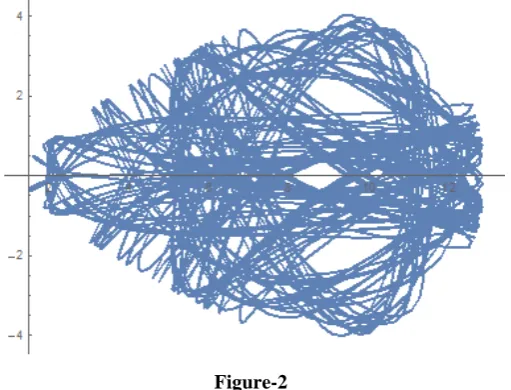
The system (5, 6, 7 and 8) is the master system. The state orbits of this master system are shown in Figure (2) and this figure shows that the system is chaotic.
Figure-2
Corresponding to master system (5, 6, 7 and 8), the identical slave system is
𝑦1̇ =𝑦2+𝑢1(𝑡) (9)
𝑦2̇ = 2𝜔𝑦4+𝜔2𝑦1+𝐴3+𝑢2(𝑡) (10)
𝑦3̇ =𝑦4+𝑢3(𝑡) (11)
𝑦4̇ =−2𝜔𝑦2+𝜔2𝑦3+𝐴4+𝑢4(𝑡) (12)
Where
𝑟112= (𝑦1−µ)2+𝑦32, 𝑟212 = (𝑦1+ 1−µ)2+ 𝑦32 𝐴3=−(𝑦1−µ) 𝑝 �1r−µ
11
3 +
3I
�E(φ, k)𝑝−F(φ, k)
6𝑝8 − �1− 𝑘
2𝑠𝑖𝑛2𝜑(𝑦1+ 1−µ)2
𝑝6 +�
1
𝑝6+
1− 𝑘2𝑠𝑖𝑛2𝜑
𝑝9 � 𝑦3
2�
× 𝛾2+𝑝3
2(𝛾2+ 𝑎2)(2𝛾2+𝑝1− r212 )�(𝛾2+ 𝑐2)�1− 𝑘2𝑠𝑖𝑛2𝜑
− (2𝑐2𝛾2+𝑝11+ 𝛾22)(𝛾2+𝑝3)𝑦32
2𝑝7(2𝛾2+𝑝1− r212 )�(𝛾2+ 𝑐2)(𝑝10+𝑝5𝛾2+ 𝛾22) 3 2�
𝐴4=−𝑦3𝑝 �1r−µ 113 +
3I
2r115 � −3µ𝑦3×
�E(𝑝φ, k) 9𝑝8 +
F(φ, k)
𝑝6𝑝8 − �1− 𝑘
2𝑠𝑖𝑛2𝜑(𝑦1+ 1−µ)2
𝑝6 +�
1
𝑝6+
1− 𝑘2𝑠𝑖𝑛2𝜑
𝑝9 � 𝑦3
2�
× 𝛾+𝑝4
2(𝛾2+ 𝑎2)(2𝛾2+𝑝1− r212 )�(𝛾2+ 𝑐2)�1− 𝑘2𝑠𝑖𝑛2𝜑
− (2𝑐2𝛾2+𝑝11+ 𝛾22)(𝛾2+𝑝4)𝑦32
2𝑝7(2𝛾2+𝑝1− r212 )�(𝛾2+ 𝑐2)(𝑝10+𝑝5𝛾2+ 𝛾22) 3 2
+ �(𝛾2+ 𝑐2)
𝑝7�(𝑝10+𝑝5𝛾2+ 𝛾22)�
𝛾2=12�(𝑦1+ 1−µ)2+𝑦32− 𝑝1+�{(𝑦1+ 1−µ)2+𝑦32− 𝑝1}2+ 4{𝑝3(𝑦1+ 1−µ)2+𝑝4𝑦32− 𝑝2}�
where 𝑢𝑖(𝑡); 𝑖 =1, 2, 3, 4 are control functions to be determined. Let 𝑒𝑖 = 𝑦𝑖−𝑥𝑖; i = 1, 2, 3, 4 be the synchronization.
From (5) to (12), we obtain the error dynamics as follows:
𝑒1̇ =𝑒2+𝑢1(𝑡) (13)
𝑒2̇ = 2𝜔𝑒4+𝜔2𝑒1+𝐴3− 𝐴1+𝑢2(𝑡) (14)
𝑒3̇ =𝑒4+𝑢3(𝑡) (15)
𝑒4̇ =−2𝜔𝑒2+𝜔2𝑒3+𝐴4− 𝐴2+𝑢4(𝑡) (16)
This above error system to be controlled is a linear system with control functions. Thus, let us redefine the control functions so that the terms in (13) to (16) which cannot be expressed as linear terms in 𝑒𝑖 's are eliminated: 𝑢1(𝑡) =𝑣1(𝑡) 𝑢2(𝑡) =−𝐴3+𝐴1+𝑣2(𝑡) 𝑢3(𝑡) =𝑣3(𝑡) 𝑢4(𝑡) =−𝐴4+𝐴2+𝑣4(𝑡) The new error system can be expressed as: 𝑒1̇ =𝑒2+𝑣1(𝑡) 𝑒2̇ = 2𝜔𝑒4+𝜔2𝑒1+𝑣2(𝑡) (17)
𝑒3̇ =𝑒4+𝑣3(𝑡) 𝑒4̇ =−2𝜔𝑒2+𝜔2𝑒3+𝑣4(𝑡) The error system (17) to be controlled is a linear system with a control input 𝑣𝑖(𝑡) (𝑖= 1, … 4) as function of the error states 𝑒𝑖 (𝑖= 1, … 4). As long as these feedbacks stabilize the system 𝑒𝑖 (𝑖= 1, … 4) converge to zero as time 𝑡 tends to infinity. This implies that master and the slave system are synchronized with active control. There are many possible choice for the control 𝑣𝑖(𝑡) (𝑖= 1, … 4). We choose. � 𝑣1(𝑡) 𝑣2(𝑡) 𝑣3(𝑡) 𝑣4(𝑡) �=𝐴 � 𝑒1 𝑒2 𝑒3 𝑒4 � (18)
and, defining a matrix 𝐵 as
�
𝑒1̇ 𝑒2̇ 𝑒3̇ 𝑒4̇
�=𝐵 �
𝑒1 𝑒2 𝑒3 𝑒4
� (20)
Where 𝐵 is
𝐵=�
−1 0 0 0
0 −1 0 0
0 0 −1 0
0 0 0 −1
� (21)
Clearly, 𝐵 has eigen values with negative real parts. This implies lim𝑡→∞|𝑒𝑖| = 0; 𝑖= 1, 2, 3, 4 and hence, complete synchronization is achieved between the master and slave systems
3.1. Numerical Simulation
We select the parameters 𝜇=.00230437 and 𝜆= 1 with the different initial conditions for master and slave systems. Simulation results for uncoupled system are presented in figures.3, 5, 7, 9 and that of controlled system are shown in figures.4, 6, 8 and 10 for respectively.
Figure-3 Figure-4
Figure-5 Figure-6
Figure-7 Figure-8
x1 y1 x1 y1
2 4 6 8 10
1 1
2 4 6 8 10
4 6 8 10 12 14
x2 y2 x2 y2
2 4 6 8 10
30 20 10 10 20 30
2 4 6 8 10
30 20 10 10 20 30
x3 y3 x3 y3
2 4 6 8 10
4 2 2 4
Figure-9 Figure-10
4. CONCLUSION
An investigation on complete synchronization in the planar restricted three problem by taking into consideration the small primary is ellipsoid and bigger primary an oblate spheroid and source of radiation, via active control technique based on Lyapunov stability theory and Routh-Hurwitz criteria have been made. Here two systems (master and slave) are compete synchronized and start with deferent initial conditions. This problem may be treated as the design of control laws for chaotic slave system using the known information of the master system so as to ensure that the controlled receiver synchronizes with master system. Hence the slave chaotic system completely traces the dynamics of the master system in the course of time. The results were validated by numerical simulations using Mathematica.
REFRENCES
1. Bhatnagar. K.B., Chawla J.M. A study of Lagrangian points in photogravitational restricted three body problems. Indian J pure appl. Math.(1979), 10(11): 1443-1451.
2. Lei Y., Xu W., Xie W, Synchronization of two chaotic four-dimensional systems using active control, Chaos, Solitons and Fractals, .(2007) ,Vol. 32, pp. 1823- 1829.
3. M. Javed Idrisi. Z.A.Taqvi. Restricted three body problem when one of the primaries is an ellipsoid. Astrophys. Space Sci, (2013), 348: 41-56.
4. Mohd Arif. Complete syncronization of a planner magnetic binaries problem when bigger primary is Oblate Spheriod and smaller primary is ellipsoid. International journal of Mathematical Archive (IJMA), (2016). 7(8), 45-52
5. Pecora L. M.,Carroll T.L. Synchronization in chaotic systems Rev Lett., (1990), Vol. 64, pp. 821-824. 6. Sharma. R.K., Z. A Taqvi. and K. B. Bhatnagar.. Existence and stability of the libration point of the restricted
three body problem when the bigger primary is a triaxial body and a source of radiation. Indian J pure appl. Math., (2001), 32(2): 255-266.
7. Tang F.,Wang LAn adaptive active control for the modified Chua’s circuit, Phys. Lett. A, (2006), Vol. 346, pp. 342-346.
8. U. E. Vincent, Synchronization of Rikitake chaotic attractor via active control, Physics Letters A 343 (2005), 133–138
9. Ucar. A., E. W. Bai, K. E. Lonngren, Synchronization of chaotic behavior in nonlinear Bloch equations, Physics Letters A 314 (2003), 96–101.
10. Ucar A., Lonngren K. E., Bai E. W. Chaos synchronization in RCL-shunted Josephson junction via active control, Chaos, Solitons and Fractals, (2007),Vol. 31, pp. 105-111.
11. Yu. A Chernikov, The photogravitational restricted three body problem soviet Astronomy-Aj (1970), Vol 14 (1) 176-181.
Source of support: Nil, Conflict of interest: None Declared.
[Copy right © 2018. This is an Open Access article distributed under the terms of the International Journal of Mathematical Archive (IJMA), which permits unrestricted use, distribution, and reproduction in any medium, provided the original work is properly cited.]
x4 y4 x4 y4
2 4 6 8 10
20 10 10 20 30
2 4 6 8 10