MICROWAVE-INDUCED, EFFICIENT, CONVENIENT AND
RAPID SYNTHESIS OF BENZYLOXYCHALCONES AS POTENT
GROWTH INHIBITOR
Nagesh Deshmukh
[a], Sainath Zangade
[b]and Avinash Shinde
[a]*
Keywords: Chalcones; Claisen-Schmidt condensation; microwave irradiation; antibacterial activity; antifungal activity.
A novel series of substituted chalcones containing benzyloxy moiety (3a-3h) was synthesized by microwave induced Claisen-Schmidt condensation of 2-acetyl-1-naphthol and its halo derivatives with different substituted aromatic aldehydes. All the synthesized chalcones were characterized by spectral analysis and screened for their antibacterial and antifungal effectiveness by using standard methods. It is found that the microwave irradiation technique is superior in terms of considerable increase in the reaction rate, yields and shortening the reaction time. The investigation of antimicrobial screening revealed that compounds (3a-3d) containing benzyloxy group at para position of aldehyde ring of chalcones possessing more potent antimicrobial activity.
*Corresponding Authors
E-Mail: E- mail address: [email protected]
[a] Department of Chemistry & P. G. Research Center, N. E. S. Science College, Nanded, Maharashtra (431602), India. [b] Department of Chemistry M. P. College, Palam, Maharashtra,
India.
INTRODUCTION
Chalcone is generic term given to compounds bearing1,3- diphenyl-2-propen-1-one framework.1 Chalcones and their derivatives are polyphenolic compounds of flavonoids family. They have been found in many plants as metabolic precursors of other flavonoids and isoflavonoids.2 It is noteworthy to mention that the presence of chalcones have been reported in plants traditionally employed for therapeutical purposes.3 Chemist have been attracted towards the nucleus of chalcones due to their relatively simple structures and wide variety of pharmacological activities.4-7 Chalcone based compounds have been reported to exhibit anticancer,8,9 anti-inflammatory activity,10,11 anti-ulcerative,12 analgesic,13 anti-viral,14 anti-fungal,15 anti-malerial16 and anti-bacterial activity17 etc. which may be altered depending on the type of substituents on aromatic rings. Chalcones are synthesized by Claisen Schmidt condensation, which involve cross aldol condensation of suitable benzaldehyde derivatives and acetophenone derivatives by base catalysed or acid catalysed reactions followed by removal of water molecule. Synthetic and naturally occurring chalcones have been extensively studied and developed as one of the pharmaceutically important molecules. Therefore, in the present investigation it has been considered worthwhile to synthesize some new chalcone derivatives that may be of value in development of new, potent, selective and less toxic antimicrobial agent by conventional and microwave irradiation methods. Microwave induced enhancement of organic reaction is gaining popularity as a non- conventional technique for rapid synthesis.18 The important features of this technique are easy access to high temperature, safe and environmentally benign techniques with shorter reaction time.
The synthesized compounds were purified by
assigned on the basis of 1H NMR, IR and GC-MS analysis. The compounds were tested for their bacterial and anti-fungal activities by standard methods.
EXPERIMENTAL
Melting points were determined in an open capillary tube and are uncorrected. IR spectra were recorded in KBr on a Perkin-Elmer spectrometer. 1H NMR spectra were recorded on a Gemini 300-MHz instrument in CDCl3 as solvent and TMS as an internal standard. The mass spectra were recorded on EISHIMADZU-GC-MS spectrometer. Elemental analysis was carried out on a Carlo Erba 1108 analyzer. Synthon-3000, Anton Paar reaction system was used for microwave synthesis. The purity of products was checked by Thin Layer Chromatography (TLC) on silica gel. All solvents and chemicals were purchased from Alfa chemicals and used without further purification.
General procedure for synthesis of chalcones (3a-3h)
Equimolar quantities (0.001 mol) of 2-acetyl-1-naphthol or its halo derivative and respective aromatic aldehydes (0.001 mol) were mixed and dissolved in minimum amount (5 mL) of ethanol. To this, catalytic quantity of aqueous KOH solution was added slowly and mixed. The entire reaction mixture was microwave irradiated for about 2-5 min at 180 W. The reactions were monitored through TLC using solvent system benzene:ethyl acetate (8:2), when the reaction was complete the reaction mixture was cooled in an ice bath and product thus formed was filtered, washed with distilled water and recrystallized from ethanol.
O OH
R
R1
X Ar-COCH3+ Ar'CHO
MW I MW I
KOH
A comparison (Table 1) of the results obtained from the two synthetic approaches indicate that the effect of microwave irradiation is not purely thermal, besides giving decreased reaction times and improved yield.
Table 1.Synthesis of chalcones under microwave irradiation.
No. X R R1 Time,
min
M.P.a 0C
Yieldb
3a H OMe OBn 3 150±2 90
3b Br OMe OBn 4 155±2 92
3c I OMe OBn 5 160±2 88
3d Cl OMe OBn 5 152±2 90
3e H OBn OMe 3.5 148±2 85
3f Br OBn OMe 4 150±2 88
3g I OBn OMe 5 158±2 92
3h Cl OBn OMe 5 152±2 85
aM.P. refers to solvent- free and other technique.27,28 bYield of the isolated product in % term.
(Hydroxynaphthlen-2-en-1-one (3a)
Yellow solid. EI-MS m/z (rel. int. %): 410 (90) [M+1]+; IR (KBr): 3420 (OH), 3059 (C-H), 1680 (C=O), 1570 (C=C) cm-1. 1H NMR (400MHz, CDCl
3) δ = 14.0 (s, OH), 8.20 (d, C=CH, J= 15.6Hz), 7.30 (d, CO=CH, J= 15.6Hz), 7.25-6.60 (m, Ar-H), 5.16 (s, CH2), 3.9(s, CH3). 13C NMR (CDCl3) δ = 192, 164, 149, 145, 144, 140, 138, 137, 136, 135, 134, 132, 131, 130, 129, 128, 127, 126, 125, 120, 118, 114, 111,71, 56. Anal. Calcd. for C27H22O4: C, 79.02; H, 5.36. Found: C, 78.97; H, 5.32
2(E)-1-(4-Bromo-1-hydroxynaphthlen-2-yl)-3-(4-benzyloxy-3-methoxyphenyl)prop-2-en-1-one (3b)
Redish solid. EI-MS m/z (rel. int. %): 489 (60) [M+2]+. IR (KBr): 3390 (OH), 3060 (C-H), 1676 (C=O), 1583 (C=C) cm-1. 1H NMR (400MHz, CDCl
3) δ = 14.0 (s, OH), 8.20 (d, C=CH, J= 15.6Hz), 7.20 (d, CO=CH, J= 16.2Hz), 6.90-6.30 (m, Ar-H), 5.10 (s, CH2), 3.9(s, CH3); 13C NMR (CDCl3) δ = 192, 164, 149, 145, 144, 140, 138, 137, 136, 135, 134, 132, 131, 130, 129, 128, 127, 126, 125, 118, 114, 111, 110, 71, 56, Anal. Calcd. for C27H21O4Br: C, 66.25; H, 4.29; Br,16.15. Found: C, 66.22; H, 4.26; Br, 16.13.
2(E)-3-(4-Benzyloxy-3-methoxyphenyl)-1-(1-hydroxy-4-iodo-naphthalen-2-yl)prop-2-en-1-one (3c)
Brown solid. EI-MS m/z (rel. int. %): 536 (95) [M+2]+. IR (KBr): 3410 (OH), 3050 (C-H0, 1678 (C=O),1583 (C=C) cm-1. 1H NMR (400MHz, CDCl
3) δ = 14.0 (s, OH), 8.30 (d, C=CH, J= 15.6Hz), 7.25 (d, CO=CH, J= 16.2Hz), 6.90-6.50 (m, Ar-H), 5.15 (s, CH2), 4.0(s, CH3). 13C NMR (CDCl3) δ = 192, 164, 149, 145, 144, 140, 138, 137, 136, 135, 134, 132, 131, 130, 129, 128, 127, 126, 125, 118, 114, 111, 92, 71, 56. Anal. Calcd. for C27H21O4I : C, 60.44; H, 3.91; I, 23.69. Found: C, 66.42; H, 3.88; I, 23.65.
2(E)-3-(4-Benzyloxy)-3-methoxyphenyl)-1-(1-chloro-4-hydroxy-naphthalen-3yl)prop-2en-one (3d)
Orange solid. EI-MS m/z (rel. int. %): 445 (62) [M+2]+. IR (KBr): 3380 (OH), 3020 (C-H), 1670 (C=O),1550 (C=C) cm-1.1H NMR( 400MHz, CDCl
3) δ = 14.0 (s, OH), 7.81 (d, C=CH, J= 15.6Hz), 7.49 (d, CO=CH, J= 16.2Hz), 7.13-6.49 (m, Ar-H), 4.90 (s, CH2), 3.73(s, CH3) 13C NMR (CDCl3) δ = 192, 164, 149, 145, 144, 140, 138, 137, 136, 135, 134, 132, 131, 130, 129, 128, 127, 126, 125, 118, 115, 114, 111, 71, 56. Anal. Calcd. for C27H21O4Cl: C, 72.80; H, 4.71; Cl, 8.08. Found: C, 72.77; H, 4.68; Cl, 8.05.
2(E)-3-(3-(Benzyloxy)-4-methoxyphenyl)-1-(1-hydroxynaphtha-len-2yl) prop-2-en-1-one (3e)
Yellow solid. EI-MS m/z (rel. int. %): 410 (80) [M+1]+. IR (KBr): 3410 (OH), 3050 (C-H), 1680 (C=O), 1570 (C=C) cm-1. 1H NMR (400MHz, CDCl
3) δ = 14.0 (s, OH), 8.10 (d, C=CH, J= 15.6Hz), 7.20 (d, CO=CH, J= 16.2Hz), 7.10-6.75 (m, Ar-H), 4.90 (s, CH2), 3.50(s, CH3). 13C NMR (CDCl3) δ = 192, 164, 149, 145, 144, 140, 138, 137, 136, 135, 134, 132, 131, 130, 129, 128, 127, 126, 125, 120, 118, 114, 111, 71, 56. Anal. Calcd. for C27H22O4: C, 79.02; H, 5.36. Found : C, 78.97; H, 5.32.
2(E)-3-(3-(Benzyloxy)-4-methoxyphenyl)-1-(1-bromo-4-hyd-roxynaphthalen-3yl)prop-2-en-1-one (3f)
Faint yellow solid. EI-MS m/z (rel. int. %): 489 (70) [M+2]+. IR (KBr): 3370 (OH), 3010 (C-H), 1680 (C=O,1560 (C=C) cm-1. 1H NMR (400MHz, CDCl
3) δ = 13.70 (s, OH), 8.15 (d, C=CH, J= 15.6Hz), 7.35 (d, CO=CH, J= 16.2Hz), 7.60-6.89 (m, Ar-H), 5.20 (s, CH2), 3.80(s, CH3). 13C NMR (CDCl3) δ = 192, 164, 149, 145, 144, 140, 138, 137, 136, 135, 134, 132, 131, 130, 129, 128, 127, 126, 125, 120, 118, 114, 111, 108, 71, 56; Anal. Calcd. for C27H21O4Br: C, 66.25; H, 4.29; Br,16.15. Found: C, 66.22; H, 4.26; Br, 16.13
2(E)-3-(3-Benzyloxy-4-methoxyphenyl)-1-(1-hydroxy-4-iodo-naphthlen-2-yl)prop-2-en-1-one (3g)
Yellow solid. EI-MS m/z (rel. int. %): 536 (75) [M+2]+. IR (KBr): 3420 (OH), 3030 (C-H), 1675 (C=O), 1560 (C=C) cm-1. 1H NMR (400MHz, CDCl
3) δ = 13.96 (s, OH), 8.43 (d, C=CH, J= 15.6Hz), 7.98 (d, CO=CH, J= 16.2Hz), 7.80-7.25 (m, Ar-H), 5.19 (s, CH2), 3.96(s, CH3). 13C NMR (CDCl3) δ = 192, 164, 149, 145, 144, 140, 138, 137, 136, 135, 134, 132, 131, 130, 129, 128, 127, 126, 125, 120, 118, 114, 111, 95, 71, 56; Anal. Calcd. for C27H21O4I: C, 60.44; H, 3.91; I, 23.69. Found: C, 66.42; H, 3.88; I, 23.65.
2(E)-3-(3-Benzyloxy)-4-methoxyphenyl)-1-(1-Chloro-4-hyd-roxynaphthalen-3yl)prop-2en-one (3h)
Brown solid. EI-MS m/z (rel. int. %): 445 (60) [M+2]+. IR (KBr): 3360 (OH), 3010 (C-H), 1670 (C=O), 1560 (C=C) cm-1. 1H NMR (400MHz, CDCl
C=CH, J= 15.6Hz), 7.90 (d, CO=CH, J= 16.2Hz), 7.73-7.49 (m, Ar-H), 4.98 (s, CH2), 3.83 (s, CH3) 13C NMR (CDCl3) δ = 192, 164, 149, 145, 144, 140, 138, 137, 136, 135, 134, 132, 131, 130, 129, 128, 127, 126, 125, 120, 118, 114, 112, 111, 71, 56; Anal. Calcd. for C27H21O4Cl: C, 72.80; H, 4.71; Cl, 8.08. Found: C, 72.77; H, 4.68; Cl, 8.05.
Biological Activity
The newly synthesized compounds were screened for their antibacterial activity against Gram +ve bacterial strain of Staphylococcus aureus (ATCC-25923), Pseudomonas aeruginasa (ATCC-27853) and Gram-ve bacterial strain of Klebsiella Pneumoniae (ATCC-700603) and Escherichia coli (ATCC-25922) by disk diffusion method.19,20 The sterile disks, previously soaked in a known concentration of the test compounds (50 mg ml-1), were placed in nutrient agar medium. Solvent and growth controls were kept. Ofloxacin was used as positive control while the disk poured in DMSO was used as negative control. The plate was incubated for 24 h at 37 0C. The susceptibility was assessed on the basis of diameter of zone of inhibition against Gram +ve and Gram -ve bacteria. Inhibition zone were measured and compare with controls.
Antifungal activity was performed by poison plate method.21 The medium used was potato dextrose agar (Himedia). The medium was prepare and sterilized at 10 psi in autoclave for 15 min. The compounds to be tested were added to the sterile medium in aseptic condition so as to get final concentration of 1 %. A plate with DMSO was prepared as negative control, similarly a plate with 1 % Gresiofulvin was prepared as standard reference plate i.e. positive control. Aspergilus niger, Penicillium chrysogenum, Fusarium monoliforme and Aspergilus flavus were selected as test fungal cultures. They were allowed to grow on slant for 48 h so as to get profuse sporulation. 5 mL of 1:100 aqueous solution of Tween 80 was added to get the slant and spores were scraped with the help of nicrome wire loop to form suspension. The fungal suspension was spot inoculated on the plates prepared using compound with the help of nicrome wire loop. The plates were incubated at room temperature for 48 h, after the incubation plates were observed for the growth of inoculated fungi.
The minimum inhibitory concentration of compounds was obtained by Broth dilution method. In this the concentration of synthesized compounds were maintained at 8 mg mL-1 in the first tube containing 1 mL of broth. The tubes were vortexed to make the initial standard concentration. This were serially dilute in other tubes and finally 1 mL was discarded from the last tube to make the dilution of 1, 0.5, 0.25 mg mL-1, respectively. To all these tubes, 0.1 mL of the long phase culture of target microorganism was added separately and incubated at 37 0C for 24-48 h for microbial growth.22,23
RESULTS AND DISCUSSION
Synthesis
In view of applications of chalcones and in continuation of
towards synthesis of bioactive compounds,24-27 we synthesized new class of benzyloxy chalcone derivatives (3a-3h) under the condition of microwave assisted Claisen- Schmidt condensation of substituted aromatic aldehydes with naphthol/halosubstituted 2-acetyl-1-naphthol in presence of KOH in good yield.28 We found that microwave technique has several advantages including clean and easy work-up procedure, short reaction time, high yield and eco-friendliness.
The structure of chalcone derivatives were characterized by recording their IR, 1HNMR and GC-MS spectra. All the chalcones showed absorption band in region 1680-1640 cm-1 due to C=O stretching vibration. 1H NMR spectra is best analyzing tool for the structural elucidation it showed two doublet in the region of δ = 8.10-8.40 ppm due to olefinic protons (-CH=CH-) and also showed a singlet in the range of 13.80-14.00 ppm due to hydroxyl group. 13C NMR spectra of chalcones were recorded in CDCl3 and are in good agreement with theoretical 13C NMR spectra proposed for all compounds.
Antimicrobial activity
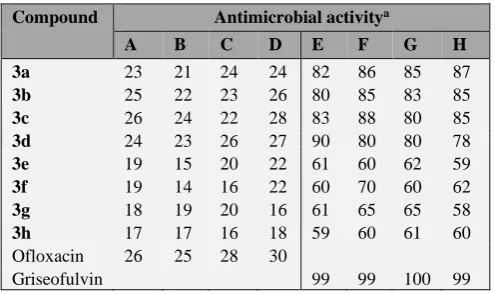
The investigation of antibacterial screening data revealed that all tested compounds (3a-3h) showed good to moderate bacterial inhibition against S. aureus, P. aeruginasa, K .pneumoniae and E. coli species. The good activity is attributed to the presence of pharmacologically active electron releasing methoxy and benzyloxy groups attached to aldehyde ring of chalcones. A comparative study also revealed that the compounds (3a-3d) containing benzyloxy group at para and methoxy group at meta position of aldehyde ring of chalcones showed more potent inhibitory activities against Gram +ve and Gram –ve bacteria than the compounds (3e-3h) having position of both groups interchanged. From this comparative study it is concluded that by changing the position of substituents of chalcones the microbial inhibition activities are altered. The bacterial zone of inhibition value are given in (Table 2).
Antifungal screening data of all compounds (3a-3h) revealed good to moderate antifungal activity against all tested organisms. In term of structure activity relationship the compounds that contain benzyloxy group at para position of aldehyde ring of chalcones showed significant antifungal activities. Results were recorded as growth of fungi in percentage of zone of inhibition in (Table 2).
Table 2. Antimicrobial data of synthesized chalcones.
Compound Antimicrobial activitya
A B C D E F G H 3a 23 21 24 24 82 86 85 87
3b 25 22 23 26 80 85 83 85
3c 26 24 22 28 83 88 80 85
3d 24 23 26 27 90 80 80 78
3e 19 15 20 22 61 60 62 59
3f 19 14 16 22 60 70 60 62
3g 18 19 20 16 61 65 65 58
3h 17 17 16 18 59 60 61 60 Ofloxacin 26 25 28 30
Griseofulvin 99 99 100 99
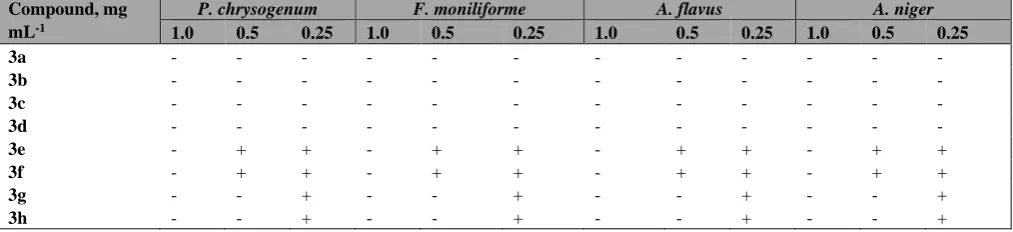
Table 3.Minimum inhibitory concentration of synthesized chalcones.
A. Bacterial strains
Compound, mg mL-1
P. aeruginosa S. aureus K. pneumonie E. coli
1.0 0.5 0.25 1.0 0.5 0.25 1.0 0.5 0. 25 1.0 0.5 0.25 3a - - - -
3b - - - -
3c - - - -
3d - - - -
3e - + + - + + - + + - + +
3f - + + - + + - + + - + +
3g - - + - - + - - + - - +
3h - - + - - + - - + - - +
B. Fungal strains
Compound, mg mL-1
P. chrysogenum F. moniliforme A. flavus A. niger
1.0 0.5 0.25 1.0 0.5 0.25 1.0 0.5 0.25 1.0 0.5 0.25 3a - - - -
3b - - - -
3c - - - -
3d - - - -
3e - + + - + + - + + - + +
3f - + + - + + - + + - + +
3g - - + - - + - - + - - +
3h - - + - - + - - + - - +
Minimum inhibitory concentration (MIC)
The minimum inhibitory concentration of the synthesized compounds was evaluated at different concentration i.e. 1.0, 0.5, 0.25 mg mL-1. The result of MIC are given in table 3, it is clear that the chalcones (3a-3d) shows more promising inhibition than chalcones (3e-3h) at minimum concentration (0.25 mg mL-1) against all tested bacterial and fungal strains. The chalcones (3g, 3h) shows good inhibition against P. aeruginosa,S. aureus (Gram+ve) and K. pneumonie, E. coli (Gram –ve) strains, at minimum concentration 0.5 mg mL-1. The chalcones 3e, 3f showed moderate inhibition against all bacterial strains at minimum concentration 1.0 mg mL-1. The chalcones 3g and 3h showed effective inhibitory potential against all fungal strains at minimum concentration 0.5 mg mL-1. The P. chrysogenum, F. moniliforme, A. flavus, A. niger are prominently affected by chalcones 3e, 3f at minimum concentration 1.0 mg mL-1. The comparative analysis also revealed that the chalcones having electron releasing benzyloxy group at para position of ring B had more potent inhibition against all bacterial and fungal strains at minimum concentration 0.25 mg mL-1.
CONCLUSION
In conclusion, salient feature of our approach is coupling microwave with keeping modernization and simplification over classical procedure for avoiding the generation of valuable toxic organic solvents, which are corrosive, and an efficient and cheap technology to synthesize chalcone derivatives. The evaluation of antimicrobial activities of chalcones carrying benzyloxy and methoxy group were reported. The activity results showed that compounds (3a-3d) possessing benzyloxy group at para position of aldehyde ring of chalcones are most active against all bacterial and
fungal strains tested than the compounds (3e-3h) having position of benzyloxy group was changed from para to meta. This electronic effect played very important role in activity, as can be seen for the compounds having electron donor groups such as benzyloxy, methoxy. Thus in future this class of benzyloxy substituted chalcones may be used for the generation of better lead molecules to fight against bacterial and fungal strains.
ACKNOWLEDGEMENT
The authors are thankful to Principal N. E. S. Science College, Nanded, for providing FT-IR and laboratory facilities. The authors are also thankful to Director Indian Institute of Chemical Technology (IICT), Hyderabad, for providing necessary instrumental facilities. The authors are grateful to department of Microbiology, N. S. B. College, Nanded, for the antimicrobial screening.
REFERENCES
1Maayan, S., Ohad, N., Soliman, K., Chalcones as potent tyrosinase inhibitors: the importance of a 2,4-substituted resorcinol moiety, Bioorg. Med. Chem., 2005, 13(2), 433-441. https://doi.org/10.1016/j.bmc.2004.10.010
2Maria, K., Dimitra, H. L., Maria, G., Synthesis and anti-inflammatory activity of chalcones and related Mannich bases, Med. Chem., 2008, 4(6), 586-596. https://doi.org/10.2174/157340608786242070
3Fontenele, J. B., Leal, L. K., Felix, F. H., Silveira, E. R., Viana, G. S. Studies on the anti-oedematogenic properties of a fraction rich in lonchocarpin and derricin isolated from Lonchocarpus
sericeus, Nat. Prod. Res., 2009, 23, 1677-1688.
4Sahu, N. K., Balbhadra, S. S., Choudhary, J., Kohli, D. V., Exploring Pharmacological Significance of Chalcone Scaffold: A Review, Curr. Med. Chem., 2012, 19(2), 209-225. https://doi.org/10.2174/092986712803414132
5Batovska, D. I., Todorova, I. T., Trends in Utilization of the Pharmacological Potential of Chalcones, Curr. Clin. Pharmacol,2010,5(1), 1-29.
https://doi.org/10.2174/157488410790410579
6Dimmock, J. R., Elias, D. W., Beazely, M. A., Kandepu, N. M., Bioactivities of chalcones, Curr. Med. Chem., 1999, 12 (6), 1125-1149.
7Ducki, S., Antimitotic Chalcones and Related Compounds as Inhibitors of Tubulin Assembly. Anticancer agent Med. Chem., 2009, 9(3), 336-347.
https://doi.org/10.2174/1871520610909030336
8Pingaew, R., Saekee, A., Mandi, P., Synthesis, biological evaluation and molecular docking of novel chalcone– coumarin hybrids as anticancer and antimalarial agents, Eur. J. Chem., 2014, 85, 65-76.
https://doi.org/10.1016/j.ejmech.2014.07.087
9Raghvan, S., Manogaran, P., Kuppuswami, B. K., Venkatraman, G., Narsimha, K. K., Synthesis and anticancer activity of chalcones derived from vanillin and isovanillin, Med. Chem. Res., 2015, 24, 4157- 4165. https://doi.org/10.1007/s00044-015-1453-2
10Hsieh, H. K., Lee, T. H., Wang, H. K. Hsieh, T. H. Lee, J. P., Wang, J. J., Wang, C. N., Lin, Synthesis and Anti-inflammatory Effect of Chalcones and Related Compounds, Pharm. Res., 1998, 15(1), 39-46.
https://doi.org/10.1023/A:1011940401754
11Satyanarayana, K., Rao, M. N., Antiinflammatory, analgesic and antipyretic activities of 3-[4-[3-(4- dimethylaminophenyl)-1-oxo-2-propenyl]phenyl]sydnone, Indian Drugs,1993, 30(7), 313-318.
12Eswara, R. G., Srinivasa, B, P., Lakshmi, P. D., Siri, S., Vaishnavi, R., Bhavana, B., Synthesis, Characterization and Antiulcer Activity of Halogen Containing Chalcones, Der Pharma Chemica, 2017, 9, 57-60.
13Viano, G. S., Bandeira, M. A., Matos, F. J. Analgesic and antiinflammatory effects of chalcones isolated from Myracrodruon urundeuva Allemao, Phytomedicine, 2003, 10, 189-195. https://doi.org/10.1078/094471103321659924
14Wu, J. H., Wang, X. H.,Yi, Y. H., Lee, K. H., Anti-aids agents 54, A potent anti-HIV chalcone and flavonoids from genus Desmos, Biorg. Med. Chem. Lett., 2003, 13(10), 1813-1815. https://doi.org/10.1016/S0960-894X(03)00197-5
15Lopez, S. N., Castelli, M. V., Zacchino, S. A., In vitro antifungal evaluation and structure–activity relationships of a new series of chalcone derivatives and synthetic analogues, with inhibitory properties against polymers of the fungal cell wall,
Biorg. Med. Chem., 2001, 9(8), 1999-2013.
https://doi.org/10.1016/S0968-0896(01)00116-X
16Liu, M., Go, P., Wilairat, M. L., Antimalarial Alkoxylated and Hydroxylated Chalones: Structure−Activity Relationship Analysis, J.Med. Chem., 2001, 44(25), 4443-4452. https://doi.org/10.1021/jm0101747
17Bekhit, A. A., Habib, N. S., Bekhit, A., Synthesis and antimicrobial evaluation of chalcone and syndrome derivatives of 4(3H)-quinazolinone, Bull. Chim. Farm , 2001,
140(5), 297-301.
18Shakil, N. A. Singh, M. K. Sathiyendiran, M. Kumar, J. Padaria, J. C., Microwave synthesis, characterization and bio-efficacy evaluation of novel chalcone based 6-carbethoxy-2-cyclohexen-1-one and 2H-indazol-3-ol derivatives, Eur. J.
Med. Chem., 2013, 59, 120-131.
https://doi.org/10.1016/j.ejmech.2012.10.038
19Cruickshank, R., Duguid, J. P., Marmion, B. P., Swain, R. H. A. Medical microbiology; a guide to the laboratory diagnosis and control of infection, 12th Ed., Churchill Livingstone, London 1975, 256.
20Collins, A. H. Microbiological methods. 2nd ed., Butterworth, London 1976.
21Cruickshank, R., Duguid, J. P., Marmion, B. P., Swain, R. H. A. Medical microbiology; a guide to the laboratory diagnosis and control of infection, Eds.12th Churchill livingstone, London 1998, 1-7.
22Hridhya, K. V., Kulandhivel, M., Antimicrobial activity of chromolaema odorata against selected pyogenic pathogens, Int. J. Pharmacog. Phytochem. Res., 2017, 9(7), 1001-1007. 23Rao, Y. K., Fang, S., Tzeng, Y., Different effect of synthesized
2-oxygenated chalcones derivatives: modulation of human cell phase distribution, Biorg. Med. Chem., 2004, 12(10), 2679-2686. https://doi.org/10.1016/j.bmc.2004.03.014
24Shinde, A., Zangade, S., Chavan, S., Vibhute, Y., Microwave induced synthesis of bis-Schiff bases from propane-1,3-diamine aspromising antimicrobial analogs, Org. Commun.,
2014, 7(2), 60-67.
25Zangade, S. B., Shinde, A. T., Nalwar, Y. S., Vibhute, Y., Microwave induced, efficient, convenient and rapid synthesis of substituted 2-pyrazolines as potentially antimicrobial agent,
Eur. Chem. Bull., 2014, 3(4), 310-314. DOI:
http://dx.doi.org/10.17628/ecb.2014.3.310-314
26Zangade, S. B., Mokle, S.S., Shinde, A.T., Vibhute, Y.B., An atom efficient, green synthesis of 2-pyrazoline derivatives under solvent free conditions using grinding technique,
Green Chem. Lett. Rev., 2013, 6,123-127.
https://doi.org/10.1080/17518253.2012.713123
27Zangade, S., Mokle, A., Vibhute, Y., An Efficient and Operationally Simple Synthesis of Some New Chalcones by Using Grinding Technique, Chem. Sci. J., 2011, 13, 1-6. https://doi.org/10.4172/2150-3494.1000011
28Unchadkar, A., Zangade, S., Shinde, A., Deshpande, M., Microwave assisted synthesis of some halosubstituted chalcones, J. Turk. Chem. Soc. Sect., A., 2015, 2(1), 1-8. https://doi.org/10.18596/jotcsa.10054