PYRIDAZINE AND ITS RELATED COMPOUNDS, PART 39.
SYNTHESIS AND ANTIMICROBIAL EVALUATION OF SOME
THIENOPYRIDAZINE BASED HETERCYCLE
A. Deeb,*
a, F. El-Mariah,
bK. El-Badry,
band H. K. Abd El-Mawgoud
bKeywords: Thienopyridazines;pyrrolothienopyridazines; pyrimidothienopyridazines, pyrazolothienopyridazines;
pyridazinothieno-quinolines; synthesis; antimicrobial activity.
The starting material, 5-amino-3,4-diphenylthieno[2,3-c]pyridazine-6-carbonitrile was subjected to subsequent reactions with aromatic and heteroaromatic aldehydes, benzylchloride, cyclohexanone, phenyl isothiocyanate, hydroxylamine hydrochloride and hydrazine hydrate to afford new polycyclic compounds. The new synthesized compounds were confirmed by their infrared, mass spectrum, 1H-NMR, and
elemental analyses, and further screened for antimicrobial activity.
* Corresponding Authors
E-Mail: [email protected]
[a] Department of Chemistry, Faculty of Science, Zagazig University, Zagazig, Egypt.
[b] Department of Chemistry, College of Women For Arts,
Science, and Education, Ain Shams University, Cairo, Egypt.
INTRODUCTION
Pyridazine derivatives and heterocyclic-annulated pyridazines continue to attract interest due to a wide spectrum of biological and therapeutic effects. They are used as analgesic,1 antibacterial,2 anti-inflammatory,3 antihypertensive,4 antihistaminic,5 anti-nociceptive agents,6 as well as platelet aggregation inhibitors.7 Thieno-pyridazines8 have been reported to possess considerable antiasthmatic9 and fibrinolytic activities.10 Also, the enami-nonitrile serves as a good synthon for construction of a many condensed heterocyclic systems.11 Based on these considerations, our interest was focused on synthesizing new heterocyclic compounds including thienopyridazine moiety with suitable substituents, these structures all on different derivatives related to compounds of biological and pharmacological interest to be obtained. The biological activity of some of the synthesized compounds has been screened.
RESULTS AND DISCUSSION
The starting material,
5-amino-3,4-diphenylthieno[2,3-c]pyridazine-6-carbonitrile 1 was synthesized following the literature procedure by refluxing a solution of 4-cyano-5,6-diphenylpyridazine-3(2H)-thione with chloroacetonitrile in dry acetone in presence of potassium carbonate.12,13
The reaction of
5-amino-3,4-diphenylthieno[2,3-c]pyridazine-6-carbonitrile 1 with an equimolecular quantity of aromatic and / or heteroaromatic aldehydes in benzene gave 5-arylidene- and 5-heteroarylideneaminothieno-pyridazine derivatives 2a-h(Scheme 1).
A mixture of compound 1 and benzyl chloride was heated in ethanol under reflux afforded 5-benzylamino derivative 3, which undergoes cyclization upon heating under reflux in presence of sodium ethoxide in ethanol gave 7-amino-3,4,6-triphenyl-5H-pyrrolo[2`,3`:4,5]thieno-[2,3-c]pyridazine 4. Alternatively, compound 4 was obtained directly upon refluxing a solution of compound 1 in ethanol with benzyl chloride in presence of sodium hydroxide. Reaction of compound 4 with nitrous acid followed the normal course of diazotization yielding clear diazonium salt solution 5, which underwent coupling with 2-naphthol in ethanolic solution in presence of sodium acetate trihydrate as buffered solution to give the corresponding azo derivative 6 (Scheme 1).
Scheme 1
Treatment of compound 1 with cyclohexanone in presence of one molar equivalent of anhydrous zinc chloride led to the separation of 1:1 complex of the expected amino derivative with zinc chloride 7.
10-Amino-3,4-diphenyl-N N SH Ph
Ph CN
N N H
S Ph Ph CN ClCH
2CN
K2CO3 N N S Ph Ph
CN N
K
N N Ph Ph
S NH2
CN NN S
Ph
Ph N
CN CHR R-CHO
N N S Ph
Ph NHCH2Ph
CN
OMe NO2 O O Me
N Me
S Me N
H
S
PhCH2Cl
N N S Ph Ph
NH
NH2
Ph
N
N S
Ph Ph
NH
N2 HSO4
Ph NN S
Ph Ph
NH
N N
Ph
O H AcONa / EtOH
NaNO2 / H2SO4
PhCH2Cl
NaOH / EtOH Reflux EtONa /
EtOH Reflux
-+
benzene / piperidene
2a, R= ; b, R=
c, R= ;d, R=
e, R= ; f, R=
g, R= ; h, R=
EtOH
+
-3 1 2a-h
4
5
6
6,7,8,9-tetrahydropyridazino[4`,3`:4,5]thieno[3,2-b ]quinoli-ne 8 was liberated by treatment of the resulting complex with alkali and extracted with benzene14,15 (Scheme 2).
Scheme 2
Treatment of compound 1 with phenyl isothiocyanate in dimethylformamide as solvent in the presence of triethylamine at room temperature for 18 h led to the corresponding N,N`-di-substituted thiourea 9, which was transformed into 7-amino-6-anilino-8-imino-3,4-diphenyl-pyrimido[4`,5`:4,5]thieno[2,3-c]pyridazine 10 by the reaction with hydrazine hydrate (98 %) in boiling ethanol. Treatment of compound 10 with acetic anhydride yielded the 7-acetyl-amino derivative 11 (Scheme 3).
Scheme 3
The reaction of
5-amino-3,4-diphenylthieno[2,3-c]pyridazine-6-carbonitrile 1 with hydroxylamine hydrochloride was carried out in methanol containing ammonium hydroxide at room temperature to give the corresponding 6-carboxamidoxime derivative 12. Further attempted reaction in boiling pyridine for 5 h afforded 3-amino-7,8-diphenyl-1H-pyrazolo[3`,4`:4,5]thieno[2,3-c ]-pyridazine hydrochloride 13, via the initial formation of 12
followed by intermediate intramolecular nucleophilic attack of amino group at position 5 to the oxime nitrogen atom with elimination of one molecule of water. Diazotization reaction of compound 13 with nitrous acid followed the normal course yielding clear diazonium salt solution 14, which underwent coupling with 2-naphthol in ethanol in presence of sodium acetate trihydrate as buffered solution to
give the corresponding azo derivative 15. The latter compound underwent readily cyclization upon heating in glacial acetic acid at reflux temperature to give 16, which was formed by elimination of one molecule of water (Scheme 4).
Compound 1 was reacted with hydrazine hydrate (98 %) in refluxing ethanol for 2 h to give 5-amino-3,4-diphenylthieno[2,3-c]pyridazine-6-carboximidohydrazide 17, while reflux-ing for 6 h gave 3-amino-7,8-diphenyl-1H-pyrazolo[3`,4`:4,5]thieno[2,3-c]pyridazine 18. Also, compound 18 was afforded by heating the imido derivative
17 in ethanol under reflux for 5 h. Additional evidences for the structure of pyrazolothienopyridazine derivative 18 was proved by its reaction with acetic anhydride to give the corresponding 3-acetylamino derivative 19, and with NaNO2 / H2SO4 to give the diazotized aminopyrazolothieno-pyridazine, which upon coupling with 2-naphthol in presence of sodium acetate trihydrate as buffered solution in ethanol (50 %) gives 15 (Scheme 4).
Scheme 4
Scheme 5
N
N S
Ph
Ph NH2
CN O ZnCl2 N N S Ph Ph N N H ZnCl2 N N S Ph Ph N H N Zn Base N N S Ph Ph N NH2 1 + .. 7 8 +
+ 2 Cl
-N
N S
Ph
Ph NH2
CN
S C N Ph
N N S Ph Ph CN N H N H Ph S DMF
Et3N
N N S Ph Ph N N NH NH2 NHPh N N S Ph Ph N N NH NHCOMe NHPh
Ac2O
H2N-NH2 EtOH
+
..
1 9
11 10
NH2OH.HCl
pyridine reflux NH4OH
MeOH, r.t N N S Ph
Ph NH2
N NH2 OH N N S Ph Ph N NH
NH2.HCl N
N S Ph
Ph NH2
N H NH NH2 N N S Ph Ph N NH NH2
H2N-NH2
EtOH Reflux
Ac2O
N N S Ph Ph N NH NHCOMe N N S Ph Ph N NH N N O H N N S Ph Ph N N NN N N S Ph Ph N NH
N2 HSO4
NaNO2
H2SO4
AcONa / EtOH
12 13 17 18 2 h Reflux 6 h
( 1 )
19 Reflux 5 h 15 glacial AcOH 16 14 + -2-Naphthol (i) NaNO2 / H2SO4
(ii) 2-Naphthol / AcONa
N
N S
Ph
Ph NH2
CN NaNO2 / H2SO4 NN S
Ph
Ph N N
CONH
2
N
N S
Ph
Ph N N OH
CONH2 N N S
Ph
Ph N N
CONH2 O H AcOH
0 o - 5 oC
+
HSO4
-1-Naphthol AcONa 0o - 5 oC
2-Naphthol AcONa 0o - 5 oC
1
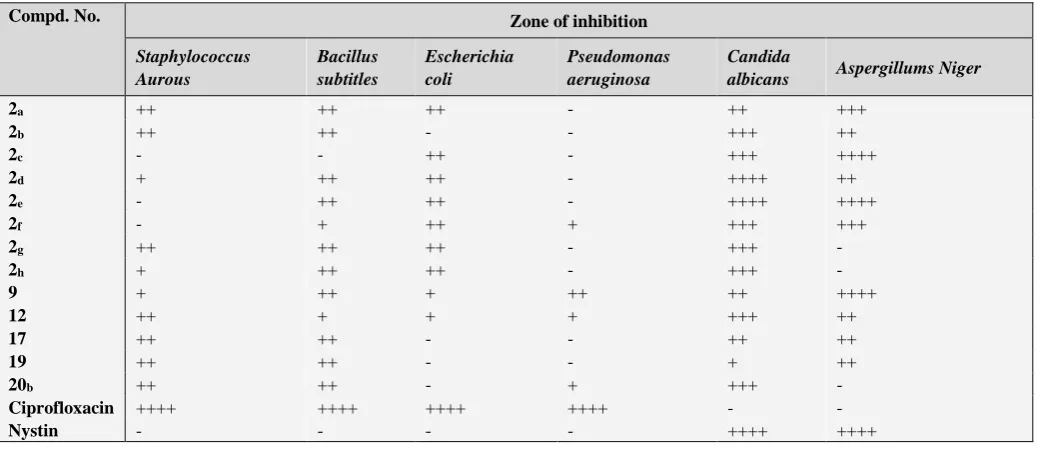
Table 1. Antimicrobial activity of the synthesized compounds
Zone of inhibition Compd. No.
Aspergillums Niger Candida
albicans Pseudomonas
aeruginosa Escherichia
coli Bacillus
subtitles Staphylococcus
Aurous
+++ ++
- ++
++ ++
2a
++ +++
- -
++ ++
2b
++++ +++
- ++
- -
2c
++ ++++
- ++
++ +
2d
++++ ++++
- ++
++ -
2e
+++ +++
+ ++
+ -
2f
- +++
- ++
++ ++
2g
- +++
- ++
++ +
2h
++++ ++
++ +
++ +
9
++ +++
+ +
+ ++
12
++ ++
- -
++ ++
17
++ +
- -
++ ++
19
- +++
+ -
++ ++
20b
- -
++++ ++++
++++ ++++
Ciprofloxacin
++++ ++++
- -
- -
Nystin
The concentration of the all synthesised compounds and the two references was 0.30 mg 0.10 mL-1 of dimethylformamide. Zone of
inhibition: + = < 15 mm; ++ = 15-24 mm; +++ = 25-34 mm; ++++ = 35-44 mm; - = no inhibition.
Diazotization of the
5-amino-3,4-diphenylthieno[2,3-c]pyridazine-6-carbonitrile 1 was carried out, followed by coupling with 1- and 2-naphthol to give the azo derivatives
20a and 20b, respectively (Scheme 5). The structure of the
prepared compounds was confirmed on the basis of spectroscopic data (IR, mass, 1H-NMR spectra) and elemental analysis as described in the experimental part.
Screening for antimicrobial activities
Applying the agar plate diffusion technique,16 the newly synthesised compounds were screened in vitro for antimicrobial activity against Gram positive bacteria
(Staphylococcus aureus and Bacillus subtilis), Gram
negative bacteria (Escherichia coli and Pseudomonas
aeruginosa), yeast (Candida albicans), and fungi
(Aspergillus niger).
In this method,a standard 5 mm sterilised filter paper disk impregnated with the compound (0.3 mg / 0.1 ml of dimethylformamide) was placed on agar plate seeded with the tested organism. The plates were incubated for 24 h at 37 °C for bacteria and 28 °C for fungi. The inhibition zone of bacteria and fungi growth around the disk were determined. The screening results are given in (Table I).
The results indicated that seven synthesized compounds 2a,
2b, 2g, 12, 17, 19 and 20b showed moderate antimicrobial
activity against the examined Gram positive bacteria
Staphylococcus aureus. On the other hand, ten synthesized
compounds 2a, 2b, 2d, 2e, 2g, 2h, 9, 17, 19 and 20b showed
moderate antimicrobial activity against the examined Gram positive bacteria Bacillus subtilis. Only the six synthesised compounds 2a, 2b, 2g, 17, 19 and 20b showed moderate
antimicrobial activity against the both examined Gram positive bacteria Staphylococcus aureus and Bacillus
subtilis.
On the other hand, seven compounds 2a, 2c, 2d, 2e, 2f, 2g
and 2h and one compound 9 showed moderate antimicrobial
activity against the examined Gram negative bacteria
Escherichia coli and Pseudomonas aeruginosa, respectively.
In addition, two compounds 2d and 2e and three
compounds 2c, 2e and 9 showed very high antifungal activity
against the examined fungi Candida albicans (yeast) and
Aspergillus niger, respectively. Only one compound 2e
showed very high antifungal activity against the both examined fungi Candida albicans and Aspergillus niger. The results revealed also that seven synthesised compounds
2b, 2c, 2f, 2g, 2h, 12 and 20b and two synthesised compounds
2a and 2f showed high antifungal activity against the
examined fungi Candida albicans and Aspergillus niger, respectively. Only one synthesised compound 2f showed
high antifungal activity against the both examined fungi
Candida albicans and Aspergillus niger.
In conclusion, results of antimicrobial activity revealed that the synthesised compounds showed moderate and / or very high antimicrobial activity against bacteria and fungi, respectively. It could be concluded from these results that the biologically active synthesised compounds are nearly as active as the standard antibacteria Ciprofloxacin against the both tested Gram positive bacteria (Staphylococcus aureus
and Bacillus subtilis) and Gram negative bacteria
(Escherichia coli and Pseudomonas aeruginosa). On the
other hand, the biologically active synthesised compounds are active as the standard Fungicid Nystin against the both tested fungi Candida albicans and Aspergillus niger.
EXPERIMENTAL
The IR spectra of compounds were recorded on a Perkin-Elmer spectrophotometer model 1430 as potassium bromide pellets and frequencies are reported in cm-1. The 1H-NMR spectra were recorded on a Perkin-Elmer R12B spectrometer 200 MHz and chemical shifts δ are in ppm relative to internal TMS, and mass spectra were recorded on a mass spectrometer HP model MS 5988 El 70 ev. Reactions were routinely followed by thin layer chromatography (TLC) on silica gel; F254 aluminum sheets (Merck). The spots were detected by UV irradiation at 254–365 nm.
General procedure for the synthesis of 5-arylidene- and
5-hete- roarylideneamino-3,4-diphenylthieno[2,3-c]pyridazine-6-car-bonitriles, 2a-h.
A mixture of compound 1 (0.5 g, 1.52 mmol) and the appropriate aromatic and heteroaromatic aldehydes (1.52 mmol) in benzene (10 mL) was heated under reflux for 3 h in presence of piperidine (0.5 mL). The solvent was then evaporated under reduced pressure, and the solid product was recrystallised from ethanol to give 2a-h.
5-[[(4-Methoxyphenyl)methylidene]amino]-3,4-diphenylthieno-[2,3-c]pyridazine-6-carbonitrile, 2a.
Yield: (0.51 g, 75 %); m.p. 154°-156 °C; IR: 2246 (C≡N), 1678 (C=N), 2926, 1448 (OCH3); MS (m/z %): 446 (M+, 2.72 %), 329 (M+ - C
8H8O, 100 %); Anal Calcd. For C27H18N4OS: C, 72.62; H, 4.06; N, 12.55; Found: C, 72.30; H, 4.13; N, 12.27 %.
5-[[(4-Nitrophenyl)methylidene]amino]-3,4-diphenylthieno[2,3-
c]-pyridazine-6- carbonitrile, 2b.
Yield: (0.52 g, 74 %); m.p. 128° - 129 °C; IR: 2248 (C≡N), 1675 (C=N), 1516 (NO2, asym.), 1341 (NO2, sym.); MS (m/z %): 461 (M+, 1.81 %), 329 (M+ - C
7H5NO2, 100 %); Anal Calcd. For C26H15N5O2S: C, 67.66; H, 3.28; N, 15.18; Found: C, 67.96; H, 3.22; N, 15.42 %.
5-[[(Furan-2-yl)methylidene]amino]-3,4-diphenylthieno[2,3-c]-pyridazine-6-carbonitrile, 2c.
Yield: (0.49 g, 79 %); m.p. 212° - 214 °C; IR: 2245 (C≡N), 1665 (C=N); MS (m/z %): 407 (M+ +1, 6.89 %), 103 (M+ - C
17H9N3OS, 100 %), 77 (64.59 %); Anal. Calcd. For C24H14N4OS: C, 70.92; H, 3.47; N, 13.79; Found: C, 70.58; H, 3.55; N, 13.51 %.
5-[[(5-Methylfuran-2-yl)methylidene]amino]-3,4-diphenylthie-no-[2,3-c]pyridazine-6-carbonitrile, 2d.
Yield: (0.54 g, 84 %); m.p. 196° - 198 °C; IR: 2973 (CH3), 2245 (C≡N), 1666 (C=N); MS (m/z %): 420 (M+, 0.64 %), 329 (M+ - C
6H6O, 100 %); Anal Calcd. For C25H16N4OS: C, 71.41; H, 3.84; N, 13.33; Found: C, 71.76; H, 3.90; N, 13.07 %.
5-[[(1-Methyl-1H-pyrrol-2-yl)methylidene]amino]-3,4-diphe-nylthieno[2,3- c]-pyridazine-6-carbonitrile, 2e.
Yield: (0.52 g, 82 %); m.p. 209° - 210 °C; IR: 2976 (CH3), 2241 (C≡N), 1665 (C=N); MS (m/z %): 419 (M+, 0.23 %), 329 (M+ - C
6H7N, 100); Anal Calcd. For C25H17N5S: C, 71.57; H, 4.09; N, 16.70; Found: C, 71.23; H, 4.18; N, 16.41 %.
5-[[(5-Methylthiophene-2-yl)methylidene]amino]-3,4-diphenyl-thieno[2,3-c]pyridazine-6-carbonitrile, 2f.
Yield: (0.53 g, 80 %); m.p. > 300 °C; IR: 2965 (CH3), 2246 (C≡N), 1664 (C=N); MS (m/z %): 436 (M+, 0.13 %), 329 (M+ - C
6H6S, 100 %); Anal Calcd. For C25H16N4S2: C, 68.78; H, 3.70; N, 12.84; Found: C, 69.10; H, 3.62; N, 12.58 %.
3,4-Diphenyl-5-[[(1H-pyrrol-2-yl)methylidene]amino]thieno-[2,3-c]pyridazine-6-carbonitrile, 2g.
Yield: (0.48 g, 78.5 %); m.p. 208° - 210 °C; IR: 3281 (NH), 2243 (C≡N), 1664 (C=N); MS (m/z %): 405 (M+, 4.80 %), 57 (M+ - C
14H10N2, - C8H5N3, 100 %); Anal Calcd. For C24H15N5S: C, 71.09; H, 3.73; N, 17.27; Found: C, 70.76; H, 3.65; N, 17.51 %.
3,4-Diphenyl-5-[[(thiophene-2-yl)methylidene]amino]thieno-[2,3-c]pyridazine-6-carbonitrile, 2h.
Yield: (0.49 g, 76 %); m.p. 140° - 142 °C; IR: 2247 (C≡N), 1673 (C=N); MS (m/z %): 422 (M+, 0.44 %), 329 (M+ - C
5H4S, 100 %); Anal Calcd. For C24H14N4S2: C, 68.22; H, 3.34; N, 13.26; Found: C, 68.59; H, 3.29; N, 13.55 %.
5-Benzylamino-3,4-diphenylthieno[2,3-c]pyridazine-6-carbonit-rile, 3.
A solution of equimolar mixture of compound 1 (0.5 g, 1.52 mmol) and benzyl-chloride (0.2 g, 1.52 mmol) in absolute ethanol (10 mL) was heated under reflux for 3 h. The solvent was evaporated, and the residue was treated with petroleum ether 40° - 60°C. The solid precipitate was filtered off, dried, and recrystallised from ethanol to give 3. Yield: (0.44 g, 69.5 %); m.p. 192° - 194 °C; IR: 3284 (NH), 2922 (CH2), 2197 (C≡N); MS (m/z %): 419 (M+ +1, 46.2 %), 149 (M+ - C
6H5, - C14H10N, 100 %); Anal Calcd. For C26H18N4S: C, 74.62; H, 4.33; N, 13.39; Found: C, 74.95; H, 4.25; N, 13.13 %.
7-Amino-3,4,6-triphenyl-5H-pyrrolo[2`,3`:4,5]thieno[2,3-c]py-ridazine 4.
Method A
The reaction mixture was heated under reflux for 6 h, cool to room temperature, poured into ice water, and neutralised with HCl. The precipitate was filtered off, washed with water, dried, and recrystallised from ethanol to give 4. Yield: (0.29 g, 45.5 %); m.p. 155°-156 °C; IR: 3442, 3319, 3177 (NH2, NH); MS (m/z %): 418 (M+, 30.8 %), 149 (M+ - C
6H5, - C14H10N, 100 %); Anal Calcd. For C26H18N4S: C, 74.62; H, 4.33; N, 13.39; Found: C, 74.99; H, 4.24; N, 13.11 %.
Method B
To a solution of sodium ethoxide [(0.1 g) of Na in (10 mL) absolute ethanol], compound 3 (0.5 g, 1.19 mmol) was added. The reaction mixture was refluxed for 5 h, cool to room temperature, poured into ice water, and neutralized with HCl. The precipitate was filtered off, washed with water, dried, and recrystallised from ethanol to give 4. It was identical with the compound prepared by method A (m.p and mixed m.p). Yield: (0.34 g, 68 %).
7-[(2-Hydroxynaphthalen-1-yl)diazenyl]-3,4,6-triphenyl-5H-pyrrolo[2`,3`:4,5]thieno[2,3-c]pyridazine, 6.
Compound 4 (0.5 g, 1.19 mmol) was dissolved in concentrated H2SO4 (5 mL), cooled to 0° - 5°C in an ice bath, then a solution of NaNO2 (0.16 g, 2.39 mmol) in H2O (5 mL) was added with stirring, keeping the temperature at 0° - 5°C. The above mixture was added drop by drop to a solution of 2-naphthol (0.17 g, 1.19 mmol) and sodium acetate (1.0 g) in ethanol (50 %, 10 mL) with stirring for 1.5 h. The precipitate was filtered off, washed with water, dried, and recrystallised from ethanol to give 6. Yield: (0.36 g, 52.7 %); m.p. 104° - 105°C; IR: broad band around 3198 (OH, NH), 1599 (N=N), 1242 (CO, phenolic); MS (m/z %): 573 (M+, 0.17 %), 63 (M+ - C
32H22N4OS, 100 %); Anal Calcd. For C36H23N5OS: C, 75.37; H, 4.04; N, 12.21; Found: C, 75.75; H, 4.12; N, 12.50 %.
10-Amino-3,4-diphenyl-6,7,8,9-tetrahydropyridazino[4`,3`:4,5]-thieno[3,2- b]quinoline, 8.
To a solution of compound 1 (0.5 g, 1.52 mmol) in cyclohexanone (10 mL), anhydrous zinc chloride (0.04 g, 1.52 mmol) was added, and the reaction mixture was heated under reflux for 30 minute. Evaporate the solvent under reduced pressure, and dissolve the residue in NaOH (10 mL, 40 %), then extract with benzene. The benzene layer was dried over anhydrous MgSO4, and evaporated to give 8. Yield: (0.35 g, 57 %); m.p. 189° - 190 °C; IR: 3500, 3358 (NH2), 2929 (CH, aliphatic), 1657 (C=N); MS (m/z %): 408 (M+, 3.78 %), 77 (M+ - C
19H15N4S, 100 %); Anal Calcd. For C25H20N4S: C, 73.50; H, 4.94; N, 13.72; Found: C, 73.82; H, 4.85; N, 13.45 %.
N-(6-Cyano-3,4-diphenylthieno[2,3-c]pyridazin-5-yl)-N`-phe-nylthiourea, 9.
Method A
To a solution of compound 1 (0.5 g, 1.52 mmol) in dimethylformamide (10 mL), phenyl isothiocyanate (0.21 g, 1.52 mmol) and triethylamine (0.5 mL) were added, the
reaction mixture was stirred at room temperature for 18 h. The reaction mixture was poured into water, then the solid product was filtered off, washed with water, dried, and recrystallised from ethanol to give 9. Yield: (0.51 g, 73 %); m.p. 218° - 219 °C; IR: 3451, 3333 (two NH), 2243 (C≡N), 1240 (C=S); MS (m/z %): 463 (M+, 0.02 %), 329 (M+ - C7H6NS, 100 %); 1H-NMR (DMSO-d6): 8.09 (s, 1H, NH),
7.90 (s, 1H,NHPh), 7.17-7.39 (m, 15H, 3Ph); Anal Calcd. For C26H17N5S2: C, 67.36; H, 3.70; N, 15.11; Found: C, 67.01; H, 3.62; N, 15.40 %.
Method B
To a solution of compound 1 (0.5 g, 1.52 mmol) in pyridine (10 mL), phenyl isothio-cyanate (0.21 g, 1.52 mmol) was added. The reaction mixture was heated under reflux for 6 h. After cooling, the reaction mixture was poured into ice water, then the solid product was filtered off, dried, and recrystallised from ethanol to give 9, which identical with that prepared by method A (m.p and mixed m.p). Yield: (0.5 g, 71 %).
7-Amino-6-anilino-8-imino-3,4-diphenylpyrimido[4`,5`:4,5]thi-eno[2,3-c]pyridazine, 10.
To a solution of compound 9 (0.5 g, 1.08 mmol) in ethanol (10 mL), hydrazine hydrate (98 %, 1.08 mmol) was added. The reaction mixture was refluxed for 3 h. The solvent was evaporated under reduced pressure, and the residue was treated with water. The solid product was filtered off, dried, and recrystallised from ethanol to give 10. Yield: (0.36 g, 72.5 %); m.p. 190° - 191 °C; IR: broad bands around 3318, 3185 (NH2, =NH, NH), 1664 (C=N); MS (m/z %): 463 (M+ +2, 0.27 %), 371 (M+ - C
6H6N, 100 %); Anal Calcd. For C26H19N7S: C, 67.66; H, 4.15; N, 21.24; Found: C, 67.31; H, 4.22; N, 21.51 %.
7-Acetylamino-6-anilino-8-imino-3,4- diphenylpyrimido-[4`,5`:4,5]thieno[2,3-c]-pyridazine, 11.
A solution of compound 10 (0.5 g, 1.08 mmol) in acetic anhydride (10 mL) was refluxed for 5 h. The solvent was evaporated under reduced pressure, and the solid product was recrystallised from acetic acid to give 11. Yield: (0.45 g, 83 %); m.p. 204° - 205 °C; IR : broad band around 3444 (=NH, NH, NH amide), 2919 (CH3), 1734 (C=O amide), 1668 (C=N); MS (m/z %): 503 (M+, 0.29 %), 63 (M+ - C24H20N6OS, 100%); Anal Calcd. For C28H21N7OS: C, 66.78; H, 4.20; N, 19.47; Found: C, 67.15; H, 4.11; N, 19.76 %.
5-Amino-3,4-diphenylthieno[2,3-c]pyridazine-6-carboxamid-oxime, 12.
To a solution of compound 1 (0.5 g, 1.52 mmol) in methanol (10 mL), hydroxylamine hydrochloride (0.11 g, 1.52 mmol) and ammonium hydroxide (0.5 mL) were added. The reaction mixture was stirred at room temperature for 24 h. The solid product was filtered off, dried, and recrystallised from ethanol to give 12. Yield: (0.29 g, 54 %); m.p. 212° - 213°C; IR: 3459 (OH), 3380, 3292, 3229, 3158 ( two NH2), 1661 (C=N); MS (m/z %): 362 (M+ +1, 12.2 %), 51 (M+ - C
(DMSO-d6) :9.27(s, 1H, OH), 7.14-7.39 (m, 10H, 2Ph), 5.74 (s, 2H,
6-NH2), 4.09 (s, 2H, 5-NH2); Anal Calcd. For C19H15N5OS: C, 63.14; H, 4.18; N, 19.38; Found: C, 63.52; H, 4.24; N, 19.09 %.
3-Amino-7,8-diphenyl-1H-pyrazolo[3`,4`:4,5]thieno[2,3-c]py-ridazinehydrochloride, 13.
To a solution of compound 1 (0.5 g, 1.52 mmol) in pyridine (10 mL), hydroxylamine hydrochloride (0.11 g, 1.52 mmol) was added. The reaction mixture was heated under reflux for 5 h. The solvent was evaporated under reduced pressure, and the residue was treated with water. The solid product was filtered off, dried, and recrystallised from ethanol to give 13. Yield: (0.41 g, 71 %); m.p. > 300 °C; IR: 3296, 3155 (NH2, NH), 1673 (C=N); MS (m/z %): 380 (M+, 0.03 %), 382 (M+ +2, 0.10 %), 304 (M+ - CH3ClN2, 100 %); Anal Calcd. For C19H14ClN5S: C, 60.07; H, 3.71; N, 18.44; Found: C, 60.40; H, 3.79; N, 18.19 %.
3-[(2-Hydroxynaphthalen-1-yl)diazenyl]-7,8-diphenyl-1H-pyra-zolo[3`,4`:4,5]thieno-[2,3-c]pyridazine, 15.
Method A
Compound 13 (0.5 g, 1.32 mmol) was dissolved in concentrated H2SO4 (5 mL), cooled to 0° - 5°C in an ice bath, then a solution of NaNO2 (0.18 g, 2.63 mmol) in H2O (5 mL) was added with stirring, keeping the temperature at 0° - 5°C. The above mixture was added drop by drop to a solution of 2-naphthol (0.19 g, 1.32 mmol) and sodium acetate (1.0 g) in ethanol (50 %, 10 mL) with stirring for 1.5 h. The precipitate was filtered off, washed with water, dried, and recrystallised from ethanol to give 15. Yield: (0.49 g, 76 %); m.p. 201° - 202 °C; IR: broad band around 3181(OH, NH), 1670 (C=N), 1623 (N=N), 1243 (CO, phenolic); MS (m/z %): 499 (M+ +1, 1.03 %), 77 (M+ - C23H13N6OS, 100 %); Anal Calcd. For C29H18N6OS: C, 69.86; H, 3.64; N, 16.86; Found: C, 69.55; H, 3.69; N, 16.58 %.
Method B
Compound 18 (0.5 g, 1.45 mmol) was dissolved in concentrated H2SO4 (5 mL), cooled to 0° - 5°C in an ice bath, then a solution of NaNO2 (0.2 g, 2.91 mmol) in H2O (5 mL) was added with stirring, keeping the temperature at 0° - 5°C. The above mixture was added drop by drop to a solution of 2-naphthol (0.21 g, 1.45 mmol) and sodium acetate (1.0 g) in ethanol (50 %, 10 mL) with stirring for 1.5 h. The precipitate was filtered off, washed with water, dried, and recrystallised from ethanol to give 15, which identical to the compound prepared by method A (m.p and mixed m.p). Yield (0.51 g, 70.5 %).
3,4-Diphenylnaphtho[2,1- e]pyridazino[4``,3``:4`,5`]thie-no[2`,3`:4,5]pyrazolo[3,2-c][1,2,4]triazine, 16.
A solution of compound 15 (0.5 g, 1.0 mmol) in glacial acetic acid (10 mL) was heated under reflux for 3 h. The solvent was then evaporated under reduced pressure, and the solid product was recrystallised from ethanol to give 16.
Yield: (0.2 g, 41.5 %); m.p. 211° - 212°C; IR: 1644 (C=N), 1558 (N=N), and there is no bands in the OH and NH regions; MS (m/z %): 480 (M+, 0.35 %), 371 (M+ - C
6H5, -N2, -2 H2, 100 %); Anal Calcd. For C29H16N6S: C, 72.48; H, 3.36; N, 17.49; Found: C, 72.80; H, 3.45; N, 17.76 %.
5-Amino-3,4-diphenylthieno[2,3-c]pyridazine-6-carboximido-hydrazide, 17.
To a solution of compound 1 (0.5 g, 1.52 mmol) in ethanol (10 mL), hydrazine hydrate (98 %, 1.52 mmol) was added, and the reaction mixture was heated under reflux for 2 h. The solvent was then evaporated under reduced pressure, and the residue was treated with water. The solid product was filtered off, dried, and recrystallised from ethanol to give 17. Yield: (0.38 g, 69 %); m.p. 179° -
180 °C; IR: broad bands around 3350, 3158 (two NH2, =NH, NH), 1670 (C=N); MS (m/z %): 360 (M+, 10.36 %), 287 (M+ - NH
2, - CH4N3, 100 %); 1H-NMR (DMSO-d6): 8.16 (s, 1H, NH), 8.05 (s, 2H, NH2), 7.05-7.83 (m, 10H, 2Ph), 5.38 (s, 1H, =NH), 4.16 (s, 2H, 5-NH2); Anal Calcd. For C19H16N6S: C, 63.31; H, 4.48; N, 23.32; Found: C, 63.01; H, 4.55; N, 23.05 %.
3-Amino-7,8-diphenyl-1H-pyrazolo[3`,4`:4,5]thieno[2,3-c]pyri-dazine, 18.
Method A
To a solution of compound 1 (0.5 g, 1.52 mmol) in absolute ethanol (10 mL), hydrazine hydrate (98 %, 1.52 mmol) was added, and the reaction mixture was heated under reflux for 6 h. The solvent was then evaporated under reduced pressure, and the residue was treated with water. The solid product was filtered off, dried, and recrystallised from ethanol to give 18. Yield: (0.37 g, 70 %); m.p. 250° -
251°C; IR: 3356, 3295, 3206 (NH2, NH), 1658 (C=N); MS (m/z %): 343 (M+, 22.6 %), 51 (M+ - C
15H10N5S, 100 %); Anal Calcd. For C19H13N5S: C, 66.45; H, 3.81; N, 20.40; Found: C, 66.80; H, 3.75; N, 20.65 %.
Method B
A solution of compound 17 (0.5 g, 1.39 mmol) in absolute ethanol (10 mL) was heated under reflux for 5 h. The solvent was concentrated, and the solid product was filtered off, and dried to give 18. It was identical with that prepared by method A (m.p and mixed m.p). Yield: (0.36 g, 75.2 %).
3-Acetylamino-7,8-diphenyl-1H-pyrazolo[3`,4`:4,5]thieno-[2,3-c]pyridazine, 19.
A solution of compound 18 (0.5 g, 1.45 mmol) in acetic anhydride (10 mL) was refluxed for 5 h. The solvent was then evaporated under reduced pressure, and the solid product was recrystallised from acetic acid to give 19. Yield: (0.46 g, 82 %); m.p. 170° - 171 °C; IR: 3413, 3168 (NH pyrazolo, NH amide), 2923 (CH3), 1749 (C=O amide), 1675 (C=N); MS (m/z %): 385 (M+, 100 %); 1 H-NMR (DMSO-d6):11.94 (s, 1H, NH-pyrazolo), 9.71 (s, 1H,
General Procedure for the synthesis of 5-[(hydroxynaphthalen-1-yl)diazenyl]-3,4-diphenylthieno[2,3- c]pyridazine-6-carbox-amide, 20a,b.
Compound 1 (0.5 g, 1.52 mmol) was dissolved in acetic acid (90 %, 5 mL), cooled to 0° - 5°C in an ice bath, then a solution of NaNO2 (0.21 g, 3.04 mmol) in concentrated sulphuric acid (5 mL) was added with stirring, keeping the temperature at 0° - 5°C. The above mixture was added drop by drop to a solution of 1- and/or 2-naphthol (0.22 g, 1.52 mmol) and sodium acetate (1.0 g) in ethanol (50 %, 20 mL) with stirring for 1.5 h. The precipitate was filtered off, washed with water, dried, and recrystallised from ethanol to give 20a , b.
5-[(4-Hydroxynaphthalen-1-yl)diazenyl]-3,4-diphenylthieno-[2,3-c]pyridazine-6-carboxamide, 20a.
Yield: (0.46 g, 61 %); m.p. 249°- 250 °C; IR: 3390 (OH), 3300, 3168 (NH2, amide), 1674 (C=O, amide), 1594 (N=N), 1201 (CO, phenolic), there is no absorption bands referred to C≡N group; MS (m/z %): 504 (M+ +3, 0.09 %), 78 (M+ - C
23H13N5O2S, 100 %); Anal Calcd. For C29H19N5O2S: C, 69.44; H, 3.82; N, 13.96; Found: C, 69.75; H, 3.89; N, 13.68 %.
5-[(2-Hydroxynaphthalen-1-yl)diazenyl]-3,4-diphenylthieno-[2,3-c]pyridazine-6-carboxamide, 20b.
Yield: (0.49 g, 64 %); m.p. > 300 °C; IR: 3381 (OH), 3307, 3168 (NH2, amide), 1682 (C=O, amide), 1604 (N=N), 1245 (CO, phenolic), there is no absorption bands referred to C≡N group; MS (m/z %): 499 (M+ -2, 0.26 %), 394 (M+ - C
7H5N, - H2, 100 %); Anal Calcd. For C29H19N5O2S: C, 69.44; H, 3.82; N, 13.96; Found: C, 69.78; H, 3.91; N, 14.22 %.
REFERENCES
1Rohet, F., Rubat, C., Coudert, P. and Couquelet, J., Bioorg. Med. Chem., 1997, 5, 655.
2Tucker, J. A., Allwine, D. A., Grega, K. C., Barbachyn, M. R.,
Klock. J. L., Adamski, J. L., Brickner, S. J., Hutchinson, D. K., Ford, C. W., Zurenko, G. E., Conradi, R. A., Burton, P. S., and Jensen, R. M.; J. Med. Chem., 1998,41, 3727.
3Tamayo, N., Liao, L., Goldberg, M., Powers, D., Tudor, Y. Y., Yu,
V., Wong, L. M., Henkle, B., Middleton, S., Syed, R., Harvey, T., Jang, G., Hungate, R., and Dominguez, C.;
Bioorg. Med. Chem., 2005, 15, 2409.
4Benson, S. C., Palabrica, C. A. and Snyder, J. K.; J. Org. Chem.,
1987, 52, 4610.
5Gyoten, M., Nagaya, H., Fukuda, S., Ashida, Y. and Kawano, Y.; Chem. Pharm. Bull., 2003, 51, 122.
6Piaz, V. D., Vergelli, C., Giovannoni, M. P., Scheideler, A. M. A.,
Petrone, G. and Zaratin, P.; ll Farmaco, 2003, 58, 1063.
7Crespo, A., Meyers, C., Coelho, A., Sotelo, E., Fraiz, N., Sotelo,
E., Yanez, M., Maes, B. U. W., Laguna, R., Cano, E., Lemiere, G. L. F. and Ravina, E., Bioorg. Med. Chem. Lett.,
2006, 16, 1080.
8Kamal El-Dean, A. M., Gaber, A. M., El-Gaby, M. S. A., Eyada,
H. A. and Al-Kamali, A. S. N., Phosphorus, Sulfur and Silicon,2004, 179, 321.
9Yamaguchi, M., Maruyama, N., Koga, T., Kamei, K., Akima, M.,
Kuroki, T., Hamana, M. and Ohi, N., Chem. Pharm. Bull.,
1995, 43 (2), 236.
10Vartanyan, R. S., Kazaryan, Z., Sheiranyan, M. A., Agaronyan, A.
S. and Stepanyan, N. O., Khim. Farm. Zh.,1996, 30, 29.
11Vieweg, H., Leistner, S., Wagner, G., Boehm, N., Krasset, U.,
Grupe, R., Lohmann, D. and Loban, G., German Patent,
1988, D257, 830. Chem. Abst., 1989, 110, 995262p.
12Deeb, A., Said, S. A., Hamed, M. M. and Yasin, F., J. Chin. Chem. Soc., 1990, 37, 287.
13Quintela, J. M., Veiga, M. C., Conde, S. and Peinador, C., Monatsh. Chem., 1996, 127, 739.
14Moore, J. A. and Kornreich, L. D., Tetrahedron Lett., 1963, 4 (20), 1277.
15Deeb, A., Essawy, A., Yassine, F., Fikry, R., Z., Naturforsch.
1991, 46b, 845-847.
16Bauer, A. W., Mkriby, W. W., Sherris, J. C. and Turck, M.; Am. J. Clin. Pathol., 1966, 45, 493.