Research Article
a
October
2018
Computer Science and Software Engineering
ISSN: 2277-128X (Volume-8, Issue-10)
Modelling and Analysis of Spectrum Handoff Schemes
Bisma Bashir
M-Tech, Electronics and Communication, Sri Sai College of Engineering,
Punjab, India
Er. Tajinder Pal Singh
Assistant Professor, Electronics and Communication, Sri Sai College of Engineering,
Punjab, India
Abstract— Cognitive radio is an intelligent technique which is used to improve spectrum utilization. Radio frequency becomes very valuable due to the increase in the number of mobile devices and different types of wireless services. Each wireless service has its own spectrum in which the user operates. However, some of the wireless services have a wide spectrum with not many users as could be accommodated. The bandwidth becomes very expensive due to the shortage of frequency. Spectrum efficiency through cognitive radio (CR) is achieved via four main functions; spectrum sensing, spectrum decision, spectrum sharing, and spectrum mobility. In this thesis we focus on spectrum mobility which is called as SPECTRUM HANDOFF which is a procedure that’s initiated when the primary users (PUs) appear to occupy its licensed band that was being utilized by the secondary users (SUs) during its idle time and enables the SUs to have an efficient and less delayed mode of communication.
Keywords— - CR, OSA, DSA, (PRP) M/G/1 Queuing Model
I. INTRODUCTION
With most of our activities involving some kind of access to network in one way or other, wireless communication has now become extremely important in modern society. This has caused the applications and services, standards, and the total of wireless users, to increase with every passing day, considering that the larger part of the limited available radio spectrum resources have been allocated well and can restrict this growth [1]. Also, finally, the amount of expansion is determined by the existing radio spectrum; the regulatory authorities and government bodies have taken up a stringent procedure/approach toward the distribution and licensing of radio frequency spectrum to disparate organizations (e.g., service providers, military applications, cellular telephony, service providers, and TV), all of these individual entities own absolute transmissions to their assigned frequency channels. By using this strict approach, the main method of accessing a radio spectrum resource is based on a fixed spectrum allocation method, known as Fixed Spectrum Access (FSA). An expansive report compiled by the (SPTF) Spectrum Policy Task Force [2] and issued by (FCC) The Federal Communication Commission, which conclusively proved the fact that a lot of the assigned (licensed) spectrum underwent quite low utilization efficiency, such as those dedicated to a military applications, analogue cellular telephony or TV, which are not completely utilized. The survey has uncovered temporal(time-related) as well as spatial(geographic) variations in the exploitation of radio spectrum, extending from 16-86% in the bands as low as 3GHz and below, while extending lower tan this at high frequencies[3]. These temporally unused spectrums, called white spaces or spectrum holes, are demonstrated in Figure 1.1. Often the spectrum holes are referred to as the “virtual channels”; these virtual channels are analytical channels constructed over the spectrum holes of the licensed PU channels [4]. Because of this, it’s mandatory that new regulations and rules are implemented to efficiently utilize the existing spectrum bands. Two solutions are being provided for the regulating authorities to conquer this problem. The first approach toward solving the aforementioned problem is to expand or augment the spectrum for the unlicensed bands. However, this solution would take a very long time and prove cumbersome for the regulators to implement on the ground on practical basis. The second solution is to grant permission to the unlicensed wireless networks to utilize the unutilized licensed spectrum bands i.e. white spaces opportunistically; the net result would be that the overall utilization would increase.
II. PROBLEM DEFINITION
Bashir et al., International Journal of Advanced Research in Computer Science and Software Engineering 8(10) ISSN(E): 2277-128X, ISSN(P): 2277-6451, pp. 66-72 secondary users towards the successful transmission of data in terms of their handoff delay, which is one of the actual themes of my research as well.
III. METHODOLOGY
To accomplish the prediction of real world behaviour either of the two following methodologies can be used:
a) System Simulation
b) Theoretical analysis
For the simulation approach, the event simulator Matrix Laboratory (MATLAB) package tool has been used to investigate the delay performance measures, like the cumulative handoff delay, the handoff delay, the total service time, and several others. MATLAB is extensively and commonly used in simulating and analysing communication networks and it gives good approximations for exponentially distributions traffic. For the theoretical analysis approach, the widely known queuing theory is used to model the corresponding proposed models. The subsequent subparts will provide us with some ideas regarding the theoretical analysis approach, concerning this topic.
IV. RESULTS AND SIMULATION
…
Ws,proactive =
E(Tproactive) = E[Xs] + E(N)(Ws,proactive +ts)
E(Treactive) = E[Xs] +(Ws,reactive)
…
ISSN(E): 2277-128X, ISSN(P): 2277-6451, pp. 66-72
Figure 2: New switching-handoff schemes total service time.
Figure 3: New switching-handoff schemes total service time for different values of Tse.
Bashir et al., International Journal of Advanced Research in Computer Science and Software Engineering 8(10) ISSN(E): 2277-128X, ISSN(P): 2277-6451, pp. 66-72
Figure 5: Random handoff scheme with different values of Tse.
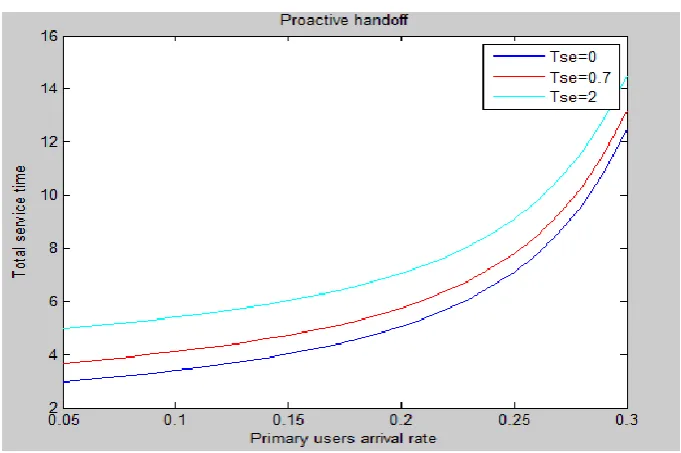
Figure 6: Proactive handoff scheme with different values of Tse.
ISSN(E): 2277-128X, ISSN(P): 2277-6451, pp. 66-72
Figure 8: Reactive handoff scheme.
Figure 9: Reactive handoff scheme with different values of Tse
A.Comparison Graphs:
Bashir et al., International Journal of Advanced Research in Computer Science and Software Engineering 8(10) ISSN(E): 2277-128X, ISSN(P): 2277-6451, pp. 66-72 Here we see that the total service time of new switching handoff scheme is lesser than the random handoff scheme, the difference increasing with increase in primary arrival rates.
Figure 11: Comparison of Proactive and Reactive handoff scheme.
Between proactive and reactive handoff schemes, proactive exhibits the least cumulative handoff delay and least total service time, because no time is wasted in spectrum sensing, and spectrum decision making, unlike the proactive handoff scheme in which the target channel is preselected.
V. CONCLUSION
Due to the growth and spread of wireless devices in the unlicensed spectrum bands, such as ISM, the bands become more and more crowded and therefore affect the performance of the wireless networks negatively. Thus, the cognitive spectrum access principles are required to utilize the existing spectrum bands more efficiently. The OSA technique is a step towards solving the issue of the spectrum being underutilized in today’s wireless networks.
REFERENCES
[1] A. Wyglinski and M. Nekovee, "Cognitive radio communications and networks," IEEE Communications Magazine, vol. 46, pp. 30-31, 2008.
[2] E. FCC, "Docket No 02-135," Spectrum Policy Task Force Report, 2002.
[3] S. M. Mishra, D. Cabric, C. Chang, D. Willkomm, B. Van Schewick, S. Wolisz, and B. Brodersen, "A real time
cognitive radio testbed for physical and link layer experiments," 2005, pp. 562-567.
[4] S. Huang, X. Liu, and Z. Ding, "Optimal transmission strategies for dynamic spectrum access in cognitive radio networks," Mobile Computing, IEEE Transactions on, vol. 8, pp. 1636-1648, 2009.
[5] I. F. Akyildiz, W. Y. Lee, M. C. Vuran, and S. Mohanty, "A survey on spectrum management in cognitive radio
networks," Communications Magazine, IEEE, vol. 46, pp. 40-48, 2008.
[6] S. Haykin, "Cognitive radio: brain-empowered wireless communications,"Selected Areas in Communications, IEEE Journal on, vol. 23, pp. 201-220, 2005.
[7] B. A. Fette, Cognitive radio technology: Academic Press, 2009.
[8] L. Kleinrock, "Queueing Systems, Vol. II: Computer Applications," ed:Wiley, New York, 1976. [9] L. Kleinrock, "Queueing systems, vol. I: Theory," ed: Wiley, New York, 1975.
[10] Available: http://www.cse.fau.edu/~bob/publications/encyclopedia.pdf
[11] J. Walraevens, D. Fiems, and H. Bruneel, "Performance analysis of priority queueing systems in discrete time," in Network performance engineering, ed:Springer, 2011, pp. 203-232.
[12] M. Tanner, Practical Queueing Analysis: McGraw-Hill, 1995.
[13] D. Efrosinin and A. Winkler, "Queueing system with a constant retrial rate, non-reliable server and threshold-based recovery," European journal of operational research, vol. 210, pp. 594-605, 2011.
[14] B. Choi and Y. Chang, "Single server retrial queues with priority calls,"Mathematical and Computer modelling,
vol. 30, pp. 7-32, 1999.
ISSN(E): 2277-128X, ISSN(P): 2277-6451, pp. 66-72 [16] J. Amador and J. Artalejo, "The M/G/1 retrial queue: New descriptors of the customer’s behavior," Journal of
computational and Applied Mathematics, vol. 223, pp. 15-26, 2009.
[17] A. Kalmychkov and G. Medvedev, "Probability characteristics of Markov local-area networks with random-access protocols," Automatic Control and Computer Sciences, vol. 24, pp. 38-46, 1991.
[18] W. D. Kelton and A. M. Law, Simulation modeling and analysis: McGraw Hill Boston, MA, 2000.
[19] B. Cao, Q. Zhang, J. W. Mark, L. X. Cai, and H. V. Poor, "Toward efficient radio spectrum utilization: User cooperation in cognitive radio networking," Network, IEEE, vol. 26, pp. 46-52, 2012.
[20] P. Yadav and P. P. Bhattacharya, "An Effective Dynamic Spectrum Access Method for Use in Cognitive Radio," 2013.
[21] Q. Zhao and B. M. Sadler, "A survey of dynamic spectrum access," Signal Processing Magazine, IEEE, vol. 24, pp. 79-89, 2007.
[22] Q. Zhao and A. Swami, "A survey of dynamic spectrum access: signal processing and networking perspectives," in Acoustics, Speech and Signal Processing, 2007. ICASSP 2007. IEEE International Conference on, 2007, pp. IV-1349-IV-1352.
[23] Y. C. Liang, H. H. Chen, J. Mitola, P. Mahonen, R. Kohno, J. Reed, and L. Milstein, "Cognitive radio: theory and application," IEEE Journal on Selected Areas in Communication, vol. 26, pp. 1-4, 2008.
[24] C. X. Wang, H. H. Chen, X. Hong, and M. Guizani, "Cognitive radio network management," Vehicular Technology Magazine, IEEE, vol. 3, pp. 28-35, 2008.
[25] J. Mitola III and G. Q. Maguire Jr, "Cognitive radio: making software radios more personal," Personal Communications, IEEE, vol. 6, pp. 13-18, 1999.
[26] J. Mitola, "Cognitive radio: An integrated agent architecture for software defined radio," Doctor of Technology, Royal Inst. Technol.(KTH), Stockholm, Sweden, pp. 271-350, 2000.
[27] A. Jamalipour, "Cognitive heterogeneous mobile networks [Message from the Editor-in-Chief]," Wireless Communications, IEEE, vol. 15, pp. 2-3, 2008.
[28] L. BERLEMANN and S. MANGOLD, "Cognitive radio and dynamic spectrum access," 2009.
[29] ITU page on definitions of ism bands. [online]. Available: http: //www.itu.int/ITU-R/terrestrial/faq/index.html [30] FCC, "Reports of commissions rules to permit unlicensed national information infrastructure (u-nii) devices in