Graph Computation Models
Selected Revised Papers from GCM 2015
20 Years of Triple Graph Grammars:
A Roadmap for Future Research
Anthony Anjorin, Erhan Leblebici and Andy Sch¨urr
20 pages
Guest Editors: Detlef Plump
Managing Editors: Tiziana Margaria, Julia Padberg, Gabriele Taentzer
20 Years of Triple Graph Grammars:
A Roadmap for Future Research
Anthony Anjorin1, Erhan Leblebici2and Andy Sch ¨urr2
Chalmers|University of Gothenburg
Technische Universit¨at Darmstadt
Abstract: Triple graph grammars (TGGs) provide a declarative, rule-based means
of specifying binary consistency relationships between different types of graphs. Over the last 20 years, TGGs have been applied successfully in a range of appli-cation scenarios including: model generation, conformance testing, bidirectional model transformation, and incremental model synchronisation.
In this paper, we review the progress made in TGG research up until now by ex-ploring multiple research dimensions, including both the current frontiers of TGG research as well as important future challenges. Our aim is to provide a roadmap for the coming years of TGG research by stating clearly what we regard as adequately researched, and what we view as still unexplored potential.
Keywords: Triple Graph Grammars, Bidirectional Model Transformation, Model
Synchronisation
1
Introduction and motivation
Triple graph grammars (TGGs) [Sch94] provide a declarative, rule-based means of specifying binary consistency relationships between different types of graphs. Over the last 20 years, TGGs have been primarily used as abidirectionalmodel transformation language. Models are encoded as graphs and model transformations, used to maintain the consistency of related pairs of models in a concurrent engineering scenario by propagating changes in both directions, are derived from a given TGG specification. Bidirectional transformations (bx) are highly relevant in numerous domains [CFH+09], and multiple frameworks, approaches, and tools have been suggested for bx(cf. [Ste08] for an overview). Important application scenarios ofbxinclude model synchro-nisation, round-tripping, and realising editable views [DWGC14].
general. In each dimension we (i) review the relevantstatus quo, providing ample references to existing formalisations and implementations, and (ii) pose future challenges required to push the current frontiers of TGG research in what we believe are the most promising directions.
The rest of the paper is structured as follows: Section2provides a brief introduction to TGGs with a running example taken from the bxexample repository [CMSG14]. Section3 presents our main contribution as a radar chart of research dimensions, motivated and clarified infor-mally using the running example. In Section4we compare our contribution with other related “visionary” papers, and conclude in Section5with a brief summary and outlook on future work.
2
Running Example and Preliminaries
A TGG specification consists of aTGG schemaand a set ofTGG rules. A TGG schema is a triple of source, correspondence, and target metamodels, which define the languages of models of the two domains (source and target) over which consistency is to be specified, as well as a language of explicit correspondence links that are created between related elements of source and target models. TGGs are symmetric as the consistency relation is not in any way directed. Referring to one domain as “source” and the other as “target” is, therefore, just a historic convention.
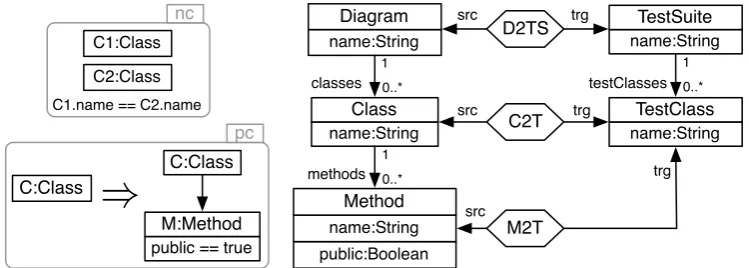
The TGG schema for our running example, a variant ofModelTests[Ste] from thebxexamples repository [CMSG14], is depicted in Fig.1. The source metamodel represents a simple language of class diagrams consisting of a hierarchy of diagrams (Diagram), classes (Class), and meth-ods (Method). All elements are named (string attributename), and methods can be public or private (boolean attributepublic). As multiplicities can only express simple constraints (dia-grams/classes contain arbitrarily many classes/methods, and every class/method is connected to exactly one diagram/class), an additional constraint language is required to formulate more com-plex domain constraints. In this paper, we use so calledgraph conditions(cf., e.g., [RAB+15]), which are less expressive than the Object Constraint Language (OCL) but fit better in the general framework of algebraic graph transformation and consequently TGGs (cf., e.g., [AST12]). Two domain constraints,ncfor negative constraint andpcfor positive constraint, are used in the source metamodel to ensure that no two classes exist with the same name, and that every class has a public method, respectively.
name:String Diagram name:String TestSuite name:String TestClass D2TS name:String Class public:Boolean name:String Method C2T M2T 1 0..* 1 0..* 1 0..* classes methods testClasses src src src trg trg trg C1:Class C2:Class C1.name == C2.name
nc
C:Class
C:Class
pc
public == true M:Method
)
A negative constraint is a patternNthat must not exist in a valid model. A positive constraint is of the formP→C, wherePandC are patterns representing the premise and conclusion of the constraint, respectively. If the premise can be found in a model then the conclusion, as an extension of the premise, must also hold. For formal definitions of graph conditions and multiplicities we refer to [Tae12,RAB+15]. To clearly differentiate patterns from (meta)models, patterns are placed in a light grey border that is tagged with the name of the pattern, and capital letters are used for the names of objects in patterns. Where there is only one possible association between types, the name of the link is omitted to prevent diagram clutter (e.g., the link between
C:ClassandM:Methodcan only be of typemethodsand is thus omitted).
Patterns contain attribute conditions such as C1.name == C2.namein nc, or public == true in pc, where the latter condition is inlined in the object M:Method. The target metamodel consists of test suites (TestSuite) with test classes (TestClass), while the cor-respondence metamodel provides types for “links” between source and target elements: diagrams correspond to test suites, classes and methods correspond to test classes.
The consistency relation between class diagrams and test suites is specified informally in [Ste], and we extend it by introducing an additional requirement concerning methods (condition 3 below). To fit in a TGG context, the conditions are additionally interpreted as requirements on the correspondence model between consistent source and target models:
1. For every diagram there exists a test suite with the same name.
2. For every class with name “Foo”, there exists at least one test class called “TestFooX” for some natural numberX.
3. Every public method of a class is associated with all test classes for the class.
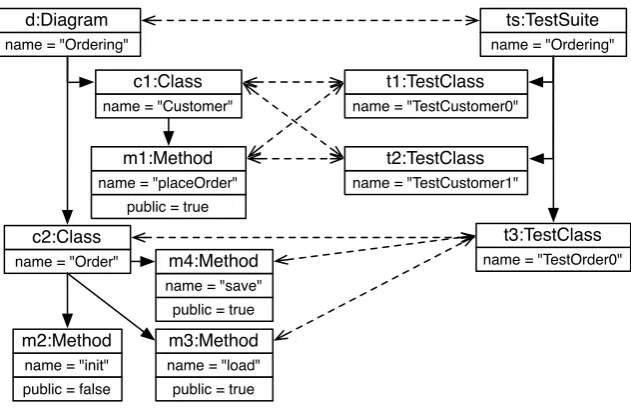
An example of a consistent triple of source, correspondence, and target models is depicted in Fig.2. The source model is a diagram with two classes, while the target model is a test suite with three test classes. Note that every class has at least one public method (cf. source domain constraintpc), and every public method is connected to every test class for its containing class.
name = "Ordering"
d:Diagram
name = "Ordering"
ts:TestSuite
name = "Customer"
c1:Class
name = "TestCustomer0"
t1:TestClass
public = true name = "placeOrder"
m1:Method
name = "Order"
c2:Class
name = "TestCustomer1"
t2:TestClass
public = true name = "load"
m3:Method
public = true name = "save"
m4:Method name = "TestOrder0"
t3:TestClass
public = false name = "init"
m2:Method
This is a model and not a pattern, so small letters are used for node names, and attribute values are depicted with a single equals sign, e.g., name = Ordering. Correspondence links are depicted as dashed bidirectional arrows with the assumption that they are of the correct type.
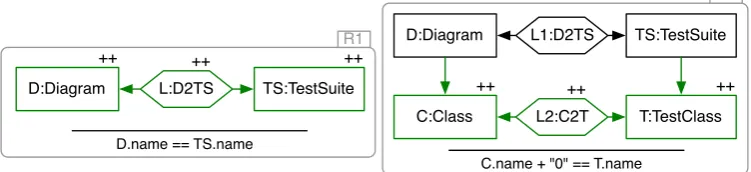
An informal consistency specification can be formalised with a set of TGG rules that together generate the language of all consistent triples such as the triple depicted in Fig.2. Two simple TGG rulesR1andR2for the running example are depicted in Fig.3. A TGG rule consists of two patternsL→R, whereLis the precondition andR, an extension of L, is the postcondition for applying the rule. Elements inLare calledcontextelements as they must be present to apply the rule, while elements inR\Lare called created elements as they are created as a result of applying the rule. To represent rules, a compact concrete syntax is used, merging both patternsL andRinto a single pattern by using colours and markup to distinguish elements: context elements are black, while created elements are green with an additional “++” markup. As with the types of links, this markup is only depicted when absolutely necessary, e.g., all links connected to a created object must be also created and do not have any explicit markup.
The ruleR1(to the left of Fig.3) creates a consistent pair of a diagram and a test suite, demand-ing that they have the same name via the simple attribute condition D.name == TS.name. Rules such asR1are referred to asisland rules[ALK+15] as they do not require context and are thus always applicable, resulting in an “island” that is not connected to anything else. The rule
R2(to the right of Fig.3) demands a consistent pair of a diagram and a test suite, and extends this pair by creating a class and a test class. A simple attribute condition is used to demand that the name of the test class be formed by adding the suffix “0” to the name of the class. Such rules are calledextension rules[ALK+15] as they create elements that are directly attached to existing context elements. With just these two TGG rules, a substantial part of the example triple in Fig.2
can already be created: R1can be used to created↔ts,R2can be applied two times to create c1↔t1, andc2↔t3. All other elements require advanced TGG language features, which will be discussed in the following sections.
D:Diagram L:D2TS TS:TestSuite
++ ++
++
R1
C:Class L2:C2T T:TestClass
++ ++
++
D:Diagram L1:D2TS TS:TestSuite
C.name + "0" == T.name
R2
D.name == TS.name
Figure 3: Basic TGG rules for running example
3
Research dimensions
Research on TGGs can be viewed in a hyperspace spanned by five dimensions each representing the progress in a certain direction, going from basic to advanced. Every “point” in this hyper-space is thus a specific combination of five properties taken from these dimensions, and can be represented as a trace through a radar chart as depicted in Fig.4. The points depicted in Fig.4
Concurrency
Expressiveness
Reliability
Tolerance Scalability
multi-domain
integration
synchronization
batch
NACs
complex attribute conditions
multi-amalgamation
PACs
transformation correctness
transformation completeness
domain correctness
domain completeness
consistent model, consistent delta
consistent model, inconsistent delta
inconsistent model, inconsistent delta
exponential in model size polynomial in
model size
polynomial in delta size
simultaneous
complex conditions
least change/surprise 1995:
2015: ??? :
Figure 4: Overview of TGG research dimensions
A brief overview of all research dimensions is provided in the following, before the five di-mensions are discussed in detail in corresponding sections3.1–3.5.
Expressiveness, defined in this paper as the class of consistency relations that can be expressed with a set of TGG language features, is a crucial dimension as increasing expressiveness is important for the practical applicability of TGGs, i.e., capturing real-world consistency relations as precisely as possible. The expressiveness dimension in Fig.4lists TGG language features that have been discussed in existing literature. As we shall see in Section3.1, our relatively simple running example already requires Negative Application Conditions (NACs), complex attribute conditions, and even multi-amalgamation.
Theconcurrencydimension represents the various operational scenarios in which TGGs can be used. The main idea is to induce a high-level consistency relation with the TGG as follows:A pair of source and target models are consistent, if they can be generated as part of a triple using the rules of the TGG.This specification is then adjusted appropriately (operationalised) so it can be used to accomplish different tasks. Typical operational scenarios are discussed in Section3.2. To ensure the practical applicability of TGGs,scalabilityis important so that real-world mod-els of realistic size can be handled appropriately. Scalability with respect to relevant factors (model size, size of changes to be propagated) is discussed in Section3.3.
The focus up until now in TGG research has been primarily on building fully automated trans-formations that guarantee consistent output for consistent input, i.e., all formal properties (cf. reliability dimension) are typically only guaranteed for consistent input. As argued by Stevens
in [Ste14], however, models might never be fully consistent in practice, with engineers
work-ing concurrently and uswork-ing tool support to improve (but not necessarily enforce!) consistency at regular steps. Related challenges for TGG research are discussed in Section3.5.
3.1 Expressiveness
Negative Application Conditions (NACs): Consider our running example and the TGG
con-sisting of the schema depicted in Fig. 1 and TGG rules R1andR2 (Fig. 3). Apart from not yet being able to fully create the example triple depicted in Fig.2,R2can be applied multiple times to create classes with the same name. This violates the negative source domain constraint
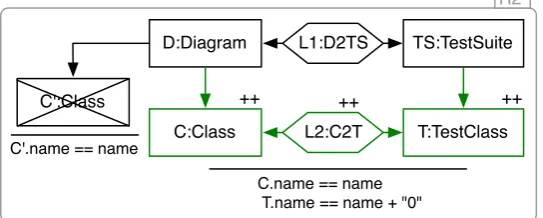
nc (Fig. 1) and should be prevented. NACs are a well-known feature from graph transfor-mation used to control rule applicability, and have been studied extensively in the context of TGGs [EHS09, GEH11, HEGO10, KLKS10, AST12]. R2can be extended with a NAC that forbids the presence of a class with the same name as the class to be created. Such an extension is depicted in Fig. 5asR2’. Negative elements are depicted as “crossed out” and extend the precondition of the rule, blocking rule application if they can be found in a model.
Transferring NACs to TGGs is, however, not as straightforward as it might seem. In contrast to normal graph transformation, the set of TGG rules is typically used as a high-level specifica-tion of consistency to deriveoperationaltransformations (cf. the concurrency dimension) and it is challenging to extend the various operationalisations to take NACs into account. Most ap-proaches restrict the usage of NACs in some way or the other, e.g., to source and target NACs consisting of only source or target elements, respectively.
Depending on the TGG approach, NACs can also have an adverse effect on scalability and, e.g., [AST12] restricts the usage of NACs to only enforcing negative domain constraints as in
R2’. Indeed, some approaches with a primary focus on scalability have explicitly chosen not to provide any support for NACs, e.g., [GHL14]. NACs are, nevertheless, an important and useful TGG language feature and the current support for NACs can still be improved especially regarding lifting current restrictions.
C:Class L2:C2T T:TestClass
++ ++
++
D:Diagram L1:D2TS TS:TestSuite
C.name == name T.name == name + "0"
R2'
C':Class
C'.name == name
Complex Attribute Conditions: In any practical application, specifying the consistency of attribute values cannot be avoided. As algebraic graph transformation is generally more suitable for specifyingstructuralrather than attribute-related relationships [Ren10], integrating a flexible handling of complex attribute conditions in TGGs has been a long standing challenge. Some of the difficulties involved are discussed in [KW07,LHGO12].
Allowing arbitrary OCL constraints in TGG rules [KRW04] certainly increases expressive-ness, but also makes it harder (perhaps impossible) to guarantee any formal properties (cf. re-liability dimension). Another approach is to use the attribute constraints in TGG rules as an “interface”, i.e., only to check the conformance of manually implemented operationalisations (e.g., in OCL or plain Java) [GHL14]. A further approach is to integrate black-box constraints in TGG rules, guaranteeing that such atomic constraints can be mixed and combined as required to formulate complex constraints in each rule [AVS12]. This allows for both user-defined, problem-specific constraints (implemented in, e.g., Java) as well as a supplied set of library constraints.
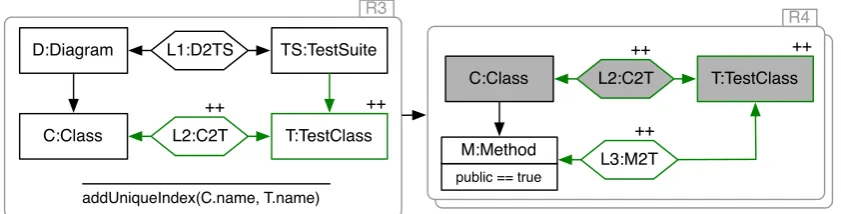
To handle our running example, a constraint addUniqueIndex(className, test-ClassName) can be implemented as a user-defined constraint and used in a TGG rule that creates a new test class for an existing class. This is depicted as ruleR3to the left of Fig. 6
(ignoreR4for the moment). Depending on the operationalisation, the constraint implementation might have to deal with (i) deciding if a given class name and test class name are consistent, (ii) deriving a consistent test class name from a given class name by post-pending a unique index, (iii) deriving a consistent class name from a given test class name by simply stripping off the index, and finally (iv) generating consistent pairs of class names and test class names. Depending on how a constraint is combined with other constraints, however, note that not all possible cases must be supported. The “feasibility” of a combination of constraints can be checked at runtime when operationalising the rules [AVS12].
Support for complex attribute conditions in TGG rules is now supported in most TGG tools to a certain extent, but again this can still be improved, especially regarding corresponding formal analysis techniques (cf. reliability dimension), which often do not take attribute values and conditions into account (cf. [DV14] for a discussion and ongoing work on this).
C:Class L2:C2T T:TestClass ++ ++
D:Diagram L1:D2TS TS:TestSuite
addUniqueIndex(C.name, T.name)
C:Class L2:C2T T:TestClass
public == true M:Method
++ ++
L3:M2T ++
R3 R4
Figure 6: Rules for adding additional test classes
Multi-Amalgamation: Considering our running example and the triple depicted in Fig. 2,
public methodsof the class. Asc1only has a single methodm1, creating the correspondence linkm1↔t2 could be accomplished by extendingR3and adding an additional rule for this case. In the case ofc2 that has two public methods, however, two linksm3↔t3 andm4↔t3 have to be created meaning that a further extension ofR3is again required. This will not work in general as classes can have arbitrarily many public methods.
A solution to the problem of establishing1-to-mrelations in a single rule application is pro-vided by multi-amalgamation [BFH87, GEH10], a well-known language feature from graph transformation. Progress on transferring multi-amalgamation to TGGs has been made [LAST15,
LAS15] and the so-calledmulti-rule R4depicted in Fig. 6can be used to handle the creation
of correspondence links to existing public methods. The main idea is to generalise TGG rules to interaction schemes, which consist of akernel rule that is applied once, and a number of multi-rules (denoted in the concrete syntax with a double border and an incoming arrow from the kernel rule) that are applied as often as possible in such a manner that all applications agree with the kernel application. In this case, the kernel isR3, which is applied to create a new test class for an existing class, whileR4is the multi-rule that is applied as often as possible (creating a correspondence link to every existing public method of the class). Multi-rules contain and ex-tend the entire kernel, but only necessary elements, emphasised with a grey background, need to be specified in the concrete syntax.
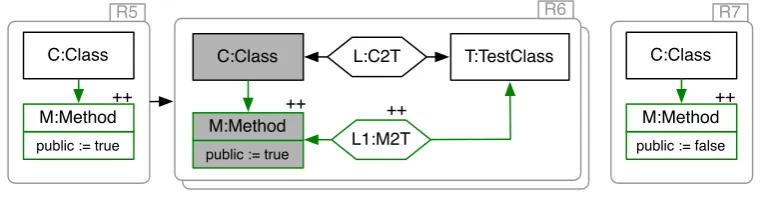
To complete our running example, we still have to add rules that create methods and connect them to their classes. Interestingly, this also requires multi-amalgamation as a newly added pub-lic method must be connected to all existing test classes. Figure7depicts an interaction scheme consisting of kernelR5to add a new public method, and multi-ruleR6to create correspondence links to all existing test classes. Finally, a so-calledignore ruleR7[ALK+15] is used to specify that adding private methods does not affect the target or correspondence models in any way.
Support for multi-amalgamation is still work in progress and requires further research, espe-cially regarding the development of the fundamental theory and related static analyses [TG15].
public := true
M:Method
C:Class C:Class L:C2T T:TestClass
L1:M2T ++
R5 R6
++ ++
public := true
M:Method
public := false
M:Method C:Class
R7
++
Figure 7: Rules for adding methods
Positive and Complex Application Conditions: The final two points on the expressiveness
equivalent to first order logic and covers a useful subset of OCL [RAB+15]. Although complex application conditions have been integrated into TGGs in [GEH11], this is only a first step in the direction as the operationalisation of such TGG rules and corresponding algorithms for the various application scenarios (cf. concurrency dimension) are not discussed.
3.2 Concurrency
Simultaneous Creation of Consistent Triples: This might seem surprising but applying TGG
rules directly as specified can already be useful. This “simultaneous” creation of triples can, for example, be used to implement a syntax directed visual modelling tool with separate models for concrete syntax and semantic interpretation [LGB07]. In this case, the TGG models the synchronised evolution of both models in parallel.
Another application for the simultaneous creation of triples is for test generation [WAS14,
HLG+11]. The idea here is to view the TGG as a high-level specification of correctness, i.e., a “test model” for a transformation that can be implemented manually in any language of choice. Even though such a transformation could be automatically derived from the TGG, in some cases it still makes sense to do this manually: (i) the TGG tool in use does not support the target platform, (ii) extra possibly problem-specific optimisations are necessary for efficiency reasons, or (iii) the TGG is incomplete in the sense that only certain (very important) aspects of the transformation are modelled and are to be tested.
Supporting the simultaneous creation of triples is straightforward but, as is often the case, the devil is in the details. Challenges include supporting NACs efficiently, implementing complex attribute conditions as high-quality attribute value generators, and guiding the generation process to produce “balanced” or realistic models with respect to the concrete task or domain. Some of these challenges are discussed in [WAS14].
Batch Transformations: A considerable amount of work has been invested in supporting
batch forward and backward transformations, which are derived automatically from a TGG. The main idea is to derive a forward transformationFWD that is able to extend an existing source model to a complete triple, i.e., appending a consistent correspondence and target model. This is depicted for our running example in Fig.8and applies analogously to a backward transforma-tionBWD. These operational scenarios are referred to as “batch” transformations as the output is created from scratch, and the entire input is processed afresh, independent of former results.
name = "Ordering" d:Diagram
name = "Customer" c1:Class
public = true name = "placeOrder"
m1:Method
name = "Ordering"
d:Diagram
name = "Ordering" ts:TestSuite
name = "Customer"
c1:Class
name = "TestCustomer0" t1:TestClass
public = true name = "placeOrder"
m1:Method FWD
There exist theoretical results characterising precisely when a TGG can be operationalised to yield forward and backward transformations, and when given forward and backward transfor-mations conform to a TGG [EEE+07]. This is particularly important when considering or in-troducing new language features as it might no longer be possible to derive a forward/backward transformation that retains the semantics of the TGG, i.e., conforms to the TGG.
Different approaches can be used to derive forward and backward transformations, ranging from fully interpretative approaches [KRW04], to “compiling” the TGG to yield a set of “for-ward” graph transformation rules that can be directly executed to realise the forward transfor-mation [EH12]. Most approaches take a mixed approach, deriving forward/backward rules and controlling their application with an underlying TGG control algorithm [GHL14,LAS14a]. A comparison of TGG approaches with a focus on batch transformations is provided in [HLG+13]. Batch transformations are certainly relevant and useful in practise [HGN+13], but it is diffi-cult to argue why TGGs are better than a straightforward combination of unidirectional model transformation languages. Arguments do include increased productivity and consistency by con-struction, but these can be guaranteed for a combination of separate unidirectional approaches, effectively “faking” bidirectionality [PDPR14] without a bx tool. Indeed, batch forward and backward transformation might not be a very convincing primary application scenario for TGGs, especially as unidirectional approaches are often more efficient [LAS14a].
Model Synchronisation: The true potential of TGGs lies more in realising incrementally
working synchronisation tools, already mentioned as future work in the first paper on TGGs
[Sch94]. Aforward model synchroniser SyncF takes a triple and a change to the source model
∆S (referred to as asource delta) as input, and produces a consistent output triple by manipu-lating the existing correspondence and target models. This means that∆Sis propagated to yield
corresponding∆C and∆T in a manner that conforms to the underlying TGG. This is depicted
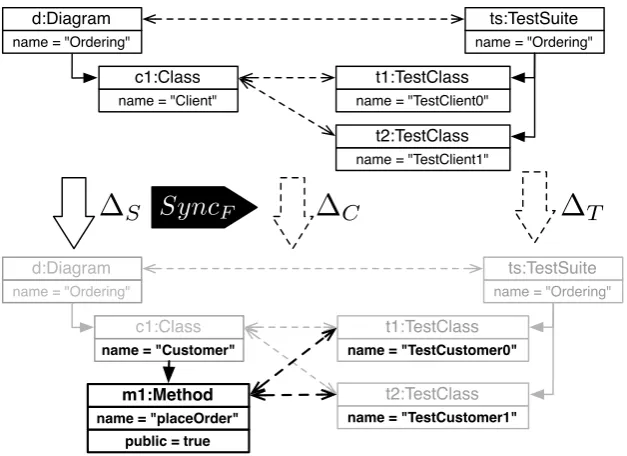
schematically in Fig. 9 for our running example (analogously for backward model synchro-nisers). Note that ∆S consists of an attribute change (c1.nameis changed from Client to
Customer), an addition of an object (methodm1), and a link (connectingc1tom1).
The challenge here is to workincrementally, taking the entire input triple into account and only changing what is necessary. This is indicated in Fig.9by greying out unaffected parts. Model synchronisation is a generalisation of the batch case as batch transformations correspond to the empty triple as input, and creating an entire source or target model as the source/target delta to be propagated. Model synchronisation cannot be “faked” so easily by combining unidirectional transformations, as it is impossible to avoid information loss in general without accessing the old state of the models involved. In our example, applying a batch forward transformation to the source model in Fig.9would result in the same triple depicted in Fig.8, i.e., test classt2would not be created. The reason here is that it is impossible to know how many additional test classes to create for each class in the source model, solely by inspecting the source model.
name = "Ordering" d:Diagram
name = "Ordering" ts:TestSuite
name = "Client" c1:Class
name = "TestClient0" t1:TestClass
name = "TestClient1" t2:TestClass
name = "Ordering"
d:Diagram
name = "Ordering"
ts:TestSuite
name = "Customer"
c1:Class
name = "TestCustomer0"
t1:TestClass
name = "TestCustomer1"
t2:TestClass S
public = true name = "placeOrder"
m1:Method
T
C
Sync
FFigure 9: A forward synchronisation
as well as multiple implementations (cf. [LAS+14b] for a comparison) exist. The different ap-proaches apply various strategies and pose certain restrictions to make a compromise between efficiency, being as incremental as possible, and guaranteeing well-behavedness. Improving the existing support for model synchronisation is a current focus of TGG research.
Model Integration: Model synchronisation can be further generalised tomodel integration,
where the task is not just to propagate a source or target delta, but to consolidate a given pair of sourceandtarget deltas applied independently to the same triple of models. Model integration is required to support concurrent engineering activities, where engineers work for a “sprint” in parallel on multiple models and then restore consistency at given points in time (cf. [Anj14,
RLSS11]). Model integration thus requires some form of conflict detection and resolution as the
pair of source and target deltas cannot be expected to be consistent in any sense.
Existing frameworks for model integration all follow the straightforward idea presented by
[XSHT13] of combining forward and backward model synchronisers with a model merge: source
Model integration can be seen astheapplication scenario forbxin general and TGGs in particu-lar. It is relatively easy to argue the added value of abxlanguage with direct support for model integration, as opposed to somehow combining unidirectional transformation languages. Model integration is, therefore, a promising current and future focus of TGG research.
Multi-Domain TGGs: In practice, even though some cases might involve only two related
models, supporting concurrent engineering activities in general will involve maintaining the con-sistency of a wholesetof related models. Thebxcommunity is currently only considering the simplified case of handling a pair of related models, not because this is all that is required, but simply because this simplifies the problem, which is already complex enough.
Nonetheless, [KS06,TA15] have already shown that at least the basic theory for TGGs can be extended elegantly from triples to arbitrarily connected networks of models. All TGG tools we are aware of, however, still consider multi-domain TGGs to be currently out-of-scope.
3.3 Scalability
An advantage of TGGs compared to, e.g., constraint solver-based solutions is the potential to scale better. This is due to the considerable experience in the graph transformation community with developing scalable graph pattern matching engines, which have been successfully lever-aged for TGGs [LAS+14b,HLG+13].
The underlying problem of “graph parsing”, however, remains difficult and na¨ıve solutions can easily explode exponentially, even for TGGs with only a few rules, and moderate model sizes. In practice, therefore, the class of supported TGGs is typically restricted in some suitable way to guarantee scalability [ALST14,HEGO10,KLKS10].
There are two relevant factors when discussing scalability of TGG-based tools: (i) the average size (number of elements) of (rule) patternsk, and (ii) the size (number of elements) of involved modelsn. To be useful in practice, current TGG tools make a tradeoff between expressiveness (e.g., restricting the usage of NACs) and scalability, ensuring at least polynomial runtime in model size, i.e., at mostO(nk).
The challenge for future work is to completely decouple synchronisation/integration time from model size, i.e., to scale polynomially with respect to the number of elements changedn0, where n0is normally much smaller thann. Approaches such as [JKS06,ARDS14,GHL14] have shown that this can be attained if the set of supported TGGs is severely restricted. Further relaxing these restrictions and still scaling with respect to delta size (perhaps at least in most “important” cases) is ongoing and future work.
3.4 Reliability
To simplify the following discussion, models will denoted by GX (G for graph), where X ∈
{S,C,T} represents the domain (source, correspondence, or target) of the model. Triples of models are consequently denoted byGS←GC→GT. The rules of a TGG generate a language
Transformation Correctness and Completeness: Let us refer to one of the operationalisa-tions on the concurrency axis as atransformationτ. A fundamental requirement is that such a derived transformationτconform to its underlying TGG:
A transformationτ istransformation correctif it produces consistent triples only.
This is formalised differently depending on the exact operationalisation: for batch transforma-tions cf. [KLKS10,SK08,EEE+07], for model synchronisation [HEO+11,LAVS12], and for model integration [HEEO12,OBE+13]. Considering our running example, transformation cor-rectness guarantees that the result of executing a synchronisation (Fig.9) will always be a triple that could also be created from scratch by applying the rules of the TGG (Fig.3,6,7).
A related and equally desired property of transformations istotality, i.e., demanding that the domain of a transformationτbe precisely stated and thatτbe total on its set of valid inputs:
τistransformation completeif it is total on a precisely defined set of valid inputs.
Although not demanded explicitly, “precisely defined” often means a set of conditions that can be checked at design time via static analysis techniques. The practical relevance of transformation completeness is that when an implementation throws an exception, this can only mean that the input was invalid (and this can possibly be ruled out with a corresponding static analysis).
Once again, transformation completeness is formalised differently depending on the opera-tional scenario: for batch transformations cf. [KLKS10, SK08,EEE+07], and for model syn-chronisation [HEO+11,LAVS12]. For our running example, transformation completeness guar-antees thatanysource delta that leads to a source model, which is part of a consistent triple, can be forward synchronised (Fig.9). Note that the concept of transformation completeness does not seem to make sense in the more general context of model integration, where a host of properties have been suggested to formulate reasonable expectations on the conflict detection and resolution process instead [HEEO12,OBE+13]. Indeed, capturing an analogous completeness property for model integration can be viewed as work in progress.
Domain Correctness and Completeness: When working with models and metamodels, the
rules of a TGG are not the sole source of consistency. The domains of the source and target models also comprise “domain” constraints, which should not be violated by valid ordomain consistentmodels. According to [EEPT06], a triple of metamodels can be formalised as atype triple graph T Gtogether with a setC of domain constraints. In analogy toL(T GG),L(T G)
denotes the set of all well-typed triples, whileL(T G,C)denotes the set of alldomain consistent triples that are well-typedandadditionally do not violate any domain constraints from a given set of constraintsC.
Given these independent sources of consistency requirements,L(T GG)andL(T G,C), the following two properties are used to demand the “compatibility” of a TGG with its domains:
A TGG isdomain correctif:G∈L(T GG)⇒G∈L(T G,C).
to the target domain), let L(T GS,CS) denote the set of all source domainconsistent models,
i.e., well-typed and valid source models according to the source type graphT GSand given set of
source domain constraintsCS:
A TGG issource domain completeif:GS∈L(T GS,CS)⇒ ∃GS←GC→GT∈L(T GG).
A static analysis technique for ensuring domain correctness given a TGG and a set of domain constraints is presented in [AST12], while initial results on analysing domain completeness is given by [EHSB13]. In both cases, an extension to advanced language features (cf. expressive-ness dimension), an implementation, and integration in a TGG tool is still work in progress. The TGG for our running example isnotdomain correct, as it can create classes without any public methods usingR2’ (Fig. 5). The analysis of [AST12] would identify this violation, and even suggest extendingR2’to create a public method together with every new class C. The TGG is also not domain complete, as numerous target domain constraints are missing, e.g., to ensure that the names of test classes are unique and can actually be generated by the TGG.
The practical relevance of domain correctness is to ensure that TGG-based tools take domain constraints adequately into account. A check for domain completeness can be used to indi-cate that certain domain consistent models cannot yet be generated by the TGG. This is often unwanted as it points to implicit domain constraints. In certain operational scenarios, domain completeness can also be exploited as a means of checking for input validity: for a batch for-ward transformation that is both transformation complete and domain complete, a source model is valid input if it is source domain consistent.
Least Change, Least Surprise: Especially relevant in the general case of model integration,
the formal property of least change or least surprise is meant to capture the perceivedquality of the synchronisation / integration process. Transformation correctness is only a very basic requirement and does not pose any restrictions on how consistency is restored. For instance, based solely on transformation correctness, i.e., ignoring runtime, there are TGGs for which it is impossible to distinguish a forward synchroniser that simply deletes all correspondence / target elements and always performs a batch forward transformation, from a forward synchroniser that works incrementally and only performs minimal changes. Compare the case of our running example depicted in Fig.8and Fig.9: Retaining test classt2 during synchronisation is obviously desirable (Fig.9), yet there is nothing stating formally that this is better than the result in Fig.8! The intuition here is to prefer synchronisers that restore consistency by “changing as little as possible”. This turns out, however, to be challenging to formalise and is a current focus of bx research. Amongst other factors, the “best behaviour” of a synchroniser is not necessarily directly connected to the “size” of the changes applied according to, e.g., some form of metric, but might be more related to being as predictable as possible, i.e., causing least surprise as opposed to afflicting least change. The interested reader is referred to [CGMS15] for a detailed overview of related work in this context as well as a discussion of challenges.
3.5 Tolerance
The current trend, especially for model integration, is towards tools thattolerate or better yet embrace inconsistencies [Ste14]. As indicated in the tolerance dimension (Fig.4), a first step in this direction could involve accepting inconsistent deltas but ensuring that the resulting triple is always consistent. In many cases, however, this might not be what is wanted at all. It might actu-ally be better for a tool to onlyimprovethe situation if possible, and not enforce full consistency (which could mean deleting everything in an extreme case) [Ste14].
For bxtools to be of any use in practice, a fine grained notion of consistency should be sup-ported, i.e., not consistent or inconsistent, but providing something akin to a “lattice” of consis-tency, together with formal guarantees to ensure that thebxtool either improves the situation with respect to consistency, or does nothing. The argument is that in practice, models might never be fully consistent, with engineers working constantly and concurrently on them [Ste14,CGMS15]. This is a completely new challenge for TGG research, as all formal results are currently based on a fully consistent starting point. It is still unclear how to provide a fine grained notion of consistency for TGGs and how best to integrate a concept of “tolerance” in the current formal framework. In combination with model integration, providing support for tolerance is perhaps theprimary future challenge that TGG research must address.
4
Related work
The goals and scope of thebxcommunity are outlined in [CFH+09]. A survey ofbxapproaches is provided by [Ste08], while a more recent feature-basedbxtaxonomy is given by [HTCH15]. A complementary classification ofbxscenarios is presented in [DWGC14]. While all these papers present and classify research inbx, giving a vision in some cases, e.g., support for increasingly symmetricbxscenarios in [DWGC14], our paper focusses solely on TGG research, and is thus able to discuss TGG-specific issues and challenges in more detail.
A proposal and vision for a repository of bx examples is presented in [CMSG14]. The bx repository has since then been established and is now a source for a growing number ofbx ex-amples, including numerous TGG specifications. While [CMSG14] does not explicitly discuss TGGs, the repository serves as a source for examples that cannot or can only partially be speci-fied using TGGs, motivating new language features, application scenarios, and formal properties. Visionary papers in the context ofbxsuch as [Ste14] on tolerance, and [CGMS15] on the prin-ciple of least change / surprise, have had a substantial influence on TGG research. In this paper, we have discussed these challenges for TGGs, stating relevant current and future work.
There are currently two TGG tool comparison papers: [HLG+13] for general aspects, and [LAS+14b] to focus primarily on support for model synchronisation. This paper complements these practical and often technical, tool-specific comparisons, by providing a more general dis-cussion and a vision for future TGG research.
for TGGs, challenges concerning tolerance and least change/surprise, both currently areas of active research in thebx community. Finally, we have identified model integration, considered clearly out-of-scope in [SK08,Sch94], as a primary focus for future TGG research.
5
Summary and conclusion
In this paper, we have given an overview of the current state-of-the-art in TGG research, organis-ing the different directions in five research dimensions with past, current, and future challenges. As a conclusion, we believe that the primary potential of TGGs in the years to come lies in realising tolerant, scalable, and reliable tools formodel integration.
Some practical but equally important points we did not have space to discuss include: ex-tending the current support for themodularityof TGG specifications [GR12,KKS07,ASLS14], establishingdebuggingframeworks, providing ampledocumentation(handbooks, examples, tu-torials), and improvingtool supportin general. Some of these issues are discussed in our TGG tool comparison papers [LAS+14b,HLG+13].
Bibliography
[ALK+15] A. Anjorin, E. Leblebici, R. Kluge, A. Sch¨urr, P. Stevens. A Systematic Approach and Guidelines to Developing a Triple Graph Grammar. In Cunha and Kindler (eds.),BX 2015. CEUR Workshop Proceedings 1396, pp. 81–95. CEUR-WS.org, 2015.
[ALST14] A. Anjorin, E. Leblebici, A. Sch¨urr, G. Taentzer. A Static Analysis of Non-Confluent Triple Graph Grammars for Efficient Model Transformation. In Giese and K¨onig (eds.),ICGT 2014. LNCS 8571, pp. 130–145. Springer, 2014.
[Anj14] A. Anjorin.Synchronization of Models on Different Abstraction Levels using Triple Graph Grammars. Phd thesis, Technische Universit¨at Darmstadt, 2014.
[ARDS14] A. Anjorin, S. Rose, F. Deckwerth, A. Sch¨urr. Efficient Model Synchronization with View Triple Graph Grammars. In Cabot and Rubin (eds.), ECMFA 2014. LNCS 8569, pp. 1–17. Springer, 2014.
[ASLS14] A. Anjorin, K. Saller, M. Lochau, A. Sch¨urr. Modularizing Triple Graph Grammars Using Rule Refinement. In Gnesi and Rensink (eds.), FASE 2014. LNCS 8411, pp. 340–354. Springer, 2014.
[AST12] A. Anjorin, A. Sch¨urr, G. Taentzer. Construction of Integrity Preserving Triple Graph Grammars. In Ehrig et al. (eds.), ICGT 2012. LNCS 7562, pp. 356–370. Springer, 2012.
[BFH87] P. Boehm, H.-R. Fonio, A. Habel. Amalgamation of graph transformations: A syn-chronization mechanism.JCSS34(2-3):377–408, 1987.
[CFH+09] K. Czarnecki, J. N. Foster, Z. Hu, R. L¨ammel, A. Sch¨urr, J. Terwilliger. Bidirec-tional Transformations: A Cross-Discipline Perspective. In Paige (ed.),ICMT 2009. LNCS 5563, pp. 260–283. Springer, 2009.
[CGMS15] J. Cheney, J. Gibbons, J. McKinna, P. Stevens. Towards a Principle of Least Surprise for Bidirectional Transformations. In Cunha and Kindler (eds.), BX 2015. CEUR Workshop Proceedings 1396, pp. 66–80. CEUR-WS.org, 2015.
[CMSG14] J. Cheney, J. McKinna, P. Stevens, J. Gibbons. Towards a Repository of Bx Exam-ples. In Candan et al. (eds.),Proceedings of the Workshops of EDBT/ICDT 2014. CEUR Workshop Proceedings 1133, pp. 87–91. CEUR-WS.org, 2014.
[Dis08] Z. Diskin. Algebraic Models for Bidirectional Model Synchronization. In Czarnecki et al. (eds.),MoDELS 2008. LNCS 5301, pp. 21–36. Springer, 2008.
[DV14] F. Deckwerth, G. Varr´o. Attribute Handling for Generating Preconditions from Graph Constraints. In Giese and K¨onig (eds.), ICGT 2014. LNCS 8571, pp. 81– 96. Springer, jul 2014.
[DWGC14] Z. Diskin, A. Wider, H. Gholizadeh, K. Czarnecki. Towards a Rational Taxonomy for Increasingly Symmetric Model Synchronization. In Ruscio and Varr´o (eds.), ICMT 2014. LNCS 8568, pp. 57–73. Springer, 2014.
[EEE+07] H. Ehrig, K. Ehrig, C. Ermel, F. Hermann, G. Taentzer. Information Preserving Bidirectional Model Transformations. In Dwyer and Lopes (eds.), FASE 2007. LNCS 4422, pp. 72–86. Springer, 2007.
[EEPT06] H. Ehrig, K. Ehrig, U. Prange, G. Taentzer. Fundamentals of Algebraic Graph Transformation. Monographs in Theoretical Computer Science. An EATCS Series. Springer, 2006.
[EET11] H. Ehrig, C. Ermel, G. Taentzer. A Formal Resolution Strategy for Operation-Based Conflicts in Model Versioning Using Graph Modifications. In Giannakopoulou and Orejas (eds.),FASE 2011. LNCS 6603, pp. 202–216. Springer, 2011.
[EH12] C. Ermel, F. Hermann. Visual Modeling and Analysis of EMF Model Transforma-tions Based on Triple Graph Grammars.ECEASST 54:1–12, 2012.
[EHS09] H. Ehrig, F. Hermann, C. Sartorius. Completeness and Correctness of Model Trans-formations Based on Triple Graph Grammars with Negative Application Condi-tions. In Boronat and Heckel (eds.),GT-VMT 2009. ECEASST 18. EASST, 2009.
[GEH10] U. Golas, H. Ehrig, A. Habel. Multi-Amalgamation in Adhesive Categories. In Ehrig et al. (eds.),ICGT 2010. LNCS 6372, pp. 346–361. Springer, 2010.
[GEH11] U. Golas, H. Ehrig, F. Hermann. Formal Specification of Model Transformations by Triple Graph Grammars with Application Conditions. In Echahed et al. (eds.), GCM 2010. ECEASST 39. ASST, 2011.
[GHL14] H. Giese, S. Hildebrandt, L. Lambers. Bridging the Gap Between Formal Semantics and Implementation of Triple Graph Grammars.SoSyM13(1):273–299, 2014.
[GR12] J. Greenyer, J. Rieke. Applying Advanced TGG Concepts for a Complex Transfor-mation of Sequence Diagram Specifications to Timed Game Automata. In Sch¨urr et al. (eds.),AGTIVE 2011. LNCS 7233, pp. 222 – 237. Springer, 2012.
[HEEO12] F. Hermann, H. Ehrig, C. Ermel, F. Orejas. Concurrent Model Synchronization with Conflict Resolution Based on Triple Graph Grammars. In Lara and Zisman (eds.), FASE 12. LNCS 7212, pp. 178–193. Springer, 2012.
[HEGO10] F. Hermann, H. Ehrig, U. Golas, F. Orejas. Efficient Analysis and Execution of Correct and Complete Model Transformations Based on Triple Graph Grammars. In B´ezivin et al. (eds.), MDI 2010. MDI 2010 1866277, pp. 22–31. ACM Press, 2010.
[HEO+11] F. Hermann, H. Ehrig, F. Orejas, K. Czarnecki, Z. Diskin, Y. Xiong. Correctness of Model Synchronization Based on Triple Graph Grammars. In Whittle et al. (eds.), MoDELS 2011. LNCS 6981, pp. 668–682. Springer, 2011.
[HGN+13] F. Hermann, S. Gottmann, N. Nachtigall, B. Braatz, G. Morelli, A. Pierre, T. Engel. On an Automated Translation of Satellite Procedures Using Triple Graph Gram-mars. In Duddy and Kappel (eds.),ICMT 2013. LNCS 7909, pp. 50–51. Springer, 2013.
[HLG+11] S. Hildebrandt, L. Lambers, H. Giese, D. Petrick, I. Richter. Automatic Confor-mance Testing of Optimized Triple Graph Grammar Implementations. In Sch¨urr et al. (eds.),AGTIVE 2011. LNCS 7233, pp. 238–253. Springer, 2011.
[HLG+13] S. Hildebrandt, L. Lambers, H. Giese, J. Rieke, J. Greenyer, W. Sch¨afer, M. Lauder, A. Anjorin, A. Sch¨urr. A Survey of Triple Graph Grammar Tools. In Stevens and Terwilliger (eds.),BX 2013. ECEASST 57. EASST, 2013.
[HTCH15] S. Hidaka, M. Tisi, J. Cabot, Z. Hu. Feature-Based Classification of Bidirectional Transformation Approaches.SoSyM, pp. 1–22, 2015.
[JKS06] J. Jakob, A. K¨onigs, A. Sch¨urr. Non-Materialized Model View Specification with Triple Graph Grammars. In Corradini et al. (eds.), ICGT 2006. LNCS 4178, pp. 321–335. Springer, 2006.
[KLKS10] F. Klar, M. Lauder, A. K¨onigs, A. Sch¨urr. Extended Triple Graph Grammars with Efficient and Compatible Graph Translators. In Sch¨urr et al. (eds.),Festschrift Nagl. LNCS 5765, pp. 141–174. Springer, 2010.
[KRW04] E. Kindler, V. Rubin, R. Wagner. An Adaptable TGG Interpreter for In-Memory Model Transformations. In Sch¨urr and Z¨undorf (eds.),Fujaba Days 2014. Pp. 35– 38. 2004.
[KS06] A. K¨onigs, A. Sch¨urr. MDI: A Rule-based Multi-document and Tool Integration Approach.SoSym5(4):349–368, 2006.
[KW07] E. Kindler, R. Wagner. Triple Graph Grammars: Concepts, Extensions, Implemen-tations, and Application Scenarios. Technical report, Software Engineering Group, Department of Computer Science, University of Paderborn, 2007.
[LAS14a] E. Leblebici, A. Anjorin, A. Sch¨urr. Developing eMoflon with eMoflon. In Ruscio and Varr´o (eds.),ICMT 14. LNCS 8568, pp. 138–145. Springer, 2014.
[LAS+14b] E. Leblebici, A. Anjorin, A. Sch¨urr, S. Hildebrandt, J. Rieke, J. Greenyer. A Com-parison of Incremental Triple Graph Grammar Tools. In Hermann and Sauer (eds.), GT-VMT 2014. ECEASST 67. EASST, 2014.
[LAS15] E. Leblebici, A. Anjorin, A. Sch¨urr. Tool Support for Multi-amalgamated Triple Graph Grammars. In Parisi-Presicce and Westfechtel (eds.), ICGT 2015. LNCS 9151, pp. 257–265. Springer, 2015.
[LAST15] E. Leblebici, A. Anjorin, A. Sch¨urr, G. Taentzer. Multi-amalgamated Triple Graph Grammars. In Parisi-Presicce and Westfechtel (eds.), ICGT 2015. LNCS 9151, pp. 87–103. Springer, 2015.
[LAVS12] M. Lauder, A. Anjorin, G. Varr´o, A. Sch¨urr. Efficient Model Synchronization with Precedence Triple Graph Grammars. In Ehrig et al. (eds.),ICGT 2012. LNCS 7562, pp. 401–415. Springer, 2012.
[LGB07] J. de Lara, E. Guerra, P. Bottoni. Triple Patterns: Compact Specifications for the Generation of Operational Triple Graph Grammar Rules.ECEASST 6, 2007.
[LHGO12] L. Lambers, S. Hildebrandt, H. Giese, F. Orejas. Attribute Handling for Bidirec-tional Model Transformations: The Triple Graph Grammar Case. ECEASST 49, 2012.
[OBE+13] F. Orejas, A. Boronat, H. Ehrig, F. Hermann, H. Sch. On Propagation-Based Con-current Model Synchronization.ECEASST57, 2013.
[RAB+15] H. Radke, T. Arendt, J. S. Becker, A. Habel, G. Taentzer. Translating Essential OCL Invariants to Nested Graph Constraints Focusing on Set Operations. In Parisi-Presicce and Westfechtel (eds.), ICGT 2015. LNCS 9151, pp. 155–170. Springer, 2015.
[Ren10] A. Rensink. The Edge of Graph Transformation - Graphs for Behavioural Speci-fication. In Engels et al. (eds.),Festschrift Nagl. LNCS 5765, pp. 6–32. Springer, 2010.
[RLSS11] S. Rose, M. Lauder, M. Schlereth, A. Sch¨urr. A Multidimensional Approach for Concurrent Model Driven Automation Engineering. In Osis and Asnina (eds.), Model-Driven Domain Analysis and Software Development: Architectures and Functions. Pp. 90–113. IGI Publishing, 2011.
[Sch94] A. Sch¨urr. Specification of Graph Translators with Triple Graph Grammars. In Mayr et al. (eds.),WG 1994. LNCS 903, pp. 151–163. Springer, 1994.
[SK08] A. Sch¨urr, F. Klar. 15 Years of Triple Graph Grammars. In Ehrig et al. (eds.),ICGT 2008. LNCS 5214, pp. 411–425. Springer, 2008.
[Ste] P. Stevens. MODELTESTSv0.1 in Bx Examples Repository.http://bx-community.
wikidot.com/examples:home.
[Ste08] P. Stevens. A Landscape of Bidirectional Model Transformations. In L¨ammel et al. (eds.),GTTSE 07. LNCS 5235, pp. 408–424. Springer, 2008.
[Ste14] P. Stevens. Bidirectionally Tolerating Inconsistency: Partial Transformations. In Gnesi and Rensink (eds.),FASE 2014. LNCS 8411, pp. 32–46. Springer, 2014.
[TA15] F. Trollmann, S. Albayrak. Extending Model to Model Transformation Results from Triple Graph Grammars to Multiple Models. In Kolovos and Wimmer (eds.),ICMT 2015. LNCS 9152, pp. 214–229. Springer, 2015.
[Tae12] G. Taentzer. Instance Generation from Type Graphs with Arbitrary Multiplicities. In Fish and Lambers (eds.),GT-VMT 2012. ECEASST 47. EASST, 2012.
[TG15] G. Taentzer, U. Golas. Towards Local Confluence Analysis for Amalgamated Graph Transformation. InICGT 2015. LNCS 9151, pp. 69–86. Springer, 2015.
[WAS14] M. Wieber, A. Anjorin, A. Sch¨urr. On the Usage of TGGs for Automated Model Transformation Testing. In Di Ruscio and Varr´o (eds.),ICMT 2014. LNCS 8568, pp. 1–16. Springer, 2014.