Volume 71 (2015)
Graph Computation Models
Selected Revised Papers from GCM 2014
Analysis of Petri Nets with
Context-Free Structure Changes
Nils Erik Flick and Björn Engelmann 20 pages
Guest Editors: Rachid Echahed, Annegret Habel, Mohamed Mosbah Managing Editors: Tiziana Margaria, Julia Padberg, Gabriele Taentzer
Analysis of Petri Nets with
Context-Free Structure Changes
Nils Erik Flick and Björn Engelmann∗
{flick,engelmann}@informatik.uni-oldenburg.de, https://scare.informatik.uni-oldenburg.de Carl-von-Ossietzky-Universität, D-26111 Oldenburg
Abstract: Structure-changing Petri nets are Petri nets with transition replacement rules. In this paper, we investigate the restricted class of structure-changing work-flow nets and show that two different reachability properties (concreteandabstract reachability) and word membership in the language of labelled firing sequences are decidable, while a language-based notion of correctness (containment of the lan-guage of labelled firing sequences in a regular lanlan-guage) is undecidable.
Keywords:Petri nets, transition replacement, correctness
1
Introduction
Petri nets or place/transition nets [DR98] are system models where resource tokens are moved around on an immutable underlying structure. They originally lack a notion of structure change or reconfiguration, but several structure-changing extensions have been formulated. In this paper, we define Petri nets together with transition replacement rules similar to graph replacement rules [EEPT06].
Petri nets are popular in the context of workflow modelling [van97], where labelled transitions correspond to tasks to be executed. An important property of workflow nets issoundness, which is decidable (in the absence of extra features such as reset arcs), and intuitively means the work-flow can always terminate correctly and there are no useless transitions. Plain workwork-flow nets, however, lack the ability of representing dynamic evolution [van01,WRR08].
Structure-changing Petri nets offer a potential solution for dealing with dynamic change in workflows by combining some advantages of Petri nets and graph grammars. In a structure-changing Petri net, structure-structure-changing rules interfere with the behaviour of a Petri net. Recon-figurations occur unpredictably, modelling the influence of an uncontrolled environment, such as the dynamic addition of a component, or the unexpected complication or iteration of a task.
In detail, the results are decision procedures for
• the firing word problem for 1-safe structure-changing workflow nets • reachability in structure-changing Petri nets
• abstract reachability in 1-safe structure-changing workflow nets
∗The work of both authors is supported by the German Research Foundation (DFG), grant GRK 1765 (Research
and undecidability of the containment of a structure-changing workflow net (labelled firing se-quence) language in a regular language.
The paper is structured as follows: inSection 2, we introduce structure-changing Petri nets and workflow nets. InSection 3we state our decidability and undecidability results.Section 4draws parallels to existing work andSection 5concludes with an outlook.
2
Structure-Changing Petri nets
In this section, we introduce Petri nets in the sense of [DR98,PW02] and extend them to struc-ture-changing Petri nets as special graph grammars.
Notation. We use−−−and+++to denote set difference and disjoint set union, respectively, andNNN for the set of natural numbers including 0. The cardinality of a setXis denoted by|X|X||X||, the length of a sequencewis also denoted|w||w||w|, and|w||w|Y|w|YY denotes the number of occurrences in w∈X∗ of symbols fromY⊆X. The symbolεεε denotes the empty word.
Assumption 1. There are two disjoint alphabetsΣand Rof transition labels and rule names, respectively.
In the following, we introduce structure-changing Petri nets with coloured places. This type of nets will be used inSection 3.
Definition 1 Anet is a tuple(P,T,F−,F+,l,c)wherePis a finite set ofplaces,T is a finite set oftransitionswithP∩T=/0,F−,F+:T×P→Nare functions assigningpresetandpostset arc multiplicities, respectively, l:T →Σis the labelling function,c:P→Nis the colouring function. A marked netis a pair N= (N,M), where N is a net andM:P→Nis called the markingofN.
Places and transitions are collectively called items. A net is said to be(strongly) connected, resp. acyclic, if it is (strongly) connected, resp. acyclic, as a graph, regarding arcs as directed edges. Isomorphism, denoted N∼=∼=∼=N0 (resp. N∼=∼=∼=N0) of (marked) nets means that there are bijections between the respective place and transition sets that preserveF±,landc(andM). The sizeof a net is|P|+|T|. A connected net with a single transition is a1-net.
Example1 (Graphical representation of a marked net; a 1-net:)
a t0
p0 p1
b t1
1 1
1 2
a
LetNbe a net. The transitiont∈Tisenabledby the markingMiff for all placesp,F−(t,p)≤ M(p). The successor marking Mt of M viat is then defined by ∀p∈P, (Mt)(p) =M(p)− F−(t,p) +F+(t,p), and(N,M)⇒t (N,Mt)is called afiring step.
For a sequenceu∈T∗, the markingMuis defined recursively asMε:=MandMau:= (Ma)u. The sequenceuis said to beenabledinMiffMuis defined.
Example2 (A firing step:)
a a a a a
Throughout this paper, all replacement rules are of a simple context-free kind that replace a single transition by an unmarked net. The adjective context-free is understood in the sense of hyperedge replacement [Hab92], which is also called context-free replacement. In our case, transitions correspond to hyperedges.
Definition 2 A (context-free) ruleis a tuple(ρ,Nl,Nr) whereρ ∈Ris therule name,Nl is a 1-net, andNris a net withPl⊆Pr, and∀p∈Pl,cl(p) =cr(p)Nl is theleft hand sideandNrthe right hand sideof the rule.
Amatchof the 1-netNl in the netNis a mappingm:Pl∪ {tl} →P∪T such thatmmaps the sole transitiontl ofNl to a transition such thatll(m(tl)) =l(tl)and the places pl ∈Pl to places inPsuch that∀p∈Pl,cl(m(p)) =c(p). The notion is extended to matches in marked nets: a matchofNl in(N,M) is a match ofNl inN. Amatchof the rule(ρ,Nl,Nr) on a marked net Nis a match of Nl inN. Anabstract application, with matchm, of ρ to a marked net Nis a pair(N,N0)such that iftl is the transition inNl, T0=T− {m(tl)}+Tr,P0=P+ (Pr−Pl),M0 coincides withMon the places fromPand has value 0 otherwise. The place colours are as inN andNr, and
F0±(t,p) =
F±(t,p) t∈T,p∈P Fr±(t,p) t∈Tr,p∈(Pr−Pl) Fr±(t,p0) t∈Tr,p=m(p0)
0 otherwise.
N ρ
⇒N0orNρ⇒,mN0is areplacement step.
used in the rule application.1
Remark1 GivenN,ρ and am, the resulting netN0is uniquely determined.
Example3 (A replacement step induced by a ruleρand a matchm:)
0 a
1
c
( )
a
0 1
c
( )
a
0 1
c
( c )
( )
a
0 1
ρ
m
A stepis either a firing step or a replacement step. We define four functions for extracting the information from a step: for a firing stepe, let τ(e):=t,λ(e):=l(t), from(e):= (N,M)
and to(e):= (N,M0). For a replacement step, letτ(e):=m(tl), λ(e):=ρ, from(e):=Nand to(e):=N0. The functions to, from,τandλ canonically extend to sequences.
Definition 3 Astructure-changing Petri netis a tupleS= (N,R), whereNis a marked net and Ris a finite set of rules.
Remark2 Every marked netNmay be seen as a structure-changing Petri net(N,/0)with empty rule set, which will be called astaticnet and by abuse of notation also denotedN. We will not distinguish betweenNand(N,/0).
Aderivationof lengthn∈Nin a structure-changing Petri netS= (N,R)is a pair(ξ,σ)of
a sequence ξ0...ξn−1 of steps and a sequence σ0...σn of marked nets such that to(ξi) =σi+1,
from(ξi) =σifor alli∈ {1, ...,n−1}andN=σ0. We writeσ0
ξ
⇒Rσnand say that(ξ,σ)starts inN=σ0andends inσn.
Example4 (A structure-changing Petri net derivation. The small numbers serve to track places through the derivation:)
0 a
1
ρ,m
0 a
2 a
1 a
0 a
2 a
1
Example5 (Rules for a vending machine which either returns 50 cent pieces or smaller change. Place colours represent denominations of coins:)
50¢
0 1 0 1
20¢
0 1 0 1
10¢
0 1 0 1
50¢
0 1
)
20¢ 20¢ 10¢
(
0 1
A marked netN0is said to be reachable inSfromNiff there is a derivation inSthat starts in Nand ends inN0. The marked nets reachable inSare also called (reachable) statesofS. We writeRS(S) for the set of all reachable states ofS. In a static net, instead of derivations one considers transition sequences, as they uniquely determine derivations. A net, rule or structure-changing Petri net isk-colouredif the highest colour assigned to any place does not exceedk−1. A marked net isk-safeif any reachable marking has at mostktokens per place.
Remark3 Note that the place colouring does not affect the behaviour of the net at all. It will be used inSection 3to specify abstract markings.
In the following, we introduce workflow nets [van97], extended by structure-changing rules, as a special case of structure-changing Petri nets.
Definition 4 A workflow netis a tuple(N,pin,pout) consisting of a netN and a pair of dis-tinguished places pin,pout ∈P, the input and output place which have no input respectively no output arcs, subject to the requirement that adding an extra transition from pout to pin would render the net strongly connected.
Definition 5 Astructure-changing workflow netis a structure-changing Petri netS= (N,R)
such that
(1)Nis a sound workflow net marked with its start marking.
(2) for every rule(ρ,Nl,Nr)∈R,Nl andNrare sound workflow nets;Nl has two places, one transition, arc weights 1.
(3)∑t∈TrF
+
r (t,pout) =∑t∈TrF
−
r (t,pin) =1 and the input (resp. output) place ofNrispin(pout). Condition (2) implies that only single-input, single-output 1-nets are permitted as left hand sides. The role of condition (3), which in our opinion does not unduly impact modelling capacity, is to avoid certain complications that otherwise arise in the analysis. Although the restrictions rule out markings with multiplicities, it is now possible to create more instances of a subnet by replacing transitions. Structure-changing workflow nets can still capture situations such as workflows that undergo complications as they are executed, as inExample 5.
Every reachable state of astructure-changing workflow netis a reachable state of some work-flow net. A structure-changing workwork-flow net is calledacyclicif every reachable state is an acyclic net. It is called1-safeif every reachable state is marked with at most one token per place.
3
Analysis of Structure-Changing Workflow Nets
In this section, we define and investigate some decision problems for structure-changing work-flow nets. We define the derivation language of a structure-changing Petri net and show that while language containment in a regular language is undecidable, two reachability problems are decidable, and the firing word problem is decidable at least for structure-changing workflow nets. We prove a series of lemmata, corresponding to a local Church-Rosser property for graph grammars [EEPT06], that allow us to equivalently re-arrange derivations, which will be conve-nient in later proofs.
Lemma 1(Independence) Given a structure-changing Petri net(N,R), a firing step(N,M)⇒t
(N,M00)and a replacement step(N,M)ρ⇒,m(N0,M0)for some(ρ,Nl,Nr)∈Rand matchmwith t6=m(tl), then there is a firing step (N0,M0)
t
⇒(N0,M000) and a replacement step (N,M00)⇒ρ
(N0,M000)whereM000(p)takes the valueM00(p)forp∈Pand 0 for p6∈P.
(N,M)
(N0,M0) (N,M00)
(N0,M000)
ρ t
t ρ
Proof. Immediate fromDefinition 2and the definition of transition firing.
The result (N0,M000) is the same only up to an isomorphism, but this will not really impact any of the results. In the scope of this section, two derivations(ξ,σ)and(ξ0,σ0)areequivalent
which only differ by a permutation of the steps are easily seen to be equivalent. In a sound workflow netN, a transition sequenceuis said to beterminalwhen(•N)u=N•.
Lemma 2(Permuting Steps) IfSis a structure-changing Petri net, for every derivation(ξ,σ)
of length n in S, under any of the conditions given below there is a derivation (ξπ,σπ) also
of length n such that σn and(σπ)n are isomorphic, and λ(ξ) =uabv and λ(ξπ) =ubavfor
someu,v∈(R∪Σ)∗anda,b∈(R∪Σ). Ifλ(ξi) =aandλ(ξi+1) =b,ta=τ(ξi),tb=τ(ξi+1), from(ξi) =N, to(ξi) =from(ξi+1) =N0and to(ξi+1) =N00,
Situation Sufficient condition for transposition a∈Σ,b∈Σ •tb∩ta•=/0
a∈Σ,b∈R ta6∈T−T0
a∈R,b∈Σ tb6∈T0−T a∈R,b∈R tb6∈T0−T
Proof. a,b∈Σ: transitions meeting the requirement can be transposed in an enabled sequence:
in a net N, if Mt1t2 exists and •t2∩t1•= /0, thent2 is enabled in M: all places in •t2 hold at
least as many tokens as inMt1, andt1 is enabled inMt2 because∀p∈•t1∩•t2 have M(p)≥
F−(p,t1) +F−(p,t2). By commutativity of additionMt1t2=Mt2t1and henceσ|u|+2= (σπ)|u|+2.
a∈Σ,b∈R: bcan be applied toσ|u| because rule applicability is independent of the
mark-ing, and by Lemma 1the same stateσ|u|+2is reached. The condition is necessary to meet the
requirements ofLemma 1: otherwise,tais not available after the replacement step.
a∈R,b∈Σis similar: since the preset of the transitiontbis unchanged by the application of R,tbis enabled in the stateσ|u|andLemma 1applies.
a,b∈R: since only the matched transition is replaced and all others remain unchanged, the rules can be swapped, yielding an isomorphic result. In this case and the previous one, the condition is necessary because otherwise the transitiontbis not present prior to the eventσi.
The homomorphism t 7→(ift∈Athen 0 else 1) defines a pre-orderwwwAAA,,,BBB on sequences of
(A+B)∗by comparing the images of sequences under the lexicographic order induced by 0<1 on{0,1}∗.
Lemma 3 Given a transition sequenceuin a marked net withT=T0+T00, andT0×T00contains
only pairs(t0,t00) where•t00∩t0• = /0, then any transition sequence that is equivalent tou and minimal with respect towT0,T00is inT0∗T00∗.
Proof. A strictly decreasing step along the lexicographic order is possible as long asLemma 2 can still be applied to a contiguous subsequencet00t0, yielding another equivalent transition se-quence.
Definition 6 A stepeiof a derivation(ξ,σ)causally precedesanother stepej,i< j, if either
λ(ξi),λ(ξj)∈Σandτ(ξi)•∩•τ(ξj)6=/0, orλ(ξi)∈R,λ(ξj)∈Σandτ(ξ)j∈codomain(mi)or
λ(ξi),λ(ξj)∈Randτ(ξ)j∈from(ei). Thecausal dependencyrelation is the transitive closure of the causal precedence relation.
hasλ(ξ) =r0s0...snrn+1where∀i,si∈Σ,ri∈R∗and ifξi,0...ξi,n=ri, thenξi,jcausally precedes
ξi,j+1, andξi,ncausally precedessi+1.
Proof. Analogous to Lemma 3. As long as there is a contiguous subsequence ξiζ ξj where
λ(ξi)∈R, λ(ζ)∈R∗,λ(ξi+1)∈Σandξi does not causally precede any ofζ ξj, by induction over the length ofζ and usingLemma 1, an equivalent but strictlywΣ,R-smaller derivation with ...ζ ξjξi...can be constructed.
3.1 Firing Word Problem
Definition 7 Thefiring languageof a structure-changing Petri net(N,R)is F(S):={f(w)∈(Σ∪R)∗| ∃N0: N⇒wRN0}
where f is the homomorphism that deletes all letters ofR and leaves transition labels Σ
un-changed.
Due to the deleting homomorphism, it is not trivial to see whether a given word woccurs in the firing language ofS.
Problem 1(Firing word problem).
Given: a structure-changing Petri netSand a wordw∈Σ∗
Question: w∈F(S)? Iswcontained in the firing language ofS?
We leave Problem 1 open and treat the firing word problem for 1-safe structure-changing workflow nets instead.
Problem 2(Problem 1for 1-safe structure-changing workflow nets).
Given: a 1-safe structure-changing workflow netSand a wordw∈Σ∗
Question: w∈F(S)? Iswcontained in the firing language ofS?
The question is decidable for 1-safe structure-changing workflow nets by the following means: while applying rules, one keeps track of the minimum length of any word in which each transi-tion could occur (theminimum word lengthdefined below). Rule matches on transitions that can only be used in words longer thanwneed not be explored, because under the postulated assump-tions the minimum word length is non-decreasing under replacement. Rules are only applied to enabled transitions. The creation of redundant transitions is limited by condition (3) of the definition of a structure-changing workflow net.
Lemma 5 LetS= (N,R)be a 1-safe structure-changing workflow net. IfN⇒∗ N0, andN0ρ,m ⇒ N00is a replacement step using rule(
ρ,Nl,Nr), and lett=m(tl). Then each transitiont∈T00−T0 hasktkN00=ktkN0−1+ktk(Nr,•N
r)≥ ktkN0, and each transition ˇt∈T− {t}haskˇtkN00≥ kˇtkN0.
Proof. Letut be a minimum-lengtht-word inNandvt a minimum-lengtht-word in(Nr,•Nr). Thenuvtis a minimum-lengtht-word inN0.
A transition sequence v∈Tr∗ is enabled in some marking in Nr precisely when it is in the corresponding marking (mapping the places viam) inN00and has the same effect on the places ofPr−Pl+m(Pl)and no effect on all other places. Ifuis a transition sequence enabled inM0, then Lemma 3guarantees the existence of a transition sequence ˜u that can be decomposed as
˜
u=uv, whereu∈T0∗andv∈(T00−T0)∗. For any suchuv, becauseMuexists and enablest,ut is also a possible transition sequence, and furthermore the shortest one containingt.
As to the second statement, let uˇt be a minimum-length ˇt-word of N00. Decomposing u as u0t0u1...tnun+1 withui∈T0∗ andti∈T00−T0, there is an equivalentwT00−T0,T0-minimal enabled
transition sequence ˜u=u˜00s0u˜01s1...u˜0m+1with ˜u0i∈T0∗,sk∈(T00−T0)∗ands0·...·sm=t0·...·tn,
and ˜u00·...·u˜0m+1=u0·...·un+1, andskis terminal inNr: assuming the contrary would imply that
any equivalent transition sequence of the form ˜u00s0u˜01s1...u˜0mhas somesksuch that the condition
(•Nr)sk =Nr• is violated. Every transition ti added in the replacement step falls into one of three sets, which we call start, middle andend. A start transition is one enabled in •Nr. A endtransition is one that has the end place ofNrin its postset. Amiddletransition is any other transition ofNr. So if ˜u00s0u˜01s1...u˜0m is such a sequence where for some k∈ {0...m},(•Nr)sk differs fromNr•then the first transition ofsk+1(ifk<m−1) can neither be a start, nor middle,
nor end transition. The latter two lead to a contradiction with wT00−T0,T0-minimality, while the former would contradict 1-safety.
Therefore one can construct a ˇt-word ofN0, namely ˜˜u00=u˜00tu˜01...u˜0mt, which is in any case atˇ most as long asuˇt, thuskˇtkN0 ≤ kˇtkN00
Proposition 1 It is decidable for any 1-safe structure-changing workflow netSand word w∈Σ∗
whether w∈F(S).
Proof. The idea of the proof was described in the text following the problem description. The following algorithm decides the question:
1: procedureWORD(N,w) 2: k:=|w|
3: St:={N}
4: whilew6=εdo
5: St:=EXPLORE(St,k− |w|)
6: aw:=w ;awas the first letter,wnow contains the rest 7: St:={(N,Ma)|(N,M)∈St} ; try successor by firing, if defined 8: returnSt6= /0
9: procedureEXPLORE(St,j)
10: repeat
12: for allenabled transitionstofNdo
13: for allmatchesmof rulesρ ontdo
14: N0:=result of replacement step ;Nρ⇒,mN0
15: if6 ∃N00∈St: N0∼=jN00then
16: addN0toSt
17: untilnonewstates found
18: returnSt
We prove that the algorithm terminates and outputs the correct answer.
The procedure WORD iterates over w. It is correct, by induction on the length of w: the induction basis is witnessed by the trivial case of the empty word. Induction hypothesis: for any j≤k∈N, the prefix uofwof length jis in the language iffSt is not empty. Induction step: for any derivation(ξ,σ)with f(λ(ξ)) =au,Lemma 4yields another derivation(ξ0,σ0), with λ(ξ0) =zau0,z∈R∗and f(u0) =u, and each stepei(i≤ |z|) causally preceded by the previous.
z1 a1 z2 a2
| {z } ∈R∗
∈
Σ
| {z } ∈R∗
∈
Σ
...
...
Each of the replacement stepsei whose corresponding rule names form thezprefix causally precedes the next; unless|z|=0, the first transition to be fired, labelleda, is created in the step e|z|−1. In any of the first|z|steps, the matched transition is enabled. This makes it unnecessary
to ever directly explore the replacement of disabled transitions.
It remains to be seen that the subset of reachable states ofSthat actually need to be explored further for the worduis finite: it is always the case that|z|, which may well be 0, can be bounded from above by a constant depending only on the rules. The reason why the EXPLOREprocedure terminates rests with the comparison that decides whether states are added toSt. The comparison is done according to an equivalence relation∼=j (j∈N): a pair of marked nets is in∼=j if they have the same subnet induced by considering only the transitions that can contribute to words of length up to j, and the places attached to these. ByLemma 5, minimum word lengths only increase and therefore all transitions with minimum word length exceeding jcan be ignored in the exploration.
Only a finite number of equivalence classes of ∼=j occur in the application of replacement steps from R. Let n be the maximum number of items in a right hand side of any rule of R. Regarding each state as a directed graph whose nodes are the places and transitions, and whose arcs are directed edges, letdbe the function assigning to each itemit the length of the shortest directed path from the placepin toit. Then by induction on the length of the derivation, no rule application leads to a state which, as a graph, has any node with more thannsuccessors. The number of items withdup to 2jis bounded byn2j. There is a finite number of 1-safe nets with these properties.
3.2 Reachability Problems
In this subsection, before defining abstract reachability we first show that concrete reachability (without using any abstraction) of a given marked net is decidable. Our construction for deciding concrete reachability is similar to the unfolding construction used in [BCKK04] in a different context. The idea is to unfold all possible rule applications until the size of the smallest net obtained using a new match exceeds the queriedN, since the size of the net grows monotonically with each rule application and the set of rules is finite.
In the construction, for each possible match, the net is extended the same way as in a rule ap-plication but the matched transitions are preserved. To control the simulation, the rule transitions and control places take care of disabling or enabling net transitions according to the simulated rule applications.
Let matchρ(N)⊆T×P∗ be the set of all matches of rule ρ on net N, each match being
uniquely determined by target transition and place mapping (we assume here that every left hand side is equipped with an arbitrary total order on the place set, inducing a bijection between place mappings and sequences overP).
Construction 1(k-unfolding). Given an-coloured structure-changing Petri net(N,R), letN0be
the net obtained fromNby adding new places{pt|t∈T}and arcs of weight 1 from eachtto its respectivept and back. The new colournis chosen for all the pt places. To each item created in the construction, we assign ahistory, which is a sequence of steps. All transitionstofN0have
hist(t) =ε. Items added in a rule applicationeµ,ρ matchingt∈Tiwill have historyhist(t)·eµ,ρ.
Fori≤k, the setTi+1is computed fromTiby disjointly adding, for every matchµ of any rule (ρ,Nl,Nr)∈R, the transitionsTr−Tl, and one transition for each match, which we callmatch transition:{thist(t)·eµ,ρ |µ∈matchρ(Ni)}whereeµ,ρis the replacement step determined byρ,µ
andNi.
The setPi+1is computed fromPiby disjointly adding, for every matchµof any rule(ρ,Nl,Nr)∈
R, the places ofPr−Pl, and onecontrol placefor every right hand side transition: Pctrl={pt | t∈Ti+1−Ti,l(t)∈Σ}.
The arc weights inNi+1are as follows:
Fi±+1(t,p) =
Fi±(t,p) t∈Ti,p∈Pi
Fr±(t,p) t∈Tr,p∈(Pr−Pl) (∗) Fr±(t,p0) t∈Tr,p=m(p0) (∗)
1 t∈Ti+Tr, p=pt
1 t=tx,c(p) =n,hist(p) =xe (F+only) 1 t=txe,c(p) =n,hist(p) =x (F−only)
0 otherwise,
where(∗)applies to items obtained from the same match of a rule(ρ,Nl,Nr),xis any sequence
Example6 (A structure-changing workflow netS= (N,R):)
a a
,
ρ, 0 a 1 0 b c 1
Example7 (The 0-unfoldingN0and the 1-unfoldingN1ofS, whereµ indicates match transitions:)
a a
a a
µ µ
c
b b c
Let κ0=κ0(S,NQ)∈Nbe the smallest number such that every marked netN reachable in any derivation(ξ,σ)without state cycles (i.e. repetition-freeσ) and with|λ(ξ)|R≥κ0 has no derivationN⇒∗R(NQ,M)for anyM. The numberκ0 is well-defined because net size increases monotonically along any derivation, and only finitely many nets of any given size are reachable. For the same reason,κ0can be effectively over-approximated by considering all derivations with
|λ(ξ)|Σ=0 that produce nets of size at most|PQ|+|TQ|.
Proposition 2 It is decidable whether a given marked netNQis reachable in a given structure-changing Petri netS= (N,R).
Proof. The idea is to determine the numberκ0(S,NQ)and reduce the question to reachability in
aκ-unfoldingNκ ofSforκ≥κ
0(S,NQ), the Petri net reachability problem being well-known
to be decidable [PW02].
(Nˆ,Mˆ) (Nκ,M)
(Nˆ0,Mˆ0) (N
κ,M
0)
strip
ρort
strip
tµort
We prove a mutual simulation ofSandNκfor any derivationξ with up toκrule applications
by induction on the length of ξ. As argued in the definition ofκ(S,NQ), no derivation with
|λ(ξ)|R>κ yieldsNQ. If|λ(ξ)|R≤κ, by induction on the length of the derivation,NκandS
simulate each other via a mapping strip, defined as follows: the image of(Nκ,M)is the marked
net ˆNwith transitions ˆT={t∈T |M(pt)>0}, places ˆP= (P−Pctrl)− {p∈P| ∀t∈•p∪p•,t6∈
ˆ
T}and ˆF−, ˆF+, ˆl, ˆcareF−,F+,l,cwith their domains restricted to ˆP, ˆT.
If ˆN⇒xRNˆ0, ifx∈R, and by hypothesis, ˆN=strip(N00)forN00= (Nκ,M)for some marking,
then Mtx=M0 such that strip(Nκ,M
0) =Nˆ0: there is a transition t
x because all rule matches for derivations of up toκ rule applications are represented as transitions inNκ; the preset oftx
Instead, the items of the right hand side are present in strip(Nκ,M0), according to the replacement
stepx. Ifx∈Σ, then the step is also simulated in strip(N).
If inNκ,Mtx=M0, then it is easy to see that the images under strip of(Nκ,M)and(Nκ,M0)
are related by the replacement step with match µ. If Mt =M0 for a non-match transition, this
corresponds via strip to a firing of that transition.
The simulation faithfully preserves all events in derivations of length up toκ.
Let us now turn our attention to a different notion of reachability, namely reachability of abstract markings. Since the state space of a structure-changing Petri net can be infinite, to specify interesting state properties it is insufficient to specify the number of tokens on specific concrete places. Instead, we fix a finite set of colours and state constraints generically, for all places of a given colour. The place colours may carry a model-specific meaning, or just encode structural information about the net. We will therefore introduce a notion ofabstract marking: a multiset that counts the total number of tokens on places of each colour in a structure-changing Petri net.
A multiset over a finite set S, orS-multiset, is a functionS→N. The set ofS-multisets is denotedNS. The singleton multiset mappinga to 1 and everything else to 0 is also writtena. Thesize|m|of a multisetmis the sum of the values. Multiset addition is component-wise. A sum∑x∈mf(x) over a multisetm∈NS is defined with multiplicities,∑x∈Sm(x)f(x). Multisets are compared using the product order, i.e. m≤m0 iff ∀s∈S, m(s)≤m0(s). In marked nets, we redefine•t andt• to mean theP-multisets p7→F±(t,p) for ±= +,−, respectively. The definition of enabledness canonically extends to multisets of transitions. For any marked net N= (N,M), we define thecolour abstractionα :N→Nto be the functioni7→∑p∈c−1(i)M(p).
Fork-coloured nets, we restrict the domain ofα to 0, ...,k−1. The set of images underα of the
reachable states ofSis denoted byARS(S), forabstract reachability set.
If N= (N,M) is a marked net, define a set of multisets over {0, ...,k−1}+T, the ex-tended reachability setER(N), asER(N) =ARS(N) +{α(m−∑t∈s•t) +s|m∈RS(N),s∈ NT enabled bym}. The set ER(N) is finite ifN is a sound workflow net with its start mark-ing. Intuitively, it represents all snapshots of the net’s state before, after and duringpossibly concurrent firing events.
Problem 3(Abstract reachability).
Given: ak-coloured structure-changing Petri netSfor somek∈N q:{0, ...,k−1} →N
Question: q∈RS(S)? Is the abstract markingqreachable?
Given a structure-changing Petri netS= (N,R), we letAAA(((SSS)))denote the set that comprisesN and the right hand sides of all rules in R. LetTTT(((SSS))) =UNw∈A(S)Tw be the set of all transitions
occurring in any right hand side or in the start net. (U
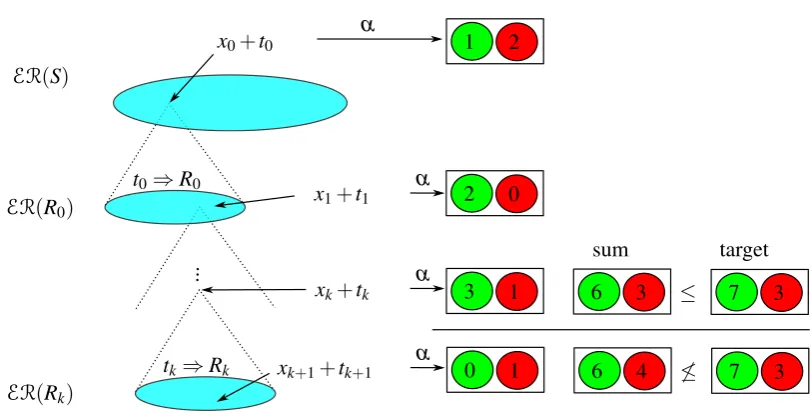
stands for a disjoint union of multiple sets). For the intuition behind the following proposition, we would like to refer toFigure 1on the following page:
Proposition 3 The abstract reachability problem is decidable for 1-safe structure-changing
ER(S)
ER(R0)
x0+t0
t0⇒R0
x1+t1
tk⇒Rk
...
xk+tk
ER(Rk)
1 2
2 0
3 1 6 3 ≤ 7 3
α
α
xk+1+tk+1 0 1 6 4 6≤ 7 3
α
sum
α
target
Figure 1: The abstract reachability procedure visualised
Proof. We present an algorithm that, given a structure-changing workflow net Sand q∈Nk, decides whether there is any reachable stateN∈RS(S)such thatα(N) =q. LetT=T(S).
1: procedureABSTRREACH(S,q) 2: Queue :=ER(N); Visited :=/0
3: whileQueue not emptydo
4: m:=pop(Queue)
5: ifm=qthen
6: returntrue
7: else
8: ifnot (|m|>|q|orm|P6≤qorm∈Visited)then
9: for allt,m0such thatm=t+m0do
10: for all{µ∈matchρ(t)|(ρ,Nl,Nr)∈R}do
11: append(Queue,{m0+m|m∈ER(Nr,•Nr}))
12: Visited :=Visited∪ {m}
13: returnfalse
To explain the algorithm, let us define a multi-rooted directed graphW, in general infinite. Its nodes are multisets over {0, ...,k−1}+T. The elements of ER(N)are the roots ofW. Each nodet+mwitht∈Thas successorsx+mwherex∈ER(Nr)andNris the right hand side of a rule that matchest. Whether a rule can matchtcan be checked directly fromA(S).
Besides those with at least one transition, Wcontains only colour abstractions of reachable markings: a derivation leading to a suitable marked net can simply be read off a path inW, because in the case of 1-safe structure-changing workflow net it is immaterialwhichtransition is replaced, so the abstraction preserves all information needed to construct a suitable derivation.
Also,Wcontains the colour abstractions ofallreachable states, by induction on the number of replacement steps in awΣ,R-minimal derivation. As long as no rule is applied, the statement
clearly holds. Suppose that the property holds for any derivation(ξ,σ) up to a certain length.
Any new replacement stepN⇒ρ N0 using a rule
ρ must match anactivated transitiont by the assumption on the derivation. Any state obtained by replacingt and executing a non-terminal sequence of transitions in the right hand side has an abstract markingm+m00, where m+t∈ ER(N), andm00is in the subset of the abstract reachability set of(N0,R)accessible with fewer replacement steps, by induction hypothesis.
It follows that the algorithm is correct since it explores Wuntil reaching nodes whose size exceeds|q|, and checks whetherqis obtained.
The complexity of the abstract reachability problem is inherited from the corresponding class of static 1-safe nets. For 1-safe nets in general, reachability is PSPACE-complete whereas it is just NP-complete for acyclic 1-safe nets [Esp96].
Proposition 4 The abstract reachability problem for acyclic 1-safe structure-changing work-flow nets isNP-complete.
Proof. It follows from the proof ofProposition 3 that the problem is not only decidable, but in NP: the answer is positive iff there exists a certain easily checked polynomial-length object, namely the path through W at most O(|R| · |q|) nodes of length O(|q|) each. NP-hardness is straightforwardly shown by a reduction from the corresponding problem for acyclic 1-safe nets. The reachability problem of 1-safe nets can be reduced to the reachability problem of 1-safe workflow nets (see Figure 2). This reduction goes as follows: for every place in the 1-safe marked net(N,M0), a complementary place is added; start end place and 2+3|P|extra items are added; the simulation is initialised by filling in the start marking and its complement, and it can be aborted without producing erroneous runs by emptying the net. Reachability ofMfrom M0 becomes reachability of the corresponding marking from the start marking of the workflow
net. The workflow net can be seen to be sound. To preserve acyclicity, one removes the com-plementary places. The reduction of the reachability problem for 1-safe workflow nets to an abstract reachability problem for the corresponding static 1-safe structure-changing workflow net is trivial: places are coloured bijectively.
Proposition 5 The abstract reachability problem for 1-safe structure-changing workflow nets isPSPACE-complete.
pin pout | {z }
initialisation ofM0
(complementary places) z }| { simulation ofN (complementary places)
|
{z
}
p1
|
{z
}
p2
|
{z
}
p3
Figure 2: Reduction from 1-safe nets to 1-safe workflow nets.
As a bonus,Wcan be used to decide coverability of an abstract markingq, i.e. the question whether any stateNwithα(N)≥qcan be reached.
Proposition 6 Coverability of an abstract marking is decidable for 1-safe structure-changing workflow nets.
Proof. W is the reachability graph of a net with place set {0, ...,k−1}+T and appropriate transitions that have as presett∈Tand postsetm, for everym∈ER(Nr,•Nr), where Nr is the right hand side of a rule matchingt. Hence coverability is reduced to Petri net coverability, which is decidable [PW02].
3.3 Containment Problems
In this subsection, we study the inclusion of the firing language of a structure-changing work-flow net in a given regular language. The motivation is that the regular language can specify all desirable net behaviour, and the problem is to check whether any undesirable firing sequences exist or not.
Problem 4(Containment in Regular Language).
Given: a regular languageL⊆Σ
∗
a 1-safe structure-changing Petri netS Question: f(L(S))⊆L?
It is well known that the emptiness of the intersection of two context-free languages is unde-cidable.
Proposition 7(Undecidability of abstract language compliance) Containment of a
Proof. By reduction from the emptiness problem for the intersection of two context-free lan-guages. LetG1= (V1,T,P1,S1)andG2= (V2,T,P2,S2)be two context-free grammars in Greibach normal form. We assume their non-terminal alphabets disjoint w.l.o.g. (V1∩V2=/0).
To distinguish the words from the two grammars, we introduce a second terminal alphabet ˆ
T :={aˆ|a∈T}and a functiondup(ε):=ε,dup(aw):=aaˆ·dup(w).
We construct the structure-changing workflow netS(G1,G2) = (N,R1∪R2).Nis as shown:
S2
s S1 e
For every production X →aX1...Xn in G1, we add a rule replacing a transition labelled X
with a linear sequence of transitions labelleda,X1, ...,Xn toR1. For productions in G2, we do
the same, but replace the terminal labela with ˆaand add the rules toR2. Disjointness of
non-terminal alphabets ensures that the rules inRiare only applicable in the subnet resulting fromSi (fori∈ {1,2}). The words accepted in these subnets hence correspond to those generated by the respective grammars. LetLbes{aaˆ|a∈T}∗ewith{s,e} 6⊆T. Now,
L(G1)∩L(G2) =/0 ⇔ F(S(G1,G2))⊆L
L(G1)∩L(G2) =/0 ⇔ F(S(G1,G2))∩L= /0
∃w∈L(G1)∩L(G2) ⇔ ∃w∈F(S(G1,G2))∩L
⇒: ifwis generated from bothG1andG2, then a derivation for it exists in both grammars. Since context-free derivations inG1andG2can be translated into sequences of rule applications in the
corresponding subnet, there obviously is a reachable net inS(G1,G2)able to accepts·dup(w)e∈ L.
⇐: All words inL can be written as sdup(w)e for some w∈T∗. To also be accepted by S(G1,G2), there must be a derivation(ξ,σ)with f(λ(ξ)) =s·dup(w)e. Now,w∈L(G1), since
w= f(λ(ξ))and the subsequence ofR1-steps inξ directly corresponds to a derivation inG1. A
symmetric argument holds forG2.
S(G1,G2)is a 1-safe structure-changing workflow net easily seen to have as reachable states
only acyclic nets marked with one or two tokens.
4
Related Work
Petri nets can be extended with structure changes via graph replacement rules, as in [MGH11]. Graph grammars [EEPT06] define replacement steps according to rules that serve to reconfig-ure the Petri net dynamically and can be mixed with transition firings. Their work, and ours, is closely related to graph grammars and results from graph replacement such as local Church-Rosser and concurrency theorems can be adapted, see [EHP+07, MGH11]. We have concen-trated on Petri net specific aspects such as reachability of markings in this paper. [BCKK04] uses similar concepts for model checking graph grammars.
allow structure changes beyond dynamic transition refinement. Safe nets-in-nets [KH10] and Hypernets [Mas11] represent a different kind of dynamic structure. With unbounded nesting of net tokens, it is possible to simulate a 2-counter machine with zero-tests. The notion of activated transitions and transition refinement are also found in [KR07]. Finally, in [vSV03], a notion of refinement for workflow nets was investigated, but with different aims.
5
Conclusion
We have introduced structure-changing Petri nets with context-free transition replacement rules based on graph replacement, and studied a number of decision problems that arose. Suitably translated, our results apply to many formalisms that add structure changes to Petri nets.
An overview of the results follows. The columns stand for structure-changing Petri nets (scpn) and structure-changing workflow nets (general, 1-safe, acyclic 1-safe scwn) respectively, “yes” means decidable, “no” undecidable, “?” unknown):
scpn scwn 1-safe acyclic 1-safe
concrete reachability yes yes yes yes Proposition 2 abstract reachability ? ? yes yes Proposition 3 firing word problem ? ? yes yes Proposition 1 regular specification no no no no Proposition 7
The firing word problem turned out to be nontrivial. Proposition 7places severe limitations on the algorithmic analysis of structure-changing Petri nets. Even for systems with a simple structure and a globally bounded token number, language containment questions are undecidable due to the possibility of imposing synchronisation on concurrent context-free processes.
Further Topics
(1) Structure-changing nets with arbitrary replacement rules hardly seem to offer promising analysis methods. It seems most fruitful to investigate classes of nets that behave sufficiently like the “simple” ones presented here, and on the other hand to apply general analysis methods known from graph replacement.
(2) Decidable problems for relatively simple subclasses of structure-changing Petri nets and case studies to evaluate which features are still lacking in order to model real dynamic workflows. We suspect that not all restrictions are necessary and are working to determine the decidability boundary more accurately.
(3) In the spirit of system correctness under adverse conditions, would be to turn the reacha-bility problems into game problems by considering some nontrivial scheduling between the two kinds of steps, and universal quantification for replacement steps: until now, rule application and firing cooperate.
Acknowledgements: We would like to thank Annegret Habel and several other SCARE
Bibliography
[BCE+07] P. Baldan, A. Corradini, H. Ehrig, R. Heckel, B. König. Bisimilarity and Behaviour-Preserving Reconfigurations of Open Petri Nets. InAlgebra and Coalgebra in Com-puter Science. LNCS 4624, pp. 126–142. 2007.
[BCKK04] P. Baldan, A. Corradini, B. König, B. König. Verifying a Behavioural Logic for Graph Transformation Systems.ENTCS104:5–24, 2004.
[BDH92] E. Best, R. Devillers, J. Hall. The box calculus: A new causal algebra with multi-label communication. InAdvances in Petri Nets. LNCS 609, pp. 21–69. 1992. [BLO03] E. Badouel, M. Llorens, J. Oliver. Modeling concurrent systems: Reconfigurable
nets. InProceedings of Int. Conf. on Parallel and Distributed Processing Techniques and Applications. CSREA Press, 2003.
[Cor95] A. Corradini. Concurrent Computing: from Petri Nets to Graph Grammars. ENTCS 2, pp. 56–70. Elsevier, 1995.
[DR98] J. Desel, W. Reisig. Place/transition Petri nets. InLectures on Petri Nets I: Basic Models. LNCS 1491, pp. 122–173. 1998.
[EEPT06] H. Ehrig, K. Ehrig, U. Prange, G. Taentzer.Fundamentals of Algebraic Graph Trans-formation. Monographs in Theoretical Computer Science. Springer, 2006.
[EHP+07] H. Ehrig, K. Hoffmann, J. Padberg, U. Prange, C. Ermel. Concurrency in Reconfig-urable P/T Systems: Independence of net transformations and token firing in recon-figurable P/T systems. InProceedings ICATPN. Pp. 104–123. 2007.
[Esp96] J. Esparza. Decidability and Complexity of Petri Net Problems - An Introduction. In Lectures on Petri Nets I: Basic Models. LNCS 1491, pp. 374–428. 1996.
[Hab92] A. Habel.Hyperedge Replacement: Grammars and Languages. LNCS 643. 1992. [HP99] S. Haddad, D. Poitrenaud. Theoretical Aspects of Recursive Petri Nets. In
Applica-tion and Theory of Petri Nets. LNCS 1639, pp. 228–247. 1999.
[KH10] M. Köhler-Bußmeier, F. Heitmann. Safeness for object nets.Fundamenta Informat-icae101(1):29–43, 2010.
[KR07] M. Köhler, H. Rölke. Web Service Orchestration with Super-Dual Object Nets. In ICATPN. LNCS 4546, pp. 263–280. 2007.
[Kre81] H.-J. Kreowski. A comparison between Petri-nets and graph grammars. In Graph-theoretic Concepts in Computer Science. LNCS 100, pp. 306–317. 1981.
[MGH11] T. Modica, K. Gabriel, K. Hoffmann. Formalization of Petri Nets with Individual To-kens as Basis for DPO Net Transformations. InProceedings PNGT 2010. Electronic Communications of the EASST 40. 2011.
[PW02] L. Priese, H. Wimmel.Petri-Netze. Springer, 2002.
[van97] W. M. P. van der Aalst. Verification of workflow nets. InApplications and Theory of Petri Nets. LNCS 1248, pp. 407–426. 1997.
[van01] W. M. P. van der Aalst. Exterminating the Dynamic Change Bug: A Concrete Approach to Support Workflow Change.Information Sys. Frontiers3(3):297–317, 2001.
[vSV03] K. van Hee, N. Sidorova, M. Voorhoeve. Soundness and Separability of Workflow Nets in the Stepwise Refinement Approach. In Applications and Theory of Petri Nets. LNCS 2679, pp. 337–356. 2003.