Available online throug
ISSN 2229 – 5046
EQUITABLE VERTEX COLORING OF SUDHA GRAPHS
𝑺
(
𝒏
,
𝒎
)
S. SUDHA & G. M. RAJA*
RIASM, University of Madras, India.
(Received On: 27-11-17; Revised & Accepted On: 04-01-18)
ABSTRACT
S
udha et al. [7] found equitable vertex coloring of Sudha graph 𝑆(𝑛, 2) and found its chromatic number is either 3 or 4 according to 𝑛 ≡0(𝑚𝑜𝑑 3) or 𝑛 ≢0(𝑚𝑜𝑑 3). In this paper, we have extended our discussion of equitable vertex coloring to the Sudha graph 𝑆(𝑛,𝑚) for 𝑚= 3, 4 & 5 and its chromatic number lies between 2 and 4.AMS CLASIFICATION CODE: 05C15.
Keywords: Sudha graph, Equitable coloring, Color classes, Chromatic number of equitable coloring.
1. INTRODUCTION
Mayer [1] introduced the definition of a equitable vertex chromatic number of a graph. An equitable vertex coloring is an assignment of colors to the vertices of a graph in such a way that no two adjacent vertices have the same color and the number of vertices in any two color classes differ atmost by one. Application of equitable vertex coloring is found in scheduling and timetabling problems. D. Grittner [2] discussed adout the equitable chromatic number of a complete bipartite graph. Dorothee [3] found the equitable vertex coloring of complete multipartite graphs and Lih [4] elaborately discussed about the equitable vertex coloring of graphs, in particular about bipartite graphs and trees in his handbook. Sudha et al. [5] introduced 𝑆(𝑛,𝑚) graph and found total coloring of 𝑆(𝑛,𝑚) graph. Sudha et al. [6] found equitable chromatic number of 𝑆(𝑛, 2) is either 3 or 4 according to 𝑛 ≡0(𝑚𝑜𝑑 3) or 𝑛 ≢0(𝑚𝑜𝑑 3).
Definition 1: Graph vertex coloring is the coloring of the vertices of a graph with the minimum number of colors without any two adjacent vertices having the same color.
Definition 2: In vertex coloring of a graph, the set of vertices of same color are said to be in that color class.
In k-coloring of a graph, there are k color classes. They are represented by𝐶[1],𝐶[2], … , where 1,2, … denote the colors.
Definition 3: A graph G is said to be equitable k-vertex colorable if its vertex set V can be partitioned into k subsets
𝑉1,𝑉2, . . . ,𝑉𝑘, such that each 𝑉𝑖 is an independent set and the condition �|𝑉𝑖|− �𝑉𝑗�� ≤1 holds for all 1≤ 𝑖 ≤ 𝑘,
1≤ 𝑗 ≤ 𝑘.
The smallest integer k for which G is equitable k-vertex coloring is known as the equitable vertex chromatic number of G and is denoted by χ𝑒𝑣𝐺.
Definition 4: The Sudha graph 𝑆(𝑛,𝑚) is a graph with the vertex set {𝑣𝑖 / 1≤ 𝑖 ≤ 𝑛} and the edges are defined as for
1≤ 𝑖 ≤ 𝑛,
(i) 𝑣𝑖 is adjacent to 𝑣𝑖+1 if 𝑖+ 1≤ 𝑛 and 𝑣𝑛 is adjacent to 𝑣1, (ii) 𝑣𝑖 is adjacent to 𝑣𝑖+𝑚 if 𝑖+𝑚 ≤ 𝑛 and
(iii)𝑣𝑖 is adjacent to 𝑣𝑖+𝑛−𝑚 if 𝑖+𝑚>𝑛 .
𝑺(𝒏,𝟑)
Theorem 1: Sudha graph𝑆(𝑛, 3) admits equitable vertex coloring and its chromatic number is either 2 or 3 according to 𝑛 is 𝑒𝑣𝑒𝑛 or 𝑛 is 𝑜𝑑𝑑.
Proof: Let 𝑣1,𝑣2,𝑣3, … ,𝑣𝑛−1,𝑣𝑛 be the vertices of the graph 𝑆(𝑛, 3) and its edges are defined as follows: for 1≤ 𝑖 ≤ 𝑛,
(i) 𝑣𝑖 is adjacent to 𝑣𝑖+1 if 𝑖+ 1≤ 𝑛 and 𝑣𝑛 is adjacent to 𝑣1, (ii) 𝑣𝑖 is adjacent to 𝑣𝑖+3 if 𝑖+ 3≤ 𝑛 and
(iii)𝑣𝑖 is adjacent to 𝑣𝑖+𝑛−3 if 𝑖+ 3 >𝑛 as shown in figure 1.
Figure-1: Sudha graph 𝑆(𝑛, 3)
There are 𝑡𝑤𝑜 cases: (i) 𝑛 is odd (ii) 𝑛 is even
Here there are three types (a) 𝑛= 7 + 6𝑗,𝑗= 1, 2, 3, … (b) 𝑛= 9 + 6𝑗,𝑗= 1, 2, 3, … (c) 𝑛= 11 + 6𝑗,𝑗= 1, 2, 3, …
The function 𝑓 from the vertex set of 𝑆(𝑛, 3) to the set of colors {1, 2, 3} is defined as follows :
Case-(i): Let 𝑛 be 𝑒𝑣𝑒𝑛.
The vertices of 𝑆(𝑛, 3) are colored as for 1≤ 𝑖 ≤ 𝑛,
𝑓(𝑣𝑖) =�1 2 𝑖𝑖 ≡≡ 0( 1(𝑚𝑜𝑑𝑚𝑜𝑑 2) 2)
The color classes 𝐶[1] and 𝐶[2] satisfy the condition �|𝐶[𝑖]|−|𝐶[𝑗]|� ≤1,1≤ 𝑖 ≤2, 1≤ 𝑗 ≤2. Since
|𝐶[1]| = |𝐶[2]| =𝑛2.
Sudha graph 𝑆(𝑛, 3) has equitable vertex coloring with this type of coloring and hence 𝜒𝑒𝑣�𝑆(𝑛, 3)�= 2 if 𝑛 is 𝑒𝑣𝑒𝑛.
Case-(ii): Let 𝑛 be 𝑜𝑑𝑑.
Type-(a): Let 𝑛= 7 + 6𝑗, 𝑗= 1, 2, 3, … The vertices of 𝑆(𝑛, 3) are colored as for 1≤ 𝑖 ≤𝑛−1
3
𝑓(𝑣𝑖) =�1 2 𝑖𝑖𝑖𝑠𝑖𝑠𝑜𝑑𝑑𝑒𝑣𝑒𝑛
for 𝑛−1
3 <𝑖 ≤ 2(𝑛−1)
3
𝑓(𝑣𝑖) =�3 2 𝑖𝑖𝑖𝑠𝑖𝑠𝑜𝑑𝑑𝑒𝑣𝑒𝑛
for 2(𝑛−1)
3 <𝑖 ≤ 𝑛 −1
𝑓(𝑣𝑖) =�3 1 𝑖𝑖𝑖𝑠𝑖𝑠𝑜𝑑𝑑𝑒𝑣𝑒𝑛
The color classes 𝐶[1],𝐶[2] and 𝐶[3] satisfy the condition |(|𝐶[𝑖]|−|𝐶[𝑗]|)|≤1,1≤ 𝑖 ≤3, 1≤ 𝑗 ≤3. Since
|𝐶[1]| = |𝐶[3]| =𝑛 −3 1
and |𝐶[2]| =𝑛+2
3 .
Sudha graph 𝑆(𝑛, 3) has equitable vertex coloring with this type of coloring and hence 𝜒𝑒𝑣�𝑆(𝑛, 3)�= 3 if 𝑛= 7 + 6𝑗,
𝑗= 1, 2, 3, … .
Type-(b): Let 𝑛= 9 + 6𝑗, 𝑗= 0,1, 2, … . The vertices of 𝑆(𝑛, 3) are colored as for 1≤ 𝑖 ≤𝑛−3
3
𝑓(𝑣𝑖) =�1 2 𝑖𝑖𝑖𝑠𝑖𝑠𝑜𝑑𝑑𝑒𝑣𝑒𝑛
for 𝑛−3
3 <𝑖 ≤ 2(𝑛−3)
3
𝑓(𝑣𝑖) =�3 2 𝑖𝑖𝑖𝑠𝑖𝑠𝑜𝑑𝑑𝑒𝑣𝑒𝑛
for 2(𝑛−3)
3 <𝑖 ≤ 𝑛 −3
𝑓(𝑣𝑖) =�3 1 𝑖𝑖𝑖𝑠𝑖𝑠𝑜𝑑𝑑𝑒𝑣𝑒𝑛
𝑓(𝑣𝑛−2) = 3,
𝑓(𝑣𝑛−1) = 1,
and 𝑓(𝑣𝑛) = 2.
The color classes 𝐶[1],𝐶[2] and 𝐶[3] satisfy the condition |(|𝐶[𝑖]|−|𝐶[𝑗]|)|≤1,1≤ 𝑖 ≤3, 1≤ 𝑗 ≤3. Since
|𝐶[1]| = |𝐶[2]| = |𝐶[3]| =𝑛3
Sudha graph 𝑆(𝑛, 3) has equitable vertex coloring with this type of coloring and hence 𝜒𝑒𝑣�𝑆(𝑛, 3)�= 3 if 𝑛= 9 + 6𝑗,
𝑗= 0, 1, 2, … .
Type-(c): Let 𝑛= 11 + 6𝑗, 𝑗= 0, 1, 2, … . The vertices of 𝑆(𝑛, 3) are colored as for 1≤ 𝑖 ≤𝑛+1
3
𝑓(𝑣𝑖) =�1 2 𝑖𝑖𝑖𝑠𝑖𝑠𝑜𝑑𝑑𝑒𝑣𝑒𝑛
for 𝑛+1
3 <𝑖 ≤ 2(𝑛+1)
3
𝑓(𝑣𝑖) =�3 2 𝑖𝑖𝑖𝑠𝑖𝑠𝑜𝑑𝑑𝑒𝑣𝑒𝑛
for 2(𝑛+1)
3 <𝑖 ≤ 𝑛
𝑓(𝑣𝑖) =�3 1 𝑖𝑖𝑖𝑠𝑖𝑠𝑜𝑑𝑑𝑒𝑣𝑒𝑛
The color classes 𝐶[1],𝐶[2] and 𝐶[3] satisfy the condition |(|𝐶[𝑖]|−|𝐶[𝑗]|)|≤1,1≤ 𝑖 ≤3, 1≤ 𝑗 ≤3. Since
|𝐶[1]| =𝑛 −3 2
and |𝐶[2]| = |𝐶[3]| =𝑛+1
3
Sudha graph 𝑆(𝑛, 3) has equitable vertex coloring with this type of coloring and hence 𝜒𝑒𝑣�𝑆(𝑛, 3)�= 3 if 𝑛= 11 +
6𝑗, 𝑗= 0, 1, 2, … .
Therefore the equitable vertex chromatic number of 𝑆(𝑛, 3) is either 2 or 3 according to 𝑛 is 𝑒𝑣𝑒𝑛 or 𝑛 is 𝑜𝑑𝑑.
Figure-2: Sudha graph 𝑆(15, 3)
Here |𝐶[1]| = 5, |𝐶[2]| = 5 and |𝐶[3]| = 5. They satisfy the conditions |(|𝐶[𝑖]|−|𝐶[𝑗]|)| < 1, 1≤ 𝑖 ≤3, 1≤ 𝑗 ≤3. This type of coloring on Sudha graph 𝑆(15, 3) satisfy the conditions for equitable vertex coloring.
Hence 𝜒𝑒𝑣�𝑆(15, 3)�= 3.
Illustration 6.1.11: Consider the graph 𝑆(17, 3). Using theorem 6.1.6 case (ii) type (c), we assign the color 1 to the vertices 𝑣1,𝑣3,𝑣5,𝑣14,𝑣16, color 2 to the vertices 𝑣2,𝑣4,𝑣6,𝑣8,𝑣10,𝑣12 and color 3 to the vertices
𝑣7,𝑣9,𝑣11,𝑣13,𝑣15,𝑣17 as shown in figure 3.
Figure-3: Sudha graph 𝑆(17, 3)
Here |𝐶[1]| = 5, |𝐶[2]| = 6 and |𝐶[3]| = 6. They satisfy the condition |(|𝐶[𝑖]|−|𝐶[𝑗]|)|≤1, 1≤ 𝑖 ≤3, 1≤ 𝑗 ≤3. This type of coloring on Sudha graph 𝑆(17, 3) satisfy the conditions for equitable vertex coloring.
Hence 𝜒𝑒𝑣�𝑆(17, 3)�= 3.
3. EQUITABLE VERTEX COLORING OF 𝑺(𝒏,𝟒) GRAPHS
Theorem 2: Sudha graph 𝑆(𝑛, 4) admits equitable vertex coloring and its chromatic number is 3.
Proof: Let 𝑣1,𝑣2,𝑣3, … ,𝑣𝑛−1,𝑣𝑛 be the vertices of the graph 𝑆(𝑛, 4) and its edges are defined as follows: for 1≤ 𝑖 ≤ 𝑛,
(i) 𝑣𝑖 is adjacent to 𝑣𝑖+1 if 𝑖+ 1≤ 𝑛 and 𝑣𝑛 is adjacent to 𝑣1, (ii) 𝑣𝑖 is adjacent to 𝑣𝑖+4 if 𝑖+ 4≤ 𝑛 and
Figure-4: Sudha graph 𝑆(𝑛, 4) There are 𝑡ℎ𝑟𝑒𝑒 cases:
(i) 𝑛= 10 + 6𝑗, 𝑗= 0, 1, 2, … (ii) 𝑛= 13 + 6𝑗, 𝑗= 0, 1, 2, …
(iii)𝑛 ≠10 + 6𝑗 and 𝑛 ≠13 + 6𝑗, 𝑗= 0, 1, 2, …
The function 𝑓 from the vertex set of 𝑆(𝑛, 4) to the set of colors {1, 2, 3} is defined as follows :
Case-(i): Let = 10 + 6𝑗, 𝑗= 0, 1, 2, … . The vertices of 𝑆(𝑛, 4) are colored as for 1≤ 𝑖 ≤𝑛
2
𝑓(𝑣𝑖) =�
1 𝑖 ≡1(𝑚𝑜𝑑 3) 2 𝑖 ≡2(𝑚𝑜𝑑 3) 3 𝑖 ≡0(𝑚𝑜𝑑 3)
for 𝑛
2<𝑖<𝑛
𝑓(𝑣𝑖) =�
2 𝑖 ≡1(𝑚𝑜𝑑 3) 3 𝑖 ≡2(𝑚𝑜𝑑 3) 1 𝑖 ≡0(𝑚𝑜𝑑 3)
and 𝑓(𝑣𝑛) = 3.
The color classes 𝐶[1],𝐶[2] and 𝐶[3] satisfy the condition |(|𝐶[𝑖]|−|𝐶[𝑗]|)|≤1, 1≤ 𝑖 ≤3, 1≤ 𝑗 ≤3. Since
|𝐶[1]| =𝑛+ 23
and |𝐶[2]| = |𝐶[3]| =𝑛−1
3 .
Sudha graph 𝑆(𝑛, 4) has equitable vertex coloring with this type of coloring and hence 𝜒𝑒𝑣�𝑆(𝑛, 4)�= 3 if 𝑛= 10 +
6𝑗, 𝑗= 0, 1, 2, … .
Case-(ii): Let 𝑛= 13 + 6𝑗, 𝑗= 0, 1, 2, … The vertices of 𝑆(𝑛, 4) are colored as for 1≤ 𝑖 ≤𝑛+3
2
𝑓(𝑣𝑖) =�
1 𝑖 ≡1(𝑚𝑜𝑑 3) 2 𝑖 ≡2(𝑚𝑜𝑑 3) 3 𝑖 ≡0(𝑚𝑜𝑑 3)
for 𝑛+3
2 <𝑖<𝑛
𝑓(𝑣𝑖) =�
2 𝑖 ≡1(𝑚𝑜𝑑 3) 3 𝑖 ≡2(𝑚𝑜𝑑 3) 1 𝑖 ≡0(𝑚𝑜𝑑 3)
[1],
|𝐶[1]| =𝑛+ 2 3
and |𝐶[2]| = |𝐶[3]| =𝑛−1
3 .
Sudha graph 𝑆(𝑛, 4) has equitable vertex coloring with this type of coloring and hence 𝜒𝑒𝑣�𝑆(𝑛, 4)�= 3 if 𝑛= 13 +
6𝑗, 𝑗= 0, 1, 2, … .
Case-(iii): Let 𝑛 ≢10 + 6𝑗 and 𝑛 ≢13 + 6𝑗,𝑗= 0, 1, 2, … The vertices of 𝑆(𝑛, 4) are colored as
for 1≤ 𝑖 ≤ 𝑛
𝑓(𝑣𝑖) =�
1 𝑖 ≡1(𝑚𝑜𝑑 3) 2 𝑖 ≡2(𝑚𝑜𝑑 3) 3 𝑖 ≡0(𝑚𝑜𝑑 3)
The color classes 𝐶[1],𝐶[2] and 𝐶[3] satisfy the condition |(|𝐶[𝑖]|−|𝐶[𝑗]|)|≤1, 1≤ 𝑖 ≤3, 1≤ 𝑗 ≤3. Since
|𝐶[1]| =𝑛+ 23
and |𝐶[2]| = |𝐶[3]| =𝑛−1
3 .
Sudha graph 𝑆(𝑛, 4) has equitable vertex coloring with this type of coloring and hence 𝜒𝑒𝑣�𝑆(𝑛, 4)�= 3 if 𝑛 ≢10 +
6𝑗 and ≢13 + 6𝑗,𝑗= 0, 1, 2, … .
Therefore the equitable vertex chromatic number of 𝑆(𝑛, 4) is 3.
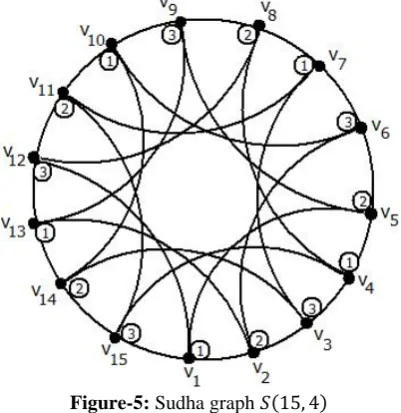
Illustration 3: Consider the graph 𝑆(15, 4). Using theorem 2 case (iii), we assign the color 1 to the vertices
𝑣1,𝑣4,𝑣7,𝑣10,𝑣13, color 2 to the vertices 𝑣2,𝑣5,𝑣8,𝑣11,𝑣14 and color 3 to the vertices 𝑣3,𝑣6,𝑣9,𝑣12,𝑣15 as shown in
figure 5.
Figure-5: Sudha graph 𝑆(15, 4)
Here |𝐶[1]| = 5, |𝐶[2]| = 5 and |𝐶[3]| = 5. They satisfy the conditions |(|𝐶[𝑖]|−|𝐶[𝑗]|)| < 1, 1≤ 𝑖 ≤3, 1≤ 𝑗 ≤3. This type of coloring on Sudha graph 𝑆(15, 4) satisfy the conditions for equitable vertex coloring.
Hence 𝜒𝑒𝑣�𝑆(15, 4)�= 3.
4. EQUITABLE VERTEX COLORING OF 𝑺(𝒏,𝟓) GRAPHS
Theorem 3: Sudha graph 𝑆(𝑛, 5) admits equitable vertex coloring and its chromatic number is lies between 2 to 4.
Proof: Let 𝑣1,𝑣2,𝑣3, … ,𝑣𝑛−1,𝑣𝑛 be the vertices of the graph 𝑆(𝑛, 5) and its edges are defined as follows:
for 1≤ 𝑖 ≤ 𝑛
(i) 𝑣𝑖 is adjacent to 𝑣𝑖+1 if 𝑖+ 1≤ 𝑛 and 𝑣𝑛 is adjacent to 𝑣1, (ii) 𝑣𝑖 is adjacent to 𝑣𝑖+5 if 𝑖+ 5≤ 𝑛 and
Figure-6: Sudha graph 𝑆(𝑛, 5) There are 𝑡𝑤𝑜 cases :
(i) 𝑛 is even (ii) 𝑛 is odd
Here there are three types (a) 𝑛 ≡0(𝑚𝑜𝑑 3)
(b) 𝑛 ≢0(𝑚𝑜𝑑 3) and 𝑛= 7 + 4𝑗, 𝑗= 1, 2, 3, … (c) 𝑛 ≢0(𝑚𝑜𝑑 3) and 𝑛= 9 + 4𝑗, 𝑗= 1, 2, 3, …
The function 𝑓 from the vertex set of 𝑆(𝑛, 5) to the set of colors {1, 2, 3, 4} is defined as follows:
Case-(i): Let 𝑛 be 𝑒𝑣𝑒𝑛.
The vertices of 𝑆(𝑛, 5) are colored as for 1≤ 𝑖 ≤ 𝑛
𝑓(𝑣𝑖) =�1 2 𝑖𝑖 ≡≡ 0( 1(𝑚𝑜𝑑𝑚𝑜𝑑 2) 2)
The color classes 𝐶[1] and 𝐶[2] satisfy the condition �|𝐶[𝑖]|−|𝐶[𝑗]|� ≤1,1≤ 𝑖 ≤2, 1≤ 𝑗 ≤2. Since
|𝐶[1]| = |𝐶[2]| =𝑛2.
Sudha graph 𝑆(𝑛, 5) has equitable vertex coloring with this type of coloring and hence 𝜒𝑒𝑣�𝑆(𝑛, 5)�= 2 if 𝑛 is 𝑒𝑣𝑒𝑛.
Case-(ii): Let n be odd.
Type-(a): Let 𝑛 ≡0(𝑚𝑜𝑑 3).
The vertices of 𝑆(𝑛, 5) are colored as for 1≤ 𝑖 ≤ 𝑛
𝑓(𝑣𝑖) =�
1 𝑖 ≡1(𝑚𝑜𝑑 3) 2 𝑖 ≡2(𝑚𝑜𝑑 3) 3 𝑖 ≡0(𝑚𝑜𝑑 3)
The color classes 𝐶[1],𝐶[2] and 𝐶[3] satisfy the condition |(|𝐶[𝑖]|−|𝐶[𝑗]|)|≤1, 1≤ 𝑖 ≤3, 1≤ 𝑗 ≤3. Since
|𝐶[1]| = |𝐶[2]| = |𝐶[3]| =𝑛3 .
Sudha graph 𝑆(𝑛, 5) has equitable vertex coloring with this type of coloring and hence 𝜒𝑒𝑣�𝑆(𝑛, 5)�= 3 if 𝑛 ≡
0(𝑚𝑜𝑑 3).
Type-(b): Let 𝑛 ≢0(𝑚𝑜𝑑 3) and = 7 + 4𝑗, 𝑗= 1, 2, 3, … . The vertices of 𝑆(𝑛, 5) are colored as
for 1≤ 𝑖 ≤ 𝑛
𝑓(𝑣𝑖) =�
[1], [2],
|𝐶[1]| = |𝐶[2]| = |𝐶[3]| =𝑛+ 14
and |𝐶[4]| =𝑛−3
4 .
Sudha graph 𝑆(𝑛, 5) has equitable vertex coloring with this type of coloring and hence 𝜒𝑒𝑣�𝑆(𝑛, 5)�= 4 if 𝑛 ≢
0(𝑚𝑜𝑑 3) and = 7 + 4𝑗, 𝑗= 1, 2, 3, … .
Type-(c): Let 𝑛 ≢0(𝑚𝑜𝑑 3) and = 9 + 4𝑗, 𝑗= 1, 2, 3, … . The vertices of 𝑆(𝑛, 5) are colored as
for 1≤ 𝑖 ≤ 𝑛 −5
𝑓(𝑣𝑖) =�
1 𝑖 ≡1(𝑚𝑜𝑑 4) 2 𝑖 ≡2(𝑚𝑜𝑑 4) 3 𝑖 ≡3(𝑚𝑜𝑑 4) 4 𝑖 ≡0(𝑚𝑜𝑑 4)
𝑓(𝑣𝑛−4) = 2,
𝑓(𝑣𝑛−3) = 3,
𝑓(𝑣𝑛−2) = 4,
𝑓(𝑣𝑛−1) = 1,
and 𝑓(𝑣𝑛) = 2.
The color classes 𝐶[1],𝐶[2],𝐶[3] and 𝐶[4] satisfy the condition |(|𝐶[𝑖]|−|𝐶[𝑗]|)|≤1, 1≤ 𝑖 ≤4, 1≤ 𝑗 ≤4. Since
|𝐶[1]| = |𝐶[3]| = |𝐶[4]| =𝑛 −4 1
and |𝐶[4]| =𝑛+3
4 .
Sudha graph 𝑆(𝑛, 5) has equitable vertex coloring with this type of coloring and hence 𝜒𝑒𝑣�𝑆(𝑛, 5)�= 4 if
𝑛 ≢0(𝑚𝑜𝑑 3) and = 9 + 4𝑗, 𝑗= 1, 2, 3, … .
Therefore the equitable vertex chromatic number of 𝑆(𝑛, 5) is lies between 2 to 4.
Illustration 4: Consider the graph 𝑆(17, 5). Using theorem 3 case (ii) type (c), we assign the color 1 to the vertices
𝑣1,𝑣5,𝑣9,𝑣16, color 2 to the vertices 𝑣2,𝑣6,𝑣10,𝑣13,𝑣17, color 3 to the vertices 𝑣3,𝑣7,𝑣11,𝑣14 and color 4 to the
vertices 𝑣4,𝑣8,𝑣12,𝑣15 as shown in figure 7.
Figure-7: Sudha graph 𝑆(17, 5)
Here |𝐶[1]| = 4, |𝐶[2]| = 5, |𝐶[3]| = 4 and |𝐶[4]| = 4. They satisfy the conditions |(|𝐶[𝑖]|−|𝐶[𝑗]|)| < 1, 1≤ 𝑖 ≤
5. EQUITABLE VERTEX COLORING OF 𝑺(𝒏,𝒎) GRAPHS
Theorem 4: Sudha graph𝑆(𝑛,𝑚), 𝑛 is even and 𝑚 is odd admits equitable vertex coloring and its chromatic number is
2.
Proof: Let 𝑣1,𝑣2,𝑣3, … ,𝑣𝑛−1,𝑣𝑛 be the vertices of the graph 𝑆(𝑛,𝑚) and its edges are defined as follows: for 1≤ 𝑖 ≤ 𝑛
(i) 𝑣𝑖 is adjacent to 𝑣𝑖+1 if 𝑖+ 1≤ 𝑛 and 𝑣𝑛 is adjacent to 𝑣1, (ii) 𝑣𝑖 is adjacent to 𝑣𝑖+𝑚 if 𝑖+𝑚 ≤ 𝑛 and
(iii)𝑣𝑖 is adjacent to 𝑣𝑖+𝑛−𝑚 if 𝑖+𝑚>𝑛.
The function 𝑓 from the vertex set of 𝑆(𝑛,𝑚), 𝑛 is even and 𝑚 is odd to the set of colors {1, 2} is defined as follows :
The vertices of 𝑆(𝑛,𝑚), 𝑛 is even and 𝑚 is odd are colored as for 1≤ 𝑖 ≤ 𝑛
𝑓(𝑣𝑖) =�1 2 𝑖𝑖 ≡≡ 0( 1(𝑚𝑜𝑑𝑚𝑜𝑑 2) 2)
The color classes 𝐶[1] and 𝐶[2] satisfy the condition �|𝐶[𝑖]|−|𝐶[𝑗]|� ≤1,1≤ 𝑖 ≤2, 1≤ 𝑗 ≤2. Since
|𝐶[1]| = |𝐶[2]| =𝑛2.
Sudha graph 𝑆(𝑛,𝑚), 𝑛 is even and 𝑚 is odd has equitable vertex coloring with this type of coloring and hence
𝜒𝑒𝑣�𝑆(𝑛,𝑚)�= 2 if 𝑛 is even and 𝑚 is odd.
Theorem 5: Sudha graph𝑆(𝑛,𝑚), 𝑛 is odd and divisible by 3, 𝑚 is odd and not divisible by 3 admits equitable vertex coloring and its chromatic number is 3.
Proof: Let 𝑣1,𝑣2,𝑣3, … ,𝑣𝑛−1,𝑣𝑛 be the vertices of the graph 𝑆(𝑛,𝑚) and its edges are defined as follows: for 1≤ 𝑖 ≤ 𝑛
(i) 𝑣𝑖 is adjacent to 𝑣𝑖+1 if 𝑖+ 1≤ 𝑛 and 𝑣𝑛 is adjacent to 𝑣1, (ii) 𝑣𝑖 is adjacent to 𝑣𝑖+𝑚 if 𝑖+𝑚 ≤ 𝑛 and
(iii)𝑣𝑖 is adjacent to 𝑣𝑖+𝑛−𝑚 if 𝑖+𝑚>𝑛.
The function 𝑓 from the vertex set of 𝑆(𝑛,𝑚), 𝑛 is odd and divisible by 3, 𝑚 is odd and not divisible by 3 to the set of colors {1, 2, 3} is defined as follows :
The vertices of 𝑆(𝑛,𝑚), 𝑛 is odd and divisible by 3, 𝑚 is odd and not divisible by 3 are colored as for 1≤ 𝑖 ≤ 𝑛
𝑓(𝑣𝑖) =�
1 𝑖 ≡ 1(𝑚𝑜𝑑 3) 2 𝑖 ≡ 2(𝑚𝑜𝑑 3) 3 𝑖 ≡ 0(𝑚𝑜𝑑 3)
The color classes 𝐶[1],𝐶[2] and 𝐶[3] satisfy the condition �|𝐶[𝑖]|−|𝐶[𝑗]|� ≤1,1≤ 𝑖 ≤3, 1≤ 𝑗 ≤3. Since
|𝐶[1]| = |𝐶[2]| = |𝐶[3]| =𝑛3.
Sudha graph 𝑆(𝑛,𝑚), 𝑛 is odd and divisible by 3, 𝑚 is odd and not divisible by 3 has equitable vertex coloring with this type of coloring and hence 𝜒𝑒𝑣�𝑆(𝑛,𝑚)�= 3 if 𝑛 is odd and divisible by 3, 𝑚 is odd and not divisible by 3.
CONCLUSION
We have established the equitable vertex coloring of Sudha graph 𝑆(𝑛,𝑚) for any 𝑛, 𝑚= 3, 4, 5 and their equitable vertex chromatic number lies between 2 and 4 depending on the values of 𝑚 and 𝑛.
REFERENCES
1. W. Mayer, “Equitable coloring,” American Mathematical Monthy 80 (1973) P:143-149.
2. D. Grittner, “The equitable chromatic number for a complete bipartite graph,” Undergraduate Honors Thesis, Millersville university PA, 1995.
3. Dorothee Blum, “Equitable chromatic number of complete multipartite graphs,” Millersville University, Millersville, PA 17551.
Innovative Mathematical Research (IJSIMR), Volume 2, Issue 1, January - 2014, PP 16-22.
6. S. Sudha and G. M. Raja, “Equitable Coloring of Prisms and the Generalized Petersen Graphs,” International Journal of Research in Engineering and Technology, Volume 2, 2014, pp. 105-11.
7. S. Sudha and G. M. Raja, “Equitable coloring of Sudha grid graphs and Sudha graph,” Global Journal of Pure and Applied Mathematics, Volume 12 (4), 2016, pp. 81-87.
Source of support: Nil, Conflict of interest: None Declared.