N A N O E X P R E S S
Open Access
Ferroelectric and magnetic properties of
Nd-doped Bi
4
−
x
FeTi
3
O
12
nanoparticles prepared
through the egg-white method
Khalid Mujasam Batoo
1*, Joselito Puzan Labis
1, Ritu Sharma
2and Mahavir Singh
2Abstract
Multiferroic behavior of Bi4−xNdxFeTi3O12(0.0≤×≤0.25, × = 0.05) ceramic nanoparticles prepared through the egg-white method was investigated. The dielectric properties of the samples show normal behavior and are explained in the light of space charge polarization. Room temperature polarization-electric field (P-E) curves show that the samples are not saturated with maximum remanence polarization,Pr=0.110μC/cm2, and a relatively low coercive field,Ec= of 7.918 kV/cm, at an applied field of 1 kV/cm was observed for 5% Nd doping. The room temperature M-H hysteresis curve shows that the samples exhibit intrinsic antiferromagnetism with a weak ferromagnetism. These properties entitle the grown nanoparticles of BNFT as one of the few multiferroic materials that exhibit decent magnetization and electric polarization.
Keywords:Nanoparticles, Multiferroic, Dielectric constant, dc magnetization
Background
Recently, there has been an extensive study in the direc-tion of search for the materials possessing magnetic as well as the ferroelectric properties because of the rich-ness of physics involved in the system as well as their potential applications in memory devices and functional sensors [1-6]. These materials exhibit phenomena such as the control of electrical polarization by the application of an external magnetic field or vice versa, providing an additional degree of freedom for the design of new devices. Materials can be considered as multiferroic where ferroelectricity and ferromagnetism make mutu-ally exclusive group [3] with the interaction of electric and magnetoelectric effects [4,7] and the effect of mutual influence of the polarization and magnetization. These phenomena are of practical interest for microelectronics, magnetic memories, sensors, and nonvolatile ferroelec-tric random access memory applications [3,8,9]. In order to be used as microelectronics and sensor techniques, magnetoelectric materials should satisfy this criterion: the magnetic and electric ordering temperature must
exceed the room temperature. However, up to now, mul-tiferroic materials for room temperature applications are very few [10]. Taking into account the recent literature, most of the published articles are referring to perovskite structures as potential multiferroics [3,11]. However, only BiFeO3 has proved multiferroic properties at room
temperature [7,12], and its complex properties are not yet well understood. Numerous studies for the search of multiferrioc properties of BiFeO3system substituted with
PbTiO3, La, Co, Nd, and Gd have been carried out in
order to improve its ferroelectric and ferromagnetic properties [13,14]. In the light of continued search for the multiferrioc materials, the substitution of Nd was used to enhance the electrical resistivity of Ba4Ti3FeO12
(BNTF) system. This paper reports the synthesization of Nd-substituted nanomaterials through the egg-white method and their dielectric, ferroelectric, and magnetic studies.
Methods
Material preparation
Nanoparticles of BNTF were prepared through egg-white method. The starting materials Bi(NO3)35H2O,
Nd(NO3)36H2O, TiCl3, and FeCl3were mixed together
in proper stoichiometric proportions. Extracted egg
* Correspondence:[email protected] 1
King Abdullah Institute for Nanotechnology, King Saud University, P.O. Box 2460, Riyadh 1151, Saudi Arabia
Full list of author information is available at the end of the article
© 2012 Batoo et al.; licensee Springer. This is an Open Access article distributed under the terms of the Creative Commons Attribution License (http://creativecommons.org/licenses/by/2.0), which permits unrestricted use, distribution, and reproduction in any medium, provided the original work is properly cited.
white (60 ml), dissolved in 40 ml of double distilled water through vigorous stirring, was added to the metal mixture at room temperature. After constant stirring for 30 min, the resultant sol–gel was evaporated at 80°C until a dry precursor was obtained. The dried precursor was sintered at 700°C for 10 h. The final material obtained was ground for 1 h using mortar and pestle.
The powder samples obtained were characterized for structural phase and nanosize formation using PANalyti-cal X'Pert Pro X-ray diffractometer (The Netherlands) with Cu Kα(λ= 1.54 Å) in the range of 20° to 80° with a sweeping rate of 2°/min.
[image:2.595.61.538.88.317.2]The microstructural and morphological analysis of the samples were carried out using a field emission scanning Figure 1XRD pattern for Bi4−xNdxTi3FeO12(0.0≤×≤0.25, × = 0.05) nanoparticles.
[image:2.595.56.538.459.715.2]electron microscope (FESEM, JSM 7600 F, JEOL Ltd., Akishima, Tokyo, Japan) and field emission transmission electron microscope (HRTEM, JEOL 2010 F, JEOL Ltd.) with the energy dispersive X-ray (EDX) facility attached.
For electrical measurements, a fixed amount of pow-der sample was taken, and a few drops of PVA were added to it. The mixture was left over night, dried at room temperature, and pressed into disc-shaped pellets (12 mm × 12 mm) with the help of hydraulic press. The pallets were heated at 500°C for 1 h, and silver paste coating was applied on opposite flat faces of the pallets to make parallel plate capacitor geometry. The dielectric measurements were performed in the frequency range 1 kHz to 1 MHz using Wayne Kerr 6500B impedance analyzer (Wayne Kerr Electronics Ltd., Woburn, MA, USA). The polarization versus electric field hysteresis measurements were carried out at 1 kV/cm field using P-E loop tracer of Marine India, New Delhi, India. Room
temperature magnetic hysteresis measurements were carried out using Lake Shore VSM (Lake Shore Croyo-tronics Inc., OH, USA) with a field of 20 kOe.
Results and discussion
Structural and morphological studies
The powder samples of BNTF were characterized for structural and phase analysis through X-ray diffraction shown in Figure 1. The XRD patterns for annealed sam-ples reveal the characteristic well-crystallized pattern with a few signatures of secondary phase corresponding to pure Bi4Ti3O12 compound and alpha-Fe2O3. Figure 2
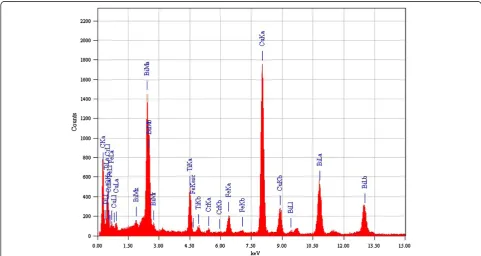
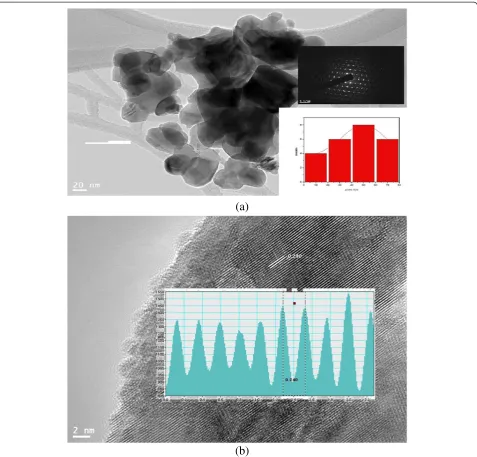
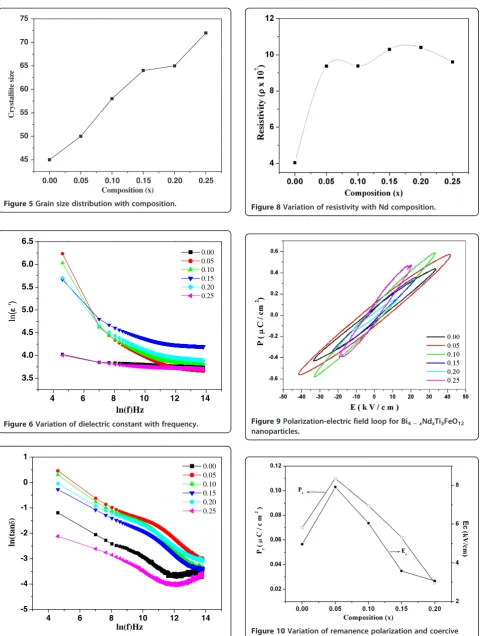
shows the EDX pattern of the pure sample confirming the chemical formation of the polycrystalline BNTF nanoparticles. Figure 3a,b shows the FE-SEM micro-structure of the fracture surfaces of pristine and 5% doped Nd sample. Interestingly, with Nd doping, the densification is promoted in the grown nanoparticles. Figure 4a shows the FE-TEM micrograph with inset showing the average grain size plot and selective area electron diffraction pattern for the composition x= 0.0. The micrograph shows irregular-shaped highly agglom-erated nanoparticles with an average grain size of 50 nm for the compositionx= 0.05. The average crystallite sizes calculated through FE-TEM show a broad size distribu-tion from 50 to 72 nm as shown in Figure 5. A high crystalline order is observed in the grown nanoparticles. Figure 4b shows lattice pattern for the composition
x= 0.05 with inset showing the d spacing value of 0.240 Å. The d value obtained collaborated well with the value obtained from X-ray diffraction pattern.
Dielectric study
The high resistivity and low dielectric loss (tanδ1.6 at 42 Hz at RT) in Nd-substituted specimens allowed the dielectric constant (E0) to be determined, as shown in Figure 6. The room temperature dielectric constant was found 515 at 1 kHz maximum for 5% Nd concentration. The obtained dielectric constant is higher than the values of thin films (107) [15,16] and Nb-doped BiFeO3ceramics [17] reported earlier. Both the dielectric
constant and loss tangent (Figure 7) are found to de-crease rapidly in low-frequency region and show fre-quency independent response above 22 kHz. These variations can be explained in the light of space charge polarization as discussed by Maxwell [18] and Wagner [19] and is in good agreement with Koop's phenomeno-logical theory [20]. At low frequencies, the space charges are able to follow the frequency of the applied field, while at high frequencies, they may not have time to build up and undergo relaxation. The low loss values at higher frequencies show potential applications of these materials in high-frequency microwave devices. More-over, the dielectric loss factor also depends on a number
(a)
[image:3.595.57.290.87.472.2](b)
Figure 3FE-SEM images of the Bi4−xNdxFeTi3O12forx= 0.0 (a) and 0.05 (b) compositions.
Batooet al. Nanoscale Research Letters2012,7:511 Page 3 of 7
of factors, such as stoichiometry and structural homo-geneity, which in turn, depend upon the composition and sintering temperature of the samples [21]. The room temperature resistivity measurements as a function of composition x are presented in Figure 8. It is seen that the resistivity of the samples increases with the increas-ing percentage Nd dopincreas-ing. The behavior may be attribu-ted to the decreasing number of the conduction ions.
Ferroelectric hysteresis
The ferroelectric hysteresis loop measurement is always hampered by the high leakage current. Because of low
resistivity of the samples, it is difficult to apply high elec-tric fields to the bulk samples. The ferroelecelec-tric polarization hysteresis loops at room temperature for Nd-doped Bi4 − xFeTi3O12 samples measured under an
applied field (E) of about 10 kV/cm are presented in Figure 9. The loops are not really saturated and repre-sent a partial reversal of the polarization almost elliptical-shaped [22,23]. The Pr and Ec values of the
BNTF nanoparticles as a function of Nd composition are shown in Figure 10. The remanence polarization,
Pr increases first and then decreases with an increasing
vaue of x. The highest value of Pr= 0.110 μC/cm2 and
(a)
[image:4.595.60.538.88.545.2](b)
0.00 0.05 0.10 0.15 0.20 0.25 45
50 55 60 65 70 75
Crystallite size
Composition (x)
Figure 5Grain size distribution with composition.
4 6 8 10 12 14
3.5 4.0 4.5 5.0 5.5 6.0 6.5
ln
(
ε
')
ln(f)Hz
0.00 0.05 0.10 0.15 0.20 0.25
Figure 6Variation of dielectric constant with frequency.
4 6 8 10 12 14
-5 -4 -3 -2 -1 0 1
ln(tan
δ
)
ln(f)Hz
0.00 0.05 0.10 0.15 0.20 0.25
Figure 7Variation of dielectric loss with frequency.
Figure 8Variation of resistivity with Nd composition.
[image:5.595.59.541.82.719.2]Figure 9Polarization-electric field loop for Bi4−xNdxTi3FeO12 nanoparticles.
Figure 10Variation of remanence polarization and coercive field with composition.
Batooet al. Nanoscale Research Letters2012,7:511 Page 5 of 7
a relatively low coercive field (Ec) of 7.918 kV/cm were
observed for 5% Nd concentration. Similar behavior in
Ec is also observed where it increases first and then
follows a decreasing trend with increasing Nd content [24,25]. The remnant polarization of the samples is not too high. It is well known that most magnetic materials usually have high electrical conductivity. Thus, few multiferrioc materials could exhibit the ferroelectric response properly. It is very critical for magnetic materials with high insulating resistivity to posses both ferroelectric and ferromagnetic properties simultaneously. Otherwise, an applied electric field would cause an increase in current for conducting samples rather than inducing electrical polarization.
M-Hhysteresis
Figure 11 shows the magnetization versus magnetic field (M-H) hysteresis loops for the BNTF nanoparticles at room temperature for the maximum applied field (H) of 20 kOe. It is seen that all the samples show intrinsic antiferromagnetism and a weak ferromagnetism with a maximum value of remnant magnetization (Mr) of
0.00107 emu/gm for sample x= 0.05. Various authors have reported earlier similar results [24-26]. The Mr
value decreases with increasing Nd doping percentage. The substitution of Nd at Bi site may lead to the effect-ive suppression of the spiral spin structure of BNTF, resulting in the appearance of magnetization. In order to verify and evaluate further the source of magnetism in the grown nanoparticles, room temperature Mossbauer spectroscopy measurements were tried on the present
samples, but due to low percentage of Fe57 in the pure and doped samples, no clear Mossbauer peaks were observed.
Conclusions
In summary, a series of nanoparticles of polycrystalline system Bi4 − xNdxFeTi3O12 were prepared through the
egg-white method to investigate the presence of multifer-roic properties. The dielectric properties show normal be-havior with respect to the frequency. Room temperature unsaturated multiferrioc properties were observed for the grown nanoparticles. All the samples show the in-trinsic antiferromagnetism with very weak ferromagnet-ism. The remanence polarization (Pr), and remanence
magnetization (Mr) values were found maximum for 5%
Nd concentration. These properties entitle the grown nanoparticles of BNFT as one of the few multiferroic materials that exhibit decent magnetization and electric polarization.
Competing interests
The authors declare that they have no competing interests.
Authors’contributions
The work in this paper has been mutually carried out by all authors. RS along with MS prepared and carried out the electrical and magnetic measurement of the samples. JPL carried out the FESEM, EDX, and FE-TEM measurements for the present work. KMB carried out the analysis of the data and write up of the paper. All authors read and approved the final manuscript.
Authors’information
[image:6.595.61.537.88.320.2]KMB is working as an assistant professor in King Abdullah Institute for Nanotechnology, King Saud University, Riyadh, Saudi Arabia. He obtained his Ph.D. in Applied Physics from Aligarh Muslim University, India. His field of
specialization is magnetic nanomaterials. JPL is working as an assistant professor in King Abdullah Institute for Nanotechnology, King Saud University, Riyadh, Saudi Arabia. He obtained his Ph.D. in Material Sciences from the Division of Quantum Materials Physics, Okayama University, Okayama, Japan. His field of specialization is structural and morphological studies of nanomaterials. RS is at present working as Ph.D. student in the Department of Physics, Himachal Pradesh University, Summer Hill, Shimla, India. Her field of specialization is ferrite materials. MS is working as a professor in the Department of Physics, Himachal Pradesh University, Summer Hill, Shimla, India. He obtained his Ph.D. from Himachal Pradesh University in collaboration with the Indian Institute of Technology, Kanpur, India. His field of specialization is magnetic materials.
Acknowledgment
Authors KMB and JPL are thankful to the National Plan of Science and Technology (NPST), King Saud University for providing the financial support under the project code: NANO-10-2012 for carrying this work.
Author details
1King Abdullah Institute for Nanotechnology, King Saud University, P.O. Box
2460, Riyadh 1151, Saudi Arabia.2Department of Physics, Himachal Pradesh University, Summer Hill, Shimla 171001, India.
Received: 25 May 2012 Accepted: 18 August 2012 Published: 18 September 2012
References
1. Smolenskii GA, Chupis IE:Ferroelectromagnets.Sov Phys Uspekhi1982, 25:475.
2. Venevtsev Yu N, Gagulin VV:Search, design and investigation of seignettomagnetic oxides.Ferroelectrics1994,162:23.
3. Hill NA:Why are there so few magnetic ferroelectrics?J Phys Chem B 2000,104:6694–6709.
4. Spaldin NA, Fiebig M:The renaissance of magnetoelectric multiferroics.
Science2005,309:391–392.
5. Wang J, Neaton JB, Zheng H, Nagarajan V, Ogale SB, Liu B, Viehland D, Vaithyanathan V, Schlom DG, Waghmare UV, Spaldin NA, Rabe KM, Wuttig M, Ramesh R:Epitaxial BiFeO3 multiferroic thin film heterostructures.
Science2003,299:1719.
6. Hill NA, Filippetti A:Why are there any magnetic ferroelectrics?J Magn
Magn Mater2002,242–245:976–979.
7. Fiebig M:Revival of the magnetoelectric effect.J Phys D: Appl Phys2005, 38:R123.
8. Scott JF, Paz de Araujo CA:Ferroelectric memories.Science1989,246:1400. 9. Paz de Araujo CA, Cuchiaro JD, McMillian LD, Scott MC, Scott JF:
Fatigue-free ferroelectric capacitors with platinum electrodes.Nature1995, 374:627–629.
10. Takahashi K, Tonouchi M:Influence of manganese doping in multiferroic bismuth ferrite thin films.J Magn Magn Mater2007,310:1174. 11. Niitaka S, Azuma M, Takano M, Nishibori E, Takata M, Sakata M:Crystal
structure and dielectric and magnetic properties of BiCrO3 as a ferroelectromagnet.Solid State Ionics2004,172:557.
12. Kimura T, Goto T, Shintani H, Ishizaka K, Arima T, Tokura Y:Magnetic control of ferroelectric polarization.Nature2003,426:55.
13. Wang DH, Goh WC, Ning M, Ong CK:Effect of Ba doping on magnetic, ferroelectric, and magnetoelectric properties in multiferroic BiFeO3at room temperature.Appl Phys Lett2006,88:212907.
14. Singh K, Kotnala RK, Singh M:Study of electric and magnetic properties of (Bi0.9Pb0.1) (Fe0.9Ti0.1)O3 nanomultiferroic system.J Appl Phys2008, 93:212902.
15. Singh K, Negi NS, Kotnala RK, Singh M:Dielectric and magnetic properties of (BiFeO3)1−x(PbTiO3)xferromagnetoelectric system.J Sol Stat Commun 2008,148:18.
16. Palkar VR, Jhon J, Pinto R:Observation of saturated polarization and dielectric anomaly in magnetoelectric BiFeO3thin films.Appl Phys Letter 2002,80:1628.
17. Hong S-H, Horns JH, Trolier-McKinstry S, Messing GL:Dielectric and ferroelectric properties of Ta-doped bismuth titanate.J Mater Sci Lett 2000,19:1661.
18. Maxwell JC:Treatise on Electricity and Magnetism. Oxford: Clarendon Press; 1873.
19. Wagner KW:Zur Theorie der Unvolkommenen Dielektrika.Ann Physik Bd 1913,40:817.
20. Koop's CG:On the dispersion of resistivity and dielectric constant of some semiconductors at audio frequencies.Phys Rev1951,83:121–124. 21. Devan RS, Chougule BK:Effect of composition on coupled electric,
magnetic, and dielectric properties of two phase particulate magnetoelectric composite.J Appl Phys2007,101:014109.
22. Kim WS, Jun YK, Kim KH, Hong SH:Enhanced magnetization in Co and Ta-substituted BiFeO3ceramics.J Magn Magn Mater2009,321:3262. 23. Uniyal P, Yadav KL:Room temperature multiferroic properties of Eu
doped BiFeO3.J Appl Phys2009,105:07D914.
24. Zhang X, Sui Y, Wang X, Wang Y, Wang Z:Effect of Eu substitution on the crystal structure and multiferroic properties of BiFeO3.J Alloy Compd 2010,507:157.
25. Das S, Basu S, Mitra S, Chakravorty D, Mondal BN:Wet chemical route to transparent BiFeO3films on SiO2substrates.Thin Sol Films2010,518:4071. 26. Rojac T, Kosec M, Budic B, Setter N, Damjanovic D:Strong ferroelectric
domain-wall pinning in BiFeO3 ceramics.J Appl Phys2010,108:074107.
doi:10.1186/1556-276X-7-511
Cite this article as:Batooet al.:Ferroelectric and magnetic properties of
Nd-doped Bi4−xFeTi3O12nanoparticles prepared through the
egg-white method.Nanoscale Research Letters20127:511.
Submit your manuscript to a
journal and benefi t from:
7Convenient online submission
7Rigorous peer review
7Immediate publication on acceptance
7Open access: articles freely available online
7High visibility within the fi eld
7Retaining the copyright to your article
Submit your next manuscript at 7 springeropen.com
Batooet al. Nanoscale Research Letters2012,7:511 Page 7 of 7