International Journal of Advances in Management, Economics and Entrepreneurship
Available online at:
www.ijamee.info
RESEARCH ARTICLE
Prospects and Challenges of Electronic Banking in Ghana: The Case of
Zenith Bank, Sunyani
Puopiel Felix*
Data Development Research, P.O.Box 198 ER,Tamale, Ghana.
*For Corresponding Author:Email:[email protected]
Abstract
The banking industry is one of the sectors that has benefited from the evolving technology by the introduction of Electronic banking (e-banking) systems which provide easy access to banking services. This study was carried out to assess the prospect and challenges of e-banking in Zenith Bank Sunyani, Ghana. Fifty (50) structured questionnaires were administered to customers of e-banking products and some staff to gather data on e-banking. The study indicated that 96.7% of respondents used banking products very often and had different types of e-banking products which were ATM, Internet Banking, Z-Prompt, Z-web Acquirer. Most respondents preferred the ATM other e-banking products because of its easy access. Additionally, most customers used combinations of the products. The study also identified benefits customers derive from e-banking as saving of time, quickness in banking transactions, easy access to account details and reduction of long queues in banking halls. The study further indicated that customer satisfaction and competition from other banks were the main influencing factors for e-banking adoption. Notwithstanding e-e-banking prospects, it is confronted with challenges such as frequent network failure, high bank charges, limit on amount of cash withdrawal and wrong debit.
Keywords: Prospects, Challenges, E-banking, ATM, Internet Banking, E-banking product.
Introduction (H1)
One main innovation technology has brought is the introduction of e-banking. Traditional banking was characterized by physical decentralization, with branches scattered around populated areas to give customers easy geographical access [1]. According to Locket and Littler [2], physical banks assure customers that their banks has substantial resource and guarantee the security of their savings. However, technology is fast growing making it difficult for the traditional banking system to compete favorably. With the advent of e- Banking, the physical decentralization of bank branches has been done away with; with customers not necessarily need to be physically present in the banking hall but can bank virtually or by other electronic means.
Particular challenges arise in trying to integrate new business model into the banking sector. It is for this reason that academic research is paramount in this emerging business model [3]. In Ghana, most banks practicing E-banking are facing challenges such as customer preference for the e-banking facility, convenience of clients to utilize and adopt e-banking facilities. While numerous studies have been undertaken to
examine issues in the wider context of e-banking and customer loyalty, comprehensive research in the area of e-banking issues and customer preferences in the specific context of Ghana has been rather limited. This study attempted to identify prospects and influencing challenges inhibiting acceptance of E-banking in Zenith Bank.
Literature Review (H1)
This section highlights on the concept of e-banking and e- e-banking product particularly in Ghana.
Definition of E-banking (H2)
banking transactions through a personal computer via the financial institution web site on the internet.
Sathye (1999) in Daniel [4], also indicated that e-banking has a variety of platforms which are: (a) Internet banking (or online banking), (b) telephone banking, (c) television-based banking, (d) mobile phone banking, and (e) PC banking (or offline banking). For many consumers, electronic banking means 24-hour access to cash through an Automated Teller Machine (ATM) or Direct Deposit of pay checks into checking or savings accounts (FTC, 2006). But e-banking now involves many different types of transactions. e-banking, also known as Electronic Funds Transfer (EFT), is simply the use of electronic means to transfer funds directly from one account to another, rather than by cheque or cash.
Types of E-banking (H2)
There are various types of e-banking. Some of the types are: Internet Banking, Telephone Banking, Automated Teller Machines (ATM) and Electronic Funds Transfer at Point of Sale
Internet Banking (H3)
Internet banking refers to systems that enable bank customers to get access to their accounts and general information on bank products and services through the use of banks website, without the intervention or inconvenience of sending letters, faxes, original signatures and telephone confirmations [5]. According to them, for those that have access to the internet and a computer all that one needs to do is to proceed to the banks website and login. This gives easy access to the person’s accounts and this enables the person to clearly see transactions that have occurred within his/her accounts.
Telephone Banking (H3)
Telebanking (telephone banking) can be considered as a form of remote or virtual banking, which is essentially the delivery of branch financial services via telecommunication devices where the bank customers can perform retail banking transactions by dialing a touch-tone telephone or mobile communication unit, which is connected to an automated system of the bank by utilizing Automated Voice Response (AVR) technology” [6]. It allows consumers to phone their financial institutions with instructions to pay certain bills or to transfer funds between accounts [7].
Automated Teller Machines (ATMs) (H3) ATM, also called 24-hour tellers are electronic terminals which give consumers the opportunity
to bank at almost any time [7]. ATM banking is one of the earliest and widely adopted retail e-banking services in Kenya [8]. It is described as a combination of a computer terminal, record-keeping system and cash vault in one unit, permitting customers to enter the bank‟s book keeping system with a plastic card containing a Personal Identification Number (PIN) or by punching a special code number into the computer terminal linked to the bank‟s computerized records 24 hours a day [9]. According to her, an ATM transaction is an average of about 6,400 per month compared to 4,300 for human tellers. According to Abor [10], it saves customers time in service delivery as alternative to queuing in bank halls. In addition, ATMs continue to serve customers whiles human tellers in the banking hall have stopped work, thereby increasing productivity for the banks.
Electronic Funds Transfer at Point of Sale (H3)
An Electronic Funds Transfer at the Point of Sale is an on-line system that allows customers to transfer funds instantaneously from their bank accounts to merchant accounts when making purchases (at purchase points). A POS uses a debit card to activate an Electronic Fund Transfer Process [11]. Point-of-Sale Transfer Terminals allow consumers to pay for retail purchase with a check card, a new name for debit card. This card looks like a credit card but with a significant difference, the money for the purchase is transferred immediately from your account to the store's account.
Importance of E-banking (H2)
The importance of e-banking cannot be over emphasized. e-banking provides easy access to banking services. The interaction between user and bank has been substantially improved by deploying ATMs, Internet banking, and more recently, mobile banking [12].
loan approval authority simultaneously [15]. Typically, loan applications received at branch level and send to head office for approval. This documents transfer to and from branch to head office consume much time and delay loan sanction period [16].
E-banking in Ghana (H2)
The banking industry in Ghana is undergoing rapid growth with the liberalization of the financial sector by the Bank of Ghana and positive economic environment [17]. With this, most banks are catching up with the ever increasing technology by bringing more innovative concepts into the banking sector. In this regard, concept of e-banking was introduced by banks to provide 24-hour service to their clients. Therefore, the earliest forms of electronic and communications technologies used were mainly office automation devices. This includes telephones, telex and facsimile. These were employed to speed up and make more efficient, the process of servicing clients. For decades, they remained the main information and communication technologies used for transacting bank business [10].
Technological innovation coupled with availability of internet services in Ghana results in banks in Ghana networking their branches and provision of service products. Because of competition almost all banks in Ghana are now providing various forms of e-banking services. For instance, a report by Abor [10] showed that Barclays Bank (Ghana) Limited and Standard Chartered Bank (Ghana.) Limited pioneered this very important electronic novelty, which changed the banking landscape in the country.
Banks in Ghana have lunched many commercials and a range of products and services. The Trust Bank Ghana, in 1995 installed the first ATM. After that, the other major banks began their ATM networks at competitive positions. Ghana Commercial Bank started its ATM offering in 2001 in collaboration with Agricultural Development Bank [10]. In Ghana, ATM is the extensive and most widely utilized e- banking services. The ATM has been the most successful delivery medium for consumer banking in this county. Customers consider it as important in their choice of banks, and banks that delayed the implementation of their ATM systems, have suffered irreparably. ATMs have been able to entrench the one-branch philosophy in this county, by being networked, people do not necessarily have to go to their branch to do some banking [10].
Ghanaian Banks have introduced various e- banking cards. For instance, the first major cash card is a product of Social Security Bank, now Soceite Generale SSB, introduced in May 1997 in this country. Furthermore, in the earlier part of year 2001 Standard Chartered Bank launched the first ever debit card in this country. A consortium of three (3) banks (Ecobank, Cal Merchant Bank and The Trust Bank) introduced a further development in electronic cards in November 2001, called „E-Card‟. This card is online in real time, so anytime a client uses the card, or changes occur in their account balance, their card automatically reflects the change [10].
E-banking at Zenith Bank Ghana Limited (H2)
Zenith Bank Ghana Limited, a subsidiary of Zenith Bank PLC has been in Ghana since September 2005. It has over the years become a leader in the provision of excellent customer service through the employment of state of the art technology. The following are some of the E-banking products the bank markets. These are Zenith Statement via e-mail, Z-Prompt, Z-Web Acquirer and Global Travel Wallet. These are briefly explained below.
Zenith Statement via e-mail (H3)
Zenith statement via-email is a service which enables customers to receive soft copies of their statements of Account through e-mail.
Z-Prompt (H3)
Z-prompt is a transaction notification system that sends text messages to customer’s phones on any network. It alerts customers on any transaction that takes place on their account with seconds of the transaction.
Z-web Acquirer (H3)
This is a product that allows institutions such as schools, NGOs, hotels and businesses to receive funds via a payment portal on their websites through the use of Visa and Master cards.
Global Travel Wallet (H3)
This product allows the customers to load their electronic wallet with any amount of funds in Dollars that can be assessed anywhere in the world through a point of sale device or any visa branded ATM.
Challenges of E-banking (H2)
however, banks are experiencing competitive pressure to roll out new business applications in very compressed time frames, often only a few months from concept to production. This competition intensifies the management challenge to ensure that adequate strategic assessment, risk analysis and security reviews are conducted prior to implementing new e-banking applications [18]. e-banking increases banks‟ dependence on information technology, thereby increasing the technical complexity of many operational and security issues and furthering a trend towards more partnerships, alliances and outsourcing arrangements with third parties, many of whom are unregulated. This development has been leading to the creation of new business models involving banks and non blank entities, such as Internet service providers, telecommunication companies and other technology firms [18].
The internet is ubiquitous and global by nature. It is an open network accessible from anywhere in the world by unknown parties, with routing of messages through unknown locations and via fast evolving wireless devices. Therefore, it significantly magnifies the importance of security controls, customer authentication techniques, data protection, audit trail procedures, and customer privacy standards [18]. Other e-banking related problems are user error, bad internet connections, access problems and security issues. Most of these problems happen less to outweigh its benefits.
Methodology (H1)
This section of the study captures the study design, source of data, study population, sampling techniques, data collection instruments and methods of data analysis. These are discussed in detail in the subsections.
Study Design (H2)
In this study, the researcher adopted a case study approach because it provided in- depth information to address the objectives. In all, 50 questionnaires were administered to staff of the bank and customers to solicit information concerning the e-banking. Part of the information was also gathered from reports in the branches of the bank concerning e-banking services.
Sources of Data (H2)
The study used data from both primary and secondary sources. Primary sources of data included questionnaire administered to selected customers and staff of the bank. The secondary sources of data constituted data gathered from
Zenith corporate plan and bulletins and in-house newsletters.
Target Population (H2)
The population of the study was made up of selected customers, and staff of Zenith Bank, Sunyani.
Sample and Sampling Technique (H2)
Fifty (50) respondents were interviewed. They consisted of IT staff (5), management staff (5) and customers of e-banking facilities (40). Purposive sampling technique was used to select staff in the IT department and management staff of the banks since they had in-depth knowledge on the e-banking products whiles accidental sampling technique was employed to select customers of the bank. An informal interview was also conducted with some officers to gather information needed for the study.
Data Collection Instruments (H2)
The main instrument used in collecting data was questionnaire. The questionnaire was developed by the researcher based on the research objectives and the literature. This constituted both open and closed-ended. The questionnaires were self-administered to the respondents. The questionnaire was used because it was considered to be more convenient as respondents could answer at their convenience.
Data Collection Procedure (H2)
The consent of all respondents was sought before they were included in the study. At each staff category, convenient sampling was used to select respondents for the study. Each respondent was made to answer each question and then the appropriate answer ticked. Where the respondent was not sure of an answer, the researcher probed until the answer was provided. This procedure was repeated for each respondents.
Data Analysis (H2)
Results and Discussion (H1)
This section analyses data gathered from the field. This includes the background information of respondents, types of customers in Zenith Bank, forms of e-banking products among others. These are discussed in detail in the subsections.
Background of Respondents (H2)
The total number of respondents were fifty (50) of which 65.2% were males and 24.8% females. The educational levels of the respondents who took part in the survey vary. Table 1 below shows the distribution of respondent’s educational level.
Table 1: Educational level of respondents
Level of Education Frequency Percent
University graduate 23 46.0
Professional certificate 11 22.0
Polytechnic / HND 10 20.0
Vocational/Technical 3 6.0
Secondary School/SSS 3 6.0
Total 50 100
Source: Field Survey, 2011
The results indicated that all respondents had some level of education and know the essence of banking. There were no illiterates among respondents which might be due to the fact illiterates do not prefer banking. The respondents were drawn from different categories. They included staff of the bank and customers.
However, customers formed core (80%) of respondents.
Types of Customers at Zenith (H2)
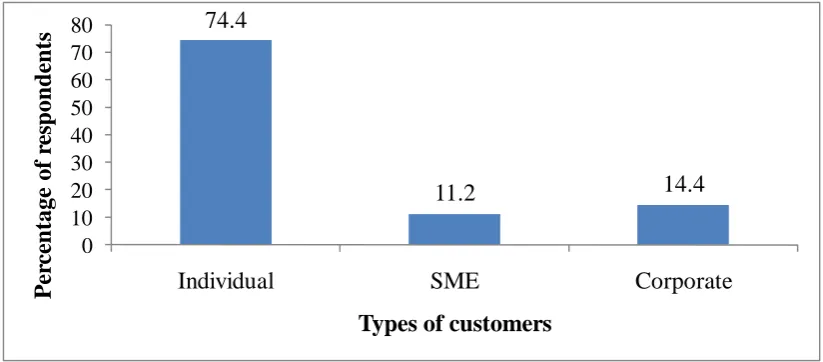
The bank has different customers. These are: individuals, Small and Medium Scale Enterprises (SME) and Corporate bodies. Figure 1 below shows the distribution of customers in the bank.
74.4
11.2
14.4
0 10 20 30 40 50 60 70 80
Individual
SME
Corporate
P
er
ce
n
tage
of
r
es
p
on
d
en
ts
Types of customers
Fig. 1: Types of customers at Zenith Bank
Fig. 1 shows that majority (74.4%) of the respondents were individual customers, whilst SME and Corporate customers represents 11.2% and 14.4% respectively. Individual customers had different e-banking products that they were willing to share with the researcher.
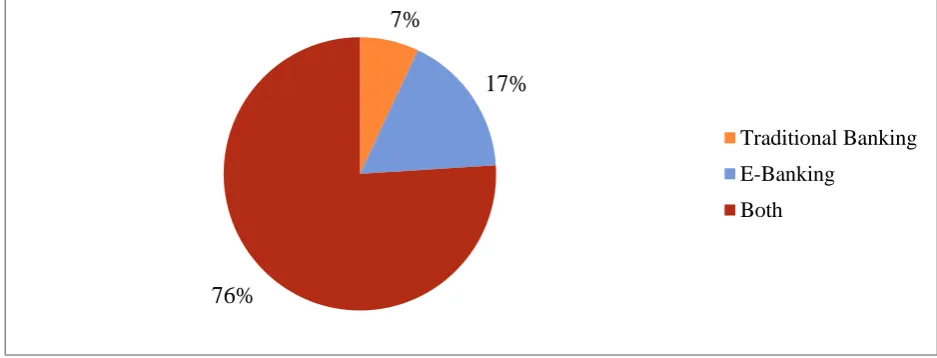
Forms of Banking Services in Ghana (H2) Generally, there are two main forms of banking services in Ghana namely, traditional and e-banking services. Figure 2 below shows responses on forms of banking services in Ghana.
The results of the study in figure 2 indicated that majority of the respondents (76%) knew both forms of banking services in Ghana. The results further indicated that 7% of the respondents were aware of only the traditional banking services, while 17% also revealed that they were aware of only the e-banking services.
Respondents’ views on E-Banking (H2)
7%
17%
76%
Traditional Banking
E-Banking
Both
Fig. 2: Forms of banking services in Ghana
transactions through a personal computer via the financial institution web site on the internet. Therefore study sought to find out how
respondents‟ perceived e-banking as indicated in table 2 below.
Table 2: Views on e-banking
View Frequency Percent
Use internet and electronic media 28 56.0
Virtual banking service provision 7 14.0
Electronic banking 15 30.0
Total 50 100
Source: Field Survey, 2013
From table 2 above, those who heard of e-banking understood it in different ways. According to most respondents (56.0%) they explained “e-banking” as the use of internet and electronic media to bank. Also, 30.0% of the respondents understood “e-banking” to mean electronic banking, while 14.0% of respondents understood it to mean virtual banking service provision system. Their
understanding commensurate with Daniel’s explanation of the concept of e-banking.
Types of e-banking Products (H2)
Generally there are types of e-banking products. These include: Internet Banking, Telephone Banking, Automated Teller Machines (ATM), Electronic Funds Transfer at Point of Sale. In this regard, responses on type of e-banking products in Zenith Bank is illustrated in table 3 below.
Table 3: Types of e-banking Products
Type of e-banking product Frequency Percentage
ATM 19 38.0
Internet Banking Services 9 18.0
Visa Debit, Credit and Prepaid cards 5 10.0
Point of Sale Devices + ATM 4 8.0
Z-Prompt + ATM 13 26.0
Total 50 100
Source: Field Survey, 2013
From table 3, the most widely used e-banking products among customers was the ATM. This constituted 38%. Most customers preferred the ATM because it provided a wide range of services, such as making deposits, funds transfer between
+Z-Prompt, Visa Debit, Credit and Prepaid cards. The combination gave customers different options to transact their businesses with ease and at their own convenience. The respondents indicated that the overriding reason for their adoption of the e-banking products was easy access to money and account information. They further added that the long and winding queues associated with the traditional banking was eradicated with the introduction of e-banking products.
Time Spent on the Use of E-Banking Products (H2)
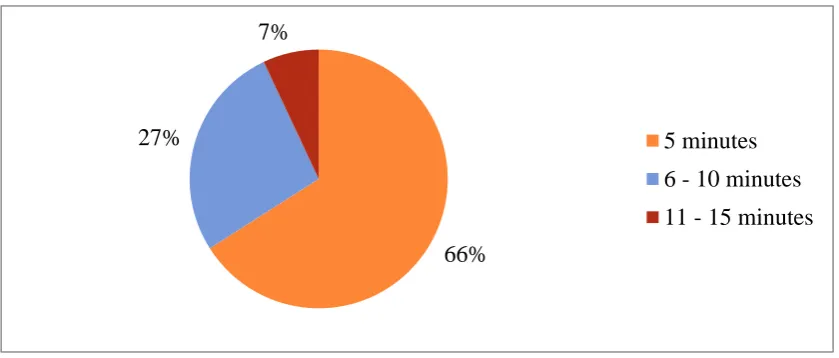
The study further sought from respondents on time spent with regard to the use of e-banking facilities. According to the result, most respondents (66%) said they spent an average of 1-5 minutes to transact business using e-banking system as illustrated in Figure 3. This might be due to the user friendly nature of most the e-banking products. Customers did not require a lot of time using e-banking products.
66% 27%
7%
5 minutes
6 - 10 minutes
11 - 15 minutes
Fig. 4: Time spent in using e-banking product
Reasons for e-Banking Products with Regard to Security (H2)
The security of e-banking is paramount to the service providers. Table 5 shows the level of security participants felt with regards to the use of E-banking facilities.
Table 5: Reasons for safety in using e-Banking
Reason Frequency Percent
Gives me privacy 15 30.0
Frauds easily detected 6 12.0
Security features are good 29 58.0
Total 50 100
Source: Field Survey, 2013
From table 5, more than half (58%) of the respondents felt that security features of e-banking were good which made it very difficult for fraudsters and hackers to operate and therefore was safe to use. In addition, 30% of them indicated that there was privacy policy in using e-banking, whilst 12% of the respondents believed that frauds were not easily detected in using e-banking facilities.
Challenges of E-banking (H2)
Notwithstanding the significant benefits of E-
banking products, it carries risks and challenges which are recognized and need to be managed by the banking institution in a prudent manner [18]. In this study, half (50%) of the respondents mentioned that the main challenge facing e-banking system is unreliable network system. This is true because internet connection which linked the systems together could easily fail resulting in collapse of the e-banking network system. However, the internet service is not provided by Zenith. The bank relies on this service provider so any hitch in their system has effect on the network of the bank. Furthermore, 20% of respondents indicated that charges attracted for using e-banking products were very high. Although the study was not able to ascertain how much is being charge for the e-banking products, almost all the banks charge for the use of the e-banking products with the exception of Barclays Bank that abolished ATM charges recently. The limit of money that could be withdrawn was also seen as a challenge by some respondents. These are summarised in table 6 below.
Summary and Conclusions (H1)
Table 6: Challenges facing E-banking products
Challenges Frequency Percent
Limit on amount of cash withdrawn 9 18.0
Unreliable network system 25 50.0
Wrong debits 3 6.0
Unreliable source of power 3 6.0
Bank charges for ATM services 10 20.0
Total 50 100
Source: Field Survey, 2011
Summary (H2)
The study shows that respondents clearly understood what e-banking means. They explained e- banking as the use of internet and electronic media to bank. Respondents were patrons of e-banking products from Zenith Bank although some customers were also operating accounts in other banks.
Another major finding is the awareness and usage of the different e-banking products by customers offered by Bank which include ATM, Visa POS Devices, Internet Banking, Visa Classic Cards and Global Travel Wallet. However, most respondents’ preferred ATM usage only, whiles significant proportion of respondents use a combination of these products.
Respondents also mentioned several advantages for using E-banking products. The most dominant reasons were easy access to money and account information 24-hour and time saving for customers to carry out other duties. Others included no more long queues as associated with the traditional mode of banking; transactions are very fast and convenient. Averagely, a customer spends less than 5 minutes transacting business with the use of E-banking products.
Notwithstanding the benefits associated with E-banking, they were challenges associated with the system. The paramount among them is the network failure. In the course of a transaction, the network could easily break down resulting in an incomplete transaction. Others mentioned by
respondents included limit on amount of cash withdrawn, wrong debits being made and increase in bank charges for the use of the E-banking products [19-20].
Conclusions (H2)
E-banking products improve customer service and ensure greater efficiency in the Banking sector. This study showed that customers of Zenith patronize E-banking products such as namely ATM, Z-Prompt, POS Devices, Internet Banking, and Visa Classic Cards. They derive certain benefits from the use of these products predominantly time saving, easy access to cash and convenient in the use of the products. However, customers prefer ATM among the E-banking products because of its effectiveness and user friendliness. The average operating time of E-banking products is less than 5 minutes. Furthermore, E-banking products have security features such as username and passwords which are used to protect the products from easy theft. Adoption of E-banking products has influencing factors. Predominant factors are customer satisfaction and competition from other banks. Increasing competition among banks to increase or retain their customer base is driving the banks to continue to adopt E-banking technologies. Despite the benefits of E-banking, it is associated with some challenges. The study shows that network failure from internet connection is the major challenge facing customers using E-banking products from Zenith. However, respondents believed that considerable education and marketing of E-banking products from the bank could attract more customers.
References
1. Ainin S, Lim CH, Wee A (2005) Prospect and challenges of e-banking in Malaysia. The Electronic Journal on Information Systems in Developing Countries. 3(1):5-19.
2. Lockette A, Littler D (1997) The adoption of direct banking services. Journal of Marketing Management. 13:791-811.
3. Daniel E, Storey C (1997) On-line banking: Strategic and Management Challenges Pergamon. PII: 4-5 (S0024-63010007).
5. Thulani D, Tofara C, Langton, R (2009) Adoption and Use of Internet Banking in Zimbabwe: An Exploratory Study. Journal of Internet Banking and Commerce, 14(1).
6. Balachandher KG, Santha V, Norhazlin I, Rajendra P (2001) Electronic banking in Malaysia: A note on Evolution of Services and Consumer Reactions. 7. Federal Trade Commission (2006) Electronic
Banking-Consumer Information. www.consumer.ftc .gov/articles/0218-electronic-banking. Accessed on 20th October, 2013.
8. Okiro K, Ndungu J (2013) The impact of mobile and internet banking on performance of financial institutions in Kenya. European Scientific Journal. 9(13):146-161.
9. Rose PS (1999) Commercial bank management, (4th
ed). Boston: Irwin/McGraw-Hill
10.Abor J (2004) Technological Innovations and Banking in Ghana: An evaluation of customers’ perceptions. Accra, University of Ghana, Legon. 11.Chorofas DN (1988) Electronic funds transfer.
London: Butterworth.
12.Claessens J, Dem V, De Cock D, Preneel B, Vandewalle J (2002) On the security of todays online electronic banking systems. Computers & Security, 21:3:257-269
13.Cheng TCE (2006) Adoption of internet banking: An empirical study in Hong Kong. Decision Support Systems, v 42:1558-1572.
14.Polatoglu VN, Ekin S (2001) An empirical investigation of the Turkish consumers’ acceptance of internet banking services. International Journal of Bank Marketing 19(4):156-165.
15.Smith AD, William T Rupp (2003) E-banking: Foundations of financial and consumer marketing in an information intensive society.Journal of e-Business and Information Technology 3(1):5-19. 16.Riyadh AN, Akter SM, Islam N (2009) The adoption
of e-banking in developing countries: A theoretical model for SMEs. International Review of Business Research Papers. 6(5):212-230.
17.Adams AN, Lamptey AO (2009) Customer perceived value in internet banking in Ghana. Masters Thesis, Lulea University of Technology, Sweden and University of Education, Winneba, Ghana.
18.Basel Committee on Banking Supervision (2001) Risk management principles for electronic banking. Bank for International Settlements.
19.Bradley L, Stewart K (2003) The diffusion of online banking. Journal of Marketing Management.10(19):1087-1109.