329
© 2018 by the Serbian Biological Society
Comparative effects of salt and alkali stress on photosynthesis and root physiology
of oat at anthesis
Yan Qin1, Jianhui Bai1, Yuqing Wang1, Jinghui Liu2,*, Yongning Hu3, Zhi Dong4,# and Lei Ji1
1 Institute of Grassland Research of Chinese Academy of Agricultural Sciences, Hohhot, 010010, P. R. China 2Science Innovation Team of Oats, Inner Mongolia Agricultural University, Hohhot, 010019, P.R. China 3Monitoring and Planning Institute of Inner Mongolia Forestry Administration, 010020, P. R. China
4Shandong Provincial Key Laboratory of Soil Erosion and Ecological Restoration, Shandong Agricultural University,
271018, P. R. China
Corresponding authors: *[email protected]; #[email protected]
Received: July 10, 2017; Revised: November 24, 2017; Accepted: November 25, 2017; Published online: November 29, 2017
Abstract: The effects of different concentrations of salt and alkali on root physiology and photosynthesis in oat (Avena sativa
L.) at anthesis were compared. Treatment with salt and particularly with alkali, decreased yield and grain weight. Both alkali and salt treatments decreased the photosynthetic rate (Pn), stomatal conductance and chlorophyll content, with the effect on Pn and the chlorophyll content more marked after treatment with alkali. The decrease in Pn induced by salt and mild
alkali (50 mmol L-1) contributed to a decrease in stoma opening. Under moderate and severe concentrations of alkali (100
and 150 mmol L-1 respectively), other factors rather than stoma closure were responsible for limiting Pn. The transpiration
rates (Tr) in alkali-treated plants were higher than in salt-treated plants. We also observed decreases in both root volume and root dry weight, and increases in root activity in alkali- and salt-treated plants. Severe alkali and salt concentrations
(150 mmol L-1) decreased the root-shoot ratio. A positive correlation between yield and root dry weight and a negative
correlation between root activity and Pn were observed. Alkali and salt treatments increased superoxide dismutase (SOD) and peroxidase (POD) activities and the malondialdehyde (MDA) content, but decreased catalase (CAT) activity. Yield was negatively correlated with MDA, and the MDA content was greater under alkali treatments than after salt treatment. We conclude that alkali treatments had more severe effects on oat plants at anthesis than salt treatments.
Key words: oat; salt stress; alkali stress; photosynthesis; root physiology; anthesis
How to cite this article: Qin Y, Bai J, Wang Y, Liu J, Hu Y, Dong Z, Ji L. Comparative effects of salt and alkali stress on photosynthesis and root physiology of oat at anthesis. Arch Biol Sci. 2018;70(2):329-38.
INTRODUCTION
Soil salinization and alkalization have very adverse effects on agricultural production [1]. About 20% of the world’s cultivated land is threatened by salinity, with this figure rising to 50% for irrigated land [2]. In China, especially in Inner Mongolia, salinity and alka-linity threaten more than 50% of the available arable land. Many studies have investigated the physiologi-cal mechanisms of plants in response to salinity and found that salinity reduces the osmotic potential of the soil solution, causing water stress, and that excess Na+ disrupts the ion balance and causes ion stress, leading to oxidative stress, which inhibits respiration and pho-tosynthesis, causing nutrition deficiency [2]. Recent studies have demonstrated that salt stress can affect
physiological processes, including osmotic adjusting materials (soluble sugars, proline, polyamines), anti-oxidant defense mechanisms, ion compartmentation and hormonal regulation [3].
In the past few decades, studies have focused on salt and/or mixed salt-alkali stress on plants, with little attention paid to the effects of alkalinity alone, despite the more severe effects of alkalinity as compared to salinity [4]. Understanding of the physiological re-sponses of crop plants to alkalinity is of paramount importance to the selection of genotypes with im-proved tolerance to alkali stress.
in osmotic adjustment, have also been found to play a role in the antioxidant system by eliminating reactive oxygen species (ROS) when plants are experiencing salt and high temperature stresses [5,6]. We hypothe-sized that polyamines affect the activity of antioxidant enzymes during alkali stress.
Studies have shown that the effects of salinity on crops are different during various growth stages [5,7]. Therefore, it is essential to differentiate between the physiological mechanisms that respond to stress at each growth stage. However, most studies have con-centrated on the seedling growth stage and not on the reproductive growth stage, with the physiologi-cal changes induced by salinity or alkalinity at the seedling stage described for wheat, rice, barley, oat, tomato and Suaeda glauca [8-12]. The typical repro-ductive stage, anthesis, is the key growth period that influences crop yield and it warrants further study.
Oat (Avena sativa L.) is a moderately salt-tolerant crop that has the potential to improve saline and alka-line soils as a biological agent. In Baicheng City (Chi-na), field tests showed that oat plants could produce seeds even under severe salt treatment (200 mmol L-1 NaCl:Na2SO4=1:1) and could tolerate soil pH values up to 9.0. Studies on the response mechanisms of oat plants to alkalinity and salinity are limited, as reduced oat production has restricted research efforts for more than 50 years [13] and the physiology of oat plants at anthesis during salt and alkali stress is unreported.
Roots absorb nutrients and water and play a role in the synthesis of amino acids, organic acids and or-ganophosphorus compounds [14,15]. In this study, we investigated the comparative effects of salt and alkali concentrations on oat root physiology at anthesis and determined whether this plays an important role in both yield and salt and alkali tolerance of oat plants.
MATERIALS AND METHODS Experimental design
This study was conducted under greenhouse condi-tions at the Inner Mongolia Agricultural Science Center from May 2011 to August 2012. The Canadian Eastern Cereal and Oilseed Research Center provided seeds of the salt- and alkali-tolerant oat genotype Vao-9 for this
study. Twenty Vao-9 seeds were sown in sand-filled (6 kg), 20-cm diameter pots and subsequently thinned to 15 plants per pot. The oat plants were watered with Hoagland nutrient solution every three days [16]. The average temperature was 16-28°C during the day and 10-15°C during the night, and the relative humidity was 50-60%. There were three replicates. Two experimental treatments were applied: salinity (NaCl and Na2SO4 at a 2:1 molar ratio) and alkalinity (Na2CO3 and NaHCO3 at a 1:2 molar ratio). When oats were at the two-leaf stage, plants were treated with 200 mL (per plot) of increas-ing salt (0, 50, 100 and 150 mmol L-1) and alkali (0, 50, 100 and 150 mmol L-1) concentrations, or with water (control plants). To prevent salt shock, the salt and al-kali treatments were initiated with low concentrations. Treatments were applied every two days, and there were four stress treatments in total (Table 1). Root samples were collected and stored in liquid nitrogen at anthesis for further analysis.
Photosynthesis
The net photosynthetic rate (Pn), stomatal conduc-tance (gs), intercellular CO2 concentration (Ci) and transpiration rate (Tr) of oat plants were measured using an Li-6400 portable photosynthesis apparatus (LICOR, USA) at anthesis. Photosynthetic characteris-tics were measured using the second functional leaves. A stoma limitation value (Ls) was calculated using the formula: Ls=1-Ci/Ca, where Ca is the CO2 concentra-tion (378-389 mmol mol-1). The chlorophyll content was measured using a SPAD meter (502Plus) [17].
Root activity, root volume, root dry matter and the root-shoot ratio
Root activity was measured in accordance with the triphenyl tetrazolium chloride (TTC) method [18]. Table1. The frequency and concentration of salt and alkali at the two-leaf stage. All four treatments were applied at the two-leaf stage.
Treatment times Salt (mmol L-1) Alkali (mmol L-1) First time 0 12.5 25 37.5 0 12.5 25 37.5
Second time 0 25 50 75 0 25 50 75
Third time 0 37.5 75 112.5 0 37.5 75 112.5
TTC is reduced by dehydrogenases that are consid-ered an indicator of root activity. Root volume was determined using the immersion method [19]. For dry weight determination, roots and aerial parts of six oat plants were separated using scissors and placed into a drying oven at 105°C for 30 min, followed by 80°C for 24 h. The ratio of root dry weight to shoot dry weight was calculated to determine the root-shoot ratio.
Antioxidant enzyme activities and MDA content
SOD, POD and CAT activities and the MDA content were determined according to the methods of Bai et al. [20]. Root samples (1 g) were suspended in 10 mL of precooled (4°C) extraction buffer (0.05 mol L-1, pH 7.8, phosphate buffer) and then ground to a fine powder using a ceramic mortar and pestle. The homogenate was centrifuged at 3000 x g at 4°C for 1 min. The crude extract was then centrifuged at 13000
x g at 4°C for 20 min.
The content of MDA, which is an end-product of lipid peroxidation, was determined using the thiobar-bituric acid (TBA) reaction. Two mL of supernatant and 2 mL of 0.5% (w/v) TBA in 10% (w/v) trichlo-roacetic acid (TCA) were mixed. The mixture was heated at 100°C for 30 min, after which it was cooled in an ice bath. Absorbances of the supernatants were recorded at 532 nm and 600 nm.
SOD activity was assayed by its ability to inhibit the photochemical reduction of nitrotetrazolium blue chloride (NBT) at 560 nm. The reaction mixture con-tained 2 mL of 15 mmol L-1 L-methionine, 0.1 mL of 0.1 mmol L-1 NBT, 0.1 mL of 0.1 mmol L-1 riboflavin and 2 mL of 0.003 mmol L-1 EDTA. The reaction was started by adding 0.1 mL of the supernatant. A complete reac-tion mixture without enzyme addireac-tion, which produced maximal color, served as the control. Distilled water served as a blank. Absorbance was recorded at 560 nm.
POD activity was determined using a reaction mixture of 50 mL of phosphate buffer (0.05 mol L-1, pH 6), 28 µL of guaiacol and 19 µL of H2O2. Three mL of the mixture and 1 mL of the supernatant were mixed. Absorbance was recorded at 470 nm.
CAT activity was determined by measuring the ini-tial rate of disappearance of H2O2 at 240 nm. The
reac-tion mixture contained 1.7 mL of 0.1 mol L-1 phosphate buffer (pH 7.8), 1.7 mL of 0.1 mmol L-1 EDTA-Na
2 and 0.2 mL of 0.1 mol L-1 H
2O2. The reaction was started by adding 0.1 mL of the supernatant and the decrease in absorbance at 240 nm for 5 min was recorded.
Polyamine contents
Put, Spd, and Spm were measured as described [21]. Samples (2 g) were suspended in 4 mL of precooled (4°C) extraction buffer (5% (v/v) aqueous perchloric acid) and then ground to a fine powder using a ce-ramic mortar and pestle. The homogenate was cen-trifuged at 15000 x g at 4°C for 30 min. Then, 500 μL of the supernatant, 7 μL of benzoyl chloride and 1 mL of NaOH (2 mol L-1) were mixed. The mixture was vortexed vigorously and then incubated for 20 min at 37°C. Two mL of saturated NaCl solution were added to stop the reaction, and 2 mL of ether was used for the benzoyl-polyamine extractions. Finally, 1 mL of the ether phase was vacuum-dried and dissolved in 100 mL of methanol.
The polyamine content was analyzed using an high-performance liquid chromatography (HPLC) sys-tem (Waters 1500) supplemented with a 2487-nm dual wavelength UV-Vis detector with a Spursil C18 column (Waters, 150×mm, 4 μm). The mobile phase consisted of a methanol:water ratio of 60:40 (V/V), a flow rate of 0.7 mL min-1 and a detection wavelength of 230 nm. The column temperature was maintained at 30°C.
Yield
Oat plants in the control, alkali- and salt-treated groups were harvested at maturity and dried at 50°C for 60 h, after which the yield and components were measured. Panicles were hand-threshed. The empty grains were separated from filled grains by immer-sion in water. The numbers of spikelets and grains per spike of 15 oat plants were averaged. The 100-grain yield and yield (20 oats) were weighed with an elec-tronic balance.
Statistical analysis
were calculated using SAS 9.0. P<0.05 was regarded as a significant difference, P<0.01 was regarded as a highly significant difference.
RESULTS
Yield and its components
Salt and alkali treatments significantly decreased oat yield. Adverse effects of alkalinity on yield were more severe than those of salinity. The yield was reduced by 29.26%, 47.13% and 64.11% by 50, 100, and 150 mmol L-1 alkali treatments, respectively. A decrease in yields of 18.75%, 33.66% and 58.83% occurred under the 50, 100, and 150 mmol L-1 salt treatments, respectively. There was no difference in spike number per pani-cle among the four levels of stress treatment. Grain number per spike of salt-treated plants increased by 51.07% and 37.46% as compared to 14.87%, 48.05% for the alkali-treated plants (Table 2).
Root activity, root volume, root dry matter and the root-shoot ratio
Salt and alkali treatments caused a decrease in root dry matter and root volume (Figs. 1 and 2). Root dry matter was positively correlated with the yield (Table 6). The lowest root dry matter was observed at the 150-mmol L-1 concentration. The root-shoot ratio was decreased by 50, 100 and 150 mmol L-1 of salt and al-kali treatments. The root activity increase ranged from 48.1%-87.5% under 50-, 100- and 150-mmol L-1alkali treatments, and from 33.3%-66.7% under 50-, 100- and 150-mmol L-1 salt treatments when compared to the control. (Figs. 1 and 2). The root volume was lower after alkali treatments than after salt treatments, and root activity was higher after alkali treatments than after salt treatments (Fig. 1).
Table 2. Effects of alkali and salt on oat yield and components in pot experiment.
Treatment Grain weight (g) Grain number per spike Effective panicles Yield (g)
Control 2.01±0.13a 6.01±0.26b 5.76±0.03a 11.91±0.48a
50 mmol L-1 salt 1.93±0.062a 9.10±1.00a 5.80±0.22a 9.68±0.28b
100 mmol L-1 salt 1.88±0.12ab 8.28±0.98a 6.10±0.13a 7.90±0.26b
150 mmol L-1 salt 1.59±0.06b 4.26±0.01bc 6.27±0.05a 4.90±0.76cd
50 mmol L-1 alkali 1.81±0.06a 6.92±0.31a 6.84±0.65a 8.43±0.31b
100 mmol L-1 alkali 1.60±0.06b 8.92±0.48a 7.28±1.00a 6.30±0.21c 150 mmol L-1 alkali 1.47±0.05b 3.42±0.33c 5.98±0.03a 4.28±0.31d Values are means±SE (n=3). Different letters in a column denote significantly different average values at the 0.05 level of probability.
Fig.1 Effects of salt stress (A) and alkali stress (B) on dry weights of panicle, leaf, stem and root.
Photosynthesis
As salt and alkali concentrations increased, Pn and gs decreased. The extent of the decrease after alkali treatments was greater than after the salt treatments (p<0.05). Pn was positively correlated with the yield and root dry matter (P<0.05) (Table 6). Mild alkali treatment (50 mmol L-1) caused an increase in the Tr of plants, while the 100-and 150-mmol L-1 alkali treatments and the 50-, 100- and 150-mmol L-1 salt treatments decreased the Tr. The Tr was higher in plants under alkali stress than under salt stress. When compared to the control, the 100- and 150-mmol L-1 alkali concentrations significantly increased Ci, while the 100- and 150-mmol L-1 salt treatments led to a decrease in Ci (Table 3).
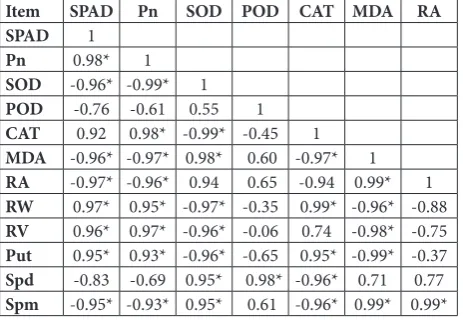
Compared to the control, all salt treatments and the mild alkali treatment (50 mmol L-1) increased the Ls, while the severe alkali treatment (150 mmol L-1) caused a decrease. Compared to the control, the 50- and 100-mmol L-1 salt concentrations caused increases in Pn/Ci, while the 150-mmol L-1 salt concentration and the 50-, 100- and 150-mmol L-1 alkali concen-trations caused a decrease. The chlorophyll contents (SPAD value) decreased under both stresses (Table 3). There was a significant positive correlation between
the yield and chlorophyll contents, and a negative cor-relation between the chlorophyll and MDA contents (P<0.05) (Table 6). Correlation analysis also showed that Pn was positively correlated with chlorophyll content (Table 7).
Antioxidant enzymes
Salt and alkali treatments stimulated an increase in SOD and POD activities in roots. The exception was a decrease in POD activity in the 150-mmol L-1 al-kali-treated plants. CAT activity under both stresses decreased (P<0.05). SOD activity was negatively cor-related with yield, and CAT activity was positively correlated with yield under salt treatments (Table 6). Of the four salt treatments, the highest SOD activ-ity occurred at 150 mmol L-1, and the highest POD activity occurred at 100 mmol L-1, with increases of 174.26% and 85.26%, respectively, as compared to the control. Of the four alkali treatments, the highest SOD activity was observed at 150 mmol L-1, and the highest POD activity at 50 mmol L-1, with increases of 166.83% and 34.37%, respectively, as compared to the control. SOD, POD and CAT activities in salt-treated roots were higher than in alkali-salt-treated roots. Salt and alkali treatments led to an accumulation of MDA, although it was lower in salt-treated roots than Table 3. The effect of salt and alkali treatments on photosynthesis of oat leaves at anthesis.
Treatment SPAD Pn (μmol m-2·s-1) Gs (mmol mol-1) Tr (mmol m-2·s-1) Ci (μmol mol-1) Ls Pn/Ci
Control 42.23±0.63a 8.19±0.02a 0.14±0.002a 4.46±0.18b 257.88±13.49a 0.32±0.01d 0.032±0.001b
50 mmol L-1 salt 40.08±0.66a 6.13±0.05b 0.06±0.005b 1.87±0.02e 174.08±12.62c 0.53±0.01b 0.035±0.001a
100 mmol L-1 salt 39.98±1.20ab 6.02±0.07b 0.06±0.006b 1.86±0.01e 156.35±12.76c 0.58±0.01ab 0.038±0.001a
150 mmol L-1 salt 37.91±1.40b 4.35±0.06d 0.06±0.005b 1.59±0.01e 157.95±16.18c 0.58±0.02a 0.028±0.001c
50 mmol L-1alkali 36.59±0.47b 5.83±0.08c 0.06±0.005b 5.73±0.03a 222.20±12.08b 0.42±0.01c 0.026±0.001c
100 mmol L-1alkali 35.50±0.95b 4.34±0.07d 0.05±0.004bc 3.29±0.13c 261.70±16.78a 0.32±0.02d 0.017±0.001d
150 mmol L-1alkali 33.67±0.53b 3.40±0.14e 0.03±0.001d 2.56±0.05d 281.11±12.21a 0.27±0.03d 0.012±0.001e
SPAD – chlorophyll contents. Values are means±SE (n=3). Different letters in a column denote average values different at the 0.05 level of probability. Table 4. The effects of salt and alkali treatments on the antioxidant enzymes in root at anthesis.
Treatment SOD (Ug-1min-1) POD (Ug-1min-1) CAT (Ug-1min-1) MDA (nmolg-1)
Control 2015.±104c 3.24±0.03b 10.04±1.31a 4.12±0.14c
50 mmol L-1 salt 3632±106b 5.99±0.55a 9.18±0.49ab 6.06±0.31bc
100 mmol L-1 salt 3999±72b 5.99±0.36a 8.75±0.11ab 7.33±1.44b
150 mmol L-1 salt 5527±70a 4.96±0.48ab 7.55±0.38b 11.19±0.63a
50 mmol L-1 alkali 3469±395b 4.35±0.16a 6.39±0.34b 8.56±0.44b
100 mmol L-1 alkali 3442±177b 3.05±0.16b 8.72±1.27ab 8.99±1.90ab
150 mmol L-1 alkali 5378±37a 2.63±0.05b 3.99±0.02c 11.19±0.79a
in alkali-treated roots (Table 4). There was a signifi-cant negative correlation between the MDA content and yield (Table 6). Correlation analysis also showed that MDA contents correlated negatively with both Pn and chlorophyll contents (Table 7).
Polyamines
Salt and alkali treatments decreased the Put content but increased Spd and Spm contents (P<0.05). There was a positive correlation between Put and yield (Ta-ble 6). Spm correlated negatively with MDA, yield and chlorophyll contents (P<0.05) (Table 7). As al-kalinity and salinity increased, an improvement of the (Spd+Spm)/Put ratio was observed (Table 5). Of the salt treatments, the 100- and 150-mmol L-1 con-centrations caused the largest increases in Spd and Spm contents, by 149.59% and 181.21%, respectively, as compared to the control. Of the alkali treatments, the 150-mmol L-1 concentration caused the largest increase in Spd and Spm contents, by 190.40% and 235.16%, respectively, as compared to the control. The extent of the increase under alkali treatment was larger than that under the salt treatment.
DISCUSSION
Effects of salt and alkali treatments on yield
Both salt and alkali treatments lowered oat yield and grain weight. The yield, grain number per spike and grain weight of alkali-treated plants were all lower than in salt-treated plants. This result is consistent with Yang et al. [22], and the higher pH levels, which may cause lower yields, in alkali-treated plants previ-ously reported [23].
Table 5. The effects of salt and alkali treatments on polyamines in roots at anthesis.
Treatment Put (nmolg-1) Spd (nmol g-1) Spm (nmolg-1) (Spd+Spm) Put
Control 266.20±8.43a 41.42±1.77d 8.47±0.83d 0.19±0.02e
50 mmol L-1Salt 220.79±6.73b 92.59±5.94b 14.30±1.49c 0.48±0.04c 100 mmol L-1Salt 171.75±2.50c 103.39±2.61b 21.40±0.50bc 0.73±0.01b 150 mmol L-1Salt 159.69±0.54c 82.40±10.27b 23.83±1.04b 0.67±0.07b 50 mmol L-1Alkali 206.30±8.49b 53.98±3.32d 16.30±1.90c 0.34±0.01d 100 mmol L-1Alkali 153.30±3.02c 69.30±7.05c 23.19±0.70b 0.60±0.06bc 150 mmol L-1Alkali 146.98±6.31c 120.29±7.78a 28.40±1.27a 1.01±0.02a Values are means±SE (n=3). Different letters in a column denote significantly different average values at the 0.05 level of probability.
Table 6. Correlation analysis of yield and physiological indexes for oat leaves and roots at anthesis.
Parameter Salt Alkali
SPAD 0.95* 0.96*
Pn 0.97* 0.97*
SOD -0.99* -0.94
POD -0.46 0.44
CAT 0.99* 0.78
MDA -0.988* -0.978*
RA -0.86* -0.76
RW 0.98* 0.95*
RV 0.78 0.98*
Put 0.95 0.98*
Spd -0.58 -0.90
Spm -0.96* -0.99*
Asterisks (*) indicate significant correlation, *(P<0.05). RA – Root activity; RW – root dry weight; RV – root volume; Pn – net photosynthetic rate; SOD – superoxide dismutase; POD – peroxidase; CAT – catalase; Put – putrescine; MDA – malondialdehyde; Spd – spermidine; Spm – spermine.
Table 7. Correlation analyses of physiological indices of oat leaves and roots at anthesis
Item SPAD Pn SOD POD CAT MDA RA
SPAD 1
Pn 0.98* 1
SOD -0.96* -0.99* 1
POD -0.76 -0.61 0.55 1
CAT 0.92 0.98* -0.99* -0.45 1
MDA -0.96* -0.97* 0.98* 0.60 -0.97* 1
RA -0.97* -0.96* 0.94 0.65 -0.94 0.99* 1
RW 0.97* 0.95* -0.97* -0.35 0.99* -0.96* -0.88
RV 0.96* 0.97* -0.96* -0.06 0.74 -0.98* -0.75
Put 0.95* 0.93* -0.96* -0.65 0.95* -0.99* -0.37
Spd -0.83 -0.69 0.95* 0.98* -0.96* 0.71 0.77
Spm -0.95* -0.93* 0.95* 0.61 -0.96* 0.99* 0.99*
Effects of salt and alkali treatments on photosynthesis
There was a significant positive correlation between yield and Pn, measured in the second functional leaves, indicating that the decrease in yield under salt and alkali treatments is related to photosynthesis at the flowering stage.
In recent years, studies have mostly concentrated on the effects of salt and mixed salt-alkali stresses on photosynthesis. The decrease in Pn induced by expo-sure to a mixed salt-alkali stress in barley and oat was most likely the result of stomatal closure [20]. Studies related to alkali treatment are scarce [24,25].
Some studies have reported that the relative mag-nitude of stoma closure and non-stoma factors in lim-iting Pn might depend on stress severity. Non-stoma factors lead to a reduction in chloroplast activity and changes in some biochemical processes [26]. Consis-tent with this result, it was found that Pn, Ci, and gs were decreased and Ls increased in response to mild alkalinity (50 mmol L-1). However, at moderate (100 mmol L-1) and severe (150 mmol L-1) alkali concen-trations, Ci increased, but Ls did not change signifi-cantly when compared to the control. This suggests that stoma closure limited the photosynthetic rate under mild alkali treatment (50 mmol L-1), and that other factors, rather than stoma closure, limited Pn under moderate (100 mmol L-1) and severe (150 mmol L-1) alkali concentrations at the flowering stage. The non-stomatal factors include the cumulative effects of water potential, osmotic potential and different bio-chemical composition. These results are not consistent with those of Yang [27], who reported that barley Ci decreased under severe alkali concentrations. This inconsistency may be due to differences in species.
Some studies have reported that stoma closure is the main driver of Pn reduction caused by salinity [28]. However, other studies have reported that salinity has little effect on Ci, and that non-stomatal factors mainly limit the photosynthetic rate [27]. In this study, salin-ity decreased Pn, Ci and gs, but stoma closure mainly limited the Pn of oat plants at the flowering stage.
Salinity caused higher Pn/Ci levels than alkalin-ity, suggesting that the effect of alkali treatment on
the activities of photosynthesis-carbon assimilation enzymes was greater than that of salt treatment. Both salt and alkali treatments caused a significant decrease in the chlorophyll content, and the extent of the reduc-tion in alkali-treated oats was larger than that in salt-treated oats. This result is similar to that of Yang [29], who reported that salt and alkali treatments decreased the chlorophyll content of wheat, perhaps because of an improvement in chlorophyll-degradation enzyme activity or deficiency in metal ions. A positive corre-lation between the chlorophyll contents and Pn was observed, indicating that the reduction in chlorophyll content mainly limits the photosynthetic rate. At mod-erate (100 mmol L-1) and severe (150 mmol L-1) salt and alkali concentrations, Tr decreased. However, Tr levels of alkali-treated plants were higher than in salt-treated plants, suggesting that alkalinity can facilitate the increase in transpiration, which could reduce leaf temperature.
Effects of salt and alkali treatments on root activity, root volume, root dry matter and the root-shoot ratio
In recent years, the relationship between plant aerial parts and roots has received considerable attention, and it was concluded that root growth can affect shoot growth and yield production [30]. To further elucidate the correlation between roots and photosynthesis and the effects of salinity and alkalinity on their relation-ship, the root dry matter, root volume, root activity, antioxidant enzyme activities and polyamine contents of roots were measured at four salt and alkali concen-trations at the flowering stage.
There was a positive correlation between root dry matter and yield. Similar results have also been report-ed in rice [31]. In this study, root activity correlatreport-ed negatively with yield in salt-treated plants, and root volume correlated positively with yield in alkali-treat-ed plants, suggesting that at the flowering stage, root physiology influenced the yield. The changes in root physiology caused by salinity and alkalinity stresses might affect the absorption of water and nutrients, which would subsequently influence yield.
with Burcu et al. [32], who reported that salinity de-creased root dry matter in wheat. The extent of the decrease observed in alkali-treated plants was greater than in salt-treated plants, indicating that the adverse effects of alkalinity on roots were more severe than those of salinity. Under both stresses, root dry mat-ter negatively correlated with SOD activity and with the MDA content, indicating that ROS is one of the main factors responsible for root dry matter reduction under these stresses.
Under severe salt and alkali concentrations (150 mmol L-1), the root-shoot ratio decreased, suggesting that the inhibitory effect of severe stress on the roots was much greater than on aerial parts. This may be due to the energy consumption of growing roots, which is twice that of the aerial parts. Unnecessary energy con-sumption caused by root redundancy could limit the yield [33]. Thus, a decrease in the root-shoot ratio in-creases salinity and alkalinity tolerance. In conclusion, tolerance to both stresses depends on the coordination between roots and the growth of aerial plant parts.
Effects of salt and alkali treatments on antioxidant enzymes
There was a significant negative correlation between the MDA contents and yield. This suggests that lipid peroxidation caused by ROS limited the yield under saline and alkaline conditions. Thus, the increase in SOD and POD activities could contribute to the im-provement of oat yield.
Many studies have investigated the effects of salt on the antioxidant system. Some researchers have claimed that salinity causes ROS accumulation, which leads to damage caused by lipid peroxidation. Many higher plants resist ROS by increasing antioxidant en-zyme activities, thereby improving salt tolerance. In this study, salt and alkali treatments increased SOD and POD activities but decreased CAT activity. This result is not consistent with that of Burcu et al. [32], who reported that salinity increases POD activity but decreases SOD and CAT activities in wheat roots.
SOD is the first line of defense against ROS. SOD catalyzes the reaction of 2O2¯+2H+→H
2O2+O2, after which H2O2 is broken down by POD and CAT. In this study, the increase in MDA content after salt and
alka-li treatments points to ROS accumulation. Compared to the salt treatments, the higher MDA contents after alkali treatments suggested that alkali caused more severe lipid peroxidation. The increase in SOD and POD activities could reduce lipid peroxidation and improve the resistance to salt and alkali. The function of POD is similar to that of CAT, and the improve-ment in POD activity could make up for the limitation of CAT activity caused by stress [34].
Effects of salt and alkali treatments on polyamines
Polyamines affect plant growth and play important roles in plant resistance to drought and salt treatments [35]. However, only a few studies have examined the mechanism of polyamine response to alkali treatment. Some reports have shown that salinity causes the ac-cumulation of Put in nonphotosynthetic organs [15], whereas some researchers have reported that salinity decreases the Put content and increases the Spm con-tent [21]. In this study, the alkali treatment decreased the Put content and increased the Spd and Spm con-tents in roots. The improvement of the (Spd+Spm)/ Put ratio was observed under alkali treatment. Stud-ies have proved that the increase in polyamine con-tents and (Spd+Spm)/Put could improve salt resis-tance [36]. Thus, the improvement of Spd, Spm and (Spd+Spm)/Put may contribute to increased alkali tolerance in oats.
Goyal [5] and Zhang [21] have reported that poly-amines also participate in the elimination of ROS and are positively correlated with the activity of antioxi-dant enzymes. In this study, there was a significant positive correlation between Spm content and SOD activity, and a positive correlation between MDA content and Spm for both salt and alkali treatments. This phenomenon suggests that Spm enhances the membrane stability of oats exposed to salt and alkali treatments.
CONCLUSION
the decrease in yield and root dry matter was greater after alkali treatments than after salt treatments. In both salt- and alkali-treated plants, the root-shoot ratio decreased, possibly in an attempt to save energy for increased stress tolerance. In plant roots, the increase in SOD activity contributed to catalyzing superoxide radicals to hydrogen peroxide, and the improvement of POD activity helped eliminate the peroxide. Spm contents, which positively correlated with SOD activity, contributed to the elimination of ROS. Root dry mat-ter and root volume correlated positively with yield, and root factors contributed to yield production. Our data suggest that photosynthesis and root physiology at anthesis were closely related to yield production under increased salt and alkali conditions. The adverse effects on oat plants of alkali were greater than those of salt. Therefore, future research should focus on the effects of alkaline conditions on oat production.
Funding: This study was financially supported by the Na-tional Key Basic Research Development Program of China (2014CB138801), the Natural Science Foundation (31200540), and Fundamental Research Funds of Central Nonprofit Research Institutes (1610332016011).
Author contributions: Yan Qin and Jianhui Bai contributed equally to this work, and are considered as first coauthors. Yan Qin, Jianhui Bai, Zhi Dong, Jinghui Liu designed the experiment, Lei Ji contributed significantly to data analysis and manuscript preparation, Yuqing Wang performed the data analyses and Yan Qin, Jianhui Bai wrote the manuscript.
Conflict of interest disclosure: The authors have no conflict of interest to disclose.
REFERENCES
1. Alasvandyari F, Mahdavi B, Hosseini SM. Glycine betaine affects the antioxidant system and ion accumulation and reduces salinity-induced damage in safflower seedlings. Arch Biol Sci. 2017;69(1):139-47.
2. Caruso G, Cavaliere C, Guarino C, Gubbiotti R, Foglia P,
Laganà A. Identification of changes in Triticum durum L.
leaf proteome in response to salt stress by two-dimensional electrophoresis and MALDI-TOF mass spectrometry. Anal Bioanal Chem. 2008;391(1):381-90.
3. Cheng YW, Qi YC, Zhu Q, Chen X, Wang N, Zhao X, Chen HY, Cui XJ, Xu LL, Zhang W. New changes in the plasma-membrane-associated proteome of rice roots under salt stress. Proteomics. 2009;9(11):3100-14.
4. Hartung W, Leport L, Ratcliffe RG, Sauter A, Duda R, Turner N. Abscisic acid concentration, root pH and anatomy do not explain growth differences of chickpea (Cicer arietinum L.)
and lupin (Lupinus angustifolius L.) on acid and alkaline soils. Plant Soil. 2002;240(1):191-9.
5. Goyal M, Asthir B. Polyamine catabolism influences antioxi-dative defense mechanism in shoots and roots of five wheat genotypes under high temperature stress. Plant Growth Regul. 2010;60(1):13-25.
6. Campestrea MP, Bordenavea CD, Origonea AC, Menen-deza AB, Ruiza OA, Rodrigueza AA, Maialea SJ. Polyamine catabolism is involved in response to salt stress in soybean hypocotyls. J Plant Physiol. 2011;168(11):1234-40.
7. Prasad S, Shamala T, Frans JMM. Long term salinity stress reveals variety specific differences in root oxidative stress response. Rice Sci. 2012;19(1):36-43.
8. Yang K, Zhang BJ, Hu YG, Wang SH, Xue XF. Effects of com-plex saline-alkaline stress on seeds germination and physi-ological and biochemical parameters of oats seedlings. Agric Res Arid Areas. 2009;27:188-92.
9. Wang B, Song FB, Ren CZ, Liu SQ, Han XY. Effects of Saline-Alkali Stress on ultrastructure in chloroplast and some physiological indexes of oats. J Jilin Agr U. 2005;27(5):473-7. 10. Wang XP, Geng SJ, Ri YJ, Cao DH, Liu J, Shi DC, Yang CW. Physiological responses and adaptive strategies of tomato plants to salt and alkali stresses. SCI Hortic-Amsterdam. 2011;130(1):248-55.
11. Yang CW, Shi DC, Wang DL. Comparative effects of salt and alkali stresses on growth, osmotic adjustment and ionic balance of an alkali-resistant halophyte Suaeda glauca (Bge.). Plant Growth Regul. 2008;56(2):179-90.
12. Li RL, Shi FC, Fukuda K, Yang YL. Effects of salt and alkali stresses on germination, growth, photosynthesis and ion accumulation in alfalfa (Medicago sativa L.). Soil Sci Plant Nutr. 2010;56(5):725-33.
13. Zhao GQ, Ma BL, Ren CZ. Growth, Gas Exchange, Chlo-rophyll Fluorescence, and Ion Content of Naked Oat in Response to Salinity. Crop Sci. 2007;47:123-31.
14. Chen WC, Cui PJ, Sun HY, Guo WQ, Yang CW, Jin H, Fang B, Shi DC. Comparative effects of salt and alkali stresses on organic acid accumulation and ionic balance of
sea-buckthorn (Hippophae rhamnoides L.). Ind Crop Prod.
2009;30(3):351-8.
15. Doganlar ZB, Demi R K, Basak H, Gul I. Effects of salt stress on pigment and total soluble protein contents of three dif-ferent tomato cultivars. Afr J Agr Res. 2010;15(15):2056-65. 16. Arnon DI, Hoagland DR. A comparison of water cul-ture and soil as media for crop production. Science. 1939;89(2318):512-4.
17. Qin JQ, Xia BC, Zhao P. Photosynthetic physiological
response of two Miscanthus floridulus populations to Cd
stress. Acta Ecologica Sinica. 2010;30(2):288-99.
18. Li ZJ, Xie XY, Zhang SQ, Liang YC. Negative Effects of Oxy-tetracycline on Wheat (Triticum aestivum L.) Growth, Root Activity, Photosynthesis, and Chlorophyll Contents. J Integr Agr. 2011;10(10):1545-53.
19. Musick GJ, Fairchild ML, Fergason VL, Zuber MS. A
method of measuring root volume in corn (Zeamays L.).
Crop Sci. 1965; 5(6): 601-2.
21. Zhang GW, Liu ZL, Zhou JG, Zhu YL. Effects of Ca(NO3)2 stress on oxidative damage, antioxidant enzymes activities and polyamine contents in roots of grafted and non-grafted tomato plants. Plant Growth Regul. 2008;56(1):7-19. 22. Yang CW, Shi DC, Wang DL. Comparative effects of salt
and alkali stresses on growth, osmotic adjustment and ionic balance of an alkali-resistant halophyte Suaeda glauca (Bge.). Plant Growth Regul. 2008;56(2):179-90.
23. Wang XP, Jiang P, Ma Y, Geng S, Wang S, Shi DC. Physiologi-cal strategies of sunflower exposed to salt or alkali stresses: restriction of ion transport in the cotyledon node zone and solute accumulation. Agron J. 2015;107(6):2181-92. 24. Guo R, Yang Z, Li F, Yan C, Zhong X, Liu Q, Xia X, Li H,
Zhao L. Comparative metabolic responses and adaptive strategies of wheat (Triticum aestivum) to salt and alkali stress. BMC Plant Biol. 2015;15(1):170.
25. Campbell SA, Nishio JN. Iron deficiency studies of sugar beet using an improved sodium bicarbonate-buffered hydro-ponics growth system. J Plant Nutr. 2000;23(6): 741-57. 26. Saeedipour S, Moradi F. Effect of drought at the
post-anthe-sis stage on remobilization of carbon reserves and some physiological changes in the flag leaf of two wheat cultivars differing in drought resistance. J Agr Sci. 2011;3(3):3425-29. 27. Yang CW, Xu HH, Wang LL, Liu J, Shi DC, Wang DL. Com-parative effects of salt-stress and alkali-stress on the growth, photosynthesis, solute accumulation, and ion balance of bar-ley plants. Photosynthetica. 2009;47(1):70-86.
28. Zheng YH, Xu XB, Wang MY, Zheng XH, Li ZJ, Jiang GM. Responses of salt-tolerant and intolerant wheat genotypes to sodium chloride: photosynthesis, antioxidants activities, and yield. Photosynthetica. 2009;47(1):87-94.
29. Yang JY, Zheng W, Tian Y, Wu Y, Zhou DW. Effects of vari-ous mixed salt-alkaline stresses on growth, photosynthesis,
and photosynthetic pigment concentrations of Medicago
ruthenica seedlings. Photosynthetica. 2011;49(2):275-84. 30. Komatsu Y. Some observations on the root development as
related to the growth of the aerial part of rice plant treated with shading and nitrogen application into lower part of fur-row slice. Jpn J Crop Sci. 2008;29(2):199-201.
31. Tang WB, Deng HB, Xiao YH, Zhang GL, Fan K, Mo H, Chen LY. Root characteristics of high-yield c liangyou rice combinations of two-line hybrid rice. Sci Agri Sinica. 2010;43(14):2859-68.
32. Seckin B, Sekmen AH, Türkan İ. An enhancing effect of exogenous mannitol on the antioxidant enzyme activities in roots of wheat under salt stress. J Plant Growth Regul. 2009;28(1):12-20.
33. Yang JC. Relationships of rice root morphology and physi-ology with the formation of grain yield and quality and the nutrient absorption and utilization. Sci Agri Sinica. 2011;44:36-46.
34. Xu J, Duan XG, Yang J, Beeching JR, Zhang P. Enhanced reactive oxygen species scavenging by overproduction of superoxide dismutase and catalase delays postharvest physi-ological deterioration of cassava storage roots. Plant Physiol. 2013;161(3):1517-28.
35. Erdei L, Trivedi S, Takeda K, Matsumot H. Effects of osmotic and salt stresses on the accumulation of polyamines in leaf segments from wheat varieties differing in salt and drought tolerance. J Plant Physiol. 1990;137(2):165-8.