e-Training Transition Project
Phase II e-Training Communications Guide
Version 1.1
August 24, 2005
National Aeronautics and Space Administration
Communications Guide for the
Phase II e-Training Transition
August 24, 2005
Approved by:
Sheila Fogle Date
e-Training Transition Project Manager
Dennis Conrad Date
T
ABLE OF
C
ONTENTS
INTRODUCTION... 4
PURPOSE... 4
BACKGROUND... 4
PHASE IIOVERVIEW... 5
COMMUNICATIONS FOR PHASE II... 6
COMMUNICATIONS OVERVIEW... 6
UNDERSTANDING AUDIENCES AND STAKEHOLDERS... 8
CORE MESSAGES... 10
COMMUNICATIONS ROLES AND RESPONSIBILITIES... 13
POTENTIAL COMMUNICATIONS VEHICLES... 14
PLANNING FOR COMMUNICATIONS... 15
EVALUATION AND FEEDBACK... 16
NEXT STEPS... 17
I
NTRODUCTION
P
URPOSEThe implementation of the NASA e-Training Learning Management System (LMS), SATERN (System for Administration, Training, and Educational Resources for NASA), will change current training business processes, as well as systems that are used for training registration, enrollment and delivery. Attention to the human and organizational impacts of change, as well as the technical aspects of the system installation, is important for success of this initiative.
The purpose of this guide is to assist NASA Centers in preparing for the e-Training transition by providing information on planning for communications. Communications can facilitate the transition to the LMS by enhancing awareness, understanding and support for the e-Training initiative throughout NASA and among interested and affected parties. This guide specifically addresses Phase II implementation and provides information that Centers can use to build and implement their e-Training
communications plans. Additional guides or updates will be provided to the Centers for other change management areas and for subsequent phases.
B
ACKGROUNDe-Training is one of the President’s Management Council approved e-Government initiatives, supporting the President’s Management Agenda (PMA) for improving the Government’s responsiveness to citizens and efficiency of operations. The vision of the initiative is to create a premier e-training environment that supports the development of the NASA workforce through simplified and one-stop access to high quality training products and processes to support learning and development.
Through the implementation of a centralized LMS, the training community within NASA will have new tools, functionality and capabilities for training administration and
delivery. Three legacy systems will be transitioned to SATERN:
• AdminSTAR – training administration system used by all Center training offices
• NASA Online Registration System (NORS) – allows students to register online for courses and is integrated with AdminSTAR, but only used at MSFC and KSC, and
• Site for Online Learning and Resources (SOLAR) – online custom content courseware system used throughout NASA
NASA has selected the Plateau Learning Management System software, a comprehensive application which will provide timely, up-to-date information and enable NASA to continue process standardization. Centers will be able to identify training requirements,
deploy learning, and track its completion. The Plateau system will also allow for tracking of certifications, and assessment of competencies. It provides desktop access to training information and courses, online enrollment and testing, course catalogs and facility management.
P
HASEII
O
VERVIEWSATERN will be implemented in several phases. The focus of Phase II is to replace legacy systems (SOLAR, NORS, and AdminSTAR) and provide functionality to support online and classroom courses, training record keeping, e-learning delivery &
management, and enrollment & scheduling management. The impact to the Centers of Phase II implementation will vary based upon current Center processes and functionality from existing systems. Additional features and functionality such as competency management and individual development planning will be configured in later phases as depicted in Figure 1.
Phase II will not include the capability for full library management. A sub-team has been formed to determine if there is a workaround within SATERN that can be used until full library management capability can be implemented.
Figure 1: e-Training Implementation Phases
P
PHHAASSEEII PPHHAASSEEIIII
Define initial configuration
Launch of system
NASA Purchase Card on-line course available
Online and Classroom Courses
Online FPP Migrati conten Archivi
Training Record Keeping e-learning delivery and mgmt Enrollment and scheduling External training (SF-182) Curricula and certification
registration - NORS Centers (Optional for other Centers)
S Interface Training History
Training Evaluation – surveys on of items and custom t
ng of Data
Discontinue use of Legacy Systems
P
PHHAASSEESSIIIIII&&IIVV
Library Management
Online Regist Centers (12/31
Competency M
Individual Dev
Vendor Cours
Sunset legacy
Center Unique
Virtual Learnin
Communities
ration – All other /05) anagement elopment Planning es systems (12/31/05) Training Systems g System
C
OMMUNICATIONS FOR
P
HASE
II
Effective communications is critical to the success of the e-Training project, because it is vital to building awareness and commitment for change. Because communications increases acceptance of change, it is essential that NASA employees impacted by the SATERN system understand the drivers and purpose for the program, and the personal and organizational benefits that will result from implementing SATERN.
NASA employees are dealing with ongoing changes that occur across the Agency. The implementation of SATERN represents just one of those changes. Understandably, such changes can create concern, anxiety, and resistance. Well-designed communications can play a critical role in addressing these reactions with messages that are meaningful to the audience, and conveyed via audience-accepted channels
C
OMMUNICATIONSO
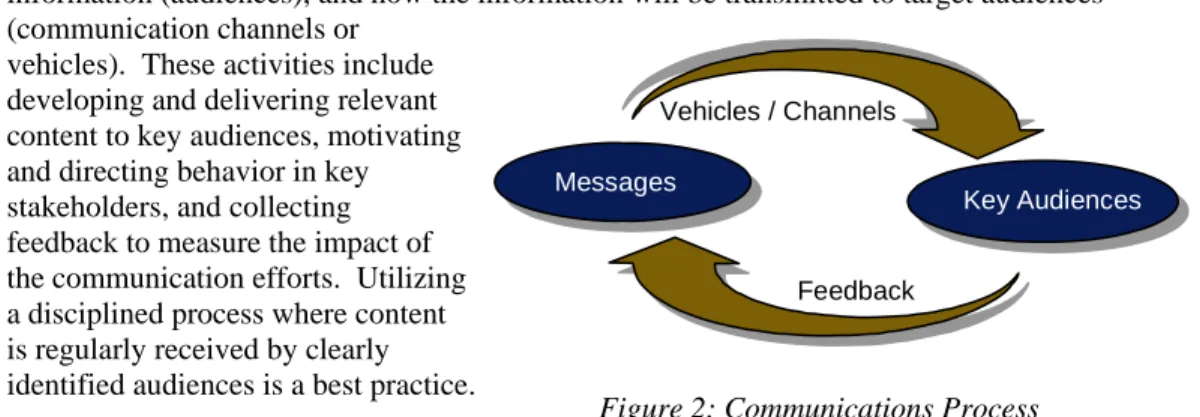
VERVIEWThe communications process (Figure 2) is a cycle of basic, repeatable activities which define what information needs to be communicated (messages), who needs to receive this information (audiences), and how the information will be transmitted to target audiences (communication channels or
vehicles). These activities include developing and delivering relevant content to key audiences, motivating and directing behavior in key stakeholders, and collecting feedback to measure the impact of the communication efforts. Utilizing a disciplined process where content is regularly received by clearly
identified audiences is a best practice.
Communications Principles
While each communication effort is unique, a few basic principles remain consistent. When formulating e-Training communications plans, NASA Centers should consider the following principles in order to increase effectiveness of communications:
Cascading” Communications. Plans should reflect the principle of cascading communications, where information is distributed to management and then to employees. The aim is to have no surprises for leadership when communications reach employees, so that managers are prepared to address their concerns. However, all staff must receive the same messages, so that they do not receive communications that management has not received, and messages are not distorted as they cascade.
Messages
MessagesKey Audiences Vehicles / Channels
Feedback
Few Messages, Many Messengers. With the communications principle of “few messages, many messengers” a communications plan focuses on a few key messages, and identifies several different means for communicating those messages to ensure that they reach every individual in each audience. Variety in the communications methods and vehicles helps reach more of the target audiences by appealing to a variety of communications styles.
Repetition. The principle of repetition should be considered as the actual
communications are developed. Each communication should begin by referencing and repeating the key messages communicated in the last communication received by that audience, and should conclude with a preview of what will be communicated next. Frequent and consistent communication of the same messages maximizes the probability that it will be heard and understood.
Two-way communication. Feedback received from the audiences is just as important as the information going out to them. Soliciting questions and comments through feedback channels signals sensitivity to the audiences’ concerns, and provides valuable input into what should be addressed in future communications. Therefore, each communication should provide a point of contact or mechanism for the audience to direct questions and concerns back to the appropriate e-Training contacts at the Center.
Communications Objectives
The implementation of e-Training communications at the Agency and Center levels will help to initiate behaviors that support the SATERN implementation. The following communication objectives have been identified:
Build awareness of the e-Training project and foster advocacy for the initiative through the communication of the purpose and benefits of the project
Increase organizational change readiness for SATERN by educating users on the details of the implementation
Manage the expectations regarding SATERN through clear communications of functionality, impacts and timeline
Promote stakeholder involvement and buy-in by communicating the
importance of their role in the success of SATERN and providing opportunities to ask questions and raise concerns
Encourage communication on the e-Training initiative by providing key stakeholders with the information necessary to explain the project objectives, impacts and benefits
U
NDERSTANDINGA
UDIENCES ANDS
TAKEHOLDERSEvery employee in NASA will be touched by the implementation of the SATERN system. However, the significance of the impacts or changes that users will experience will differ according to the audience segment. Understanding the stakeholders and different audiences that are impacted is the key to delivering effective communications. Because stakeholders and audiences vary by Center, this guide specifically focuses on key audience groups that are common across all Centers.
It is important that Centers with significant audience segments not defined in this document use the format outlined here as a guide to define desired behaviors and key messages for these additional groups.
Key Audiences
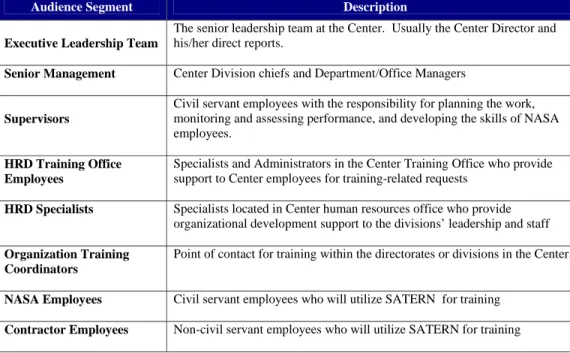
Effective communication requires up-front identification and analysis of key audiences who are critical to the e-Training project success. Within this document, Center level audiences (versus Agency level) will be the primary focus. In identifying these audiences, it is important to group them together in manageable segments. An effort should be made to understand the perspectives and issues of each key audience group. This will help ensure properly targeted vehicles and relevant content. The following table provides a summary of the key audiences in the Center that should be the target of e-Training communications:
Audience Segment Description
Executive Leadership Team
The senior leadership team at the Center. Usually the Center Director and his/her direct reports.
Senior Management Center Division chiefs and Department/Office Managers
Supervisors
Civil servant employees with the responsibility for planning the work, monitoring and assessing performance, and developing the skills of NASA employees.
HRD Training Office Employees
Specialists and Administrators in the Center Training Office who provide support to Center employees for training-related requests
HRD Specialists Specialists located in Center human resources office who provide
organizational development support to the divisions’ leadership and staff Organization Training
Coordinators
Point of contact for training within the directorates or divisions in the Center.
NASA Employees Civil servant employees who will utilize SATERN for training
Contractor Employees Non-civil servant employees who will utilize SATERN for training
Key Audience Requirements
In crafting a communications plan, it is important to understand the behaviors or actions Centers hope to elicit from each audience, and the information these stakeholders need in order to take these actions. Some information, such as the purpose and benefits of SATERN, will be important for all stakeholders. The table below outlines key requirements by audience segment.
Audience Segment Desired Behaviors / Actions What They Need to Know
Executive Leadership Team
Articulate e-Training core messages when communicating to
staff and other Center audiences
Senior Management
Provide general support – present no “roadblocks” to the
SATERN implementation
Purpose and benefits of e-Training
Impacts to people, systems and processes; implementation phases (high
level)
Rationale behind decision to implement SATERN
Where to go/whom to contact for information
Supervisors
Take a leadership role in communicating with staff about the
SATERN implementation, new processes, etc.
Purpose and benefits of e-Training
How and when SATERN will impact employee training, and business
processes
Where to go/whom to contact for information
HRD Training Office
Take an active role in the implementation of SATERN to
ensure a successful implementation at their Center.
Participate in planning activities, stay aware of developments,
and raise questions and concerns to the project office
Purpose and benefits of e-Training
Impacts to people, systems and processes; implementation phases
Major project milestones and schedule (data migration, implementation)
Implementation plans/progress
Where to go/whom to contact for information
HRD Specialists
Be proactive in articulating e-Training core messages and
providing updates to staff in divisions
Purpose and benefits of e-Training
Impacts to people, systems and processes; implementation phases
Where to go/whom to contact for information
Organization Training Coordinators
Be proactive in articulating e-Training core messages and
providing updates to staff in their organization
Take an active role in the implementation of SATERN as
required
Purpose and benefits of e-Training
Impacts to people, systems and processes; implementation phases
How and when SATERN will impact Training Coordinators:
- what will change; what they will be doing differently
- new processes
Civil Servant Employees Exhibit awareness that SATERN is coming and be able to articulate how it benefits NASA as an Agency and its people
Purpose and benefits of e-Training
C
OREM
ESSAGESCore messages serve as anchor concepts and provide the discipline for the various communications elements. They are based upon the requirements of the audience segments and the communications objectives.
In successfully implementing SATERN, communications will play a critical role at the strategic, tactical, and personal levels. Regardless of the vehicle – face to face, e-mail or newsletters – many of the questions that users have can be addressed by core messages from one of these levels.
Center communications should incorporate and build upon these critical concepts. Messages will need to be customized to each Center’s specific culture and adjusted by project status.
Strategic Core Messages
Strategic communications is the means of aligning the performance of individuals and the organization with NASA’s mission and strategy. Words and ideas can enable employees to understand and commit to the goals and objectives associated with the SATERN implementation. Strategic core messages answer the question: What are we doing and why?
e-Training is an e-Government initiative and NASA is required to participate.
e-Training is one of the President’s Management Council approved e-Government initiatives, supporting the President’s Management Agenda (PMA), for improving the Government’s responsiveness to citizens and efficiency of operations. Because e-Training is a PMA initiative, NASA is required to participate.
The e-Training initiative is expected to improve Agency services and save taxpayer dollars. The Federal Government expects that the e-Training initiative will enable Agencies to better able to attract, retain, manage and continuously educate the highly skilled professionals needed for a flexible and high-performing government workforce, while saving tax payers about $784 million over the next 10 years.
NASA will reduce costs through the consolidation of multiple learning systems.
At NASA, the implementation of SATERN will achieve economies of scale through the consolidation of multiple learning systems. Three legacy systems will be transitioned to the e-Training LMS:
o AdminSTAR – training administration system used by all Center training offices,
o NASA Online Registration System (NORS) – allows students to register online for courses and is integrated with AdminSTAR, (at MSFC and KSC), and
o Site for Online Learning and Resources (SOLAR) – online custom content courseware system used throughout NASA.
Ease of access and improved functionality will support the development of NASA employees. SATERN will offer learners one-stop access to a robust training environment to support employee learning and development. SATERN will enable management of training information and courses, certifications, competencies, and individual development plans.
NASA will achieve improved consistency and efficiency in training operations. SATERN will allow for the continued implementation of standard training processes, on-line access to consolidated training data, and ease of delivery and administration of training courses and schedules.
Tactical Core Messages
Tactical communications carry the specific messages of what changes will happen, who is affected, when, why and how. Tactical core messages answer the questions: How will we accomplish our goal? What actions are desired?
Implementation of SATERN is a significant transformation effort.
The system functionality will be implemented in phases. The goal for Phase II is to implement functionality to replace the three legacy learning systems. Additional functionality will be rolled out over time. The impact to the Centers will vary depending on the Phase. We do not have all of the answers regarding the timing and impacts of the implementation, but commit to sharing what we know as schedules are finalized.
Involvement from Center representatives and SOLAR disciplines is key to the success of SATERN.
Representatives from each Center and each SOLAR discipline have been involved in making configuration decisions and working to standardize processes. This
involvement is critical to the success of the SATERN implementation and to ensuring that NASA reaps the benefits of a centralized learning system.
Implementation of SATERN will involve changes to the Center’s current business learning processes. As we implement an Agency-wide system for learning
management, we must also move from different approaches toward common processes that all Centers use for learning administration. Because Center learning processes are currently not consistent, the impacts of the process changes will vary by Center. However, this is an important first step toward preparing Centers for the move to the NSSC.
The e-Training initiative is aligned with other Agency transformation efforts.
The team is aligned and working with the NSSC to achieve the goal of a smooth transition of training processes in the future. Contacts have also been established to
Tailoring Tactical Messages to Specific Audiences
Additional tactical messages will vary by audience in terms of content and level of detail. For example, SATERN’s phased implementation means that certain Centers will be impacted differently in Phase II than others. The senior leaders and managers must have a clear understanding of the specific changes that will take place at their Center.
The following questions should be addressed:
How does the implementation of Phase II functionality affect our Center? Will our Center lose any of its current functionality?
How will our Center processes change?
Who is involved in the Phase II activities? What is my role?
Personal Core Messages
Personally, communication can be a motivating force when the message carries a credible "what's in it for me?" and therefore is meaningful for employees. For communications to be successful, the Centers will need to communicate the benefits of the SATERN as well as how it will affect the daily activities of each audience. Personal core messages address how activities will be impacted on a day-to-day level and answer the question: Who will be impacted and how?
NASA employees will be responsible for online and onsite class enrollment (for Centers that implement online registration functionality in Phase II).
In Phase II, learners will utilize the system to enroll in courses and schedule training. Approvals for onsite classroom training will be routed electronically. Learners will be able to check the status of their enrollment and training history from their desktop. The SATERN system is easy to use and support will be available. SATERN is an
intuitive easy-to-use system to assist in planning and managing learning activities. The system will send e-mail reminders on scheduled training that can be imported to the learner’s calendar. Self-paced training, informational sessions, job aids, and helpdesk support will be available for learners.
Training will be made available to employees in roles significantly impacted by SATERN. Specialists in the training office and eTraining coordinators in the organizations will have the opportunity to participate in training on SATERN. Automated approvals and electronic documents will improve routing. Their expertise is required and important to help with acclimating learners to the new system. Tailoring Personal Messages to Specific Audiences
Additional personal messages will vary by audience in terms of content and level of detail. For example, Center Training Office employees will experience the greatest change in what they do, and how they perform their job duties. Thus, communications and other change management activities must address the concerns and “need to knows” for these audiences.
The following questions should be addressed: What does this mean to me and my job?
Will this change how I perform my work? If so, how and when will it change? What support will be provided to me during Phase II and beyond?
C
OMMUNICATIONSR
OLES ANDR
ESPONSIBILITIESEach NASA Center has identified a change management representative who is responsible for the coordination of e-Training change management activities (communications, training and process) at their Center. For the SATERN implementation, the e-Training Agency change management team will play an
overarching communications role while change management representatives at the Center will focus on local communications.
The e-Training Project at the Agency level is responsible for creating a communications strategy and plan for impacting Agency-level stakeholders and for providing core messages that can be tailored by each Center. Center change management
representatives will coordinate all Center communications efforts with those of the Agency, and their messages should be consistent and aligned with Agency messages. The e-Training Project change management team will support Center communications efforts by providing communications support, and communication tools and templates.
Summary of Communications Roles and Responsibilities e-Training Center Representative:
• Ensure all Center communications are executed as appropriate. • Participate in various e-Training communication activities. e-Training Center Change Management Representative:
• Coordinate and execute all Center communications with Agency Team or as appropriate. • Provide consistent messages that are aligned with Agency core messages.
• Have all communication products approved via the proper channels. • Participate in various e-Training communication activities.
• Work with their Center e-Training Representative to carry out communication plan. e-Training Agency Change Management Team:
• Overarching role to communicate the right information at the right time to the right audience.
• Create communications strategy and plan.
• Provide Agency core messages and other appropriate messages.
• Support Center communications efforts by providing tools and templates as needed.
• Lead change management conference calls and other e-Training change management
P
OTENTIALC
OMMUNICATIONSV
EHICLESCommunications channels and vehicles are the means by which the right messages get to the right audiences. An important communications best practice is to use a number of different vehicles to convey consistent messages to key audience groups. These include the channels currently in use in the organizations. Center representatives will need to determine the most appropriate and effective vehicle for each audience and type of communication.
A variety of print and technology-enabled communications vehicles exist at NASA as well as a number of established face-to-face meetings. Centers will need to leverage existing, active communications channels and seek out new vehicles for communicating with key audience segments.
Centers will need to select and prioritize based upon anticipated effectiveness for reaching targeted audience in a timely manner. The following is a list of vehicles for possible use for e-Training communications.
Print and technology / e-enabled vehicles
Center websites Center newsletters
Center-wide directed e-mails Posters and flyers
Face to Face Vehicles
Town Hall Meetings Staff Meetings One-on-one Briefings
P
LANNING FORC
OMMUNICATIONSConsistent, core messages are essential to the effectiveness of the Center communications plans for the SATERN implementation. Centers will need to tailor messages with the audiences in mind. This is no easy task given the variety and diversity of stakeholder groups with different levels of knowledge, awareness, experience, and viewpoints of the SATERN program and its objectives. Accordingly, the initial focus of Centers should be on increasing awareness of the e-Training initiative among stakeholders. However, as the project progresses, more tailored and frequent communications to audience segment groups will be required, as well as a shift in messages. The table below outlines a suggested schedule for planning for communications.
Timeframe Audience Segment Content Potential Vehicle(s)
• Executive Leadership Team
• Senior Management
• One-on-one briefings
• Staff meeting presentations
• Talking Points
Aware
n
ess
8 - 12 weeks
prior to launch • All Audiences
• High-level overview
• Purpose and benefits of SATERN
• Town Hall Meetings
• Center-wide e-mails
• HRD Training Office
• Organization Training Coordinators
• Major milestones and schedule
• Detail on implementation plans and progress
• One-on-one briefings
• Directed e-mails / Talking Points
U nde r st a n di n g
6 - 8 weeks
prior to launch •
All audiences
• Project status and schedule
• High level process impacts
• Impacts of SATERN on each audience
• Town Hall meetings
• Staff meetings
• Center website / newsletter
4 -6 weeks prior to launch
• All audiences
• Details on training approach and schedules
• Information on support plans
• Update on implementation
• Pre - Go-Live announcements
• Course Announcements
• Center website / newsletter
• Town hall / Staff meetings
Center-wide e-mails 2-3 weeks
prior to launch
• Administrative Users (HRD Training Office,
Organization Training Coordinators and others)
• SATERN Process and functionality • Training sessions
• Job Aids
Im pl em ent at ion 1-2 weeks prior to launch
• All learners • How to use SATERN • Self-paced training / Job Aids
• Informational sessions
c
k Launch and post
implementation (ongoing)
• All audiences • Go-Live announcements
• Update on SATERN implementation progress and
future phases
• Feedback sessions
• Help Desk
Communications Phases
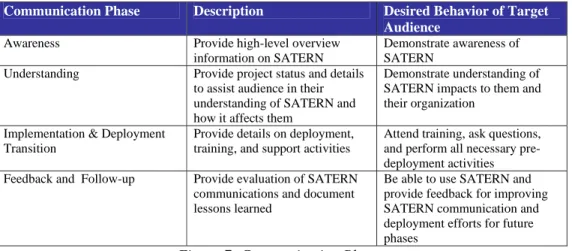
As outlined in the previous chart, messages to targeted audiences will change based upon phases of communication. Phases include: awareness, understanding, implementation, and feedback. As the implementation of the system approaches, stakeholders will require more detailed and targeted information.
Communication Phase Description Desired Behavior of Target
Audience
Awareness Provide high-level overview
information on SATERN
Demonstrate awareness of SATERN
Understanding Provide project status and details
to assist audience in their understanding of SATERN and how it affects them
Demonstrate understanding of SATERN impacts to them and their organization
Implementation & Deployment Transition
Provide details on deployment, training, and support activities
Attend training, ask questions, and perform all necessary pre-deployment activities Feedback and Follow-up Provide evaluation of SATERN
communications and document lessons learned
Be able to use SATERN and provide feedback for improving SATERN communication and deployment efforts for future phases
Figure 7: Communication Phases
E
VALUATION ANDF
EEDBACKFeedback received from the targeted audiences is just as important as the information going out to them. Feedback mechanisms can help NASA Centers measure the reach, impact, and overall effectiveness of the communications effort. Soliciting questions and comments through feedback measures signals sensitivity to the audiences’ concerns about the SATERN implementation and assures audiences that they are being heard.
Centers can adjust and improve communications activities based on audience and stakeholder feedback. In addition, continuous feedback from the audiences can provide insight into the effectiveness of the current communications vehicles and messages as well as valuable input into what should be addressed in future communications.
Feedback Channels
It is recommended that Centers establish an e-mail address for questions from learners and administrators regarding the SATERN system, and conduct face-to-face feedback sessions to allow for airing of concerns. When conducting feedback sessions, the following questions may be useful in assessing the effectiveness of completed or ongoing communications activities, and in soliciting suggestions for how to adjust and improve subsequent communications efforts.
• What communications have you received about SATERN?
• Was the information useful to you?
• Was the information given to you in a timely manner?
• Do you feel you received too much, too little, or enough information about SATERN?
• What additional information do you need to know?
• What changes would you like to see made to ensure effective communication about SATERN in the future?
NASA Centers can also use event-based mechanisms to gauge the effectiveness of specific communications vehicles. Examples include:
• Reply cards distributed at presentations and marketing fairs
• Evaluation forms provided at the end of information sessions
• Feedback links embedded into websites and e-mail messages
• Face-to-face focus groups or feedback workshops, to get a continuous understanding of communication needs and how to meet them
• Mini-surveys via email or telephone
Periodic assessments can also be useful to track progress and/or identify challenges. Examples of periodic feedback mechanisms include written surveys, personal interviews, and focus groups. The e-Training Agency Change Management team will implement these mechanisms on an Agency-wide basis as appropriate.
N
EXTS
TEPSUsing the information contained in this guide, Centers can build a communications plan that outlines the audience segment, vehicles and messages that will be implemented at the Center level. In summary, there are seven key steps to implementing Center
communications plan for SATERN:
; Establish Center communications goals ; Define any additional audience segments ; Create / modify core messages for each audience ; Select vehicles for each message and audience ; Identify timing for each message
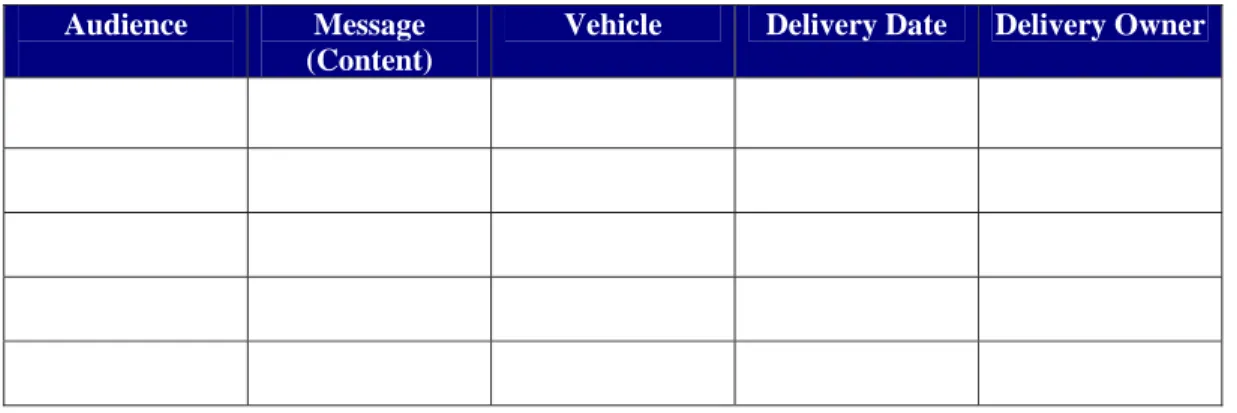
The matrix below is a sample template that can be used for Center planning.
Audience Message
(Content)
Vehicle Delivery Date Delivery Owner
Figure 8: Sample Template for Center Communications Planning
S
UPPORT FORC
OMMUNICATIONSThe e-Training Agency change management team is available to address questions on communications planning and to provide support and assistance to Center change management representatives in the creation of Center-level plans. Communications tools such as sample memos, articles and, Talking Points that can be tailored to each Center will be delivered to Center contacts to help facilitate implementation efforts.
Questions on this guide or requests for communications support should be directed to Yvette Robinson at 202-358-0327 or Gregory McHugh at 202-358-3974.