Power Quality Improvement in 3P4W System Using Unified Power Quality
Conditioner (UPQC) with P-Q Theory
Prasanthi M1, Firoz Ali Mohammad2, Ravi Kumar Reddy P3 1*Pursuing M.Tech in the field of Power & Industrial Drives 2*Working as, HOD in the EEE Department, NCET, Vijayawada, AP
3*Pursuing M.Tech in the field of Power & Industrial Drives
ABSTRACT:
Unified power quality conditioners (UPQCs) allow the mitigation of voltage and current disturbances that could affect sensitive electrical loads while compensating the load reactive power. Diverse control techniques have been proposed to evaluate the instantaneous output voltage of the series active power filter of the UPQC but, in most cases, these controllers only can compensate a kind of voltage disturbance. This paper presents a Unified Power Quality conditioner (UPQC) Design connected to three phase four wire system (3P4W). The neutral of series transformer used in the fourth wire for the 3P4W system. The neutral current that may flow toward transformer neutral point is compensated by using a four-leg voltage source inverter topology for shunt part. The series transformer neutral will be at virtual zero potential during all operating conditions. In this simulation we observe the power quality problems such as unbalanced voltage and current, harmonics by connecting non linear load to 3P4W system with Unified Power Quality conditioner. A new control strategy such as unit vector template is used to design the series APF to balance the unbalanced current present in the load currents by expanding the concept of single phase P-Q theory. The P-Q theory applied for balanced three phase system. And also be used for each phase of unbalanced system independently.
I.INTRODUCTION:
Unified power quality conditioners (UPQCs) consist of combined series and shunt active power filters (APFs) for simultaneous compensation of voltage and current disturbances and reactive power. They are applicable to power distribution systems, being connected at the point of common coupling (PCC) of loads that generate harmonic currents. Diverse topologies have been proposed in literature for UPQCs in single-phase configurations, i.e. two IGBT half bridges or multilevel topologies, but this paper focus on the commonly employed general. As can be seen, the power converters share a dc-bus and, depending
on their functionalities, employ an isolation transformer (series APF) or an inductance (shunt APF) as voltage or current links.
The series APF must compensate the source voltage disturbances, such as harmonics, dips or over-voltages, which might deteriorate the operation of the local load while the shunt APF attenuates the undesirable load current components (harmonic currents and the fundamental frequency component which contributes to the reactive load power). Moreover, the shunt APF must control the dc-bus voltage in order to ensure the compensation capability of the UPQC. These functionalities can be carried out by applying diverse control strategies which can operate in the time domain, in the frequency domain or both. Time domain methods, such as pq or dq based methods allow the fast compensation of time-variant disturbances but make more complex their selective compensation. In this sense, frequency domain methods are more flexible but their dynamical response is slower.
The power electronic devices due to their inherent nonlinearity draw harmonic and reactive power from the supply. In three phase systems, they could also cause unbalance and draw excessive neutral currents. The injected harmonics, reactive power burden, unbalance, and excessive neutral currents cause low system efficiency and poor power factor. The use of the sophisticated equipment/loads at transmission and distribution level has increased considerably in recent years due to the development in the semiconductor device technology. The equipment needs clean power in order to function properly. At the same time, the switching operation of these devices generates current harmonics resulting in a polluted distribution system.
and shunt (APF).They are two types of filters one is passive filters and another one is active filters. In passive filters they are using L and C components are connected. By connecting passive filters the system is simplicity and cost is very low. And so many disadvantages is there, that is resonance problems and filter for every frequency and bucky. That’s we are choosing the active filters. By using active filters the power converter circuit Using active components Like IGBTs, MOSFETs, etc., and energy storage device (L or C).The advantages are filtering for a range of frequencies and no resonance problems and fast response.
But only very few disadvantages are there that is cost is high. By connecting series active filters the voltage harmonic compensation, high impedance path to harmonic currents these are the main functions. All these non-linear loads draw highly distorted currents from the utility system, with their third harmonics component almost as large as the fundamental. The increasing use of non-linear loads, accompanied by an increase in associated problems concerns both electrical utilities and utility customer alike.
II. EXISTING SYSTEM:
The power electronic devices due to their inherent nonlinearity draw harmonic and reactive power from the supply. In three phase systems, they could also cause unbalance and Draw excessive neutral currents. The injected harmonics, reactive power burden, unbalance, and excessive neutral currents cause low system efficiency and poor power factor. To improve the power quality we use filters. They are two types of filters one is passive filters and another one is active filters. In passive filters they are using L and C components are connected. By connecting passive filters the system is simplicity and cost is very low. And so many disadvantages is there, that is resonance problems and filter for every frequency and bucky.
In this project presents a Design of a Unified Power Quality conditioner (UPQC) connected to three phase four wire system (3P4W). That’s we are choosing the active filters. By using active filters the power converter circuit using active components like IGBTs, MOSFETs, etc., and energy storage device (L or C).The advantages are filtering for a range of frequencies and no resonance problems and fast response. But only very few disadvantages is there that is cost is high. By connecting series active filters the voltage harmonic compensation, high impedance path to harmonic currents these are the main functions. All these non-linear loads draw highly distorted currents from the utility system, with
their third harmonics component almost as large as the fundamental.
III.PROPOSED UPQC SYSTEM:
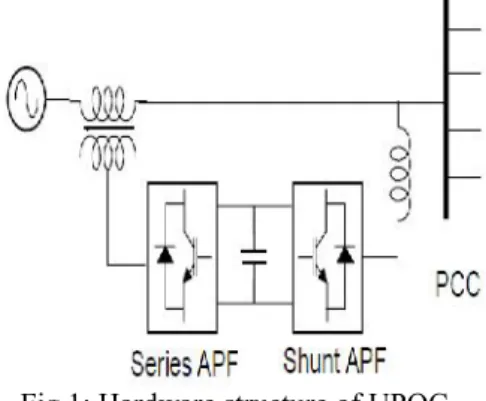
1. Unified Power Quality Conditioner: Unified power quality conditioners (UPQCs) consist of combined series and shunt active power filters (APFs) for simultaneous compensation of voltage and current disturbances and reactive power. They are applicable to power distribution systems, being connected at the point of common coupling (PCC) of loads that generate harmonic currents. Diverse topologies has been proposed in literature for UPQCs in single-phase configurations, i.e. two IGBT half bridges or multilevel topologies, but this paper focus on the commonly employed general structure depicted in figure 1. As can be seen, the power converters share a dc-bus and, depending on their functionalities, employ an isolation transformer (series APF) or an inductance (shunt APF) as voltage or current links.
The series APF must compensate the source voltage disturbances, such as harmonics, dips or over-voltages, which might deteriorate the operation of the local load while the shunt APF attenuates the undesirable load current components (harmonic currents and the fundamental frequency component which contributes to the reactive load power). Moreover, the shunt APF must control the dc-bus voltage in order to ensure the compensation capability of the UPQC. These functionalities can be carried out by applying diverse control strategies which can operate in the time domain, in the frequency domain or both. Time domain methods, such as pq or dq based methods, allow the fast compensation of time-variant disturbances but make more complex their selective compensation. In this sense, frequency domain methods are more flexible but their dynamical response is slower.
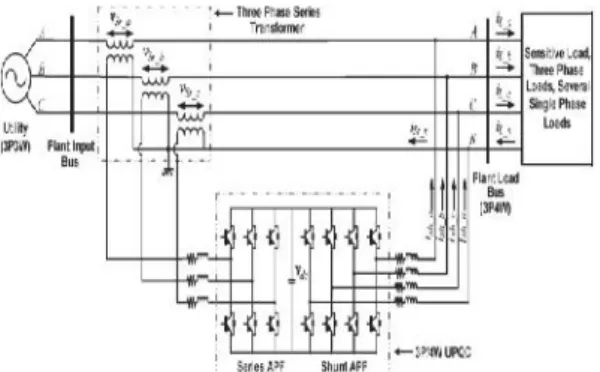
station.Fig.2 shows the 3P3W system is connected to UPQC maintaining the Integrity of the specifications.
Figure 2: 3P3W System is connected to UPQC If we want to upgrade the system now from 3P3W to 3P4W due to installation of some single-phase loads and if the distribution transformer is close to the plant under consideration, utility would provide the neutral conductor from this transformer without major cost involvement. In recent cases, this may be a costly solution because the distribution transformer may not be situated in close vicinity. Recently, the utility service providers are putting more and more restrictions on current total harmonic distortion (THD) limits, drawn by nonlinear loads, to control the power distribution system harmonics pollution. At the same time, the use of sophisticated equipment or load has increases significantly, and it needs clean power for its proper operation. A
Figure 3: 3P4W System is connected to UPQC In addition to easy expansion of 3P3W system to 3P4W system is shown in figure 3. As shown in Figure.2 the UPQC should necessarily consist of three-phase series transformer in order to connect one of the inverters in the series with the line to function as a controlled voltage source. If we could use the neutral of three-phase series transformer to connect a neutral wire to realize the 3P4W system, then 3P4W system can easily be achieved from a 3P3W system (figure.2).The
neutral current, present if any ,would flow through this fourth wire toward transformer neutral point. This neutral current can be compensated by using a split capacitor topology or a four leg voltage source inverter (VSI) topology for a shunt inverter. The four-leg VSI topology requires one additional leg as compared to the split capacitor topology.VSI structure is much easier than that of the split capacitor.
But here the UPQC design by using P-Q theory and it is connected to 3P4W system. Thus, the structure would help to realize a 3P4W system at distribution load end. This would eventually result in easy expansion from 3P3W to 3P4W systems. A new control strategy to generate balanced reference source currents under load condition is also proposed in this paper and also UPQC design by using P-Q theory is also explained in the next section.
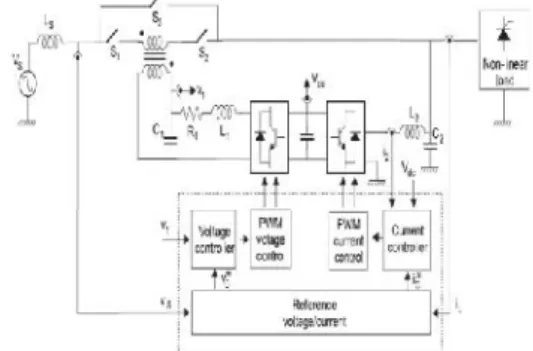
3. Functional structure of UPQC: The basic functionalities of a UPQC controller are depicted in figure 4. The voltage compensation (vC∗) and current injection (iC∗) reference signals, required for compensation purposes, are evaluated from the instantaneous measurements of the source voltage (vS), the dc-bus voltage (vdc) and the load current (iL). These reference signals are compared to the measured feedback signals v1 and i2 and applied to the decoupled voltage and current controllers, which ensure that the compensation signals correspond to the reference ones. The gate signals of the power converters are obtained by applying pulse width modulators to the controller outputs. The power converters switch at high frequency generating a PWM output voltage waveform which must be low-pass filtered (L1, R1 and C1 in case of series APF and L2 y C2 for the shunt APF). Switches S1, S2 and S3 control the compensation status of the UPQC.
compensation, both in harmonic order and harmonic magnitude. Different approaches have been proposed for current control of grid-connected voltage source converters. Hysteresis controllers are implemented by means of simple analog circuits but, as drawback, the spectrum of the output current is not localized, which complicates the output filter design.
PI controllers have been widely applied but, due to their finite gain at the fundamental grid frequency, they can introduce steady state errors. This can be solved by means of generalized integrators. Fuzzy logic and artificial neural networks (ANN) has been also proposed as current controllers in case of multiple harmonic.
Fig 4: General structure of UPQC controller 4. Description of Implementation of Series APF:In series APF the Inverter injects a voltage in series with the line which feeds the polluting load through a transformer. The injected voltage will be mostly harmonic with a small amount of sinusoidal component which is in-phase with the current flowing in the line. The small sinusoidal in-phase (with line current ) component in the injected voltage results in the right amount of active power flow into the Inverter to compensate for the losses within the Series APF and to maintain the D.C side capacitor voltage constant. Obviously the D.C voltage control loop will decide the amount of this in-phase component. Series active power filter compensate current system distortion caused by non-linear load by imposing a high impedance path to the harmonic current. The line diagram of series active power filter is shown in below figure.5.
Fig 5: Line diagram of series active power filter 5. Description of Implementation of Shunt APF: The active filter concept uses power
electronics to produce harmonic current components that cancel the Harmonic current components that cancel the harmonic current components from the non- linear loads. The active filter uses Power electronic switching to generate harmonic currents that cancel the harmonic currents from a non-linear load. In this configuration, the filter is connected in parallel with the load being compensated .Therefore the configuration is often referred to as an active parallel or shunt filter.
Fig 6: Shunt Active power filter
Fig.6 illustrates the concept of the harmonic current cancellation; so that the current being supplied from the source is sinusoidal. The voltage source inverter used in the active filter makes the harmonic control possible. This inverter uses dc capacitors as the supply and can switch at a high frequency to generate a signal that will cancel the harmonics from the non-linear load. The control algorithm for series APF is based on unit vector template generation scheme. Whereas the control strategy for shunt APF is discussed in this section. Based on the load on the 3P4W system, the current drawn from the utility can be unbalanced. In this paper, the concept of single phase P-Q theory. According to this theory, a single phase system can be defined as a pseudo two-phase system by giving /2 lead or /2 lag that is each phase voltage and current of the original three phase systems. These resultant two phase systems can be represented in -coordinates, and thus P-Q theory applied for balanced three phase system can also be used for each phase of unbalanced system independently.
Where represents the reference load voltage and VLm represents the desired load voltage magnitude. Similarly, for phase b, the load voltage in - coordinates can be represented by
/2 lead as
In addition, for phase c, the load voltage in -coordinates can be represented by /2 lead as
By using the definition of three-phase system, the instantaneous power components can be represented as
Instantaneous active power,
Instantaneous reactive power,
Considering phase a, the phase instantaneous load active and instantaneous load reactive powers can be represented by
Where,
In (10) PLa and qLa(11), and represent the dc
components that are responsible for fundamental load active and reactive powers, whereas ̇ and
̇ represent the ac components that are responsible for harmonic powers. The fundamental instantaneous load active and reactive power components can be extracted from PLa and qLarespectively, by using low pass filter
(LPF). Therefore, the instantaneous fundamental load active power for phase‘a’is given by
And the instantaneous fundamental load reactive power for phase a is given by
The instantaneous fundamental load active power for phase b is given by
The instantaneous fundamental load reactive power for phase b is given by
The instantaneous fundamental load active power for phase c is given by
The instantaneous fundamental load reactive power for phase c is given by
The aforementioned task can be achieved by summing instantaneous fundamental load active power demands of all the three phases and redistributing it again on each utility phase from (12), (14), (16)
Thus, the reference compensating currents are representing a perfectly balanced 3-phase system can be extracted by taking the inverse of (9)
In (20),
P
dc/P
h is the precise amount ofper-phase active power that should be taken from the source in order to maintain the dc-link voltage at a constant level and to overcome the losses associated with UPQC. Therefore, the reference source current for phase a, b and c can be estimated as
The reference neutral current signal can be extracted by simply adding all the sensed load currents, without actual neutral current sensing, as
By using above equations to design the both series and shunt active power filters by connecting the 3P4W system as shown in next section.
V. SIMULATION RESULTS:
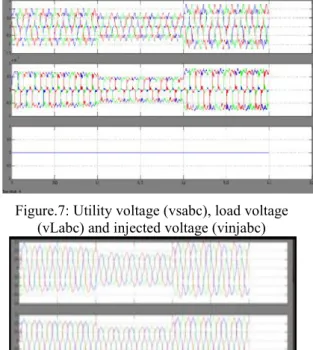
Figure.7: Utility voltage (vsabc), load voltage (vLabc) and injected voltage (vinjabc)
Figure.8: Source current (isabc), load current (iLabc) and shunt compensating current (iShabc)
Fig 9: Dc-link voltage (vdc), and neutral current flowing towards series transformer (iSr_n)
Utility voltages are assumed to be distorted with voltage THD of 27.0 %.The distorted voltage profile is shown in figure 7 in utility voltage. The resulting load current profile shown in figure.8 has THD of 12.10%. The UPQC should maintain the voltage at load bus at a desired value and free from distortion.
VI. CONCLUSION:
The design of a unified power quality conditioner (UPQC) connected to 3p4w distribution system has been presented in this paper. Where upqc is installed to compensate the
different power quality problems, which may play an important role in future upqc- based distribution system. The simulation results shows that the distorted and unbalanced load currents seen from the utility side act as perfectly balanced source currents and are free from distortion. Here we can absorb the power quality problems like voltage and current unbalanced and reduced the total harmonic distortion (THD) of 3P4W system utilizing 3p3w system to connect the UPQC. APPLICATIONS:
Used in
Distribution systems,
And Transmission systems. ADVANTAGES:
It compensate
Supply voltage
Flicker/imbalance,
Reactive power,
Negative sequence current,
And Harmonics.
VII. REFERENCES:
[1] Vinod khadkikar, Ambrish Chandra, “A novel structure for three phase four-wire distribution system utilizing unified power quality conditioner(UPQC),” IEEE Transaction on industry application ,Vol.45,no.5,pp.1897-1902,Sep/oct.2009.
[2] B. Singh, K. Al-Haddad, and A. Chandra, “A review of active power filters for power quality improvement,” IEEE Trans. Ind. Electron., vol. 45, no. 5, pp. 960–971, Oct. 1999.
[3] Y.Komatsu and T.Kawabata, “A Control method of active power filter in unsymmetrical and distorted voltage system,” in proc.Conf.IEEE Power Convers. 1997, vol.1, pp.161-168.
[4] C. A. Quinn and N. Mohan, “Active filtering of harmonic currents in three-phase, four- wire systems with three-phase and singlephase nonlinear loads,” in Proc. 7th IEEE APEC, 1992, pp. 829– 836.
[5] M.Aredes, K.Heumann, and E.h.Watanabe, “An universal active power line conditioner,” IEEE Trans. power Del., vol.13, no.2, pp.542-551,Apri.1998.
[6] R. Faranda and I. Valade, “UPQC compensation strategy and design aimed at reducing losses,” in Proc. IEEE ISIE, 2002, vol. 4, pp. 1264–1270.
conditioner without references calculation,” in Proc. 19th IEEE APEC, 2004, vol. 1, pp. 829– 836.
[8] V.Khadkikar, A. Chandra, A.O.Barry, and T.D.Nguyen, “Application of UPQC to protect a sensitive load on a polluted 2012 International Conference on Computer Communication and Informatics (ICCCI -2012), Jan. 10 – 12, 2012, Coimbatore, INDIA distribution network,” in proc.IEEE PES General Meeting. Montreal, QC, Canada, 2006, 6 pp.
[9] M. T. Haque, “Single-phase PQ theory,” in Proc. 33rd IEEE PESC, 2002, vol. 4, pp. 1815– 1820.
[10] J.M.Correa ,S.Chakraborty,M.G.Simoes,and F.A.Farret, “A single phase high frequency AC micro grid with an unified power quality conditioner,” in Conf.Rec.38th IEEE IAS Annu. Meeting, 2003, vol.2, pp.956-962.
[11] H.Akagi, Y.kanazawa, and A. Nabae, “Instantaneous reactive power compensators comparing switching devices without energy storage components,” IEEE Trans. Ind.Appl., vol IA- 20,no.3,pp.625-630,may/Jun.1984.
[12] L.H.Tey,P.L.So and Y.C.Chu,“Unified power quality conditioner for improving power quality using ANN with Hysterisis control,” IEEE Tran. Power Electronics,vol.9,no.3,may 1994,pp.1441-1446
[13] Moleykutty George,karthik Prasad Basu, “ Three-phase Shunt active power fliter” American journal of applied sciences,5(8):909- 916,2008.
VIII. AUTHOR PROFILE:
1*PRASANTHI M pursuing M.Tech in Nimra College of Engineering and Technology, Vijayawada. His specialization is Power & Industrial Drives. He graduated in Electrical and Electronics Engineering from JNTU Hyderabad. His research interest includes Power Electronic Converters and drives.
2*FIROZ ALI MOHAMMEDhe is presently working as HOD in the department of EEE at Nimra college of Engineering and Technology, Vijayawada, Andhra Pradesh, India. He received B.Tech degree in EEE from JNTU in 2003 and M.Tech in Power Electronics and Industrial drives (PE&ID) from Satyabama University in 2005 respectively. His research interests include Power Electronics and Electrical Machines.