Collaborative Hierarchical Caching with Dynamic
Request Routing for Massive Content Distribution
Jie Dai
†, Zhan Hu
†, Bo Li
†, Jiangchuan Liu
‡, Baochun Li
§ †Hong Kong University of Science and Technology
‡
Simon Fraser University,
§University of Toronto
Abstract—Massive content delivery in metropolitan networks
has recently gained much attention with the successful deploy-ment of commercial systems and an increasing user popularity. With an enormous volume of content available in the network, as well as the growing size of content owing to the popularity of high-definition video, the exploration of capacity in the caching network becomes a critical issue in providing guaranteed service. Yet, collaboration strategies among cache servers in emerging scenarios, such as IPTV services, are still not well understood so far. In this paper, we propose an efficient collaborative caching mechanism based on the topology derived from a real-world IPTV system, with a particular focus on exploring the capacity of the existing system infrastructure. We observe that collaboration among servers is largely affected by the topology characteris-tics and heterogeneous capacities of the network. Meanwhile, dynamic request routing within the caching network is strongly coupled with content placement decisions when designing the mechanism. Our proposed mechanism is implemented in a dis-tributed manner, and is amenable to practical deployment. Our simulation results demonstrate the effectiveness of our proposed mechanism, as compared to conventional cache cooperation with static routing schemes.
I. INTRODUCTION
The delivery of large volumes of content — such as high-definition videos and operating system software updates — is becoming a daily routine over the Internet, mostly provided by content service providers. For example, Netflix now accounts for around30%of peak downstream traffic in US with its rapid growth of online video subscribers. Operating system releases, such as Ubuntu 11.04, have also relied on the public Internet using mirror servers deployed worldwide [1]. Furthermore, more cloud-oriented applications require massive amounts of content to be delivered between service providers and end users.
Such explosively increasing demand has posed significant challenges to network infrastructure providers, who promise quality of service to users. On one hand, the large amount of available content consumes a huge amount of storage resources if such content is replicated at service providers. On the other hand, the delivery of massive content may also overwhelm link capacities, raising the issue of balancing the tradeoff between network infrastructure investments and quality of service guarantees. As such, a critical challenge now is to
†The research was supported in part by a grant from NSFC/RGC under
the contract N HKUST610/11, by grants from HKUST under contracts RPC11EG29, SRFI11EG17-C and SBI09/10.EG01-C, by a grant from Huawei Technologies Co. Ltd. under the contract HUAW18-15L0181011/PN, by a grant from Guangdong Bureau of Science and Technology under the contract GDST11EG06.
best utilize existing network infrastructures to better support future demand for massive content delivery.
It is well known that the network infrastructure at a service provider is, in general, a caching network, in which multiple cache servers are deployed at different locations. Servers are connected in a certain topology, and cooperate to resolve requests sent from clients. More specifically, cache servers collaboratively make storage decisions and route content re-quests inside the cache hierarchy. This requires a carefully designed placement strategy for cached content, along with a specific request routing mechanism. In a conventional caching network that supports web content delivery, the perceived service quality can be improved with collaborative caching by minimizing the end-to-end latency of data packets. However, the problem becomes even more challenging when the col-laborative caching mechanism is used to aid massive content delivery.
Despite a large amount of deployed commercial systems and modelling research on traditional hierarchical caching networks, there exists few works in the literature that address challenges with collaborative caching when massive content delivery is considered, especially with implications from real-world systems. In this paper, we investigate the capacity provisioning problem in hierarchical caching networks, based on a real-world IPTV system. Our caching network topology has been obtained from a commercial deployment of China Telecom Guangzhou [2], which provides IPTV service to millions of users in a metropolitan network. According to our observations, the overall topology is similar to a hierarchical structure that is widely applied in web caching systems [3]. However, the collaborative caching problem that we address in this paper exhibits a number of different features. Existing works that investigate cache hierarchies have mainly assumed static content request routing mechanisms. Requests are simply forwarded to the upper-layer parent server when the content is not locally available. Such fixed routing paths have simplified the problem of finding the optimal content placement inside the network. In contrast, in this paper, we point out that in order to maximize the potential for cache cooperation in the existing infrastructure, dynamic request routing needs to be designed jointly with content placement strategies in a tightly coupled fashion.
Another important feature that distinguishes our work from similar problems is the large amount of bandwidth that is consumed as massive contents are delivered [4]. The link capacity is rarely the bottleneck for web cache servers [5].
Thus, the methods applied in web systems usually define the optimization objectives using the notion of “cost,” which is derived from the estimation of distance between requests and cache servers. However, it is necessary to consider the impact of hard bandwidth constraints for links in our target system. In this sense, a dynamic request routing scheme also helps to avoid the over-utilization of links in the cache hierarchy. Comparatively speaking, our study tries to optimize the maxi-mum amount of supported requests while emphasizing the link capacity constraint, which is a practical concern in real-world IPTV systems.
In this paper, we take advantage of insights from a real-world topology to derive an efficient collaborative caching mechanism. Based on heterogeneous request patterns at dif-ferent locations of the system and asymmetric settings of cache capacities, we design our strategic content placement strategy and the corresponding request routing rules. More specifically, we decompose these two problems into different layers of cooperation, so that practical distributed algorithms can be achieved. Our simulation results show that excellent performance can be achieved with the proposed mechanism, compared to conventional cache cooperation with static rout-ing.
The remainder of the paper is organized as follows. In Sec. II, we discuss our contribution with comparisons to related works. In Sec. III, we present characteristics of our real-world system, along with a description of our problems at hand. Sec. IV introduces the cache cooperation framework and the corresponding caching strategies. Sec. V evaluates the performance of the proposed caching mechanisms. Finally, we conclude the paper in Sec. VI.
II. RELATEDWORK
The cooperation of cache servers in hierarchical caching networks has long been investigated in web caching sys-tems. Wolman et al. [5] evaluated the potential advantages and drawbacks of inter-proxy cooperation in a large-scale Web environment. The analysis is conducted on a tree-like cache hierarchy through extensive measurements. Korupolu
et al. [3] considered a cache content placement problem in
a hierarchical network environment. They provided approx-imation algorithms that minimize the average access cost measured by the hop count. Rodriguez et al. [6] proposed a caching architecture in hierarchical web caching systems where leaf nodes connected to the same parent node can cooperate together. Similar cache content placement strategies, proposed in [7]–[9], that formulated the problem with the objective of minimizing average object access costs, which is affected by the distance between the source of requests and the closest server with the requested content. Our work differs in its focus on massive content delivery, that consumes large amounts of link bandwidth in the network infrastructure. As a result, our work consists of different problem constraints and optimization objectives.
Request routing policies have also been discussed in the context of Content Delivery Network (CDN). Wang et al. [10]
explored strategies to redirect requests in CDNs that aimed to achieve load balancing and traffic locality. Laoutaris et
al. [11] introduced the cache inference problem that infers
the characteristics of caching agents. The design is used in the decision of forwarding missed streams to available proxy caches. Betkas et al. [12] discussed joint content placement and the request routing strategies. However, request routing in these studies generally represents server selection strategies in CDNs. In contrast, our work focuses on a real-world system infrastructure that provides specific link-level routing schemes. With dynamic request routing, we maximize the potential of capacity provisioning in the network, combined with concerns on strategic cache content placement.
Cache content placement in IPTV systems has recently drawn attention in several studies. Borst et al. [13] developed cooperative cache management algorithms that aimed to min-imize bandwidth costs. The work is based on the assumption that the bandwidth cost is positively correlated to the packet hop count. However, there was a lack of discussions on content redirection mechanisms. Compared to their works, we in-clude more specific cooperation mechanisms by exploring the three-level cache hierarchy with our proposed request routing scheme. Moreover, we consider heterogenous settings of user demands and link capacities. Applegate et al. [14] formulated collaborative caching as a global optimization problem, which can take hours to be solved. Compared to their works, we propose a lightweight collaborative caching mechanism that is specifically designed for cache cooperation in practical deployments, taking advantage of specific characteristics of the cache topology.
III. COLLABORATIVECACHINGMECHANISM In this section, we first analyze the potential of cache collaboration by presenting basic properties of the system topology, and then propose our challenges and a practical decomposition of our problem.
A. Hierarchical Cache Topologies
jj' ji
ii' 0i
ij
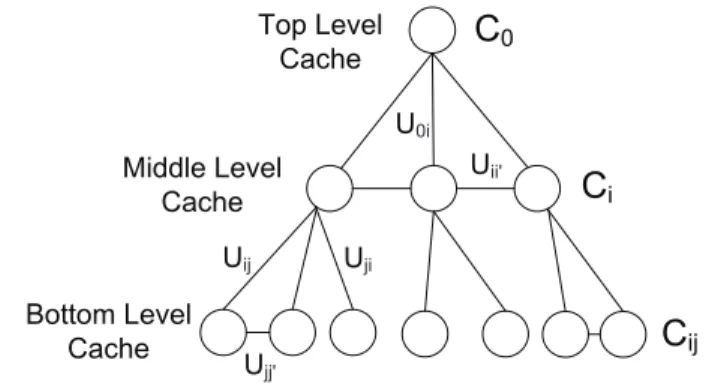
Fig. 1. The topology of a hierarchical caching network.
Hierarchical topologies have been applied in many existing systems that provide public IPTV or massive content delivery services. Fig. 1 represents a typical three-level cache topology
derived from a real-world IPTV system deployed by China Telecom in Guangzhou. As indicated by Fig. 1, we can categorize the set of cache servers into three groups, located at the top level, middle level, and bottom level, and represented by {C0, Ci, Cij}, respectively. Middle level serversCi, each
with the storage capacity Bi, denotes the ith child of a top
level serverC0. A cache serverCij, with its storage capacity
Bij, indicates thejth child of cache server Ci.
Each content request, issued by clients, attempts to access a certain contentk∈K, with its content sizesk. The content
can be considered as video segments in IPTV systems or file blocks in file downloading systems. The storage decision
Xk = {0,1} is used to denote whether or not content
k is placed at the cache server. Content requests are first directed to the corresponding bottom level server Cij based
on the location of requests. After receiving requests, Cij
either returns the corresponding contents if they are locally available, or routes requests to other cache servers in the hierarchy if contents are unavailable. Content requests are possibly routed to directly-connected bottom level servers or the parent server Ci. Similar actions are taken at the middle
level server that either returns the corresponding content, or routes them to other cache servers through dynamic request routing. Requests can be directed to other sibling nodes ofCij
to satisfy the downstream content requests, or to neighboring servers at the middle level. A “last resort” option is to route requests to the top level serverC0, which is the source content server that stores all available contents in the entire network. Content requests will eventually be served or rejected given the constraints on content availability and link capacities.
The links that connect different cache servers in the hierar-chy have heterogenous capacities. The link capacity between a pair of nodes at the bottom level is represented byUjj′. The capacity of the link from the bottom level server to the middle level server is denoted byUji. The reverse direction from the
middle to the bottom level has a link capacity Uij, which
is considered to be sufficiently large in the system. The link capacity between a pair of nodes at the middle level is Uii′.
Finally, The link capacity from the source server to middle level servers is indicated by U0i.
B. Problem Definition and Decomposition
The problem we investigate in this paper is a joint problem of cache content placement and a corresponding dynamic request routing scheme. Storage and routing decisions are made based on user request patterns, heterogenous cache sizes, link capacities and the specific system topology. Our objective is to explore the capacity of the existing system infrastructure by maximizing the amount of supported requests.
Intuitively, shorter paths of data packets result in less traffic in the network backbone. To maximize the amount of supported requests, it is more favourable to replicate popular contents at each of the bottom level servers. However, this strategy is questionable when we introduce the cooperation among cache nodes through dynamic request routing in the cache hierarchy. Moreover, the problem becomes even more
complicated when we consider the bandwidth consumed dur-ing the delivery of massive contents in IPTV or file download-ing systems, which is especially important when we deal with heterogeneous link capacities and user demands in real-world systems. It has been shown in previous work [15] that the content placement problem in the cache hierarchy is NP-hard even without considering dynamic routing schemes and link capacity constraints.
To address this challenge, we propose an appropriate de-composition of the problem to find an efficient yet practical solution. Based on the topology derived from the system, we divide the original problem into sub-problems that focus on the cooperation in different cache levels. We first discuss the cooperation among interconnected servers at the bottom level. This is derived from the practical scenario where bottom level servers co-located in the same location are connected by high capacity links. The cooperation among bottom level servers connected via the middle level cache will then be investigated. Such a form of cooperation is achieved through the unique downstream content retrieval with dynamic routing decisions. The third step involves the cooperation among middle level cache servers. Content requests received at the middle level can be directed to appropriate neighboring servers through the proposed mechanism. We will derive practical content placement and dynamic request routing schemes in subsequent discussions.
IV. CACHECONTENTPLACEMENT AND REQUESTROUTING
In this section, we present our mathematical model that aim to address all the aforementioned challenges. Each level of cache cooperation is analyzed with the topological properties, and the corresponding collaborative caching scheme is also proposed.
A. Direct Bottom Level Cooperation
We define the average arrival rate of content requests at bottom level server Cij as λij. The proportion of requests
that attempt to access content k is represented by pk, and
we assume that such a distribution pattern is uniform for all fully connected servers co-located in the same location. For convenience, a request to content k is said to be a
type-k request. Thus the rate of type-k requests at server Cij is
represented by λk
ij =λijpk. Combined with concerns on the
segment size, we treatλk
ijsk as the bandwidth requirement of
type-krequests in one time unit.
As denoted by Fig. 2, fully interconnected cache servers at the bottom level are able to disseminate contents via direct links. In the deployed system that we observe, these servers are usually placed in the same equipment room while inter-connecting links are typically with high bandwidth capacities. We then investigate the sub-problem that aims to maximize the amount of supported traffic at this level by utilizing the capacity of direct links. We useJ ={j, j′, j′′...} to represent the interconnected cache set{Cij, Cij′, Cij′′...}. The notation
yk
jj′ is used to represent the fraction of type-k requests atCij
being directed to Cij′, which actually indicates the routing strategy of interconnected cache servers at the bottom level. We then formulate the supported traffic maximization problem as: Maximize X j∈J X j′∈J X k∈K λk ijskyjjk′+ X j∈J X k∈K λk ijskXijk Subject to: X k∈K skXijk ≤Bij ∀j∈J X k∈K λk ijskykjj′ ≤Ujj′ ∀j, j′∈J Xijk + X j′∈J yjjk′ ≤1 ∀j∈J, k∈K 0≤yk jj′ ≤X k ij′ ∀j, j′∈J, k∈K Xijk ={0,1} ∀j∈J, k∈K (1) Constraints in problem (1) include the storage capacity constraint, the link capacity constraint, and the relation be-tween content storage and the request forwarding decision. It is always optimal to serve a request by the first en-countered server with the requested content. Thus, we have
Xk ij+
P
j′∈Jy k
jj′ ≤1. This guarantees that the request will not be directed to other servers if the content is locally available. Without loss of generality, we assume that the link capacity
Ujj′ is consistently larger than Pk∈Kλkijsk, ∀j ∈ J. The
assumption is practical based on our observations in the real-world system. This leads to the following theorem, which is used in cache cooperation of interconnected bottom level servers.
Theorem 1: GivenP
j∈JBij≤Pk∈Ksk, for any content
k such thatXk
ij= 1, we have Xijk′ = 0,∀j′6=j.
Proof: Suppose in the optimal solution of problem (1),
we haveXk
ij =Xijk′ = 1andj6=j′. With the assumption that
Ujj′ ≥ Pk∈Kλkijsk, the constraint Pk∈Kλkijskyjjk′ ≤Ujj′ can be removed from the problem. We change the value of
Xk
ij′ to 0 and the corresponding value of yjk′j to 1, which
generates an assignment no worse than the optimal solution. Given P
j∈JBij ≤Pk∈Ksk, we set the value of Xk
′
ij′ from
0 to 1 for certain content k′ such that Xk′
ij = 0 ∀j ∈ J.
The routing decision is made as yk′
jj′ = 1 ∀j 6= j′, which yields an assignment that surpasses the optimal solution with P
j∈Jλ k′
ijsk′. This is a contradiction.
Theorem 1 suggests that all duplicated contents in the
interconnected server set need to be removed and replaced by other unavailable contents. Moreover, all directly connected servers can be treated as one single server with aggregated incoming requests, storage capacities and bandwidth capacities in subsequent steps of our analysis. There is no need to consider the strategic placement of contents with such a combination, since the traffic can be easily routed through direct links at the bottom level.
B. Indirect Bottom Level Cooperation
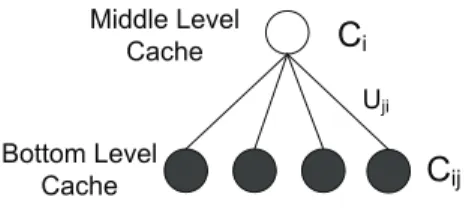
Fig. 3. Indirect Bottom Level Cooperation.
If the content is available at the bottom level, the request could be immediately served by the attached cache server or the interconnected server set. When the request is not fulfilled, it will then be routed to the corresponding upper level server. To maximize the overall amount of supported requests, we now proceed to explore the potential of indirect cache cooperation among bottom level servers as shown in Fig. 3. The main idea is to achieve downstream content retrieval through a path of the tree rooted at the parent middle level server. There exists a number of challenges in finding appropriate caching mechanisms in this form of cooperation. First, cache servers are not placed in the same place as compared to the interconnected server set at the bottom level. Therefore, user demands received by cache servers are also heterogeneous, which can be represented by different access patterns pk
ij.
In addition, the caching decision becomes more complicated owing to the bandwidth capacity constraints Uji and the
storage capacity constraintsBij, which are usually asymmetric
in practical systems.
In this step, we use J = {j, j′, j′′...} to represent the child server set of Ci as {Cij, Cij′, Cij′′...}. These child servers are connected via the middle level server Ci. Since
content delivery among nodes are sharing uplinks of bottom level servers, it would be challenging to keep track of the status of the pairwise content delivery. We instead define the proportion of the uplink ofCij that is dedicated to serve
type-krequests asqk
ij. The request routing decision is then made at
Ci based on the value ofqkij. For the bottom level cache Cij,
the total traffic handled locally is given by P
k∈KX k ijskλkij,
in which λk
ij = λijpkij. The amount of requests supported
by other bottom level servers constitutes another part of the optimization objective. We then formulate the indirect bottom level cooperation problem as:
Maximize X j∈J X k∈K qk ijUji+ X j∈J X k∈K λk ijskXijk (2) Subject to: X k∈K skXijk ≤Bij ∀j∈J (3) X j∈J qk ijUji≤ X j∈J λk ijsk(1−Xijk) ∀k∈K (4) X k∈K qk ij ≤1 ∀j∈J (5) 0≤qijk ≤X k ij ∀j∈J, k∈K (6) Xk ij ={0,1} ∀j∈J, k∈K (7)
To achieve a distributed solution with heterogeneous set-tings of input parameters, a conventional method is to apply Lagrangian relaxation. Constraints (4) and (6) can be incorpo-rated into the objective function by associating a Lagrangian multiplier with each constraint.ηkis associated with constraint
(4) and γk
ij is associated with constraint (6). Then the
La-grangian dual problem is represented as: Minimize L(ηk, γijk)
Subject to: ηk ≥0, γijk ≥0
(8) The objective functionL(ηk, γijk)in the dual problem is:
L(ηk, γijk) = maxX j∈J X k∈K (Uji−ηkUji−γijk)qkij +X j∈J X k∈K (ηkλkijsk+ (γkij+ (1−ηk)λkijsk)Xijk)
The Lagrangian subproblem can then be decomposed into |J| storage allocation problems and |J| link allocation prob-lems. Both storage and link allocation problems can be solved in a distributed manner at each bottom level cache server. The Lagrangian multipliers are then updated at each iteration with the coordination of the middle level server Ci, in order to
find the optimal solution through the subgradient algorithm. However, our simulation studies show that our algorithm above requires a long time to converge, especially when there exists a large number of objects. Inspired by the Lagrangian relaxation method, we propose a heuristic algorithm by limiting the decision of qk
ij at each iteration. The proposed algorithm
can achieve much faster convergence with a near-optimal performance.
We decompose the Lagrangian multiplier ηk into
coeffi-cients ηk
ij to achieve a finer granularity in controlling the
storage and bandwidth allocation decisions at each iteration.
ηk
ij reflects the interest of storing a particular content and the
willingness of sharing stored content. We then omitγk
ijand put
constraint (6) into the optimization problem. At each iteration
t, cache serverCij first solves the storage allocation problem
as the following: Maximize X k∈K (1−ηk ij)λ k ijskXijk Subject to: X k∈K skXijk ≤Bij Xijk ={0,1} ∀k∈K (9)
In a practical system setting, contents can be divided into segments with equal sizes for convenience. Therefore, the optimal solution of the storage allocation problem is given as: Xk ij(t) = ( 1, fork∈[1, z); 0, fork∈[z,|K|] (10)
In solution (10), the content set K is sorted in descending order by the critical index (1−ηk
ij)λkij, and z = min{h :
Ph
k=1sk > Bij}. Given the storage decision at each bottom
level server, the middle level server Ci acts as a master node
to collect the temporal information from Cij. It calculates
the content demand Qk(t) for k at the current iteration as
the following, which will then be distributed to bottom level servers:
Qk(t) =
X
j∈J
λkijsk(1−Xijk(t)) ∀k∈K (11)
Then each cache serverCij solves the bandwidth allocation
problem individually such that:
Maximize X k∈K (Uji−ηkijUji)qkij Subject to: X k∈K qk ij≤1 qk ijUji≤Qk(t) ∀k∈K 0≤qkij≤X k ij(t) ∀k∈K (12)
The optimal bandwidth allocation in the collaboration can be achieved as: qkij(t) = Qk(t) Uji for k∈[1, z)andX k ij(t) = 1; Uji−Pzk−=11Qk(t) Uji for k=z; 0 for k∈(z,|K|] orXk ij(t) = 0 (13) In solution (13), the content set K is sorted in descending order by the critical index (1 −ηk
ij), and z = min{h :
Ph
k=1Qk(t)Xijk(t)> Uji}.
The parent cache serverCiis then responsible for gathering
temporal results from bottom level servers and updating the value ofηk
ij for the next iteration:
ηk ij(t+1) =η k ij(t)+θ(t)( X j∈J qk ij(t)Uji−Qk(t))∗f( X k∈K qk ij(t)) (14)
The insufficient provisioning of bandwidth in the collabo-ration for certain contentkleads to a decreasing value ofηk
ij,
which then inspires servers to store and share the correspond-ing content. The function f() is positively correlated to the remaining bandwidth of current allocation(1−P
k∈Kq k ij(t)).
θ(t) = 1/t denotes the step size in the current iteration t. Both of them ensure the quick convergence of the proposed heuristic algorithm.
The entire process of indirect bottom level cooperation is then summarized in Algorithm 1.
Algorithm 1 Indirect Bottom Level Cooperation 1) Initialize coefficients ηk
ij(0) = 0,∀j∈J, k∈K.
2) Iterate until coefficients ηk
ij converge toηkij ∗ : a) CalculateXk ij(t)according to Equation (10), ∀j∈ J, k ∈K. b) Calculate demandsQk(t)atCi. c) Calculateqk ij(t)according to Equation (13), ∀j ∈ J, k ∈K. d) Update coefficientsηk ijaccording to Equation (14), ∀j∈J, k∈K.
3) Obtain the near-optimal solution as qk ij ∗ = qk ij(t) and Xk ij ∗ =Xk ij(t).
Based on the previous results of qk ij ∗ and Xk ij ∗ , we then define the routing map Rb = [R1
bj, R2bj, ..., Rkbj, ...] for the
dynamic request routing in the indirect bottom level coopera-tion at Ci. The probability of routing a request for content k
toCij is given as: Rk bj = qk ij ∗ Uji P j∈Jλ k ijsk(1−Xijk ∗ ) (15)
Note that the summation of the probabilityP
j∈JR k bjmight
be smaller than 1 since not all requests are promised to be fulfilled in indirect bottom level cooperation even though the contents are available. Remaining requests are routed to neighboring middle level servers or the top level server with probability(1−P
j∈JRkbj).
We have now obtained a cache cooperation mechanism that fully explores the potential of downstream content retrieval. The assignment is in a distributed fashion while both asym-metric link capacities and heterogeneous user demands are considered. Note that the capacity of the middle level server is not involved in making a decision, which allows us to further explore the opportunity of middle level cache cooperation in the next subsection. Compared to cache cooperation with static routing, our exploration of indirect bottom level cooperation can be beneficial in the scenario of heterogenous user demands as servers can fulfill others’ requests through downstream content retrieval, while the exploration of the middle level cooperation can be beneficial in the scenario of homogeneous user demands, as middle level servers do not have to store nearly duplicated contents with our dynamic routing scheme.
C. Middle Level Cooperation
ii' 0i
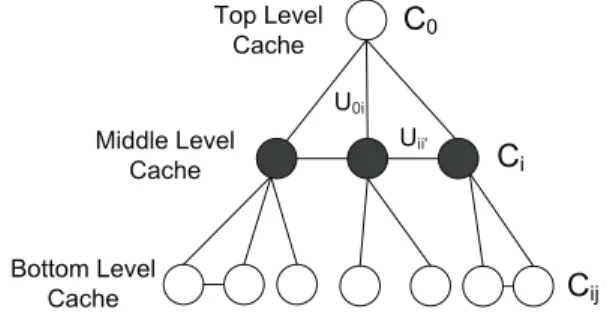
Fig. 4. Middle Level Cooperation.
Given our proposed mechanisms, the intra-links of the bottom level and the inter-links between the middle and bottom level have been utilized in cache cooperation. The amount of requests being processed at the middle level is then given below: λk i = X j∈J λk ij(1−X k ij ∗ )−X j∈J qk ij ∗ Uji/sk ∀i∈I, k∈K (16) On this basis, we now proceed to explore middle level cache cooperation as indicated by Fig. 4. We observe that any intra-link at the middle level is dedicated to the content transfer be-tween a pair of servers, called neighboring servers. To ensure a minimum delay in each data packet, we impose the restriction that requests in middle level cooperation can only be routed to neighbors of each node. The main challenge here is to find the appropriate content placement within the neighboring server set with respect to heterogeneous demands and link capacities. We useI={i, i′, i′′...}to represent the child cache servers of
C0as{Ci, Ci′, Ci′′...}. For each cache serverCi, we define its
neighboring set asNi={nij|j= 1,2, ...},NijI. Based on
demands at each cache server, we then associate a cost-utility index with each contentkat serverCiwhen considering cache
content placement: uk i = uk il+ukir sk ∀i∈I, k∈K (17) The utility function includes two parts as the local utility
uk
il and the remote utility u k
ir. The local utility u k il should
be positively correlated to demand λk
i. Meanwhile, it is also
related to content availability of contentkwithin the neighbor-ing setNi, which affects middle level cache cooperation. The
remote utilityuk
ir also needs to reflect the potential of cache
cooperation, which will be positively correlated to content demand rates at neighboring servers. The information above on neighboring servers can be obtained through periodical information exchanges. Furthermore, both utilities are con-strained by the link capacity Uniji and Uinij among middle
level servers as a special characteristic of massive content distribution. The cost of placing contentkatCi is the storage
cost sk. We then derive the utility function based on the aforementioned consideration: uk il=λ k isk(1− max nij∈Ni Xk nij(1−ρ Unij i avg(U))) (18) ukir= X nij∈Ni λknijsk(1−X k nij)(1−ρ Uinij avg(U))) (19)
In this formulation, ρ is a tunable parameter that satisfies
0 < ρ < 1. The smaller the value of ρ, the greater sensitivity to remote content availability will be. The nota-tion avg(U) denotes a non-negative average link capacity as
max(P
nij∈NiUniji/|Ni|, ǫ >0). Our definition of the utility
function has addressed many concerns in our system design. We first investigate its properties using two special scenarios in link capacity settings.
Proposition 1: The caching decision of Ci is not affected
by the neighboring server nij with limited link connectivity
such that Uniji=Uinij →0.
Proof: In this case, there will be no content delivery
between this pair of middle level servers. From the definition of the utility we have:
ρ
Unij i avg(U) =ρ
Uinij avg(U) = 1
It precludes the impact of Xk
nij and λ k nij from u k ir and uk
il. Therefore, the caching decision of local serverCi is not
affected by the status of neighboring server nij.
Proposition 2: When the link capacity is unlimited, no
utility will be gained for duplicating contents within a pair of cache servers.
Proof: In this scenario, we have Uniji = Uinij → ∞,
which suggests that the cache cooperation can be achieved as long as the content is stored in neighboring server nij. From
the definition we have,
ρ
Unij i avg(U) =ρ
Uinij avg(U) = 0
If the neighbor server has content k as Xk
nij = 1, we
have the utility uk
ir(nij) = λknijsk(1 − X k nij) = 0 and uk il=λ k isk(1− max nij∈Ni Xk
nij) = 0. Therefore, no utility will be
gained for duplicating katCi for this pair of servers.
In other cases of link capacity settings, the utility function also conforms to the practice of cache cooperation design. The increase of link capacity Uniji leads to an increase with
1−ρ
Unij i
avg(U), which further results in a decreasing concern on
local demands when the content is stored in the corresponding neighboring server. Similarly, the increase ofUinij implies that
demands from the server with a larger link capacity are given higher priorities when considering content placement. More-over, both local and remote utilities decreased for contents that are already placed in neighboring servers, which emphasizes the requirement of content heterogeneity.
The selection of parameterρhas also significantly affected the performance of our proposed mechanism. On one hand, a higher request heterogeneity among neighbors leads to a larger value ofρ, which satisfies both requirements of local demands and the content heterogeneity requirement among neighboring servers. On the other hand, the value of ρ should be care-fully chosen in the case of homogeneous request patterns. Generally, the setting ofρ should be negatively correlated to the bandwidth provisioned, i.e., positively correlated to the amount of arriving requests. This can help satisfy popular content requests without dynamic routing while maintaining a certain level of storage heterogeneity for the benefit of cache cooperation.
Based on the analysis above, we then propose the content placement strategy for middle level cache cooperation in Algorithm 2.
Algorithm 2 Content Placement in Middle Level Cooperation 1) For each contentk∈K, associate cost-utility index uk i
based on Equation (17).
2) Sort contents in a descending order based onuk i.
3) Fill in the cache storage in a greedy manner, i.e., contents with higher ranks are preferentially stored and contents with lower ranks are preferentially evicted. Dynamic routing at the middle level is based on con-tent availability at neighboring servers and the link capacity
Uniji. Since each link is dedicated to the content transfer
between a pair of servers, our routing design therefore aims to deliver appropriate types and amounts of requests to each neighboring server. We define the routing map Rn
ij = [R1 nij, R 2 nij, ..., R k
nij, ...], k ∈ K for each neighbor nij and
perform the logical subtraction for subsequent calculations:
Rn ij=Xnij− X j′6=j Xn ij′ −XCi ∀nij∈Ni (20) Rm nij=Xnij−Rnij−XCi ∀nij∈Ni (21) Rn
ij denotes contents that only have single copies in
neighbor set Ni. Thus type-k requests are routed to nij if
Rk
nij = 1. R m
nij denotes contents that have multiple copies
in neighbor set Ni, in which the dynamic request routing
still needs careful consideration. To address this challenge, we further define a global availability map as:
Rg= X nij∈Ni Xn ij− X nij∈Ni Rn ij−XCi (22)
We then adjust the routing mapRn
ij based on request rates
at Ci and the comparison between the value of Uniji and
P
k∈Kλ k iRknij.
• If Pk∈KλkiRkn
ij ≤ Uniji, we iteratively move the
content k such that Rk
nij = 0, R mk nij = R k g = 1 into Rn ij by setting R k nij = 1, R mk nij = R k g = 0. We repeat
4 4.5 5 5.5 6 6.5 7 7.5 8 x 10⁴ 0.6 0.7 0.8 0.9 1
Amount of Requests Per Bottom Level Server
Percentage of Supported Requests
D−Routing S−Routing
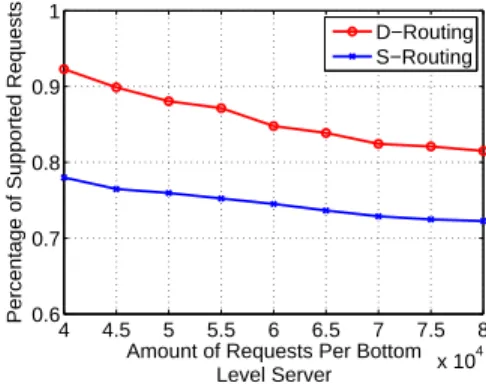
Fig. 5. The percentage of supported requests in collaborative caching versus different amounts of content requests. 4 4.5 5 5.5 6 6.5 7 7.5 8 x 10⁴ 0 1 2 3 4 5 6x 10 5
Amount of Requests Per Bottom Level Server
Amount of Supported Requests
D−Routing B−Level D−Routing M−Level S−Routing B−Level S−Routing M−Level
Fig. 6. The amount of supported requests in different cache levels versus different amounts of content requests. 4 4.5 5 5.5 6 6.5 7 7.5 8 x 10⁴ 0 0.1 0.2 0.3 0.4 0.5 0.6 0.7 0.8 0.9 1
Amount of Requests Per Bottom Level Server
Percentage of Supported Requests
D−Routing B−Level D−Routing M−Level S−Routing B−Level S−Routing M−Level
Fig. 7. The percentage of supported requests in different cache levels versus different amounts of content requests.
P
k∈Kλ k
iRknij > Uniji, or we cannot find contentksuch
that Rk nij = 0,R mk nij =R k g = 1.
• IfPk∈KλkiRnkij > Uniji, we iteratively remove the
con-tent such that Rk
nij = 1from
Rn
ij by setting R k nij = 0.
We repeat the process until P
k∈Kλ k
iRknij ≤Uniji.
After the aforementioned processes, a set of routing maps defines a near-optimal request routing scheme based on con-tent availability and heterogenous link capacities. Type-k re-quests are routed to nij if Rknij = 1. Note that routing maps
are mutually exclusive such thatRn
ij−Rnij′ =Rnij. D. Dynamic Request Routing
Based on our decomposed cache cooperation design pro-posed in Sec. IV, we have solved the coupled problems of content placement and dynamic request routing, considering practical concerns in massive content distribution. For any type-k request, we summarize our dynamic request routing scheme in Algorithm 3.
Algorithm 3 Dynamic Request Routing
1) After receiving a type-k request at bottom level server
Cij, fulfill the request if Xijk = 1.
2) If not yet fulfilled, check the content availability of the interconnected server set, route the request to the corresponding server if the content is available. 3) If not yet fulfilled, route the request to the middle level
serverCi, fulfill the request if Xik = 1.
4) If not yet fulfilled, check the following three options: a) Check the routing map Rb. Route the request
for content k to bottom level server Cij with
probabilityRk
bj according to Equation (15).
b) Otherwise, check the routing maps Rn
ij for each
nij. IfRknij = 1for somenij, route the request to
the neighboring server nij.
c) As a last resort, route the request to the top level server.
V. PERFORMANCEEVALUATION
In this section, we evaluate our cache cooperation scheme using system settings derived from a real-world IPTV system,
in comparison with a conventional static hierarchical caching scheme. Unlike our proposed dynamic request routing, static hierarchical caching usually defines fixed routing paths from the bottom level to the top level, and makes collaborative caching decisions correspondingly. Therefore, the most popu-lar contents are replicated at the lower level while less popupopu-lar contents are placed at the upper level.
We use Python to implement a simulator that constructs the cache topology as a three-level hierarchy, in which each top and middle level server has four children servers. We use the Zipf-Mandelbrot model [16] to formulate the content request pattern with the shape parameter 0.7 ≤ α ≤ 0.8 and 4 ≤
q≤5. The average link capacity of Uji, Uii′, and U0i is set
to1GB/s,2GB/s and4GB/s initially based on the real-world system. The storage capacity of top level, middle level, and bottom level servers are given as 100%,20% and 5%of the entire content set. The parameter ρ is adjusted between 0.5
and0.8 to adapt to different settings of the system.
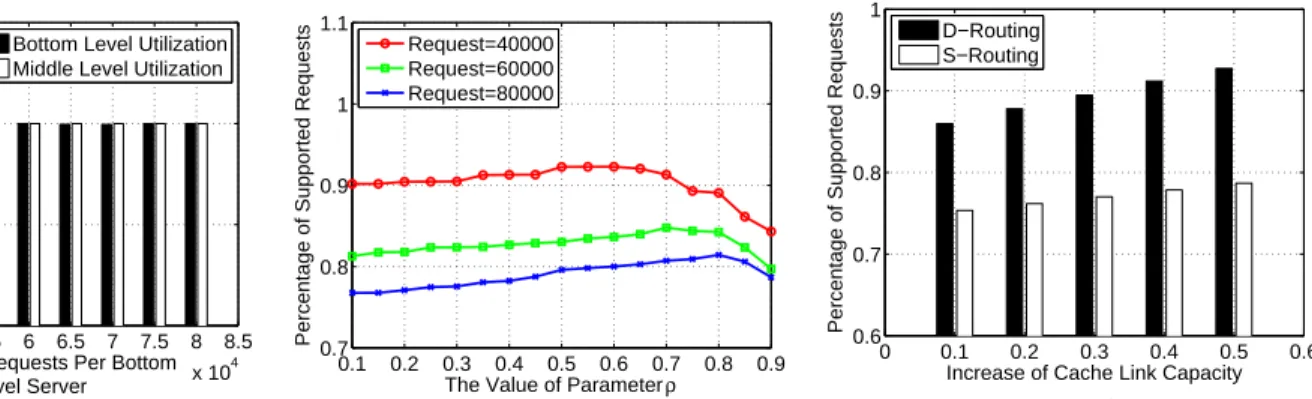
We first compare the cache cooperation performance be-tween dynamic (denoted as D-Routing) and static request rout-ing (denoted as S-Routrout-ing) in Fig. 5. It can be observed that the percentage of supported requests of D-Routing consistently outperforms that of S-Routing with 13% to 18% improve-ments. The performance gap is achieved through downstream content retrieval or the middle level cooperation in D-Routing. However, the gap is gradually decreasing with an increasing number of content requests, as long as link capacities in D-Routing have been fully utilized.
We then analyze the amount of supported traffic in different levels of cache cooperation in Fig. 6. The traffic supported by the bottom level is calculated as the summation of requests directly satisfied at the bottom level and the contribution from indirect bottom level cooperation. The traffic supported by the middle level is a combination of direct content transfer from middle level servers and the support from middle level cache cooperation. It is not surprising that both middle level and bottom level of S-Routing fulfill less demands compared to that of D-Routing. Meanwhile, bottom level servers satisfy much more demands than middle level servers in D-Routing, which can be explained as most content requests are already served in D-Routing through downstream content retrieval.
3.5 4 4.5 5 5.5 6 6.5 7 7.5 8 8.5 x 10⁴ 0.8 0.9 1 1.1
Amount of Requests Per Bottom Level Server
Link Utilization
Bottom Level Utilization Middle Level Utilization
Fig. 8. The link utilization in D-Routing versus different amounts of content requests.
0.1 0.2 0.3 0.4 0.5 0.6 0.7 0.8 0.9 0.7 0.8 0.9 1 1.1
The Value of Parameter ρ
Percentage of Supported Requests
Request=40000 Request=60000 Request=80000
Fig. 9. The percentage of supported requests in D-Routing with different values of parameterρ.
0 0.1 0.2 0.3 0.4 0.5 0.6 0.6 0.7 0.8 0.9 1
Increase of Cache Link Capacity
Percentage of Supported Requests
D−Routing S−Routing
Fig. 10. The percentage of supported requests in collaborative caching with different increases of cache link capacities.
If we further investigate the percentage of supported traffic in different levels in Fig. 7, we find that both middle level and bottom level contribution in D-Routing can maintain a stable performance with different amounts of incoming requests, which clearly reveals the stability of our proposed collaborative caching mechanism.
The utilization of intra-links at the middle level and inter-links between the middle and bottom level reflect the effec-tiveness of the proposed mechanism with D-Routing. Fig. 8 shows that both middle level and bottom level cooperation are sufficiently good initially with over90%utilization. When demands increase over the entire system, larger amounts of requests received at different levels lead to the full utilization of link capacities for both downstream content retrieval and middle level cache cooperation.
We then investigate the impact of parameter ρ in Fig. 9. The amount of requests per bottom level server is adjusted from40000to80000. The increasing amount of requests also reflects a decreasing trend of the bandwidth provisioned in the system. We first observe that the percentage of fulfilled requests is gradually decreasing with an increasing input scale. Meanwhile, the optimal value of ρ is also “shifting,” such that a larger amount of requests (80000) achieves the optimal result when ρ = 0.8 while a smaller amount of requests (40000) achieves the optimal value with ρ = 0.6. This practically proves our previous analysis that the selection ofρ
should be negatively correlated to the bandwidth provisioned, in order to maintain a balance between the requirement of local demands and the adequate level of content heterogeneity among neighboring servers at the middle level.
Fig. 10 introduces the sensitivity analysis on cache capacity settings by adjusting the link capacity in the system. Although the performance of S-Routing also has nearly1%improvement for each 10% of extra link capacities, the performance gap between S-Routing and D-Routing is still gradually increasing. The rationale is that the proposed D-Routing can successively explore the maximum potential of cache cooperation with expanded link capacities.
VI. CONCLUSION
In this paper, we have proposed a new collaborative caching mechanism based on the topology derived from a real-world
system that provides IPTV services in a metropolitan network. In particular, we have focused on the exploration of the exist-ing network infrastructure to better support new scenarios of massive content distribution. We have shown that dynamic re-quest routing helps explore the capacity of a caching network. Our simulation results have demonstrated the effectiveness of our proposed mechanism, as compared to conventional static routing schemes.
REFERENCES
[1] “Ubuntu Mirrors,” https://wiki.ubuntu.com/Mirrors/. [2] “China Telecom,” http://en.chinatelecom.com.cn/.
[3] M. R. Korupolu, C. G. Plaxton, and R. Rajaraman, “Placement Algo-rithms for Hierarchical Cooperative Caching,” in Proc. ACM SODA, Jan. 1999.
[4] L. Chen, M. Meo, and A. Scicchitano, “Caching Video Contents in IPTV Systems with Hierarchical Architecture,” in Proc. IEEE ICC, Jun. 2009. [5] A. Wolman, G. M. Voelker, N. Sharma, N. Cardwell, A. Karlin, and H. M. Levy, “On the Scale and Performance of Cooperative Web Proxy Caching,” in Proc. ACM SOSP, Dec. 1999.
[6] P. Rodriguez, C. Spanner, and E. W. Biersack, “Analysis of Web Caching Architectures Hierarchical and Distributed Caching,” IEEE/ACM
Trans-actions on Networking, vol. 9, no. 4, 2001.
[7] W. Li, E. Chan, G. Feng, D. Chen, and S. Lu, “Analysis and Perfor-mance Study for Coordinated Hierarchical Cache Placement Strategies,”
Computer Communications, vol. 33, no. 15, 2010.
[8] K. Li, H. Shen, F. Y. L. Chin, and S. Q. Zheng, “Optimal Methods for Coordinated Enroute Web Caching for Tree Networks,” ACM
Transac-tions on Internet Technology, vol. 5, no. 3, 2005.
[9] X. Jia, D. Li, H. Du, and J. Cao, “On Optimal Replication of Data Object at Hierarchical and Transparent Web Proxies,” IEEE Transactions on
Parallel and Distributed Systems, vol. 16, no. 8, 2005.
[10] L. Wang, V. Pai, and L. Peterson, “The Effectiveness of Request Redirection on CDN Robustness,” in Proc. USENIX OSDI, Dec. 2002. [11] N. Laoutaris, G. Zervas, A. Bestavros, and G. Kollios, “The Cache Inference Problem and its Application to Content and Request Routing,” in Proc. IEEE INFOCOM, May 2007.
[12] T. Bektas, J.-F. Cordeau, E. Erkut, and G. Laporte, “Exact Algorithms for the Joint Object Placement and Request Routing Problem in Content Distribution Networks,” Computers and Operations Research, vol. 35, no. 12, 2008.
[13] S. Borst, V. Gupta, and A. Walid, “Distributed Caching Algorithms for Content Distribution Networks,” in Proc. IEEE INFOCOM, Mar. 2010. [14] D. Applegate, A. Archer, V. Gopalakrishnan, S. Lee, and K. Ramakr-ishnan, “Optimal Content Placement for a Large-Scale VoD System,” in
Proc. ACM CoNext, Nov. 2010.
[15] I. Baev, R. Rajaraman, and C. Swamy, “Approximation Algorithms for Data Placement Problems,” SIAM J. on Computing, vol. 38, no. 4, 2008. [16] M. Hefeeda and O. Saleh, “Traffic Modeling and Proportional Partial Caching for Peer-to-Peer Systems,” IEEE/ACM Trans. Netw., vol. 16, no. 6, 2008.