SAIGA NEWS
With additional support from:
Saiga male in winter camouflage. Photo by Eugeny Polonsky Saiga male in winter camouflage. Photo by Eugeny Polonsky
Providing a six-language forum for exchange of ideas
and information about saiga conservation and ecology
Contents
Feature article
E.J. Milner-Gulland The sustainable use of saiga antelopes: Perspectives and prospects
Updates
Buyanaa Chimeddorj and Bayarbaatar Buuveibaatar The population of Mongolian saigas has increased Buyanaa Chimeddorj Camel-herders’ participation in Mongolian saiga conservation
Buyanaa Chimeddorj Mongolian students have fenced 5 springs in cooperation with herders
Elmira Mustafina Rutting aggregations monitored in three saiga populations in Kazakhstan
Elmira Mustafina and Bakhtiyar Taykenov Results of monitoring calving saigas in the Ustyurt population in 2020
Elmira Mustafina The proposed Centre-West transport corridor threatens saigas in central Kazakhstan
Elmira Mustafina Eight dogs from the Kazakh Border Service taught to search for saiga horns Alan Aldashev Proof obtained of individual saigas coming into Uzbekistan from Kazakhstan Olga Obgenova Works of art by Russian Steppe Wildlife Club members
Olga Obgenova Russian steppe clubs celebrating World Wildlife Day
Olga Obgenova, Natalya Shivaldova and Elmira Mustafina COVID-19 did not cancel Saiga Day in 2020
Articles
Valery Shmunk An innovative approach to estimating saiga numbers in the North-West pre-Caspian area Luiza Mardonova et al. The Saigachy Reserve: saigas return to Uzbekistan
Maria Gritsina et al. The Saigachy Reserve in Uzbekistan as a case study of the introduction of a fauna and flora monitoring system
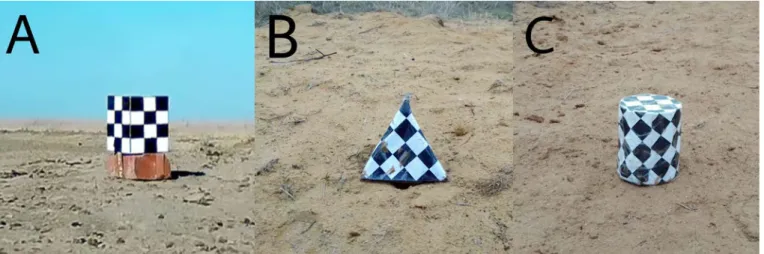
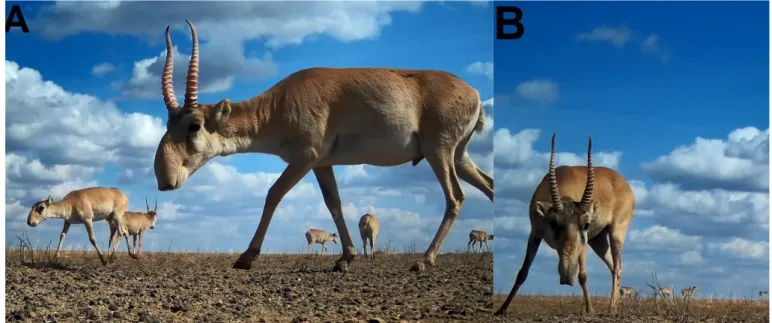
Yekaterina Berezina et al. Approaches to studying sensory laterality in saigas: experiments in the wild Nadezda Kashinina et al. On the genetic potential for resistance of the saiga population in the North-West pre-Caspian area to helminths and other parasites
A selection of new publications
Saiga hero: Enkhtuvshin Shiilegdamba, Mongolia
In memoriam: Amankul Bekenov
Editorial team:China: Guihong Zhang ([email protected]), Qulong Education Ltd & Professor Zhigang Jiang (zhigangjiang@vip. sina.com), Institute of Zoology, Chinese Academy of Sciences. Kazakhstan: Dr. Yu.A. Grachev, Institute of Zoology ([email protected]),
Elmira Mustafina, ACBK ([email protected]). Mongolia: B. Buuveibaatar, ([email protected]), WCS-Mongolia, B. Chimeddorj ([email protected]), WWF-Mongolia. Russia: Professor Yu. Arylov, Kalmyk State University ([email protected]) & Dr. A. Lushchekina,
Institute of Ecology & Evolution ([email protected]). Uzbekistan: Dr.E. Bykova [Executive Editor] ([email protected]) &. Dr. A. Esipov, Institute of zoology, Uzbek Academy of Sciences ([email protected]). UK: Professor E.J. Milner-Gulland [Advisory Editor], Oxford University ([email protected]) & Dr. David Mallon [Reviewer], IUCN Antelope Specialist Group ([email protected]). Graphic design by
Dinara Adilova ([email protected]).
All contributions are welcome, in any of our six languages. Please send them to [email protected] or to one of the Editors. We publish twice a year.
Guidelines for authors are available in English and Russian at www.saiga-conservation.com or on request from the Editors. Please contact the Editors responsible for Saiga News in your country, or the Executive Editor Elena Bykova ([email protected]), if you have any questions or con-cerns.
This publication is available online at www.saigaresourcecentre.org, www.saiga-conservation.com and
www.saigak.biodiversity.ru/publications.html, and as a pdf or in hard copy on request to the Editors, in Chinese, English, Kazakh, Mongolian, Russian and Uzbek.
The sustainable use of saiga antelopes: Perspectives and prospects
E.J. Milner-Gulland Oxford university and Saiga Conservation Alliance [email protected] Although everyone within the saiga community isunited on the overall goal of our work — to once again see saigas take their place as an abundant keystone species within healthy ecosystems — the route to achieving this aim is less clear, and varies between populations and countries. One particularly challenging topic is the role which sustainable hunting of saigas could and should play within saiga conser-vation efforts. This topic is explicitly highlighted as a priority for research within the draft Medium Term International Work Programme for 2021-2025 under the CMS’s Memorandum of Understanding on saiga conservation (which will be discussed at the next Meeting of the Parties currently planned for 2021 in Astrakhan, Russia).
In order to address this priority, the Bundesamt für Naturschutz of the German Government commis-sioned a report to provide a foundation for exploring the potential for sustainable use of the saiga antelope,
and to define the pre-conditions which need to be fulfilled to ensure that such use would be sustain -able in practice. The report was written collectively by experts from within the saiga range States and
China, and by international experts. The authors have expertise in population dynamics, wildlife harvesting and wildlife trade. They also consulted with a wider group of colleagues, including individuals responsible for saiga conservation and management in range State governments, members of academic institu-tions and NGOs.
The report includes chapters on the theory of sus-tainable harvesting with application to saiga, poten-tial management structures for saiga harvesting,
population-specific considerations, a view from China
as a major consumer nation and former range state, and information on the international trade in saiga products and its status under CITES. Throughout, we
endeavour both to give detailed information specific
to saigas, but also to provide examples and les-sons from other relevant species and geographies to provide the reader with ideas and concepts around sustainable wildlife use. Finally, we summarise the insights from the report and suggest ways forward. Sustainable use, in the biological sense, is the use of a natural resource in such a way that it is maintained
in the long term at a level that allows it to fulfil its role
in the wider ecosystem. Sustainability more broadly has social, economic and ecological components; in order for the use of a natural resource to be sustain-able, all three must be considered, because without one element the others will fail. The report focuses on consumptive use (i.e. hunting), as the most usual connotation of the term “sustainable use” in the saiga
context. However, sustainable use can be defined
to include activities such as phototourism, or any
other way of obtaining benefits from using saigas
in a non-consumptive way that doesn’t threaten the population (and ideally enhances it).
The report was compiled based on the best available
information in the scientific literature, official reports
and expert knowledge. However, it is not intended to
give definitive answers to the questions surrounding
Saiga rutting season in progress. Stepnoi reserve, Russia.
sustainable use. Most importantly this is because decisions must be made by the governments and au-thorities responsible for saiga management. However, it is also because there are still substantial gaps in
our knowledge that need to be filled in order to sup -port any discussions about the future of sustainable use. These include:
1. The development of a comprehensive popula-tion dynamics model for each populapopula-tion, that can explore harvesting options.
This should include other drivers of saiga population dynamics, including disease outbreaks and climate change, and may need to be spatially explicit.
2. Exploration of the economic feasibility of different options for sustainable management.
This could include the exploration of financial mod -els for harvesting, processing and sale of different
saiga products, as well as the costs and benefits of
different institutional structures.
3. Consultation with local residents to understand their behaviours and perspectives.
This should include getting an understanding of the prevalence and drivers of saiga poaching and consumption using modern indirect questioning methods. It should also include participatory explora-tion of local people’s relaexplora-tionships with saigas and
preferences for receiving benefits from their presence
(including alternative livelihood options as well as sustainable use).
4. Development of a plan for adaptive management at the population level.
This should draw on scientific evidence and include
institutional as well as biological factors. So for example it could use a model to estimate popula-tion quotas, which change every year depending on circumstances. It would also require annual data collection to feed into the model, on threats and
population dynamics. The plan would also include regular review of the institutional, social and economic functioning of saiga management, and early warn-ing triggers for intervention if, for example, there is a change in support for management (e.g. problems experienced by hunting associations).
5. Deciding on a suitable legislative and regulatory structure.
Governments would need to ensure that a suitable legislative and regulatory framework for managing sustainable hunting is in place, including stockpile management. This could include an assessment of the requirements for institutional, administrative and enforcement capacity-building at national, regional and local levels. A consideration of the potential roles of different institutional structures for sustainable hunting (including state institutions at local, regional and national levels, private game management organ-isations, hunting associations, and wildlife manage-ment authorities) would also be useful.
6. Continued investment in ongoing monitoring of the system.
The monitoring and protection of saiga populations is getting better and more comprehensive, and more robust, over time. This will need to continue to im-prove in order to justify and support sustainable use. There should also be ongoing monitoring of social and governance aspects of the harvesting and trade
systems, including equitable benefit sharing and local
perceptions of saigas and of sustainable use, and of the effectiveness of trade controls.
7. Understanding and control of demand for saiga products.
Saiga poaching for international trade will only be controlled when demand for illegal saiga products in consumer countries is controlled. Currently demand is high in some countries (e.g. Singapore), but there is very little knowledge about the level of demand in other countries, e.g. China. However, there are still
Feature article (cont.)
large seizures and saiga products are still widely available online and in physical markets. There is also no understanding of how legal and illegal products might interact in consumer markets (e.g. would legal horn be seen as an inferior, superior or indistinguish-able product). The potential for laundering and for demand either being reduced or exacerbated by legal products needs to be investigated.
8. Control of stockpiles in consumer countries.
The lack of registration and control of stockpiles means that there is very little knowledge of how much new saiga horn is entering international trade. Unless the illegal horn trade is brought under control, poaching will continue to be a threat to all saiga populations. There will also be no prospect of a legal international horn trade under CITES. Unfortunately, this is something that range state governments have little control over, and instead governments of con-sumer countries must tackle, with the support of international NGOs.
9. Investigation of the potential for non-consumptive sustainable uses.
We were not able to assess the potential of other sustainable uses in the report. However, tourism in particular has potential. Tourism in general is being heavily promoted in some parts of the saiga’s range
(e.g. Uzbekistan). Saiga-focussed international tourist trips have been piloted in both Kazakhstan and Rus-sia. The infrastructure for international tourism is not fully developed in the saiga range areas, and travel to see saigas may be challenging in some parts of the range. However, nature-based tourists are more likely to be prepared to accept rougher conditions in order to see rare and unusual species. There is the potential to link saiga tourism to other attractions such as cultural sites and bird-watching. It can also generate and support local enterprises such as craft-making, guiding, and homestays.
Overall, the aim of the report is to lay the foundations for further exploration of the many issues surround-ing the sustainable use of saigas in the future. The intended audience is all those interested in the con-servation of saigas around the world, from a range of organisations, but particularly those responsible for making decisions about saiga management in range State governments.
The report is available online here: https://www.
cms.int/saiga/sites/default/files/document/unep_ cms_saiga_mos4_inf.20_sustainable-use-saiga-antilopes_e_0.pdf [English] and https://www.cms.int/
saiga/sites/default/files/document/unep_cms_saiga_ mos4_inf.20_sustainable-use-saiga-antilopes_ru.pdf
[Russian].
Saiga beauty in the Stepnoi reserve. Photo by Eugeny
Updates
Mongolia
The population of Mongolian saigas has increased
Buyanaa Chimeddorj1 and Bayarbaatar Buuveibaatar21 — WWF-Mongolia, [email protected];
2 — WCS-Mongolia, [email protected]
The Mongolian saiga is a critically endangered sub-species, which only inhabits Mongolia. In 2014, there were 15,000 Mongolian saigas. Unfortunately, thou-sands of them died in 2017 due to the goat plague (PPR) and a winter dzud (weather which combines a lack of grass, extreme temperatures and heavy snowfall) causing food shortages. Together with illegal hunting and habitat loss, this reduced the population to 3800 in December 2018. Experts from WWF-Mongolia and the Saiga Ranger Network com-pleted a population assessment in January 2020 which showed that the population size had increased to 7,667 (95% CI = 5,074 — 11,724) individuals, an increase of approximately 20% since the last survey in December 2018.
The assessment was performed using the internation-ally recognized line transect method in the Shargiin Gobi, Khuis Gobi, Durgun steppe, Mankhan soum of
Khovd province, Zavkhan soum of Uvs province, and Durvuljin soum of Zavkhan province. B. Gantulga,
spe-cies officer from WWF-Mongolia said “Last summer
was favourable for saiga; unfortunately this doesn’t happen every year. Therefore, strong conservation efforts should continue”.
Although the Mongolian saiga population has grown substantially, this is not a source of relief because droughts, overgrazing and infectious diseases could still have devastating effects on this vulnerable popu-lation. Programmes to reintroduce Mongolian saigas into several independent populations could substan-tially reduce these risks. Researchers also pointed out that the protection of Mongolian saiga range by the State and a reduction in illegal hunting would also help save this extremely rare sub-species from the extinction.
Camel-herders’ participation in Mongolian saiga conservation
Buyanaa Chimeddorj WWF-Mongolia, [email protected]This year, poor pasture and harsh winter conditions are expected in most areas of the Altai Sayan region, which may reduce the number of Mongolian saigas. Moreover, many herders live in the Mongolian saiga range, leading to a shortage of grazing for wildlife and domestic animals. Therefore, WWF-Mongolia
organized a “Сamelmen” campaign in November, 2019
to hear herders’ comments on how to properly use pasture and to promote the importance of Mongolian saigas. Herdsmen participated in the campaign, and the campaign team moved between locations by camel. According to the organizers, 14 camelmen and saiga rangers were involved in the journey, and they met about 100 herders from 60 families who lived in the saiga range to explain the importance of pasture and Mongolian saigas.
Herders said that: “Mongolian saigas are very rare this year. It’s unbelievable how sparse they are. Seems like it’s going to be a rough winter because there is less food for them”. They also shared their views on pasture: “Pasture use should be timely. There is a lack of legal regulation. Instead of having more livestock, it is important to have a small number of livestock
that are economically and financially sustainable.”
Herders agreed that without pasture, neither livestock nor wild animals would survive.
Updates (cont.)
Mongolian students have fenced 5 springs in cooperation with herders
Buyanaa Chimeddorj WWF-Mongolia, [email protected]Eco-club students successfully initiated protection of the headwaters of natural springs in 2018, which
was the first time this had been done in Mongolia.
WWF-Mongolia has supported them from the begin-ning. Together with local authorities and citizens, they fenced 4 natural springs in 2018, resulting in an increase in water flow for both livestock and wildlife. Automatic camera footage prove that not only humans drink from these springs, but many wild animals as well. The eco-club students called on locals to take action to protect the natural springs, and herders from 7 soums (districts) of Gobi-Altai province do-nated MNT 21 million (7900 USD). In the summer of 2020, the eco-club students were more active. They collaborated with herders to fence 5 natural springs in Sharga and Khuis Gobi, which is the home range
of Mongolian saigas. The eco-club students signed a tripartite contract with the soum administration and herders, and handed over the fence key to the herders. In other words, herders are expected to be responsible for the protection of the springs. The students will conduct quarterly surveys, which will include monitoring of these automatic cameras.
Due to the state of emergency declared by the Kazakh government in May 2020, the monitoring of calving saiga aggregations by ACBK covered only the Ustyurt population this year. The survey was carried out by ACBK specialists from the Ustyurt Plateau’s monitor-ing and wildlife conservation team and resulted in the recording of a large aggregation of calving saigas for
the first time in ten years.
Before launching the expedition, the researchers obtained the following data:
y Information about all locations where saiga had
been recorded for the last 3 years (2017—2019);
y Information from satellite transmitters which were
used to record all locations frequented by collared
saiga between 1st and 15th May in previous years, using a transect survey method;
y Information from local people about saiga calving
aggregations in the Soviet period.
Our team compared the newly obtained data with this
information and identified sites for their preliminary
survey.
Every day during the expedition, starting from 5th May, we recorded groups of saiga numbering 19 to 163 individuals, but did not identify any newborn
ani-mals. On the sixth day our team finally found a mass
calving site 51.6 km2 in area in Aktobe Province. The aggregation was studied between 12th and 17th May, during which the biometric parameters of 26 calves
Kazakhstan
Rutting aggregations monitored in three saiga populations in Kazakhstan
Elmira Mustafina Association for the Conservation of Biodiversity of Kazakhstan (ACBK), [email protected] Between 17th and 27th December 2019, 12
research-ers from the Association for the Conservation of Biodiversity of Kazakhstan (ACBK) studied saiga rutting aggregations. They surveyed the animals’ behaviour during this period, established a mean ratio of males to females and obtained information on rutting habitats. The work was implemented as part of the Altyn Dala Conservation Initiative.
This was the first study of rutting males in the
Ural population, currently the largest saiga popu-lation in the world. The survey was carried out in Kaztal District of West Kazakhstan Province us-ing a drone with a wide-angle lens. The Betpak Dala population was monitored in Kostanay, Ak-tobe and Karaganda Provinces, where the largest
aggregation was recorded in the Irgiz Turgay Nature Reserve, as in the previous year. Other rutting ag-gregations were observed in the Alty Say eco-park (https://www.youtube.com/watch?v=9Lmuq0nlX7s). Rutting animals in the Ustyurt population, the country’s smallest population, were studied in Aktobe Province. The survey covered a total area of 3,200 km2. There were around 100,000 saiga recorded in the Ural popu-lation, about 20,000 in the Betpak Dala population and approximately 900 in the Ustyurt population.
Sex and age were identified for 22,882 individuals.
The mean ratio of adult males to females in the Ural population was 1:15, in the Betpak Dala population 1:10 (compared to 2017 — 1:22, and 2018 — 1:11), in the Ustyurt population — 1:5.
Results of monitoring calving saigas in the Ustyurt population in 2020
Elmira Mustafina and Bakhtiyar Taykenov Association for the Conservation of Biodiversity of Kazakhstan (ACBK), [email protected]
Updates (cont.)
were measured. In total 986 saiga individuals were recorded, including 530 calves. The mass calving
took place on a site that had suffered a fire in 2019,
and which held sources of rainwater. The vegetation included Agropyron, Artemisia, Anabasis salsa, Rheum tataricum and other plants.
According to the Kazakh government’s 2019 aerial survey, the Ustyurt population numbers around 5,900 individuals in Kazakhstan, making it the world’s most endangered saiga population. Interestingly, in 1998-2005 this was the largest saiga population. Poaching was the main cause of the decrease in saiga numbers. Nevertheless, appropriate conservation measures have resulted in its growth in recent years; in 2018 numbers grew by 37%, in 2019 — 59.5%. The large calving aggregations recorded during the 2020 expe-dition indicate that current conservation measures are yielding satisfactory results.
The use of up-to-date technologies by ACBK special-ists to patrol and monitor the area, such as the SMART system, drones and satellite telemetry, facilitates the accumulation of reliable data to help study and conserve saigas and their habitats. Active dialogue
with local people also once again proved an efficient
means to tackle poaching.
It should be added that the State Territorial Inspec-torates and Okhotzooprom under the Committee for Forestry and Wildlife of the Ministry of Ecology, Geology and Natural Resources of the Republic of Kazakhstan take steps to protect large calving ag-gregations throughout Kazakhstan, including the Ustyurt population.
This work was implemented as part of the Altyn Dala Conservation Initiative (ADCI) aimed at conserving key species of steppe ecosystems, with the support of Fauna and Flora International.
Run, little saiga, run! Photo by Bakhtiyar Taikenov
Newborn saiga calves were tagged with ear tags for follow-up research. Photo by Bakhtiyar Taikenov
Rutting aggregations monitored in three saiga populations in Kazakhstan
Elmira Mustafina Association for the Conservation of Biodiversity of Kazakhstan (ACBK), [email protected] The Kazakh government plans to build a series of
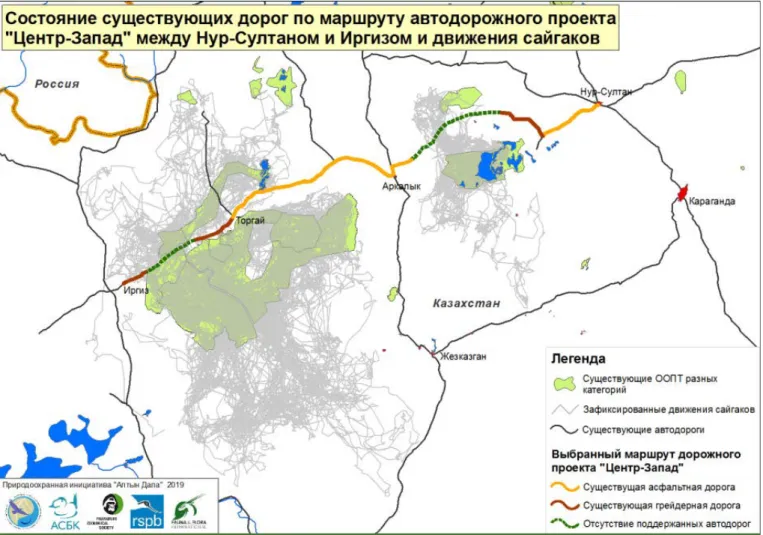
transport corridors — Centre-West, Centre-South, Centre-East and Centre-North — as part of the “Nurly Zhol” programme to modernise the country’s road network. These roads will form a part of the Western Europe -Western China transcontinental corridor. The construction was ordered by the Committee of Highways under the Ministry for Industry and Infra-structural Development of the Republic of Kazakhstan. These roads will form a part of the Western Europe -Western China transcontinental corridor. The Centre-West section will connect the cities of Nur-Sultan and Aktau (about 2,000 km) (fig. 1).
Segments of the Centre-West route in Kostanay and Akmola Provinces will cross saiga migration routes. The currently proposed route between the city of Nur-Sultan and Shalkar village threatens the Betpak Dala population and within that, the Tengiz sub-population. The road will run very close to the territories of the Irgiz-Turgay and Altyn Dala State Nature Reserves and Irgiz-Turgay-Zhilanshik ecological corridor, which play an essential part in the conservation of the Betpak Dala saiga population — facts that were given little attention by the road’s Environmental Impact Assess-ment. Moreover, the road crosses the Turgay State Nature Reserve, which contains a system of lakes
Fig. 1. Centre-West road project in Kazakhstan. 1=Ural population, 2=Ustiurt population, 3=Betpakdala population. Red line = proposed Centre-West road project. Yellow lines = Existing major roads.
in the lower reaches of the Irgiz and Turgay Rivers listed in the Ramsar Convention and as an Important Bird Area. This was completely neglected by project designers and the Environmental Impact Assessment. Based on its experience in working in this region and available data on local ecosystems, the Association for the Conservation of Biodiversity of Kazakhstan (ACBK) insists that the projected route should be changed as soon as possible for a new and more sustainable one. According to a study by ACBK, sai-gas from the Betpak Dala population generally avoid crossing the existing paved roads, and freely cross dirt roads (as in the Arkalyk—Irgiz segment of the road)
Furthermore, saigas in the Ustyurt population fitted
with transmitters did not cross the Shalkar-Beyneu
rail-way line for over 2 years after its construction — from
autumn 2017 to late December 2019.
ACBK believes that the proposed road will become a source of considerable disturbance in these
ar-eas. The traffic will frighten off animals and be an
obstruction to their movement (whether temporary or permanent) (fig. 2).
The inevitable increase in traffic will have an unpre -dictable impact on their migration, which may be aggravated by the presence of people and machines maintaining the road. Potential threats to the Betpak-dala saiga population from the Centre-West project include:
y Fragmentation of the range and loss of habitats
Saiga may stop using areas north of both road
Fig. 2. The current state of Centre-West project roads between Nur-Sultan and Irgiz, overlaid with data on saiga movements. Green patches = existing protected areas, grey lines = movements of satellite-tagged saigas, black lines = existing roads. Chosen route of the Centre-West road project: Yellow line= existing asphalt road, red line = existing graded road, green dot-ted line= currently lacking a road.
segments. This may force them to stay in areas with
insufficient food, which will have a negative impact
on the animals’ health and reproduction.
y Limited food resources
Even if the saiga movement is not blocked com-pletely, the road will most probably impact their sea-sonal migration to important summer pastures in the north. The animals will have to stay longer in areas with scarce food, which will impact their health and reproduction.
y Higher risk of diseases
Aggregations may form south of the road as saigas try to cross to reach the calving grounds during the spring migration. This may result in various epidemics, some of which may be quite dangerous (the causes of the last outbreak of Pasteurellosis in 2015 still remain largely unclear). Moreover, this will increase disease risk for domestic animals.
y Lower saiga numbers
The shrinkage of undisturbed areas of habitat, dis-turbance of migration routes and higher threat to the animals’ lives may lead to a reduction in saiga numbers in both the main population and the Tengiz sub-population and a consequence loss in value as a renewable hunting resource.
y Damage to the Ramsar site
The breaking of ecological connections between the two clusters of Protected Areas, particularly in the Irgiz-Turgay region, will cause damage to the Ramsar wetland.
These negative impacts will make it impossible to restore the saiga population to the level of the 1980s. The only way to solve the problem is to change the course of the Centre-West road northwards, so that it bypasses the most important habitats.
Since 2017 ACBK has submitted a series of official
requests to the authorities to change the course of the road in connection with the potential threat to the saiga’s habitats. However, our appeals have been ignored and the transport corridor project is now 80% completed. In 2020 ACBK has been more active in attempting to solve the problem, appealing to the Ministry of Ecology, Geology and Natural Resources of the Republic of Kazakhstan and promoting cover-age of the issue in the mass media.
You can follow the campaign to change the course of the Centre—West road via the hashtags #SaveSaigaWays,
#КиікЖолы, #СохранимПутиСайгака, as well as on the website savesaiga.kz.
Eight dogs from the Kazakh Border Service taught to search for saiga horns
Elmira Mustafina Association for the Conservation of Biodiversity of Kazakhstan (ACBK), [email protected] Between 10th February and 18th June 2020, eight
dogs from the Kazakh Border Service took an initial training course under the Searching for Derivatives
programme, where they were taught to find saiga
and argali horns, snow leopard skins and steppe tortoises. The course was held in Almaty, at the Dog Centre under the Financial Monitoring Committee, Ministry of Finance of the Republic of Kazakhstan.
Officers from the Border Service and their dogs suc -cessfully passed all their exams, where they were asked to show their practical skills in detecting wildlife derivatives in hand luggage, road vehicles and railway carriages. On 19th June, all the dogs demonstrated
their ability to find saiga horns at an exhibition per -formance marking the completion of the training.
Updates (cont.)
The trained dogs will operate in strategically important locations on the border. In total, 17 specialist dog-handlers will work on controlling the illegal trade in wildlife products.
Since 2014 the Association for the Conservation of Biodiversity of Kazakhstan (ACBK) has been
imple-menting this project to train officers and their dogs
to detect wildlife derivatives as part of the Altyn Dala Conservation Initiative. The work is supported by Fauna & Flora International.
Proof obtained of individual saigas coming into Uzbekistan from Kazakhstan
Alan Aldashev Association for the Conservation of Biodiversity of Kazakhstan (ACBK),In January 2020 camera traps captured a few sai-gas in the Saigachy Reserve in Uzbekistan (see the article by M. Gritsina et al. in this issue). This piece of news inspired specialists from the Association for the Conservation of Biodiversity of Kazakhstan (ACBK) to drive to the border with Uzbekistan to see if the saiga had used the special gaps cut in the border fence in 2015 as a result of the joint efforts of ACBK, the Committee for Forestry and Wildlife under the Ministry of Ecology, Geology and Natural Resources of the Republic of Kazakhstan and the country’s Border Service (see Saiga News, 21). In April 2020 specialists from ACBK and rangers from the Border Service surveyed a 335-km section along the border by car and detected saiga footprints in seven locations. They established that in three cases the animals travelled along the fence, and in four locations they managed to cross the border. In addition, according to border soldiers and local people, several saiga individuals were recorded near the border fence in December 2019 and April 2020. Therefore, the efforts to mitigate the negative impact of the border fence on the saiga migration have begun to yield results. More trips in the migration season
are planned to further study this issue, as well as to
fit satellite transmitters on several saigas from the
Ustyurt population.
This work is implemented as part of the Altyn Dala Conservation Initiative (ADCI) with the support of the Committee for Forestry and Wildlife under the Ministry of Ecology, Geology and Natural Resources of the Republic of Kazakhstan and Fauna and Flora International (FFI).
Dog handlers with dogs. Photo by Dina Djulayeva
Saiga crossing place over a wire fence on the border between Kazakhstan and Uzbekistan. Photo by Bahtiyar
Russia
Works of Art by Russian Steppe Wildlife Club members
Olga Obgenova Association for Steppe Wildlife Clubs of Russia, [email protected] The Steppe Wildlife Clubs established with the
sup-port of the Saiga Conservation Alliance in Russian rural secondary schools near saiga habitats in the North-West pre-Caspian area hosted a series of
events in the first half of 2020.
The clubs organised various competitions and train-ing courses and staged theatrical performances and sporting events, competitions and quest games. One of the most remarkable was a competition to make handicrafts and leaflets held by the Tropoi Saigaka (Along the Saiga’s Path) Steppe Wildlife Club (Troitskoye village). Club members made a series of plywood badges, called Saigas in Flight, and a ‘saiga’ cup, which were awarded to the winners of Saiga Day competitions (see O. Obgenova’s article about Saiga Day in this issue). A master class in origami at the Druzya Prirody (Wildlife Friends) steppe club (Elista city) resulted in the creation of a unique and very touching paper saiga by the children from the club. The clubs were also involved in the celebration of Maslennitsa (Shrovetide) — an ancient holiday dedi-cated to parting with the winter and welcoming the spring. At the festival kids from the Vozrozhdeniye (Resurrection) steppe club put on saiga masks, sang and danced in a ring, and distributed colourful hand-outs and calendars with images of saiga to their neighbours to remind them of the antelopes living side-by-side with them and wanting care and protec-tion (see http://saiga-conservaprotec-tion.org/2020/03/06/ goodbye-winter-hello-spring).
The “Ecology. Wildlife. Human” poetry competition organised in Russia in March 2020 by the Idea All-Russian Centre for Civil and Youth Initiatives helped to spotlight a large number of young poets. The poem Saiga Herd by 11-year-old Alexandra Myasy-ayeva from the Elvg-delvg Erdnikhn steppe club was
a prize-winner, while the poem The Legend About Saigas by 12-year-old Lilia Abasova from the Voz-rozhdeniye club won a prize at the regional contest
“The Wildlife of Astrakhan Province through the Eyes of Children”. Ekaterina Pakhomova and Lilia Abasova, members of the Vozrozhdeniye steppe club (Liman village), continued the poetic marathon by reading their collection of poems on the school radio under the common title of “The Beauty of the Steppe” as part of the “We Speak about Wildlife in Verse” programme. Children presented new drawings at the We Draw Saigas competition held annually at every Steppe Wildlife Club. Five students from the Elvg-delvg Erd-nikhn steppe club (Erdniyevsky village) took part in an all-Russian competition and were awarded with various diplomas and souvenirs for drawings about saiga protection and the wildlife of their native steppe.
The process of making an origami saiga. Photo by Ye. Kh.
‘Sustaining life on Earth’ was the subject chosen in 2020 for World Wildlife Day, celebrated across the globe on 3rd March. The International Fund for Animal Welfare (IFAW), in cooperation with UNDP and the CITES Secretariat, organised a drawing competition for children and young people aged between 4 and 18 from 20 countries around the world. Two mem-bers of the Vozrozhdeniye club from the village of Liman, Astrakhan Province of Russia, won this pres-tigious competition (see http://saiga-conservation. org/2020/03/19/world-wildlife-day).
In addition, as part of World Wildlife Day celebrations, members of the Druzya Prirody Steppe Wildlife Club (Elista city) gave a lesson about wildlife entitled The Relict Antelope, and a master class in drawing a saiga. They also organised a competition to guess the names of plants from the saiga’s vegetarian diet, to identify food chains in steppe communities, and nega-tive impacts on saiga, such as poaching, infectious diseases, deep snow or hard snow crust (djut), and irrigation structures preventing saiga movements. The website for this lesson (see https://заповедныйурок. рф/lessons/?cat=6&search=1) suggested that kids complete a test to gain the status of ‘saiga friends”.
Members of the Vozrozhdeniye steppe wildlife club organised an extracurricular event, Wildlife Day, for year-four pupils. They familiarised the pupils with the history of the festival, told them about animals living in their native land and suggested that the children take part in an interesting competition which consisted of several stages: Sounds of Wildlife, Quiz, Who Am I? and Who Lives in the Fairytale? The stu-dents were asked to guess the names of animals from their voices; identify animals by letters written on their behalf; and imagine fairytales with wild ani-mal protagonists. By the close of the event the kids attached beams to the sun which cast light upon everyone. The little participants were awarded with notepads and badges with images of saigas from the Stepnoy Reserve.
Updates (cont.)
Wildlife Day in the village of Liman. Photo by T. A. Gaydukova
Russian steppe clubs celebrating World Wildlife Day
Olga Obgenova Association for Steppe Wildlife Clubs of Russia, [email protected]
Abasova Liliya and Shevchenko Ekaterina, the win-ners of World Wildlife Day Youth Art contest. Photo by
International
COVID-19 did not cancel Saiga Day in 2020
Since online event organisation was new to us, we
faced some initial difficulties in setting up our com -munications network. It went more smoothly when
Steppe Club managers identified children’s and their
parents’ willingness to use mobile phones for com-munication, their access to the internet, and their skill in using social networks. To involve a broader public in saiga conservation we set up Facebook and Instagram groups (https://www.facebook.com/ groups/538287830414698, https://www.instagram.
com/rusaiga_stepnyekluby). From the very first day
these groups began to receive numerous works of art by members of steppe clubs and interesting posts about saiga conservation. They thus proved excellent platforms for exchange of experience and information.
The first joint activity for Saiga Day was the Saiga
Challenge online competition organised by the World Wildlife Fund (WWF) Russia. Children from various
age groups enjoyed creating collages in which saigas were placed into pictures by famous artists. They posted their works on their webpages and on Face-book and Instagram, where they could be followed via hashtags #большесайгака #saigaday #wwfrussia. Members of the Vozrozhdeniye (Resurrection) Steppe Wildlife Club posted a video, where they congratu-lated viewer on Saiga Day and recited poems they had written themselves (see https://www.youtube. com/watch?v=sz4PsvJtEVg).
A series of activities for various age groups was developed to involve as many children as possible in the online celebration of Saiga Day. Electronic co-louring books entitled “Let’s draw a Saiga” and “Our Antelope” were distributed via our network to the parents of primary school pupils, who used them to familiarise themselves with the saiga and discover the interesting world it lives in, as well as to learn to draw this unique animal.
Junior secondary school pupils took part in the Hand-made Ecobook competition, where they were given a chance to show off their creative abilities and knowledge about saigas and learn new forms of distant cooperation.
Senior pupils joined the Youth for Saiga international smart mob. The activity was done at home; many involved their family members. Using ecomasks and face painting, teenagers developed their own It is clear that Saiga Day is the most important annual event for Steppe Wildlife Clubs. Shortly after Saiga Day in 2019, the Clubs began planning for the 2020 festival. But the unexpected coronavirus pandemic resulted in various restrictions and thwarted all their plans. In this difficult year, the coordinators of the Steppe Wildlife Clubs in all the saiga range states made a joint decision to celebrate the event online so as to meet all sanitary norms and restrictions.
Russia
Olga Obgenova Association for Steppe Wildlife Clubs of Russia, [email protected]
Saiga Beatles crossing Abbey Road, one of many reimagi-nations of famous works of art adding saigas
Updates (cont.)
unique saiga image. The kids posted their selfies
in masks with a placard, with an inscription calling for saiga protection on their personal webpages, with hashtags #Мызасайгака #Weforsaiga and on Facebook and Instagram (see https://www.facebook. com/100050522689931/videos/125933805767375). The online celebration of Saiga Day was interesting and eventful. All six Russian steppe wildlife clubs took part. Moreover, the members’ exciting posts on social networks attracted other pupils from various schools. Thus, over 110 children took part in the Saiga Challenge, including from the remote village of Achinery in Chernozemel’ District and the village of Uldyuchiny in Priyutnensk District, both in the Re-public of Kalmykia, where pupils are now planning to organise new Steppe Wildlife Clubs.
The finale of the online celebration of Saiga Day
2020 was on 5 June; World Environment Day. The participants and winners were awarded electronic
certificates and diplomas. After the quarantine is
over the prize winners will be given souvenirs and
certificates and diplomas in paper form. The club
with particularly outstanding results will be awarded the Saiga Cup designed and created by Tomirlan Burvyashov and Aldar Badmayev — members of the Tropoy Saygaka (Along the Saiga’s Path) steppe club, Troitskoye village, Republic of Kalmykia. A proud and majestic saiga silhouette rises from a pedestal with the inscription ‘saiga’ (‘todo bichg’) in the Old Kalmyk script.
Other members of this club, Aylana Kolkanova and Gilana Kikeyeva, guided by their technology teacher Alexei Borisovich Khulkhachiyev, created a plywood badge, Saiga in Flight. To design the sketch for this wonderful work the girls made a deep study into saiga behaviour, body structure and proportions. Now all the members of the Tropoy Saygaka club proudly wear these badges. Prize winners of various competitions held on Saiga Day will also be awarded such badges. In conclusion, I would like to express the opinion of Russian Steppe Wildlife Club members and their friends and parents: we want to improve the saiga’s situation, we want their numbers to grow in our steppe, and we will make every effort to achieve this!
Handmade Saiga Cup. Photo by Yu. B. Arsenova
Children from the Tropoy Saygaka steppe clubs with their handmade Saiga in Flight plywood badges. Photo by
Saiga Day is traditionally celebrated in early May, because this is when saiga babies are born on the Ustyurt Plateau. The quarantine imposed in many parts of the world changed the ways we celebrated but did not impact on our celebratory traditions or change the goal of the festival that has become so popular over the years. Unfortunately, illegal hunting for horns and meat has led to a sharp decrease in saiga numbers. Therefore, the main goal of all activi-ties related to the Saiga Day is to acquaint people more closely with this unique antelope and let them learn more about its unusual ability to adapt to its environment and its complex history from ancient times to the present day.
How to support saigas online: an original approach and diverse opportunities
Given the current conditions caused by the quarantine, a group consisting of experts from the Institute of Zo-ology, Ecomaktab NGO, teachers and Steppe Wildlife Club managers, supported by the Saiga Conservation Alliance, developed various interesting competitions and quizzes. To raise interest and knowledge in children and their parents three competitions were designed for various age groups.
A quiz book was prepared for primary school pupils, who could download it to their smartphones or com-puters and complete the tasks in standard paper notebooks. Older pupils were asked to compete in designing an ecological book with a saiga or a saiga family as a protagonist(s). The students were pro-vided with recommendations on how to use various techniques, including plasticine and dough modelling, comics and appliqué, to design their eco-book, aiming
to help the children find their own artistic style. Senior
students were offered participation in the Youth for Saiga smart mob. This task also required creative
approaches and new ideas. The first step was to
develop their image using face painting and masks. The next thing to do was to design a mini-placard
with a phrase in support of the saiga. The final stage
included taking a selfie and posting it on Telegram
or Facebook with hashtags #Молодёжьзасайгака, #Youthforsaiga.
Results, surprises and discoveries
Children from four steppe clubs in the villages of Kara-kalpakstan (secondary school No. 26) and Jaslyk, the town of Muinak (school No. 1) and the city of Nukus (school No. 46) took part in the competitions. In total, through social networking groups the competitions reached over 1,000 children. About 300 kids posted their works on social networking sites to take part in the competitions.
The pupils’ creative abilities came as a true surprise to the organisers. Amalia Rakhmatullina, a nine-year student from school No. 46 in Nukus, made a 3D saiga mask and later uploaded a master-class in making such masks which she had developed (see https:// www.facebook.com/100003618498772/videos/pc b.3037319206337951/1969791519818112). Ay-gerim Isabayeva, an eight-year student from school No. 26 in the village of Karakalpakstan, designed an eco-book by hand-embroidering all the characters of her fairytale, using silk thread on black velvet and alternating embroidery and appliqué. Eleonora Tursynbayeva, a seven-year pupil from school No. 46 in Nukus designed a series of fabulous characters using traditional Karakalpak embroidery. The style she used is very laborious and requires a lot of assiduity and concentration. In the old days Karakalpak girls
used to fill their dowries with dresses they themselves
had decorated with handmade embroideries that told stories about herself, her family and her dreams. Nowadays, traditional Karakalpak embroidery is be-ing gradually replaced by mechanical needlework. So the organisers were truly happy to meet one of these wonderful girls who had inherited this traditional craft from their mothers and grandmothers.
The pupils prepared theatrical performances and made home videos, where children and saigas were
Uzbekistan
Updates (cont.)
the main characters. These home performances featured numerous characters usually played by their brothers and sisters with the involvement of their parents and grandparents. Some of the children operated cameras, others edited videos, while others acted as scriptwriters and directors. We were very happy to receive these family works, where adults took part and were truly engrossed by the process. As a result, entire families became more environmentally conscious and understood saigas better.
The face painting competition also proved a pleas-ant surprise: the kids used no-toxic paints to create complex steppe scenes on their faces. There was enough space for several saiga individuals on a child’s little face.
Probably, all these works of art created by young tal-ents could not be arranged in an ordinary exhibition hall, but in the online gallery there was enough room for every piece of art. So everyone could exhibit their work and view others’ made using a wide range of techniques, as well as vote for those they liked best. Every young storyteller and artist managed to reflect their dream: ‘The saiga has been restored, it is close to us and we will do our best to protect it.’
“Saiga Friends” clubs across Kazakhstan celebrate Saiga Day annually, organized by ACBK with the sup-port of the Saiga Conservation Alliance. In 2020, Saiga Day was held online. Children received tasks, color-ing books and other materials specially prepared by ACBK for their independent participation. They also took part in the competition “Who hides the mask?”, in which club members hand-made masks of animals living in steppe, desert and semi-desert ecosystems.
The authors of the best works will receive prizes from ACBK and the Saiga Conservation Alliance. In total, 5 clubs from the following villages took part in the celebration: Akkaytym (Aktobe region), Borsy (West Kazakhstan Region), Baitursynov and Koskol (Kostanay region).
Kazakhstan
Elmira Mustafina Association for the Conservation of Biodiversity of Kazakhstan (ACBK), [email protected]
The youngest participant in Saiga Day from Uzbekistan. Photo by Neli Kim
Reliable data on the state of populations of rare spe-cies are essential to develop conservation measures and evaluate the results of interventions. However, owing to its biological features it is quite hard to estimate the size and, particularly, the sex-and-age structure of a saiga population. These steppe ante-lopes are extremely cautious and almost incessantly on the move. A variety of traditional methods have been used to estimate the size of the saiga popula-tion in the north-west pre-Caspian Sea area (Yashkul’ and Chernozemli Districts of Kalmykia and Liman District of Astrakhan Province), including surveys from light aircraft and vehicles, which often result in considerable errors. Moreover, these methods were not safe for the environment, as vehicles moving in parallel lines close to each other to survey an area damage steppe soils. The sound of the engines of light aircraft flying low above the ground disturbs the animals, sometimes even causing panic.
According to leading specialists in this field, to this
day no completely satisfactory method of counting saigas has been developed, which minimises both error and disturbance at the same time. This hampers the planning of activities to restore this once-abundant species. The estimates of population size made by various experts greatly diverge and therefore cannot be used as reliable indicators to develop Russia’s Saiga Conservation Strategy. It is thus extremely
important to design and put into practice a reliable approach to counting saigas.
Despite the availability of a huge amount of data on saiga biology, specialists’ opinions diverge about the optimal season for undertaking a census. Some experts suggest flights over calving aggregations (April—May), others — in the rutting period (Novem-ber—December). A third group believes that air surveys should be done in June, sometime after the calving, when saigas concentrate near drinking places. The
first option is inappropriate because of the distur -bance which will inevitably take place, however cau-tiously specialists may behave. The other two options have been tested by researchers with the support of WWF-Russia since 2018.
The tests include the use of drones manufactured
by ZALA Aero (model 421-16Е) equipped with photo,
video and thermal cameras on a gyro-stabilised plat-form. Importantly, the drones have low-noise electric engines and a relatively long range of 50 km. The low vibration and noise cause very little disturbance to the animals, which is essential for surveys. The result is that the animals pay almost zero attention to a drone flying 350 m or higher above the ground. Only in the rutting period, according to latest aerial data, the saiga’s sensitivity to noise grows, which makes it necessary to raise the drones to a height of 400 or even 500 m. Another advantage of drones is that the photo and video material thus obtained can be re-analysed in future. Monitoring using mod-ern drones makes it possible to obtain precise data without causing damage to the environment and to complete a survey of a relatively small saiga popula-tion within a few days.
In June 2019 drone surveys were carried out with the support of WWF-Russia when saigas formed aggregations near artesian pools in protected areas, such as the Chernye Zemli and Mekletinsky Reserves (Kalmykia) and Stepnoi Reserve (Astrakhan Province).
An Innovative Approach to Estimating Saiga Numbers in the North-Western
pre-Caspian area
Valery Shmunk WWF-Russia office in the Russian Caucasus ecoregion, [email protected]
Saigas at an artesian well in the Stepnoi Reserve. Photo by WWF Russia
During the survey specialists recorded 5,150 indi-viduals, 11% of which were adult males. Over 4,200 animals were recorded near a big artesian well not
far from the field station in Stepnoi reserve, about
500 in Chernye Zemli and 200 in Mekletinsky reserve. In November 2019 the team estimated the drones’ potential in the rutting period. The use of thermal cameras and the low temperatures allowed for night-surveys, which are almost impossible in summer. According to the survey, the steppes in the north-west pre-Caspian area are inhabited by a population of about 6,350 saiga individuals. Nevertheless, the need to survey at a greater height than in June
con-siderably complicated the identification of the sex of
adult animals. In addition, in the rutting period saiga does not form compact aggregations so the groups were scattered over an extensive area, which required longer survey routes: in comparison with summer the total distance grew almost three-fold; from 1,015.5 km to 2,968.3 km, which also increased the cost of the operation.
Each of the two periods has its advantages and shortcomings. The survey in June requires much less flying time (3-4 times less than the rutting period), which is very important from many aspects,
includ-ing financial, since every kilometre of flight is quite
expensive. Besides, the saiga’s noise-sensitivity in the
rut (requiring higher flying) makes it more difficult to
identify the animals’ sex and age. On the other hand,
the winter period allows for efficient use of thermal
cameras. The main threat that has led to a critical decrease in saiga numbers is selective poaching targeted at males, which is why it is very important to know the proportion of males in a population. In total, during the survey the drones covered a dis-tance of 4,207.3km in the Chernye Zemli, Mekletinsky and Stepnoi Reserves, which required 69 operating hours. Both in winter and in summer, most of the animals (68%) were recorded in Stepnoi reserve. Before the end of 2020 draft methodological instruc-tions for saiga monitoring will be prepared with the support of WWF Russia. After discussion with a wide range of specialists, they will be forwarded for approval to the Ministry of Natural Resources and Environment of the Russian Federation.
See also: https://snob.ru/entry/191865, https:// wwf.ru/resources/news/bioraznoobrazie/wwf-ros- sii-podvel-itogi-otsenki-chislennosti-saygaka-po-in-novatsionnoy-metodike, https://nat-geo.ru/nature/ russkaya-koza
Articles (cont.)
Drone before launch in the Chernye Zemli Reserve. Photo by WWF Russia
The Saigachy Reserve was established following Resolution No. 238 (Cabinet of Ministers of the Re-public of Uzbekistan, 22nd July 2016) ‘On measures to streamline issues related to the creation and organ-isation of integrated (landscape) nature reserves’ and was granted the status of Protected Area of National Importance. The goal of the Saigachy reserve is to conserve the original condition of natural objects and complexes which are ecologically important for the region. It is situated in the northern portion of the Ustyurt Plateau, in the Muinak and Kungrad Districts of Karakalpakstan. The reserve has a total area of 628,300 ha and a core zone of 219,800 ha. The main objective of the Reserve is to conserve and restore saigas and other rare and endangered species of fauna and flora included in the Red Data Book of Uzbekistan and IUCN Red List. The activities implemented in the reserve form a part of Uzbekistan’s obligations under international conventions, including the CBD and the CMS MoU Concerning Conserva-tion, Restoration and Sustainable Use of the Saiga Antelope, as well as the bilateral agreement between Kazakhstan and Uzbekistan on protection, restoration and sustainable use of the saiga population.
In November 2019, 10 camera traps were installed in the Saigachy Reserve as part of a project to develop a standard biodiversity monitoring approach for cold winter desert biomes, which was supported by the Central Asian Desert Initiative (CADI; see the article by Gritsina et. al. in this issue). Alongside endangered species, researchers obtained information on other mammals, such as the Steppe Cat Felis silvestris ssp. ornata, Red Fox Vulpes vulpes, Wild Boar Sus scrofa, Asian Badger Meles leucurus, and some bird species, including diurnal raptors.
The camera traps are installed in permanent moni-toring spots, which allows for monthly updating of information on wild animals inhabiting the reserve. The camera trap monitoring programme will soon cover almost the entire territory of the reserve. It will
be used to improve the efficiency of management of
the protected area, as well as to develop an action plan to conserve rare species of wild animals and their habitats.
To prevent poaching, boards have been installed in human settlements and near the reserve, carry-ing the inscription “Saiga huntcarry-ing prohibited”. The project team, in cooperation with specialists from the Karakalpak Department of the Uzdaverloyikha Institute, used GPS to specify coordinates for the edge of the Protected Area, where they installed border-marking signs.
Rangers patrol the Reserve on a daily basis. The enor-mous area and absence of cellular communication
cause difficulties in ensuring the rangers’ security
and coordinating work during their operations and monitoring activities. Lawbreakers generally use fast
and mobile motorcycles, so it is often very difficult
or even impossible for rangers in vehicles to catch them on the steppe.
The Saigachy Reserve: saigas return to Uzbekistan
Luiza Mardonova1, Alisher Abdurakhmonov2, Sarvar Akhmedov11 — Biodiversity and Protected Areas Department, State Committee of the Republic of Uzbekistan on Ecol-ogy and Environmental Protection; 2 — Saigachy Reserve
Corresponding author: Luiza Mardonova[email protected]
Watering places organised for wild animals in the reserve. Photo by Saigachy Reserve
The Reserve staff have also begun organising wa-tering places for saiga sand other wild animals, by installing pumps in 10 unused wells. The water from
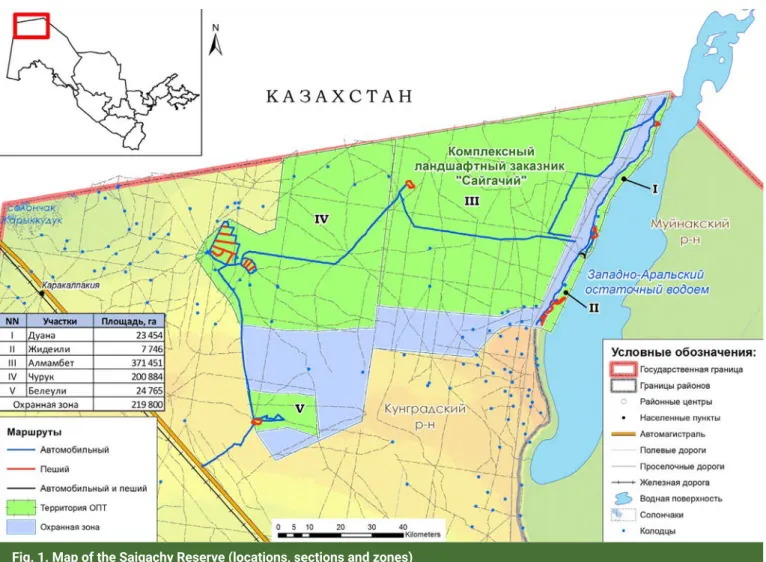
these wells flows into troughs (fig. 1). A few artesian
well pools are to be constructed soon in two sections of the reserve, Almambet and Beleuli.
To develop an ecological culture in local people, Reserve staff are organising activities to raise the awareness of children and adults about the impor-tance of protecting rare animals and plants. So, they told attendees at a meeting with people from Jaslyk village how to monitor animals with the help of cam-era traps. Reserve staff also met pupils of secondary schools from the same district to tell them about rare species of fauna and flora in the region and the importance of conserving them. Similar events were organised in schools in Nukus.
As an additional step, signs informing citizens about their legal responsibilities, including concerning poaching for saigas and other endangered species, were designed and placed in railway stations, school buildings, markets and other structures within human settlements.
In conclusion, after its reorganisation the Saigachy
Reserve is gradually becoming an efficient instrument
to protect an area of the Ustyurt Plateau containing unique fauna and flora. The return of a small group of saigas to their original wintering and breeding grounds has aroused hope that this species’ popula-tion will be restored in Uzbekistan.
Articles (cont.)
People of Jaslyk village acquainting themselves with how to monitor animals using camera traps. Photo by Saigachy Reserve
(а) A pregnant female and (b) a female with a newborn calf in the Saigachy Reserve in spring 2020. Photos from a camera trap, Saigachy Reserve/CADI
In 2019, activities to develop a fauna and flora moni-toring system were carried out as part of the Central Asia Desert Initiative (CADI) project supported by the Biodiversity and Protected Areas Department under
the State Committee of the Republic of Uzbekistan on Ecology and Environmental Protection. This system will be used in the Saigachy Reserve on the Ustyurt Plateau in the northern part of Karakalpakstan (fig. 1).
The Saigachy Reserve in Uzbekistan as a case study of the introduction of
a fauna and flora monitoring system
Maria Gritsina1, Natalia Marmazinskaya2, Luiza Mardonova3, Maksim Mitropolsky2
1 — Institute of Zoology, Academy of Sciences of the Republic of Uzbekistan; 2 — Uzbek Zoological Soci-ety; 3 — Biodiversity and Protected Areas Department, State Committee of the Republic of Uzbekistan on Ecology and Environmental Protection
Corresponding author: Maria Gritsina[email protected]
Fig. 1. Map of the Saigachy Reserve (locations, sections and zones)
Table of parts of the reserve and their area in hectares: I — Duana, II — Zhideili, III — Almambet, IV — Churuk, V — Beleuli, Buffer zone
Blue lines: Road, Red lines: Walking routes, Black lines: Joint vehicle and walking routes, Green polygon: Territory of the Saigachy Landscape reserve, Blue polygon: Buffer zone
Red line: State border, Grey line: District border, Grey dot: District centre, Black dot: Village, Orange line: Main road, Thin grey lines: Tracks, Cross-dashed line: Railway, Blue: Waterbody (remains of Aral sea), Shading: Saldpan, Blue dots: Wells
Articles (cont.)
The goal of the project was to design a monitoring concept and put it into practice with the help of the Protected Area staff. The project included:
y identification of sites with higher levels of biodiver
-sity within Saigachy reserve, based on a literature review, examination of satellite maps and study of
the results of field research carried out in April 2019;
y specifying permanent monitoring routes; y installing camera traps;
y collecting samples of flora (higher vascular plants)
and fauna (birds and mammals);
y specifying the technical support level required and
identifying the ranger team’s needs;
y identifying the rangers’ level of knowledge in
re-gional biodiversity and their skills in operating the monitoring and survey equipment available
at Saigachy (camera traps, range finders, GPS
and other);
y preparing a brief identification guide to typical
reptile, bird and mammal species and developing methodological guidance for the monitoring of fauna and flora.
In November 2019 the project team held a training course in biodiversity monitoring for employees of the Saigachy Reserve and Kungrad State Forestry and Hunting Enterprise, where the trainees learnt
about the legal basis for monitoring activities, census and survey methods, use of GPS and installation of camera traps. During the practical part of the training the project team and the reserve’s rangers installed ten camera traps in the Saigachy reserve’s main land-scapes (in the Duana, Zhideili, Almambet, Churuk and Beleuli sections of the reserve), in locations where it was possible to record the rarest representatives of the local fauna. The participants also carried out vehicle and point surveys of birds and mammals. Between November 2019 and January 2020, the camera traps recorded nine mammal species, four of which — the Brandt’s Hedgehog Hemiechinus
hy-pomelas, Turkmen Сaracal Caracal caracal michaelis,
Corsac Fox Vulpes corsac and Saiga Saiga tatarica — are listed in the Red Data Book of Uzbekistan (2019). The most important achievement of this project was a recording of 20-25 saiga individuals in the Almam-bet section of the reserve. A camera trap captured the animals regularly between 2nd and 4th January 2020 (95 photos in total). The herd included at least two mature and four juvenile males; the rest were females. According to the rangers, in total there were 35 saigas in this section.
In addition, the reserve’s rangers reported about one male and three females in the Beleuli section in March 2018. In the winter of that year they observed a group of 10—15 individuals along the Aral Sea shore. On 21st December 2018, 6 saigas were recorded in the Almambet section, including one adult male. Some saiga individuals are known to stay throughout the
year in the Duana section, in an area between the escarpment (chink) and the Aral shore. Abdusalom Normatov also reported observing about 100 indi-viduals on the former Vozrozhdeniye (Resurrection) Island on 18th February 2020. In addition, several records of groups of 15—20 saigas were made during the winter of 2019—2020 in the forest plantations on the dry bottom of the Aral Sea.
The Ustyurt saiga population is known to be impacted by the border fence built by the Kazakh government in 2012 and by the segment of the Kazakh Railway between Beyneu and Shalkar which was opened in 2017. Both block their traditional migration routes. In 2016 some changes were made in the structure of the border fence; 125 openings with a total length of 150 km were cut in the fence (Olson, 2013).
Indi-vidual animals use the openings, but no significant
migration has been recorded in recent years (Bykova et. al., 2016). However, according to records made in the winter of 2019/2020, a small number of saigas overcame the barrier and crossed the state border
to winter in Uzbekistan. This fact was confirmed by Saigachy Reserve employees, who identified saiga
footprints and faeces near the openings in the bor-der fence (oral report by A. Abdurakhmanov) and researchers from the Association for the Conserva-tion of Biodiversity of Kazakhstan who found saiga tracks in seven locations along the barrier (see the update above). Since it is obvious that saigas are crossing these linear structures, it would be appro-priate, in cooperation with the border service and ranger team, to monitor regularly the territory along
the border between Uzbekistan and Kazakhstan to learn more about the animals crossing the border, their mortality as a result, and to inspect pipelines and trenches in the area. Continued use of camera traps will help researchers to estimate the numbers of saigas crossing these linear structures and migrating into the territory of Uzbekistan. The reports of saigas in the Aralkum desert (Aral sea bed) suggest the need to start regular monitoring here as well.
To conclude, the reliable recent data on the pres-ence of migrating saigas, together with records of a number of other rare mammal species, are another
confirmation of the importance of the Saigachy Re -serve for the conservation of regional biodiversity. The monitoring system developed for the Saigachy reserve in this project will be put forward for consid-eration and approval to the State Committee of the Republic of Uzbekistan on Ecology and Environmental Protection and Academy of Sciences of the Republic of Uzbekistan.
The CADI project (https://cadi.uni-greifswald.de/en/ home) is implemented jointly by the University of Greifswald, Michael Succow Foundation (Greifswald city) and Food and Agriculture Organisation of the United Nations (FAO) as part of the International Cli-mate Initiative (IKI), with the support of the Federal Ministry of the Environment, Nature Conservation and Nuclear Safety (BMU) provided on the basis of a resolution by the German Bundestag.
Caracal captured by camera traps in the Duana zone of the Saigachy Reserve. Photo by Saigachy/CADI/Maksim Mitropolsky, Natalia Marmazinskaya
Joint work with Saigachy rangers. Photo by Natalia