InfiniCloud: Leveraging the Global InfiniCortex Fabric
and OpenStack Cloud for Borderless High Performance
Computing of Genomic Data
Kenneth Ban1,2, Jakub Chrzeszczyk3, Andrew Howard3, Dongyang Li3, Tin Wee Tan2,4
c
The Author 2017. This paper is published with open access at SuperFri.org
InfiniCloud is a geographically distributed, high performance InfiniBand HPC Cloud which aims to enable borderless processing of genomic data as the part of the InfiniCortex project. This paper provides a high-level technical overview of the architecture of InfiniCloud and how it can be used for high performance computation of genomic data in geographically distant sites by encapsulation of workflows/applications in Virtual Machines (VM) coupled with on-the-fly configuration of clusters and high speed transfer of data via long range InfiniBand.
Keywords: Genomics, Cloud-Computing, InfiniBand, Trans-continental, Virtualization, SR-IOV, OpenStack, HPC.
Introduction
The advent of big data has driven the need for flexible high performance computing platforms in order to analyze large amounts of data using user defined reproducible workflows, particularly in the emerging field of genomics and healthcare informatics. These workflows typically require a specific stack of applications with their operating system specific dependencies, which can be different for each pipeline and can frequently change over time as updates are released. In addi-tion to the heterogenous nature of applicaaddi-tions, such workflows demand high CPU performance paired with large memory capability as well as a high-performance interconnect for analysis of large genomic/healthcare datasets [9, 11].
In response to this growing need for high performance and flexible computing for analysis of large datasets [8], A*CRC and NCI teams collaborated to define a new cloud computing platform called InfiniCloud, which combines high performance cloud computing powered by OpenStack [6] with the high speed InfiniBand network architecture. This platform was optimized to provide high performance computing with minimal overhead within virtual instances, coupled with native InfiniBand protocol to provide high speed interconnect and transfer of data between the instances.
In cloud computing, resources are presented in a form of virtual machines (VMs). VMs are an abstraction layer which allows hardware resources of a physical system to be presented as number self-contained pools of virtual CPU cores, RAM, storage and network bandwidth that are used to run isolated operating system instances. These resources can be dedicated or shared, depending on performance requirements of the applications running in the cloud environment. The operating image can be created, customized, and versioned by users to ensure that the computing environment is reproducible and flexible. This is particularly important in the field of genomics, where processing pipelines are highly interconnected and can be dependent on a specific version of operating system, kernel, libraries and application binaries. This level of
1Institute of Molecular and Cell Biology, A*STAR, Singapore
flexibility is typically difficult to achieve on a traditional High Performance Computing cluster running multi-purpose system images.
Despite its advantages for reproducible and flexible computing, one major bottleneck in traditional cloud computing platforms is the inefficient and slow transfer of large datasets, com-monly encountered in genomic analysis. To address this, we extended the InfiniCloud platform to address the need for efficient high speed transfers by leveraging on the long range Obsidian Long-bow E100 InfiniBand extenders, enabling unprecedented high speed transfer of large datasets and VM images across trans-Pacific distances between two geographically distant InfiniCloud platforms in Singapore and Canberra. This capability enables borderless high performance cloud computing by high speed transfer of large datasets together with workflows/applications encap-sulated in VMs. The workflows/applications in VMs can be parallelized in virtual instances by the on-the-fly setup of cluster compute nodes, thus opening the door for scaling up reproducible computing environments beyond any one single HPC cloud computing site.
We envision that the InfiniCloud platform combined with long range InfiniBand as part of a global fabric (InfiniCortex) [14] will enable seamless distributed high performance computing amongst geographically distant InfiniCloud nodes, breaking down barriers to meet the challenge of big data computing.
1. InfiniCloud Platform
The InfiniCloud platform was developed on the NCI and A*CRC hardware and is based on OpenStack cloud computing software stack with custom modifications.
1.1. Hardware Components
Currently, InfiniCloud consists of two sites: one located at the NCI (National Computational Infrastructure), in Canberra, Australia and the second at A*CRC, Singapore (fig. 1). The total count of compute cores available is 264, supporting 3TB of memory and a local storage capacity of 15TB (SSD and HDD). All instances are connected to the shared 56Gbit FDR IB fabric.
Figure 1. InfiniCloud sites (left: NCI, Canberra, right: A*CRC, Singapore)
1.1.1. Server Specifications
Table 1. NCI InfiniCloud configuration
Servers 10x Fujitsu PRIMERGY CX250 CPU Intel Xeon E5-2650
Memory 256GB
Interconnect Mellanox FDR
Local storage 1x Intel DCS3500 or 3x Intel DCS3500
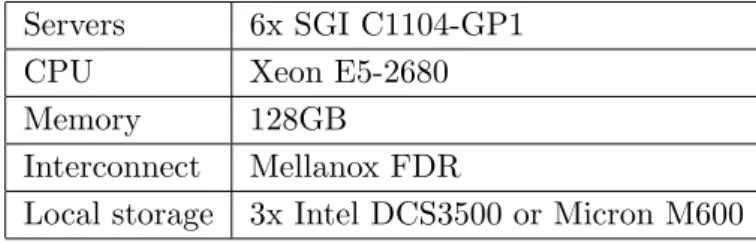
Table 2.A*CRC InfiniCloud hardware configuration
Servers 6x SGI C1104-GP1 CPU Xeon E5-2680 Memory 128GB
Interconnect Mellanox FDR
Local storage 3x Intel DCS3500 or Micron M600
1.1.2. Local Area Network Components (each site)
The core of InfiniCloud is a global InfiniBand interconnect, which consists of a local FDR switch at each site to connect the local compute nodes, combined with an Obsidian Strategics Longbow E100 range extender connecting the AU and SG InfiniCloud network fabrics (tab. 3 and fig. 2).
Table 3. Network configuration
Switching FDR IB
Range extender Obsidian Strategics Longbow E100 Subnet manager OpenSM (active:AU; standby: SG)
1.1.3. Global Area Network
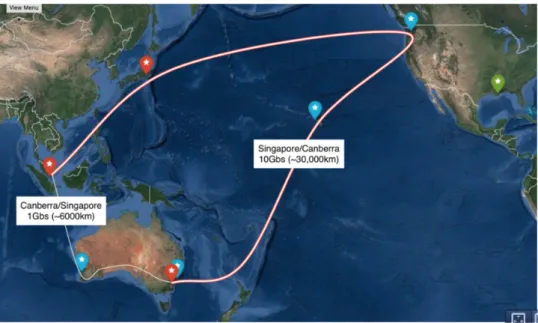
To enable the global InfiniBand connection, the A*CRC and NCI teams worked closely with AARNet (AU), SingAREN (SG) and Pacific NorthWest GigaPop (PNWGP) in Seattle (USA) to secure a dedicated 10Gbit/s layer 2 link between Canberra and Singapore using spare fibre capacity. Due to the network topology connecting Australia (with the majority of the bandwidth provided to the more densely populated East Coast of Australia), the link was routed via the longer eastern path, crossing the Pacific Ocean twice through PNWGP in Seattle with an RTT of 305ms. In contrast, while exhibiting better delay characteristics more direct western path through Western Australia, Indian Ocean and Guam has limited capacity and is only capable of providing a 1Gbit/s connection (fig. 3).
1.2. InfiniCloud Installation and Configuration
Figure 2. InfiniCloud Network Topology
Figure 3. InfiniCloud wide-area networking
Table 4.InfiniCloud software stack Operating System CentOS 6.6 x86 64 InfiniBand drivers Mellanox OFED 2.4
a variable number of compute nodes (ranging from 4-8). All node classes are integrated to form a fully featured HPC Cloud.
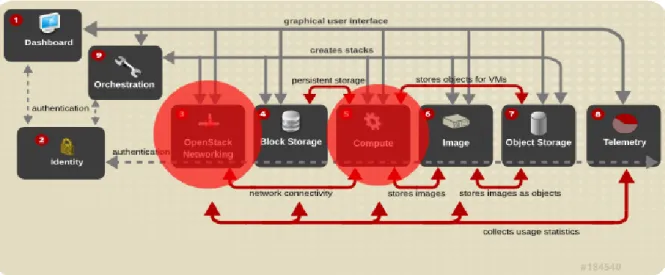
The management node is used for bare metal provisioning and cluster-wide configuration. The controller node provides API, CLI and GUI access to the cloud and is responsible for managing all the core areas of cluster operation: identity management, scheduling, VM image storage, network management and providing an orchestration layer. Compute nodes provide CPU, RAM, storage and high performance IOV networking [12] to the virtual instances. SR-IOV networking support is a requirement for enabling InfiniBand capability in virtual instances. Building the InfiniCloud cluster required a high degree of customization in order to enable native InfiniBand capability in virtual instances, as well as to provide access to the global InfiniBand network connecting Australia and Singapore. Tab. 5 and fig. 4 show the list of these modifications: (i) A custom virtual interface module adds support for SR-IOV virtual function networking in the nova-compute component; (ii) an embedded switch module implements linking virtual functions to guests and enforces network access restrictions; and (iii) a custom DHCP server package adds InfiniBand support. On top of this, OpenStack out-of-tree patches were necessary in order to force the use of a single partition key, as required by the global InfiniBand fabric. After installing the additional modules and patches, compute nodes are configured to directly connect the HCA to the upstream network, bypassing the layer 2 agent traditionally present on OpenStack compute nodes, as this functionality is now provided by the embedded switch.
Table 5. InfiniCloud OpenStack Customizations
Neutron Server enable SR-IOV and native IB capability Neutron Networker enable EoIPoIB support
Nova Compute enable SR-IOV and native IB capability Neutron Agent enable SR-IOV and native IB capability DHCP enable IPoIB support
eswitchd enable InfiniCortex global IB connectivity
2. InfiniCloud InfiniBand Capabilities
After cloud provisioning is complete and all the customizations required for global InfiniBand communications are in place, the system has the ability to provide virtual instances on demand, connected over InfiniBand with full ability to communicate with remote instances using RDMA over a trans-Pacific 10Gbit/s network.
2.1. High bandwidth capability — local connectivity
A high bandwidth capability within a cluster allows for the efficient transfer of data to compute nodes. Listing 1 demonstrates high bandwidth capability (∼6 GB/sec) between 2 virtual instances, close to the line rate on the FDR interconnect:
Listing 1. Local interconnect performance between a pair of virtual machines hosted in Singapore
-R D M A _ W r i t e BW Test
Dual - port : OFF Device : mlx4_0
Number of qps : 1 T r a n s p o r t type : IB
C o n n e c t i o n type : RC Using SRQ : OFF
TX depth : 128
CQ M o d e r a t i o n : 100
Mtu : 2048[ B ]
Link type : IB
Max inline data : 0[ B ]
rdma_cm QPs : OFF
Data ex . method : E the rne t
-local address : LID 0 x05 QPN 0 x0a5e PSN 0 x90c425 RKey 0 x b 8 0 1 1 7 0 0 VAddr (...) remote address : LID 0 x1a QPN 0 x0cac PSN 0 x94503d RKey 0 x 7 0 0 1 1 8 2 b VAddr (...)
-# bytes # i t e r a t i o n s BW peak [ MB / sec ] BW average [ MB / sec ] MsgRate [ Mpps ]
65536 5000 5984.52 5976.36 0.0 956 22
-2.2. High bandwidth capability — global connectivity
Integral to the data transfer component is the use of the Obsidian Strategics dsync+ util-ity [1] which utilizes the RDMA (Remote Direct Memory Access) capabilities to provide long range InfiniBand RDMA transfers between InfiniBand-connected virtual instances. This high performance transfer capability uncouples the need for the data to be located close to the com-pute nodes, enabling the computing of data to scale beyond a single site.
Listing 2. Global interconnect performance between a pair of virtual machines hosted in Singapore and Australia
[ r o o t @ t e s t 0 1 ~]# dsync -- direct - io -- option Xfer :: RDMA :: Buffer - Size = 5 3 6 8 7 0 9 1 2 0 \ -- option Xfer :: RDMA :: IO - Block - Size = 1 0 4 8 5 7 6 0 \
1 9 2 . 1 6 8 . 2 0 0 . 1 4 4 : / scratch / kuba / r e f e r e n c e _ d s e t / / scratch / kuba - test / Fi nis hed g e n e r a t i n g remote file list . 40 files , 3 directores , 381 GB . Fi nis hed ch eck ing local files . Need to get 40 files , 381 GB .
Tr ans fer xfer - ib - rdma network usage 3050 B in 0 s (10.0 kB / s ) Tr ans fer xfer - ib - rdma network usage 381 GB in 8 m19s (764 MB / s ) Done . T r a n s f e r r e d 381 GB in 8 m27s (752 MB / s )
The remarkable performance observed with long range InfiniBand RDMA provides a signif-icant improvement (∼20 fold) over standard TCP/IP protocols.
3. Using InfiniCloud for Parallelized Workflows in Genomic
Analysis
The InfiniCloud platform provides a high performance cloud computing environment for flexible workflows, coupled with unprecedented high speed transfer of big data sets over large geographical distances. A key application that takes advantage of these high performance char-acteristics is the analysis of genomic sequences which has seen an exponential growth in demand with the advent of next generation sequencing technologies.
The rapid development of next generation of sequencing technologies has dramatically re-duced the cost of sequencing genomes [13]. Previously, it took ∼USD $2.7 billion and 10 years to sequence one human genome, but currently the cost has dropped several orders of magnitude to ∼USD $1,000 per genome with the introduction of platforms such as the Illumina HiSeq X sequencer. This drop in cost coupled with the ability to sequence a complete human genome in a few days has driven the adoption of genomic sequencing in research labs as well as hospitals. Although the cost and speed of sequencing has dramatically improved, the transfer and computation of the genomic data remains a bottleneck in translating that data into the insights needed for improving patient care [10]. Typically, sequencers are not colocated with the compute resources and require the transfer of data in a timely manner. For example, a single Illumina HiSeq X can sequence 32 whole human genomes a week, resulting in ∼6 TB of genomic data. Such volume of data would take over six and a half days to transfer on a dedicated 100Mbps TCP/IP network, assuming ideal conditions and 100 % efficiency. The same transfer could be completed in just under three hours, using long distance InfiniBand [10]. This high performance data transfer capability of native InfiniBand transport would provide the scalability to cope with the growth of genomic data, given the increasing adoption of genomic sequencing in clinical and research labs.
In addition, the computational analysis of genomic data for clinical use requires enforcement of reproducibility standards in addition to the data provenance and security guarantees needed to comply with ethical and legal privacy issues. A computational platform for clinical genomics needs to meet the following challenges:
• High speed data transfers from sequencing data stores to the computational platform
• Easy provisioning of compute clusters for processing genomic data from multiple samples using parallel workflows
• High CPU and network performance for rapid analysis of large datasets
• Mechanisms for data provenance and security (e.g. using ephemeral containers) for com-putation at remote sites
3.1. Provisioning of instances and on-the-fly setup of cluster compute nodes for parallel workflows
To address these challenges, we implemented a software stack on top of the InfiniCloud platform that leverages the use of VM instances or containers to encapsulate workflows, together with automated provisioning of virtual instances and the setup of virtual compute clusters for parallelized workflows.
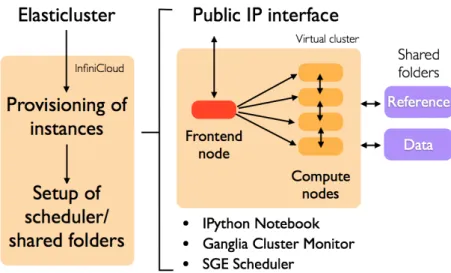
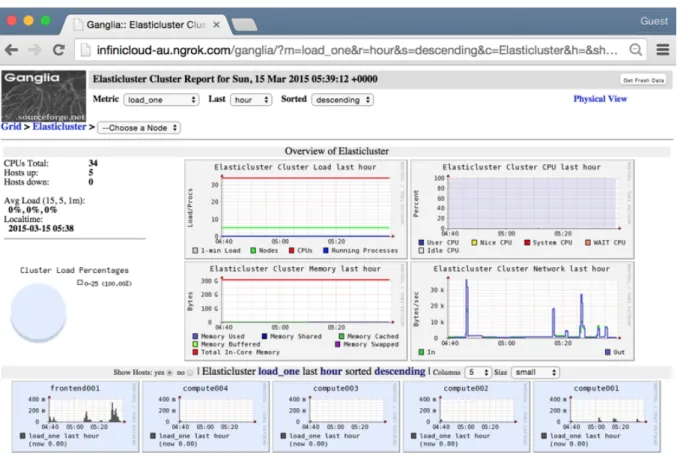
We adapted ElastiCluster [2] for use on InfiniCloud to enable easy provisioning of instances and setup of virtual clusters for parallel workflows (fig. 5). In our configuration, ElastiCluster was used to provision instances and set up a virtual cluster consisting of a frontend node and a user-defined number of compute nodes. To enable cluster computing for parallel workflows, we configured ElastiCluster to install and setup the SGE job scheduler [5], Ganglia monitoring tools [3], and the IPython notebook interface [4]. The package versions used are listed in tab. 6.
Table 6.Cluster computing stack
IPython Notebook shell (BASH/Python/R); 2.4.1 IPython parallel engine
SGE Grid engine job scheduler 6.2u5 Ganglia Cluster monitoring (CPU/Memory/Network) 3.1.7
Figure 5. On-the-fly provisioning and setup of virtual clusters for parallelized workflows
Figure 6. Ganglia cluster monitoring
3.2. Implementation of variant calling genome analysis pipeline
Next, we demonstrate how the on-the-fly provisioning and setup of virtual machines can be used to parallelize a genomic analysis workflow. We chose a clinically relevant workflow, called variant calling, that takes genomic sequences from cancer samples and detects mutations in genes that could be used to determine the prognosis of a patient, or to identify potential chemotherapy drugs that could be used for treatment. As each cancer sample can be analyzed separately, the workflow is amenable to simple asynchronous parallelization without any inter-process communication.
The implementation of genomic workflows typically involves several processing steps that are run using different applications that may vary in complexity of the setup dependencies. The ability to install and run them in a virtual instance allows the different applications to be set up to interoperate properly, then replicated for parallel workflows.
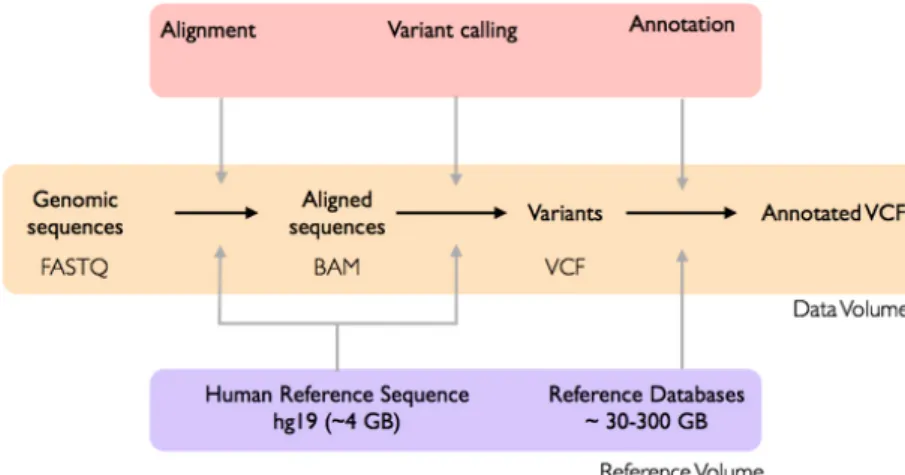
In this workflow, genomic sequences are processed in a pipeline through a series of steps using different applications to identify and annotate mutations (fig. 8). We use the pipeline application to orchestrate the steps in processing and to distribute the processing to the compute nodes using the SGE job scheduler:
1. Genomic sequences from each cancer sample are processed with an aligner — the applica-tion that compares the sequences to a human reference genome sequence and identifies the position and alignment of each sequence from the cancer samples.
2. The files from each cancer sample are processed by a variant caller program, which com-pares the aligned sequences to the human reference genome sequence to identify variations (substitutions, insertions, deletions) in the cancer samples.
3. The variant files from each cancer sample are annotated. A specialized application compares each variation to multiple databases to identify what the potential effects of each mutation have on regions in the genome.
The applications are pre-installed in the VM images together with their dependencies to enable portability between InfiniCloud platforms. The reference datasets required by the aligner, variant caller, and annotation tool are located in a data volume that can be mirrored between InfiniCloud platforms. The genomic dataset is isolated in a separate volume which also stores the results of the analysis (fig. 8); this isolation provides the flexibility for maintaining data provenance and security.
3.3. Demonstration of genome analysis workflow for remote cloud computing
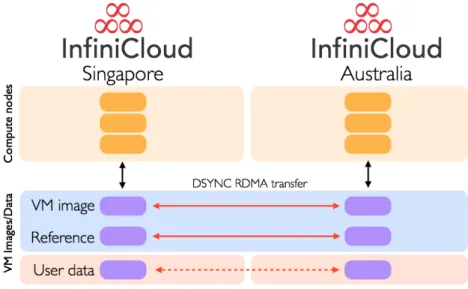
We demonstrate the computation of genomic sequences from multiple cancer samples on the InfiniCloud platform in Canberra, Australia from Singapore by remote provisioning of instances, setup of the cluster, and mounting of reference/data volumes (fig. 9).
• The VM images are mirrored from Singapore to Australia so that both sites have the same application/workflow backends for genomic analysis
• The common reference volume is automatically mirrored from Singapore to Australia and attached to the frontend and compute nodes
• The data volume is synchronized according to a user-defined workflow and attached to the frontend and compute nodes
• Genomic data is transferred from Singapore to Australia for computation
• Results are transferred back from Australia to Singapore
• The data volume on remote site can be deleted in cases where genomic data cannot be stored offsite for data provenance and security reasons
Figure 9. Borderless HPC cloud computing of genomic data across different sites for scalability
For the analysis, the genomic data is first transferred from Singapore into the data volume (Australia) using the dsync+ utility. Here, we achieve a transfer of ∼233 GB of data in 5.5 minutes (∼696 MB/sec) from Singapore to Australia via Seattle (∼30,000 km). The data from multiple cancer samples is then analyzed with the variant calling pipeline. Fig. 10 and fig. 11 show the CPU and network resource utilization during the pipeline run.
As an illustration of the output from the variant calling pipeline, fig. 12 shows mutations detected in a tumour suppressor gene (TP53) in a cancer sample which generally signifies a bad prognosis.
Figure 10. Aggregate CPU load
Figure 11. Aggregate network utilization
Conclusions
We present a new cloud computing platform called InfiniCloud, which combines high per-formance cloud computing powered by OpenStack [6] with the high speed/low latency of an InfiniBand network architecture. This platform delivers high performance computing with min-imal overhead within virtual instances, coupled with native InfiniBand protocol for high speed interconnect transfer of data between the instances.
In addition, the InfiniCloud platform incorporates long range InfiniBand extension and en-ables unprecedented high speed transfers of large datasets such as genomic data and VM images across global distances. This capability enables borderless high performance cloud computing that integrates high speed transfer of large datasets together with workflows/applications encap-sulated in VMs. This encapsulation allows easy parallelization of virtual instances and on-the-fly instantiation of cluster compute nodes using ElastiCluster.
We envision that the InfiniCloud platform combined with long range InfiniBand as part of the InfiniCortex global InfiniBand fabric [14], will enable seamless distributed cloud-based high performance computing amongst geographically distant InfiniCloud nodes, breaking down borders and illuminating the path to exascale computing to meet the challenge of supporting current and future big data computing needs.
This research was undertaken with the assistance of resources from the National Computa-tional Infrastructure (NCI), which is supported by the Australian Government.
This work was supported by the A*STAR Computational Resource Centre through the use of its high performance computing facilities.
This paper is distributed under the terms of the Creative Commons Attribution-Non Com-mercial 3.0 License which permits non-comCom-mercial use, reproduction and distribution of the work without further permission provided the original work is properly cited.
References
1. dsync+. http://www.obsidianresearch.com/products/software/dsync+/index.html.
2. ElastiCluster. https://github.com/gc3-uzh-ch/elasticluster.
3. Ganglia monitoring system. http://ganglia.sourceforge.net/.
4. IPython interactive computing. http://ipython.org/.
5. Open grid scheduler. http://gridscheduler.sourceforge.net/.
6. OpenStack cloud computing platform. http://www.openstack.org.
7. Georges A, Li Q, Lian J, O’Meally D, Deakin J, Wang Z, Zhang P, Fujita M, Patel HR, Holleley CE, Zhou Y, Zhang X, Matsubara K, Waters P, Graves JA, Sarre SD, and Zhang G. High-coverage sequencing and annotated assembly of the genome of the Australian dragon lizard Pogona vitticeps. Gigascience, 4(45), Sep 2015. DOI: 10.1186/s13742-015-0085-2.
Singa-pore,http://www.hpcadvisorycouncil.com/events/2014/singapore-workshop/preso/
12_ANU.pdf, November 2014.
9. Marius Hillenbrand, Viktor Mauch, Jan Stoess, Konrad Miller, and Frank Bellosa. Virtual InfiniBand clusters for HPC clouds. In Proceedings of the 2nd International Workshop on
Cloud Computing Platforms, page 9. ACM, 2012. DOI: 10.1145/2168697.2168706.
10. Andrew Howard. NCI InfiniCloud: Expanding clouds with high speed InfiniBand inter-connects. http://www-lk.apan.net/meetings/Fukuoka2015/Sessions/22/NCI_Howard_
InfiniCloud_APAN_Fukuoka_TAN.pdf.
11. Wei Huang, Jiuxing Liu, Bulent Abali, and Dhabaleswar K Panda. A case for high perfor-mance computing with virtual machines. In Proceedings of the 20th annual international
conference on Supercomputing, pages 125–134. ACM, 2006. DOI: 10.1145/1183401.1183421.
12. Jithin Jose, Mingzhe Li, Xiaoyi Lu, Krishna Chaitanya Kandalla, Mark Daniel Arnold, and Dhabaleswar K Panda. SR-IOV support for virtualization on infiniband clusters: Early experience. In Cluster, Cloud and Grid Computing (CCGrid), 2013 13th IEEE/ACM
In-ternational Symposium on, pages 385–392. IEEE, 2013. DOI: 10.1109/ccgrid.2013.76.
13. E. R. Mardis. A decade’s perspective on DNA sequencing technology.Nature, 470(7333):198– 203, Feb 2011. DOI: 10.1038/nature09796.
14. Tin Wee Tan, Dominic S.H. Chien, Yuefan Deng, Seng Lim, Sing-Wu Liou, Jonathan Low, Marek Michalewicz, Gabriel Noaje, Yves Poppe, and Geok Lian Tan. InfiniCortex: A path to reach Exascale concurrent supercomputing across the globe utilising trans-continental InfiniBand and Galaxy of Supercomputers. Submitted to Supercomputing Frontiers 2015 conference proceedings, Singapore.