210
GENERAL ASPECTS REGARDING THE GROWTH FRESHWATER FISH
IN CUBES, AN ALTERNATIVE FOR AQUACULTURE IN ROMANIA
CABA I.L.1), LAZA E.A.1), PĂUN A.1), VLĂDUŢ V.1), COSTACHE M.2), MATACHE A.3), ANDREI P.4), SÎRBU F.D.5), MOŞOIU C.6) 1)
INMA Bucharest / Romania; 2)S.C.D.P. Nucet / Romania; 3)SAFE SMART SYSTEM Câmpina; 4)SC CALORIS SA Bucharest / Romania; 5) AGROMAD Crops SRL / Romania; 6)IBA Bucharest / Romania
E-mail:[email protected]
Keywords: fish grown in cages, health, nutrition
ABSTRACT
Due to the increased consumption of fish, as an alternative to achieving healthy population nutrition, the development of European aquaculture also shows an increasing trend. At present, freshwater culture is about 42% of total European fish production. Valuable species, from an economic point of view, can be reared in intensive systems in cages on running
waters or ponds, combined with less valuable species. There are also new species that are gradually becoming increasingly important for the fish industry in Europe. Freshwater aquaculture in Romania is based on rainbow trout and carp which are still predominant species, but there is significant demand for valuable fish species [11,12,16].
INTRODUCTION
Aquaculture practiced in Romania is largely based on traditional fish farming technologies, it is not a sufficient source of freshwater carnivorous species (pike, perch, chalice) and certain species of freshwater omnivorous fish (sturgeons,
sleep, tilapia). Combined pond
technologies (natural reservoirs) - in fish breeding cages (artificial reservoir) is an integrated system in the semi-intensive farming system, where fish feed on granules and fish outside the cages feed
on the remains of food left unused by fish in cages and natural food. We want all
entrepreneurs who are considering
setting up a business based on this
technology to have the minimum
knowledge necessary to make the right decision. The authors recommend careful study of other specialized papers in the field depending on the species of fish that are wanted to adopted, the intensity of the population of the fish, the natural conditions, etc.
MATERIAL AND METHOD
ASPECTS REGARDING THE GROWTH OF FISH IN CAGES
1. Construction of cages
Generally, a cage is made up of a rigid net with double mesh panels with a finer net on the top to prevent floating grain flushing, a lid that prevents the fish from escaping, and at the same time provides protection against predators and floats to keep the living on the surface water [13]. The materials from which the cages are made are among the most
211
also into account the size of the fish [19, 20, 21, 22, 23].
Smaller cages should be provided with lids that can be made of the same materials as cages or more resistant
materials. However, it should be
considered that they must allow for the behavior of fish to be followed by food administration and easy access to the removal of unconsumed food or dead fish.
The floaters supporting the cages can be made of very varied materials, such as floating sponges, expanded polyester, PVC pipes, etc. The cages can be anchored to the bottom of the basin or can also be fixed by docks, floating pontoons or other rigid objects that allow this.
The shapes that cages can have are extremely varied. It is generally used in circular, square or rectangular shapes, there are many opinions that the shape of
the cages does not influence the production (Figure 1).
The size of the cages depends to a large extent on that of the aquatic basin and the presence of additional aeration systems. In practice, cages with variable volumes, from 1 m3 to over 30 m3, are used, but the smallest are easier to exploit and more economical. Large cages, although having a lower cost per unit volume, yields per m3 are lower primarily due to a reduced water exchange rate between their interior and exterior. The most commonly used cylindrical cages of 1.2 x 1.2 m (diameter x depth), cubic sides of 1.2 m or parallelepiped of 2.4 x 2.4 x 1.2 m (length x width x depth), 2,4 x 1,2 x 1,2 m and 3,7 x 1,8 x 1,2 m. These sizes are
recommended by fish breeders
experienced in raising fish in cages.
Figure 1. Cage lifting cylinders (Masser) Figure 2. Cages for fish growth
There are also much bigger cages, they are generally used in the marine environment but also in the case of large surface lakes. In Romania, modular living systems (Figure 2) have been built
together with access ways (some
pontoons wood). The cage are circular, with a 6 m side and a 4.5 m deep, with a volume of approx. 420 mc. In these cages you can grow all fish species that are suitable for this technology [18].
2. Location of cages
Many types of aquatic basins can be used successfully for practicing this method of fish growth, including ponds,
natural or artificial lakes, various
accumulations of water, canals or even flowing water courses. For aquatic basins to be appropriate, they must meet the following conditions [22, 23]:
- their surface is better than half a hectare.
- the shores should not be easily erodable and the access of animals to them should be restricted or even prohibited.
212
forages not to accumulate, but to fall on the bottom of the basins.
Also, at a depth of more than 2 m, the
submerged macro flora is poorly
developed, so it does not impede the good circulation of water through the walls of the cages as it would happen at lower depths.
- the water level should not fluctuate more than 50-60 cm during the summer
- there must be a way to access the basin
that is practicable under any
environmental conditions. This is another essential condition for fish to grow in cages, as this method requires daily feeding and monitoring of fish. Also, when additional aeration is used, access to an electrical source is required.
- aquatic basins should not show too many fish outside the cages as they affect the production inside the cages.
3. Feeding the fish grown in cage
Irrespective of the species that grows in this system, feed to fish has a decisive influence on production results. Since fish
in cages cannot benefit from natural food, only nutritionally balanced nutritionally granulated feed can ensure good growth but also a good state of their health.
The feed must not be sink, but remain on the surface of the water or fall very slowly, so that the fish have enough time to consume it before it passes through
the meshes of the bottom nets.
Feed is administered in at least two secrets per day at regular intervals for at least 6 days a week [3, 4, 14].
The amount of food to be
administered varies depending on age fish, temperature [6, 15, 17], water quality, health, etc. being generally between 1-5% of an individual's body weight. Currently, two types of food
dispensers: reflex dispensers and
automatic dispensers.
The dispensers on request fig. 3 are made up of a hopper for storage of the feed axially passed through a vertical rod immersed with the bottom in the culture water which, when touched by the fish, causes the granules to fall into the water.
.
Fig. 3. Distributor on request Fig. 4. Vibrator automatic distributor
Automatic dispensers are periodically activated with timer relays that are
programmed to operate at certain
intervals the time required for the
technological feeds required. The
automatic dispensers (Figures 4, 5, 6, 7 and 8) can be: vibratory, helical screw,
pallet dispenser, rotary disk, etc.
213
Fig. 7. Rotary disc distributor Fig. 8. Vibratory dispenser dispenser
4. Ventilation of fish growth systems in cages 4.1. Characteristics of dissolved gases
The gas - to - water level can be expressed as concentration (C - mg / l), voltage (T - mmHg) or as a percentage of its saturation concentration in water [6,9].
The correlation between the concentration of a water dissolved in water and its tension, according to Henrz's law, is:
Ti = Fi x Ci where:
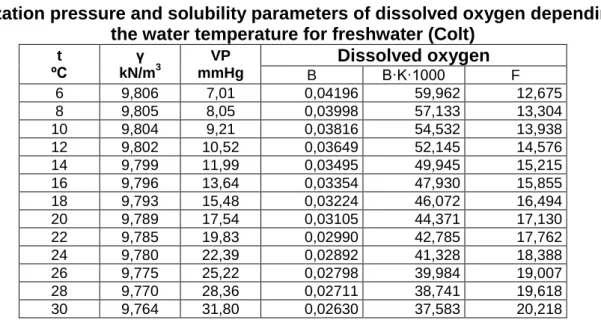
- Fi = factor of conversion of the dissolved gas tension (mmHg / mg / l); Fi parameter values depend on water temperature (Table 1). - Ti = dissolved gas tension (mmHg);
- Ci = concentration of dissolved gas (mg / l), - i = the dissolved gas species
By summing the partial pressure, Ti, of all the gases present in the solution results in the total dissolved gas tension (TGP), namely:TGP = Σ TiThe difference (ΔP) between total dissolved gas tension (TGP) and local barometric pressure (BP) is the most suggestive indicator of the degree of overloading of dissolved water in water.Water is considered to be over-saturated when ΔP> 0, where ΔP is defined as:
ΔP = TGP-BP
Table 1
Vaporization pressure and solubility parameters of dissolved oxygen depending on the water temperature for freshwater (Colt)
t
ºC kN/mγ 3
VP mmHg
Dissolved oxygen
B B·K·1000 F 6 9,806 7,01 0,04196 59,962 12,675 8 9,805 8,05 0,03998 57,133 13,304 10 9,804 9,21 0,03816 54,532 13,938 12 9,802 10,52 0,03649 52,145 14,576 14 9,799 11,99 0,03495 49,945 15,215 16 9,796 13,64 0,03354 47,930 15,855 18 9,793 15,48 0,03224 46,072 16,494 20 9,789 17,54 0,03105 44,371 17,130 22 9,785 19,83 0,02990 42,785 17,762 24 9,780 22,39 0,02892 41,328 18,388 26 9,775 25,22 0,02798 39,984 19,007 28 9,770 28,36 0,02711 38,741 19,618 30 9,764 31,80 0,02630 37,583 20,218
The meaning of the notations in the table is as follows:
t = water temperature (ºC)
γ = specific water weight (kN / m3
); VP = water vapor pressure (mmHg); B = Bunsen coefficient (gas / pressure at 760 mm Hg pressure absolute);
K = ratio of molecular weight to volume of gas (mg / ml);
B · K · 1000 = gas solubility (mg / l at a partial pressure of 760 mm Hg);
214
The degree of saturation can also be estimated as follows:
% saturation = 100
BP TGP
Dissolved gases in water are mainly oxygen, carbon dioxide and nitrogen.
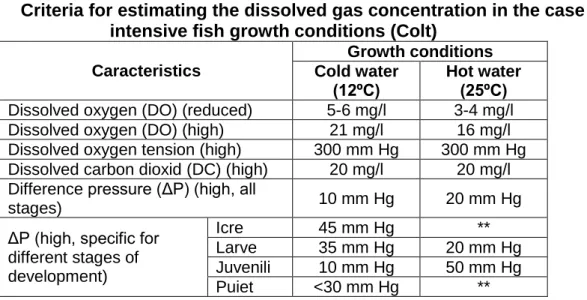
The critical concentrations of
dissolved carbon dioxide (DC), presented in Table 2 may affect renal activity by stimulating the precipitation of phosphate
anion in calcium phosphate and
depositing it into the renal channels. A high DC concentration can also reduce the blood's ability to carry oxygen.
Table 2
Criteria for estimating the dissolved gas concentration in the case of intensive fish growth conditions (Colt)
Caracteristics
Growth conditions Cold water
(12ºC)
Hot water (25ºC)
Dissolved oxygen (DO) (reduced) 5-6 mg/l 3-4 mg/l Dissolved oxygen (DO) (high) 21 mg/l 16 mg/l Dissolved oxygen tension (high) 300 mm Hg 300 mm Hg Dissolved carbon dioxid (DC) (high) 20 mg/l 20 mg/l Difference pressure (ΔP) (high, all
stages) 10 mm Hg 20 mm Hg
ΔP (high, specific for different stages of development)
Icre 45 mm Hg **
Larve 35 mm Hg 20 mm Hg Juvenili 10 mm Hg 50 mm Hg Puiet <30 mm Hg **
The efficiency of aeration /
oxygenation equipment is conditioned by the judicious design of the tower according to the following factors: the technologically required oxygen addition rate: the allowable limits for nitrogen content dissolved (DN) and carbon dioxide (DC); admissible degree of
over-saturation (ΔP); the predictable changes
of the DO, DN and DC variables for a certain type of contactor.
4.2 Performance indicators of air - oxidization systems
- In the practice of aquaculture farming systems, a variety of equipment is used to enrich the water content of oxygen, depending on the degree of production
intensity and the ecotechnological
particularities of the fish species.
Depending on this, there are, in principle, two systems of equipment to ensure the optimum oxygen content of water, namely: air-to-air aeration equipment and pure oxygen input equipment in the water
mass; each of these systems is
characterized by specific performance indices.
Ventilation growth systems generally use air-to-air aeration equipment (water / air contactors). The main aeration equipment used in these are: floating surface stirrers, submersible air diffusers, surface ejector with ejector tube, water jet agitators, etc.
Air-to-air aeration systems are
designed to accelerate the absorption of oxygen in the air by various processes most commonly used to consist primarily in increasing the water-air contact surface and / or introducing air under pressure into the mass of water.
The standard rate of oxygen transfer (SOTR) is the product of the mass
transfer coefficient, the saturation
concentration of the dissolved gas and the volume of the contactor fluid, according to the relationship.
SOTR = (KLa) 20ºC · (C *) 20ºC · V · 10-3
where:
215
- (KLa) 20ºC = global mass transfer coefficient at the standard temperature of 20 ° C (1 / h);
- (C *) 20 ° C = saturation concentration of
the dissolved gas (mg / l);
- V = volume of liquid in the contactor (l). Standard Aeration Efficiency (ESA) is an indicator that expresses the energy efficiency of aeration equipment; the physical significance of the SAE indicator is the ratio between the standard rate of oxygen transfer for a particular type of equipment and the power consumed by it, according to the relationship:
SAE =
PW SOTR
where:
- SAE = standard aeration efficiency (kg / kW · h)
- PW = the power consumed by the aeration equipment (kW);
SOTR = (KLa) 20ºC · (C *) 20ºC · V · 10-3 where:
- SOTR = standard oxygen transfer rate (kg / h);
- (KLa) 20ºC = global mass transfer
coefficient at the standard temperature of 20 ° C (1 / h);
- (C *) 20 ° C = saturation concentration
of the dissolved gas (mg / l);
- V = volume of liquid in the contactor (l).
In the case of non-standard
temperatures, it is necessary to correct the values of the SOTR and ESAs by
considering the following parameters: actual (actual) values of dewatering concentrations, barometric pressures and water composition (surfactant content and suspended solids).
The performance of diffusion aeration equipment is expressed by a specific
indicator, namely the oxygenation
efficiency (OE%), which is determined with the relation:
OE = 100
2
aer O
aer P X
Q
OTR
where:
- OTR = oxygen transfer rate (rate) (kg / h); - Qaer = volumetric flow rate of the air
introduced into the water (m3 / h);
- Paer = densitatea aerului introdus (kg/m3);
- Xo2 = fracţia molară a oxigenului.
4.3 Surface aeratours
Surface aerators provide, by various methods, spraying air in water or spraying water into atmospheric air in order to achieve the largest contact surface at which gas will be exchanged between the two phases [5]. The main constructive variants of surface aerators used in aquaculture farming systems are: floating surface agitators, surface ejectors with ejector tube and water jet aerators. Below are some models of aerators:
Fig. 9. FLOBUL surface aerator design Fig. 10. Aerator type AEROPULSE
The FLOBUL fan (Fig. 9),
manufactured in France, consists of an electric motor at a speed of 1,500 rpm, (1) which has a four-blade propeller (3) mounted directly on the shaft.
216
for protection against the penetration of impurities and fish. The AEROPULSE aerator (fig. 10) consists of an electric motor with a speed of 3,000 rpm, (3), which has a 3-blade propeller (5) mounted directly on the shaft. The position of the propeller motor can be adjusted as necessary between 30° and 90° to the surface of the water gloss by means of a special device (2). The aerator is supported on the surface of water by floats made of high-density polyethylene (1 and 4), and is provided at the bottom with a stainless-steel sieve (6). Aspiration air from the atmosphere is introduced into the water which in turn is
strongly agitated by the propeller thus creating the premises of a very good air-water mixture.
5. Monitoring and control of water quality
The main objectives of the monitoring and control of aeration equipment are to minimize energy consumption and ensure a long service life [6,15,17].
Measurement of oxygen
concentration in water as well as other physico - chemical water can be carried
out continuously or at intervals.
Measurements made at time intervals are done with handheld probes (Fig. 11, 12).
Fig.11. Oxygen measurement device Fig.12. PH meter
RESULTS AND DISCUSSIONS
Aquaculture in general can generate
great material satisfaction if
entrepreneurs in this field are armed with specialized solid knowledge [18]. In cases where specialists recommendations are not followed, the problems that may arise in aquaculture practiced in the wild are as follows:
a) damages arising from chemical agents
Water, as a fish's living environment, is defined as a suspension of more or less numerous chemicals that give it a whole set of properties [9,10].
Maintaining these properties within certain limits, against which the fish have adapted during their phylogenesis, is a normal chemistry, favorable to the growth and reproduction of these fish.
Abnormal fish chemistry can be determined by:
- unwanted processes naturally
produced in ponds;
- deliberate or forced waste spills from agriculture, animal husbandry, industry, community activities, etc.;
- mistakes in the application of pool maintenance technologies;
- mistakes in the application of breeding and fish breeding technologies;
- drug substances used for different treatments;
- fish distributed to fish, inappropriate qualitatively and quantitatively.
Although the accumulated knowledge of the pathophysiological effects of the chemical properties of water and their zootechnical consequences are numerous, they remain far from satisfactory.
b)water temperature as patogen factor
217
lakes or seas. If weather conditions or human intervention are exceeded limits over a longer time, whether above or below the lower limit, the fish suffer due to metabolic deficiencies. Particularly high
and sudden temperature variations trigger high mortality [6, 15, 17]. Table 3 contain the pathophysiological incidences of temperature variations on both sides of the optimum area.
Table 3
Pathophysiological Incidences of temperature variations on both sides of the optimum area
Effects
pathophysiological
Suboptimal temperatures
Overoptimal temperatures
Metabolism bazal reduced high
Metabolic activity reduced diminuată
Oxygen consumption reduced high
Respiratory rhythm reduced high Gill absorption and
penetration of the toxin
reduceds highs
Defense reactions reduced high
Gastrointestinal motility reduced high Pathological risks
bio aggressors medial compounds and bacteria
The indirect effect of water temperature on the health status of fish is felt by: - conditioning the values of the qualitative parameters of the water to which the fish is very sensitive, such as the oxygen; - Stimulating the proliferation of algae, some of which are toxic and bacteria with a role in the mineralization of organic substances in decomposition;
- stimulating the multiplication of bioaggregators.
c) materials in suspension
Suspended matter are solid, finely divided solids of a mineral or organic nature present in water, which gives it a turbid state.
The indirect effect of suspended matter is more complex and consists of: - diminishing brightness;
- reduction of photosynthesis;
- increased water temperature as a result of increased caloric absorption;
- retaining a smaller amount of oxygen in water; - diminishing primary production and natural production. Suspended materials come from precipitation, from various
pollutant sources.In intensive fish
farming, manure is a source of
suspended matter. Optimal values of the
amount of suspension material
recommended in aquaculture are:- for eggs incubation, in salmon culture, <25 mg/l;- in other cases, <75 mg/l.
d) gas overseas
Atmospheric gas over-precipitation is the cause of skin emphysema (gas bubbles under the skin) or gaseous emboli of 110 - 115%. As saturation increases, the exposure duration required for triggering morbid disorders decrease. The passage of air from the gaseous to the solvated state in the fish body generates these disorders.
Causes of water over-precipitation in solvates can be both natural and induced.
e) insufficient content of oxygen in water
218
Fish can often die by choking in winter, in densely populated basins, as well as in summer in polluted waters with high temperature and weak current.
Deficiency in solvated oxygen in the water causes the fish to suffocate and ultimately to die; the different species die successively, depending on the amount of oxygen they need. Oxygen-depleted fish are no longer fed, swim near the surface of the water, they breathe mildly, clump to the feeding holes, are apathetic, devoid of reactivity, lose orientation reflex and die.
The damage caused to fish by the presence of a large amount of oxygen in the water is rare. These can occur, for example, when the fish is transported in polyethylene bags with atmospheric oxygen. Excess oxygen in water can lead to fish paralysis.
f) excess of carbon dioxide in water
Carbon dioxide is solubilized in water in molecular state; only 10% of it forms carbonic acid.
In stagnant waters, the CO2 level is stratified due to photosynthetic assimilation of the phytoplankton, respectively the layer above has less CO2 free than the lower layer. It is possible that in the surface layer, free carbon dioxide is consumed entirely in the photosynthesis process, in which case the pH of the water can rise to more than 8.3.
g) pathological state caused by water from nitrogen substances
Nitrogen compounds in fish pathogenic water are ammonia (NH3), nitrites (NO2-) and some cases of nitrates (NO3-).
They result from the decomposition of dead organic matter, from the reduction of nitrates and nitrites present or organic, or, be produced by metabolism, such as ammonia.
Among the pathological conditions of fish caused by nitrate, the most common are ammonia and nitrite poisoning.
CONCLUSIONS
- the high density of fish in the cages can cause problems with water quality and the spread of disease;
- fodder must be unaltered and nutritionally complete, providing all the protein, carbohydrates, lipids, vitamins and minerals needed;
- cages can be easily vandalized, which requires strict guarding of them;
- daily intervention is required at each cage level. - if no additional aeration is applied, the production per hectare may be less than in the semi - intensive growing system in the pond;
- all of the above can be considered disadvantages, but they can enumeration and many advantages that could be safe arguments for many fish farmers to apply this method of fish growth on their own
farm. Among these, the following can be mentioned:
- the method can be practiced on water courses or aquatic basins of the most varied (ponds, reservoirs or natural lakes etc.) that are not suitable for emptying or emptying;
- the costs of building / arranging the ponds are eliminated;
- fish growth varieties are cheap, so a relatively small initial investment is needed; - the dynamics of fish growth is very easy monitoring;
- all the links of the technological flow can be under permanent control;
- fishing is easy, the method allows the use of an aquatic pool for both fish growth and sport fishing.
BIBLIOGRAPHY
1. Arlati G., Bronzi P., 1993 - Sturgeon farming in Italy, Proc. Intern. Sturgeon Symp. Moscow, VNIRO. 321-332 pp.
219
and exotic sturgeons in natural habitats in Central and Western Europe, Journal Applied Ichthyology, 18, 444-448.
3. Bódis M, Makkos-Takács SZ., 2004 -
Süllő nevelése táppal – ketreces kísérletek (rearing pikeperch with dry feed—cage experiments), Halászat 97:136–138 (in Hungarian).
4. Bódis, M. and Bercsényi, M., 2009 -
The effect of different daily feed rations on the growth, condition, survival and feed conversion of juvenile pikeperch ( Sander lucioperca ) reared with dry feed in net cages, Aquaculture International 17(1): 1-6.
5. Çelikkale M. S., Memiş D., Ercan, E.
and Çağıltay, F., 2005 - Growth
performance of juvenile Russian sturgeon (Acipenser gueldenstaedtii Brandt & Ratzenburg, 1833) at two stocking densities in net cages, Journal of Applied Ichthyology, 21: 14–18.
6. Dostatni D., Mamcarz A., Kozlowski J., Poczyczynski P. 1999 - Influence of the thermal conditions during tank rearing on further growth of whitefish larvae (Coregonus lavaretus L.) in illuminated cages. Archives of Polish Fisheries 7(1) 53-60. 7. Edwards P., 2011 - Aquaculture for enhancing nutritional and economic improvement in Asia. Compendium of Asian-Pacific Aquaculture 2011, Annual Conference of the WAS-APC, 17-20 January, 2011, Kochi, India pp. 1-11.
8. FAO, 2017 - FAO Fisheries and
Aquaculture Department, Fishery information, Data and Statistics Unit. FishStat Plus. Universal software for fishery statistics
time series. Rome (available at
http://www.fao.org/fishery/statistics/softwa re/fishstat/en).
9. Fermin A., C. and Seronay G. A.,
1998 - Effects of different illumination
levels on Zooplankton abundance, feeding periodicity, growth and survival of the Asian sea bass, Lates calcarifer (Bloch), fry in illuminated floating nursery cages, Aquaculture 157 (3-4) 227-237. 10. Filipiak J., Czerniejewski P., Sadowski J., Trzebiatowski R., 1999 -
Comparison of the effect of cage-rearing of sterlet (Acipenser ruthenus) and Russian × Siberien sturgeon (Acipenser gueldenstadetdti× A. baeri) hybrid fry in cooling water, EJPAU 2(2), #03. Available Online:
http://www.ejpau.media.pl/volume2/issue 2/fisheries/art-03.html
11. Filipiak J., Trzebiatowski R., 1995 -
Preliminary results of rearing Acipenserid fish in cages in cooling water. In: Intern. Conf.: New fish species in aquaculture (24-24 October 1995). Spec. Publ. Agricult. Univ. of Szczecin, Poland: 83-84 pp. 12. Fontaine P., Tamazouzt L., Capdeville B., 1996 - Growth of the Eurasian perch (Perca fluviatilis L.) reared in floating cages and in water recirculated system: first results, Journal of Applied Ichthyology 12(3-4):181-184. 13. Masser M.P., 1988 - Cage Culture; Cage Construction, Placement, and Aeration, SRAC Publication no. 162. 14. Masser M.P., 1988 - Cage Culture; Handling and Feeding Caged Fish, SRAC Publication no. 164.
15. Masser M.P., 1988 - Cage Culture; Site Selection and Water Quality, SRAC Publication no. 161.
16. Masser M.P., 1988 - Cage Culture; Species Suitable for Cage Culture, SRAC Publication no. 163.
17. Masser M.P., 1988 - Cage Culture; Cage Culture Problems, SRAC Publication no. 165.
18. Masser M.P., 1988 - Cage Culture; Harvesting and Economics, SRAC Publication no. 166.
19. Masser M.P., 1988 - What is Cage Culture, SRAC Publication no. 160.
20. Mazic P.M., Parker N.C., 2011 -
Semicontrolled Systems, pag. 241-284 in G.A. Wedemeyer, editor. Fish hatchery management, second edition. American Fisheries Society, Bethesda, Maryland. 21. Swann LaDon, Selock D., 1994 -