WSN with Cluster Head and Mobile Sink Node
Ms K.Kayalvizhi Mrs.P.Umarani
Department of Computer Science and Engineering Department of Computer Science and Engineering SSM College of Engineering, Komarapalayam, SSM College of Engineering, Komarapalayam
Tamil Nadu, India Tamil Nadu, India
[email protected] [email protected]
Abstract—In wireless sensor networks, energy efficiency is considered to be a crucial issue due to the limited battery capacity of the sensor nodes. Due to the converge cast nature of
traditional WSN packet forwarding approaches resulting in the concentration of data traffic
towards the sinks, the nodes in the vicinity of the static sinks are more likely to deplete their
batteries before other nodes. Load-balancing is implicitly provided by the sink mobility,
shifting the hotspots around the sinks and spreading the increased energy drainage around the
sink, which helps achieving uniform energy consumption that extends the network lifetime.
To ease the data collection efforts in such scenarios, thus making mobile sinks more
applicable, heterogeneous architectures stemming from the marriage of WSNs with other
types of networks are also possible. In this project addition propose a novel hierarchical
routing protocol for WSNs with a mobile sink, named Ring Routing. By visiting each
selected ANs node can efficiently gather data from cluster heads and transport the data to the
static data sink.. The results show that when each cluster has at-most two cluster heads, the
scheme achieves over more energy saving per node and more energy saving on cluster heads
comparing with data collection through multi-hop relay to the static data sink.
Index Terms—Mobile sinks, distributed routing, data dissemination, energy
efficiency,mobility, wireless sensor networks
I-INTRODUCTION
Sensor networks are deployed to
sense, monitor, and report events of
interest in a wide range of applications
including, but are not limited to, military,
health care, and animal tracking. In many
applications, such monitoring networks
are expected to operate over an extended
period of time, making energy efficient
monitoring an important feature for
unattended networks. In such scenarios,
nodes are designed to transmit information
only when a relevant event is detected.
Consequently, given the location of
an event-triggered node, the location of a
real event reported by the node can be
approximated within the node’s sensing
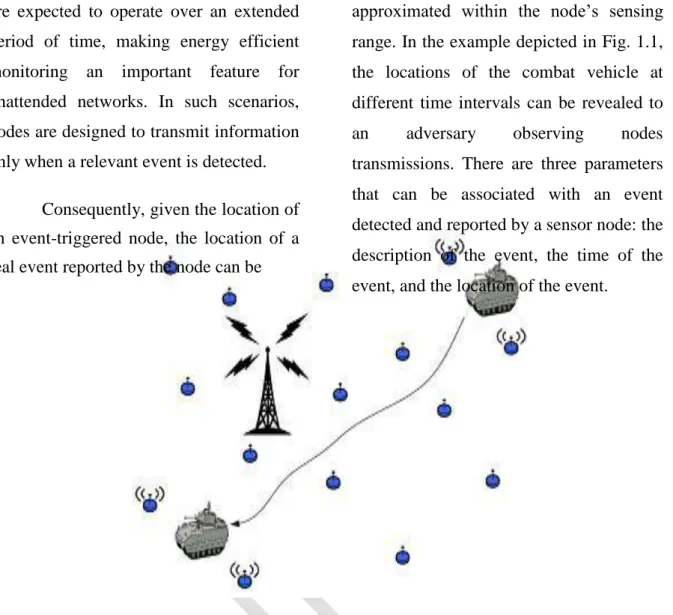
range. In the example depicted in Fig. 1.1,
the locations of the combat vehicle at
different time intervals can be revealed to
an adversary observing nodes
transmissions. There are three parameters
that can be associated with an event
detected and reported by a sensor node: the
description of the event, the time of the
event, and the location of the event.
Figure 1.1 A sensor network deployed in a battlefield. Only nodes in close proximity to
the combat vehicle are broadcasting information, while other nodes are in sleep mode.
When sensor networks are
deployed in untrustworthy environments,
protecting the privacy of the three
parameters that can be attributed to an
event-triggered transmission becomes an
important security feature in the design of
wireless sensor networks. While transmitting the ―description‖ of a sensed
event in a private manner can be achieved
via encryption primitives, hiding the
timing and spatial information of reported
events cannot be achieved via
cryptographic means. Encrypting a
message before transmission, for instance,
can hide the context of the message from
ciphertext is indicative of information
transmission. The source anonymity
problem in wireless sensor networks is the
problem of studying techniques that
provide time and location privacy for
events reported by sensor nodes.
II-RELATED WORKS
Mario di francesco and Sajal k.
Das crewman stated, Wireless sensor
networks (WSNs) have emerged as an
effective solution for a wide range of
applications. Most of the traditional WSN
architectures consist of static no des which
are densely deployed over a sensing area.
Recently, several WSN architectures based
on mobile elements (MEs) have been
proposed. Most of them exploit mobility to
address the problem of data collection in
WSNs.
In this paper defined WSNs with
MEs and provide a comprehensive
taxonomy of their architectures, based on
the role of the MEs. Then, we present an
overview of the data collection process in
such scenario, and identify the
corresponding issues and challenges. On
the basis of these issues, we provide an
extensive survey of the related literature.
Finally, we compare the underlying
en problems and future research directions.
The authors Elyes ben hamida,
Guillaume chelius decribes in wireless
sensor networks, data dissemination is
generally performed from the sensor nodes
towards a static sink. In this paper, we
address the particular case where the sink
is mobile, according to an unpredictable
mobility pattern. First, we study existing
approaches. As an alternative, we present
the Line-Based Data Dissemination
(LBDD) protocol. Next, we analytically
evaluate the communication cost of this
protocol and we compare it to other
approaches. Finally, realistic simulations
are performed and results show that LBDD
outperforms previous approaches and
presents the best tradeoff among the
evaluated protocols.
Youngsang yun and Ye xia
proposes a framework to maximize the
lifetime of the wireless sensor networks
(WSN) by using a mobile sink when the
underlying applications tolerate delayed
information delivery to the sink. Within a
prescribed delay tolerance level, each node
does not need to send the data immediately
as it becomes available. Instead, the node
can store the data temporarily and transmit
it when the mobile sink is at the most
longest WSN lifetime. To find the best
solution in the proposed framework, we
formulate optimization problems that
maximize the lifetime of the WSN subject
to the delay bound constraints, node
energy constraints, and flow conservation
constraints. We conduct extensive
computational experiments on the
optimization problems and find that the
lifetime can be increased significantly as
compared to not only the stationary sink
model but also more traditional mobile
sink models. We also show that the delay
tolerance level does not affect the
maximum lifetime of the WSN.
III-EXISTING SYSTEM
Ring Routing is an energy efficient,
reliable routing protocol that provides fast
data delivery. Extensive simulations are
conducted to evaluate the performance of
Ring Routing. It is compared with two
existing mobile sink routing protocols,
Line-Based Data Dissemination (LBDD)
and Railroad terms of energy consumption,
lifetime and data reporting delay metrics.
Ring Routing outperforms its competitors
in almost all scenarios and proves to be a
successful routing solution.
Ring Routing, is a hierarchical
mobile sink routing protocol. In this
existing system, the most influential
hierarchical mobile sink routing protocols
are reviewed and their benefits and
drawbacks are determined. Lastly the
highlights of Ring Routing with respect to
these protocols are determined.
DRAWBACKS OF EXISTING
SYSTEM
How to find anchor node and compatible pairs for each sink node
is not studied.
Partition the continuous space to locate the optimal anchor node for
each sink node is not carried out.
To achieve optimal overall routing diversity is not carried out.
Schedule uploading from multiple sink in not done.
IV-PROPOSED SYSTEM
METHODOLOGY
The proposed system includes
solving the problem of how to find anchor
node and compatible pairs for each sink
the optimal anchor node for each sensor
network. Then finding the compatible pairs
becomes a matching problem to achieve
optimal overall routing diversity. The
second problem is how to schedule
uploading from multiple sink node. An
algorithm that adapts to the transmission
scheduling algorithms is included.
ADVANTAGES
The proposed system has following
advantages.
ARCHITECTURE OF PROPOSED METHODOLOGY
To find anchor node pairs for each sink node is
studied.
Partition the continuous routing to locate the optimal
polling point for each sink node
is carried out.
To achieve optimal overall routing diversity is
carried out.
Schedule uploading from multiple sink nodes in done.
Enhanced and Energy Efficient Ring Routing Protocol for
WSN with Cluster Head and Mobile Sink Node
Node Add Batteries Ring Routing
Add Node Add Batteries Initialized Node
Detail s
View Cloud
View Batteries Status Ring
Detail s
Sink Node Clustering
Receive packet
Find Ring Routing Path
V-CONCLUSION
The proposed system introduces a
method to improve routing performance
with small routing states. It solves the local
minimum problem by embedding a
network topology to a low-dimensional
Euclidean space where hop distances
between pairwise nodes. Based on accurate
hop distance comparison between
neighboring nodes, the greedy forwarding
can find the shortest path between two
nodes. The project shows that the routing
quality can be improved by embedding a
network topology to a Euclidean space.
Nearest node location need not be
retrieved from base station, since partial
path information (achieved through
maintaining trusted value of the path) is
maintained. Calculation overhead is
reduced since it maintains the quality
details of previous communications.
REFERENCES
[1] R. Jaichandran, A. Irudhayaraj, and
J. Raja, ―Effective strategies and
optimal solutions for hot spot
problem in wireless sensor networks (WSN),‖ in Proc. 10th
Int. Conf. Inf. Sci. Signal Process.
Appl., 2010, pp. 389–392.
[2] S. Olariu and I. Stojmenovi,
―Design guidelines for maximizing lifetime and avoiding energy holes
in sensor networks with uniform
distribution and uniform reporting,‖ in Proc. IEEE
INFOCOM, 2006, pp. 1–12.
[3] J. Luo and J.-P. Hubaux, ―Joint
mobility and routing for lifetime
elongation in wireless sensor networks,‖ in Proc. INFOCOM
24th Annu. Joint Conf. IEEE Comput. Commun. Soc., vol. 3,
2005, pp. 1735–1746.
[4] I. Chatzigiannakis, A. Kinalis, and
S. Nikoletseas, ―Efficient data
propagation strategies in wireless
sensor networks using a single mobile sink,‖ Comput. Commun.,
vol. 31, no. 5, pp. 896–914, 2008.
[5] D. K. Goldenberg, J. Lin, A. S. Morse, B. E. Rosen, and Y. R.
Yang, ―Towards mobility as a network control primitive,‖ in
Proc. 5th ACM Int. Symp. Mobile ad hoc Networ. comp., ser.
MobiHoc ’04.New York, NY,
USA: ACM, 2004, pp. 163–174.
[6] M. Di Francesco, S. K. Das, and G.
mobile elements: A survey,‖ ACM sensor networks: A survey,‖ in
Trans. Sens. Netw., vol. 8, no. 1, Proc. IFIP Wireless Days, 2009,
pp. 1–31, 2011. pp. 1–6.
[7] W. Liang, J. Luo, and X. Xu,
―Prolonging network lifetime via a
controlled mobile sink in wireless sensor networks,‖ in Proc. IEEE
Global Telecommun. Conf., 2010,
pp.1–6.
[8] Z. Wang, S. Basagni, E.
Melachrinoudis, and C. Petrioli,
―Exploiting sink mobility for
maximizing sensor networks lifetime,‖ in Proc. 38th Annu.
Hawaii Int. Conf. Syst. Sci., 2005,
p.287.
[9] J. Rao and S. Biswas,
―Network-assisted sink navigation for
dis-tributed data gathering: Stability
and delay-energy trade-offs,‖
Comput. Commun., vol. 33, no. 2,
pp.160–175, 2010.
[10] E. Hamida, and G. Chelius,
―Strategies for data dissemination
to mobile sinks in wireless sensor networks,‖ IEEE Wireless
Commun., vol. 15, no. 6, pp. 31– 37, Dec. 2008.
[11] Y. Faheem, S. Boudjit, and K.