IOS Press
A Convolutional Neural Network-based
Model for Knowledge Base Completion and
Its Application to Search Personalization
Dai Quoc Nguyen
a,*, Dat Quoc Nguyen
b, Tu Dinh Nguyen
aand Dinh Phung
aa Monash University, Australia
E-mails: [email protected], [email protected], [email protected] bThe University of Melbourne, Australia
E-mail: [email protected]
Editors:Luis Espinosa Anke, Cardiff University, UK; Thierry Declerck, DFKI GmbH, Germany; Dagmar Gromann, Technical University Dresden, Germany
Solicited reviews:Sergio Oramas, Pompeu Fabra University, Spain; two anonymous reviewers
Abstract.In this paper, we propose a novel embedding model, named ConvKB, for knowledge base completion. Our model
ConvKB advances state-of-the-art models by employing a convolutional neural network, so that it can capture global relationships and transitional characteristics between entities and relations in knowledge bases. In ConvKB, each triple(head entity, relation, tail entity)is represented as a 3-column matrix where each column vector represents a triple element. This 3-column matrix is then fed to a convolution layer where multiple filters are operated on the matrix to generate different feature maps. These feature maps are then concatenated into a single feature vector representing the input triple. The feature vector is multiplied with a weight vector via a dot product to return a score. This score is then used to predict whether the triple is valid or not. Experiments show that ConvKB obtains better link prediction and triple classification results than previous state-of-the-art models on benchmark datasets WN18RR, FB15k-237, WN11 and FB13. We further apply our ConvKB to a search personalization problem which aims to tailor the search results to each specific user based on the user’s personal interests and preferences. In particular, we model the potential relationship between the submitted query, the user and the search result (i.e., document) as a triple(query, user, document)on which the ConvKB is able to work. Experimental results on query logs from a commercial web search engine show that ConvKB achieves better performances than the standard ranker as well as strong search personalization baselines.
Keywords: Knowledge base completion, Convolutional neural network, ConvKB, Link prediction, Triple classification, Search personalization
1. Introduction
Large-scale knowledge bases (KBs), such as YAGO [41], Freebase [3] and DBpedia [25], are usually databases of triples representing the relationships
be-tween entities in the form of fact(head entity, relation,
tail entity)denoted as(h, r, t), e.g.,(Melbourne, cityOf, Australia). These KBs are useful resources in many
*Corresponding author. E-mail: [email protected].
applications such as semantic searching and ranking [21, 38, 60], question answering [17, 66] and ma-chine reading [61]. However, the KBs are still incom-plete, i.e., missing a lot of valid triples [40, 55]. There-fore, much research work has been devoted towards
knowledge base completionorlink predictionto
pre-dict whether a triple(h, r, t)is valid or not [4].
Many embedding models have proposed to learn vector or matrix representations for entities and rela-tions, obtaining state-of-the-art (SOTA) link prediction
results [35]. In these embedding models, valid triples obtain lower implausibility scores than invalid triples. Let us take the well-known embedding model TransE [5] as an example. In TransE, entities and relations
are represented byk-dimensional vector embeddings.
TransE employs a transitional characteristic to model relationships between entities, in which it assumes that if(h, r, t)is a valid fact, the embedding of head entity
hplus the embedding of relationrshould be close to
the embedding of tail entityt, i.e.vh +vr ≈vt (here,
vh,vrandvtare embeddings ofh,randtrespectively).
That is, a TransE scorekvh +vr−vtkp of the valid
triple(h, r, t) should be close to 0 and smaller than
a scorekvh0 +vr0 −vt0kp of an invalid triple (h’, r’,
t’). The transitional characteristic in TransE also
im-plies the global relationships among same dimensional
entries of vh, vr andvt. Other transition-based
mod-els extend TransE to use additional projection vectors or matrices to translate head and tail embeddings into the relation vector space, such as: TransH [54], TransR [27], TransD [19], STransE [33] and TranSparse [20]. Furthermore, DISTMULT [62] and ComplEx [48] use a tri-linear dot product to compute the score for each triple. Recent research has shown that using relation paths between entities in the KBs could help to get contextual information for improving KB completion performance [16, 26, 29, 32, 47]. See other embedding models for KB completion in Nguyen [31].
Recently, convolutional neural networks (CNNs), originally designed for computer vision [24], have sig-nificantly received research attention in natural lan-guage processing [9, 22]. CNN learns non-linear fea-tures to capture complex relationships with a remark-ably less number of parameters compared to fully connected neural networks. Inspired from the suc-cess in computer vision, Dettmers et al. [10] proposed ConvE—the first model applying CNN for KB
com-pletion. In ConvE, onlyvhandvrare reshaped and then
concatenated into an input matrix which is fed to the
convolution layer. Different filters of the same3×3
shape are operated over the input matrix to output fea-ture map tensors. These feafea-ture map tensors are then vectorized and mapped into a vector via a linear
trans-formation. Then this vector is computed withvt via a
dot product to return a score for(h, r, t). See a formal
definition of the ConvE score function in Table 1. It is worth noting that ConvE focuses on the local
relation-ships among different dimensional entries in each ofvh
orvr, i.e.,ConvE does not observe the global
relation-ships among same dimensional entries of an embed-ding triple (vh,vr,vt), so that ConvE ignores the
transi-tional characteristic in transition-based models, which is one of the most useful intuitions for KB completion. In this paper, we present ConvKB—a novel embed-ding model which proposes a novel use of CNN for the KB completion task. In ConvKB, each entity or
re-lation is associated with an uniquek-dimensional
em-bedding. Let vh, vr andvt denotek-dimensional
em-beddings ofh,randt, respectively. For each triple(h,
r, t), the corresponding triple ofk-dimensional
embed-dings (vh,vr,vt) is represented as ak×3input matrix.
This input matrix is fed to the convolution layer where
different filters of the same1×3shape are used to
ex-tract the global relationships among same dimensional entries of the embedding triple. That is, these filters are repeatedly operated over every row of the input matrix to produce different feature maps. The feature maps are concatenated into a single feature vector which is then computed with a weight vector via a dot product
to produce a score for the triple(h, r, t). This score is
used to infer whether the triple(h, r, t)is valid or not.
Our contributions in this paper are as follows:
– We introduce ConvKB—a novel embedding model
of entities and relationships for knowledge base completion. ConvKB models the relationships among same dimensional entries of the embed-dings. This implies that ConvKB generalizes tran-sitional characteristics in transition-based embed-ding models.
– We evaluate ConvKB on two benchmark datasets
WN18RR [10] and FB15k-237 [45], and show that ConvKB obtains better link prediction perfor-mance than previous SOTA embedding models. In particular, ConvKB obtains the best mean rank and the highest Hits@10 on WN18RR, and pro-duces the highest mean reciprocal rank and high-est Hits@10 on FB15k-237.
– We also evaluate ConvKB for triple classification
on two benchmark datasets WN11 and FB13 [40]. The goal is to classify whether a given triple is valid or not. ConvKB also does better than previ-ous SOTA models, obtaining the best and second best accuracies on WN11 and FB13, respectively.
– We adapt ConvKB to search personalization
rel-evant documents are ranked higher. More spe-cially, we train our ConvKB to measure a score
for each triple (query, user, document), and to
reward higher plausibility scores for more rele-vant documents. We then verify this application of ConvKB on the query logs of a commercial web search engine. Experimental results show that ConvKB significantly improves the ranking quality over the strong baselines.
The paper is organized as follows. We provide re-lated work in Section 2. We then describe our proposed model ConvKB in Section 3. We evaluate and compare ConvKB with previous models on the link prediction and triple classification tasks in Section 4. The appli-cation of ConvKB to search personalization is intro-duced in Section 5. The conclusion is finally presented in Section 6.
2. Related work
TransH [54] extends TransE to allow entities play-ing different roles in different relations. Each relation
ris associated with a relation-specific hyperplanewr,
and then the embeddings ofhandtare projected to this
hyperplane. The TransH score function is defined as:
fTransH(h,r,t) =kvh⊥+vr−vt⊥kp
wherevh⊥ =vh−wTrvhwrandvt⊥=vt−wTrvtwrare
the projected embeddings ofhandtonwrrespectively.
TransR [27] extends TransH to perform projections
where each relation ris associated with a projection
matrix Wr which is used to map entity embeddings
into the vector space of relations:
fTransR(h,r,t) =kWrvh+vr−Wrvtkp
Both TransH and TransR use only one vector or ma-trix to perform projections, ignoring the fact that head and tail entities have different properties to each re-lation. Therefore, head and tail entities should be as-sociated with their own projection vectors or ma-trices as presented in direct extensions of TransH and TransR such as TransD [19], STransE [33], lpp-TransD [65], TransR-FT [12], TranSparse [20] and ITransF[59]. The transitional characteristics in these transition-based models can be intuitively defined as:
if(h,r,t)is a valid fact, theprojectedembedding ofh
plus the embedding ofris close to theprojected
em-bedding oft. This reflects global relationships among
same dimensional entries ofprojected entity
embed-dings with relation embedding. In our ConvKB model,
Table 1
The score functions in previous models and in our ConvKB model.
kvkpdenotes thep-norm ofv.hvh,vr,vti=Pivhivrivti denotes a
tri-linear dot product.v = Re(v)−ıIm(v)withRe(v)andIm(v)
corresponding to the real and imaginary parts of the complex-valued vectorv, andıdenoting the square root of -1. In addition,gdenotes a non-linear function.∗denotes a convolution operator.·denotes a dot product.concatdenotes a concatenation operator.bvdenotes a 2D reshaping ofv.Ωdenotes a set of filters.
Model The score functionf(h,r,t)
TransE kvh+vr-vtkp
DISTMULT hvh,vr,vti
ComplEx Re(hvh,vr,vti)
ConvE g(vec(g(concat(bvh,bvr)∗Ω))W)·vt
Our ConvKB concat(g([vh,vr,vt]∗Ω))·w
each filter with the shape of1×3is responsible for
mapping head, tail and relation embeddings to the rela-tion vector space. So ConvKB can generalize the tran-sitional characteristics in the transition-based models.
DISTMULT [62] and ComplEx [48] use a tri-linear dot product to compute the score for each triple. See formal definitions of DISTMULT and ComplEx in Ta-ble 1. In addition, NTN [40] uses a bilinear tensor operator into a neural network to compute the triple score. Recent approaches also show that using rela-tion paths between entities in the KBs could help to get contextual information for improving the KB completion performance [16, 26, 32, 47]. For
exam-ple, PTransE-ADD [26] and TransE-COMP [16]
rep-resent each path by summing up the embeddings of
all relations in the path, while Bilinear-COMP[16] and
PRUNED-PATHS [47] represent each relation in the path by a matrix and directly use matrix multiplication to modeling relation path. Some approaches also incor-porate textual mentions derived from a large external corpus for improving the performance [14, 45, 46, 53]. See other methods for learning from KBs in [31, 35].
3. Proposed ConvKB model
A knowledge baseGis a collection of valid factual
triples in the form of (head entity, relation, tail
en-tity)denoted as(h,r,t)such thath,t ∈ E andr ∈ R
whereEis a set of entities andRis a set of relations.
Embedding models aim to define ascore function f
giving an implausibility score for each triple (h,r,t)
h r t
k = 4
matrix 4×3 3 filters 1×3 convolution
3 feature maps are concatenated
score ReLU
dot product
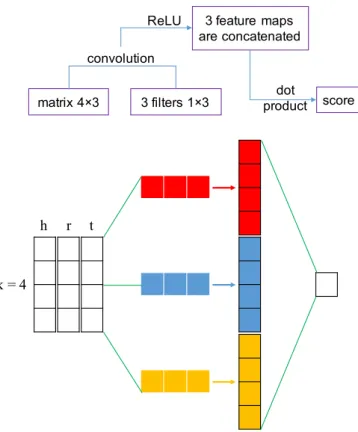
Figure 1. Process involved in the proposed ConvKB (withk= 4andτ= 3for illustration purpose).
We denote the dimensionality of embeddings byk
such that each embedding triple (vh,vr,vt) are viewed
as a matrixA= [vh,vr,vt]∈Rk×3. AndAi,: ∈R1×3
denotes thei-th row of A. Suppose that we use a
fil-terω ∈ R1×3 operated on the convolution layer. ω
is not only aimed to examine the global relationships between same dimensional entries of the embedding
triple (vh,vr,vt), but also to generalize the transitional
characteristics in the transition-based models.ωis
re-peatedly operated over every row ofAto finally
gen-erate a feature mapv= [v1,v2, ...,vk]∈Rkas:
vi=g(ω·Ai,:+b)
whereb∈Ris a bias term andgis a non-linear
acti-vation function such as ReLU.
Our ConvKB uses different filters∈R1×3to
gener-ate different feature maps. LetΩandτdenote the set
of filters and the number of filters, respectively, i.e.τ=
|Ω|, resulting inτfeature maps. Theseτfeature maps
are concatenated into a single vector∈Rτk×1which is
then computed with a weight vectorw∈ Rτk×1via a
dot product to give a score for the triple(h,r,t). Figure
1 illustrates the computation process in ConvKB.
Formally, we define the ConvKB score functionf as
follows:
f(h,r,t) =concat(g([vh,vr,vt]∗Ω))·w
whereΩandware shared parameters, independent of
h,randt;∗denotes a convolution operator; andconcat
denotes a concatenation operator.
If we only use one filterω(i.e. usingτ = 1) with
a fixed bias term b = 0 and the activation function
g(x) = |x| or g(x) = x2, and fix ω = [1,1,−1]
andw = 1 during training, ConvKB reduces to the
plain TransE model [5]. So our ConvKB model can be viewed as an extension of TransE to further model global relationships.
We use the Adam optimizer [23] to train ConvKB
by minimizing the loss functionL[48] withL2
regu-larization on the weight vectorwof the model:
L= X
(h,r,t)∈{G∪G0}
log 1 + exp l(h,r,t)·f(h,r,t)
+λ 2kwk
Input: knowledge baseG, set of entitiesE, set of relationsR, set of filtersΩ, weight vectorw, batch size
batch_size,L2-regularizerλ, booleaninit_f ilter_normal, pre-trained entity and relationk-dimensional
embeddings produced by TransE [5].
// Initialize variables.
fore∈ Edo
ve←embeddings_by_TransE(e)
forr∈ Rdo
vr ←embeddings_by_TransE(r)
// Using a truncated normal distribution with init_f ilter_normal=T rue while using [0.1,0.1,−0.1] with init_f ilter_normal=False.
forω∈Ωdo
Initialize(ω,init_f ilter_normal)
w←uniform
−
√ 6 √
k×|Ω|+1, √
6 √
k×|Ω|+1
// Optimization step.
forepoch = 1, 2, ..., 200do fori = 1, 2, ...,batch_size|G| + 1do
Sampleavaild_batchofbatch_sizetriples(h,r,t)fromG. invalid_batch={}
for(h,r,t)∈vaild_batchdo
invalid_batch←invalid_batch∪sample_invalid_triple(h,r,t)
batch←vaild_batch∪invalid_batch
for(h,r,t)∈batchdo
Compute f(h,r,t) =concat(g([vh,vr,vt]∗Ω))·w
if(h,r,t)is validthen
l(h,r,t)= 1
else
l(h,r,t)=−1
Computegradient∇Lbatchw.r.tbatch:∇P(h,r,t)∈batchlog 1 + exp l(h,r,t)· f(h,r,t)
+λ2kwk2 2
Updateentity and relation embeddings, weight vectorwand filters w.r.t∇Lbatch.
Algorithm 1:Parameter optimization for ConvKB in the KB completion.
in which,l(h,r,t)=
1for(h,r,t)∈ G −1for(h,r,t)∈ G0
hereG0 is a collection of invalid triples generated by
corrupting valid triples in G. We use the common
Bernoulli trick [27, 54] to generate the head or tail
en-tities for invalid triples. For each relationr, letηh
de-note the averaged number of head entities per tail
en-tity whilstηtdenote the averaged number of tail
enti-ties per head entity. Given a valid triple(h,r,t)of
re-lationr, we then generate a new head entity h0 with
probability ηt
ηt+ηh to form an invalid triple(h
0,r,t)and
a new tail entity t0 with probability ηh
ηt+ηh to form an
invalid triple(h,r,t0). Algorithm 1 details the learning
process of our ConvKB model.
4. KB completion evaluation
Table 2
Statistics of the experimental datasets. In both WN11 and FB13, each validation and test set also contains the same number of incor-rect triples as the number of corincor-rect triples. It is to note that the FB13 test set is filtered to only contain 7 relations taken from 13 relations appearing in the FB13 training set.
Dataset | E | | R | #Triples in train/valid/test
FB15k-237 14,541 237 272,115 17,535 20,466 WN18RR 40,943 11 86,835 3,034 3,134 FB13 75,043 13 316,232 5,908 23,733 WN11 38,696 11 112,581 2,609 10,544
WN18RR and FB15k-237 are subsets of two common datasets WN18 and FB15k [5], respectively. As noted by Toutanova and Chen [45], WN18 and FB15k are easy because they contain many reversible relations. So knowing relations are reversible allows us to easily predict the majority of test triples, e.g. state-of-the-art results on both WN18 and FB15k are obtained by us-ing a simple reversal rule as shown in Dettmers et al. [10]. Therefore, WN18RR and FB15k-237 are created to not suffer from this reversible relation problem in WN18 and FB15k, for which the knowledge base com-pletion task is more realistic. It is also worth noting that when constructing datasets FB13 and WN11, Socher et al. [40] filtered out triples from the test set if either or both of their head and tail entities also appear in the training set in a different relation type or order. Table 2 gives statistics of the experimental datasets.
4.1. Link prediction 4.1.1. Task description
In the KB completion or link prediction task [5], the purpose is to predict a missing entity given a relation
and another entity, i.e, inferringhgiven(r,t)or
infer-ringtgiven(h,r). The results are calculated based on
ranking the scores produced by the score functionf on
test triples. Following Bordes et al. [5], for each valid
test triple(h,r,t), we replace eitherhort by each of
other entities inE to create a set of corrupted triples.
We use the “Filtered” setting protocol [5], i.e., not
tak-ing any corrupted triples that appear in the KB into accounts. We rank the valid test triple and corrupted triples in ascending order of their scores.
We employ three common evaluation metrics: mean rank (MR), mean reciprocal rank (MRR), and Hits@10 (i.e., the proportion of the valid test triples ranking in top 10 predictions). Lower MR, higher MRR or higher Hits@10 indicate better performance. We report the
fi-nal scores on the test set for the model obtaining the
highest Hits@10 score on the validation set.1
4.1.2. Training protocol
We use the common Bernoulli trick [27, 54] to generate the head or tail entities when sampling in-valid triples. We also use entity and relation
embed-dings produced by TransE to initializeentity and
re-lation embeddings in ConvKB.2 We train TransE
us-ing a grid search of hyper-parameters: the
dimension-ality of embeddingsk∈ {50,100}, SGD learning rate
∈ {1e−4,5e−4,1e−3,5e−3},l1-norm orl2-norm, and
marginγ ∈ {1,3,5,7}. The highest Hits@10 scores
on the validation set are when usingl1-norm, learning
rate at5e−4,γ= 5 andk= 50 for WN18RR, and using
l1-norm, learning rate at5e−4,γ= 1 and k = 100 for
FB15k-237.
To learn our model parameters including entity and
relation embeddings, filtersωand the weight vectorw,
we use Adam [23] and select its initial learning rate
∈ {5e−6,1e−5,5e−5,1e−4,5e−4}. We use ReLU as
the activation functiong. We fix the batch size at 256
and set the L2-regularizerλat 0.001 in our objective
function. The filtersω are initialized by a truncated
normal distribution or by[0.1,0.1,−0.1]. We select the
number of filtersτ∈ {50,100,200,400,500}. We run
ConvKB up to 200 epochs and use outputs from the last epoch for evaluation. The highest Hits@10 scores
on the validation set are obtained when usingk= 50,
τ = 500, the truncated normal distribution for filter
initialization, and the initial learning rate at 1e−4 on
WN18RR; and k = 100,τ = 50,[0.1,0.1,−0.1]for
filter initialization, and the initial learning rate at5e−6
on FB15k-237.
4.1.3. Main experimental results
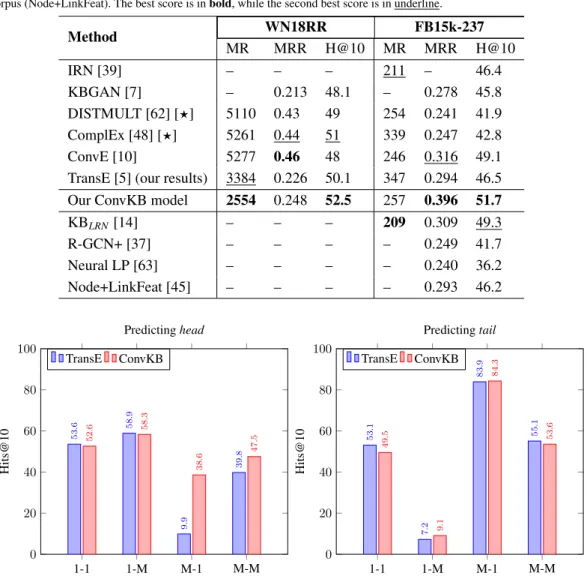
Table 3 compares the experimental results of our ConvKB model with previous published results, using the same experimental setup. Table 3 shows that Con-vKB obtains the best MR and highest Hits@10 scores on WN18RR and also the highest MRR and Hits@10 scores on FB15k-237.
ConvKB does better than the closely related model TransE on both experimental datasets, especially on FB15k-237 where ConvKB gains significant
improve-1Some previous works also reported Hits@1. However, the
for-mulas of MRR and Hits@1 show a strong correlation between these two scores. So using Hits@1 does not really reveal any additional information for this task.
2We employ a TransE implementation available at: https://
Table 3
Link prediction results on WN18RR and FB15k-237 test sets. MRR and H@10 denote the mean reciprocal rank and Hits@10 (in %), respectively. [?]: Results are taken from Dettmers et al. [10] where Hits@10 and MRR are rounded to 2 decimal places on WN18RR. The last 4 rows report results of models that exploit information about relation paths (KBLRN, R-GCN+ and Neural LP) or textual mentions derived from a large
external corpus (Node+LinkFeat). The best score is inbold, while the second best score is in underline.
Method WN18RR FB15k-237
MR MRR H@10 MR MRR H@10
IRN [39] – – – 211 – 46.4
KBGAN [7] – 0.213 48.1 – 0.278 45.8
DISTMULT [62] [?] 5110 0.43 49 254 0.241 41.9
ComplEx [48] [?] 5261 0.44 51 339 0.247 42.8
ConvE [10] 5277 0.46 48 246 0.316 49.1
TransE [5] (our results) 3384 0.226 50.1 347 0.294 46.5
Our ConvKB model 2554 0.248 52.5 257 0.396 51.7
KBLRN [14] – – – 209 0.309 49.3
R-GCN+ [37] – – – – 0.249 41.7
Neural LP [63] – – – – 0.240 36.2
Node+LinkFeat [45] – – – – 0.293 46.2
1-1 1-M M-1 M-M
0 20 40 60 80 100
53
.
6 58
.
9
9
.
9
39
.
8
52
.
6 58
.
3
38
.
6 47
.
5
Hits@10
Predictinghead
TransE ConvKB
1-1 1-M M-1 M-M
0 20 40 60 80 100
53
.
1
7
.
2
83
.
9
55
.
1
49
.
5
9
.
1
84
.
3
53
.
6
Hits@10
Predictingtail
TransE ConvKB
Figure 2. Hits@10 (in %) on the FB15k-237 test set w.r.t each relation category.
ments of 347−257 = 90 in MR (which is about
26% relative improvement) and 0.396 − 0.294 =
0.102in MRR (which is 34+% relative improvement),
and also obtains 51.7% −46.5% = 5.2% absolute
improvement in Hits@10. Previous work shows that TransE obtains very competitive results [26, 32, 36, 48]. However, when comparing the CNN-based em-bedding model ConvE with other emem-bedding models, Dettmers et al. [10] did not experiment with TransE. We reconfirm previous findings that TransE in fact is a strong baseline model, e.g., TransE obtains better MR and Hits@10 than ConvE on WN18RR.
ConvKB obtains better scores than ConvE on both datasets (except MRR on WN18RR and MR on FB15k-237), thus showing the usefulness of taking transitional characteristics into accounts. In particu-lar, on FB15k-237, ConvKB achieves improvements of
0.394−0.316 = 0.078in MRR (which is about 25%
relative improvement) and51.7%−49.1% = 2.6%
in Hits@10, while both ConvKB and ConvE produce similar MR scores. ConvKB also obtains 25% rela-tively higher MRR score than the relation path-based
model KBLRN on FB15k-237. In addition, ConvKB
hypern ym deri vationally_related_form member_meron ym has_part instance_h ypern ym synset_domain_topic_of also_see verb_group member_of_domain_re gion member_of_domain_usage similar_to 20 40 60 80 100 17 . 4 96 . 4 28 . 9 25 . 9 48 . 4 40 . 4 72 . 3 97 . 4 19 . 2 37 . 5 100 22 . 5 96 34 . 4 30 . 2 46 . 7 37 . 7 70 . 5 97 . 4 21 . 2 33 . 3 100 Hits@10 TransE ConvKB 0 10 20 30 40 50
39.9
34.3
8.1
5.5
3.9
3.6 1.8
1.2
0.8
0.8
0.1
40.1
34.2
8.5 5.5 3.4 3.6 1.5 1.3 1.1 0.7 0.1
%T riples w .r .t each relation
%Triples in Test %Triples in Train
hypern ym deri vationally_related_form member_meron ym has_part instance_h ypern ym synset_domain_topic_of also_see verb_group member_of_domain_re gion member_of_domain_usage similar_to 0.1 0.2 0.3 0.4 0.5
7 . 6 · 10 − 2 0 . 43 0 . 13 0 . 11 0 . 3 0 . 3 0 . 24 0 . 36 8 . 3 · 10 − 2 0 . 27 0 . 29 0 . 12 0 . 43 0 . 17 0 . 12 0 . 29 0 . 28 0 . 22 0 . 37 0 . 1 0 . 21 0 . 31 MRR TransE ConvKB 0 10 20 30 40 50
39.9
34.3
8.1
5.5
3.9
3.6
1.8
1.2
0.8
0.8
0.1
40.1 34.2 8.5 5.5 3.4 3.6 1.5 1.3 1.1 0.7 0.1 %T riples w .r .t each relation
%Triples in Test %Triples in Train
Figure 3. Hits@10 and MRR on the WN18RR test set w.r.t each relation. The right y-axis is the percentage of triples corresponding to relations.
gives better MR than ConvKB. We plan to extend Con-vKB with relation path information to obtain better link prediction performance in future work.
Following Bordes et al. [5], we explore the Hits@10 results on the FB15k-237 test set corresponding to the
relation categories. For each relation r, we calculate
the averaged numberηh of heads per tail and the
av-eraged number ηt of tails per head. If ηh <1.5 and
ηt <1.5,ris classified as one-to-one (1-1). Ifηh <1.5
andηt >1.5,ris classified as one-to-many (1-M). If
ηh>1.5 andηt<1.5,ris classified as many-to-one (
M-1). Ifηh >1.5 andηt >1.5,ris classified as
many-to-many (M-M). We find that 17, 26, 81 and 113 relations
are classified as 1-1, 1-M, M-1 and M-M, respectively. And 0.9%, 6.3%, 20.5% and 72.3% of the FB15k-237 test triples have their relations classified as 1-1, 1-M, M-1 and M-M, respectively.
Figure 2 shows the Hits@10 results for separately predicting head and tail entities on the FB15k-237 test set with respect to (w.r.t.) each relation category. We find that ConvKB is outperformed by TransE in 1-1 as 1-1 relations are relatively rare. We also find that both TransE and ConvKB are easier to predict entities on the relational “side 1” triples (i.e., predicting head en-tities in 1 and M, and predicting tail enen-tities in 1-1 and M-1-1). However, TransE is not good at predict-ing head entities in M-1 and M-M where TransE ob-tains the Hits@10 scores of 9.9% and 39.8%, while ConvKB is better in achieving the Hits@10 scores of 38.6% and 47.5%, respectively. A reason is probably that ConvKB could bring a generalization of project-ing the embeddproject-ing triples into the vector space of rela-tions rather than TransE. Hence, this helps ConvKB to better modeling M-1 and M-M relations.
For a more concrete example, Figure 3 presents Hits@10 and MRR scores on WN18RR w.r.t. each
re-lation type.member_meronymandhypernymare 1-M
and M-1 relations, respectively. We find that TransE encounters a difficulty when dealing with these tion types. E.g., for 1,251 triples containing the rela-tionhypernymfrom 3,134 test triples in the WN18RR test set, TransE only obtains the Hits@10 and MRR scores of 17.4% and 0.076 respectively, while ConvKB performs better than TransE and gets the Hits@10 and MRR scores of 22.5% and 0.121 respectively. In sum-mary, figures 2 and 3 show that ConvKB are better at modeling 1-M, M-1 and M-M relations than TransE.
4.2. Triple classification 4.2.1. Task description
The triple classification task aims to predict whether
a given triple(h,r,t)is valid or not [40]. Each
rela-tionris associated with a thresholdθr. For an unseen
test triple(h,r,t), if its score is belowθrthen it will be
classified as valid, otherwise invalid. Following Socher
et al. [40], the relation-specific thresholdθris obtained
by maximizing the micro-averaged classification accu-racy on the validation set.
4.2.2. Training protocol
Similar to the training protocol in Section 4.1.2, we sample invalid triples using the common Bernoulli trick and also train TransE to produce entity and re-lation embeddings for initializing embeddings in Con-vKB. The best accuracies obtained by TransE on the
validation set are when usingl1-norm, learning rate at
0.01,γ= 7 andk= 50 for WN11, and usingl2-norm,
Table 4
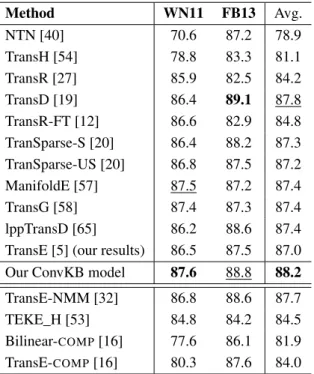
Accuracy results (in %) on the WN11 and FB13 test sets. The last 4 rows report accuracies of the models that use relation paths or incor-porate with a large external corpus. The best score is inboldwhile the second best score is in underline. “Avg.” denotes the averaged accuracy over two datasets.
Method WN11 FB13 Avg.
NTN [40] 70.6 87.2 78.9
TransH [54] 78.8 83.3 81.1
TransR [27] 85.9 82.5 84.2
TransD [19] 86.4 89.1 87.8
TransR-FT [12] 86.6 82.9 84.8
TranSparse-S [20] 86.4 88.2 87.3
TranSparse-US [20] 86.8 87.5 87.2
ManifoldE [57] 87.5 87.2 87.4
TransG [58] 87.4 87.3 87.4
lppTransD [65] 86.2 88.6 87.4
TransE [5] (our results) 86.5 87.5 87.0
Our ConvKB model 87.6 88.8 88.2
TransE-NMM [32] 86.8 88.6 87.7
TEKE_H [53] 84.8 84.2 84.5
Bilinear-COMP[16] 77.6 86.1 81.9
TransE-COMP[16] 80.3 87.6 84.0
then use a grid search to choose the hyper-parameter for ConvKB. We monitor the accuracy after each train-ing epoch, and obtain the best accuracies on validation
set when usingk= 50, τ = 200, the truncated
nor-mal distribution for filter initialization, and the initial
learning rate at5e−4on WN11; and k = 100,τ= 200,
also the truncated normal distribution for filter
initial-ization, and the initial learning rate at5e−5on FB13.
4.2.3. Main results
Table 4 presents the accuracy results of our ConvKB model and previous published results on the WN11 and FB13 datasets. On WN11, ConvKB obtains an accuracy of 87.6% which outperforms all other mod-els. On FB13, ConvKB gains a second highest accu-racy of 88.8% which is 0.3% outperformed by TransD. Compared to TransE, ConvKB absolutely improves by 1.1% on WN11 and 1.3% on FB13. Overall, ConvKB yields the best performance averaged over these two benchmark datasets. This also indicates the generaliza-tion of ConvKB over different datasets.
Regarding to TransE, Table 4 demonstrates that we obtain very competitive accuracies of 86.5% and 87.5% on WN11 and FB13 respectively. On WN11,
profession gender nationality institution cause_of_death religion ethnicity 75 80 85 90 95 100
86
.
3
84
.
8
95
.
4
83
.
7
80
87
.
8
88
.
4
88
.
6
84
.
9
95
.
4
86
82
.
7
90
.
7
89
Accurac
y
(%)
TransE ConvKB
0 5 10 15 20 25 30 35
27.9
24.4 23.2
9.5
6.7 5.1 3.1
14.5
18.8
15
4.9
3.4
2.6
1.5
%T
riples
w
.r
.t
each
relation
%Triples in Test %Triples in Train
Figure 4. Accuracy results on the FB13 test set w.r.t each relation. The right y-axis is the number of triples corresponding to relations.
TransE is comparable with TransD, TransR-FT and TranSparse-S while it scores better than lppTransD
and TransE-COMP. On FB13, TransE performs slightly
better than ManifoldE and TransG while it achieves
similar scores in comparison with TransE-COMP and
TranSparse-US. Note that TransR, TranSparse-S/US and TransD also perform the embedding initialization using TransE outputs (but these models do not report their TransE accuracy results). Hence, these models might get better results when using our TransE results as shown in this paper.
Figure 4 visualizes the accuracy results of different relations on FB13 for TransE and ConvKB. Relations
institutionandprofessioncan be categorized as M-M where ConvKB is about 2.3% absolute higher accu-racy than TransE, while remaining relations can be cat-egorized as M-1. In short, Figure 4 shows that Con-vKB performs equal to or better than TransE for all 7 relations in the FB13 test set.
5. Application for search personalization
Table 5
Basic statistics of the dataset [51].
# users 106
#distinct queries 6,632
#SAT clicks 8,052
#distinct documents 33,591
That historical information can be used to build the
userprofile, which is crucial to effective
personaliza-tion [42, 43, 50, 52].
Given auser, a submittedqueryand thedocuments
returned by a search system for that query, our ap-proach is to re-rank the returned documents so that the more relevant documents should be ranked higher. Fol-lowing Vu et al. [51], we represent the relationship be-tween the submitted query, the user and the returned
document as a (h, r, t)-like triple(query, user,
docu-ment). The triple captures how much interest a user puts on a document given a query. Therefore, we can also evaluate the effectiveness of our ConvKB model for the search personalization task.
We evaluate ConvKB using the search results re-turned by a commercial search engine. We use the same dataset of query logs of 106 anonymous users from Vu et al. [51]. A log entity consists of a user iden-tifier, a query, top-10 returned documents ranked by the search engine and clicked documents along with the user’s dwell time. Vu et al. [51] employed the SAT criteria [13] to identify whether or not a clicked docu-ment is relevant from the query logs (i.e., a SAT click).
They then assigned arelevantlabel to a returned
docu-ment if it is a SAT click and also assignedirrelevant
la-bels to the remaining top-10 documents. The rank
po-sition of therelevantlabeled documents is used as the
ground truth to evaluate the search performance before and after re-ranking. As a result, the dataset contains
8,052 valid triples(query, user, relevant document)in
which 5,658, 1,184 and 1,210 valid triples are used for training, validation and test, respectively. Table 5 presents the dataset statistics.
5.1. Evaluation protocol
Our ConvKB model is used to re-rank the original list of top-10 documents returned by the commercial search engine as follows: (1) We train ConvKB and use the trained model to calculate a score for each triple
(question,user,document). (2) We then sort the scores in the ascending order to achieve a new ranked list. To
evaluate the performance, we use two common metrics
in document ranking: MRR and [email protected]
5.2. Training protocol
5.2.1. Query and document embedding initialization
We initialize query and document embeddings for ConvKB and the baseline TransE, then fix query and document embeddings (i.e. not updating these embed-dings) during training.
To initialize document embeddings, we follow Vu et al. [51] to train a LDA topic model [2] with 200
top-ics only on therelevant documents (i.e., SAT clicks)
extracted from the query logs. We then use the trained LDA model to infer the probability distribution over topics for each document. We use the topic propor-tion vector of each document as its document
em-bedding (i.e.k = 200). In particular, the zth element
(z= 1,2, ...,k) of the vector embedding for document
dis:vd,z=P(z|d)where P(z|d)is the probability of
the topiczgiven the documentd.
We also represent each query by a probability
dis-tribution vector over topics. LetDq = {d1,d2, ...,dn}
be the set of top n ranked documents returned for
a query q (here, n = 10). The zth element of the
vector embedding for query q is defined as in [51]:
vq,z = P n
i=1λiP(z| di), whereλi = δ
i−1 Pn
j=1δj−1 is the
exponential decay function ofiwhich is the rank ofdi
inDq. Andδis the decay hyper-parameter (0< δ <1).
5.2.2. Hyper-parameter tuning
Similar to the training protocol presented in Section 4.1.2, we run model up to 200 epochs and perform a grid search to choose optimal hyper-parameters on the
validation set. Following Vu et al. [51], we useδ= 0.8.
We also monitor the MRR score after each training epoch and obtain the highest MRR score on the
val-idation set when using the marginat 5,l1-norm and
learning rate at5e−3 for TransE; and usingτ = 500,
the truncated normal distribution for filter
initializa-tion, and the initial learning rate at5e−4for ConvKB.
5.3. Results
Table 6 presents the experimental results of Con-vKB, TransE and the previous published results of other strong baselines, in which ConvKB obtains high-est MRR and Hits@1 scores. In particular, ConvKB
3We re-rank the list of top-10 documents returned by the search
Table 6
Experimental results on the test set.?denotes the results reported in Vu et al. [51].SE: The original rank is returned by the search engine.
CI: This baseline use a personalized navigation method based on previously clicking returned documents [44].SP: A search personal-ization method makes use of the short-term profiles [1, 50]. The sub-scripts denote the relative improvement over the baselineTransE.
Model MRR Hits@1(%)
SE[?] 0.559 38.5
CI[44] [?] 0.597 41.6
SP[1, 50] [?] 0.631 45.2
TransE[5] [?] 0.645 48.1
STransE[33] [?] 0.656 50.1
TransE(our results) 0.669 50.9
OurConvKBmodel 0.750+12.1% 59.9+17.7%
does significantly better than TransE with relative im-provements at 12.1% for MRR and 17.7% for Hits@1. It is probably because our model not only can cap-ture richer relational characteristics within the triple but also generalize the transitional relationships be-tween embeddings of user queries and relevant docu-ments for user profiles. We also obtain higher TransE results than those reported in Vu et al. [51]. The rea-son is that for each valid triple, rather than using only one invalid triple as in [51], we take into account its all invalid triples to train TransE (each valid or invalid triple contains a relevant- or irrelevant-labelled docu-ment, respectively).
6. Conclusion
In this paper, we propose a novel embedding model ConvKB for the knowledge base completion task. ConvKB applies the convolutional neural network to explore the global relationships among same dimen-sional entries of the entity and relation embeddings, so that ConvKB generalizes the transitional characteris-tics in the transition-based embedding models. Exper-imental results show that our ConvKB model outper-forms other state-of-the-art models on two benchmark datasets WN18RR and FB15k-237 for the link predic-tion task, and on two other benchmark datasets WN11 and FB13 for the triple classification task. ConvKB obtains the best mean rank and the highest Hits@10 on WN18RR and obtains the highest mean reciprocal rank and Hits@10 on FB15k-237. In addition, Con-vKB produces the best accuracy on WN11 and the sec-ond best accuracy on FB13. Moreover, we show the
effectiveness of ConvKB for search personalization, in which ConvKB outperforms the strong baselines on the query logs of a commercial web search engine.
In the future work, we plan to extend ConvKB with relation path information to achieve better perfor-mance. We will also adapt ConvKB to other personal-ization tasks where we can model each task as a triple relationship, e.g. in personalized query suggestion or auto-completion.
Our ConvKB implementation is available at: https: //github.com/daiquocnguyen/ConvKB.
Bibliographic note
This paper extends our paper [34] published in Pro-ceedings of NAACL-HLT 2018 (Volume 2: Short Pa-pers). We first add a significantly improved analysis to the link prediction task. Then we conduct new ex-tensive empirical study on the triple classification and search personalization tasks.
Acknowledgement
This research was partially supported by the Aus-tralian Research Council (ARC) DP150100031 and DP160103934.
References
[1] P. N. Bennett, R. W. White, W. Chu, S. T. Dumais, P. Bailey, F. Borisyuk, and X. Cui. Modeling the impact of short- and long-term behavior on search personalization. InProceedings of the 35th International ACM SIGIR Conference on Research and Development in Information Retrieval, SIGIR ’12, pages 185–194, Portland, Oregon, USA, 2012. ACM. URL http://dx. doi.org/10.1145/2348283.2348312.
[2] D. M. Blei, A. Y. Ng, and M. I. Jordan. Latent dirichlet allo-cation. In T. G. Dietterich, S. Becker, and Z. Ghahramani, ed-itors,Advances in Neural Information Processing Systems 14, pages 601–608. MIT Press, 2002. URL http://papers.nips.cc/ paper/2070-latent-dirichlet-allocation.pdf.
[3] K. Bollacker, C. Evans, P. Paritosh, T. Sturge, and J. Taylor. Freebase: A collaboratively created graph database for struc-turing human knowledge. InProceedings of the 2008 ACM SIGMOD International Conference on Management of Data, SIGMOD ’08, pages 1247–1250, Vancouver, Canada, 2008. ACM. ISBN 978-1-60558-102-6. URL https://doi.org/10. 1145/1376616.1376746.
[5] A. Bordes, N. Usunier, A. Garcia-Duran, J. Weston, and O. Yakhnenko. Translating embeddings for modeling multi-relational data. In C. J. C. Burges, L. Bottou, M. Welling, Z. Ghahramani, and K. Q. Weinberger, editors,Advances in Neural Information Processing Systems 26, pages 2787–2795. Curran Associates, Inc., 2013.
[6] F. Cai, S. Wang, and M. de Rijke. Behavior-based personal-ization in web search. Journal of the Association for Infor-mation Science and Technology, 68(4):855–868, 2017. URL https://doi.org/10.1002/asi.23735.
[7] L. Cai and W. Y. Wang. KBGAN: Adversarial learning for knowledge graph embeddings. InProceedings of the 2018 Conference of the North American Chapter of the Association for Computational Linguistics: Human Language Technolo-gies, Volume 1 (Long Papers), pages 1470–1480, New Orleans, Louisiana, 2018. Association for Computational Linguistics. URL http://www.aclweb.org/anthology/N18-1133.
[8] Z. Cheng, S. Jialie, and S. C. Hoi. On effective personal-ized music retrieval by exploring online user behaviors. In
Proceedings of the 39th International ACM SIGIR Confer-ence on Research and Development in Information Retrieval, SIGIR ’16, pages 125–134, Pisa, Italy, 2016. ACM. URL http://doi.org/10.1145/2911451.2911491.
[9] R. Collobert, J. Weston, L. Bottou, M. Karlen, K. Kavukcuoglu, and P. Kuksa. Natural language processing (almost) from scratch.Journal of Machine Learning Research, 12:2493–2537, 2011. URL www.jmlr.org/papers/volume12/ collobert11a/collobert11a.pdf.
[10] T. Dettmers, P. Minervini, P. Stenetorp, and S. Riedel. Convo-lutional 2D knowledge graph embeddings. InProceedings of the 32nd AAAI Conference on Artificial Intelligence, AAAI’18, pages 1811–1818. AAAI Press, 2018. URL https://www.aaai. org/ocs/index.php/AAAI/AAAI18/paper/view/17366. [11] Z. Dou, R. Song, and J.-R. Wen. A large-scale evaluation
and analysis of personalized search strategies. In Proceed-ings of the 16th International Conference on World Wide Web, WWW ’07, pages 581–590, Banff, Alberta, Canada, 2007. In-ternational World Wide Web Conferences Steering Committee. URL http://doi.org/10.1145/1242572.1242651.
[12] J. Feng, M. Huang, M. Wang, M. Zhou, Y. Hao, and X. Zhu. Knowledge graph embedding by flexible translation. In Pro-ceedings of the Fifteenth International Conference on Prin-ciples of Knowledge Representation and Reasoning, KR’16, pages 557–560, Cape Town, South Africa, 2016. AAAI Press. URL https://www.aaai.org/ocs/index.php/KR/KR16/ paper/view/12887.
[13] S. Fox, K. Karnawat, M. Mydland, S. Dumais, and T. White. Evaluating Implicit Measures to Improve Web Search. ACM Transactions on Information Systems, 23(2):147–168, 2005. URL http://doi.org/10.1145/1059981.1059982.
[14] A. García-Durán and M. Niepert. KBLRN: End-to-End Learning of Knowledge Base Representations with La-tent, Relational, and Numerical Features. arXiv preprint abs/1709.04676, 2017. URL https://arxiv.org/abs/1709.04676. [15] M. Grbovic. Search ranking and personalization at Airbnb. InProceedings of the Eleventh ACM Conference on Recom-mender Systems, RecSys ’17, pages 339–340, Como, Italy, 2017. ACM. URL http://doi.org/10.1145/3109859.3109920. [16] K. Guu, J. Miller, and P. Liang. Traversing knowledge graphs
in vector space. InProceedings of the 2015 Conference on Em-pirical Methods in Natural Language Processing, pages 318–
327, Lisbon, Portugal, 2015. Association for Computational Linguistics. URL http://aclweb.org/anthology/D15-1038. [17] Y. Hao, Y. Zhang, K. Liu, S. He, Z. Liu, H. Wu, and J. Zhao. An
end-to-end model for question answering over knowledge base with cross-attention combining global knowledge. In Proceed-ings of the 55th Annual Meeting of the Association for Compu-tational Linguistics (Volume 1: Long Papers), pages 221–231, Vancouver, Canada, 2017. Association for Computational Lin-guistics. URL http://aclweb.org/anthology/P17-1021. [18] M. Harvey, F. Crestani, and M. J. Carman. Building user
profiles from topic models for personalised search. In Pro-ceedings of the 22Nd ACM International Conference on Infor-mation & Knowledge Management, CIKM ’13, pages 2309– 2314, San Francisco, California, USA, 2013. ACM. URL http://doi.org/10.1145/2505515.2505642.
[19] G. Ji, S. He, L. Xu, K. Liu, and J. Zhao. Knowledge graph embedding via dynamic mapping matrix. InProceedings of the 53rd Annual Meeting of the Association for Computa-tional Linguistics and the 7th InternaComputa-tional Joint Conference on Natural Language Processing (Volume 1: Long Papers), pages 687–696, Beijing, China, 2015. Association for Compu-tational Linguistics. URL http://www.aclweb.org/anthology/ P15-1067.
[20] G. Ji, K. Liu, S. He, and J. Zhao. Knowledge graph com-pletion with adaptive sparse transfer matrix. In Proceed-ings of the Thirtieth AAAI Conference on Artificial Intelli-gence, AAAI’16, pages 985–991, Phoenix, Arizona, 2016. AAAI Press. URL https://www.aaai.org/ocs/index.php/AAAI/ AAAI16/paper/view/11982.
[21] G. Kasneci, F. M. Suchanek, G. Ifrim, M. Ramanath, and G. Weikum. Naga: Searching and ranking knowledge. In
Proceedings of the 2008 IEEE 24th International Conference on Data Engineering, ICDE ’08, pages 953–962, Washing-ton, DC, USA, 2008. IEEE Computer Society. URL https: //doi.org/10.1109/ICDE.2008.4497504.
[22] Y. Kim. Convolutional neural networks for sentence clas-sification. InProceedings of the 2014 Conference on Em-pirical Methods in Natural Language Processing (EMNLP), pages 1746–1751, Doha, Qatar, 2014. Association for Compu-tational Linguistics. URL http://www.aclweb.org/anthology/ D14-1181.
[23] D. Kingma and J. Ba. Adam: A method for stochastic opti-mization. arXiv preprint arXiv:1412.6980, 2014. URL https: //arxiv.org/abs/1412.6980.
[24] Y. Lecun, L. Bottou, Y. Bengio, and P. Haffner. Gradient-based learning applied to document recognition. Proceedings of the IEEE, 86(11):2278–2324, 1998. URL http://doi.org/10.1109/ 5.726791.
[25] J. Lehmann, R. Isele, M. Jakob, A. Jentzsch, D. Kontokostas, P. N. Mendes, S. Hellmann, M. Morsey, P. Van Kleef, S. Auer, et al. DBpedia – a large-scale, multilingual knowledge base extracted from Wikipedia. Semantic Web, 6:167–195, 2015. URL https://doi.org/10.3233/SW-140134.
[27] Y. Lin, Z. Liu, M. Sun, Y. Liu, and X. Zhu. Learning entity and relation embeddings for knowledge graph completion. In
Proceedings of the Twenty-Ninth AAAI Conference on Artificial Intelligence, AAAI’15, pages 2181–2187, Austin, Texas, 2015. AAAI Press. URL https://www.aaai.org/ocs/index.php/AAAI/ AAAI15/paper/view/9571.
[28] X. Liu. Modeling users’ dynamic preference for personal-ized recommendation. InProceedings of the 24th Interna-tional Conference on Artificial Intelligence, IJCAI’15, pages 1785–1791, Buenos Aires, Argentina, 2015. AAAI Press. URL https://www.ijcai.org/Proceedings/15/Papers/254.pdf. [29] Y. Luo, Q. Wang, B. Wang, and L. Guo. Context-dependent
knowledge graph embedding. InProceedings of the 2015 Con-ference on Empirical Methods in Natural Language Process-ing, pages 1656–1661, Lisbon, Portugal, 2015. Association for Computational Linguistics. URL http://aclweb.org/anthology/ D15-1191.
[30] N. Nanas, M. Vavalis, and A. De Roeck. A network-based model for high-dimensional information filtering. In Pro-ceedings of the 33rd International ACM SIGIR Conference on Research and Development in Information Retrieval, SIGIR ’10, pages 202–209, Geneva, Switzerland, 2010. ACM. URL http://doi.org/10.1145/1835449.1835485.
[31] D. Q. Nguyen. An overview of embedding models of enti-ties and relationships for knowledge base completion. arXiv preprint, arXiv:1703.08098, 2017. URL https://arxiv.org/abs/ 1703.08098.
[32] D. Q. Nguyen, K. Sirts, L. Qu, and M. Johnson. Neigh-borhood mixture model for knowledge base completion. In
Proceedings of The 20th SIGNLL Conference on Computa-tional Natural Language Learning, pages 40–50, Berlin, Ger-many, 2016. Association for Computational Linguistics. URL http://www.aclweb.org/anthology/K16-1005.
[33] D. Q. Nguyen, K. Sirts, L. Qu, and M. Johnson. Stranse: a novel embedding model of entities and relationships in knowl-edge bases. InProceedings of the 2016 Conference of the North American Chapter of the Association for Computational Lin-guistics: Human Language Technologies, pages 460–466, San Diego, California, 2016. Association for Computational Lin-guistics. URL http://www.aclweb.org/anthology/N16-1054. [34] D. Q. Nguyen, T. D. Nguyen, D. Q. Nguyen, and D. Phung. A
novel embedding model for knowledge base completion based on convolutional neural network. InProceedings of the 2018 Conference of the North American Chapter of the Association for Computational Linguistics: Human Language Technolo-gies, Volume 2 (Short Papers), pages 327–333, New Orleans, Louisiana, 2018. Association for Computational Linguistics. URL http://www.aclweb.org/anthology/N18-2053.
[35] M. Nickel, K. Murphy, V. Tresp, and E. Gabrilovich. A Re-view of Relational Machine Learning for Knowledge Graphs.
Proceedings of the IEEE, 104(1):11–33, 2016. URL https: //doi.org/10.1109/JPROC.2015.2483592.
[36] M. Nickel, L. Rosasco, and T. Poggio. Holographic embed-dings of knowledge graphs. InProceedings of the Thirtieth AAAI Conference on Artificial Intelligence, AAAI’16, pages 1955–1961, Phoenix, Arizona, 2016. AAAI Press. URL https://www.aaai.org/ocs/index.php/AAAI/AAAI16/paper/ view/12484.
[37] M. Schlichtkrull, T. Kipf, P. Bloem, R. v. d. Berg, I. Titov, and M. Welling. Modeling relational data with graph convolutional
networks.arXiv preprint arXiv:1703.06103, 2017. URL https: //arxiv.org/abs/1703.06103.
[38] M. Schuhmacher and S. P. Ponzetto. Knowledge-based graph document modeling. InProceedings of the 7th ACM Interna-tional Conference on Web Search and Data Mining, WSDM ’14, pages 543–552, New York, New York, USA, 2014. ACM. URL http://doi.org/10.1145/2556195.2556250.
[39] Y. Shen, P. Huang, M. Chang, and J. Gao. Traversing knowl-edge graph in vector space without symbolic space guidance.
arXiv preprint arXiv:1611.04642v4, 2017. URL https://arxiv. org/abs/1611.04642v4.
[40] R. Socher, D. Chen, C. D. Manning, and A. Ng. Reason-ing with neural tensor networks for knowledge base comple-tion. In C. J. C. Burges, L. Bottou, M. Welling, Z. Ghahra-mani, and K. Q. Weinberger, editors,Advances in Neural In-formation Processing Systems 26, pages 926–934. Curran As-sociates, Inc., 2013.
[41] F. M. Suchanek, G. Kasneci, and G. Weikum. Yago: A core of semantic knowledge. InProceedings of the 16th International Conference on World Wide Web, WWW ’07, pages 697–706, Banff, Alberta, Canada, 2007. International World Wide Web Conferences Steering Committee. URL http://doi.org/10.1145/ 1242572.1242667.
[42] J. Teevan, S. T. Dumais, and E. Horvitz. Personalizing search via automated analysis of interests and activities. In Proceed-ings of the 28th Annual International ACM SIGIR Conference on Research and Development in Information Retrieval, SI-GIR ’05, pages 449–456, Salvador, Brazil, 2005. ACM. URL http://doi.org/10.1145/1076034.1076111.
[43] J. Teevan, M. R. Morris, and S. Bush. Discovering and us-ing groups to improve personalized search. InProceedings of the Second ACM International Conference on Web Search and Data Mining, WSDM ’09, pages 15–24, Barcelona, Spain, 2009. ACM. URL http://doi.org/10.1145/1498759.1498786. [44] J. Teevan, D. J. Liebling, and G. Ravichandran Geetha.
Under-standing and predicting personal navigation. InProceedings of the Fourth ACM International Conference on Web Search and Data Mining, WSDM ’11, pages 85–94, Hong Kong, China, 2011. ACM. URL http://doi.org/10.1145/1935826.1935848. [45] K. Toutanova and D. Chen. Observed versus latent features for
knowledge base and text inference. InProceedings of the 3rd Workshop on Continuous Vector Space Models and their Com-positionality, pages 57–66, Beijing, China, 2015. Association for Computational Linguistics. URL http://www.aclweb.org/ anthology/W15-4007.
[46] K. Toutanova, D. Chen, P. Pantel, H. Poon, P. Choudhury, and M. Gamon. Representing text for joint embedding of text and knowledge bases. InProceedings of the 2015 Con-ference on Empirical Methods in Natural Language Process-ing, pages 1499–1509, Lisbon, Portugal, 2015. Association for Computational Linguistics. URL http://aclweb.org/anthology/ D15-1174.
[48] T. Trouillon, J. Welbl, S. Riedel, E. Gaussier, and G. Bouchard. Complex embeddings for simple link prediction. In Proceed-ings of the 33rd International Conference on International Conference on Machine Learning - Volume 48, ICML’16, pages 2071–2080, New York, NY, USA, 2016. JMLR.org. URL http://proceedings.mlr.press/v48/trouillon16.pdf. [49] T. Vu, D. Song, A. Willis, S. N. Tran, and J. Li.
Improv-ing search personalisation with dynamic group formation. In
Proceedings of the 37th International ACM SIGIR Conference on Research & Development in Information Retrieval, SIGIR ’14, pages 951–954, Gold Coast, Queensland, Australia, 2014. ACM. URL http://doi.org/10.1145/2600428.2609482. [50] T. Vu, A. Willis, S. N. Tran, and D. Song. Temporal latent
topic user profiles for search personalisation. InProceedings of the European Conference on Information Retrieval, pages 605–616, Vienna, Austria, 2015. Springer International Pub-lishing. URL https://doi.org/10.1007/978-3-319-16354-3_67. [51] T. Vu, D. Q. Nguyen, M. Johnson, D. Song, and A. Willis. Search Personalization with Embeddings. In Proceedings of the European Conference on Information Retrieval, pages 598–604, Aberdeen, Scotland, 2017. Springer International Publishing. URL https://doi.org/10.1007/978-3-319-56608-5_ 54.
[52] T. Vu, A. Willis, U. Kruschwitz, and D. Song. Personalised query suggestion for intranet search with temporal user pro-filing. InProceedings of the 2017 Conference on Confer-ence Human Information Interaction and Retrieval, CHIIR ’17, pages 265–268, Oslo, Norway, 2017. ACM. URL http: //doi.org/10.1145/3020165.3022129.
[53] Z. Wang and J. Li. Text-enhanced representation learning for knowledge graph. InProceedings of the Twenty-Fifth Inter-national Joint Conference on Artificial Intelligence, IJCAI’16, pages 1293–1299, New York, New York, USA, 2016. AAAI Press. URL https://www.ijcai.org/Proceedings/16/Papers/187. pdf.
[54] Z. Wang, J. Zhang, J. Feng, and Z. Chen. Knowledge graph embedding by translating on hyperplanes. InProceedings of the Twenty-Eighth AAAI Conference on Artificial Intelligence, AAAI’14, pages 1112–1119, Quebec City, Quebec, Canada, 2014. AAAI Press. URL https://www.aaai.org/ocs/index.php/ AAAI/AAAI14/paper/view/8531.
[55] R. West, E. Gabrilovich, K. Murphy, S. Sun, R. Gupta, and D. Lin. Knowledge base completion via search-based ques-tion answering. In Proceedings of the 23rd International Conference on World Wide Web, WWW ’14, pages 515– 526, Seoul, Korea, 2014. International World Wide Web Con-ferences Steering Committee. URL http://doi.org/10.1145/ 2566486.2568032.
[56] R. W. White, W. Chu, A. Hassan, X. He, Y. Song, and H. Wang. Enhancing personalized search by mining and modeling task behavior. InProceedings of the 22nd International Confer-ence on World Wide Web, WWW ’13, pages 1411–1420, Rio de Janeiro, Brazil, 2013. International World Wide Web Con-ferences Steering Committee. URL http://doi.org/10.1145/ 2488388.2488511.
[57] H. Xiao, M. Huang, and X. Zhu. From one point to a man-ifold: Knowledge graph embedding for precise link predic-tion. InProceedings of the Twenty-Fifth International Joint
Conference on Artificial Intelligence, IJCAI’16, pages 1315– 1321, New York, New York, USA, 2016. AAAI Press. URL https://www.ijcai.org/Proceedings/16/Papers/190.pdf. [58] H. Xiao, M. Huang, and X. Zhu. Transg : A generative model
for knowledge graph embedding. InProceedings of the 54th Annual Meeting of the Association for Computational Linguis-tics (Volume 1: Long Papers), pages 2316–2325, Berlin, Ger-many, 2016. Association for Computational Linguistics. URL http://www.aclweb.org/anthology/P16-1219.
[59] Q. Xie, X. Ma, Z. Dai, and E. Hovy. An interpretable knowledge transfer model for knowledge base completion. InProceedings of the 55th Annual Meeting of the Associa-tion for ComputaAssocia-tional Linguistics (Volume 1: Long Papers), pages 950–962, Vancouver, Canada, 2017. Association for Computational Linguistics. URL http://aclweb.org/anthology/ P17-1088.
[60] C. Xiong, R. Power, and J. Callan. Explicit semantic ranking for academic search via knowledge graph embedding. In Pro-ceedings of the 26th International Conference on World Wide Web, WWW ’17, pages 1271–1279, Perth, Australia, 2017. In-ternational World Wide Web Conferences Steering Committee. URL https://doi.org/10.1145/3038912.3052558.
[61] B. Yang and T. Mitchell. Leveraging knowledge bases in lstms for improving machine reading. InProceedings of the 55th Annual Meeting of the Association for Computational Lin-guistics (Volume 1: Long Papers), pages 1436–1446, Vancou-ver, Canada, 2017. Association for Computational Linguistics. URL http://aclweb.org/anthology/P17-1132.
[62] B. Yang, W.-t. Yih, X. He, J. Gao, and L. Deng. Embedding Entities and Relations for Learning and Inference in Knowl-edge Bases. InProceedings of the International Conference on Learning Representations, 2015. URL https://arxiv.org/abs/ 1412.6575.
[63] F. Yang, Z. Yang, and W. W. Cohen. Differentiable learning of logical rules for knowledge base reasoning. In I. Guyon, U. V. Luxburg, S. Bengio, H. Wallach, R. Fergus, S. Vishwanathan, and R. Garnett, editors,Advances in Neural Information Pro-cessing Systems 30, pages 2319–2328. Curran Associates, Inc., 2017.
[64] L. Yang, Q. Guo, Y. Song, S. Meng, M. Shokouhi, K. Mc-Donald, and W. B. Croft. Modeling User Interests for Zero-Query Ranking. In Proceedings of the European Confer-ence on Information Retrieval, pages 171–184. Springer In-ternational Publishing, 2016. URL https://doi.org/10.1007/ 978-3-319-30671-1_13.
[65] H.-G. Yoon, H.-J. Song, S.-B. Park, and S.-Y. Park. A translation-based knowledge graph embedding preserving log-ical property of relations. InProceedings of the 2016 Con-ference of the North American Chapter of the Association for Computational Linguistics: Human Language Technolo-gies, pages 907–916, San Diego, California, 2016. Association for Computational Linguistics. URL http://www.aclweb.org/ anthology/N16-1105.