www.ijtes.net
Using Technology to Support Student
Learning
in
an
Integrated
STEM
Learning Environment
Dazhi Yang, Sally J. Baldwin Boise State University
To cite this article:
Yang, D. & Baldwin, S.J. (2020). Using technology to support student learning in an
integrated STEM learning environment.
International Journal of Technology in Education
and Science (IJTES), 4(1), 1-11.
Volume 4, Issue 1, Winter 2020
ISSN: 2651-5369
Using Technology to Support Student Learning in an Integrated STEM
Learning Environment
Dazhi Yang, Sally J. Baldwin
Article Info
Abstract
Article History
Received: 2 December 2018
This paper provides the first review and illustration of technology-use strategies for supporting student learning in different integrated science, technology, engineering, and mathematics (STEM) learning environments. An integrated STEM learning environment may focus on integrating and learning science and mathematics or integrating and learning engineering and technology simultaneously for multiple levels of learners. An integrated STEM learning environment breaks down disciplinary boundaries and allows students to apply multidisciplinary knowledge in solving problems. This study illustrates four technology-use strategies to support student learning in an integrated STEM learning environment: a) providing authentic learning contexts, b) offering web-based inquiry environments, c) expanding learning through immersive and interactive technology, and d) transforming students from consumers to creators. It also addresses the challenges that manifest in integrated STEM learning environments. The study provides practical implications and research directions for technology-supported learning in integrated STEM learning environments. Accepted:
25 February 2019
Keywords
Integrated STEM Learning environments Technology-supported Technology-use strategies
Introduction
An integrated STEM learning environment refers to a learning context where students learn more than one discipline of science, technology, engineering, and mathematics (STEM), as well as practice multi-disciplinary knowledge in solving a problem. An integrated STEM learning environment can occur in a lesson, unit, course, or program through hands-on problem-solving (Moore & Smith, 2014). Students can become more innovative and creative by being exposed to an interdisciplinary learning environment such as an integrated STEM learning environment (Salzman, 2013). However, there are challenges associated with the design and implementation of such an environment. First, traditional disciplinary boundaries must be broken down in order to effectively infuse multiple disciplines into a purposely designed lesson or unit.
Secondly, instructors‟ expertise may not extend to all STEM subjects (Sanders, 2008) in facilitating student learning in such an integrated learning context. Lastly, learning in an integrated STEM environment can be cognitively taxing for students because students have to learn and apply content knowledge of multiple subjects simultaneously in problem solving (Lamb, Akmal, & Petrie, 2015). Facilitating this type of student learning is not an easy task for teachers in such learning contexts.
Advancements in educational technology have provided various opportunities for supporting student learning, and they offer unique affordances for complex, integrated STEM learning environments. For example, learning experiences can be expanded using immersive and interactive technology (e.g., simulations and games) to facilitate learning multiple subjects simultaneously. Technology can bring remote subject content experts into the classroom to make up for the potential lack of content knowledge on the instructors‟ part in an integrated STEM learning environment (Lunce, 2006; Smith & Mader, 2017). Students‟ understanding of subject content can be increased too with the use of technology (U.S. Department of Education, 2017). This paper reviews and provides practical examples of technology-use strategies, such as the use of web-based inquiry and computer simulations to support student learning in integrated STEM learning environments. The authors also address the challenges associated within such integrated learning environments.
Integrated STEM Learning Environments
(connecting math with engineering). Research suggests that integrated STEM learning encourages scientific inquiry and the engineering design process (Kennedy & Odell, 2014) and increases technological and scientific literacy (Breiner, Harkness, Johnson, & Koehler, 2012).
However, research also indicates many instructors are not adequately prepared for teaching STEM (Epstein & Miller, 2011). As a result, student learning may be constrained by the instructors‟ content knowledge of subjects being taught. In an integrated STEM learning environment, students must have certain knowledge (e.g., about scientific concepts or mathematical formulas) and know how to apply that knowledge to solve problems (National Research Council, 2015). This interdependency adds complexity in terms of learning and facilitating student learning in an integrated STEM learning environment. STEM integration also requires extensive collaboration among instructors and subject matter experts, which may create additional challenges due to the demanding nature of successful collaborations (Gauvain, 2014).
Technology-Supported Learning
Technology refers to a broad collection of tools, modalities of delivery and presentation, as well as strategies for guiding the use of technology (i.e., technology-use strategies) (Tamim, Bernard, Borokhovski, Abrami, & Schmid, 2011). Technology can be used to increase student engagement and motivation, expand experiences, and accelerate learning by acting as a supplementary learning resource both in and outside the classroom (U.S. Department of Education, 2017). Subsequently, advancements in technology also impact pedagogy, such as the multimedia learning theories developed by Richard Mayer (Mayer, 2009), which guide the design and application of multimedia for educational purposes.
Technology can also be used to support collaboration and communication. Learners can engage in asynchronous and synchronous communication, work with a wide range of media, in groups or individually, and for various purposes (Mioduser, Nachmias, & Forkosh-Baruch, 2017). Technology-supported collaboration and communication facilitate active learning (Mioduser et al., 2017) and can provide a forum for discussions and writing activities. Immersive and interactive technology, such as augmented reality (AR) and virtual reality (VR), can provide students with feelings of immersion that increase students‟ understanding and involvement in STEM subjects (Restivo, Chouzal, Rodrigues, Menezes, & Lopes, 2014). AR provides students with opportunities for authentic learning, engagement, and increased motivation (Hsu, Lin, & Yang, 2017). Interactive, immersive games that involve science, mathematics, engineering, and technology can provide support to students trying to make sense of the complexity of integrated STEM learning (Lemke, 2013).
Connecting Technology with an Integrated STEM Learning Environment
Technology offers various opportunities for students to learn technology and tools and become engaged in subject content. Technology can facilitate the exploration of STEM subjects and provide support for students to connect different disciplinary ideas, for example, when using simulations. Technology also encourages students to reorganize scientific and mathematical ideas in a new way (e.g., building robots or creating content). Students and teachers are able to create and solve a larger amount of problems through the use of technology (Beal & Cohen, 2012). Therefore, it is critical to connect technology with integrated STEM learning and investigate how to use technology to support student learning and address the challenges associated with such complex learning environments.
The use of technology and subject content mutually influence one other (Koehler & Mishra, 2009). In a technology-supported, integrated STEM learning environment, technology, content learning, and professional career training often become intertwined and inseparable. In this paper, the technology component (T) in STEM refers to the tools and delivery modalities (e.g., using texts and multimedia) (Tamim et al., 2011) that help students become technologically proficient learners, users, and consumers, as well as being the technical, disciplinary training related to the needs of industry and workforce preparation.
to underlying STEM concepts” (Chiu et al., 2013, p. 144). However, with the promise of an integrated STEM learning environment and technology-supported learning come challenges with learning STEM. It is necessary to investigate how to use technology to support student learning in integrated STEM environments. Since the use of technology needs to be content specific (as discussed in the TPACK framework) (Koehler & Mishra, 2009), the introduction of technology into the learning environment adds new complexities. The authors discuss here the technology-use strategies in supporting student learning in an integrated STEM learning environment with specific content-related examples (studies). The guiding research question was: How could technology be used to support student learning in integrated STEM learning environments?
Method
Since there has been no synergistic effort on connecting technology use with integrated STEM learning environments from the perspective of using technology to support student learning, the authors chose to address the research question by reviewing empirical literature.
Search Selection Criteria and Outcomes
The authors performed a search in the EdITLib (Education and Information Technology Digital Library), Education Research Complete (EBSCO), Education Resources Information Center (ERIC), Web of Science, and Google Scholar databases on relevant studies regarding technology use and integrated STEM learning environments. The search keywords were integrated STEM and technology, integrated STEM curriculum, integrated STEM and technology-supported learning, and integrated STEM learning environments. The authors sought literature in which technology was used to support student learning in integrated K-20 (kindergarten to college) STEM learning environments. The inclusion criterion was the integrated learning environment and the exclusion criterion was the non-integrated environment. The search was limited to studies published in 2000 or later in peer-reviewed journals to reflect advances in technology. Although there were more than 400 studies on technology-supported learning for individual STEM subjects, only 22 studies were conducted in an integrated STEM learning environment.
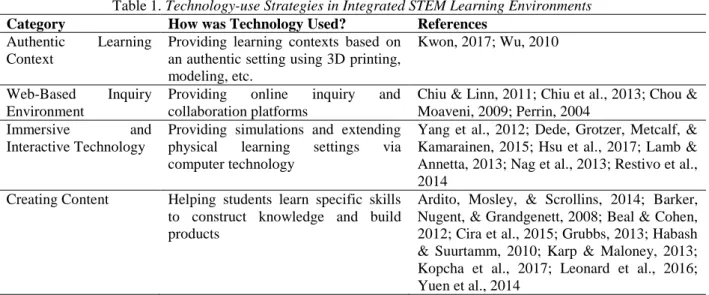
The authors reviewed the 22 studies focusing on how technology was used to support student learning in integrated STEM learning environments. Then, the authors sorted the studies into categories based on the technology-use strategies utilized (see Table 1), according to an open coding procedure that attached themes to the texts (Strauss & Corbin, 1990). An open coding procedure is a widely used qualitative procedure for analyzing text-based data, in this case, the 22 selected studies. The four strategies that emerged from analyzing the studies were: a) providing an authentic learning context for students, b) offering students a web-based inquiry environment, c) expanding learning with immersive and interactive technology, and d) transforming students from consumers to creators. Table 1 presents these emerged strategies (themes) and provides brief explanations for how technology was used. The studies were then sorted by individual strategy and placed in the references column.
Table 1. Technology-use Strategies in Integrated STEM Learning Environments
Category How was Technology Used? References
Authentic Learning Context
Providing learning contexts based on an authentic setting using 3D printing, modeling, etc.
Kwon, 2017; Wu, 2010
Web-Based Inquiry Environment
Providing online inquiry and collaboration platforms
Chiu & Linn, 2011; Chiu et al., 2013; Chou & Moaveni, 2009; Perrin, 2004
Immersive and
Interactive Technology
Providing simulations and extending physical learning settings via computer technology
Yang et al., 2012; Dede, Grotzer, Metcalf, & Kamarainen, 2015; Hsu et al., 2017; Lamb & Annetta, 2013; Nag et al., 2013; Restivo et al., 2014
Creating Content Helping students learn specific skills to construct knowledge and build products
Drawing on the empirical literature, the authors illustrate how the use of technology supports student learning in different types of integrated STEM learning environments, and how technology-use strategies help address the challenges of an integrated STEM learning environment.
Technology- Use Strategies for Integrated STEM Learning Environments
Providing an Authentic Learning Context
Authentic learning is an instructional approach that provides students an opportunity to apply knowledge to real-world problems, promoting a deeper understanding for students (Kelley & Knowles, 2016), which is especially relevant for an integrated STEM learning environment. STEM subjects require patience and perseverance to be mastered, which are difficult traits to nurture in students who are used to instant gratification (Demski, 2009). An authentic learning context is important for engaging learners and showing them how they can apply their learning in their daily lives. It can help generate a sense of learning satisfaction. Furthermore, an authentic context provides students with hands-on experience in solving real-world problems by using activities and tools similar in nature to those of professionals. An authentic context also helps prepare students for technical careers which also can empower and motivate them (Kelley & Knowles, 2016).
To provide an authentic learning context, Wu (2010) used computer-based modeling in an integrated STEM learning environment that focused on science and technology. In Wu‟s study, a computer-based air pollution modeling tool (APoMT) was used to investigate the effect of different variables on air quality. The APoMT was a simplified version of a scientific model based on the one used by scientists to encourage authentic inquiry and which focused on specific variables such as wind speed and weather conditions to demonstrate how multiple variables affect air quality. The APoMT was used to engage tenth grade students in authentic learning activities similar to the activities scientists would perform. To help students build accurate relationships between variables and improve the accuracy of their models, students were provided with simulated data and were expected to connect variables in specific ways. The results suggested that students significantly improved their understanding about air quality and performed well on planning, identifying variables, and testing their models.
How does a technology-enabled authentic learning environment support student learning?
Modeling allows scientists to “simulate how components of a system work together and interact with each other” (Wu, 2010, p. 197). In Wu‟s study, students used the APoMT to plan, identify and connect variables, and design and test models (i.e., modeling activities). The students learned technology (the modeling process) and scientific knowledge while using the APoMT, highlighting a benefit of integrating STEM disciplines. The APoMT enabled students to use technology in an authentic context, allowed students to go beyond making observations of phenomena, and provided real-time responses to students‟ questions while they were testing or validating their hypotheses. The APoMT also helped students identify and define variables, and analyze relationships among variables.
How does a technology-enabled authentic learning environment help address challenges of integrated STEM?
The use of a technology-enabled authentic learning environment (e.g., computer modeling system) helps alleviate some challenges associated with an integrated STEM learning environment. First, students are able to solve problems while learning about scientific concepts (e.g., air quality), which integrates the use and learning of technology and scientific inquiry in a meaningful way. Second, the access to an expert‟s knowledge within a modeling system helps overcome the lack of content knowledge on the teachers‟ side, making the implementation of an integrated STEM learning environment possible. Third, technology-supported modeling systems can help students focus their attention and working memory on specific variables to better facilitate learning and avoid cognitive overload.
Offering a Web-Based Inquiry Environment
scientific problems (National Research Council, 2015). Chiu and Linn (2011) used a web-based science inquiry environment (WISE) to support the integration of engineering into secondary science and math curricula while allowing students to conduct scientific inquiry. Within the WISE modules, students were encouraged to think like engineers, and apply mathematics and physics concepts while conducting experiments. One curricular unit in WISE guided students through an investigation on airbag safety in automobile collisions. In another unit about climate change, technology was used to help students visualize the greenhouse effect and view molecular simulations. Students used online brainstorming sessions and discussion forums to collaborate with their peers within WISE. Students could view relevant videos within WISE, and then refine or add information to their discussion posts.
Chiu et al. (2013) used a similar web-based engineering design learning environment (WISEngineering) to introduce engineering design to middle school students in an effort to improve their understanding of mathematics concepts and engineering practices in an integrated way. Students were able to build upon existing knowledge through a process of developing criteria, and evaluating new ideas. The learning unit that “introduced difficult concepts with explicit scaffolding, and visualization-based feedback” (Chiu et al., 2013, p. 153) in WISEngineering had a positive effect on all students. Within the WISEngineering environment, students progressed by designing and sharing an engineering project, and then participated in discussions other students‟ ideas. The students enjoyed learning and using technology.
How does a web-based inquiry environment support student learning?
A web-based inquiry environment provides students opportunities “to compare, contrast, critique, and distinguish” existing ideas with new ideas (Chiu & Linn, 2011, p. 3). In WISE students learned about force, motion, and velocity in the context of driving cars. This helped students identify and solve problems in realistic contexts through the process of eliciting ideas (recognizing ideas and connecting existing and new ideas), adding new ideas, distinguishing ideas, and sorting out ideas. Generic systems were broken down into smaller parts or individual processes to guide students to investigate relationships between different variables. WISE also facilitated teachers‟ selection and planning of complex and realistic contexts for the integration of engineering into K-12 science and math curriculum.
The WISE platform included visualizations that encouraged students to engage in systems thinking. Within WISE, students could manipulate animated and graphical representations of scientific phenomena to highlight how features of the phenomena interacted, which helped students create a design solution. WISE also included assessments that required students to “explain, graph, and draw their understanding” (Chiu & Linn, 2011, p. 7), and supplied a meaningful context for learning scientific, mathematical, and technological concepts. The WISEngineering environment purposefully guided students through the specifications and constraints that must be considered prior to developing engineering design solutions. Then, the students were encouraged to develop knowledge to address these elements by embarking on an investigation and considering different ideas using an online sketch wall to reflect on their work. Students developed STEM skills, such as identifying problems and finding possible solutions, instead of simply focusing on building a prototype. In addition, students were encouraged to evaluate their work and the work of their peers based on the design criteria.
How does a web-based inquiry environment help address challenges of integrated STEM?
In a web-based inquiry environment like WISE, students are able to learn and communicate in different modalities via multimedia and various communication tools. The affordance of a web-based inquiry environment helps alleviate some challenges associated with an integrated STEM learning environment. A web-based inquiry environment allows students to conveniently use screenshots, share notes, and critique ideas, all of which provide support for students to build science and engineering knowledge. In addition, embedded assessments, such as those within WISE, help measure students‟ connections for both science content and engineering skills, facilitating the integration of different subject content knowledge.
Expanding Learning with Immersive and Interactive Technology
Immersive and interactive technologies (e.g., simulations, games) provide an opportunity for students to perform experiments or investigate phenomena beyond physical constraints (de Jong, Sotiriou, & Gillet, 2014; Webb, Yang, & Senocak, 2014). For example, simulations allow students to manipulate data, explore variables, and observe their effects to gain an understanding of the relationships between variables (de Jong, Linn, & Zacharia, 2013). Innovative technology, like AR and VR, can provide contextual learning experiences (Dede et al., 2015) and offer immersive experiences, which have been found to add value to learning (Hsu et al., 2017; Restivo et al., 2014). Lamb and Annetta (2013) used laboratory simulations to support student learning in an integrated STEM learning environment that focused on science and technology. Their study investigated the effects of an online laboratory for high school chemistry compared to traditional instruction. Students were provided content instruction through webquests and online simulations over a nine-week period to explore chemistry phenomena at multiple scale levels (macroscopic and nanometer). The online simulations mitigated differences in teachers‟ experience levels. A low student to computer ratio encouraged exploration, and allowed students to complete modules without peer interference (Lamb & Annetta, 2013).
In Nag et al.‟s (2013) study, virtual simulation and gaming were used to support student learning in an integrated STEM learning environment. Students programmed miniature satellites using a web browser through a collaborative gaming simulation. Each group of students was provided a miniature satellite. The students designed and programmed the satellites to test navigation, flight, and “control algorithms in microgravity” (Nag et al., 2013, p. 145). Students also had their programming tested on the International Space Station (ISS). During this process, students gained programming skills and knowledge in math, engineering, physics, and space.
How does expanding learning with immersive and interactive technology support student learning?
Immersive technology, like computer simulations, provides a unique approach to explain difficult and complex processes and phenomena both at the macro and micro levels (Webb et al., 2014; Yang et al., 2012). With the assistance of computer simulations, students can manipulate molecules, change different variables, and “see” phenomena that is unobservable to the naked eye. The use of immersive and interactive technology, such as computer simulations, greatly facilitates students learning different subjects content simultaneously and helps overcome the boundaries of single disciplines. In Lamb and Annetta‟s study, students were able to use a virtual manipulative (another kind of immersive technology/simulation) with multiple methods of support from graphs and texts, to images and interaction. The simulations provided a fluid integration of science and technology, which in return provided students a more realistic way to learn. With the ability to manipulate information on the computer, students understood chemistry concepts better. In addition, the students‟ cognitive load was reduced in an integrated STEM learning environment by “making information more explicit” (Lamb & Annetta, 2013, p. 612).
In Nag et al.‟s study, a gaming simulation was used as an immersive environment to give students hands-on experience in programming satellites. Teachers were given support in teaching integrated STEM by working collaboratively with “certified …educators from participating schools…and/or community-based organizations” (Nag et al., 2013, p. 159). The simulation engaged students in well-integrated activities by immersing them in an interactive environment through programing and applying STEM skills. The ability to collaborate with other groups of students and teachers provided an opportunity for students to learn and further develop their skills. Schools unable to afford STEM laboratories could offer their students this low-cost hands-on virtual experience as an alternative.
How does expanding learning with immersive and interactive technology help address the challenges of integrated STEM?
In Nag et al.‟s study, the affordance of immersive and interactive technology, in the form of virtual gaming and simulation, helped alleviate several challenges associated with an integrated STEM learning environment. The ability to collaborate with other students, teachers, and experts and experiment within the environment provided an opportunity for students to learn different disciplinary content in an integrated way. Immersive and interactive technology incorporates content knowledge and provides students the ability to experiment, reducing the need for instructors to be content experts in specific STEM disciplines and laboratory procedures.
Creating Content
When transforming from subject content consumers into creators such as building a robot with wires and resistors and then programming it (Grubbs, 2013), students deepen their understanding of STEM subjects, as well as their ability to problem solve, verify solutions, and collaborate with others. Technology provides a canvas and/or the tools to motivate and engage learners (e.g., children programming with Scratch or building Lego robots) in various kinds of content creation (Schradie, 2011). Creating content with technology offers learners a chance to showcase integrated STEM projects and provides opportunities to role play and engage in design challenges (Grubbs, 2013). Content creation using technology supports learning skills that link students to future careers (Cira et al., 2015) and develops creative thinking and problem-solving skills. Technology can also help students disseminate their content creation (e.g., an online exhibition of a green energy city) to a larger audience, thus promoting more opportunities for students to showcase their learning and motivating them to become content creators while increasing their self-efficacy in learning.
Ardito et al. (2014) illustrated how technology was used to support students to become content creators in an integrated STEM learning environment that focused on science, engineering and mathematics. In this study, LEGO Mindstorms NXT were used to teach computer programing and robotics. The assembly and design of the robots helped students learn and practice mathematical concepts in an integrated way, presenting students with challenges of increasing difficulty. The use of robotics helped students “connect the skills learned in mathematics” (Ardito et al., 2014, p. 77) and increased problem-solving and collaboration skills. The robots‟ activities provided an engineering design process for students to construct knowledge while learning science and mathematics. Beal and Cohen (2012) illustrated how technology was used to support student learning in an integrated STEM learning environment that focused on science, technology, and mathematics. In their study, middle school students used a web-based application, Teach Ourselves (TO), to create and share learning materials. With TO students could create problems (termed problem posing) from readily available information or by seeking new information. Students were thus provided a realistic experience, involving problem posing and problem solving, similar to what they could expect in future professional careers. This type of technology use differed from the practice of answering problems in a textbook.
How does technology support students creating content?
Creatingcontent with the support of technology, such as designing and programming robots, supports active learning and deeper understanding. By creating content, students reorganized and reshaped their knowledge, which deepened their learning and encouraged creativity. In Ardito et al.‟s study, students progressed from learning how to program to utilizing specific concepts (e.g., conditional statements, repeating blocks) to programming robots. Students displayed collaborative thinking in design, construction, and problem-solving. The use of robotics allowed students to engage in trial and error, and explore the relationship of different mathematical concepts (e.g., measurement of circumference, measurement of length) in a collaborative way. Beal and Cohen‟s (2012) TO system supported students in posing/modifying problems and to consider solutions more easily than using paper and pencil. Students were motivated to pose problems through the use of a leader board, badges, and points, all of which were facilitated by the TO application. The TO application also allowed students to share their work with peers with less effort. Furthermore, the TO system helped students reflect on problems in new ways and deepened their understanding.
How does technology-supported content creation help address the challenges of integrated STEM?
concepts) were connected. The robots helped students demonstrate relevant scientific and mathematical concepts and provided a way to productively connect disciplinary knowledge in an integrated context (Becker & Park, 2011).
The TO application facilitated creating and solving mathematical and science problems with students. The study demonstrated that using technology helped students create content and solve peer-authored problems. The use of technology also supported integrated STEM learning by providing students a realistic experience that made learning more meaningful.
Technology-supported content creation helps alleviate a few challenges associated with an integrated STEM learning environment. First, content creation by posing problems in the TO system with its resources, collaboration mechanisms, and support, helps align students‟ STEM knowledge level with the complexity of the integrated STEM context (Nadelson & Seifert, 2017). Second, creating content with technology provides scaffolding for students and teachers to engage in open-ended design challenges, which helps support collaborative learning (e.g., when building robots in Grubb‟s 2013 study) and learning by doing, thus helping to overcome shortfalls in teacher understanding of engineering concepts.
Discussion and Conclusion
This paper provides an overview of the technology-use strategies for supporting student learning in integrated STEM learning environments. The authors hope to raise awareness of the intersection of technology-supported learning and integrated STEM learning. Currently, neither the integrated STEM learning environment nor technology has been fully utilized to its full potential (Chiu et al., 2013). The limited research currently available regarding technology-use strategies and integrated STEM learning environments further demonstrates that connecting the two is necessary and critical.
The use of technology in integrated STEM learning environments can expand effective teaching and learning beyond what is possible with a traditional teaching and learning approach. Categorizing the technology-use strategies (e.g., providing an authentic context, offering a web-based inquiry environment, using interactive and immersive technology, and creating content) can help educators adopt effective strategies to support and guide student learning in integrated STEM environments. It is critical to note that the strategies described in the selected studies were supported through research and theoretical frameworks, which also reflect the effective use of technology. For example, Wu‟s (2010) APoMT was informed by theories and design principles of scaffolding, and the WISE platform was based on the knowledge integration (KI) framework (Chiu & Linn, 2011).
The use of technology in the four strategies identified in this paper both supports student learning and enhances students‟ experiences in meaningful ways. The selected studies serve as examples of how technology can increase both technological and scientific literacy, and supports the idea of students knowing and doing, as advocated by widespread initiatives in STEM education (Canada 2067; U.S. Department of Education, 2016). The selected studies also demonstrate technology-use strategies used to support student learning in different types of integrated STEM learning environments, often providing „real-world‟ experiences (i.e., similar to those of professionals) for students and encouraging engagement. By infusing technology into a complex STEM learning environment, we can expose students to authentic contexts and provide opportunities to develop technical skills that highlight the learning of STEM disciplines (e.g., Wu, 2010), all without disciplinary boundaries. In the real world, STEM subjects are intrinsically linked; for example, mathematics is a problem-solving tool for engineers and engineers use science and mathematics to design and create products for numerous practical purposes.
Future Directions
integrated STEM education. Technology-use strategies that involve innovative VR and AR experiences for integrated STEM learning environments especially need to be explored.
This study focuses on the technology-use strategies rather than specific technology or tools. Future effort on research and identifying specific kinds of technology and tools that can be used to support student learning in integrated STEM learning environments would be helpful for instructors. Future research on effective design and implementation of technology-supported, integrated STEM learning environments for improving student performance and retention is necessary. Understanding the resources necessary to execute these technology-use strategies would be enlightening, as would investigating the transferability of the technology-use strategies. Future research on the synergistic effects of the use of technology within integrated STEM environments could provide more strategies for practitioners. It is recommended that instructors and researchers collaborate and communicate successful technology-use strategies to encourage sound technological practices in integrated STEM environments.
References
Ardito, G., Mosley, P., & Scollins, L. (2014). We, robot: Using robotics to promote collaborative and mathematics learning in a middle school classroom. Middle Grades Research Journal, 9(3),73-88. Barker, B. S., Nugent, G., & Grandgenett, N. (2008). Examining 4-H robotics and geospatial technologies in the
learning of science, technology, engineering, and mathematics topics. Journal of Extension, 46(3), 1-9. Beal, C. R., & Cohen, P. R. (2012). Teach ourselves: Technology to support problem posing in the STEM
classroom. Creative Education, 3(4), 513-519.
Becker, K., & Park, K. (2011). Effects of integrative approaches among science, technology, engineering, and mathematics (STEM) subjects on students' learning: A preliminary meta-analysis. Journal of STEM Education: Innovations and Research, 12(5/6), 23-37.
Breiner, J. M., Harkness, S. S., Johnson, C. C., & Koehler, C. M. (2012). What is STEM? A discussion about conceptions of STEM in education and partnerships. School Science and Mathematics, 112(1), 3-11.
Canada 2067. (2017, 15 December). Help shape the future of STEM education in Canada. Retrieved from
https://canada2067.ca/en/articles/help-shape-the-future-of-stem-education-in-canada/
Chiu, J. L. & Linn, M. C. (2011). Knowledge integration and wise engineering. Journal of Pre-College Engineering Education Research, 1(1),1-14.
Chiu, J. L., Malcolm, P. T., Hecht, D., DeJaegher, C. J., Pan, E. A., Bradley, M., & Burghardt, M. D. (2013). WISEngineering: Supporting precollege engineering design and mathematical understanding. Computers & Education, 67, 142-155.
Chou, K. C., & Moaveni, S. (2009). Web-based interactive steel sculpture for the Google generation. Journal of STEM Education: Innovations & Research, 10(2), 50–59.
Cira, N. J., Chung, A. M., Denisin, A. K., Rensi, S., Sanchez, G. N., Quake, S. R., & Riedel-Kruse, I. H. (2015). A biotic game design project for integrated life science and engineering education. PLOS Biology, 13(3), 1-8.
Dede, C., Grotzer, T., Metcalf, S., & Kamarainen, A. (2015). Ecomobile: Designing for contextualized stem learning using mobile technologies and augmented reality. In H. Crompton and J. Traxler (Ed.) Mobile learning and STEM (pp. 116-142). New York, NY: Routledge.
de Jong, T., Linn, M. C., & Zacharia, Z. C. (2013). Physical and virtual laboratories in science and engineering education. Science, 340(6130), 305-308.
de Jong, T., Sotiriou, S., & Gillet, D. (2014). Innovations in STEM education: The Go-Lab federation of online labs. Smart Learning Environments, 1(1), 3-8.
Demski, J. (2009). STEM picks up speed: The use of authentic scenarios to teach abstract concepts such as constant velocity is helping educators spark student interest in math and science. THE Journal (Technological Horizons in Education), 36(1), 22-26.
Drake, S. M. (2012). Creating standards-based integrated curriculum: The common core state standards edition. Thousand Oaks, CA: Corwin Press.
Epstein, D., & Miller, R. T. (2011). Slow off the mark: Elementary school teachers and the crisis in science, technology, engineering, and math education. Center for American Progress. Retrieved from http://files.eric.ed.gov/fulltext/ED536070.pdf.
Gauvain, M. T. (2014, April). The social context of integrated STEM education. Presented at the Conference of American Educational Research Association, Philadelphia, PA.
Habash, R. W., & Suurtamm, C. (2010). Engaging high school and engineering students: A multifaceted outreach program based on a mechatronics platform. IEEE transactions on education, 53(1), 136-143. Hsu, Y. S., Lin, Y. H., & Yang, B. (2017). Impact of augmented reality lessons on students‟ STEM
interest. Research and Practice in Technology Enhanced Learning, 12(1), 2.
Karp, T., & Maloney, P. (2013). Exciting young students in grades K-8 about STEM through an afterschool robotics challenge. American Journal of Engineering Education, 4(1), 39-53.
Kelley, T. R., & Knowles, J. G. (2016). A conceptual framework for integrated STEM education. International Journal of STEM Education, 3(1), 11. https://doi.org/10.1186/s40594-016-0046-z.
Kennedy, T. J., & Odell, M. R. L. (2014). Engaging students in STEM education. Science Education International, 25(3), 246-258.
Koehler, M. J., & Mishra, P. (2009). What is technological pedagogical content knowledge? Contemporary Issues in Technology and Teacher Education, 9(1) 60-70. Retrieved from http://www.citejournal.org/volume-9/issue-1-09/general/what-is-technological-pedagogicalcontent-knowledge
Kopcha, T. J., McGregor, J., Shin, S., Qian, Y., Choi, J., Hill, R., ... & Choi, I. (2017). Developing an integrative STEM curriculum for robotics education through educational design research. Journal of Formative Design in Learning, 1(1), 31-44. https://doi.org/10.1007/s41686-017-0005-1.
Kwon, H. (2017). Effects of 3D printing and design software on student‟s interests, motivation, mathematical and technical skills. Journal of STEM Education, 18(4) 37-42.
Lamb, R., Akmal, T., & Petrie, K. (2015). Development of a cognition‐priming model describing learning in a STEM classroom. Journal of Research in Science Teaching, 52(3), 410-437.
Lamb, R. L., & Annetta, L. (2013). The use of online modules and the effect on student outcomes in a high school chemistry class. Journal of Science Education and Technology, 22(5), 603-613.
Lemke, J. L. (2013). Investigating interactive immersive worlds: Assessing the relevance of computer games for STEM learning environment design. Retrieved from https://bit.ly/2QcgRyj.
Leonard, J., Buss, A., Gamboa, R., Mitchell, M., Fashola, O. S., Hubert, T., & Almughyirah, S. (2016). Using robotics and game design to enhance children‟s self-efficacy, STEM attitudes, and computational thinking skills. Journal of Science Education and Technology, 25(6), 860-876.
Lunce, L. M. (2006). Simulations, bringing the benefits of situated learning to the traditional classroom. Journal of Applied Educational Technology 3(1), 37–45.
Mayer, R. (2009). Multimedia learning. Cambridge: Cambridge University Press. https://doi.org/10.1017/CBO9780511811678
Mioduser, D., Nachmias, R., & Forkosh-Baruch, A. (2017, March). New literacies for the knowledge society. In J. Voogt, G. Knezek, R. Christensen, K.W. Lai, K. Pratt, P. Albion, ... & P. Resta, (Ed.), The international handbook of information technology in primary and secondary education: Part 2 (pp. 23-42). Boston, MA: Springer.
Moore, T. J., & Smith, K. A. (2014). Advancing the state of the art of STEM integration. Journal of STEM Education: Innovations and Research, 15(1), 5-10.
Nadelson, L. S., & Seifert, A. L. (2017). Integrated STEM defined: Contexts, challenges, and the future. The Journal of Educational Research, 110(3), 221-223.
Nag, S., Katz, J. G., & Saenz-Otero, A. (2013). Collaborative gaming and competition for CS-STEM education using SPHERES Zero Robotics. Acta Astronautica, 83(2013), 145-174.
National Research Council (NRC). (2015). Guide to implementing the next generation science standards. Washington, DC: National Academies Press.
Perrin, M. (2004). Inquiry-based pre-engineering activities for K-4 students. Journal of STEM Education: Innovations & Research, 5(3/4), 29–34.
Restivo, T., Chouzal, F., Rodrigues, J., Menezes, P., & Lopes, J. B. (2014, April). Augmented reality to improve stem motivation. In Global Engineering Education Conference (EDUCON), 2014 IEEE (pp. 803-806). IEEE.
Salzman, H. (2013). What shortages? The real evidence about the STEM workforce. Issues in Science and Technology, 29(4), 58-67.
Sanders, M. (2008). STEM, STEM education, STEMmania. Technology Teacher, 68(4), 20-26.
Schradie, J. (2011). The digital production gap: The digital divide and Web 2.0 collide. Poetics, 39(2), 145–168. Smith, B., & Mader, J. (2017). Align your curriculum with the ISTE standards. The Science Teacher 84 (5), 8. Spektor-Levy, O., Israeli, N., Plutov, I., & Perry, N. (2017). Inquiry-based science education and the digital
research triad. In D. Tsybulsky & I. Levin (Ed.), Digital tools and solutions for inquiry-based STEM learning (pp. 1-32). Hershey, PA: IGI Global.
Tamim, R. M., Bernard, R. M., Borokhovski, E., Abrami, P. C., & Schmid, R. F. (2011). What forty years of research says about the impact of technology on learning: A second-order meta-analysis and validation study. Review of Educational Research, 81(1), 4-28.
Trygstad, P. J. (2013). 2012 National survey of science and mathematics education: Status of elementary school science. Chapel Hill, NC: Horizon Research, Inc.
U.S. Department of Education. (2016). STEM 2026: A vision for innovation in STEM education. Retrieved from https://innovation.ed.gov/files/2016/09/AIR-STEM2026_Report_2016.pdf.
U.S. Department of Education. (2017). Use of technology in teaching and learning. Retrieved from https://www.ed.gov/oii-news/use-technology-teaching-and-learning.
Webb, J., Yang, D., & Senocak, I. (2014). Interactive molecular-level descriptions in engineering educational simulations. Proceedings of 2014 American Society for Engineering Education Annual Conference and Exposition (ASEE), Indianapolis, IN.
Wu, H.-K. (2010). Modeling a complex system: Using novice-expert analysis for developing an effective technology-enhanced learning environment. International Journal of Science Education, 32(2), 195-219. Yang, D., Streveler, R. A., Miller, R. L., Slotta, J., Matusovich, H., & Magana, A. (2012). Using computer-based online learning modules to promote conceptual change: Helping students understand difficult concepts in thermal and transport science. International Journal of Engineering Education, 28(3), 686-700.
Yuen, T. T., Boecking, M., Tiger, E. P., Gomez, A., Guillen, A., Arreguin, A., & Stone, J. (2014). Group tasks, activities, dynamics, and interactions in collaborative robotics projects with elementary and middle school children. Journal of STEM Education: Innovations and Research, 15(1), 39-45.
Author Information
Dazhi Yang Boise State University
1901 University Drive, Boise ID 83725 USA
Contact e-mail: [email protected]
Sally J. Baldwin Boise State University