Algorithm based PI-PD Controller
Tayyab Ali*, Suheel Abdullah Malik, Muhammad Adeel, Muhammad Amir, Department of Electrical Engineering
International Islamic University Islamabad, Pakistan
*Corresponding author: [email protected]
Abstract
The ball and beam system is one of the commonly used benchmark control apparatus for evaluating numerous different real systems and control strategies. It is inherently nonlinear and open loop unstable system. In this paper, we have suggested Evolutionary Algorithm (EA) based Proportional Integral-Proportional Derivative (PI-PD) controller for the set point tracking of this well-known ball and beam system. A linearized model of the ball and beam system is deduced and PI-PID control methodology is employed. The popular EA technique such as Genetic algorithm (GA) is used for tuning of the controller. The optimized values of the controller parameters are achieved by solving a fitness function using GA. The transient performance of the proposed GA based PI-PD controller (GA-PI-PD) is evaluated by carrying set point tracking analysis of the ball and beam system through MATLAB/Simulink simulations. Furthermore, the performance of GA-PI-PD controller is investigated using four different performance indices such as Integral of squared value of error (ISE), Integral of time multiplied by squared value of error (ITSE), Integral of absolute value of error (IAE) and Integral of time multiplied by absolute value of error (ITAE). The comparison of transient performance including rise time, settling time and % overshoot is made with SIMC-PID and H-infinity controllers. The comparison reveals that GA-PI-PD controller yielded transient response with small % overshoot and settling time. The superior performance of the GA-PI-PD controller has witnessed that it is highly effective for maintain good stability and the set point tracking of ball and beam system with fast settling time and less overshoot than SIMC-PID and H-infinity controllers.
Keywords: Stability control, Ball and Beam system, Set point tracking, Evolutionary Algorithms, Genetic Algorithm (GA), Proportional Integral-Proportional Derivative (PI-PD) controller, SIMC based PID controller, H-infinity controller, Open loop unstable systems.
Introduction
The ball & beam system has been used to study and analyze the stability control of many control engineering problems [1]. Ball & beam system comprises of ball, beam, gear, motor and position sensors. The ball and beam system is an open-loop unstable system [2]. In ball & beam system, main aim is to change the ball position as desired by varying the beam angle [3-4]. Since open loop response of this system is unstable, so a controller is always required to make this system stable. For this purpose, many controllers have been used for the stabilization of ball and beam system such as Fuzzy controller, SIMC-PID, H-infinity and LQR and [2-11]. Many traditional tuning techniques have been used for the tuning of these controllers. Evolutionary computational techniques such as Differential Evolution (DE) and Particle Swarm Optimization (PSO) have been explored successfully for the tuning of controllers. It has been observed that these evolutionary computational techniques have given satisfactory transient response than classical tuning techniques. In [8], Differential Evolution based PID (DE-PID) controller has been implemented for the control ball & beam system. In [9], I-PD controller tuned by Particle Swarm Optimization (PSO) has been designed to control the desired system. In this work, PI-PD controller has been used for the set point tracking of ball & beam system. Genetic Algorithm (GA) is an evolutionary computational technique, which has been utilized in this research for the tuning of proposed controller. The comparison of the GA-PI-PD controller with SIMC based PID (SIMC-PID) and H-infinity controller is presented to evaluate the working of the proposed controller.
Mathematical Modeling and Controller Design
Transfer function of ball and beam system between gear angle (𝛉(s)) and ball position (P(s)) has been derived in this section. The schematic diagram of the system is provided in Figure 1. Parameters of the ball & beam system and their values are specified in Table 1.
Fig 1: Schematic of Ball and Beam System
The linear acceleration of the ball along the mounted beam is written by using Lagrangian equation of motion[2,9].
(J
R2+ m ) 𝑝̈ + mgsinα− m𝑝𝛼̇
2 (1)
where
R is representing the ball’s radius m is representing the mass of the ball
g is representing the gravitational acceleration J is representing the moment of inertia of the ball
p is representing the ball’s position
α is defined as the beam angle
Linearization of equation (1) about 𝛼 = 0 can be written as:
(J
R2+ m ) 𝑝̈ = − mgα (2) also
α= (𝑑
L)θ (3)
where,
L is representing the beam’s length
d is the distance between joint of the lever arm and the center of the gear
Substituting equation (3) into equation (2),
(J
R2+ m ) 𝑝̈ = − mg (
𝑑
L)θ (4)
Taking Laplace transform of equation (4) yields as,
GBB(s)= P(s)
θ(s)= − mg𝑑
L(J
R2+m)
1
𝑠2 (5)
GBB(s) represents the transfer function of the ball and
beam system.
Table 1: Ball and Beam system’s parameters
After substitution of parameters’ values in equation 5 from Table 1,GBB(s) can be written as
GBB(s) = P(s)
θ(s)= 0.7
s2 (6)
Controllers for Ball and Beam System
In this research, Genetic Algorithm (GA) based Proportional Integral-Proportional Derivative (PI-PD) controller has been used for set point tracking of the ball & beam system. PI-PD controller has two degrees of freedom. It has both close loop as well as feedback characteristics, which lead to an efficient set point tracking of the desired system [12-13].
PI-PD Controller
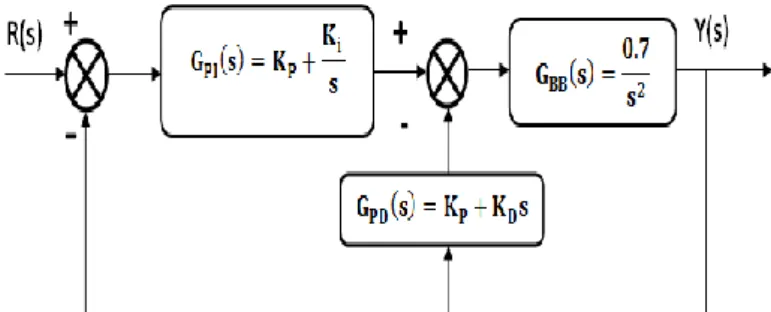
In PI-PD controller, Proportional Derivative (PD) controller is associated with feedback path whereas Proportional Integral (PI) controller is associated with feed-forward path. Figure 2 shows the block diagram representation of PI-PD controller. Y(s) represents the output of the system whereas R(s) denotes the input of the system.
Fig 2: Block diagram of PI-PD controller along with ball and beam system
Close-loop transfer function of the proposed PI-PD controller can be obtained as (GC(s)),
GC(s) = Y(s) R(s)=
0.7KPs+0.7Ki
s3+0.7s2+1.4K
ps+0.7Ki (7)
Controller’s Tuning
To determine optimum value of the controller’s constants (KP, Ki, KD), one has to utilize different tuning techniques. Many conventional tuning techniques have been used to do this but in recent past evolutionary computational techniques have been widely used to tune the controllers. These techniques include Particle Swam Optimization (PSO) and Differential Evolution (DE) etc. Genetic Algorithm (GA) has been explored in this research work for tuning purpose. The block diagram representation for the set point tracking of ball & beam system with evolutionary computation based controller is demonstrated in Figure 3.
Fig 3: Block Diagram of the set point tacking of ball and beam system
Genetic Algorithm (GA)
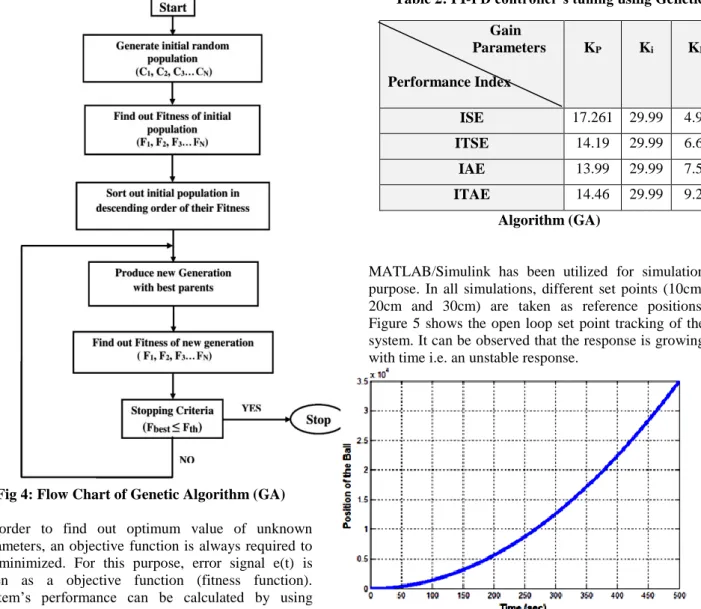
Genetic Algorithm (GA) is as evolutionary algorithm based upon Darwin’s theory. GA was invented in the early 1970’s by John Holland. It is used for the solution of different optimization problems [14]. GA is a stochastic algorithm, which has been provoked by evolutionary genetics [15]. The basic idea is to create new random generations till you will find out best solution. After getting optimum solution of a problem, algorithm has been stopped. The flow chart diagram of the GA is given in Figure 4.
Parameter’s symbol
Description of Parameters
Value
L Beam’s length 0.4 m
R Radius of the Ball 0.015 m
d Offset of the lever arm
0.04 m
J Ball’s moment Inertia of the
2mR2/5
kgm^2
g Gravitational
acceleration
-9.8m/s2
Fig 4: Flow Chart of Genetic Algorithm (GA)
In order to find out optimum value of unknown parameters, an objective function is always required to be minimized. For this purpose, error signal e(t) is taken as a objective function (fitness function). System’s performance can be calculated by using different performance indices, which are associated with different parameters like overshoot (os), settling time (ts), steady state error (ess.) and rise time (tr) etc.
Four different types of errors including Integral of squared value of error (ISE), Integral of time multiplied by squared value of error (ITSE), Integral of absolute value of error (IAE) and Integral of time multiplied by absolute value of error (ITAE) have been considered as performance indices in this research work. These indices have been minimized using Genetic Algorithm (GA), which is implemented through MATLAB Optimization Toolbox. These performance indices can be obtained as,
ISE = ∫ eT 2(t)dt
0 (8)
IAE = ∫ |e(t)|dt0T (9)
ITAE = ∫ t|e(t)|dt0T (10)
ITSE = ∫ te0T 2(t)dt (11)
Simulation Results and Discussion
In this section, GA-PI-PD controller is implemented for the set point tracking of ball and beam system given by equation 6.
Table 2: PI-PD controller’s tuning using Genetic
Algorithm (GA)
MATLAB/Simulink has been utilized for simulation purpose. In all simulations, different set points (10cm, 20cm and 30cm) are taken as reference positions. Figure 5 shows the open loop set point tracking of the system. It can be observed that the response is growing with time i.e. an unstable response.
Fig 5: Open-loop set point tracking of ball and beam system
Implementation of GA-PI-PD controller for the set point tracking is provided in this section. In Table 2, optimum tuning parameters of PI-PD controller acquired by GA have been provided. Figure 6 and 7 shows the output responses of GA-PI-PD controller for IAE and ISE respectively. Similarly Figure 8 and 9 shows the output responses of GA-PI-PD controller for ITSE and ITAE respectively. Table 3 represents the transient response performance of GA-PI-PD controller with each performance index. It can be observed from the results of Table 3 that GA-PI-PD controller with ISE exhibits relatively less rising time with zero % overshoot. Moreover, it can be observed that GA-PI-PD controller with ITAE gives lower value of settling time. Finally, it can be concluded that GA-PI-PD controller yields much better transient response in terms of steady state error (ess.), settling time (ts), overshoot (OS) and rise time (tr).
Gain Parameters
Performance Index
KP Ki KD
ISE 17.261 29.99 4.96
ITSE 14.19 29.99 6.68
IAE 13.99 29.99 7.55
Fig 6: Set point tracking of GA-PI-PD controller with IAE
Fig 7: Set point tracking of GA-PI-PD controller with ISE
Fig 8: Set point tracking of GA-PI-PD controller with ITSE
Fig 9: Set point tracking of GA-PI-PD controller with ITAE
Table 3: Comparison of GA-PI-PD controller with different performance indices
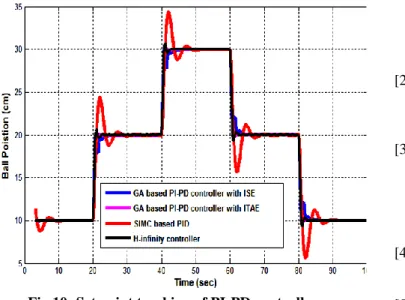
Figure 10 shows the comparison of GA-PI-PD controller with SIMC-PID and H-infinity controller as used in [2]. The performance comparison is also provided in Table 4. Figure 10 and Table 4 reveal that GA-PI-PD controller yields very negligible % overshoot with rise time (tr) and settling time (tS)
relatively less than SIMC-PID and H-infinity controller.
0 10 20 30 40 50 60 70 80 90 100
0 5 10 15 20 25 30 35
Time (sec)
B
a
ll
p
o
s
it
io
n
(
c
m
)
Desired Position
IAE (GA based PI-PD controller)
0 10 20 30 40 50 60 70 80 90 100
0 5 10 15 20 25 30 35
Time (sec)
Ball
positi
on (cm
)
Desired Position
ISE(GA based PI-PD controller)
0 10 20 30 40 50 60 70 80 90 100
0 5 10 15 20 25 30 35
Time (sec)
Ball
positi
on (cm
)
Desired Position
ITSE (GA based PI-PD controller)
Performance
Parameter
Performance Index
Settling Time
(sec) s-s Erro
r
Rise Time
(sec)
% Overshoo
t
IAE 2.30 0 0.60 1.73
ITAE 1.08 0 0.70 1
ISE 3.24 0 0.46 0
Fig 10: Set point tracking of PI-PD controller vs. SIMC based PID and H-infinity controller
Table 4: Comparison of GA-PI-PD with SIMC-PID and H-infinity controller [2]
Performance Parameter
Controller
Settling Time
(sec) s-s Erro
r
% Oversho
ot
Rise Time
(sec)
GA-PI-PD
ISE 3.24 0 0 0.46
ITAE 1.08 0 1 0.70
SIMC-PID controller 10.9 0 40 1
H-infinity controller 3.7 0 6.7 1.1
Conclusions
The set point trancking response of ball and beam system has been investigated using PI-PD controller. An evolutioary computational technique Genetic Algorithm (GA) has been utilized to find out optimum parameters of the proposed controller. ITSE, ISE, ITAE and IAE have been utilized for the assessment of PI-PD controller. Simulation results reveal that GA-PI-PD controller with each performance index is very effective as comapred to SIMC-PID and H-infinty controller [2]. GA-PI-PD controller has very little overshoot (os), settling time(tS) and rise time (tr). Since GA-PI-PD
controller has very small % overshoot, it will be very reliable for the plant dynamics. Similarly rise time and settling time have been reduced so that sytem will achieve its desired position within very small time intrerval. Finally it can be concluded that GA-PI-PD controller is much efficient and valuable for the set point tracking of ball & beam systems which will be very supportive for the control of many engineering problems in the future.
References
[1] W. Yu and F. Ortiz, “Stability analysis of PD
regulation for ball and beam system,” in Proceedings of 2005 IEEE Conference on Control Applications, 2005. CCA 2005., 2005, pp. 517–522.
[2] S. Sathiyavathi and K. Krishnamurthy, “PID control of ball and beam system-A real time experimentation,” J. Sci. Ind. Res., vol. 72, 2013, pp. 481–484.
[3] M. Keshmiri, A. F. Jahromi, A. Mohebbi, M. H. Amoozgar, and W.-F. Xie, “Modeling and control of ball and beam system using model based and non-model based control approaches,” Int. J. smart Sens. Intell. Syst., vol. 5, no. 1, 2012, pp. 14–35.
[4] S. S. Abdullah, M. Amjad, M. I. Kashif, and Z. Shareef, “A simplified intelligent controller for ball and beam system,” 2010.
[5] J. Huang and C.-F. Lin, “Robust nonlinear control of the ball and beam system,” in American Control Conference, Proceedings of the 1995, vol. 1, 1995, pp. 306–310.
[6] H. K. Lam, F. H. F. Leung, and P. K. S. Tam, “Design of a fuzzy controller for stabilizing a ball-and-beam system,” in Industrial Electronics Society, 1999. IECON’99 Proceedings. The 25th Annual Conference of the IEEE, vol. 2, 1999, pp. 520–524.
[7] Q. Wang, M. Mi, G. Ma, and P. Spronck, “Evolving a neural controller for a ball-and-beam system,” in Machine Learning and Cybernetics, 2004. Proceedings of 2004 International Conference on,, vol. 2, 2004, pp. 757–761.
[8] K. T. Prasad and Y. V Hote, “Optimal PID controller for Ball and Beam system,” in Recent Advances and Innovations in Engineering (ICRAIE), 2014, pp. 1–5.
[9] D. D. Kumar, B. Meenakshipriya, and S. S. Ram, “Design and comparison of PID and PSO based I-PD controller for ball and beam system,” vol.9, no.12, 2016, pp.1-5.
[10] B. Meenakshipriya and K. Kalpana, “Modelling and Control of Ball and Beam System using Coefficient Diagram Method (CDM) based PID controller,” IFAC Proc. Vol., vol. 47, no. 1, 2014, pp. 620–626.
[11] W. Yuanyuan and L. Yongxin, “Fuzzy PID controller design and implement in Ball-Beam system,” in Control Conference (CCC), 2015 34th Chinese, 2015, pp. 3613–3616.
[12] K. Ogata and Y. Yang, “Modern control engineering,” 1970.
[13] M. Araki and H. Taguchi, “Two-degree-of-freedom PID controllers,” Int. J. Control Autom. Syst., vol. 1, 2003, pp. 401–411. [14] N. Thomas and D. P. Poongodi, “Position
control of DC motor using genetic algorithm based PID controller,” in Proceedings of the World Congress on Engineering, vol. 2, 2009, pp. 1–3.
![Fig 1: Schematic of Ball and Beam System The linear acceleration of the ball along the mounted beam is written by using Lagrangian equation of motion[2,9]](https://thumb-us.123doks.com/thumbv2/123dok_us/7984015.2118197/1.892.501.781.700.930/schematic-linear-acceleration-mounted-written-lagrangian-equation-motion.webp)
![Figure 10 shows the comparison of GA-PI-PD controller with SIMC-PID and H-infinity controller as used in [2]](https://thumb-us.123doks.com/thumbv2/123dok_us/7984015.2118197/4.892.54.808.76.1090/figure-shows-comparison-controller-simc-pid-infinity-controller.webp)