THE CHALLENGE OF COMMUNITY COLLEGE STUDENT ACADEMIC MOTIVATION: THE GO FOR GROWTH! INTERVENTION
Jonathan Clark Wright
A dissertation submitted to the faculty at the University of North Carolina at Chapel Hill in partial fulfillment of the requirements for the degree of Doctor of Philosophy in the Department
of School Psychology in the School of Education.
Chapel Hill 2018
Approved by: Steve Knotek Judith Meece Sandra Evarrs Rune Simeonsson
© 2018
ABSTRACT
Jonathan Clark Wright: The Challenge of Community College Student Academic Motivation: The Go for Growth! Intervention
(Under the direction of Steve Knotek and Judith Meece)
The community college student population has been found to be less academically prepared than their four-year counterparts. This relatively at-risk group is argued to struggle with academic motivation in the college setting. Researchers studying student implicit theories of intelligence have found that students who struggle in academia may do so because of
To my loving wife, Allie Arpajian, thank you for your endless joy, love, and support. To my parents, Denis Wright and Nancy Wright, and my sister, Meredith Wright thank you for your
TABLE OF CONTENTS
LIST OF TABLES ...x
LIST OF FIGURES ... xi
CHAPTER 1: INTRODUCTION AND LITERATURE REVIEW ...1
Statement of the Problem ...2
Characterizing Community College Students ...4
Developmental Education ...5
New Student Orientation...7
Social and Emotional Learning (SEL) ...8
Malleable forms of Social and Emotional Learning ...9
Social and Emotional Learning in College Students ...10
Social and Emotional Learning Interventions ...12
Social and Emotional Learning Interventions for College Students ...13
Need for Focus on Motivation ...14
Mastery and Performance Goals ...16
Defining Mastery and Performance Goal Orientations ...17
Goal Orientation and Self-Efficacy ...19
Goal Orientation and Affect...20
Goal Orientation and Academic Success ...20
Goal Orientation in College Students ...22
Teaching Strategies that Promote Mastery Orientation ...23
Mindset ...24
Mindset in College Students ...27
Problem Theory ...31
Current Study ...33
Conceptual Mediational Model...33
Logic Model and Theory of Change ...33
Purpose of the Study ...34
Research Question 1 ...35
Hypothesis 1 for Research Question 1 ...35
Hypothesis 2 for Research Question 1 ...35
Hypothesis 3 for Research Question 1 ...35
Research Question 2 ...35
Hypothesis 1 for Research Question 2 ...35
Hypothesis 2 for Research Question 2 ...36
Hypothesis 3 for Research Question 2 ...36
Hypothesis 4 for Research Question 2 ...36
Research Question 3 ...36
Hypothesis 1 for Research Question 3 ...36
Hypothesis 2 for Research Question 3 ...36
Research Question 4 ...36
Hypothesis for Research Question 4 ...36
Research Question 5 ...37
Research Question 6 ...37
CHAPTER 2: METHODOLOGY ...38
Participants ...38
Measures ...39
Course Grades ...39
Retention ...39
Demographics ...39
Fidelity ...41
Feasibility ...42
Procedures ...43
Feasibility and Acceptability of Intervention ...43
Intervention ...44
CHAPTER 3: RESULTS ...49
Preliminary Analyses ...49
Fidelity ...50
Grade in Psychology Course ...52
Level of Growth Mindset ...56
Level of Mastery Orientation ...59
Retention ...63
Mindset and Goal Orientation ...66
Implementation Feasibility and Acceptability of Intervention ...67
CHAPTER 4: DISCUSSION ...68
Findings Related to Implementation ...68
Findings Related to Student Success ...69
Grades ...69
Retention ...71
Interpretation ...71
Findings Related to Motivation ...74
Unexpected Findings ...75
Research Limitations ...77
Future Directions ...80
Implications of Research...83
APPENDIX 1: INFORMED CONSENT FORM FOR FACULTY ...88
APPENDIX 2: DEMOGRAPHIC QUESTIONNAIRE ...90
APPENDIX 4: THE SUBJECT SPECIFIC GROWTH MINDSET SCALE ...92
APPENDIX 5: ACHIEVEMENT GOAL QUESTIONNAIRE ...93
APPENDIX 6: THE PALS PERCEPTION OF CLASSROOM GOAL STRUCTURE SUBSCALE ...94
APPENDIX 7: FIDELITY SURVEY ...95
APPENDIX 8: FEASIBILITY SURVEY ...96
APPENDIX 9: TEACHING STRATEGIES FOR PROMOTING GROWTH MINDSET AND MASTERY ORIENTATION ...97
APPENDIX 10: REMINDER E-MAIL TO FACULTY ORIENTATION ...99
APPENDIX 11: POWERPOINT SLIDES ...100
APPENDIX 12: INFORMED CONSENT FORM FOR STUDENTS ...103
APPENDIX 13: SESSION PROTOCOLS ...105
APPENDIX 14: THE GROWTH MINDSET HANDOUT ...107
APPENDIX 15: VIDEO LINK AND TRANSCRIPT...109
APPENDIX 16: CONTROL FACULTY SURVEY ...112
LIST OF TABLES
Table 1 – Means and Standard Deviations of Study Variables ...50
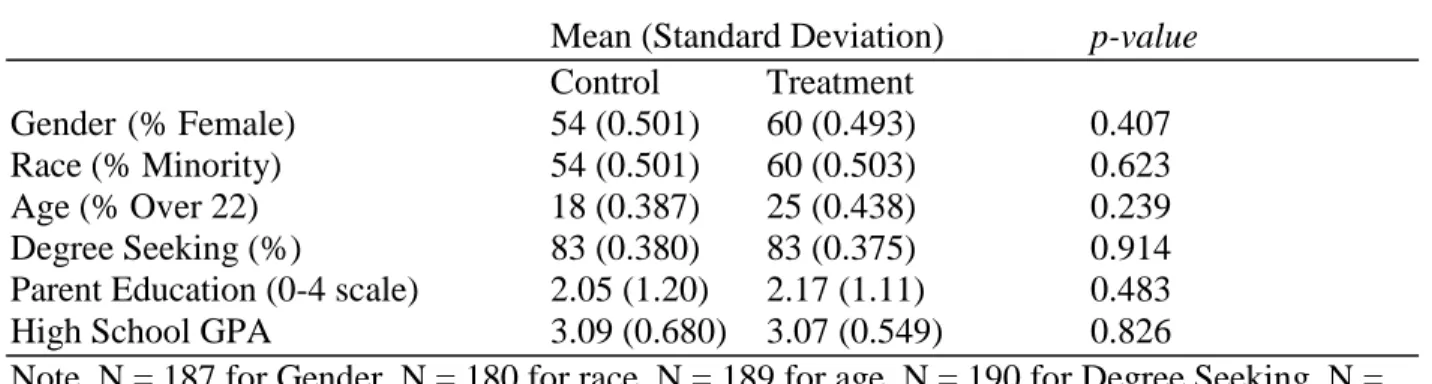
Table 2 – Mean Comparisons of Demographics Variables Between Treatment and Control Groups ...50
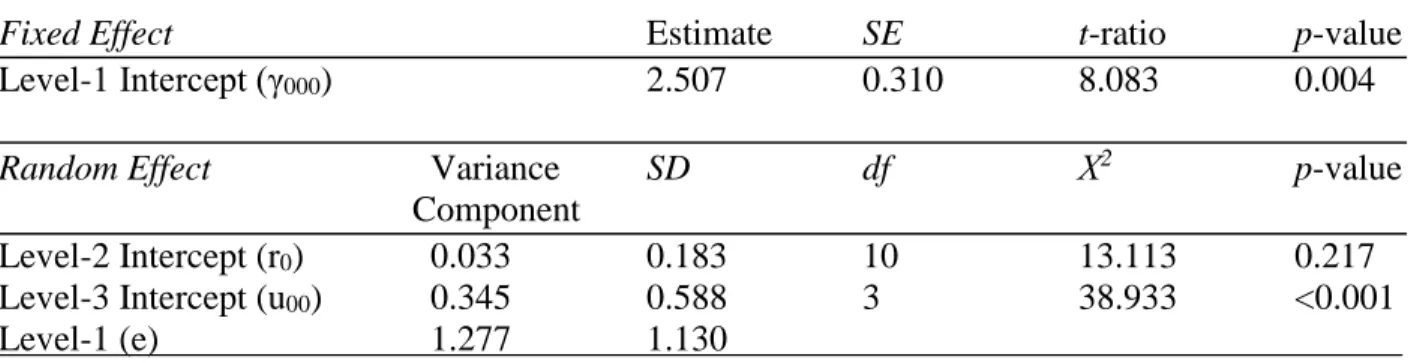
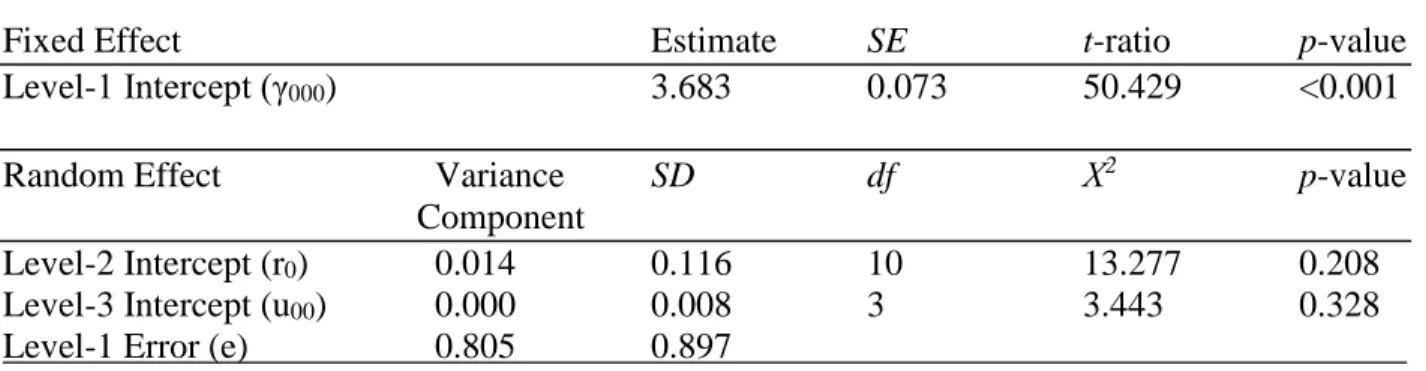
Table 3 – Null Three-Level Hierarchical Linear Model of Grade in Psychology Course ...53
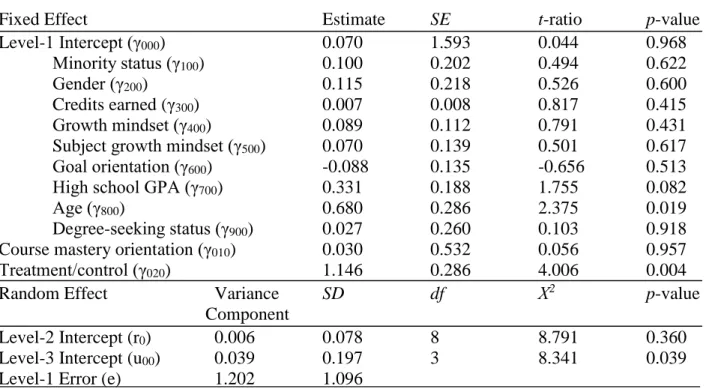
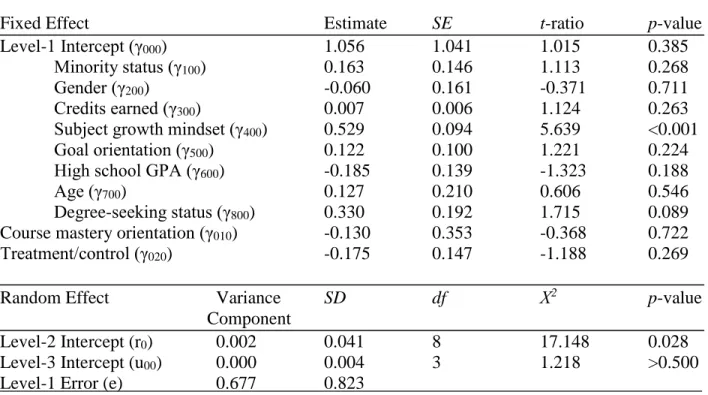
Table 4 – Full Three-Level Hierarchical Linear Model of Grade in Psychology Course ...54
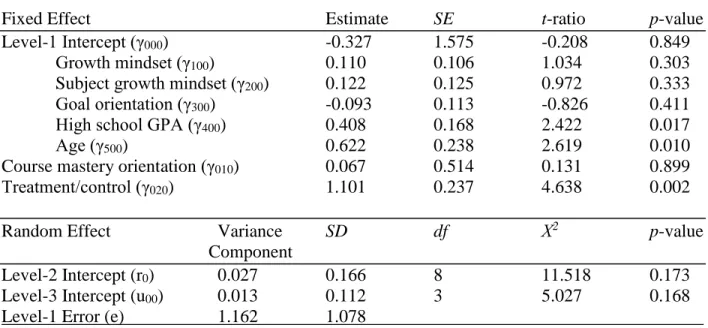
Table 5 – Reduced Three-Level Hierarchical Linear Model of Grade in Psychology Course ...55
Table 6 – Null Three-Level Hierarchical Linear Model of Growth Mindset ...57
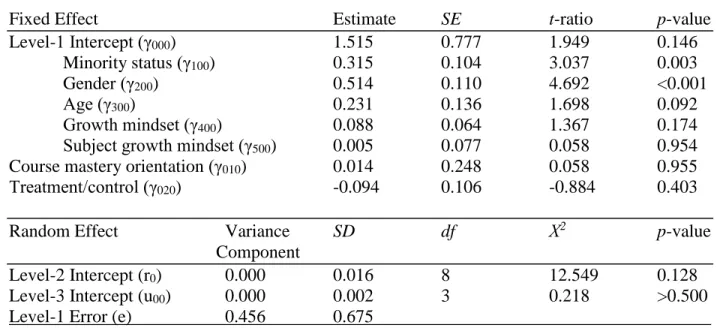
Table 7 – Full Three-Level Hierarchical Linear Model of Growth Mindset ...58
Table 8 – Reduced Three-Level Hierarchical Linear Model of Growth Mindset ...59
Table 9 – Null Three-Level Hierarchical Linear Model of Mastery Orientation ...60
Table 10 – Full Three-Level Hierarchical Linear Model of Mastery Orientation ...62
Table 11 – Reduced Three-Level Hierarchical Linear Model of Mastery Orientation ...63
Table 12 – Null Three-Level Hierarchical Linear Model of Retention ...64
Table 13 – Full Three-Level Hierarchical Linear Model of Retention ...65
Table 14 – Reduced Three-Level Hierarchical Linear Model of Retention ...66
Table 15 – Simple Linear Regression of Mastery Orientation on Growth Mindset ...66
LIST OF FIGURES
CHAPTER 1: INTRODUCTION AND LITERATURE REVIEW
Community college students comprise a large portion (45%) of the undergraduate students in the United States (Knapp, Kelly-Reid, & Ginder, 2012), with approximately 40% enrolled full-time and 60% enrolled part-time (Knapp et al., 2012). This represents a total of 12.3 million students enrolled in community colleges (in fall 2014) (American Association of Community Colleges [AACC], 2016). These students have less academic success as measured by degree attainment and retention than their four-year college counterparts. Community college staff have employed programming to improve success for students, but academic success rates for students remain low (Jaggars & Xu, 2010; Jaggars & Xu, 2011; Shapiro, Dundar, Yuan, Harrel, & Wakhungu, 2014).
Two widely used methods designed to combat community college students’
disproportionate academic difficulties include remedial education (Bailey, Jeong, & Cho, 2010; Kolajo, 2004), which are efforts colleges make to bring students from below necessary academic standards to meet them, and new student orientation activities (Hollins, 2004; Hollins, 2009; Sidle & McReynolds, 1999) designed to help new college students adjust to the college setting. However, these efforts have been found to be insufficient to promote academic success for all (or even most) students (Bailey et al., 2010; Hollins, 2009; Jaggars & Xu, 2010; Jaggars & Xu, 2011; Shapiro et al., 2014).
One factor that may contribute to the relatively poor academic performance of
1994; Elias et al., 1997; Weissberg, Durlak, Domitrovich, & Gullotta, 2015), which includes behaviors and cognitions that are not purely academic, but still contribute to student success (e.g. work habits, emotion regulation, and strength of interpersonal relationships). Of these “non-cognitive” abilities, academic motivation (starting and maintaining behaviors and cognitions relating to academic success) has been found to significantly predict student success (Becker, McElvany, & Kortenbruck, 2010; Robbins, Lauver, Le, Davis, & Langley, 2004), and is likely to be malleable in students (Bempechat, London, & Dweck, 1991; Blackwell, Trzesniewski, & Dweck, 2007; Mueller & Dweck, 1998). More specifically, interventions that target students’ implicit theories of intelligence have yielded large effects on the level of growth mindset (the implicit belief that effort and time can improve intelligence in an area).
Researchers have also found that students who more greatly endorse growth mindsets tend to have greater academic success, although the majority of this research has been conducted with students in primary and secondary levels (McCutchen, Jones, Carbonneau, & Mueller, 2015; Mueller & Dweck, 1998; Romero, Master, Paunesku, Dweck, & Gross, 2014; Shively & Ryan, 2013). There has been little research on how growth mindset interventions may help to improve academic success in college-aged populations, despite the possibility that these interventions may provide another avenue to help community college students find academic success.
Statement of the Problem
as 25% of first-time students enrolling in the fall do not persist to the spring semester, and of those who do enroll in the subsequent spring semester, approximately 20% do not return for the following fall semester, resulting in a net loss of 40% of the initial cohort of students from the first fall semester to the second fall semester (Jaggars & Xu, 2010; Jaggars & Xu, 2011). According to the National Center for Education Statistics [NCES] (2014a), approximately 57% of students enrolling for the first time at four-year institutions obtain bachelor’s degrees within six years. A similar statistic for community college students shows that only 20% of students attain any degree or certificate within 150% of the time it normally takes to receive that degree (e.g., for a 2-year associate’s degree, completion within 3 years; NCES, 2014b). The differences between graduation rates for community colleges and public four-year institutions are likely due in large part to the selectivity of the institution, as the majority of community colleges are open-access institutions (allowing all students who apply to attend) whereas the majority of public four-year institutions have at least some selectivity criteria. Data from NCES (2014a) found that even among four-year institutions, selectivity criteria predicted student graduation rates such that, among open-access four-year institutions 33% of students obtained a bachelor’s degree within six years while 86% of students attending public four-year institutions with an acceptance rate lower than 25% received a bachelor’s degree within six years. Interestingly, this figure still suggests that open-access four-year institutions have greater degree attainment (33%) than community colleges (20%).
proportion of students who belong to groups that are particularly vulnerable to difficulties with transition to college, adaptation to the lifestyle of college, and eventual retention is much higher in community colleges than at four year institutions (Adebayo, 2008; Aspelmeier, Love, McGill, Elliot, & Pierce, 2012; Engle & Tinto, 2008; Petty, 2014; Smith & Zhang, 2011). These
vulnerable groups include: minority students, first-generation college students (the first in their family to attend college), and students with disabilities. Approximately 52% of all low-income first-generation college students attend public two-year colleges as compared to 35% of students who are neither low income nor first-generation students (Engle & Tinto, 2008).
First-generation, low-income students are also more likely to have a disability, which is another risk factor associated with transition and retention problems (Engle & Tinto, 2008). To further understand the difficulties faced by many community college students, it is important to understand who these students actually are.
Characterizing community college students. American community college students enrolled in credit-seeking programs are predominantly white (49%), followed by Hispanic (22%), black (14%), Asian/pacific islander (6%), other/unknown (4%), two or more races (3%), Native American (1%), and nonresident alien (1%) (AACC, 2016). Fifty-seven percent of community college students enrolled in credit-seeking programs are female, and the average age of a community college student is 28 (AACC, 2016). Approximately 62% of full-time
community college students are employed (22% full-time), and 73% of part-time students are employed (41% full-time) (AACC, 2016). Fifty-eight percent of community college students receive financial aid to attend school, despite the average annual tuition and fees costing them $3,430 (compared to $9,410 for public in-state tuition costs at four-year colleges and
first-generation college students, seventeen percent of community college students are single parents, and students with disabilities make up 12% of community college students as well (AACC, 2016). Clearly, community college students are a diverse group with many risk factors for academic failure. Many students who enroll at community colleges also find themselves
underprepared for the academic expectations of the institutions. One of the primary methods that community colleges use to help students who are underprepared is through developmental
(remedial) education.
Developmental Education. Developmental education is one strategy employed at colleges to help underprepared students as they enter their institutions. In order to assess the level of proficiency in math, reading, and writing of incoming college students, 92% of
community colleges around the country use standardized placement exams. The most commonly utilized placement exams are the ACCUPLACER by the College Board and the COMPASS test by ACT (Hughes & Scott-Clayton, 2011). Students’ scores on the standardized placement exam often determine whether they must take between zero and four remedial courses (in reading, writing, and mathematics) to reach “college level” coursework in many subject areas, including courses in subjects other than English and mathematics. In 2010, Bailey et al. published an article that found an average of 59% of entering community college students were referred for remedial (or “developmental”) math and 33% were referred for remedial reading courses.
required to take two or more developmental courses, however, show significantly decreased rates of success, taking, on average, three additional semesters to graduate, and having an average GPA of 2.86 compared to 3.25 for those not required to take any developmental courses or those taking only one course (Kolajo, 2004). Additionally, only 46% of students referred to
developmental reading and 33% of those referred to developmental math actually complete their sequence of developmental education within three academic years (Bailey et al., 2010). Rates of referrals for developmental education are significantly lower in the four-year college student population, with approximately 30% of students referred to at least one developmental course (NCES, 2012).
Students taking developmental courses have also been shown to exhibit less adaptive forms of motivation (Morrison, 1999). Morrison (1999) found that students in developmental education exhibited lower willingness to sacrifice time and effort to succeed in their courses when compared to the entire freshman cohort. In addition, she found that a majority of students enrolled in developmental courses fell below the freshman mean on their enjoyment of the learning process, a measure synonymous with intrinsic motivation. Morrison (1999) also found that students’ academic self-confidence (one’s perception of one’s ability to perform well in school, particularly in testing situations) was similarly below the freshman mean. Interest and confidence in one’s ability have also been found to be important predictors of academic performance (Wigfield & Eccles, 2000). Thus, low levels of interest and confidence may
New Student Orientation. Hollins (2009) described new student orientation as any efforts that are made by college support staff to aid students in transitioning from high school (or workplace) to college. College students may attend new student orientations, which have been found helpful for students who are academically underprepared (Cuseo, 1997; Glass & Garrett, 1995; Hollins, 2009). Two primary forms of orientation exist at colleges. Students may attend “assembly hall” events which last between 2-4 hours, and/or they may enroll in a preparedness “course”, which is typically a one-credit course offered to freshman during their first semester. The major functions and goals of new student orientation are to improve academic readiness of students and assist students with social and life adjustments (Hollins, 2009).
Hollins (2009) found that students participating in new student orientation had better academic outcomes (GPA, retention) than students who did not. Other studies have supported these findings (e.g., Brunelle-Joiner, 1999; Busby, Gammel, & Jeffcoat, 2002; Starke, Harth, & Sirianni, 2001; Yarbrough, 1993), although the results of other studies have shown inconsistent results (e.g., Boudreau & Kromrey, 1994; Stewart, 1997; Green & Miller, 1998). This
(though it is rarely formally included) and that has shown promise for students is through
targeting their social and emotional learning (Crick & Dodge, 1994; Elias et al., 1997; Weissberg et al., 2015).
Social and Emotional Learning (SEL)
One area that has shown promise for improving academic success is through student social and emotional learning (SEL), which is defined as the acquisition of knowledge, skills, and attitudes that: enhance personal development, promote work habits that are ethical and productive, and help to create and maintain positive interpersonal relationships (Weissberg et al., 2015). SEL is a broad term that encompasses many academic behaviors. Specific SEL
behaviors that relate to student academic motivation include: understanding one’s own strengths and limitations, having realistic self-efficacy and optimism, and perseverance through challenges (Crick & Dodge, 1994; Elias et al., 1997; Weissberg et al. 2015). Most research on SEL has been conducted with students in K-12 settings, despite the fact that college students have been found to be one of the most vulnerable populations in terms of social and emotional adjustment (Adlaf, Gliksman, Demers, & Newton-Taylor, 2001; American College Health Association [ACHA], 2011; Stallman, 2010; Stewart-Brown et al., 2000). Moreover, SEL has been found to be significantly predictive of academic success in college students (Gerdes & Mallinckroct, 1994; Parker, Hogan, Eastabrook, & Wood, 2006; Pritchard & Wilson, 2003; Ramos-Sánchez & Nichols, 2007), highlighting its importance in this population.
made clear in state policy, as all 50 states have adopted preschool-level social and emotional development standards, and many states have also developed more comprehensive social and emotional learning standards. One state, Illinois, has even developed standards for SEL that extend from preschool to high school. Direct evidence has been found suggesting that SEL interventions may be effective for college students (Jones, 2004; MacLeod, Coates, & Hetherton, 2008; Mattanah et al., 2010; Oman, Shapiro, Thoresen, Plante, & Flinters, 2008; Shapiro, Oman, Thorsensen, Plante, & Flinters, 2008). SEL interventions have been shown to be effective for students at all ages, and may be a particularly powerful addition to the community college setting.
Hoyert & O’Dell, 2009; McCutchen et al., 2015; Sakiz, 2011). The second is the self-management domain, which includes the abilities that are involved with the regulation of emotions and behaviors. Specific skills within the self-management domain include: delaying gratification, controlling impulsive behaviors, perseverance through challenges, and stress management (Weissberg et al., 2015).
Davis, Solberg, de Baca, and Gore (2014) found evidence that malleable forms of social and emotional learning can predict academic success. Specifically, they found that the
perception of the importance of college in 8th grade was a meaningful predictor of both
cumulative high school GPA and progress towards high school graduation. In addition, student motivation, classroom self-efficacy, health-related concerns, and academic stress (in 8th grade)
also significantly predicted student progress towards graduation. Klem and Connell (2004) found that elementary school and middle school students who rate their teachers as providing classroom environments that are structured settings with high and clear expectations experience higher levels of academic engagement in school. In addition, they found that students who indicated that their teachers were more caring and friendly were also more likely to be more academically engaged. These findings suggest that SEL is a central component of academic success at the primary and secondary levels of education.
Social and emotional learning in college students. As stated by Conley (2015), the need for social and emotional learning does not end in high school, and SEL is an equally important part of the mission of institutions of higher education, since most colleges and universities strive to “educate students to be knowledgeable, responsible, socially skilled, healthy, caring, and contributing citizens” (Greenberg et al., 2003, p. 466). Compared to
experience higher levels of stress, maladjustment issues, and mental health problems such as anxiety and depression (ACHA, 2011; Adlaf et al., 2001; Stallman, 2010; Stewart-Brown et al., 2000). This may be due to many characteristics of institutions of higher education, including: a lack of structure, increased academic demands, new social roles, and increased social and environmental pressures (Conley, 2015). More specifically, students usually transition away from externally focused responsibility (i.e., parent-guided) to more internally focused (i.e., self-guided) responsibility, and are also often adjusting socially to a new peer group, and are
developing new kinds of relationships with faculty and staff, who may serve as parental figures (Conley, 2015).
Unsurprisingly, social and emotional learning has been shown to relate to student success in college. Parker et al. (2006) found a significant relationship between social and emotional factors (intrapersonal factors, interpersonal factors, adaptability, and stress) and rates of
withdrawal from college. Pritchard and Wilson (2003) found that emotional factors (i.e. stress, self-esteem, and optimism) and social factors (i.e. use of alcohol, presence of romantic
For students who were not struggling academically, significant predictors of persistence have been shown to include: informal contact with professors, satisfaction with the quality of courses taken, and a sense of self-confidence (Gerdes & Mallinckrodt, 1994). For students who were struggling academically, significant predictors of retention were found to be: satisfaction with extracurricular activities, lack of anxiety, and an absence of thoughts about dropping out (Gerdes & Mallinckrodt, 1994). Social and emotional skills have been shown to have additional impact for students beyond academic outcomes, including: success at work, better mental health outcomes and well-being, and more positive interpersonal relationships (Bar-On, Handley, & Fund, 2006; Jordan & Ashkanasy, 2006; Lopes, Salovey, Coté, & Beers, 2005; Mayer, Salovey, & Caruso, 2004). Social and emotional learning is clearly an important factor in determining student success in college, but is it possible for educators to influence SEL in their students?
Social and emotional learning interventions. Although we know that social and emotional learning is vitally important to academic success, it is equally important to determine if it is possible to influence SEL in students through intervention. Social and emotional learning interventions are those that attempt to foster SEL behaviors using explicit instruction and
pedagogy and curriculum that support SEL interventions are related to more significant
improvements in academic success (Jones & Bouffard, 2012; Merrell & Gueldner, 2010; Yoder, 2013; Zins et al., 2004).
Durlak et al. (2011) conducted a large meta-analysis of school-based universal social and emotional learning interventions for students in kindergarten through high school. They found strong evidence that participants in SEL interventions showed many positive outcomes,
including: improved social and emotional skills, improved attitudes about themselves, improved attitudes about others, improved attitudes about school, greater levels of prosocial behavior, reduced conduct behaviors, reduced internalizing problems, and improved academic
performance compared to controls. In fact, students that participated in SEL interventions also exhibited an 11-percentile point gain in achievement level on average compared to controls. Durlak and colleagues (2011) found that, in the few reviewed studies that included follow-up data, participation in SEL interventions showed significant (although reduced) effects for students after six months or more. Most current research on SEL interventions has been with students in primary or secondary education, although there is some research that supports the use of SEL interventions at the post-secondary level.
Social and emotional learning interventions for college students. In a large scale meta analysis of universal mental health promotion and disorder prevention programs in higher
which may impact how students respond when faced with academic or other “life” challenges while in school. There is also evidence that mind/body interventions (which are similar to mindfulness interventions) can help to reduce levels of stress and anxiety in college students (Deckro et al., 2002).
Psychoeducational techniques for improving social emotional learning have also been shown to have effectiveness, although less so than skills-training programs (Conley, Durlak, & Kirsch, 2015). One type of psychoeducational intervention technique, freshman seminar courses, has been found to have success in improving academic outcomes when utilizing an SEL-centered curriculum (Wang, Wilhite, Wyatt, Young, & Bloemker, 2012). Wang and colleagues (2012) found that, when compared with students taking a traditional freshman seminar course, students in the SEL seminar course exhibited greater social and emotional learning and had higher GPAs than students in the traditional course. This academic impact was shown to last for four semesters following the intervention, suggesting that the SEL intervention had a positive and enduring impact on student academic success.
Social and emotional learning is clearly an important factor for academic success in the college setting, and it is clear that interventions designed to improve social and emotional functioning have proven to be effective for this population, despite their underutilization in the college setting. One specific area for intervention within the broad SEL framework that has shown promising results in improving student outcomes is student academic motivation.
Need for Focus on Motivation
been shown to be important in academic settings ranging from primary school to postsecondary institutions. Motivation for reading was found to be positively related to later reading literacy, and this relation was mediated by reading amount, meaning that children who are motivated to read tend to read more frequently and then develop better literacy skills as a result (Becker et al., 2010). Robbins et al. (2004) conducted a large meta-analysis of motivational factors in college students and found that having strong academic goals and academic self-efficacy (defined as beliefs and attitudes about their own abilities) were strongly related to college retention. Robbins and colleagues (2004) also found that achievement motivation (motivation to achieve success, overcome obstacles, and complete tasks) was strongly related to college GPA. Some aspects of academic motivation have also been found to have an impact on how students respond to challenges and ultimately utilize adaptive or maladaptive academic strategies (Bandalos et al., 2003; Dweck & Leggett, 1988; McCutchen et al., 2015; Sakiz, 2011).
Motivation requires either physical actions and/or cognitions that lead an individual towards a specific goal, and it is through environmental changes in these actions and/or
cognitions that an individual’s motivation may be increased or decreased. Both instigation and sustainment of the activity are equally important, and challenges to either may have an impact on one’s motivation (Schunk et al., 2014). One form of cognition that impacts whether students are motivated in the classroom is self-concept, which is defined as students’ beliefs and attitudes about their own abilities, and includes how they perceive themselves as students (Hattie, 1992).
emotional learning-rich environments in junior high school as compared to elementary school. More recently, Ryan, Shim, and Makara (2013) found that the transition from elementary to middle school was associated with a decline in GPA as well as a decline in intrinsic value for schoolwork. Self-concept and effort in schoolwork have also been shown to decline across school years (from 3rd through 11th grade) (Yeung, 2011). Intrinsic academic motivation, defined as motivation to learn in a classroom due to the enjoyment and valuing of the course content or task itself, is another factor that has been found to decrease through primary and secondary school (Lepper, Corpus, & Iyengar, 2005; Spinath & Steinmayr, 2008).
When considering the implications of motivation and self-concept for community college students, it is important to recognize that despite the relative novelty of the college setting to these students, they carry experiences with education that span 13 years or more and are often filled with negative and/or de-motivating experiences. Through this long history of experiences, community college students have had many prior opportunities to develop thoughts, feelings, and beliefs surrounding what education is, how confident they are in themselves to be successful in an educational setting, and how they fit socially into that environment. Where do these thoughts, feelings, and beliefs come from, and how might educators promote the adoption of adaptive forms?
Mastery and Performance Goals
More specifically, the original achievement goal theory states that two types of goals exist: mastery goals, where the individual is motivated by learning and mastering the subject/task, and performance goals, whereby one is motivated by being able to prove that one is capable of performing the task. These goals, when combined with success or failure at a task, then produce predictable results (Ames, 1992; Covington & Omelich, 1979; Elliot & Harackiewicz, 1996; Elliot & McGregor, 2001; Elliot & Thrash, 2001; Harackiewicz, Barron, & Elliot, 1998).
Students who adopt performance goals who then experience failure have been found to avoid putting forth much effort in the task in the future, to protect their perception of their ability and their self-efficacy in the area (Covington & Omelich, 1979). Achievement goals have been found to relate to self-efficacy (Bandalos et al., 2003; Dweck & Leggett, 1988; Sakiz, 2011), affect (Ames, 1992; Jagacinski & Nichols, 1984; Jagacinski & Nichols, 1987), and academic success (Diseth, 2011; Hoyert & O’Dell, 2009). Educators may be able to utilize this knowledge to improve student learning through the use of strategies in the classroom (Ames, 1992; Deemer, 2004; Meece, Anderman, & Anderman, 2006; Young, 2005).
competence on a task, avoiding negative peer or instructor evaluations, and/or public
acknowledgment of academic success (Ames, 1992). Students using mastery goal orientation and students using performance goal orientation perceive ability and effort differently. Students using a mastery goal orientation see effort as a central feature of ability, such that increasing effort should lead to increased ability. Students using a performance goal orientation, however, see effort and ability as inversely related—they believe that students who don’t put forth much effort to be successful must have innately higher abilities, and students who require extra effort to succeed in a task have less ability to do that task (Schunk et al., 2014). Indeed, students using a performance goal orientation may subsequently avoid putting in much effort into tasks to protect their perceptions of their own ability and self-worth (Covington & Omelich, 1979).
standard (Elliot, 1999; Pintrich, 2000a; Pintrich, 2000b). These theories can be conceptualized as the intersection of two dimensional constructs - “mastery versus performance” and “approach versus avoid.” The “mastery versus orientation” dimension describes how the student compares themselves to peers and external sources (performance) or to an internal goal (mastery) and the “approach versus avoid” dimension describes whether the goal is to achieve success (approach) or avoid failure (avoid).
Goal orientation and self-efficacy. Students utilizing mastery goal orientations have also been found to exhibit higher levels of self-efficacy and competence, particularly when faced with difficult tasks (Bandalos et al., 2003; Dweck & Leggett, 1988; Sakiz, 2011). Findings on self-efficacy in students utilizing performance goal orientations have been mixed. Students utilizing performance approach goal orientations have been found to have higher self-efficacy and competence beliefs than students with performance avoidance goals in some research (Anderman & Midgley, 1997; Skaalvik, 1997; Wolters, Yu, & Pintrich, 1996). Middleton and Midgley (1997), however, found that having a performance goal orientation was unrelated to self-efficacy. Some researchers (Middleton & Midgley, 1997; Skaalvik, 1997) have also argued that performance avoidance orientations were negatively related to self-efficacy. The
mechanism behind this argument is that students using performance approach orientations who do well in their studies may receive a boost to their self-efficacy, but students who use
orientations may only experience high self-efficacy as long as their performance remains high (Schunk et al., 2014).
Goal orientation and affect. Having a mastery goal orientation has been associated with more positive affective states than having a performance goal orientation, particularly a
performance avoid approach (Ames, 1992; Jagacinski & Nichols, 1984; Jagacinski & Nichols, 1987, Pekrun, Elliot, & Maier, 2006; Pekrun, Elliot, & Maier, 2009; Rawsthorne & Elliot, 1999). Mastery goals have been associated with higher levels of pride and satisfaction in completing tasks (Ames, 1992; Jagacinski & Nichols, 1984; Jagacinski & Nichols, 1987) as well as (in a meta-analysis of 23 experimental studies) self-reported interest, enjoyment, and choosing to continue the activity (Rawsthorne & Elliot, 1999). Mastery performance goals have also been associated with a range of positive emotional states such as hope, pride, and the enjoyment of learning (Pekrun et al., 2006; Pekrun et al., 2009). Mastery orientations have been theorized to yield better affective outcomes because those with mastery orientations tend to view doing poorly on tasks as opportunities for growth, whereas students with performance orientations tend to view doing poorly on tasks as indicators that they are not (and will not be) able to complete the task successfully in the future (Schunk et al., 2014).
Goal orientation and academic success. Researchers studying how goal orientations relate to academic outcomes have generally found an indirect link between goal orientation and academic achievement (Diseth, 2011; Hoyert & O’Dell, 2009). Diseth (2011) found that exhibiting a mastery orientation strongly related to using “deep learning strategies” in
mastery orientation was more strongly predictive of academic success). Hoyert and O’Dell (2009), however, found that student goal orientation is an important predictor of academic success, but only after failing an examination. They contend that students with mastery orientations who fail an exam are more likely to persist and eventually succeed in the course, whereas students with performance orientations tend to give up more easily (Hoyert & O’Dell, 2009). They also found that students who have success on an exam were found to succeed in the course, regardless of goal orientation. In addition, Hoyert and O’Dell (2009) looked at both traditional age and non-traditional (older) age students and found the effect to be consistent for both, although non-traditional students were found to be significantly more likely to endorse mastery orientations.
The reasons why students who utilize mastery goal orientations tend to have better academic outcomes may be due to the different cognitive strategies that are involved during learning. Students using mastery goal orientations have been found to be more likely to self-monitor their cognition and to be more aware of their own learning (Meece, Blumenfeld, & Hoyle, 1988; Meece & Holt, 1993; Middleton & Midgley, 1997; Pintrich, 1999; Pintrich & Schrauben, 1992; Pintrich, Roeser, & De Groot, 1994; Wolters et al., 1996). In addition, mastery goal orientations have been associated with greater so-called “deep processing” strategies,
including organization (e.g., outlining) and elaboration (e.g., summarizing) (Bandalos et al., 2003; Bouffard, Boisvert, Vezeau, & Larouche, 1995; Graham & Golan, 1991; Kaplan & Midgley, 1997).
Garcia, 1993; Pintrich et al., 1993), and are more likely to seek help from useful sources
(Karabenick, 2004; Linnenbrink, 2005; Newman, 1994; Newman, 1998a; Newman, 1998b; Ryan & Pintrich, 1997; Ryan & Pintrich, 1998; Ryan, Pintrich, & Midgley, 2001). In comparison, students using performance-avoid goal orientations are more likely to create obstacles to successful performance (Urdan, 2004), and are less likely to exhibit help-seeking behaviors (Schunk et al., 2014). How, though, might the influence of mastery and performance goal orientations be unique for students in college settings?
Goal orientation in college students. College students have been found to endorse mastery orientations and performance orientations at nearly similar rates, although they endorse mastery goal orientations at slightly greater rates (Hoyert & O’Dell, 2009). Mesa (2012) conducted a study with community college mathematics students and found that students were slightly more likely to endorse mastery goal orientations in their mathematics courses, at both the remedial and college course levels. Interestingly, the faculty predicted that their students would be significantly more likely to endorse performance-goal orientations than they actually were, suggesting that faculty perceptions of their students’ goal orientations may be inaccurate. Similarly, Hoyert and O’Dell (2009) found in a sample of four-year college students that the students were slightly more likely to endorse mastery goals than they were performance goals on a five-point Likert-scale (mastery = 3.57, performance = 3.36). Although college students
Teaching strategies that promote mastery orientation. Teaching methods have been found to have an impact on whether students utilize mastery or performance goal orientations in the classroom. Ames (1992) found that three structural changes could be targeted within the classroom using various strategies to promote the use of a mastery orientation: “task” structural changes focused on creating meaningful, interesting tasks within the classroom, “authority” structural changes promoted student autonomy and helped students make good choices, and “evaluation / recognition” structural changes focused on how teachers evaluated and encouraged students within the classroom. This method of classroom intervention has also been promoted by others (Deemer, 2004; Meece et al., 2006; Young, 2005).
Ames (1992) suggested specific research-based instructional strategies for each of the three targeted “structures”. For “task” structural strategies, Ames (1992) suggested creating tasks that are novel and interesting (but still challenging) for students. She also suggested helping students to develop and utilize effective learning strategies (and specifically, helping students learn to set short-term goals for themselves). For “authority” structures, Ames (1992) espoused giving students the autonomy to make choices and help make decisions within the classroom, and helping students to develop independence and a sense of personal responsibility. For “evaluation / recognition” structures, Ames (1992) recommended that teachers focus
Mindset
One potential explanation for how goal orientations develop is through their implicit theories of intelligence, also known as “mindset”. Carol Dweck and her colleagues have found evidence that much of what causes a student to develop their goal orientations can be attributed to their personal beliefs about their own ability and intelligence (Dweck, 1999). Specifically, Dweck (1999) contended that students develop perceptions over time regarding their abilities and intelligence and that interactions with their environments help to shape their attributions towards their own abilities. Carol Dweck’s early research utilized an attribution theory framework and was focused on implementing “attribution retraining” interventions that sought to change the attributions of students from perceiving failure as a lack of control to instead viewing failure as due to a lack of effort (Dweck, 1975; Dweck & Reppucci, 1973).
were a worthwhile endeavor, but the practicality of intervening in the naturalistic school setting with moderate-to-large groups of children limited the benefits for students. Thus, attribution retraining may be best utilized for small groups of children by highly trained professionals.
Carol Dweck (Bempechat et al., 1991; Dweck, 1999; Dweck, Chiu, & Hong, 1995; Kamins & Dweck, 1999; Hong, Chiu, Dweck, & Lin, 1998) refocused her research on a concept related to attributions and attribution retraining: attributions and beliefs regarding one’s own ability. These attributions (also called implicit theories of intelligence) fall into two major categories: the “growth” mindset and the “fixed” mindset. Students with a growth mindset see their intelligence as malleable and able to be improved with effort, whereas students with a fixed mindset see their intelligence as stable from birth and unrelated to effort (Dweck, 1999).
Students’ beliefs about their intelligence have been found to influence whether they adopt a mastery orientation or a performance orientation with specific tasks (Dweck, 1999; Robins & Pals, 2002). Dweck’s (1999) research found that students who tend to see their abilities and intelligence as fixed over time tend to simultaneously develop performance orientations,
believing that, since their abilities are fixed, their performance is key to academic success (rather than their persistence or understanding). On the other hand, Dweck contended that students who see their abilities and intelligence as malleable tend also to view their performance as secondary to their persistence and ability to challenge themselves to understand new information and develop new, difficult abilities. Not surprisingly, students who have growth mindsets also tend to have greater academic success (McCutchen et al., 2015).
teachers who give praise to students for high ability actually undermine their motivation.
Teachers who give praise to students for their inherent abilities (e.g. “you’re so smart!”, “You’re good at this!”) actually emphasize a fixed mindset (and simultaneously emphasize adoption of a performance-goal orientation) by rewarding academic performance (as opposed to effort) and presuming that students who “are smart” will continue to show high achievement regardless of effort. Indeed, Mueller and Dweck (1998) found that children who received praise for their intelligence were subsequently more likely to describe their intelligence as a fixed trait and children praised for hard work tended to exhibit a growth mindset. High-achieving students who exhibit a fixed mindset were found not have negative academic consequences as long as they continued to experience high academic achievement, despite their goal-orientations continuing to be performance-based (Mueller & Dweck, 1998).
The issue, as Mueller and Dweck (1998) found, was that students who earned this fixed-mindset-based praise and later failed a task showed less task persistence, less task enjoyment, worse future task performance, and more attributions of their failure to low-ability. The
implications of these results are that instructors who praise fixed traits also encourage students to value these “traits” and develop performance goal orientations, and, when these students
Mindset in college students. These implicit theories of intelligence have also been researched with college student populations. Shively and Ryan (2013) found that, in a sample of college algebra students, students who endorsed a growth mindset in general intelligence (i.e. not specific to math or algebra) showed more help-seeking behaviors and earned higher course grades than those who endorsed a fixed mindset. They also found that, in general, college algebra students endorsed more growth-mindset implicit theories of intelligence when asked about general intelligence than when asked about their abilities in mathematics. Interestingly, they also found that over the course of the semester, students’ views grew more fixed in both general intelligence and mathematics ability, but that this decline was greater for their beliefs in their mathematics ability. Clearly, although implicit theories of intelligence are often
conceptualized as relatively stable, change is still possible, and there may be specific subjects in which students more highly endorse fixed mindsets.
Growth Mindset and Goal Orientation Interventions
Exhibiting a growth mindset is important for students of all ages, including college students (McCutchen et al., 2015; Shively & Ryan, 2013). Students who struggle academically may be using fixed mindsets and performance orientations, or may not have academic goals at all (Diseth, 2011; Hoyert & O’Dell, 2009; McCutchen et al., 2015; Mueller & Dweck, 1998),
however, implicit theories of intelligence may be influenced by changes at the institutional or classroom level (Bempechat et al., 1991; Blackwell et al., 2007; Mueller & Dweck, 1998). Blackwell et al. (2007) found that middle school students participating in eight 25-minute sessions showed a positive change in classroom motivation and no longer exhibited a downward decline in classroom grades, as compared with a control group. Students’ grades
post-intervention were nearly 0.3 grade points (on a 4.0 scale) higher for the experimental group than the control group, and this reflected a 0.1 grade point increase from their grade prior to the intervention for the experimental group compared with a 0.15 grade point decrease for the control group. This intervention only differentiated the intervention between the experimental and control groups for four sessions- thus the unique aspects of the intervention that resulted in this difference only required approximately two hours of classroom time.
Bempechat et al. (1991) found that elementary school children were more likely to choose mastery goals over performance goals when given a prompt indicating that the ability to complete the task was malleable rather than fixed. Students in the malleable task condition were also more consistent in their expectancies for future success (Bempechat et al., 1991).
suggesting that the intensity of intervention was not strong enough to influence students’ response to failure.
One way to bolster the intensity of interventions in this area may be to utilize instructors as agents of change. Mueller and Dweck (1998) found that the type of feedback given to fifth-grade students impacted their goal orientations. They also found that students praised for ability endorsed performance orientations and those praised for effort endorsed mastery orientations. Attributions of failure were also impacted by the type of praise students received, such that those praised for ability attributed failure to a lack of ability and those praised for effort attributed failure to a lack of effort (Mueller & Dweck, 1998). In one of the tasks in this study, Muller and Dweck (1998) also found that students receiving praise for ability showed declines in their ability to complete the task later (which is unexpected since practice effects were predicted to help all students improve), whereas students receiving praise for effort showed the expected improvement in their ability to complete the task.
Paunesku et al. (2015) found support for the use of a mindset intervention to improve academic outcomes. They delivered an online module that was designed to take 45 minutes to complete to high school students who were at risk of academic failure. They found a 6.4 percentage point increase in grade in core courses for at-risk students who participated in their intervention compared to controls. This study lends evidence both for the use of an online intervention to improve level of growth mindset and for the effectiveness of having a brief intervention duration.
interpreted as being due to ability or effort. Hong et al. (1998) conducted a study that found evidence that students with growth mindsets were more likely to elect to take a tutorial (a desirable academic behavior) in a subject than students with fixed mindsets, but only for those with low ability. Students with high ability in the subject were equally likely to elect to
participate in the tutorial regardless of their mindset. Indeed, even growth mindset interventions appear to have differential effects for students with low and high ability. Paunesku et al. (2015) found that students who were not at risk for dropping out of high school did not derive any significant benefit between their pre-intervention and post-intervention GPA, but students who were at-risk of dropping out gained a significant increase (of around 0.03 grade points, compared to a loss of 0.06 grade points for controls). Thus, students who have lower ability may have a greater benefit in terms of their academic success than students who have higher ability.
Though little research has been published regarding the implementation of mindset interventions in college students, one such study found evidence that at-risk college students who are taught to view intelligence as malleable (i.e., to have a growth mindset) showed higher rates of academic effort and better study habits compared to controls (Sriram, 2013), suggesting that mindset interventions may have effectiveness in the college setting. The lack of research in this area, when combined with the academic struggles of many community college students, is the major impetus for the current study.
Problem Theory
The issue that the current proposed intervention is designed to address is that of
community college student academic success and persistence. Community college students are often not academically successful for a multitude of reasons. Community college staff have attempted to help these students in a number of ways, most notably through the use of developmental (remedial) education and through new student orientation, although these methods have not been sufficient to foster success in a large proportion of these students. A novel method that has empirical evidence for students of all age groups is the use of social and emotional learning interventions. These interventions, which target components of education that are often not taught explicitly to students, seek to improve how students interact with their education through their behaviors and cognitions.
ability as students and not due to their level of effort. These “fixed mindsets”, when combined with failure of an assignment or exam (which, for new college students, is more likely to occur due to the increased academic rigor of college courses as compared to high school or job requirements), may result in demotivated students. Students with fixed mindsets who face academic challenges have been found to experience less academic success than students who exhibit growth mindsets. As evidenced by prior research, students’ implicit theories of intelligence can be influenced in a number of ways to promote the use of a “growth” mindset over a “fixed” mindset, and can be accomplished using brief, “wise” intervention procedures. Thus, the current study seeks to improve community college student academic outcomes through the use of a “wise” intervention that has been created through the combination of evidence-based techniques from prior research. This intervention seeks to improve student academic success indirectly, by first encouraging students to utilize growth mindsets and to utilize mastery orientations in the classroom.
Current Study
The problem that the proposed intervention, called the Go for Growth! intervention, is attempting to alleviate is student academic failure due to low academic motivation. The intervention will compare academic success measures (course grade and retention) for students receiving the intervention and controls. It is hypothesized that the intervention will increase students’ level of growth mindset and mastery orientation, and that this will result in
improvements in academic outcomes.
Conceptual mediational model. The Go for Growth! intervention will seek to utilize evidence from prior research to improve academic success in community college students. This intervention will attempt to foster growth mindsets in community college students. The
conceptual mediational model (Figure 1) shows the predicted relations between the variables of interest for this intervention.
It is probable that the indirect effect of the intervention on academic achievement will have an impact on student implicit theory of intelligence, and thus should also mediate the relationship between student implicit theory of intelligence and academic outcomes. The best outcomes for students should exist when they have a teacher who utilizes the evidence-based methods for interacting with their students and when they receive direct psychoeducation in class regarding growth mindset.
expected to impact students. The logic model (Figure 2) is a method for visualizing the
connections between program objectives and inputs with proximal and distal levels of impact.
The theory of change is another visual method used to ensure that the proposed
intervention methods match the expected outcomes and how features of the intervention logically impact mediators and outcomes. The theory of change for the Go for Growth! intervention (Figure 3) shows how the initial inputs of: training teachers to implement the teaching component of the intervention and training teachers how to promote growth mindset are mediated by how well the intervention is applied by these agents of change. In addition, the response of the teacher to the intervention will impact how well the two classroom components are implemented. Successful application of these techniques is expected to increase adoption of growth mindsets and mastery orientation in students, both at the course-level and overall implicit theories of intelligence. How well this is achieved will depend on how students respond to the content and change in teachers in the classroom. It is subsequently hypothesized that students with higher endorsement of growth mindset and mastery orientation will achieve better academic outcomes (measured by grade) and thus will be less likely to dropout the next semester. In addition, students who have growth mindsets at the end of the semester are also more likely to persist even if they do not succeed in their courses, as they are more likely to adopt mastery orientations that bolster their academic persistence.
influencing students’ level of growth mindset, level of mastery orientation, and academic success (measured by GPA and retention). Research questions and hypotheses for the present study are as follows.
Research question 1. Do students who receive the Go for Growth! intervention have better academic outcomes?
Hypothesis 1 for research question 1. It is predicted that students who receive the
intervention will have significantly better grades in the course where they received the intervention than students who do not receive the classroom intervention.
Hypothesis 2 for research question 1. It is predicted that students who receive the Go
for Growth! intervention will be more likely to return the following semester, as compared to controls.
Hypothesis 3 for research question 1. It is predicted that students who have lower prior
academic ability will show greater gains in academic outcomes than students with higher prior ability.
Research question 2. Do students who more highly endorse growth mindset and/or mastery goal orientation have greater academic success?
Hypothesis 1 for research question 2. It is predicted that students who more highly
Hypothesis 2 for research question 2. It is predicted that students who more highly
endorse mastery orientations will have higher grades in their psychology course than students who more highly endorse performance orientations.
Hypothesis 3 for research question 2. It is predicted that students who more highly
endorse growth mindset will be more likely to return the following semester than students who more highly endorse fixed mindsets.
Hypothesis 4 for research question 2. Students who more highly endorse mastery
orientations will be more likely to return the following semester than students who more highly endorse performance orientations.
Research question 3. Does the Go for Growth! intervention impact student endorsement of goal orientation and/or mindset?
Hypothesis 1 for research question 3. It is predicted that students receiving the Go for
Growth! intervention will show higher endorsement of growth mindset as compared to controls.
Hypothesis 2 for research question 3. It is predicted that students receiving the Go for
Growth! intervention will show higher endorsement of mastery orientation as compared to controls.
Research question 4. Is the endorsement of growth/fixed mindset related to the endorsement of mastery/performance orientation?
Hypothesis for research question 4. It is predicted that there will be a positive, linear
Research Question 5. Was the fidelity of implementation maintained in the study? Research Question 6. What level of treatment acceptability & feasibility of
CHAPTER 2: METHODOLOGY
Participants
Participants included 190 students and four faculty in General Psychology courses during the fall 2016 semester at Guilford Technical Community College (GTCC) in Jamestown, North Carolina. The participating students were diverse in terms of race (47.2% white, 52.8% non-white minority), gender (43.3% male, 56.7% female), and age (78.4% 18-22, 8.4% 23-27, 4.2% 28-32, 3.2% 33-37, 5.3% older than 37). The student participants also self-reported a range High School Grade Point Averages (0.6% 0.0-0.9, 1.9% 1.0-1.9, 30.8% 2.0-2.9, 61.6% 3.0-3.9, 5.0% 4.0 or greater), level of parent education (7.6% no high school diploma, 25.0% high school diploma, 32.1% some college, 20.7% college degree, 14.7% graduate/professional degree). Most participating students were seeking a degree of some type (82.1%).
In order to recruit participants, the researcher contacted psychology instructors at GTCC via standardized e-mail. Participants were asked to reply to the researcher if interested. Initially, five instructors expressed interest in participating in the study. Although instructors teaching courses in an online format were invited to participate, none expressed interest in participation, thus, only the face-to-face format was utilized. The five participating instructors were randomly assigned to two groups, one receiving the intervention and one asked to teach the course as usual. Three instructors were chosen for the treatment group and two for the control group. One
psychology courses during the fall 2016 semester. Of those, 5 were included in the treatment condition and 9 were included in the control condition. The instructors signed electronic consent forms (see Appendix 1) indicating their intent to participate. In order to recruit student
participants, the researcher entered the classrooms of the participating faculty and explained the study and the consent form to students who were present in class during that day. No
compensation was offered to students for participation to limit possible perceived coercion. A total of 190 students agreed to participate in the study, 79 in the treatment condition and 111 in the control group.
Measures
Course grade. The student’s grade (on a 4.0 scale) in the participating general
psychology course was collected through GTCC’s institutional research department. Grades at the institution included A (4.0), B (3.0), C (2.0), D (1.0), and F (0.0).
Retention. Retention at the institution was assessed through data collected through the institutional research department at GTCC. This measure will be a simple yes/no indicator of whether the student registered for any courses in the spring semester (2017) by the deadline for registering for courses at GTCC.
Motivational factors. Factors related to motivation were assessed by self-report survey methods. The Theories of Intelligence Scale – Self Form for Adults (Dweck, 1999) was used to assess whether students possess a growth mindset or fixed mindset (see Appendix 3). This measure provides students statements such as “You have a certain amount of intelligence, and you can’t really do much to change it” and asks students to rate how much they agree with each statement on a 1-6 scale, where 1=strongly agree and 6=strongly disagree. Internal reliability for this measure has previously been shown to be very high (0.98; Dweck et al., 1995). This
measure was used in full as written by Dweck (1999), but, since this questionnaire assesses overall mindset across subdomains (i.e. subject), another survey was used to assess course specific beliefs regarding mindset. This survey, which was created by the experimenter, was based strongly on the Theories of Intelligence Scale (Dweck, 1999) and has five items that assess domain-specific mindsets (see Appendix 4). Based on the data collected through this study, the Theories of Intelligence scale was found to have a Cronbach’s Alpha of 0.881, and the Subject-Specific Theories of Intelligence Scale had a Cronbach’s Alpha of 0.725, both indicating a high degree of internal reliability.
In order to assess whether students exhibited mastery orientations, the mastery-approach and mastery-avoid subscales from the Achievement Goal Questionnaire (AGQ) were used (Elliot & McGregor, 2001; See Appendix 5). The AGQ is a 12-item survey that was developed using items used in prior research on goal orientations (Elliot & Church, 1997). The authors utilized prior factor analysis data and synthesized items from other validated sources to create the
utilized only two of the subscales (mastery-approach and mastery-avoid), totaling 6 items. The Achievement Goal Questionnaire was previously found to have high reliability in a sample of introductory psychology students, with Cronbach’s alphas between 0.83 and 0.92 (Elliot & McGregor, 2001). The Cronbach’s Alpha based on the current study was found to be 0.746. A confirmatory factor analysis from the present data revealed that the two included subscales were supported, with eigenvalues of 2.68 for the primary factor of achievement goal orientation and a factor with an eigenvalue of 1.84 representing the Approach versus Avoid subscales.
The Patterns of Adaptive Learning Scales (PALS) perception of classroom goal
structures subscale was also given to students to assess their perceptions of the degree to which their classroom promotes mastery orientation (Midgley et al., 2000) (see Appendix 6). This subscale consists of six items rated on a five-point Likert-type scale indicating how “true” each statement is in the student’s opinion (1= “Not at all true”, 3 = “Somewhat true”, 5 = “Very true”). Reliability has been previously shown to be high (Chronbach’s Alpha = 0.76) for
students in elementary, middle, and high school (Midgley et al., 2000). It has also been found to be valid for assessing goal orientation in a sample of college students, and was found to be the most valid scale for measuring goal orientation with college students when compared with two other commonly utilized scales (Jagacinski & Duda, 2001). The Cronbach’s Alpha based on the data collected from this study was 0.771.
Fidelity. An intervention that is not implemented with fidelity cannot be evaluated with confidence since the measured effects may be due to a lack of fidelity by some agents of change. The Go for Growth! intervention assessed fidelity of implementation via a survey given to students in their survey packet (See Appendix 7). This survey evaluated whether the
three “yes” or “no” questions: “did your instructor spend time at the beginning of the semester teaching you about implicit theories of intelligence (growth mindset versus fixed mindset)?”, “did your instructor teach you about growth mindsets at all during the semester?”, and “did your instructor remind you about the importance of growth mindset more than once during the
semester?” The rest of the items in the scale utilized a Likert-type scale for statements, where 1 = “strongly agree” and 4 = “strongly disagree”. Two of these items were designed to assess whether the instructor implemented the psychoeducational component: “I understand the meaning of ‘growth mindset’ and ‘fixed mindset’,” and “I think my instructor believes that intelligence can be increased through hard work.”
Additional items were used to assess whether instructors utilized the recommended teaching strategies with students during the semester. These include the following items: “My instructor praised or criticized my effort this semester (by saying things like “you worked really hard!”),” “The assignments in my class were interesting,” “My instructor helped me to establish academic goals for myself during the semester,” “My instructor encouraged me to actively participate in the course,” “My instructor provided me with choices in assignments and activities within the course,” and “My instructor seemed annoyed or angry when I made mistakes or asked questions during class.” An overall fidelity score was calculated from the Likert-type items for all students, and had an internal reliability of 0.775. These scores were averaged across students within each course to calculate a mean “course” fidelity score.
intervention was perceived as easy to implement and worth faculty time. These statements were as follows: “The Go for Growth! intervention was easy for me to implement in my classroom,” “The Go for Growth! intervention seemed worth the time I invested to implement it,” “I believe the Go for Growth! intervention should include more materials/activities,” and “I believe the Go for Growth! intervention should be shorter/include less materials/activities.” Two additional questions were included to assess whether instructors had knowledge about growth mindset prior to the start of the intervention. These statements were: “I had heard about growth mindset before the semester began.”, and “I knew a great deal about growth mindset before the semester began.” The final question was a general comment section where faculty were asked to write any
additional comments. Procedures
Feasibility and acceptability of intervention. Careful consideration was made when designing the intervention procedure to ensure the feasibility and acceptability of the intervention by the institution and the participating faculty. The experimenter spoke with the department chair for social sciences at GTCC, who agreed that the intervention was worth exploring. After he met with his faculty and discussed the opportunity to participate in research with them