DE WILDEMAN, É. 1913. Decades novarum specierum florae katan-gensis. VIII–XI. Repertorium specierum novarum regni vegeta-bilis 11: 535–547.
DIETRICH, A.G. 1833. Species plantarum. Nauck, Berlin.
FOSTER, R.C. 1936. Notes on nomenclature in Iridaceae. Contributions from theGrayHerbarium of Harvard University 114: 37–50. GEERINCK, D. 2001. Les variations infraspécifiques de Moraea
ven-tricosa Baker (Iridaceae d’Afrique centrale). Taxonomania 4: 4, 5.
GEERINCK, D. 2003. Une nouvelle espèce pour la famille des Iri-daceae au Congo-Kinshasa: Moraea schaijesiorum Geerinck. Taxonomania 10: 11.
GEERINCK, D. 2005. Iridaceae. In D. Geerinck, C. Schaijes & M. Schaijes, Flore d’Afrique Centrale. Jardin Botanique National de Belgique. Meise.
GOLDBLATT, P. 1977. Systematics of Moraea (Iridaceae) in tropical Africa. Annals of the Missouri Botanical Garden 64: 243–295. GOLDBLATT, P. 1986. The moraeas of southern Africa. Annals of
Kirs-tenboschBotanic Gardens 14: 1–224.
GOLDBLATT, P. 1993. Iridaceae. In G.V.Pope, Flora zambesiaca. Flora Zambesiaca Managing Committee, London.
GOLDBLATT, P. 1996. Iridaceae. In R.M. Polhill, Flora of tropical East Africa. Balkema, Rotterdam.
GOLDBLATT, P. 1998. Reduction of Barnardiella, Galaxia, Gynan-driris, Hexaglottis, Homeria and Roggeveldia in Moraea. Novon
8: 371–377.
GOLDBLATT, P. & MANNING, J.C. 2010. Moraea intermedia and M. vuvuzela (Iridaceae: Iridoideae), two new species from western South Africa, and some nomenclatural changes and range exten-sions in the genus. Bothalia 40: 146–153.
P. GOLDBLATT* & J.C. MANNING**,***
*B.A. Krukoff Curator of African Botany, Missouri Botanical Garden, P.O. Box 299, St. Louis, Missouri 63166, USA. E-mail: [email protected]
** Compton Herbarium, South African National Biodiversity Institute, Private Bag X7, 7735 Claremont, Cape Town.
*** Research Centre for Plant Growth and Development, School of Biological and Conservation Sciences, University of KwaZulu-Natal, Pietermaritzburg, Private Bag X01, Scottsville 3209, South Africa; E-mail: [email protected]
MS. received: 2011-03-16.
MONIMIACEAE
TAXONOMIC AND NOMENCLATURAL NOTES ON THE MONOTYPIC GENUS XYMALOS AND GENERAL INFORMATION ON THE FAMILY MONIMIACEAE
INTRODUCTION
Harvey (1863) originally described Xylosma mono-spora Harv., based on specimens from KwaZulu-Natal but without precise localities (Cooper 1251 and Cooper 1204), as belonging to the Flacourtiaceae. In 1878, Bentham described Toxicodendrum acutifolium Benth. from the Eastern Cape for the same taxonomic entity but placed it in the Euphorbiaceae. Later Engler (1895, 1900) described the species yet again, this time from Tanzania, under the name Paxiodendron usambarense Engl. but placing it in the Lauraceae.
Baillon (1887) compared Harvey’s X. monospora (which has a monocarpellate ovary with a solitary ovule, sessile stigma, and drupaceous, non-dehiscent fruit) with Hyaenanche Lamb., then in the Euphorbiaceae but now in Picrodendraceae (APG III 2009). Species of Hyaenanche have 4-locular ovaries with two ovules per locule, 3–5 styles connate in the lower half, and dehiscent capsules. Baillon (1887) concluded that the two entities placed respectively by Bentham (1878) in Xylosma G.Forst. and by Harvey (1863) in Toxicoden-drum were in fact conspecific but did not belong in either Toxicodendrum or Xylosma. He therefore placed it in a new genus Xymalos Baill., which is an anagram of Xylosma, which means fragrant wood—referring to the leaves and wood that are lemon-scented when crushed. He placed Xymalos in the Bixaceae.
De Jussieu founded the family Monimiaceae in 1809 based on three genera, Monimia Thou., Atherosperma Labill. (a monotypic genus from Australia and Tasma-nia), and Siparuna Aubl. (a large neo-tropical genus with over 70 species). Oliver (1896) was the first to place Xymalos in the Monimiaceae and also emended the generic description. This familial transfer was fol-lowed by amongst others Baker & Wright (1909),
Per-kins & Gilg (1911), Wright (1912), Engler (1915), Verd- court (1968), and Stannard (1997). Warburg (1893) recognized Xymalos as closely related to the Flacour-tiaceae, but Gibbs (1917) and Hutchinson (1973) both placed Xymalos in the Trimeniaceae. Currently Xymalos is placed in Monimiaceae subfamily Mollinedioideae (Thorne 1974; Philipson 1987, 1993). Molecular data support this classification (Renner 1998, 1999). Moni-miaceae is a pantropical family in the order Laurales and in a broad sense comprises 440 species and 34 genera (Philipson 1987, 1993). The small families Atherosper-mataceae and Siparunaceae have since been excluded from the Monimiaceae. Trimeniaceae is excluded from the order Laurales—a decision that is well supported by phylogenetic and morphological studies (Mooney et al. 1950; Renner 1999; Renner & Chanderbali 2000; Romanov et al. 2007; APG III 2009). Mabberley (2008) recorded 24 genera in the family but the new mono-typic genus, Grazielanthus, from the Brazilian Atlantic Coastal Forest has since been described by Peixoto & Pereira-Moura (2008). The family currently comprises 150–220 species of shrubs and small trees in 25 genera (Renner et al. 2010). It has a highly disjunct, presum-ably Gondwanan distribution, mainly in the southern hemisphere (Renner et al. 2010). Xymalos monospora occurs in montane forests in east tropical and southern Africa, West Cameroon, and on Bioko, an island once connected to Africa (Figure 1).
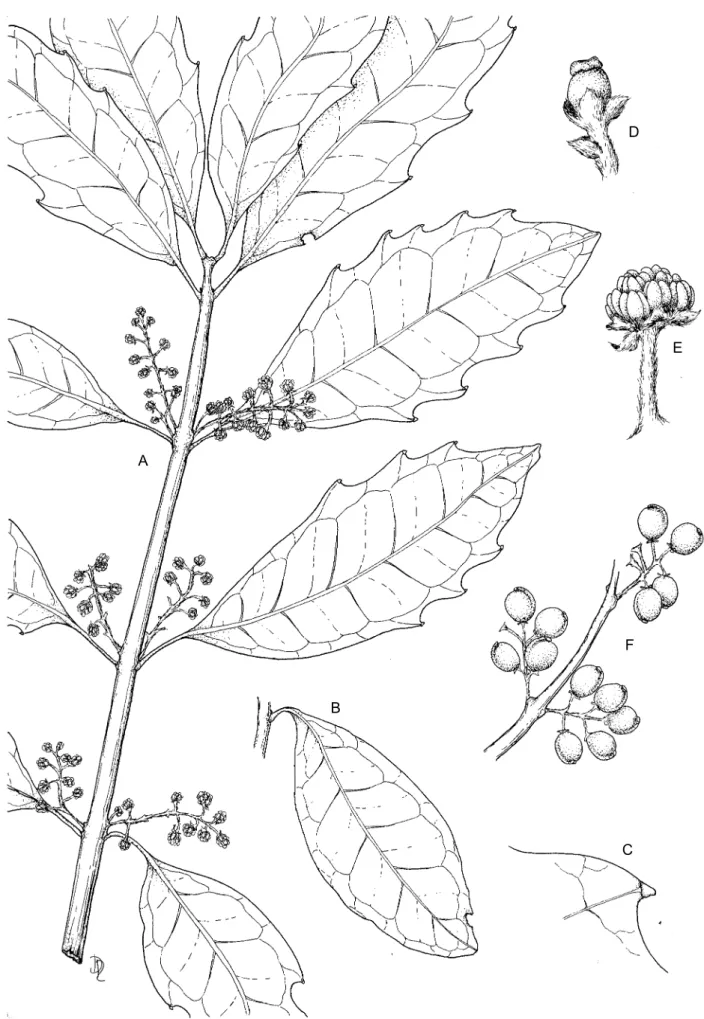
dotted due to the presence of numerous glands or ‘ethe-real oil cells’ (Lorence 1985), and are lemon-scented when crushed. The lack of stipules is considered by Hickey & Wolfe (1975) to be derived within the Lau-rales. Xymalos has leaves with margins that possess a ‘monimioid tooth’ with an undivided median vein and an indurated cap (Figure 4), another derived character in the Laurales (Lorence 1985), or the leaves are some-times entire. Leaves are pinnately veined with prominent venation on the lower surface and the secondary veins originate at uniform angles to the costa (Lorence 1985), looping and joining well within the margin, sometimes leaving a bullate or puckered surface above. Plants are usually dioecious or monoecious and the yellow flowers are very small and mostly unisexual, except for Horto-nia Wight ex Arn., which have bisexual flowers (Endress & Igersheim 1997). The latter is a Sri Lankan genus, sister to Xymalos (Renner et al. 2010), and possesses flowers with an elaborate perianth comprising spirally arranged petaloid and sepaloid series, 6–14 free, stalked carpels borne on a discoid receptacle, appendaged sta-mens and with staminodes present (Lorence 1985). The receptacle in Monimiaceae is deeply concave, cupuli-form or urceolate (Mooney et al. 1950). The family is characterized by apocarpous gynoecia with uniovulate carpels (Endress & Igersheim 1997), surrounded by a flat or concave floral cup (Lorence 1985). The fruit(lets) are presented on the opened floral cup. Male flowers have a 4–8-lobed perianth with few to many stamens, with or without appendages and arranged in whorls or sometimes spirally or irregularly disposed, either with-out a pistillode or with remnants of one. The anthers are 2–4-sporangiate. Staminodes are absent or present in female flowers, carpels are few to many (only one in Xymalos) and sessile or stipitate, with a solitary, anatro-pous ovule. In the genera Kibara Endl. (Malaysia) and Xymalos (Africa) the discoid stigma is sessile on the turbinate ovary, but a style is present in all other genera, typically short and included, but exserted in Monimia (Philipson 1986, 1993). Ovules in Xymalos are crassinu-cellate and bitegmic (Leinfellner 1966) and the carpels are strongly ascidiate in the Mollinedioideae (Endress
nard in his account for Flora zambesiaca (1997), both of which only mention Xymalos monospora. Both of these authors and subsequent publications by Philipson (1993), Jordaan (2000, 2003), Da Silva et al. (2004) and Mabberley (2008) consider Xymalos a monotypic genus occurring in tropical and southern Africa. In Mozam-bique, Xymalos is recorded north of the Zambezi River at Ribáuè, Gurué (Stannard 1997) and Nampula (Da Silva et al. 2004) and south of the Zambezi at Tsetssera (Stannard 1997). Cavaco collected a specimen south of the Save River (southern Mozambique) and somewhere between Mapai and Pafuri (Kruger National Park area) (type specimen mentioned in the protologue). In this area between Save River and Mapai there is certainly no suitable habitat for Xymalos monospora, which usually grows in Afromontane forest, and the closest locality, Tsetssera, is roughly 400 km to the north of the Mapai-Pafuri record. Therefore, the locality is very doubtful as given in the protologue, namely: ‘Sul do Save, entre Mapai et Pafuri, in Moçambique’.
Cavaco compared the holotype of X. mossambi-censis with specimens of X. monospora from southern and tropical Africa housed in the Paris Herbarium (e.g. Rudatis 1418, Stolz 2063, Holst 4249) and concluded that his specimen constituted a new species. We have not seen the type but Cavaco’s (1949) protologue and accompanying illustration indicate that X. mossambi-censis differs essentially from X. monospora in having larger leaves with entire margins and fasciculate rather than racemose inflorescences. Throughout the distribu-tion range of X. monospora, the leaf margins vary from entire (Figure 2) to coarsely serrate with widely spaced gland-tipped teeth (Figure 3). Inflorescences are always axillary and vary from cymose to racemose. There are no significant differences between X. mossambicensis and X. monospora, and they are therefore considered as conspecific.
TAXONOMY
Xymalos monospora (Harv.) Baill. in Bulletin Men-suel de la Société Linnéenne de Paris 1: 650 (1887); Warb.: 53 (1893); Oliv.: t. 2444 (1896); Sim: 288, t. 121 (1907); Baker & C.H.Wright: 170 (1909); Per-kins & Gilg: 10, t. 5 (1911); C.H.Wright: 493 (1912); F.W.Andrews: 7 (1950); J.Léonard: 402, t. 39 (1951); Keay: 55 (1954); Verdc.: 1, t. 1 (1968); Fouilloy: 109 (1974); R.B.Drumm.: 237 (1975); Pooley: 96 (1993); A.E.van Wyk & P.van Wyk: 302 (1997); Stannard: 43 (1997); Lötter: 114 (2002); M.Coates Palgrave: (2002); FIGURE 1.—Distribution of Xymalos monospora based on specimens
Boon: 104 (2010). Xylosma monospora Harv.: 52, t. 181 (1863). Type: South Africa, Natal [KwaZulu-Natal], without precise locality, Cooper 1251 (TCD—dig-ital image!, lecto., designated here; K—dig(TCD—dig-ital image!, PRE!, isolecto.). [Note: Of the two collections cited in Harvey’s protologue of Xylosma monospora, Cooper 1251 is chosen as the lectotype because there are more duplicates of this collection than of Cooper 1204.]
Toxicodendrum acutifolium Benth.: 214 (1878). Type: South Africa, Eastern Cape, ‘British Caffraria’, Barber & Barber 10 (K—digital image!, holo.).
Paxiodendron usambarense Engl.: 182 (1895). Xyma-los usambarensis (Engl.) Engl.: 310 (1901). Type: Tan-ganyika [Tanzania], E Usambara Mountains, Gonja, Bulwa, Holst 4249 (B, holo.†; P—digital image!, lecto., designated here; COI—digital image!, JE—digital image!, K—digital image!, isolecto.).
P. usambarense var. serratifolia Engl.: 182 (1895). Type: Tanganyika [Tanzania], Kilimanjaro, Marangu, Volkens 2264 (B, holo.†; JE—digital image!, lecto., des-ignated here).
P. ulugurense Engl.: 389 (1900). Xymalos ulugurense (Engl.) Engl.: 310 (1901); Baker & C.H.Wright: 170 (1909). Type: Tanganyika [Tanzania], Uluguru Moun-tains, Lukwangule Plateau, Goetze 274 (B, holo.†; K— digital image!, lecto., designated here).
Xymalos mossambicensis Cavaco: 45 (1949). Type: ‘Moçambique [Mozambique], Sul do Save, entre Mapai et Pafuri’, Cavaco 89 (P, holo.).
Note: Most type specimens were seen as digital images on websites. Where the holotypes have been destroyed during World War II in the Berlin Herbarium, as in the case of Holst and Goetze specimens, lectotypi-fication is covered by article 9.15 of the Code (McNeill et al. 2006), which provides for narrowing the lectotype to a single specimen. There are records of duplicates of Holst 4249 verified by Engler, isotypes of Paxiodendron usambarense, in K, COI, JE and P, all of them flower-ing material, and all specimens show entire leaves. The Paris specimen is selected because it is the only one which gives the exact type locality in Tanzania. All the syntypes of Paxiodendron usambarense Engl. var.
ser-ratifolia Engl. (three Volkens specimens) were destroyed in Berlin, but one extant isosyntype, Volkens 2264, is seen on ALUKA [http://plants.jstor.org/], housed at JE, and is therefore selected as the lectotype. This speci-men has leaves with widely-spaced teeth in contrast with all the isotypes of the typical P. usambarense with entire leaves. There is only a fragment of the duplicate of Goetze 274 at K, which is selected as the lectotype for Xymalos ulugurense.
Evergreen tree up to 8(–20) m, mostly single-stemmed, with dense, rounded, spreading crown. Bark silvery grey or grey-brown, rough, slightly fissured, with prominent lenticels, flaking in large scales to leave concentric, ridged markings; inner wood lemon-yellow; sap reddish. Leaves simple, opposite, glabrous, lemon-scented when crushed, pellucid-dotted; lamina narrowly elliptic to obovate, 40–200 × 15–100 mm, apex acute, rounded or shortly acuminate, base cuneate, margin usu-ally irregularly and coarsely glandular-serrate, some-times entire; midrib sunken above, prominent beneath, lateral veins 6–9, looping well within margin, reticu-late venation prominent on both surfaces; petiole up to 30 mm long, glabrous. Inflorescences racemose or pa-niculate, solitary or paired in leaf axils, 10–35(–70) mm long; peduncles 5–10 mm long; bracts triangular, 1.0–2.5 mm long. Flowers unisexual, small, yellowish or greenish; pedicels 1–3 mm long, velvety. Perianth 1–2 mm long, hairy. Petals absent. Male flowers: peri-anth 4–6-lobed; lobes rounded to ovate; stamens 6–15 or more; anthers subsessile. Female flowers: perianth 3–5-lobed; lobes ovate, rounded to triangular, velvety, mar-gins ciliate; ovary obovoid, cylindrical or turbinate, gla-brous; stigmas sessile, discoid, thick, glabrous. Fruit an ovoid to ellipsoid drupe, (5–)10–25 × 3–15 mm, slightly asymmetrical, glabrous, orange or reddish, fleshy, crowned with persistent stigma. Seed solitary, ellipsoid, compressed, 10 × 8 mm, white (Figure 4). Flowering time: June–Oct.
Diagnostic characters: leaves of Xymalos monospora are opposite and translucent gland-dotted, with a lemon smell when crushed. The bark is very distinctive, flak-ing to reveal circular or worm-like markflak-ings, and when cut has a lemon-like smell (Lötter 2002). Small, fragrant yellow flowers, the sexes on separate trees, appear from June to October (Lötter 2002), arranged in racemes and FIGURE 2.—Xymalos monospora showing entire leaves.
FIGURE 4.—Xymalos monospora, A, C & E, Mohle 389 (PRE); B, Van der Schijff 5630 (PRE); D, Compton s.n. (PRE53940); F, De Winter & Killick8954 (PRE). A, flowering twig × 1; B, leaf with entire margin × 1; C, tip of tooth on leaf margin × 2; D, female flower × 8; E, male flower × 4; F, fruiting branch × 1. Artist: Daleen Roodt.
A
B
C E
often produced in clusters from old leafless wood (Sim 1907). The fruits are ovoid, smooth, 1-seeded drupes, often enclosed by a perianth or a fleshy receptacle, with a persistent stigma.
Distribution and habitat: Xymalos monospora grows in Afromontane, scarp or coastal forests, or in grass-lands associated with forests, in moist areas near water-courses, from near sea level to above 2 000 m. It occurs in eastern tropical and southern Africa, from southern Sudan as far south as the Eastern Cape. Tadesse (2000) suggests that the species could also occur in Ethiopia but has not yet been recorded there. Distinctive disjunct populations occur in the highland forests of Nigeria on the Gotel Mountains (Aluka Library [http://plants.jstor. org/]), Cameroon Mountains (Cable & Cheek 1998) and on the Island of Bioko, formerly Fernando Pó (Keay 1954) (Figure 1). The range of Xymalos monospora falls well within the archipelago-like Afromontane Region of Endemism (White 1978, 1983). This African phytocho-rion is of special biogeographical and evolutionary sig-nificance because of its putatively ancient status.
Pollination: Xymalos monospora is wind- or insect pollinated, but this needs further investigation (Philip-son 1993). Quantities of pollen are produced by the male flowers, and most specimens collected possess male flowers, with very few of the ± 50 specimens in the National Herbarium, Pretoria, with female flowers.
Leaf damage: there is some damage to the leaves on ± 100 specimens examined, usually in the form of black patches or holes in the leaf blade (Figure 5). Xymalos monospora is the host for an unusually large number of fungal pathogens (Doidge 1950), which are probably the cause of the damage to the leaves. The leaf edges are also sometimes eaten away (Figure 3) and the species is a host for the larva of the butterfly Papilio dardanus Brown (mocker swallowtail) (Papilionidae) (Picker et al. 2004; butterflycorner website [en.butterflycorner.net]).
ACKNOWLEDGEMENTS
We would like to thank Hester Steyn for preparing the distribution map, and the artist Daleen Roodt for the line drawing.
REFERENCES
ANDREWS, F.W. 1950. Theflowering plants of the Anglo-Egyptian Sudan 1. Buncle, Scotland.
ANGIOSPERM PHYLOGENY GROUP (APG III). 2009. An update of the Angiosperm Phylogeny Group classification for the orders and families of flowering plants: APG III. Botanical Journal of the Linnean Society 161: 105–121.
BAILLON, H.E. 1887. Sur une Bixacée à ovaire uniloculaire et unio-vulé. Bulletin Mensuel de la Société Linnéenne de Paris 1: 650. BAKER, J.G. & WRIGHT, C.H. 1909. Monimiaceae. In W.T.
Thisel-ton-Dyer, Flora of tropical Africa 6,1: 167–171. Reeve, London. BENTHAM, G. 1878. Notes on Euphorbiaceae. Journal of the Linnean
Society 17: 185–267.
BOON, R. 2010. Pooley’s, trees of eastern South Africa: a complete guide. Flora and Fauna Publication Trust, Durban.
ENGLER, H.G.A. 1895. Lauraceae. Die Pflanzenwelt Ost-Afrikas und der Nachbargebiete C: 182. Reimer, Berlin.
ENGLER, H.G.A. 1900.Berichte über die botanischen Ergebnisse der Nyassa-See- und Kinga-Gebirgs-Expedition. Botanische Jahr-bücher 28: 332–510.
ENGLER, H.G.A. 1901. Beiträge zur Flora von Afrika. Berichte über die botanischen Ergebnisse der Nyassa-See- und Kinga-Gebirgs-Expedition. Botanische Jahrbücher 30: 239–445.
ENGLER, H.G.A. 1915. Monimiaceae. Die Pflanzenwelt Afrikas ins-besondere seiner tropischen Gebiete 3,1: 219. Engelmann, Leip-zig.
FOUILLOY, R. 1974. Monimiaceae. In C. Cusset, Flore du Cameroun
18: 107–116. Muséum National d’Histoire Naturelle, Paris. GIBBS, L.S. 1917. Trimeniaceae. A contribution to the phytogeography
and flora of the Arfak mountains. Taylor & Francis, London. HARVEY, W.H. 1863. Thesaurus Capensis 2. Hodges & Smith, Dublin. HICKEY, L.J. & WOLFE, J.A. 1975. The base of angiosperm phylog-eny: vegetative morphology. Annals of the Missouri Botanical Garden 62: 538–589.
HUTCHINSON, J. 1973. Trimeniaceae. The families of flowering plants, edn 3. Clarendon Press, Oxford.
JORDAAN, M. 2000. Monimiaceae. In O.A. Leistner, Seed plants of southern Africa: families and genera. Strelitzia 10: 414. National Botanical Institute, Pretoria.
JORDAAN, M. 2003. Monimiaceae. In G. Germishuizen & N.L. Meyer, Plants of southern Africa: an annotated checklist. Strelitzia 14: 743. National Botanical Institute, Pretoria.
JUSSIEU, A.L. DE. 1809. Mémoire sur les Monimiées, nouvel ordre de plantes. Annales du Museum National d’Histoire Naturelle, Paris 14: 116–135.
KEAY, R.W.J. 1954. Monimiaceae. In J. Hutchinson & J.M. Dalziel,
Flora of West tropical Africa, 2nd revised edn, vol. 1,1: 54, 55. Crown Agents for Oversea Government and Administrations, London.
KLOPPER, R.R., CHATELAIN, C., BÄNNINGER, V., HABASHI, C., STEYN, H.M., DE WET, B.C., ARNOLD, T.H., GAUTIER, L., SMITH, G.F. & SPICHIGER, R. 2006. Checklist of the flow-ering plants of sub-Saharan Africa. South African Botanical Diversity Network Report No. 42. SABONET, Pretoria. LEINFELLNER, W. 1966. Über die Karpelle verschiedener
Magno-liales, II. Xymalos, Hedycarya und Siparuna (Monimiaceae). Österreichische Botanische Zeitschrift 113: 448–458.
LÉONARD, J. 1951. Monimiaceae. In Flore du Congo Belge et du Ruanda-Urundi 2: 400–402. Bruxelles.
LORENCE, D.H. 1985. A monograph of the Monimiaceae (Laurales) in the Malagasy region (Southwest Indian Ocean). Annals of the Missouri Botanical Garden 72: 1–165.
LÖTTER, M. 2002. Monimiaceae. In E. Schmidt, M. Lötter & W. McCleland, Trees and shrubs of Mpumalanga and Kruger National Park. Jacana, Johannesburg.
MABBERLEY, D.J. 2008. Mabberley’s plant-book: A portable diction-ary of the vascular plants, edn 3. Cambridge University Press, Cambridge.
McNEILL, J., BARRIE, F.R., BURDET, H.M., DEMOULIN, V., HAWKSWORTH, D.L., MARHOLD, K., NICOLSON, D.H., PRADO, J., SILVA, P.C., SKOG, J.E., WIERSEMA, J.H. & TURLAND, N.J. (eds.). 2006. International Code of Botanical Nomenclature (Vienna Code) Adopted by the Seventeeth Interna-tional Botanical Congress Vienna, Austria, July 2005. Gantner Verlag, Ruggell, Liechtenstein. [Regnum Vegetabile 146]. MOONEY, L.L., BAILEY, I.W. & SWAMY, B.G.L. 1950. The
mor-phology and relationships of the Monimiaceae. Journal of the
POOLEY, E. 1993. The complete field guide to trees of Natal, Zululand & Transkei. Natal Flora Publications Trust.
RENNER, S.S. 1998. Phylogenetic affinities of Monimiaceae based on cplDNA gene and spacer sequences. Perspectives in Plant Ecol-ogy, Evolution and Systematics 1: 61–77.
RENNER, S.S. 1999. Circumscription and phylogeny of the Laurales: evidence from molecular and morphological data. American Journal of Botany 86: 1301–1315.
RENNER, S.S. & CHANDERBALI, A.S. 2000. What is the relation-ship among Hernandiaceae, Lauraceae, and Monimiaceae, and why is this question so difficult to answer? International Journal of Plant Science 161, suppl.: S109–S119.
RENNER, S.S., STRIJK, J.S., STRASBERG, D. & THÉBAUD, C. 2010. Biogeography of the Monimiaceae (Laurales): a role for East Gondwana and long-distance dispersal, but not West Gond-wana. Journal of Biogeography 37: 1227–1238.
ROMANOV, M.S., ENDRESS, P.K., BOBROV, A.V.F.CH., MELIKI-AN, A.P. & BEJERANO, A.P. 2007. Fruit structure and system-atics of Monimiaceae s.s. (Laurales). Botanical Journal of the Linnean Society 153: 265–285.
SIM, T.R. 1907. The forests and forest flora of the Colony of the Cape of Good Hope. Taylor & Henderson, Aberdeen.
STANNARD, B.L. 1997. Monimiaceae. In G.V. Pope, Flora zambesi-aca 9, 2: 42–44. Royal Botanic Gardens, Kew.
TADESSE, M. 2000. Monimiaceae. In S. Edwards, M. Tadesse, D. Seb-sebe & I. Hedberg, Flora of Ethiopia & Eritrea 2, 1: 13. Depart-ment of Systematic Botany, Uppsala, Sweden.
THORNE, R.F. 1974. A phylogenetic classification of the Annoniflora.
Aliso 8: 147–209.
THUNBERG, C.P. 1796. Konglinga Vetenskaps Academiens Nya Han-dlingar: 188. t. 7.
VAN WYK, A.E. (Braam) & VAN WYK, P. 1997. Field guide to trees of southern Africa. Struik, Cape Town.
VERDCOURT, B. 1968. Monimiaceae. In R.M. Polhill, Flora of tropi-cal East Africa: 1–3. Crown Agents for Oversea Governments and Administrations, London.
WARBURG, O. 1893. Flacourtiaceae. In A. Engler & K. Prantl, Die natürlichen Pflanzenfamilien 3,6a: 1–56. Engelmann, Leipzig. WHITE, F. 1978. The Afromontane Region. In M.J.A. Werger,
Bioge-ography and ecology of southern Africa. Junk, The Hague. WHITE, F. 1983. The Vegetation of Africa: a descriptive memoir to
accompany the UNESCO, AETFAT, UNSO vegetation map of Africa, Paris.
WRIGHT, C.H. 1912. Monimiaceae. In W.T. Thiselton-Dyer, Flora capensis 5,1: 492, 493. Reeve, London.
Websites accessed:
ALUKA LIBRARY. http://plants.jstor.org/ (accessed July 2011). ANGIOSPERM PHYLOGENY WEBSITE (APweb). www.mobot.org/
MOBOT/Research/APweb/ (accessed July 2011).
BUTTERFLYCORNER WEBSITE. http://en.butterflycorner.net/ (ac-cessed September 2009).
INTERNATIONAL PLANT NAMES INDEX [IPNI]. Published on the Internet http://www.ipni.org/ (accessed July 2011).
M. JORDAAN* & M. LÖTTER **
* National Herbarium, South African National Biodiversity Institute, Private Bag X101, 0001, Pretoria. † Student affiliation: Department of Plant Science, University of Pretoria, 0002 Pretoria.
** Scientific Services, Mpumalanga Tourism & Parks Agency, Private Bag X1088, Lydenburg, 1120.