doi 10.15802/stp2017/118187 © V. D. Petrenko, O. L. Tiutkin, I. O. Sviatko, 2017
UDC 624.138.9-625.02-625.122
V. D. PETRENKO
1, O. L. TIUTKIN
2, I. O. SVIATKO
3*1
Dep. «Bridges and Tunnels», Dnipropetrovsk National University of Railway Transport named after
Academician V. Lazaryan, Lazaryan St., 2, Dnipro, Ukraine, 49010, tel. +38 (056) 373 15 79, e-mail [email protected], ORCID 0000-0002-5902-6155
2
Dep. «Bridges and Tunnels», Dnipropetrovsk National University of Railway Transport named after
Academician V. Lazaryan, Lazaryan St., 2, Dnipro, Ukraine, 49010, tel. +38 (056) 373 15 79, e-mail [email protected] ORCID 0000-0003-4921-4758
3*
Dep. «Bridges and Tunnels», Dnipropetrovsk National University of Railway Transport named after Academician V. Lazaryan, Lazaryan St., 2, Dnipro, Ukraine, 49010, tel. +38 (056) 373 15 79, e-mail [email protected], ORCID 0000-0002-7099-2637
STUDY OF THE EFFECT OF SOIL CEMENT ELEMENTS WHEN
STABILIZING ROADBED MODEL IN LABORATORY CONDITIONS
Purpose. Experimental studies allow determining the stress-strain state or bearing capacity of the tested soil body. A preliminary study of the results of model testing and experimental research allows us to find the optimal solutions and to justify the parameters of the chosen technology. The purpose of this work is to determine the effect of soil cement elements when stabilizing the roadbed on a weak subgrade using the soil tests in laboratory condi-tions. Methodology.During the development of measures for the reconstruction and consolidation of soil bodies, their strength is tested using many methods. In all cases, we take into account the physical and mechanical charac-teristics of soils obtained as a result of research, as well as the existing regulatory documents. We performed the experimental studies by model testing in laboratory conditions. The model testing was based on the corresponding relationships between geometric sizes, mechanical properties of materials, loads and other factors on which the stress-strain state depends. During testing, the model was loaded gradually. We maintained each load level up to conditional stabilization of the soil deformation. We took the readings from measuring devices at each stage of load-ing after achievement of stabilization of soil mass deformations. We fixed the readload-ings in the test journal. Findings.During stabilization with soil cement piles there is an improvement in mechanical properties, which leads to a decrease in deformations by 2…3.5 times. Each test is accompanied with graphs of relative deformations-stress dependence, as well as deformation curves and compression curves. According to the results of experimental stu-dies, it can be seen that when testing a model with cement piles, compared with a model without soil cement piles, the relative deformations of the samples taken prior to the experiment and after the experiment almost coincide, in-dicating a decrease in deformability under load. Originality.We proved that this stabilization type positively affects the stress-strain state of the soil body, by increasing its physical and mechanical characteristics. The obtained results allow for rational design of subgrade stabilization work with the help of modern technologies. Practical value. The in-depth analysis of the results of experimental studies opens up possibilities for theoretical synthesis and develop-ment of theoretical foundations, which will allow in the future avoiding, in the similar cases, the experidevelop-mental veri-fication of the stabilization type given for the relative type of soil. It is confirmed that this method of stabilization used can be applied in real conditions.
Keywords: roadbed; soil cement elements; trough study; soil tests
Introduction
Knowledge of the mechanical properties of soils is equally important for both the roadbed and the calculation of the rolling stock-embankment interaction.
It is clear that the mechanical properties of any soil, in different operation conditions, should vary significantly.
When calculating the interaction of subgrade soil with the track superstructure, the urgent task is
to identify the parameters that determine the de-velopment of deformations in subgrade soil.
they use hypothesis – evidence-based assumptions put forward to explain any process which after checking may be true or false.
In the process of learning, experimental re-search is a necessary step in obtaining empirical knowledge.
Experiment is the most important part of scien-tific research. Its basis is a scienscien-tifically advanced experience with precisely calculated and controlled conditions.
The main purpose of the experiment is to iden-tify the properties of the objects under study, to test the validity of the hypotheses, and on this basis to study widely and deeply the topic of scientific re-search [1, 8].
The development of modern computing sys-tems and applications allow receiving answers to almost all questions pertaining to predict the be-haviour and characteristics of stress-strain state of soil. However, there are problems when this is not enough, for example, there are no theoretically substantiated solutions, or the tasks themselves are rather complicated.
Experimental studies allow us to determine the stress-strain state or bearing capacity of the tested subgrade [2, 3, 4].
Most of the experimental studies should be per-formed on large-scale models, and only in special cases one should perform natural experiments. Pre-liminary study of the results of model testing and experimental research allows us to find the optimal solutions and to substantiate the parameters of the chosen technology in industrial conditions.
Purpose
Experimental studies of the roadbed construc-tion, which is reinforced by ground-cement piles, are carried out to solve the following issues:
– analysis of the results of numerical and full-scale model testing with the purpose of obtaining the methodology of calculations at the design stage;
– definition of dependencies of soil body pro-perties on the parameters of roadbed stabilization.
Methodology
Experiment is called a set of researches, which are united by one purpose, one system of restrictions in space and time.
The study is the realization on the object of cer-tain conditions and rules. As a result of the experi-ment, an event occurs, the appearance of which is fixed by some parameter, which, as a rule, has a numerical definition and characterizes the result to a large extent.
The experiment is the most important part of scientific research. This is one of the main ways to gain new scientific knowledge. More than 2/3 of all labour resources of science are spent on experi-ments. The base of the experimental study is an ex-periment, which is a scientifically established expe-rience or observation of a phenomenon in clearly defined conditions that allow it to be monitored, manipulated, reproduced every time when these conditions are repeated. The experiment differs from the usual, every day, passive observation by the active influence of the researcher on the phe-nomenon under study.
The main purpose of the experiment is testing the theoretical positions (confirmation of the work-ing hypothesis), as well as a broader and more pro-found study of the topic of scientific research.
The experiment should be carried out as soon as possible with minimum costs at the highest quality of the results.
During the development of measures for the re-construction and stabilization of soil bodies, their strength is tested using many methods. In all cases, we take into account the physical and mechanical characteristics of soils obtained as a result of re-search, as well as the existing regulatory documents. The experiment method corresponds to the mo-dern level of science, takes into account the experi-ence gained earlier. The proposed method includes the justification of the research design, instrumental support, etc. [9].
Model testing is a method of studying any phe-nomenon by comparison with another phephe-nomenon similar thereto, that is, the reproduction of the pro-perties of an object on a specially reproduced ana-logue-model. There are mathematical model testing, physical model testing, model testing on mechanical models.
In this paper, simulation is an experimental solu-tion to a problem and occupies an intermediate posi-tion between analytical calculaposi-tions and field stu-dies.
doi 10.15802/stp2017/118187 © V. D. Petrenko, O. L. Tiutkin, I. O. Sviatko, 2017 other factors on which the stress-strain state depends
[2, 7].
The design of the model allows providing the requirements of all normative documents regulating soil tests in laboratory conditions.
The model scale is chosen in such a way that the geometric dimensions, material characteristics, load, and other model parameters are interconnected by a system of equations that is a condition of similarity.
The preparatory phase included making up an experiment program, in particular the selection of independent and dependent variables, the analysis of the ways to achieve the testing integrity, the identi-fication of the optimal sequence of experimental actions, the development of methods for fixing and analysing the results, preparing the necessary equipment, giving guidance to the test subjects, and forming a sample.
In accordance with the study tasks, the work program provided for soil tests in conjunction with ground-cement elements.
During the study the following procedure was performed:
1 – Arrangement of a constructive solution for soil body stabilization
2 – Assembly of load and measuring systems 3 – Test
4 – Disassembly of measuring and loading sys-tems
5 – Removal of the soil body and examination of the soil cement elements.
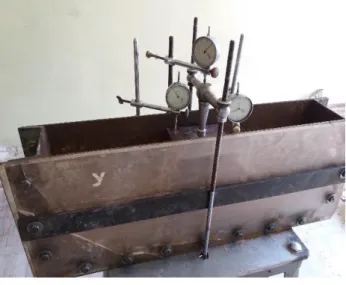
The initial stage of experimental research is the construction of a control model. For this purpose, we used the laboratory trough of the DNURT labo-ratory, filled with soil in accordance with the road-bed transverse profile. Laboratory trough is a capa-city of 0.65x0.25x0.12m, which eliminates the sub-grade deformations, and, accordingly, their effect on the results of the study.
General construction of the trough with measu-ring devices is shown in Fig. 1.
During testing, the model was loaded gradually. The maximum load was 16 kg. The value of maximum pressure was calculated at R65 rails and 25t load per axle.
Each load level was maintained up to conditio-nal stabilization of soil deformation. We took the readings from measuring devices at each stage of loading after achievement of stabilization of soil body deformations. We fixed the readings in the test journal. Upon reaching the maximum load, we
un-loaded the tested model fixing the readings of the measuring devices.
Fig. 1. Model of soil bank in trough with measuring devices.
Fig. 2. Roadbed model before the test
The journal was filled in neatly, without any cor-rections. Simultaneously with measurements, we conducted pre-processing of the results and their analysis. This analysis allows controlling the pro-cess under study, adjusting the experiment, impro-ving the technique, and increasing the efficiency of the experiment.
Findings
We carried out the model testing in laboratory conditions using a standard trough filled with soil in accordance with the roadbed transverse profile.
Laboratory trough is a capacity of
It should be noted that the soil properties cor-respond to complicated engineering and geological conditions, and the soil itself (loam) for laboratory experiments was sampled on the problem areas of the railway [5, 10].
After performing the control calculation of an unshaped roadbed, we obtained the maximum de-formations of 5…8 mm.
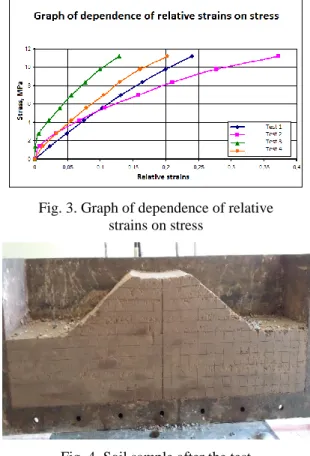
The maximum relative deformations are 0.24…0.372 mm for the non-stabilized body, and 0.125…0.2 mm for the stabilized body (Fig. 3). Accordingly, when reinforced with soil cement piles there is an improvement in mechanical prop-erties, which leads to a decrease in deformations by 2…3.5 times. Moreover, we can say that the residual deformations have at least half of the de-formations of crushed stone bed (Fig. 4).
It should be noted that after the test all the piles remained in the initial state, no cracks, chips and other damages were detected (Fig. 5).
After each stage of the tests, we performed la-boratory testing of soil samples before and after loading.
Each test is accompanied with graphs of rela-tive deformations-stress dependence, as well as deformation curves and compression curves.
Fig. 3. Graph of dependence of relative strains on stress
Fig. 4. Soil sample after the test
Fig. 5. Appearance of the soil cement elements in the bank body after the test
According to the results of experimental stud-ies, it can be seen that when testing a model with cement piles, compared with a model without soil cement piles, the relative deformations of the sam-ples taken prior to the experiment and after the ex-periment almost coincide, indicating a decrease in deformability under load.
The conducted experiments showed the in-crease in soil deformation as a result of the place-ment of soil ceplace-ment eleplace-ments, due to the soil con-solidation. It can be assumed that the total defor-mation module of the entire body, taking into ac-count stabilizing soil cement elements, will be much higher.
Originality and practical value
The paper considers the possibility of stabili-zing the roadbed on a weak subgrade using the soil cement piles. We proved that this stabilization type positively affects the stress-strain state of the soil body, by increasing its physical and mechanical characteristics.
The in-depth analysis of the results of experi-mental studies opens up possibilities for theoretical synthesis and development of theoretical founda-tions, which will allow in the future avoiding, in the similar cases, the experimental verification of the stabilization type given for the relative type of soil.
The implemented stabilization of the roadbed with the soil cement elements will contribute to improving the track strength and state.
doi 10.15802/stp2017/118187 © V. D. Petrenko, O. L. Tiutkin, I. O. Sviatko, 2017 Conclusions
The experience of designing and operating the track structure has shown that over time it is neces-sary to take certain measures to improve the soil body characteristics to allow further normal opera-tion of the roadbed.
When increasing the load on the weak subgrade as a result of the construction of the other track, back filling or increased axial load when changing the rolling stock, the process of settling and con-solidation can continue again. Therefore, one of the most expedient and perspective variants of de-signing and reconstruction of embankments on weak subgrade is the subgrade stabilization using string cementation. The arrangement of soil ce-ment piles allows providing short terms for road-bed stabilization, the possibility of quick putting
into operation of the track section and small values of subsidence.
Soil cement elements that are widely used abroad, as well as in the construction of industrial and civilian facilities, can be applied for rein-forcement of transport constructions, namely, when stabilizing both the roadbed and weak sub-grade.
The use of model testing allows us to detect the stress-strain state of a soil body with any geometric and physical-mechanical characteristics.
The presented method of experimental research allows estimating objectively the real influence of soil cement elements on the soil body of the weak subgrade roadbed.
Thus, it is confirmed that this method of stabi-lization used can be applied in real conditions.
LIST OF REFERENCE LINKS
1. Аналітична записка до Концепції Державної цільової програми розвитку пасажирських перевезень на залізничному транспорті України до 2020 року. – Київ : Київдіпротранс, 2010. – 39 с.
2. Довідник основних показників роботи залізниць України (2005–2015 роки) / ПАТ «Українська заліз-ниця». – Київ, 2016. – 58 с.
3. Курган, Н. Б. Предпосылки создания высокоскоростных магистралей в Украине / Н. Б. Курган // Укр. залізниці. – 2015. – № 5–6 (23–24). – С. 16–21.
4. Оцінка економічної ефективності усунення обмежень швидкості руху поїздів, пов’язаних зі станом залізничної колії / А. А. Босов, М. Б. Курган, Д. М. Курган, С. Ю. Байдак // Вісн. Дніпропетр. нац. ун-ту залізн. трансп. ім. акад. В. Лазаряна. – Дніпропетровськ, 2011. – Вип. 41. – С. 106−115.
5. Петренко, В. Д. Порівняльний аналіз методів укріплення земляного полотна / В. Д. Петренко, І. О. Святко, Д. О. Ямпольський // Стр-во, материаловедение, машиностроение : сб. науч. тр. / При-днепр. гос. акад. стр-ва и архитектуры. – Днепропетровск, 2013. – Вып. 69. – С. 369–373.
6. Правила розрахунків залізничної колії на міцність і стійкість : ЦП-0117 : затв. наказом Укрзалізниці від 13.12.2004 р. № 960-ЦЗ. – Київ : ЦП УЗ, 2004. – 69 c.
7. Barreira, A. Competitiveness of high-speed rail / A. Barreira, V. Reis, R. Macario // Transportation Research Record : Journal of the Transportation Research Board. − 2013. – Vol. 2374. − P. 9−16. doi: 10.3141/2374-02. 8. High speed rail. First track to sustainable mobility [Electronic resource]. – Paris : UIC, 2009. – 14 р. – Availa-ble at: http://www.vialibre-ffe.com/PDF/4509_AVE_UIC.pdf. – Title from the screen. – Accessed : 15.02.2017.
9. New routes on old railways: increasing rail’s mode share within the constraints of the existing railway network / S. P. Blainey, J. Armstrong, A. S. J. Smith, J. M. Preston // Transportation. – 2016. – Vol. 43. – Iss. 3. – P. 425–442. doi: 10.1007/s11116-015-9582-5.
10. Petrenko, V. D. Estimation of subgrade strengthening influence using soilcement elements / V. D. Petrenko, I. O. Sviatko, O. L Tiutkin // Наука та прогрес транспорту. – 2016. – № 4 (64). – С. 161–168. doi: 10.15802/stp2016/78254.
В. Д. ПЕТРЕНКО
1, О. Л. ТЮТЬКІН
2, І. О. СВЯТКО
3*1Каф. «Мости і тунелі», Дніпропетровський національний університет залізничного транспорту імені академіка
В. Лазаряна, вул. Лазаряна, 2, Дніпро, Україна, 49010, тел. +38 (056) 373 15 79, ел. пошта [email protected], ORCID 0000-0002-5902-6155
2Каф. «Мости і тунелі», Дніпропетровський національний університет залізничного транспорту імені академіка
В. Лазаряна, вул. Лазаряна, 2, Дніпро, Україна, 49010, тел. +38 (056) 373 15 79, ел. пошта [email protected], ORCID 0000-0003-4921-4758
3*Каф. «Мости і тунелі», Дніпропетровський національний університет залізничного транспорту імені академіка
В. Лазаряна, вул. Лазаряна, 2, Дніпро, Україна, 49010, тел. +38 (056) 373 15 79, ел. пошта [email protected], ORCID 0000-0002-7099-2637
ДОСЛІДЖЕННЯ ВПЛИВУ ГРУНТОЦЕМЕНТНИХ
ЕЛЕМЕНТІВ ПРИ УКРІПЛЕННІ МОДЕЛІ ЗЕМЛЯНОГО
ПОЛОТНА В ЛАБОРАТОРНИХ УМОВАХ
Мета. Експериментальні дослідження дозволяють визначити напружено-деформований стан або несучу здатність ґрунтового масиву, що розглядається. Попереднє вивчення результатів моделювання й експериме-нтальних досліджень дозволяє підібрати оптимальні рішення та обґрунтувати параметри обраної технології. Метою даної роботи є визначення впливу ґрунтоцементних елементів укріплення земляного полотна на сла-бкій основі за допомогою випробування ґрунтів у лабораторних умовах. Методика. Під час розробки захо-дів щодо реконструкції та укріплення ґрунтових масивів виконується перевірка їх міцності за допомогою багатьох методів. В усіх випадках до уваги приймають фізико-механічні характеристики ґрунтів, отримані в результаті досліджень, а також діючі нормативні документи. Експериментальні дослідження виконувались шляхом моделювання в лабораторних умовах. Моделювання здійснювалось на основі відповідних співвід-ношень між геометричними розмірами, механічними властивостями матеріалів, навантаженнями та іншими факторами, від яких залежить напружено-деформований стан. При проведенні випробувань навантаження моделі здійснювалось поступово. Кожну ступінь навантаження витримували до умовної стабілізації дефор-мації ґрунту. Зняття відліків із вимірювальних пристроїв на кожному ступені навантаження виконувалось після досягнення стабілізації деформацій ґрунтового масиву. Фіксування відліків із обладнання відзначалось у журналі випробувань. Результати. При укріпленні ґрунтоцементними палями моделі земляного полотна відбувається покращення механічних властивостей, що призводить до зменшення деформацій у 2…3,5 рази. Для кожного випробування побудовані графіки залежності відносних деформацій від напруження, а також графіки деформацій та компресійні криві. За результатами експериментальних досліджень можна побачити, що при випробуванні моделі з влаштуванням ґрунтоцементних паль, порівняно з моделлю без влаштування ґрунтоцементних паль, відносні деформації зразків, що були відібрані до експерименту та після експерименту, майже збігаються, що свідчить про зменшення деформативності під навантаженням. Наукова новизна. Доведено, що даний тип укріплення позитивно впливає на напружено-деформований стан ґрунтового масиву шляхом підвищення його фізико-механічних характеристик. Отримані результати дозволяють раціонально проектувати роботи з укріплення ґрунтової основи за допомогою сучасних техно-логій. Практична значимість. Поглиблений аналіз результатів експериментальних досліджень відкриває можливості для теоретичного узагальнення та розробки теоретичних основ, що дозволить у подальшому уникнути в аналогічних випадках експериментальної перевірки приведеного в роботі виду укріплення для даного виду ґрунту. Підтверджено, що використаний метод укріплення може бути застосований у реальних умовах.
doi 10.15802/stp2017/118187 © V. D. Petrenko, O. L. Tiutkin, I. O. Sviatko, 2017
В. Д. ПЕТРЕНКО
1, А. Л. ТЮТЬКИН
2, И. А. СВЯТКО
3*1Каф. «Мосты и туннели», Днепропетровский национальный университет железнодорожного транспорта имени
академика В. Лазаряна, ул. Лазаряна, 2, Днипро, Украина, 49010, тел. +38 (056) 373 15 79, эл. почта [email protected], ORCID 0000-0002-5902-6155
2Каф. «Мосты и туннели», Днепропетровский национальный университет железнодорожного транспорта имени
академика В. Лазаряна, ул. Лазаряна, 2, Днипро, Украина, 49010, тел. +38 (056) 373 15 79, эл. почта [email protected], ORCID 0000-0003-4921-4758
3*Каф. «Мосты и туннели», Днепропетровский национальный университет железнодорожного транспорта имени
академика В. Лазаряна, ул. Лазаряна, 2, Днипро, Украина, 49010, тел. +38 (056) 373 15 79, эл. почта [email protected], ORCID 0000-0002-7099-2637
ИССЛЕДОВАНИЕ ВЛИЯНИЯ ГРУНТОЦЕМЕНТНЫХ ЭЛЕМЕНТОВ
ПРИ УКРЕПЛЕНИИ МОДЕЛИ ЗЕМЛЯНОГО ПОЛОТНА
В ЛАБОРАТОРНЫХ УСЛОВИЯХ
Цель. Экспериментальные исследования позволяют определить напряженно-деформированное состоя-ние или несущую способность рассматриваемого грунтового массива. Предварительное изучесостоя-ние результа-тов моделирования и экспериментальных исследований позволяет подобрать оптимальные решения и обос-новать параметры выбранной технологии. Целью данной работы является определение влияния грунтоце-ментных элементов укрепления земляного полотна на слабом основании с помощью испытания грунтов в лабораторных условиях. Методика. При разработке мероприятий по реконструкции и укреплению грун-товых массивов выполняется проверка прочности с помощью многих методов. Во всех случаях во внимание принимают физико-механические характеристики грунтов, полученные в результате исследований, а также действующие нормативные документы. Экспериментальные исследования выполнялись путем моделирова-ния в лабораторных условиях. Моделирование осуществлялось на основе соответствующих соотношений между геометрическими размерами, механическими свойствами материалов, нагрузками и другими факто-рами, от которых зависит напряженно-деформированное состояние. При проведении испытаний нагрузки модели осуществлялись постепенно. Каждую степень нагрузки выдерживали до условной стабилизации де-формации грунта. Снятие отсчетов с измерительных устройств на каждой ступени нагрузки выполнялось после достижения стабилизации деформаций грунтового массива. Фиксирование отсчетов по оборудованию отмечалось в журнале испытаний. Результаты. При укреплении грунтоцементными сваями модели земля-ного полотна происходит улучшение механических свойств, что приводит к уменьшению деформаций в 2...3,5 раза. Для каждого испытания построены графики зависимости относительных деформаций от напряжения, а также графики деформаций и компрессионные кривые. Из анализа результатов эксперимен-тальных исследований можно заключить, что при испытании модели с устройством грунтоцементных свай, по сравнению с моделью без устройства грунтоцементных свай, относительные деформации грунтов были меньше. Научная новизна. Доказано, что данный тип укрепления положительно влияет на напряженно-деформированное состояние грунтового массива, а также на его физико-механические характеристики. По-лученные результаты позволяют рационально проектировать работы по укреплению грунтового основания с помощью современных технологий. Практическая значимость. Углубленный анализ результатов экспе-риментальных исследований открывает возможности для теоретического обобщения и разработки теорети-ческих основ, позволит в дальнейшем избежать в аналогичных случаях экспериментальной проверки приве-денного в работе вида укрепления для данного вида грунта. Подтверждено, что использованный метод укрепления может быть применен в реальных условиях.
Ключевые слова: земляное полотно; грунтоцементные элементы; лотковые исследования; испытания грунтов
REFERENCES
1. Analitychna zapyska do Kontseptsii Derzhavnoi tsilovoi prohramy rozvytku pasazhyrskykh perevezen na zaliznychnomu transporti Ukrainy do 2020 roku. (2010). Kyiv: Kyivdiprotrans. (in Ukrainain)
2. PJSC Ukrzaliznytsia (2016). Dovidnyk osnovnykh pokaznykiv roboty zaliznyts Ukrainy (2005–2015 roky). Kyiv. (in Ukrainian)
4. Bosov, A. A., Kurhan, M. B., Kurhan, D. M., & Baidak, S. Yu. (2012). Estimation of economic efficiency from restrictions elimination of speed movement of trains. Bulletin of Dnipropetrovsk National University of Railway Transport named after Academician V. Lazaryan, 41, 106-115. (in Ukrainian)
5. Petrenko, V. D., Sviatko, I. O., & Yampolskyi, D. O. (2013). Porivnialnyi analiz metodiv ukriplennia zemlia-noho polotna. Stroitelstvo, materialovedenie, mashinostroenie, 69, 369-373. (in Ukrainian)
6. Pravyla rozrakhunkiv zaliznychnoi kolii na mitsnist i stiikist: TsP-0117 : zatv. nakazom Ukrzaliznytsi vid 13.12.2004 r. №960-TsZ. (2004). Kyiv: TsP UZ. (in Ukrainain)
7. Barreira, A., Reis V., & Macario, R. (2013). Competitiveness of high-speed rail. Transportation Research Record: Journal of the Transportation Research Board, 2374, 9-16. doi: 10.3141/2374-02. (in English) 8. High speed rail. First track to sustainable mobility. (2009). Retrieved from:
http://www.vialibre-ffe.com/PDF/4509_AVE_UIC.pdf. (in English)
9. Blainey, S. P., Armstrong, J., Smith, A. S. J., J. & Preston, M. (2016). New routes on old railways: increasing rail’s mode share within the constraints of the existing railway network. Transportation, 43(3), 425-442. doi: 10.1007/s11116-015-9582-5. (in English)
10. Petrenko, V. D., Sviatko, I. O., & Tiutkin, O. L. (2016). Estimation of subgrade strengthening influence using soilcement elements. Science and Transport Progress, 4(64), 161-168. doi: 10.15802/stp2016/78254. (in Eng-lish)
11. Thelisson, G. (2012, July). Overhead line from start to finish. Railway Gazette International, 48-49. (in Eng-lish)
Ass. Professor. V. P. Kupriy, Ph.D. in Engineering Sc. (Ukraine); Prof. S. I. Holovko, Dr. Sc. (Tech.) (Ukraine) recommended this article to be published