www.ijemst.com
Uptake as a Mechanism to Promote
Student Learning
Clare Valerie Bell
University of Missouri
To cite this article:
Bell, C. V. (2013). Uptake as a mechanism to promote student learning.
International
Journal of Education in Mathematics, Science and Technology, 1
(4), 217- 229.
This article may be used for research, teaching, and private study purposes.
Any substantial or systematic reproduction, redistribution, reselling, loan, sub-licensing,
systematic supply, or distribution in any form to anyone is expressly forbidden.
Authors alone are responsible for the contents of their articles. The journal owns the
copyright of the articles.
Volume 1, Number 4, October 2013, Page 217-229
ISSN: 2147-611X
Uptake as a Mechanism to Promote Student Learning
Clare Valerie Bell*
University of Missouri
Abstract
This study is a descriptive examination of uptake that occurred during classroom discourse in 33 Algebra I classrooms in nine U.S. states. Uptake refers to the act of taking up mathematical comments, questions, and constructions as objects of discourse. Uptake is important because it can be used for scaffolding authentic opportunities to learn and promoting productive dispositions toward learning.
Data used in this study were taken from video-recorded and transcribed observations of 63 class sessions—30 participating teachers were observed twice and 3 were observed only once. Coding of uptake data resulted in 5 categories of types of utterances being taken up and 16 categories of how the utterance was used in the episode of uptake. Analysis across all categories indicates that teachers most frequently provided mathematical explanations and reasoning, even when asking for students’ reasoning and explanations, which limited students’ opportunities to express mathematical reasoning. Episodes of uptake resulting in more dialogic interaction did occur, but were relatively rare. Findings of this study have potential to help teachers and teacher educators become more aware of using uptake to strategically foster more authentic, student-centered discourse environments and increase students’ opportunities to learn.
Key words: Uptake, Algebra I, Opportunity to learn
Introduction
The National Research Council broadened the definition of mathematical proficiency by recommending five interrelated strands: conceptual understanding, procedural fluency, strategic competence, adaptive reasoning, and productive dispositions (NRC; Kilpatrick, Swafford, & Findell, 2001). Mathematical proficiency is developed as students engage in problem solving, communicate ideas and reasoning, make connections among ideas inside and outside the domain of mathematics, and represent mathematical ideas in a variety of forms (National Council of Teachers of Mathematics (NCTM), 2000). More recently the Common Core State Standards (National Governors Association Center for Best Practices (NGAC), Council of Chief State School Officers (CCSSO), 2010) have integrated these strands of mathematical proficiency and NCTM process standards in the Common Core State Standards for Mathematical Practice. The practices include engagement in activities that require looking for and expressing regularity in reasoning, modeling with mathematics, and constructing viable arguments as part of learning mathematics with understanding.
One approach to engaging students in communication about mathematical practices is through the use of uptake
within classroom discussions (Cobb, Boufi, McClain, & Whitenack, 1997; Nystrand, Wu, Gamoran, Zeiser, & Long, 2003; Yackel & Cobb, 1996). Uptake refers to discourse processes during which a teacher takes up verbal utterances, prior actions, or non-verbal constructions as objects of discourse. Students’ verbal utterances may include questions, answers, conjectures, or descriptions of actions or mathematical reasoning (e.g., “Did you hear what Peter asked? Let’s listen again and try to respond to his question.”). Prior actions may include any actions observed by the teacher or students (e.g., “I just saw Kiera use a table to solve that problem. Why might that be a good strategy?”). Non-verbal constructions may include a variety of mathematical representations related to students’ actions during their mathematical work (“Take a look at the equation that Mari wrote. What might she have been thinking about this situation?”).
[Uptake] makes the [original] response the momentary topic of discourse…. [and] may play an important role in facilitating the negotiation of understandings, as conversants listen and respond to each other. Moreover, by building on the voices of others and by establishing intertextual links among speakers, uptake acts to promote coherence within the discourse. (Nystrand et al., 2003, p. 146)
This study of a sample of Algebra I classrooms across 9 U.S. states focuses on uptake, which can be used to scaffold opportunities to learn and promote productive dispositions toward learning. While the use of uptake has been examined in English and social studies classes (e.g., Nystrand et al., 2003), literature examining other content areas, particularly mathematics, is rare. Studies of revoicing, a particular type of uptake, is more common in mathematics education literature (e.g., Herbel-Eisenmann, Drake, & Cirillo, 2009; O’Connor & Michaels, 2009). The aim of this study is to more broadly examine the use of uptake in Algebra I classes and how it might contribute to opportunity to learn (OTL; Gee, 2008). I argue that scaffolding students’ mathematical reasoning during classroom discourse is critical to providing OTL, specifically to learn mathematics with understanding as called for in current standards for mathematics education. Uptake has potential to bring students’ mathematical reasoning to the forefront of classroom discussions, to engage students in discussion of their own reasoning, and to disrupt pervasive Initiate-Respond-Evaluate (IRE) patterns of discourse (Pape et al., 2010). This research was guided by following questions: What types of student utterances are taken up in Algebra I classrooms? In what ways is uptake used in these classes?
Theoretical Framework
This study is framed within a sociocultural perspective of teaching and learning (e.g., Gee, 2008; Rogoff, 1990, 1998; Vygotsky, 1978) and literature on classroom discourse (e.g., Baxter & Williams, 2010; Cobb, Boufi, McClain, & Whitenack, 1997; Gresalfi, 2009; Nystrand et al., 2003; Williams & Baxter, 1996). Through a discussion of the literature, I make a case for examining teachers’ uptake of students’ comments, questions, and products of mathematical work for discussion in order to better understand the effects of such uptake on providing opportunities to learn (see Gee, 2008).
Sociocultural Theory and Classroom Discourse
Sociocultural perspectives on teaching and learning recognize the importance of social interaction within learning environments (Bakhtin, 1986; Rogoff, 1990, 1998; Vygotsky, 1978). From these perspectives, knowledge is not constructed individually, but is constructed jointly within a learning community. Students develop their understanding of competence in mathematics through interactions within the social contexts of the classroom (Baxter & Williams, 2010; Gresalfi, 2009; Gresalfi, Martin, Hand, & Greeno, 2009; Williams & Baxter, 1996). Teachers support students’ learning by engaging them in mathematical practices that include communication of mathematical reasoning. Communication in mathematics classes may include talking, listening, writing, reading, and various other forms of social interaction where participants share ideas with one another (Heibert et al., 1998).
Williams and Baxter (1996) use the term discourse-oriented teaching to describe “actions taken by a teacher that support the creation of mathematical knowledge through discourse among students” (p. 22). They believe that teachers regularly make decisions during instruction that create contexts for the construction of mathematical knowledge. In other words, teachers help lead or direct students to make mathematical meaning. To create a supportive discourse-oriented context, a teacher must provide both social and analytic scaffolding. Social scaffolding refers to supporting “norms for social behavior and expectations regarding discourse” (Williams & Baxter, 1996, p. 24). Analytic scaffolding refers to supporting students’ developing mathematical ideas. When scaffolding mathematical ideas, a teacher may need to redirect a conversation, push students to go more deeply in expressing their ideas, provide essential information, model thinking processes, or revoice students’ ideas to provide clarification.
comments, or other representations (“experientially real mathematical objects,” p. 260) with the purpose of analyzing them at a higher cognitive level. An analysis of such uptake within classroom discourse is of interest to teachers and teacher educators because it clarifies how teachers might proactively support their students’ development of mathematical understanding in ways that are compatible with current process and practice standards for mathematics.
Patterns of Discourse
Very often, classroom discourse consists mainly of IRE patterns of interaction, where the teacher controls the content of discussion (Mehan, 1979; Nystrand et al., 2003). IRE interactional turns consist of three utterances: (a) the teacher initiates with a question, (b) the student responds to this question, and (c) the teacher evaluates the student’s response. Typically, the purpose of IRE is for students to demonstrate recall of information or provide correct mathematical calculations. As an alternative, a teacher may work to create a more student-centered context for learning by facilitating meaningful verbal interactions that engage students in construction rather than simply recall of knowledge (Cazden, 2001; Chapin, O’Connor, & Anderson, 2003).
The notion of providing meaningful verbal interactions aligns with goals conveyed in mathematics education reform documents, such as positioning students’ ideas as central components of discourse-rich classroom contexts (Kilpatrick et al., 2001; NCTM, 2000; NGAC-CCSSO, 2010). As suggested in the literature presented above on discourse and collective reflection, a teacher may scaffold meaningful verbal interactions by questioning students’ ideas, pressing them to explain or justify their reasoning, or asking them to reflect on their mathematical thinking. With the belief that it is important for teachers to be aware of classroom interaction as a dynamic process, Nystrand et al. (2003) have sought to understand unfolding classroom discourse in English and social studies classrooms. The researchers were particularly interested in what types of teacher actions led to episodes of dialogic discourse, which can be contrasted with the relatively predictable form and content of IRE patterns of interaction. Dialogic discourse refers to verbal classroom interactions that function to persuade discourse participants and negotiate meaning (e.g., Bakhtin, 1986) and are used as a thinking device to generate new meaning (e.g., Lotman, 1988).
In a previous study, Nystrand and Gamoran (1991) found that very little class time is spent on authentic teacher questions, extended episodes of uptake, and discussion. This was also a finding of Nystrand et al. (2003); however, they additionally found that specific types of teacher and student discourse moves led to the dialogic discourse that did occur. Authentic teacher questions (i.e., questions for which the answer was not readily known by the teacher) and uptake of students’ comments served as bids for dialogic interaction. In addition, student questions, when taken up for discussion, were especially strong in initiating dialogic episodes. In episodes of dialogic interactions, the teacher’s role was to facilitate discussion while students made substantive contributions in the form of observations, conjectures, argumentation, and reasoning.
Scaffolding of OTL
Gee (2008) conceptualizes OTL in terms of the relationship between learners and their environments, with acknowledgement of the central role of participation in shared talk and other social practices. According to Gee, learning environments, which include the material world and other people and their actions and speech, consist of affordances or perceived action possibilities with which students interact. The student must have the capacity to transform the affordances into action. The ways that affordances are made available, made public, and come to be used are critical issues in OTL. The teacher’s role is to provide support for students to act upon affordances of the classroom. Discourse provides a conduit between classroom affordances and student learning—it is through discourse that teachers are able to scaffold students’ actions on affordances of the classroom environment toward learning mathematics.
beyond the individual’s performance to the ways in which students’ actions in the classroom are made meaningful in the larger context. She found that “individual participation, small group work, and teacher interventions conjointly shape productive dispositions and students’ opportunities to learn” (Gresalfi, 2009, p. 362). Furthermore, structures of the context such as the expectation for collaborative work influenced the likelihood of students developing productive dispositions, allowed deeper conceptual understanding of mathematical concepts, and helped prepare students for future learning.
In summary, contemporary views of mathematics education call for engaging students in mathematical activities to develop mathematical proficiency (Kilpatrick et al., 2001; NCTM 2000; NGAC, CCSSO, 2010). It is through social interaction that students develop understanding of culturally established mathematical practices (Gresalfi, 2009; Williams & Baxter, 1997; Wells, 2007; see also Rogoff, 1990, Vygotsky, 1978). Classroom discourse provides the conduit between affordances of the classroom and student learning. Teachers can facilitate meaningful classroom interactions that engage students in the construction of knowledge (Cazden, 2001; Chapin, O’Connor, & Anderson, 2003) by taking up students’ mathematical comments, questions, and constructions for collective reflection (e.g., Cobb et al., 1997; Gresalfi, 2009; Nystrand et al., 2003). Uptake makes students’ ideas and representations of their mathematical thinking available for public (whole class) examination. Strategic use of uptake during mathematics class can increase social support for learning and provide opportunities for students to act on affordances for learning, thus increasing OTL (Gee, 2008; Gresalfi, 2009).
With this study, I seek to understand how uptake is used in Algebra I classrooms. Addressing this gap in the literature will provide teachers and teacher educators with information about a variety of possibilities for strategically using uptake to foster learning environments where students act on affordances of the classroom to develop mathematical understanding.
Context of the Study
The present study is based on classroom observations that occurred during the first year of a four-year randomized control trial. Treatment group teachers participated in a one-week summer institute and implemented classroom connectivity technology (CCT) during the first year of the study. The CCT, TI-Navigator™, allowed the teacher to wirelessly communicate with the students’ graphing calculator through the teacher’s computer and a hub system. Control group teachers and their students used graphing calculators without CCT. Control group teachers participated in treatment activities during the second year. The focus of the present study is on the social interactions in both treatment and control group classrooms during the first year and does not consider the impact of CCT for comparative purposes.
Method
Participants
Thirty-three (Rx = 17, C = 16) of 127 teachers in the larger study participated in classroom observations. Project investigators identified potential classrooms for observation and sought teachers' agreement. The observations were conducted in nine U.S. states (i.e., North-East: New York and Pennsylvania; South: Arkansas, Florida, North Carolina, and South Carolina, and Texas; Mid-West: Ohio; and West: Oregon), a convenience sample selected to minimize travel and lodging expenses.
Most teachers were white (.88) and female (.79). Over half of the teachers held a mathematics degree. A majority taught in suburban (.58) or urban (.33) areas with fewer teachers in rural areas (.09). On average, the teachers had 13 years of teaching experience (SD = 8.46) with fewer years of teaching Algebra I (M = 6.69; SD
= 5.91). The schools had relatively low percentages of students eligible for free/reduced lunch (M = 15.82; SD = 14.33) and non-white students (M = 18.04; SD = 19.55).
Data Sources
Data Analysis
The present study focuses on portions of the classroom observations that were previously coded as uptake (correct answers, incorrect answers, questions, or comments) according to a priori coding categories in a classroom discourse codebook (Pape, Owens, Bell, Bostic, Kaya, & Irving, 2008; Pape et al., 2010). Uptake was just one of approximately 20 coding categories in the previous codebook that were established through an iterative process beginning with a review of extant literature. A team of four researchers, including the author, trained together for four days to review the coding scheme, videos, and transcripts. In the first phase of training, we watched 2 videos and coded them together. In the second phase, we watched 2 videos, coded individually, and then discussed results to come to consensus. Following training, the remaining transcripts were randomly assigned to pairs of coders (first and second). First coders initially watched the video to become familiar with participants, the lesson, and the classroom environment. The first coder then coded the transcript, reviewing the video as needed for clarification. The coded transcript was then sent to the second coder, who verified coding and indicated any discrepancies with the first coder. Discrepancies were resolved through discussion. Overall, there was 94% agreement between pairs of coders in this phase of coding.
For the present study, coding and analysis involved an emergent process. Each episode of uptake identified in the previous study was re-examined and recoded in NVivo by the author using a constant comparative method of inquiry. New categories were created by renaming each episode. This cyclical process was repeated several times as new categories emerged.
Results
Coding of the uptake led to identification of two categorical divisions—content type and function (Bell & Pape, 2012). Content type included(a) correct answers or solutions, (b) incorrect answers or solutions, (c) multiple answers or solutions, (d) other comments, ideas or mathematical constructions, and (e) questions (see Table 1). The categories of correct answers, incorrect answers, and multiple answers are self-explanatory. Comments and ideas included uptake of other statements (not discussed in terms of being correct, incorrect, or multiple answers); constructions included non-verbal representations, such as graphs, drawings, and data collected with the CCT. The final category, questions, is also self-explanatory.
Table 1. Categories and themes of uptake by content type and function Content Type
Category # of Sourcesa # of Referencesb
Correct answers or solutions 16 27
Incorrect answers or solutions 19 31
Multiple answers or solutions 13 18
Other comments, ideas, mathematical constructions
31 77
Questions 23 47
(200 total) c Function
Theme # of Sources # of References
1. Initiating and sustaining activity 10 15
2. Identifying and clarifying 27 51
3. Explaining processes 36 90
4. Examining mathematical ideas 37 95
5. Focusing on reasoning 13 21
For the purpose of this discussion, categories of function were grouped into five themes, including (a) initiating and sustaining activity, (b) identifying and clarifying, (c) explaining processes, (d) examining mathematical ideas, and (e) focusing on reasoning (see Table 1). Within the presentation of themes that follows, a limited number of episodes of uptake are offered as examples.
Functions of Uptake
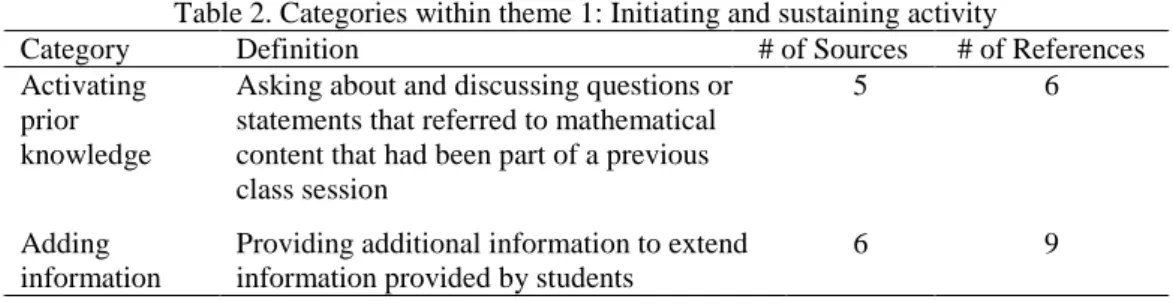
The first theme within functions of uptake, initiating and sustaining activity, involved encouraging mathematical activity by activating prior knowledge or adding information to a discussion (see Table 2). These typically occurred when teachers introduced a new topic or when students needed more information in order to begin or continue engagement in mathematical activity. For example, in the following excerpt, the teacher was activating students’ knowledge of the previous day’s topic by taking up one student’s correct answer (“slope,” line 1.1.4) to a question about the meaning of m in the formula y = mx+ b.
1.1.1† T: Who remembers the formula I taught you yesterday; the slope intercept form for linear equations? Y equals. Emily.
1.1.2 S: Mx plus b.
1.1.3 T: Y equals mx plus b. … Who can tell me what m stands for? Yes, ma’am. 1.1.4 S: Slope.
1.1.5 T: Slope. What is slope? Brian was absent yesterday … if you say “Brian, m equals slope,” and he says, “What is slope?” what would you tell him?
1.1.6 S: Slope is the angle that it goes down.
1.1.7 T: Okay. And what can you tell from that m, like we were talking about, if it’s negative or
positive; what does that tell you? 1.1.8 S: That it’s going down or it’s going up.
In this excerpt, the teacher took up the term “slope” by asking questions in the context of helping another student understand the meaning of the mathematical concept (line 1.1.5). The student responded with an answer that was true for an example of a negative slope. By following up with the question in line 1.1.7, the teacher pressed for a more generalized statement. Although the student did provide a more general statement, the teacher continued to ask for more. This press helped to bring out a greater number of ideas about slope in the continuing discussion.
Table 2. Categories within theme 1: Initiating and sustaining activity
Category Definition # of Sources # of References
Activating prior knowledge
Asking about and discussing questions or statements that referred to mathematical content that had been part of a previous class session
5 6
Adding information
Providing additional information to extend information provided by students
6 9
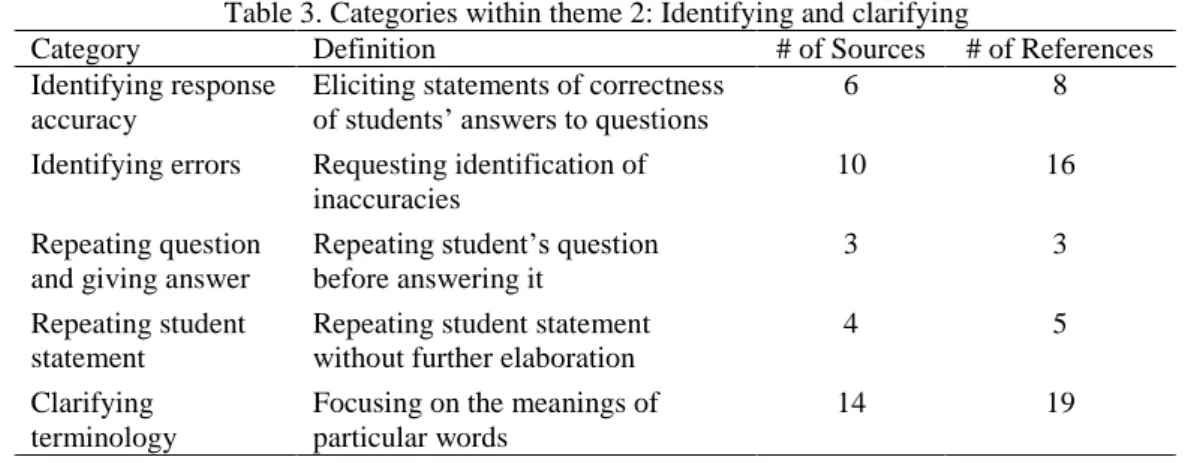
The second theme within functions of uptake, identifying and clarifying, included identifying response accuracy, identifying errors, repeating question and giving answer, repeating student statement, and clarifying terminology (see Table 3). Frequently, teachers repeated or revoiced students’ statements to verify a students’ statement or to provide clarity. For example, a teacher took up a student’s graph of a linear equation (line 2.1.1), which was projected on a screen for whole-class examination, and another student, Lori, identified an error.
2.1.1 T: What could have happened here? … Lori. 2.1.2 L: They had like the wrong intercept.
2.1.3 T: It appears that the slope is correct, but they have the wrong intercept. What intercept did they have?
† Classroom discourse excerpts are numbered to identify the theme, episode example, and speakers’ turn (i.e.,
In this excerpt, Lori responded to the teacher’s prompt by making an observation about another student’s representation (line 2.1.2). The teacher revoiced Lori’s statement to first highlight the portion of the projected representation that was correct (“It appears the slope is correct…”) and then repeated Lori’s identification of an error (“but they have the wrong intercept”). The students were then asked to analyze the graph in more detail.
Table 3. Categories within theme 2: Identifying and clarifying
Category Definition # of Sources # of References
Identifying response accuracy
Eliciting statements of correctness of students’ answers to questions
6 8
Identifying errors Requesting identification of inaccuracies
10 16
Repeating question and giving answer
Repeating student’s question before answering it
3 3
Repeating student statement
Repeating student statement without further elaboration
4 5
Clarifying terminology
Focusing on the meanings of particular words
14 19
A significant portion of this second theme, identifying and clarifying, resulted from teachers’ efforts to focus
students’ attention on terminology. These episodes of uptake were focused on meanings of words, as in the following excerpt coded as clarifying terminology that began with a student’s mathematical comment.
2.2.1 S: I’m thinking that maybe when you add or subtract it moves the origin up or down on the y -axis. Like if you subtract it will move it down because it makes it a negative, and if you add it, it moves it up.
2.2.2 T: Did you say it moves the origin?
2.2.3 S: No, I mean it moves the place where it crosses the line. 2.2.4 T: Where it crosses what line?
2.2.5 S: The y-axis. 2.2.6 T: The y. Okay.
The student initially used the term origin to talk about the y-intercept (line 2.2.1). Instead of pointing out the student’s error, the teacher took up the statement by asking a question (line 2.2.2). This allowed the student to discover his/her own error. Overall, episodes of clarification helped students understand important terms, differences between terms, or correct usage so that they would be able to accurately express their ideas.
A third theme within functions of uptake, explaining processes, included discussing procedure, eliciting student explanation, explaining by teacher, and guiding to answer (see Table 4). When a student provided an answer, the teacher could have requested an explanation of how the student arrived at that answer. The largest number of uptake episodes within this category, however, involved the teacher rather than a student providing an explanation, which limited the students’ expressions of mathematical understanding.
3.1.1 T: Let’s look at the other ones that are correct; we have a lot of them. What do they have in common? They’re doing what times x?
3.1.2 S: Two times.
3.1.3 T: Two times the x. You found when you tried to add a number it didn’t work; there was no
pattern. When you tried to multiply there was no nice pattern. So you have to combine the multiplication and addition ... We tried multiplying all the x’s by two and found that when we added one to it, it gave us out the right y value. That is the correct pattern.
Table 4. Categories within theme 3: Explaining processes
Category Definition # of Sources # of References
Discussing procedure Talking about procedural steps 12 16 Eliciting student
explanation
Asking students how they arrived at an answer or solution
5 7
Explaining by teacher [Teacher] explaining a process used by a student
27 58
Guiding to answer Leading the students to find an answer
8 9
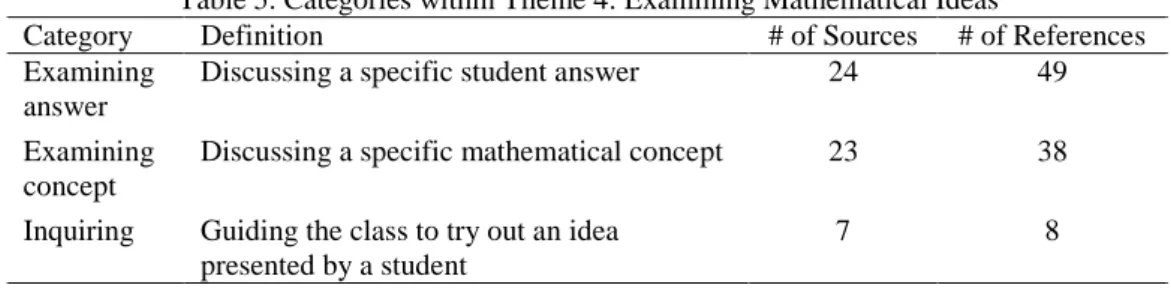
The fourth and largest theme within functions of uptake was examining mathematical ideas, which included
examining answer, examining concept, and inquiring (see Table 5). Within this theme, students were encouraged to assess their actions and to explain or justify their reasoning. In the following example coded as
examining concept, the teacher had been guiding students to explore their mathematical conjectures. The teacher took up a student’s comment by questioning the meaning of the term the student had used while suggesting how another student might be able to use two coordinate points on a plane to generate the equation of a graphed line. During this exchange, the CCT provided a shared display that allowed discussion of the concept in terms of its graphic representation (line 4.1.2).
4.1.1 T: What do you mean by “relation”?
4.1.2 S: Like see how they both connect.... They had the same equation because they’re both on the line.
4.1.3 T: Okay, so you know it’s the same equation because they’re both on the line. Okay.
4.1.4 S: So you want to figure out what that equation is by looking at the coordinates and see what x is compared to y.
4.1.5 T: Okay, I followed everything up to that last thing. What do you mean you want to see what x is as compared to y?
4.1.6 S: Okay, you look at your x and you say, “Well what do I have to do to x to get it to y.”
Because the teacher’s statement in line 4.1.3 implied desire for more detail, the student continued to voice understanding of a relationship between x (input) and y (output) values of a function. After the teacher pressed for more (line 4.1.5), the student restated her reasoning in terms of “self-talk” that might be used during mathematical activity (line 4.1.6). This discussion not only provided a picture of the student’s conceptual understanding for the teacher, but also a model of his/her mathematical reasoning for other students in the class.
Table 5. Categories within Theme 4: Examining Mathematical Ideas
Category Definition # of Sources # of References
Examining answer
Discussing a specific student answer 24 49
Examining concept
Discussing a specific mathematical concept 23 38 Inquiring Guiding the class to try out an idea
presented by a student
7 8
Episodes of the category of examining answer occurred more frequently than examining concept (see Table 5). In the following excerpt, which was coded as both examining answer and adding information, students were asked to identify the y-intercept of an equation.
4.2.1 T: We have eight people saying the y-intercept is eight, some saying three, two, and negative eight. What do you think?
4.2.2 S: Eight.
4.2.3 T: We’ve got a plus eight so it’s a positive eight. If it was minus eight it would be a negative eight. So y-intercept is at eight. If you went up eight units on the y-axis, that’s where this thing would fall.
correct?” and the teacher accepted the student’s answer. Notice how the teacher added an explanation of the answer. Not all episodes of uptake coded as examining answers were as limited in student input, but they tended to elicit short responses to a teacher’s question.
A less prevalent category within examining mathematical ideas was inquiring, which occurred when a teacher suggested exploring a process based on a student’s question or conjecture (see Table 5). The student’s conjecture in the following example, which was restated by the teacher in line 4.3.1, related to the subscripts of coordinate points in the distance formula‡—whether choosing one point as “first” and the other as “second” would matter.
4.3.1 T: Dylan said it matters which one we pick. So let’s reverse it and see what happens. Let’s call that one “one” and that one “two.” …now tell me – let’s see, Sally, what is my y sub two? What is the y in the second point?
4.3.2 S: Sorry. Y. I mean zero.
4.3.3 T: Very good. And let’s see, Irma, what is my y sub one? The y in the first point? Which is? First point.
4.3.4 I: One.
4.3.5 T: One. Okay, and now we’re going to say x sub two. Casey, which one is x sub two?
4.3.6 C: Negative one. … [Conversation continued with the teacher asking questions and students calculating values.]
4.3.7 T: Oh, did it matter? 4.3.8 Ss: No.
The restatement of the student’s conjecture was followed by the teacher’s suggestion of trying the formula with the order of the points reversed (line 4.3.1). The teacher’s questions that followed (every other line) were requests for identification of the values of the coordinates and calculations, which required one- or two-word responses from the students. Trying alternative approaches in this category of uptake was often in the context of enacting procedures with the teacher talking through the steps. While it is possible that the students gained deeper understanding of a concept, there is no evidence of how the students thought about the mathematics after trying the alternative approach.
Finally, the fifth theme within functions of uptake, focusing on reasoning, occurred when teachers pressed students to express their mathematical reasoning or asked them to talk about their strategic behavior, which made students’ mathematical thinking objects of classroom discourse (see Table 6). It is important to note, however, that this type of uptake did not occur very frequently. The following excerpt, coded as press for reasoning, followed the teacher’s uptake of a student’s correct response to a question. It resulted in a lengthy
dialogue (more than 80 teacher and student “turns”) with voicing of mathematical conjectures and reasoning. The class was investigating the relationship between y = –2x and y = –1x on graph paper after having explored the relationships between y = x and y = 2x, and then y = 4x.
5.1.1 T: So how did you know which way your line was going to move? ... Was it going to go up, was it going to get steeper? More shallow? How did you know what was going to happen to it. Wendy? …
5.1.2 W: Since there’s a negative in the formula it can’t—the line can’t go through a plane, as Sara called it, where there’s two positives because one of them has to be negative.
5.1.3 T: Okay, so what Sara was talking about a minute ago?
5.1.4 W: Yes. And since we already plotted the y equals x and this is just the same thing except there’s a negative in there, so I knew just to flip it. There’s a negative.
5.1.5 T: Okay, so you looked more at your y equals x line and said it’s just going to be inverse?
Before this excerpt, the CCT had been used to stimulate discussion of relationships between linear equations with positive coefficients of x. Then, based on the new understanding, students were asked to predict comparable relationships between linear equations with negative coefficients of x (line 5.1.1). Following the first question, the teacher expedited discussion by providing examples of what the students may have observed about the graphic representations. In response, a student referenced an earlier statement made by another
‡
Given the two points
( , )
x y
1 1 and( ,
x y
2 2),
the distance between these points can be calculated using thefollowing formula: 2 1 2 1
2 2
(
)
(
)
student. This is an example of social construction of knowledge and provides evidence of students having acted upon affordances for learning (see Gee, 2008; Gresalfi, 2009). The student then offered more detailed information about the inverse relationship (line 5.1.4), which the teacher revoiced to support students’ understanding and development of language to express mathematical ideas.
Table 6. Categories within theme 5: Focusing on reasoning
Category Definition # of Sources # of References
Pressing for reasoning
Asking for mathematical reasoning 12 17
Talking about strategy
Discussing a strategy to solve a problem
2 4
In the following excerpt, also coded as press for reasoning, the student responded to the teacher’s question with a statement she believed to be true, but did not explain the “why.”
5.2.1 T: Identity. What leads you to believe it's an identity?
5.2.2 S: Because … three-t plus six and three-t minus six is ... [identity].
5.2.3 T: So she says three-t plus six and three-t minus six is going to end up with an identity. Let's see if she's right. .... Now your reasoning? Three-t plus six and three-t minus six, so you knew it was one of those special cases. If we look back at the three-t's you told me that they will [inaudible], and if the six equals negative six it's going to eliminate the three-t's from both sides, is that a true statement or a false statement?
5.2.4 S: False.
5.2.5 T: It's a false statement. So is a false statement going to lead us to no solution or an identity? No solution.
Following the teacher’s question in line 5.2.1, the student responded, and the teacher repeated the student’s incorrect answer. The teacher then proceeded to discuss a procedure for testing for identity, leading to the conclusion that the equation had no solution. As also seen in the theme of explaining processes (see Table 4), where the majority of episodes of uptake consisted of teacher explanations, the teacher took over explaining instead of pressing the students to do more.
In another episode of press for reasoning, the teacher and students were discussing parabolas and axes of symmetry. One student, Haley, noticed that all of the solutions had been “x equal something” and asked, “Can it never be y equals?” The teacher indicated that it was a good question, and then proceeded to encourage the students to answer Haley’s question (line 5.3.1).
5.3.1 T: If I do y equals something, it’s going to go this way, right? Is there any way that I can do a y
equals something that will cut that in half? 5.3.2 S: Well can you have the graph sideways?
5.3.3 T: Yes. ... In Algebra Two you’ll get into that and they’re called hyperbolas …but for right now it’s just going to go up and down. ….
5.3.4 S: What if you had two of them, one up and down… like parallel?
As the conversation continued, students made conjectures and asked further questions of each other and the teacher to explore the concept of axes of symmetry, which illustrates students acting upon affordances of the social environment as they took up each other’s ideas for the purpose of understanding the mathematics more deeply.
Discussion
Resulting categories of coding were grouped according to content type and function. Each episodes of uptake was coded only once for content type, but may have been coded in more than one category of function. For example, a correct answer (content type) may have resulted in deeper examination a mathematical concept (function), explanation of a process (function), and/or press for students to voice the reasoning used in problem solving (function).
Analyses across all categories of uptake indicate that teachers frequently provided mathematical explanations and reasoning during episodes of uptake, which can be seen in many excerpts provided above. For example, uptake that was coded as the teacher adding information (a category within the theme of initiating and sustaining activity; see Table 2) often revealed that teachers provided answers or extended student comments rather than pressing the students to express their ideas (e.g., 4.2.1 – 4.2.3). Similarly, in the majority of episodes coded within explaining processes (see Table 4), the discussion following the initial uptake consisted of teacher-centered exchanges focused on the “how-to” of mathematical procedures rather than students’ justifications of their actions (e.g., 3.1.1 – 3.1.3). Although these episodes of uptake may have helped students to begin or continue mathematical activity, they did not encourage them to express and discuss mathematical reasoning, which limited OTL (see Gee, 2008; Gresalfi, 2009).
Two other frequently occurring categories within functions of uptake contained little, if any, evidence of students’ mathematical reasoning. For example, in explaining by teacher (within the theme of explaining processes; see Table 4), a teacher explanation typically started with either repetition of a student’s answer or
direction of the students’ attention to a mathematical representation, and then the teacher told the students how they should have found the answer or provided an evaluation of the mathematical representation (e.g., 3.1.3).
Examining answer (within the theme of examining mathematical ideas; see Table 5), a second frequently occurring category, was predominantly focused on how to get a specific answer (e.g., 4.2.1 – 4.2.3). The discussion was about what should have been done rather than why it was done.
There were notable differences in the nature of discourse between particular categories of the function of uptake and the type of content being taken up for discussion. For example, uptake coded as pressing for reasoning
(within the theme of focusing on reasoning; see Table 6) provided insight into differences in the ways that teachers’ discourse moves facilitated opportunities for students to express mathematical reasoning. Pressing for reasoning was most effective, meaning that students provided mathematical reasoning and contributed more to discussion, when the teacher took up content types of correct answers and solutions and other comments, ideas, and mathematical constructions (see 5.1.1 – 5.1.6 above). Within these episodes, teachers often used open-ended and “why”-type questions or they revoiced students’ comments to model mathematical language (e.g., 5.1.5). With such scaffolding of OTL, students were able to collaboratively analyze and discuss products of their own work.
In contrast, pressing for reasoning when taking up content-type categories of students’ incorrect answers or solutions, multiple answers or solutions, and questions rarely resulted in expression of student reasoning (e.g., 5.2.1 – 5.2.5). This difference may be attributed to beliefs that follow from traditional teaching paradigms where students’ work is evaluated as either correct or incorrect. If correct answers are assumed to be evidence of good mathematical thinking or ability, discussion of correct answers should provide examples of good mathematical reasoning. Following the same line of reasoning, incorrect answers would be indicators of weak mathematical reasoning or lack of ability. Therefore, when taking up incorrect answers, multiple answers, and student questions, a teacher “helps” by providing solutions and reasoning. Such an approach might be seen as limiting OTL because the teacher responds to errors or questions as though the students who provided them are not able to express mathematical reasoning, which then limits the class’s exposure to a variety of models of mathematical reasoning and may discourage development of productive dispositions (see Gresalfi, 2009). In the few instances where taking up a student’s question did result in exploration of a concept and expression of students’ reasoning, the uptake was followed by one or more of the following: (a) the teacher asked guiding questions to help students to construct an answer to their own questions, (b) the teacher continued to take up students comments during the episode, and/or (c) students continued to ask questions beyond the original question that was taken up (e.g., 5.3.1 – 5.3.4 above).
engage in mathematical reasoning. Conversely, when teachers engaged students in relatively dialogic, reflective discourse, students themselves provided mathematical reasoning, asked questions, and were motivated to look more deeply into particular mathematical concepts. The dialogic interactions appear to have increased opportunities to learn mathematics with understanding.
Conclusion and Recommendations
While teachers participating in this study did take up students’ utterances a few times during observed lessons, most episodes of uptake only weakly supported students’ expression of mathematical reasoning. However, through uptake, teachers can encourage extended conversations where students express their own reasoning, ask questions, and explore options for answering questions. My recommendation based on this study is for teachers to use uptake more often during mathematics classes so that students’ actions form the base from which understanding is built. This approach to building understanding would highlight students’ actions as affordances of the classroom leading to greater OTL through social interaction.
Although uptake can serve as a bid for dialogic discourse and help to create contexts for students to more actively and meaningfully participate in the construction of knowledge, uptake cannot guarantee that dialogic interaction will occur. Uptake can be used superficially, resulting in IRE patterns of interaction. If the goal in mathematics education is to engage students in meaningful activities and discussions where they construct mathematical knowledge, then more emphasis must be placed on creating rich environments and supporting OTL.
Teachers may find that uptake is most effective when they purposefully focus on the function of uptake during mathematical discussions. They must ask themselves what they want to accomplish with not only understanding of a particular mathematical concept, but also with mathematical processes and practices, including communication of mathematical ideas. Teachers might also encourage students to take up their classmates’ mathematical contributions. Uptake potentially encourages deeper examination of mathematical concepts than is evidenced through IRE patterns of verbal interaction. Both teacher and student uptake can engage discourse participants in mathematical processes as envisioned by NCTM (2001), NRC (Kilpatrick et al., 2001) and NGAC, CCSSO (2010).
Limitations
Recoding of uptake for this study was done by the author. The categories of uptake function were determined by the verbal context. I looked at questioning and comments leading up to and following the utterance that was taken up by the teacher. Teachers were not asked to verify my interpretations. Additionally, this study did not include comparisons between classrooms with and without CCT. Next steps for research will include investigation of data for the effects of CCT on uptake and other patterns of interaction during classroom discourse over three years.
References
Bakhtin, M. M. (1986). Speech genres and other late essays. Austin, TX: Univ. of TX Press.
Baxter, J. A., & Williams, S. (2010). Social and analytic scaffolding in middle school mathematics: managing the dilemma of telling. Journal of Mathematics Teacher Education, 13, 7-26.
Bell, C. V., & Pape, S. J. (2012). Uptake of students’ comments, questions, and representations during algebra 1 classes. Paper presented at the American Educational Research Association Annual Meeting, Vancouver, BC.
Cazden, C. B. (2001). Classroom discourse: The language of teaching and learning (2nd Ed.). Portsmouth, NH: Heinemann.
Chapin, S. H., O’Connor, C., & Anderson, N. C. (2003). Classroom discussions: Using math talk to help students learn. Sausalito, CA: Math Solutions Publications.
Cobb, P., Boufi, A., McClain, K., and Whitenack, J. (1997). Reflective discourse and collective reflection.
Journal for Research in Mathematics Education, 28(3), 258-277.
H. Haertel, & L. J. Young (Eds.), Assessment, equity, and opportunity to learn (pp. 76-108). New York: Cambridge University Press.
Gresalfi, M. S. (2009). Taking up opportunities to learn: Constructing dispositions in mathematics classrooms.
The Journal of the Learning Sciences, 18, 327-369. doi:10.1080/10508400903013470
Gresalfi, M. S., Martin, T., Hand, V., & Greeno, J. (2009). Constructing competence: An analysis of student participation in the activity systems of mathematics classrooms. Educational Studies in Mathematics, 70, 49-70. doi:10.1007/s10649-008-9141-5
Heibert, J., Carpenter, T. P., Fennema, E., Fuson, K. C., Wearne, D., Murray, H., … Human, P. (1998). Making sense: Teaching and learning mathematics with understanding. Portsmouth, NH: Heinemann.
Herbel-Eisenmann, B., Drake, C. & Cirillo, M. (2009). “Muddying the clear waters”: Teachers’ take-up of the linguistic idea of revoicing. Teaching and Teacher Education, 25, 268-277.
Kilpatrick, J., Swafford, J., & Findell, B. (Eds.). (2001). Adding it up: Helping children learn mathematics. Washington, DC: National Academy Press.
Lotman, Y.M. (1988). Text within a text. Soviet Psychology, 26, 32–51.
Mehan, H. (1979). Learning lessons. Cambridge, MA: Harvard University Press.
Mewborn, D. S., & Huberty, P. D. (1999). Questioning your way to the standards. Teaching Children Mathematics, 6(4), 226-246.
National Council of Teachers of Mathematics (NCTM). (2000). Principles and standards for school mathematics. Reston, VA: Author.
National Governors Association Center for Best Practices (NGAC), Council of Chief State School Officers (CCSSO). (2010). Common Core State Standards for Mathematics. Washington, DC: Author.
http://www.corestandards.org
Nystrand, M., & Gamoran, A. (1991). Instructional discourse, student engagement, and literature achievement.
Research in the Teaching of English, 25(3), 261-290.
Nystrand, M., Wu, L. L., Gamoran, A., Zeiser, S., & Long, D. A. (2003). Questions in time: Investigating the structure and dynamics of unfolding classroom discourse. Discourse Processes, 35(2), 135-198. O’Connor, M. C., & Michaels, S. (2009). Aligning academic task and participation status through revoicing:
Analysis of a classroom discourse strategy. Anthropology and Education Quarterly, 24(4), 318-335. Pape, S. J., Bell, C. V., Owens, S. K., Bostic, J. D., Irving, K. E., Owens, D. T., et al. (2010). Examining verbal
interactions within connected mathematics classrooms. Paper presented at the Annual Meeting of the AERA, Denver, CO.
Pape, S. J., Owens, S. K., Bell, C. V., Bostic, J. D., Kaya, S., & Irving, K. E. (2008). Classroom Connectivity in Mathematics and Science Achievement: Algebra I Discourse Codebook. Gainesville, FL: University of Florida.
Rogoff, B. (1990). Apprenticeship in thinking. New York: Oxford University Press.
Rogoff, B. (1998). Cognition as a collaborative process. In D. Kuhn & R.S. Siegler (Eds.), Cognition,
perception and language [Vol. 2, Handbook of Child Psychology (5th ed.), W. Damon (Ed.)] pp. 679-744. New York: Wiley.
Vygotsky, L. (1978). Mind and society. Cambridge, MA: Harvard University Press.
Wells, G. (2007). Semiotic mediation, dialogue and the construction of knowledge. Human Development 50, 244-274. doi:10.1159/000106414
Williams, S. R., & Baxter, J. A. (1996). Dilemmas of discourse-oriented teaching in one middle school mathematics classroom. The Elementary School Journal, 97, 21–38.
Yackel, E., & Cobb, P. (1996). Sociomathematical norms, argumentation, and autonomy in mathematics.