TREES: A Comparison of
Tree-Based Data Mining Methods
by Richard A. Derrig and Louise Francis
ABSTRACT
One of the most commonly used data mining techniques is
decision trees, also referred to as classification and
regres-sion trees or C&RT. Several new deciregres-sion tree methods are
based on ensembles or networks of trees and carry names
like TreeNet and Random Forest. Viaene et al. compared
several data mining procedures, including tree methods and
logistic regression, for modeling expert opinion of fraud/no
fraud using a small fixed data set of fraud indicators or
“red flags.” They found that simple logistic regression did
as well at matching expert opinion on fraud/no fraud as the
more sophisticated procedures. In this paper we will
intro-duce some publicly available regression tree approaches
and explain how they are used to model four proxies for
fraud in insurance claim data. We find that the methods
all provide some explanatory value or lift from the
avail-able variavail-ables with significant differences in fit among the
methods and the four targets. All modeling outcomes are
compared to logistic regression as in Viaene et al., with
some model/software combinations doing significantly
bet-ter than the logistic model.
1. Introduction
In the past decade, computationally intensive techniques collectively known as data mining have gained popularity for explanatory and pre-dictive applications in business. Many of the techniques, such as neural network analysis, have their roots in the artificial intelligence discipline. Data mining procedures include several that should be of interest to actuaries dealing with large and complex data sets. One of the most popular of the data mining tools, decision trees, originated in the statistics discipline, although an implementation of trees or classification and re-gression trees (C&RT) known as C4.5 was in-dependently developed by artificial intelligence researchers. The seminal book by Brieman et al. (1993) provided an introduction to decision trees that is still considered the standard resource on the topic. Two reasons for the popularity of decision-tree techniques are (1) the procedures are relatively straightforward to understand and explain, and (2) the procedures address a number of data complexities, such as nonlinearities and interactions, that commonly occur in real data. In addition, software for implementing the tech-nique, including both free open source as well as commercial implementations, has been available for many years.
While recursive partitioning, a common ap-proach to estimation, underlies all the implemen-tations of trees, there are many variations in the particulars of fitting methods across software products. For instance, different kinds of trees can be fit, including the classic single trees and the newer ensemble trees. Also, different good-ness-of-fit measures can be used to optimize par-titioning in creating the final tree, including de-viance and the Gini index.
The four objectives of this paper are to
² describe the principal variations in tree meth-ods;
² illustrate the application of tree methods to the identification of key parameters for the
suc-cessful claim investigation on suspicion of fraud;1
² compare the accuracy of a number of tree-based data mining methods; and
² assess the impact of a few modeling tools and methods that different software implementa-tions of tree-based methods incorporate.
A number of different tree methods, as well as a number of different software implementations of tree-based data mining methods, will be com-pared for their explanatory accuracy in the fraud application. Including the two baseline methods, eight combinations of methods and software are compared in this study. Our comparisons include several software implementations in order to show that specific implementations of the deci-sion tree algorithms matter.
It should be noted that the tree-based software compared in this paper incorporate both algo-rithms and modeling techniques. The software products differ not only with respect to algo-rithms but also with respect to their modeling ca-pabilities. Thus, graphical and statistical diagnos-tics, procedures for validation, and methods for controlling for over-parameterization vary across the software implementations, and this variabil-ity contributes to differences in accuracy (as well as practical usefulness) of the products.
The fraud analyses in this paper use data from a personal automobile bodily injury closed-claim database to explain the outcomes of four differ-ent fraud surrogates. This application is a classi-fication application, where the modeler’s objec-tive is the identification of two or more distinct groups. Obviously, these methods can be used in other classification problems, such as the deci-sion to underwrite specific types of risks.
Our selection of tree methods will be com-pared to two “baseline” prediction methods. The baseline prediction methods are (1) logistic
re-1See Derrig, 2002, for a general discussion of fraud in insurance
gression and (2) naïve Bayes. The baseline meth-ods were selected as computationally efficient procedures that make simplifying assumptions about the relationship between explanatory and target variables. We use straightforward imple-mentations of the two methods without an at-tempt to optimize the hyperparameters.2 Viaene et al. (2002) applied a wider set of procedures, including neural networks, support vector ma-chines, and a classic general linear model, logis-tic regression, on a small single data set of in-surance claim fraud indicators or “red flags” as predictors of expert opinion on the suspicion of fraud. They found that simple logistic regression did as well as the more sophisticated procedures at predicting expert opinion on the presence of fraud.3 Stated differently, the logistic model per-formed well enough in modeling the expert opin-ion of fraud that there was little need for the more sophisticated procedures. There will be a number of distinct differences between the data and modeling targets used in our analysis and that of Viaene et al. They applied their meth-ods to a database with only 1,400 records, while our database contained approximately 500,000 records, more typical of a database size for cur-rent data mining applications. In addition, most of the predictors used by Viaene et al. were binary, that is, they could take on only two values, whereas the data for this study con-tain a more common mixture of numeric vari-ables and categorical varivari-ables with many po-tential values, such as treatment lag in days and zip code.
2In other words, the baseline methods were applied in an automated
way. No attempt was made to optimize variable selection or vari-able transformation, or search for significant interaction terms. The baseline methods are intended to be simple and easily implemented examples of their class of modeling procedures and thus serve as an easy-to-hit modeling target that may be able to be improved.
3They also found that augmenting the categorized red flag variables
with some other claim data (e.g., age, report lag) improved the lift as measured by AUROC across all methods but the logistic model still did as well as the other methods (Viaene et al., 2002, Table 6, pp. 400—401).
A wide variety of statistical software is now available for implementing fraud and other ex-planatory and predictive models through cluster-ing and data mincluster-ing. In this paper we will in-troduce a variety of C&RT (pronounced “cart,” but in this paper CART refers to a specific soft-ware product) approaches4 and explain in gen-eral how they are used to model complex depen-dencies in insurance claim data. We also investi-gate the relative performance of a few software products that implement these models. As an il-lustrative example of relative performance, we test for the key claim variables in the decision to investigate for excessive or fraudulent prac-tices in a large claim database. The software pro-grams we will investigate are CART, S-PLUS/ R-TREE, TreeNet, Random Forests, and Insight-ful Tree and Ensemble from the InsightInsight-ful Miner package. The naïve Bayes benchmark method is from Insightful Miner, while logistic regression is from R/S-PLUS. The data used for this anal-ysis are the auto bodily injury liability closed claims reported to the Detailed Claim Database (DCD) of the Automobile Insurers Bureau of Massachusetts from accident years 1995 through 1997.5 Three types of variables are employed. Several variables thought to be related to the de-cision to investigate are included in the DCD, such as outpatient provider medical bill amounts. A few other variables are derived from publicly available demographic data sources, such as in-come per household for each claimant’s zip code. Additional variables are derived by accumulat-ing statistics from the DCD (e.g., the distance from the claimant’s zip code to the zip code of the first medical provider or claimant’s zip code rank for the number of plaintiff attorneys per zip code). The decision to order an independent medical examination or a special investigation for fraud, and a favorable outcome for each in
4A wider set of data mining techniques is considered in Derrig and
Francis (2006).
5See Section 2 for an overview of the database and descriptions of
terms of a reduction or denial of the otherwise indicated claim payment, are the four modeling targets.
Eight modeling software results for each mod-eling target are compared for effectiveness based on a standard evaluation technique, the area un-der the receiver operating characteristic curve (AUROC) as described in Section 4. We find that the methods all provide some explanatory value or lift from the DCD variables, used as in-dependent variables, with significant differences in accuracy among the eight methods and four targets. Modeling outcomes are compared to lo-gistic regression as in Viaene et al. (2002) but the results here are different. They show some soft-ware/methods can improve significantly on the explanatory ability of the logistic model, while some software/methods are less accurate. The different result may be due to the relative rich-ness of this data set and/or the types of inde-pendent variables at hand compared to the Vi-aene data.6 This exercise should provide prac-ticing actuaries with guidance on regression tree software and market methods to analyze com-plex and nonlinear relationship commonly found in all types of insurance data.
The paper is organized as follows. Section 1 covers the general setting for the paper. Section 2 describes the data set of Massachusetts auto bodily injury liability claims, and variables used for illustrating the models and software imple-mentations. Descriptions and illustrations of the data mining methods appear in Section 3. In Sec-tion 4 we describe software for modeling non-linearities. Comparative outcomes for each soft-ware implementation are described in Section 5 with numerical results shown in Section 6. Im-plications for the use of the software models for explanatory and predictive applications are dis-cussed in Section 7.
6In a companion paper we show how “important” each variable
is within and across software implementations (Derrig and Francis 2006).
2. Description of the
Massachusetts auto bodily injury
data
The database we will use for our analysis is a subset of the Automobile Insurers Bureau of Massachusetts Detail Claim Database (DCD); namely, those claims from accident years 1995— 1997 that had been closed by June 30, 2003 (AIB 2004). All auto claims7 arising from injury cov-erages [Personal Injury Protection (PIP)/Medical Payments excess of PIP,8 Bodily Injury
Liabil-ity (BIL), Uninsured and Underinsured Motorist] are reported to DCD. While there are more than 500,000 claims in this subset of DCD data, we will restrict our analysis to the 162,761 third party BIL coverage claims.9 This will allow us to divide the sample into large training, test, and holdout subsamples, each containing in excess of 50,000 claims.10 The dataset contains fifty-four variables relating to the insured, claimant, acci-dent, injury, medical treatment, outpatient medi-cal providers (2 maximum), and attorney pres-ence. Note that many insurance databases, in-cluding the DCD, do not contain data or variables indicating whether a particular claim is suspected of fraud or abuse. For such databases, other ap-proaches, such as unsupervised learning meth-ods, might be applied.11 In the DCD data, there
are three claims handling techniques for
mitigat-7Claims that involve only third-party subrogation of personal injury
protection (no fault) claims but no separate indemnity payment or no separate claims handling on claims without payment are not reported to DCD. Our sample removed all personal and company identifying information to form an analytic subset of the actual data.
8Combined payments under PIP and Medical Payments are
re-ported to DCD.
9BIL claim payments are the sum of the liability claim payment plus
a no-fault subrogation paid by the third-party carrier. Thus they are representative of the full third-party liability on each claimant’s injuries.
10With a large holdout sample, we are able to estimate tight
confi-dence intervals for testing model results in Section 6 using the area under the ROC curve measure.
11See Brockett et al. (2002) for the use of the unsupervised PRIDIT
ing claims cost of fraud or abuse that are reported when present, as well as outcome, and formu-laic savings amounts for each of the techniques. These variables can serve as surrogates of suspi-cion of fraud and abuse but they stand on their own as applied investigative techniques.
The claims handling techniques tracked are In-dependent Medical Examination (IME), Medi-cal Audit (MA), and Special Investigation (SIU). IMEs are performed by licensed physicians of the same type as the treating physician.12 They cost approximately $350 per exam with a charge of $75 for no-shows. They are designed to verify claimed injuries and to evaluate treatment modal-ities. One sign of a weak or bogus claim is the failure to submit to an IME and, thus, an IME can serve as a screening device for detecting fraud and build-up claims. MAs are peer reviews of the injury, treatment, and billing. They are typically done by physicians without a claimant examina-tion, by nurses on insurers’ staff or by third-party organizations, and sometimes also by expert sys-tems that review the billing and treatment pat-terns.13 Favorable outcomes are reported by in-surers when the damages are mitigated, when the billing and treatment are curtailed, and when the claimant refuses to undergo the IME or does not show.14 In the latter two situations the insurer is on solid ground to reduce or deny payments un-der the failure-to-cooperate clause in the policy (Derrig and Weisberg 2004).
Special Investigation (SIU) is reported when claims are handled through nonroutine
investiga-12This fact is a matter of Massachusetts law which at the time
ap-peared to permit only IMEs by the same type of physician, say a chiropractor, as the type is treating physician. Recently, the Mas-sachusetts Supreme Court inBoone v. Commerce Insurance, 451 Mass. 198 (2008)clarified that IMEs must be conducted by physi-cians of a similar, but not necessarily exactly the same, specialty. This situation may differ in other jurisdictions.
13Because expert bill review systems became pervasive by 2003,
reaching 100% in some cases, DCD redefined the reported MA to encompass only peer reviews by physicians or nurses for claims reported after July 1, 2003.
14The standard Massachusetts auto policy has a claimant
coopera-tion clause for IME both in the first party PIP coverage and in the third party BI liability coverage.
tive techniques (accident reconstruction, exami-nations under oath, and surveillance are the ex-pensive examples), possibly including an IME or Medical Audit, on suspicion of fraud. For the most part, these claims are handled by Special Investigative Units (SIU) within the claim de-partment or by some third-party investigative ser-vice. Occasionally, companies will be organized so that additional adjusters, not specifically a part of the company SIU, may also conduct special investigations on suspicion of fraud. Both types are reported to DCD within the special inves-tigation category and we refer to both by the shorthand SIU in subsequent tables and figures. Favorable outcomes are reported for SIU if the claim is denied or compromised based on the special investigation.
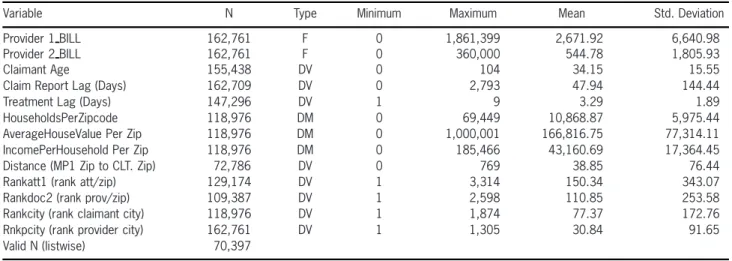
For purposes of this analysis and demonstra-tion of models and software, we employ 21 po-tential explanatory variables and four target vari-ables. The target variables are prescribed field variables of DCD. Thirteen predicting variables are numeric, two from DCD fields (F), eight from internal demographic type derived data (DV), and three from external demographic data (DM), as shown in Table 1. A frequent data-mining prac-tice is to “derive” explanatory or predictive vari-ables from the primary dataset to be “mined” by creating summary statistics of informative sub-sets such as RANK ATT/ZIP, the rank of a sim-ple count of the number of attorneys in the Mas-sachusetts zip code with BIL claims. While many such variables are possible, we use only a repre-sentative few such derived variables, denoted by DV.
occur-Table 1. Auto injury liability claim numeric variables
Variable N Type Minimum Maximum Mean Std. Deviation Provider 1 BILL 162,761 F 0 1,861,399 2,671.92 6,640.98 Provider 2 BILL 162,761 F 0 360,000 544.78 1,805.93 Claimant Age 155,438 DV 0 104 34.15 15.55 Claim Report Lag (Days) 162,709 DV 0 2,793 47.94 144.44 Treatment Lag (Days) 147,296 DV 1 9 3.29 1.89 HouseholdsPerZipcode 118,976 DM 0 69,449 10,868.87 5,975.44 AverageHouseValue Per Zip 118,976 DM 0 1,000,001 166,816.75 77,314.11 IncomePerHousehold Per Zip 118,976 DM 0 185,466 43,160.69 17,364.45 Distance (MP1 Zip to CLT. Zip) 72,786 DV 0 769 38.85 76.44 Rankatt1 (rank att/zip) 129,174 DV 1 3,314 150.34 343.07 Rankdoc2 (rank prov/zip) 109,387 DV 1 2,598 110.85 253.58 Rankcity (rank claimant city) 118,976 DV 1 1,874 77.37 172.76 Rnkpcity (rank provider city) 162,761 DV 1 1,305 30.84 91.65 Valid N (listwise) 70,397
N=Number of nonmissing records; F=DCD Field, DV=Internal derived variable, DM=External derived variable
Source: Automobile Insurers Bureau of Massachusetts, Detail Claim Database, AY 1995–1997 and Authors’ Calculations.
Table 2. Auto injury liability claim categorical variables
Variable N Type Type Description Policy Type 162,761 F Personal 92%, Commercial 8%
Emergency Treatment 162,761 F None 9%, Only 22%, w Outpatient 68% Health Insurance 162,756 F Yes, 15%, No 26%, Unknown 60%
Provider 1—Type 162,761 F Chiro 41%, Physical Th. 19%, Medical 30%, None 10% Provider 2—Type 162,761 F Chiro 6%, Physical Th. 6%, Medical 36%, None 52%
1993 Territory 162,298 F Rating Territories 1 (2.2%) Through 26 (1.3%); Territory 1–16 by increasing risk, 17–26 is Boston Attorney 162,761 F Attorney present (89%), no attorney (11%)
1 SIU Done 162,761 F Special Investigation Done (7%), No SIU (93%)
2 IME Done 162,761 F Independent Medical Examination Done (8%), No IME (92%)
3 SIU Favorable 162,761 F Special Investigation Favorable (3.4%), Not Favorable/Not Done (95.6%) 4 IME Favorable 162,761 F Independent Medical Exam Favorable (4.4%), Not Favorable/Not Done (96.6%)
Injury Type 162,298 F Injury Types (24) including minor visible (4%), strain or sprain, back and/or neck (81%), fatality (0.4%), disk herniation (1%) and others
N=Number of nonmissing records F=DCD Field
Note: Descriptive percentages may not add to 100% due to rounding
Source: Automobile Insurers Bureau of Massachusetts, Detail Claim Database, AY 1995–1997 and Authors’ Calculations.
rences of the accident and reporting of the claim and amount of time between occurrences of the accident and the first outpatient medical treat-ment are included. Geographic and claim risk indicators, i.e., rating territory and distance from claimant to provider are also used. The four rank variables15 are calculated to represent the rela-tive claim, attorney, and provider activity at zip code and city levels. One important caveat of
15Each of the rank variables uses the ranking, not the actual data
values.
Eight explanatory variables and four target variables (IME and SIU, Decision and Favorable Outcome for each) are categorical variables, all taken as reported from DCD, as shown in Ta-ble 2.
Similar claim investigation variables are now being collected by the Insurance Research Coun-cil (IRC) in their periodic sampling of country-wide injury claims (IRC 2004a, pp. 89—104).16 Nationally, about 4% and 2% of BI claims in-volved IMEs and SIU, respectively, only one-half to one-quarter of the Massachusetts rate. Most likely this is because (1) a majority of other states have a full tort system and so BIL contains all injury liability claims and (2) Massachusetts is a fairly urban state with high claim frequencies and more dubious claims.17 In fact, a recent IRC study shows Massachusetts has the highest per-centage of BI claims in no-fault states that are suspected of fraud (23%) and/or buildup (41%) (IRC 2004b, p. 25). It is, therefore, entirely con-sistent for the Massachusetts claims to exhibit more nonroutine claim handling techniques. Fa-vorable outcomes average about 50% when an IME is done or a claim is referred to SIU. We now turn to descriptions of the types of models, and the software programs that implement them, in the next two sections before we describe how they are applied to model the IME and SIU target variables.
3. Data mining and software
models
3.1. How tree models handle data
complexity
Traditional actuarial and statistical techniques often assume that the functional relationship
be-16The IRC also includes an index bureau check as one of the claims
handling activities but this practice is universal in Massachusetts.
17Prior studies of Massachusetts Auto Injury claim data for fraud
content included Weisberg and Derrig 1998, (suspicion regression models), Derrig and Weisberg 1998, (claim screening with scor-ing models) and Derrig and Weisberg 2004, (effect of investigative technique on claim settlements).
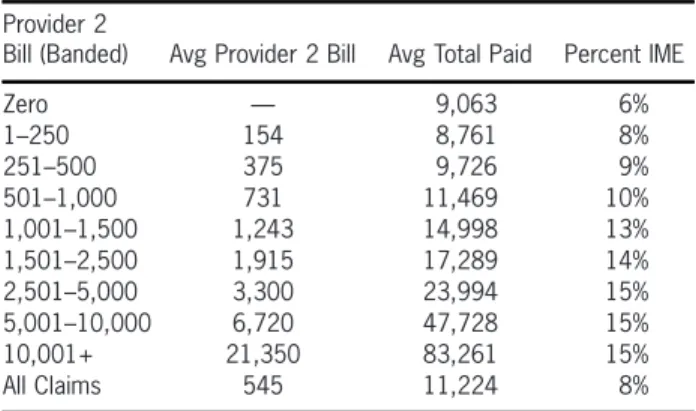
Table 3. Example 1 and 2 data
Provider 2
Bill (Banded) Avg Provider 2 Bill Avg Total Paid Percent IME Zero — 9,063 6% 1–250 154 8,761 8% 251–500 375 9,726 9% 501–1,000 731 11,469 10% 1,001–1,500 1,243 14,998 13% 1,501–2,500 1,915 17,289 14% 2,501–5,000 3,300 23,994 15% 5,001–10,000 6,720 47,728 15% 10,001+ 21,350 83,261 15% All Claims 545 11,224 8%
tween the independent variables and the depen-dent or target variable is linear or that some trans-formation of the variables exists so that tech-niques can treat the relationship as linear. In-surance data, however, often contain variables where the relationship among variables is com-plex and not susceptible to transformation to the linear world. Typically when nonlinear relation-ships exist, the exact nature of the nonlinearity (i.e., where some transformation can be used to establish linearity) is not known. In the field of data mining, a number of nonparametric tech-niques have been developed which can model complex relations without any assumption being made about the nature of the nonlinearity. We il-lustrate how each of our tree methods reviewed in this paper models nonlinearities in the follow-ing two relatively simple examples. The variables in this example were selected because of a known nonlinear relationship between independent and dependent variables.
EXAMPLE 1 The dependent variable, a numeric
variable, is total paid losses and the independent variable is provider 2 bill. Table 3 displays av-erage paid losses at various bands of provider 2 bill.
EXAMPLE 2 The dependent variable, a binary
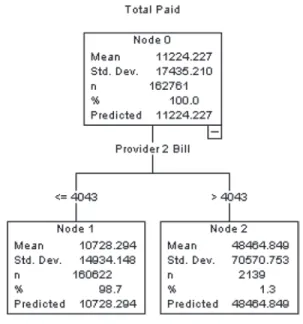
Figure 1. CART example of parent and children nodes: Total paid as a function of provider 2 bill
3.2. Trees
In this section we give a brief introduction to decision tree methodology. Hadidi (2003) pro-vides a more thorough introduction to trees and their use in insurance. Trees, also known as clas-sification and regression trees (C&RT), fit a model by recursively partitioning the data into two groups, one group with a higher value on the dependent variable and the other group with a lower value on the dependent variable. Each par-tition of the tree is referred to as a node. When a parent node is split, the two children nodes, or “leaves” of the tree, are each more homogenous (i.e., less variable) with respect to the dependent variable.18 A goodness-of-fit statistic is used to select the split which maximizes the difference between the two children nodes. When the in-dependent variable is numeric, such as provider 2 bill, the split takes the form of a cutpoint, or threshold:x¸candx < cas in Figure 1, with the value $4,043 for provider 2 bill as the cutpoint in this example.
18There are Tree Software models that may split nodes into three
or more branches. The CHAID and Exhaustive CHAID techniques in SPSS classification trees are an example of such software.
The cutpointcis found by evaluating all possi-ble values for splitting the numeric variapossi-ble into higher and lower groups, and selecting the value that optimizes the split in some manner. When the dependent variable is numeric, the split is typically based on the value which results in the greatest reduction in a residual sum of squares or some function of the residual errors such as the R2 or F statistic. For this example, all values of provider 2 bill are searched and a split is made at the value $4,043. All claims with provider 2 bills less than or equal to $4,043 go to the left node and “explain” a total paid of $10,728 and all claims with provider 2 bill greater than $4,043 go to the right node, and “explain” a total paid of $48,465. This is depicted in Figure 1. The tree graph shows that the total paid mean is signifi-cantly lower for the claims with provider 2 bills less than $4,043.
Alternatively, when a predictor variable is cat-egorical, all possible two-way groupings of the categories of the variable are tested. The group-ing that optimizes the goodness-of-fit measure for the variable is the one that is used to par-tition the data into two groups that are signifi-cantly different with respect to the value of the dependent variable. For instance, if injury type is used to model paid losses, the data can be split into a group including back/neck injuries, neck sprains, other sprains, minor lacerations, and a group that includes all other injuries. The mean claim payments of these two groups are approx-imately $9,000 and $25,000, respectively.
One statistic often used as a goodness-of-fit measure to optimize tree splits is the sum squared error or the total squared deviation of actual val-ues around the predicted valval-ues. The selected cutpoint is the one which produces the largest re-duction in total sum squared errors (SSE). That is, for the entire database the total squared devi-ation of paid losses around the predicted value (i.e., the mean) of paid losses is 7:00£1013. The
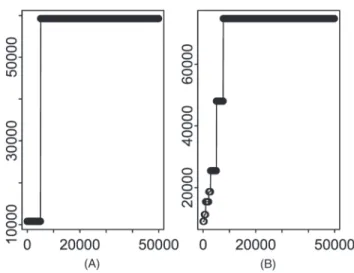
par-Figure 2A and B. CART example with two and seven nodes: Total paid as a function of provider 2 bill
titioned using $4,043 as the cutpoint. Any other partition of the provider bill produces a larger SSE than 4:65£1013. For instance, if a cutpoint of $10,000 is selected, the SSE is 4:76£1013.
The two nodes in Figure 1 can each be split into two more children nodes and these can then be further split. The sequential splitting continues until no (significant) improvement in the good-ness of fit statistic occurs. The nodes containing the result of all the splits resulting from apply-ing a sequence of decision rules, i.e., the final nodes, are often referred to as terminal nodes. The terminal nodes provide the predicted values of the dependent variables. When the dependent variable is numeric, the mean of the dependent variable at the terminal nodes is the prediction.
The curve of the predicted value resulting from a tree fit to total paid losses is a step function. As shown in Figure 2A, with only two termi-nal nodes, the fitted function is flat until $4,043, steps up to a higher value, and then remains flat. Figure 2B displays the predicted values of a tree with seven terminal nodes. The steps or increases are more gradual for this function.
The procedure for modeling data where the dependent variable is categorical (binary in our example) is similar to that of a numeric variable.
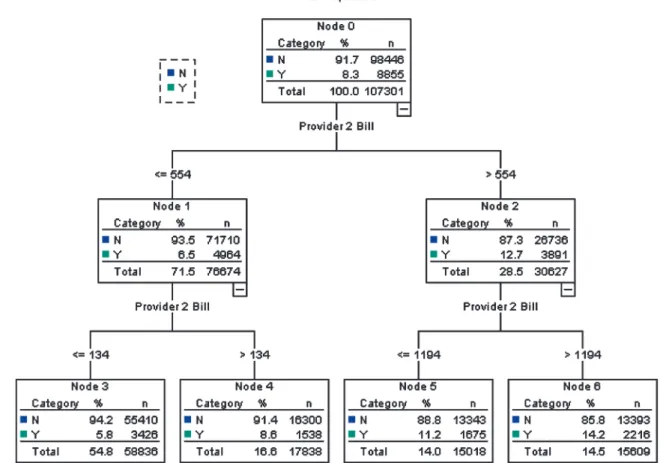
For instance, one of the binary fraud surrogates is independent medical exam (IME) requested, yes or no. The target classifications are claimants for whom an IME was requested and the group of (presumably legitimate) claimants where an IME was not requested. At each step, the tree proce-dure selects the split that best improves or lowers node heterogeneity. That is, it attempts to parti-tion the data into two groups so that one partiparti-tion has a significantly higher proportion of the tar-get category, IME requested, than the other node. A number of statistical goodness-of-fit statistics measures are used in different products to select the optimal split. These include entropy/deviance and Gini index. Kantardzic (2003), Breiman et al. (1993), and Venibles and Ripley (1999) describe the computation and application of the Gini in-dex and entropy/deviance measures.19A score or probability can be computed for each node after a split is performed. This is generally estimated based on the number of observations in the target groups versus the total number of observations at the node. The terminal node score or probabil-ity is frequently used to assign records to one of the two classes. Typically, if the model score exceeds a threshold such as 0.5, the record is as-signed to the target class of interest; otherwise it is assigned to the remaining class.
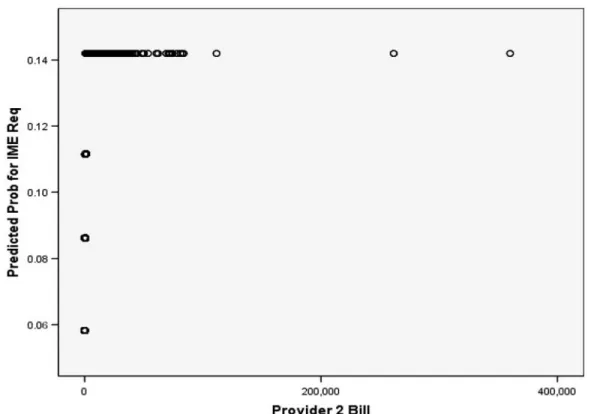
Figure 3A displays the result of using a tree procedure to predict a categorical variable from the AIB data. The graph shows that each time the data is split on provider 2 bill, one child node has a lower proportion and the other a higher propor-tion of claimants receiving IMEs. The fitted tree function is used to model a nonlinear relationship between provider bill and the probability that a claim receives an IME as shown in Figure 3B.
Tree models use categorical as well as numeric independent variables in modeling complex data.
19For binary categorical data assumed to be generated from a
Figure 3A. CART example with seven nodes IME proportion as a function of provider 2 bill
However, because the levels on categorical data may not be ordered, all possible two-way splits of categorical variables must be considered be-fore the data are partitioned.
The final tree model in a data mining applica-tion will typically use many predictor variables, with different predictor variables incorporated into the model at different nodes. To prevent overfitting, the technique of pruning is used. This technique uses a goodness-of-fit measure to “prune” or eliminate branches and nodes based on eliminating those that do not contribute a sig-nificant improvement in the model’s fit. Prun-ing may be thought of as analogous to back-wards stepwise regression, where the modeler fits a full regression incorporating all possible predictor variables, and then one by one removes those variables that are not deemed “significant”
by a goodness-of-fit measure, such as the F statistic.
3.3. Ensemble models—boosting
Figure 3B. CART example with four step functions: IME proportion as a function of provider 2 bill
numeric dependent variables, is used in another round of fitting as a dependent variable.20 For
models with categorical dependent variables, the error is often computed as a rate or proportion, i.e., the number of total records for a given node of a tree that were misclassified, compared to the sample size of the node. For both numeric and categorical dependent variables, the error is also typically used in the computation of weights in subsequent rounds of fitting, with records con-taining larger errors receiving higher weighting in the next round of estimation.
20If only two models were fit, one to the dependent variable and
one to the residual from that model, the predicted value would be ˆY1+wt1ˆe1, where ˆY1 is the first round fitted value for the de-pendant variable and ˆe1 is the fitted value ofY¡Yˆ1 andwt1is a weight. Therefore,E(Y) = ˆY1+wt1E(Y¡Yˆ1). That is, each tree in the sequence further refines the fit by estimating the error for the observation and adding it back to the prediction. When the depen-dent variable is categorical, one can think of the actual value for an observation as either 0.0 or 1.0, and the error as a positive or nega-tive value between 0.0 and 1.0 representing the deviation between the probability of the target variable from the model and the ac-tual value of the dependent variable. The acac-tual implementation in boosting is typically more complex than this intuitive description.
One algorithm for computing weights is de-scribed by Hastie, Tibshirani, and Friedman.21
Consider an ensemble of trees 1, 2,: : :,M. The er-ror for themth tree measures the departure of the actual from the fitted value on the test data after themth model has been fit. When the dependent variable is categorical, as it is in the illustrative fraud application in this paper, a common error measure used in boosting is:
errm=
PN
i=1wiI(yi6=Fm(xi))
PN i=1wi
(3.1)
where N is the total number of records, wi is a weight (which is initialized to 1=N in the first round of fitting),I is an indicator function equal to zero if the category is correctly predicted and one if the class assigned is incorrect, yi is the categorical indicator dependent variable, x is a matrix of predictors, andFm(xi) is the prediction for theith record of themth tree.
21See p. 301. Note that the literature also describes other error and
Then, the coefficient alpha is a function of the weight.
®m= log
μ1¡err
m errn

(3.2)
and the new weight is wi,m+1=wmexp(®mI(yi6= Fm(xi))).
The process is performed many times until no further statistical improvement in the fit is ob-tained.
The formulas presented above describe a gen-eral approach to boosting.22 The specific boost-ing procedures implemented differ among soft-ware products. For instance, TreeNet (Freidman 2001) uses stochastic gradient boosting.23One of the modeling issues one encounters when apply-ing ensemble models is that of overfittapply-ing; that is, the model being estimated contains many param-eters and its fit is generally assessed by apply-ing a goodness-of-fit measure only to the train-ing sample. The model may provide an excellent fit to the training data but a poor fit to valida-tion or holdout data. Stochastic gradient boost-ing incorporates a number of procedures which attempt to build a more robust model by con-trolling the tendency of large complex models to overfit the data. A key technique used is resam-pling. A new sample is randomly drawn from the training data each time a new tree is fit to the residuals from the prior round of model estima-tion. The goodness-of-fit of the model is assessed on data not included in the sample, the valida-tion24 data. Another procedure used by TreeNet to control overfitting is shrinkage or regulariza-tion. Regularization refers to any procedure that prevents overfitting. For instance, variable selec-tion techniques such as stepwise regression
miti-22Boosting has been applied to fraud detection modeling in Viaene,
Derrig, and Dedene (2004).
23TreeNet is compared to the non-tree method of neural networks
for fraud detection in Francis (2005).
24A validation sample is used by many modeling procedures to tune
the parameters of a model. That is, it is a separate sample from the training sample that is incorporated as part of the goodness of fitting used in estimating the model. However, as it is not the sample the model was fit to, it is resistant to overfitting. An additional sample, referred to as the test sample, is used for a final test of the models goodness of fit, after a final model is developed.
gate overfitting by selecting only significant vari-ables for inclusion in the model. One kind of regularization is shrinkage, where credibility is perhaps the most familiar example of shrinkage to actuaries. The approach shrinks or reduces the parameter estimate associated with a given pre-dictor variable25in a given model. For instance, a credibility procedure might “shrink” the weight assigned to a given class, moving the estimate for the class towards the overall mean. The ob-jective of shrinkage is to reduce the tendency of a model with many parameters to overfit, or to fit noise, rather than pattern in the data.26
Alternatively, the Insightful Miner (Iminer) Ensemble model employs a simpler implemen-tation of boosting which does not use shrinkage and applies nonstochastic boosting using all the training data in each round of fitting.
The final estimate resulting from an ensemble approach will be a weighted average of all the trees fit. Note that:
² Using a large collection of trees allows many different variables to be used. Some of these would not be used in smaller simpler models.27
² Many different models are used. The predic-tive modeling literature (Hastie et al. 2001; Francis 2003) indicates that composites of multiple models perform better than the pre-diction of a single model.28
² Different training and validation records are used in parameterizing the model (with sto-chastic gradient boosting as implemented in TreeNet and bagging as implemented in Random Forest, but not the Iminer Ensemble tree). This makes the procedure more robust to the influence of a few extreme observations.
25Or it may shrink or reduce the parameter estimate associated with
a function, as in the case of stochastic gradient boosting
26See Harrell (2001), pp. 61—64, for a more detailed description of
shrinkage.
27Note that the ensemble tree methods employ all 21 variables in
the models.
28The ROC curve results in Section 6 show that TreeNet and
The method of fitting many (often 100 or more) small trees results in fitted curves which are al-most smooth. Figures 4A and 4B display two nonlinear functions fit to total paid and IME re-quested variables by the TreeNet ensemble model and show the increased flexibility of the output functions compared to the simple tree step func-tions.
3.4. Ensemble models—bagging
Bagging is an ensemble approach based on re-sampling or bootstrapping. Bagging is an acro-nym for “bootstrap aggregation” (Hastie et al. 2001). Bagging does not use the error from the prior round of fitting as a dependent variable or weight in subsequent rounds of fitting. Bagging uses many random samples of records in the data to fit many trees. For instance, an analyst may decide to take 50% of the data as a training set each time a model is fit. Under bagging, 100 or more models may be fit, each one to a different 50% sample. The trees fit are unpruned and are not necessarily small trees with 5 to 10 termi-nal nodes as with boosting. Each tree may have a different number of terminal nodes. By aver-aging the predictions of a number of bootstrap samples, typically using a simple average of all the models fit, bagging reduces the prediction variance.29 The implementation of bagging used in this paper is known as Random Forest. Brie-man (2001) points out that using different vari-ables, as well as different records in the different trees in the Random Forest ensemble, seem to re-duce the correlation between the different models fit and improve the accuracy of the overall pre-diction. For the analysis in this paper, one-third of the dataset was sampled as a training set for each tree fit, while one-third was used as a val-idation or “out of bag” sample for assessing the goodness-of-fit of the tree at that iteration. The
29Hastie, Tibshirani, and Friedman describe how the estimate
re-sulting from bagging is similar to a posterior Bayesian estimate.
remaining third was the test sample. (See “Vali-dation and Testing” in Section 4 for a more de-tailed discussion of training, validation, and test samples).
Figure 5A displays an ensemble Random For-est tree fit to total paid losses and Figure 5B dis-plays a Random Forest tree fit to IME.
3.5. Naïve Bayes
The naïve Bayes method is relatively simple and easy to implement. In our comparison, we treat it as one of two benchmark data mining methods. That is, we are interested in how more complex methods improve performance (or not) against an approach where simplifying assump-tions are made in order to make the computaassump-tions more tractable. We also use a logistic regression models as the second benchmark.
The naïve Bayes method was developed for categorical data. Specifically, both dependent and independent variables are categorical.30 There-fore, its application to fitting nonlinear functions will be illustrated only for the categorical target variable IME. In order to utilize numeric predic-tor variables it was necessary to derive new cat-egorical variables based on discretizing, or “bin-ning,” the distribution of data for the numeric variables.31
The key simplifying assumption of the naïve Bayes method is the assumption of indepen-dence. Given each category of the dependent variable, all predictor variables are assumed to act independently in influencing the target vari-able. Interactions and correlations among the pre-dictor variables are not considered.
Bayes rule is used to estimate the probabil-ity that a record with given independent variable
30Although our implementation of naïve Bayes uses only
cate-gorical predictor variables, some implementations allow numerical predictors.
31The numeric variables were grouped into five bins or into
Figure 4A. Ensemble prediction of total paid
Figure 5A. Random Forest prediction of Total Paid
Figure 5B. Random Forest prediction of IME
vector X=fxig is in category C=fcjg of the dependent variable.
P(cjjX) =P(Xjcj)P(cj)=P(X): (3.3)
Because of the naïve Bayes assumption of condi-tional independence, the probability that an ob-servation will have a specific set of values for the independent variables is the product of the
conditional probabilities of observing each of the values given category cj
P(Xjcj) =Y i
P(xijcj): (3.4)
The method is described in more detail in Kan-tardzic (2003). To illustrate the use of naïve Bayes in predicting discrete variables, the pro-vider 2 bill data was binned into groups based on the quintiles of the distribution. Because about 50 percent of the claims have a value of zero for provider 2 bills, only four categories are created by the binning procedure. The new variable was used to estimate the IME targets. Figure 6 dis-plays a bar plot of the predicted probability of an IME for each of the groups. Figure 7 displays the fitted function. This function is a step func-tion which changes value at each boundary of a provider 2 bill bin.
3.6. Nonadditivity: interactions
Conventional statistical models such as regres-sion and logistic regresregres-sion assume not only lin-earity, but also additivity of the predictor ables. Under additivity, the effect of each vari-able can be added to the model one at a time. When the exact form of the relationship between a dependent and independent variable depends on the value of one or more other variables, the effects are not additive and one or more inter-actions exist. For instance, the relationship be-tween provider 2 bill and IME may vary by type of injury (i.e. traumatic injuries versus sprains and strains). Interactions are common in insur-ance data (Weisberg and Derrig 1998; Francis 2003).
With conventional linear statistical models, in-teractions are incorporated with multiplicative terms:
Y=a+b1X1+b2X2+b3¤X1¤X2: (3.5)
Figure 6. Bayes predicted probability IME requested vs. quintile of provider 2 bill
Figure 7. Naïve Bayes predicted IME vs. provider 2 bill
If one of the two variables is categorical, the interaction terms allow the slope of the fitted line to vary with the levels of the categorical variable. If both variables are continuous, the interaction is a bilinear interaction (Jaccard and
The conventional approach to handling inter-actions has some limitations. Each of the tree-based data mining techniques used in this paper has efficient methods for searching for signifi-cant interactions.
² Only a limited number of types of interactions can be modeled easily.
² If many predictor variables are included in the model, as is often the case in many data min-ing applications, it can be tedious, if not im-possible, to find all the significant interactions. Including all possible interactions in the model without regard to their significance likely re-sults in a model which is over-parameter-ized.
² Interactions are inherent in the method used by trees to partition data. Once data have been partitioned, different partitions can and typi-cally do split on different variables and cap-ture different interactions among the predictor variables. When the decision rules used by a tree to reach a terminal node involve more than one variable, in general, an interaction is being modeled.
² Ensemble methods incorporate interactions be-cause they are based on the tree approach,
² Naïve Bayes, because it assumes conditional independence of the predictors, ignores inter-actions.
² Logistic regression incorporates interactions in the same way ordinary least squares regres-sion does: with product interaction terms. In this analytic comparison study, no attempt was made to incorporate interaction terms as this procedure lacks an efficient way to search for the significant interactions.
3.7. Multiple predictors
Thus far, the discussion of the tree-based mod-els concerned only simple one or two variable models. Extending the tree methods to incorpo-rate many potential predictors is straightforward. For each tree fit, the method proceeds as follows:
² For each variable determine the best two-way partition of the data.
² Select the variable which produces the best improvement in the goodness-of-fit statistic to split the data at a particular node.
² Repeat the process (at each node) of partition-ing the data until no further improvement in fit can be obtained. Different variables can be used to partition the data at different nodes.
4. Software for modeling nonlinear
dependencies and testing the
models
4.1. Software for modeling nonlinear
dependencies
Four software products were included in our fraud comparison: They are CART, TreeNet, S-PLUS (R) and Insightful Miner.32 One of the
products, R, is open source software that can be downloaded and used for free,33 while the other
products are commercial software. A description of some of the features of each product, includ-ing features that are useful to the practitioner but have no impact on the model’s accuracy can be found in a related pdf document posted on the Casualty Actuarial Society’s VarianceWeb Site.
4.2. Validating and testing
It is common for data mining practitioners to partition the data into three groups (Hastie, Tib-shirani, and Friedman 2001). One group is used for “training,” or fitting the model. Another group, referred to as the validation set, is used for “testing” the fit of the model and re-estimating parameters in order to obtain a better model. It is common for a number of iterations of test-ing and fitttest-ing to occur before a final model is selected. The third group of data, the “holdout”
32Software products used in the comparison were based on (1)
software licensed to the authors, (2) free software, and (3) software that the authors were granted temporary use of by the company licensing the software.
sample, is used to obtain an unbiased test of the model’s accuracy. Cross validation is an alterna-tive approach to a validation sample that is espe-cially appropriate when the sample size used in the analysis is relatively modest. Cross-valida-tion is a method involving holding out a por-tion of the training sample, say, one-fifth of the data, fitting a model to the remainder of the data and testing it on the held-out data. In the case of five-fold cross-validation, the process is re-peated five times and the average goodness-of-fit of the five validations is computed. The various software products and procedures have different methods for validating the models. Some (In-sightful Miner Tree) only allow cross-validation. Others (TreeNet) use a validation sample.34 S-PLUS (R) allows either approach35to be used (so a test sample of about 20% of the training data was used as we had a relatively large database). Neither validation sample nor cross-validation was used with naïve Bayes or logistic regres-sion36to tune the parameters of the model during fitting.37
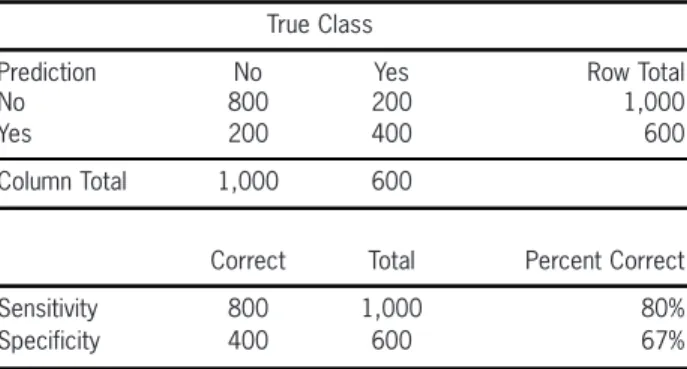
In this analysis, approximately a third of the data, about 50,000 records, was used as the hold-out sample for the final testing and comparison of the models. Two key statistics often used to compare model accuracy are sensitivity and specificity.Sensitivityis the percentage of events (i.e., claims with an IME or referred to a special investigation unit) that were predicted to be those events. The specificity is the percentage of non-events (in our applications claims believed to be legitimate) that were predicted to be nonevents. Both of these statistics should be high for a good model. Table 4, often referred to as a confusion
34The TreeNet software also allows cross-validation, but it is easier
and probably more typical to use a validation sample.
35In general, some programming is required to apply either
ap-proach in S-PLUS (R).
36For a more extensive discussion of logistic regression see Hosmer
and Lemshow (1989).
37With parametric models such as logistic regression, validation
samples are not usually part of the estimation procedure. The im-plementation of naïve Bayes used here did not provide a validation procedure for tuning the model.
Table 4. Sample confusion matrix: Sensitivity and specificity
True Class
Prediction No Yes Row Total No 800 200 1,000 Yes 200 400 600 Column Total 1,000 600
Correct Total Percent Correct Sensitivity 800 1,000 80% Specificity 400 600 67%
matrix (Hastie, Tibshirani, and Friedman 2001), presents an example of the calculation. In the ex-ample confusion matrix, 800 of 1,000 nonevents are predicted to be nonevents so the sensitivity is 80%. The specificity is 67% since 400 of 600 true positives are accurately predicted.
The sensitivity and specificity measures dis-cussed above are dependent on the choice of a cutoff value for the prediction. Many mod-els score each record with a value between zero and one, though some other scoring scale can be used. This score is sometimes treated like a probability, although the concept is much closer in spirit to a fuzzy set measurement function.38 A common cutoff point is 50% and records with scores greater than 50% are classified as events and records with scores below that value are clas-sified as nonevents.39 However, other cutoff val-ues can be used. Thus, if a cutoff lower than 50% were selected, more events would be accurately predicted and fewer non-events would be accu-rately predicted.
Because the accuracy of a prediction depends on the selected cutoff point, techniques for as-sessing the accuracy of models over a range of cutoff points have been developed. A common procedure for visualizing the accuracy of models used for classification is the receiver operating
38See Ostaszewski (1993) or Derrig and Ostaszewski (1995). 39One way of dealing with values equal to the cutoff point is to
characteristic (ROC) curve.40 This is a curve of sensitivity versus specificity (or more accurately 1.0 minus the specificity) over a range of cut-off points. It illustrates graphically the sensitivity or true positive rate compared to 1-specificity or false alarm rate. When the cutoff point is very high (i.e., 1.0) all claims are classified as legit-imate. The specificity is 100% (1.0 minus the specificity is 0), but the sensitivity is 0%. As the cutoff point is lowered, the sensitivity in-creases, but so does 1.0 minus the specificity. Ultimately a point is reached where all claims are predicted to be events, and the specificity de-clines to zero (1:0¡specificity = 1:0). The base-line ROC curve (where no model is used) can be thought of as a straight line from the origin with a 45-degree angle. If the model’s sensitiv-ity increases faster than the specificsensitiv-ity decreases, the curve “lifts” or rises above a 45-degree line quickly. The higher the “lift” or “gain,” the more accurate the model is.41 ROC curves have been used in prior studies of insurance claims and fraud detection regression models (Derrig and Weisberg 1998; Viaene et al. 2002). The use of ROC curves in building models as well as com-paring performance of competing models is a well established procedure (Flach et al. 2003).
A statistic that provides a one-dimensional summary of the predictive accuracy of a model as measured by an ROC curve is the area under the ROC curve (AUROC). In general, AUROC val-ues can distinguish good models from bad mod-els but may not be able to distinguish among good models (Marzban 2004). A curve that rises quickly has more area under the ROC curve. A model with an area of 0.50 demonstrates no pre-dictive ability, while a model with an area of 1.0 is a perfect predictor (on the sample the test is
40A ROC curve is one example of a so-called “gains” chart. 41ROC curves were developed extensively for use in medical
di-agnosis testing in the 1970s and 1980s (Zhou, McClish, and Obu-chowski 2002 and more recently in weather forecasting (Marzban 2004).
performed on). For this analysis, SPSS was used to produce the ROC curves and area under the ROC curves. SPSS generates cutoff values mid-way between each unique score in the data and uses the trapezoidal rule to compute the AUROC. A nonparametric method was used to compute the standard error of the AUROC.42
We show the AUROC results for our analyses in Section 6.
5. Modeling the decision to
investigate and favorable outcome
The remainder of this paper is devoted to illus-trating the usefulness and effectiveness of eight model/software combinations applied to our four fraud applications, the decision to investigate via IMEs or referral to SIU, and favorable outcomes from IME or SIU referrals. We model the pres-ence and proportion of favorable outcomes of each investigative technique for the DCD sub-set of automobile bodily injury liability (third party) claims from 1995—1997 accident years.43 We employ 21 potentially predicting variables of three types: (1) 11 typical claim variable fields informative of injury claims as reported, both categorical and numeric, (2) three external demo-graphic variables that may play a role in captur-ing variations in investigative claim types by ge-ographic region of Massachusetts, and (3) seven internal “demographic” variables derived from informative pattern variables in the database. Variables of type 3 are commonly used in predic-tive modeling for marketing purposes. The vari-ables used for these illustrations are by no means optimal choices for all three types of variables. Optimization can be approached by other proce-dures (beyond the scope of this paper) that max-imize information and minmax-imize cross correla-tions and by variable construction and selection by domain experts.
42The details of the formula are supplied in SPSS documentation
that can be found at the SPSS Web Site, www.spss.com.
The eight model/software combinations we will use here are
1) TreeNet 5) Iminer Ensemble
2) Iminer Tree 6) Random Forest 3) SPLUS Tree 7) Naïve Bayes
4) CART 8) Logistic
Numbers 1—6 are six tree models, and 7—8 are benchmark models (naïve Bayes and logistic).
CART and TreeNet are Salford Systems stand-alone software products that perform one tech-nique. CART (Classification and Regression Trees) does tree analysis, and TreeNet applies stochastic gradient boosting to an ensemble of trees using the method described by Freidman (2001). The S-PLUS procedure used here in the fraud comparison is found in both S-PLUS and in a freeware version in R though S-PLUS does not contain an implementation of Random For-est,44while R does. The S-PLUS GLM (general-ized linear models) was used for logistic regres-sion. The naïve Bayes, Tree, and Ensemble Tree procedures from Insightful Miner are used here in the fraud comparison.
Many of the products used in this comparison contain the capability of ranking variables in im-portance to the model. This capability is useful in variable selection and as an aid in understanding and interpreting the model. Because the meth-ods for ranking variables and the results of the ranking are significant additional topics, they are outside the scope of this paper.45
We next turn to consideration of model perfor-mance as a whole in Section 6 with an interpre-tation of the models and variables relative to the problem at hand in Section 7.
44For a discussion of the Random Forest freeware in R see Liaw
and Wiener 2003.
45See Derrig and Francis 2006 for a discussion of the importance
ranking of the 21 variables used here. Each independent variable may have a differenent “importance” level depending on the target variable.
Table 5. Area under the ROC curve—IME decision
CART Tree S-PLUS Tree Iminer Tree TreeNet AUROC 0.669 0.688 0.629 0.701 Lower Bound 0.661 0.680 0.620 0.693 Upper Bound 0.678 0.696 0.637 0.708
Iminer Random Iminer Naïve
Ensemble Forest Bayes Logistic AUROC 0.649 0.699 0.676 0.677 Lower Bound 0.641 0.692 0.669 0.669 Upper Bound 0.657 0.707 0.684 0.685
Table 6. Area under the ROC curve—IME favorable
CART Tree S-PLUS Tree Iminer Tree TreeNet AUROC 0.651 0.664 0.591 0.683 Lower Bound 0.641 0.653 0.578 0.673 Upper Bound 0.662 0.675 0.603 0.693
Iminer Random Iminer Naïve
Ensemble Forest Bayes Logistic AUROC 0.654 0.697 0.670 0.677 Lower Bound 0.643 0.676 0.660 0.667 Upper Bound 0.665 0.697 0.681 0.687
6. Comparing the models
Table 7. Area under the ROC curve—SIU decision
CART Tree S-PLUS Tree Iminer Tree TreeNet AUROC 0.607 0.616 0.565 0.643 Lower Bound 0.598 0.607 0.555 0.634 Upper Bound 0.617 0.626 0.575 0.652
Iminer Random Iminer Naïve
Ensemble Forest Bayes Logistic AUROC 0.539 0.667 0.615 0.612 Lower Bound 0.530 0.658 0.605 0.603 Upper Bound 0.548 0.677 0.625 0.621
Table 8. Area under the ROC curve—SIU favorable
CART Tree S-PLUS Tree Iminer Tree TreeNet AUROC 0.598 0.603 0.547 0.678 Lower Bound 0.584 0.589 0.555 0.667 Upper Bound 0.612 0.617 0.575 0.689
Iminer Random Iminer Naïve
Ensemble Forest Bayes Logistic AUROC 0.575 0.643 0.607 0.610 Lower Bound 0.530 0.630 0.593 0.596 Upper Bound 0.548 0.657 0.625 0.623
above the benchmarks on SIU and IME decisions but below on SIU and IME favorable.
We note that, in general, the model scores for SIU as measured by AUROC are significantly lower than for IME across all eight model/soft-ware combinations. This reduction in AUROC values may be a reflection of the explanatory variables used in the analysis; i.e., they may be more informative about claim build-up, for which IME is the principal investigative tool, than about claim fraud, for which SIU is the principal inves-tigative tool.
Figures 8 to 11 show the ROC curves for TreeNet compared to the Logistic for both IME and SIU Decisions.46 As we can see, a simple display of the ROC curves may not be sufficient to distinguish performance of the models as well as the AUROC values.
Tables 9 and 10 display the relative perfor-mance of the model/software combinations ac-cording to AUROC values and their ranks. With naïve Bayes and Logistic as the benchmarks,
46All twenty ROC curves are available from the authors.
Figure 8. TreeNet ROC Curve—IMEAUROC = 0:701
Figure 9. TreeNet ROC Curve—SIUAUROC = 0:643
TreeNet, and Random Forest do better than the benchmarks, while CART, Iminer Tree, and Iminer Ensemble do worse.
Figure 10. Logistic ROC Curve—IMEAUROC = 0:677
by positions farther to the right and closer to the top of the square. This graph clearly shows that TreeNet and Random Forest procedures do bet-ter than the other tree procedures and the bench-marks.
7. Conclusion
The focus of this paper has been to
² introduce a class of data mining techniques with potential applications in insurance,
² compare a number of different techniques and software implementations of those techniques, and
² illustrate applications of the techniques in in-surance to fraud modeling for claims.
Insurance data often involve both large volumes of information and nonlinearity and complex-ity of variable relationships. A range of data-manipulation techniques have been developed by computer scientists and statisticians that are now categorized as data mining, techniques with the principal advantages of the efficient handling of large data sets and the fitting of nonlinear func-tions to that data. In this paper we illustrate the use of software implementations of six
classifi-Figure 11. Logistic ROC Curve—SIUAUROC = 0:612
Table 9. Ranking of methods by AUROC—decision
Method SIU AUROC SIU Rank IME Rank IME AUROC Random Forest 0.667 1 2 0.699 TreeNet 0.643 2 1 0.701 S-PLUS Tree 0.616 3 3 0.688 Iminer Naïve
Bayes 0.615 4 5 0.676 Logistic 0.612 5 4 0.677 CART Tree 0.607 6 6 0.669 Iminer Tree 0.565 7 8 0.629 Iminer Ensemble 0.539 8 7 0.649
Table 10. Ranking of methods by AUROC—favorable
Method SIU AUROC SIU Rank IME Rank IME AUROC TreeNet 0.678 1 2 0.683 Random Forest 0.643 2 1 0.697 S-PLUS Tree 0.603 5 5 0.664 Logistic 0.610 3 3 0.677 Iminer Naïve
Bayes 0.607 4 4 0.670 CART Tree 0.598 6 7 0.651 Iminer Ensemble 0.575 7 6 0.654 Iminer Tree 0.547 8 8 0.591
explana-Figure 12A. Plot of AUROC for SIU vs IME decision
Figure 12B. Plot of AUROC for SIU vs IME favorable
tory models using the DCD and external demo-graphic variables. Four target categorical vari-ables were selected to model: the decision to re-quest an independent medical examination (IME) or a special investigation (SIU) and the favorable outcome of each investigation. The two decision
also an interest in modeling the conditions un-der which the investigation will be successful. All our models are explanatory, relating the key portions from the closed claim data with the in-vestigation variables. Applying these techniques to produce a real-timepredictivemodel must rec-ognize that closed claim data arrives at different points in time. The explanatory models will at least guide the process of choosing informative features for real-time predictive models. It should be noted that the topic of insurance fraud and its drivers is an area of active research. For in-stance, the December 2002 issue of theJournal of Risk and Insurancewas devoted entirely to fraud research and the Web Site www.derrig.com lists many studies at the IFRR tab. That said, the fo-cus of this paper is the comparison of techniques applied to a large complex insurance database, rather than specific findings related to fraud and abuse investigations.
Eight modeling software results were com-pared for effectiveness of modeling the targets based on a standard procedure, the area under the receiver operating characteristic curve (AUROC). We find that the methods all provide some predictive value or lift from the predict-ing variables we make available, with signifi-cant differences at the 95% level among the eight methods and four targets. Seven modeling out-comes are compared to logistic regression as in Viaene et al. (2002) but the results here are differ-ent. They show that some software/methods can improve on the predictive ability of the logistic model. Straightforward applications of TreeNet and Random Forest do significantly better than the benchmark naïve Bayes and logistic meth-ods, while Iminer Tree and Iminer Ensemble do significantly worse. That some model/software combinations do better than the benchmarks is due to the relative size and richness of this data set and/or the types of independent variables at hand compared to the Viaene data (2002).
No general conclusions about auto injury claims can be drawn from the exercise presented here, except that these modeling techniques should have a place in the actuary’s repertory of data manipulation techniques. Technological ad-vancements in database assembly and manage-ment, especially the availability of text mining for the production of variables, together with the easy access to computer power, will make the use of these techniques mandatory for analyzing the nonlinearity of insurance data. As for our part in advancing the use of data mining in actuar-ial work, we will continue to test various soft-ware products (with and without various bells and whistles) that implement these and other data mining techniques.
References
AIB,SeeAutomobile Insurers Bureau of Massachusetts. Automobile Insurers Bureau of Massachusetts, Detail Claim
Database, Claim Distribution Characteristics, Accident Years 1995—1997, Boston, MA: AIB, 2004.
Breiman, L., J. Friedman, R. Olshen, and C. Stone, Classi-fication and Regression Trees, New York: Chapman and Hall, 1993.
Breiman, L., “Random Forests,”Machine Learning45, 2001, pp. 5—32.
Brockett, P. L., R. A. Derrig, L. L. Golden, A. Levine, and M. Alpert, “Fraud Classification Using Principal Compo-nent Analysis of RIDITs,”Journal of Risk and Insurance
69, 2002, pp. 341—371.
Derrig, R. A., and K. Ostaszewski, “Fuzzy Techniques of Pattern Recognition in Risk and Claim Classification,”
Journal of Risk and Insurance62, 1995, pp. 447—482. Derrig, R. A., “Insurance Fraud,”Journal of Risk and
Insur-ance69, 2002, pp. 271—287.
Derrig, R. A., and L. Francis, “Comparison of Methods and Software for Modeling Nonlinear Dependencies: A Fraud Application,” International Congress of Actuaries, June 2006, Paris.
Derrig, R. A., and H. I. Weisberg, “AIB PIP Claim Screen-ing Experiment Final Report–UnderstandScreen-ing and Im-proving the Claim Investigation Process,” Massachusetts Division of Insurance, DOI, R98-4, July 1998.
Flach, P., H. Blockeel, C. Ferri, J. Hernandez-Orallo, and J. Struyf, “Decision Support for Data Mining: An Introduc-tion to ROC Analysis and Its ApplicaIntroduc-tions,”Data Mining and Decision Support, eds. D. Mlandenic, Nada Lavrac, Marko Bohanec, and Steve Moyle, Boston: Kluwer Aca-demic, 2003.
Fox, J.,An R and S-PLUS Companion to Applied Regression, Thousand Oaks, CA: SAGE Publications, 2002. Francis, L. A., “Martian Chronicles: Is MARS Better than
Neural Networks?” Casualty Actuarial Society Forum, Winter 2003, pp. 253—320.
Francis, L. A., “A Comparison of TreeNet and Neural Net-works in Insurance Fraud Prediction,” paper presented at CART Data Mining Conference, 2005, San Francisco, CA.
Friedman, J., “Greedy Function Approximation: The Gra-dient Boosting Machine,”Annals of Statistics 29, 2001, pp. 1189—1232.
Hadidi, N., “Classification Ratemaking Using Decision Trees,” Casualty Actuarial SocietyForum, Winter 2003, pp. 253—283.
Harrell, F.,Regression Modeling Strategies With Applications to Linear Models, Logistic Regression and Survival Anal-ysis, New York: Springer, 2001.
Hastie, T., R. Tibshirani, and J. Friedman,Elements of Sta-tistical Learning, New York: Springer, 2001.
Hosmer, D. W., and S. Lemshow,Applied Logistic Regres-sion, New York: Wiley, 1989.
Insurance Research Council,Auto Injury Insurance Claims: Countrywide Patterns in Treatment Cost and Compensa-tion, Malvern, PA: IRC, 2004a.
Insurance Research Council,Fraud and Buildup in Auto In-jury Insurance Claims, Malvern, PA: IRC, 2004b.
IRC,SeeInsurance Research Council.
Jaccard, J., and R. Turrisi, Interaction Effects in Multiple Regression, Thousand Oaks, CA: SAGE, 2003.
Kantardzic, M.,Data Mining, New York: Wiley, 2003. Liaw, A., and M. Wiener, “Classification and Regression by
Random Forest,”R News2/3, 2003, pp. 18—22.
Marzban, C., A Comment on the ROC Curve and the Area Under it as Performance Measures, Center for Analysis and Prediction of Storms, Norman, OK: University of Oklahoma, 2004.
Ostazewski, K. M., An Investigation into Possible Applica-tions of Fuzzy Sets Methods in Actuarial Science, Schaum-burg, IL: Society of Actuaries, 1993.
Venebles, W., and B. Riplye,Modern Applied Statistics with S-PLUS(3rd ed.), New York: Springer, 1999.
Viaene, S., R. A. Derrig, and G. Dedene, “A Case Study of Applying Boosting Naïve Bayes for Claim Fraud Diag-nosis,”IEEE Transactions on Knowledge and Data Engi-neering16, 2004, pp. 612—620.
Viaene, S., B. Baesens, G. Dedene, and R. A. Derrig, “A Comparison of State-of-the-Art Classification Techniques for Expert Automobile Insurance Fraud Detection,” Jour-nal of Risk and Insurance69, 2002, pp. 373—421. Weisberg, H. I., and R. A. Derrig, “Methodes Qualitatives
Pour la Detection des Demandes d’Indemnisation Fraud-uleuses,” RISQUES 35, July—September 1998, pp. 75— 101.