THE ROLE OF POLITICAL SIMILARITY IN ROMANTIC RELATIONSHIPS
Chelsea Jacqueline Phillips
A dissertation submitted to the faculty of the University of North Carolina at Chapel Hill in partial fulfillment of the requirements for the degree of Doctor of Philosophy in the Department of Political Science.
Chapel Hill 2014
ii © 2014
iii ABSTRACT
CHELSEA JACQUELINE PHILLIPS: The Role of Political Similarity in Romantic Relationships
(Under the direction of Thomas Carsey)
After 60 years of studying political behavior, political scientists have concluded that
Americans are not well-informed about politics, interested in political affairs, engaged in
political behavior, or constrained ideologically. Yet, psychological scholarship on
interpersonal relationships shows that these same Americans seem to use explicitly political
criteria when selecting social networks, picking discussion partners, and even choosing
spouses. Why do Americans, who appear to be politically ignorant and disinterested when
answering survey questions, use their political attitudes when doing something as
fundamental as evaluating potential and actual relationship partners? I argue this is because
political attitudes are “core attitudes” revealing fundamental values that are difficult to
compromise on. Thus, individuals seek like-minded partners when pursuing romantic
relationships.
In chapter one, I explore the role of political attitudinal similarity in the attraction
process. Using an experimental technique, I show that individuals evaluate politically similar
strangers more favorably than they do politically dissimilar strangers. Participants are also
more attracted to politically similar others and would prefer to spend time with and pursue
iv
In chapter two, I look at the role of political identity similarity in the attraction
process. Using another experimental technique, I show that individuals expect relationships
with politically similar others to be more satisfying and less conflictual than relationships
with politically dissimilar others.
Finally, in chapter three, I consider the role of political attitudinal similarity in
non-marital romantic relationships. I show that the political attitudes of couples are more similar
than we would expect by chance. Couples seem to be politically similar due to choice, not
coincidental selection based on other characteristics or convergence of attitudes over time.
Moreover, politically similar couples are more satisfied with their romantic relationships than
politically dissimilar couples.
Overall, I demonstrate that political phenomena influence the most intimate
relationships humans pursue—dating and marriage. By uncovering an important role for
politics in these very personal processes, I show that politics is much more fundamental to
human behavior than political scientists currently assume, and that we would be wise to
v
TABLE OF CONTENTS
Chapter One: The Role of Political Attitudinal Similarity in the Attraction Process ... 1
Introduction ... 1
Cognitive Consistency and Reinforcement ... 2
Why We Should Expect Couples to Share Similar Political Attitudes ... 4
Research Design: “Bogus Strangers” ... 8
What Does “Politically Similar” Mean? ... 8
The “Bogus Stranger” Method ... 9
Results ... 13
Political Similarity Interpersonal Attraction ... 20
TABLES: BOGUS STRANGER ... 23
FIGURES: BOGUS STRANGER ... 24
REFERENCES ... 27
Chapter Two: The Role of Political Identity Similarity in the Attraction Process ... 29
Introduction ... 29
Partisanship and Ideology as Social Identities ... 31
Balance, Conflict, and Social Identities ... 32
The Expected Impact of Political Identities on Interpersonal Attraction ... 35
The Online Dating Experiment ... 36
Results ... 40
Political Similarity Interpersonal Attraction ... 46
TABLES: ONLINE DATING ... 48
FIGURES: ONLINE DATING ... 53
REFERENCES ... 57
Chapter Three: Role of Political Similarity in Non-Marital Romantic Relationships ... 60
Introduction ... 60
vi
Why We Should Expect Couples to be Politically Similar ... 66
The Process: From Initial Attraction to Relationship Maintenance or Dissolution ... 68
Research Design ... 72
Political Attitudes Survey (PAS) ... 72
Analytic Procedures ... 74
Results ... 76
Hypothesis 1: Political Similarity ... 76
Hypothesis 2 (Social Homogamy) v. Hypothesis 3 (Assortative Mating) ... 78
Hypothesis 4: Assumed Convergence ... 79
Hypothesis 5: Observed Convergence ... 81
Hypothesis 6: Relationship Satisfaction... 81
Politics and Romance ... 84
TABLES: DYADIC PANEL ... 87
FIGURES: DYADIC PANEL ... 98
REFERENCES ... 99
vii
LIST OF TABLES
Table 1: Conditions for “Bogus Stranger” Experiment ... 23
Table 2: Conditions for Online Dating Experiment ... 48
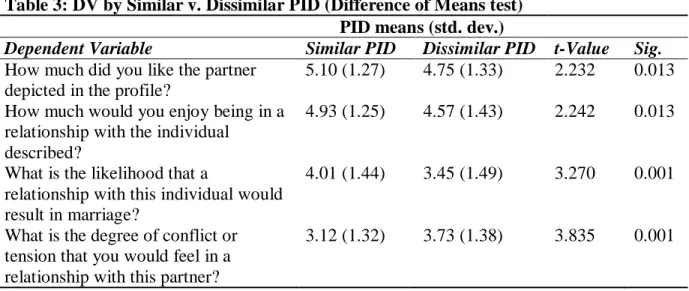
Table 3: DV by Similar v. Dissimilar PID (Difference of Means test) ... 49
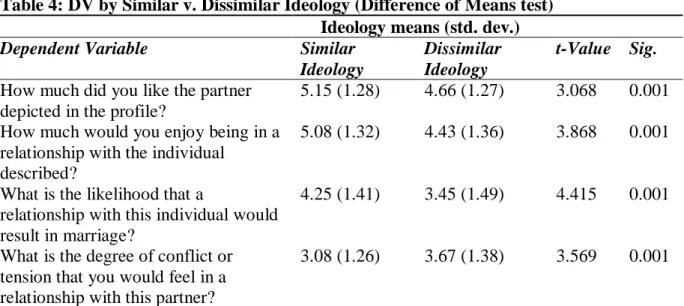
Table 4: DV by Similar v. Dissimilar Ideology (Difference of Means test) ... 50
Table 5: Emotion Experienced by Similar v. Dissimilar PID Condition ... 51
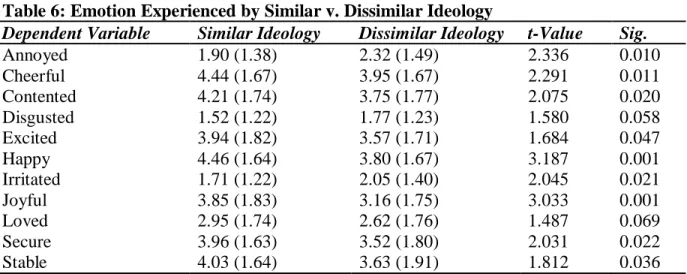
Table 6: Emotion Experienced by Similar v. Dissimilar Ideology ... 52
Table 7: Operationalization of Variables ... 87
Table 8: Coding Instructions for Demographic/Background Variables ... 88
Table 9: Couple Concordance on 17 Political Attitude Items, Pearson’s r ... 89
Table 10: OLS Regression Results for Couple Political Similarity controlling for Background Characteristics ... 90
Table 11: OLS Regression Results for Couple Political Similarity ... 91
Table 12: Difference of Means Test, Couple Political Similarity Wave 1 v. Wave 2 ... 92
Table 13: Difference of Means Test, Couple Political Similarity Wave 2 v. Wave 3 ... 93
Table 14: Difference of Means Test, Couple Political Similarity Wave 1 v. Wave 3 ... 94
Table 15: OLS Regression Results for Overall Couple Satisfaction (Wave 1) ... 95
Table 16: OLS Regression Results for Overall Couple Satisfaction (Wave 2) ... 96
viii
LIST OF FIGURES
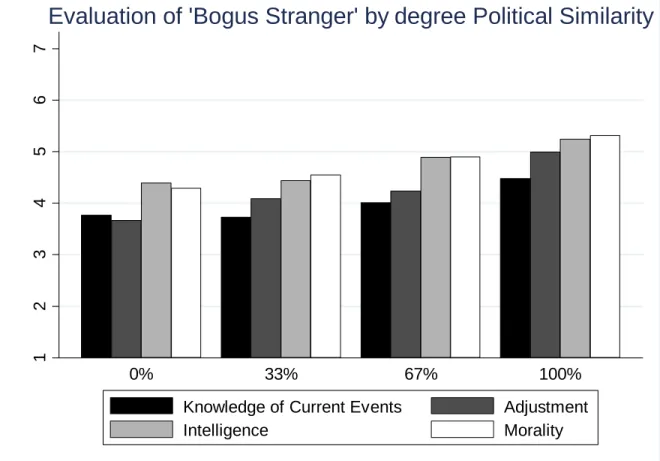
Figure 1: Participants’ Evaluation of the “Bogus Stranger’s” Knowledge of Current Events, Adjustment, Intelligence, and Morality by the Percent
of Politically Similar Attitudes ... 24
Figure 2: Participants’ Evaluation of how much they would Like Working with the “Bogus Stranger” on a Project and how much they
would Like the “Bogus Stranger” as a person... 25
Figure 3: Participants’ Evaluation of how much they would Like to Date
the “Bogus Stranger” or would Enjoy Being Married to the “Bogus Stranger”... 26
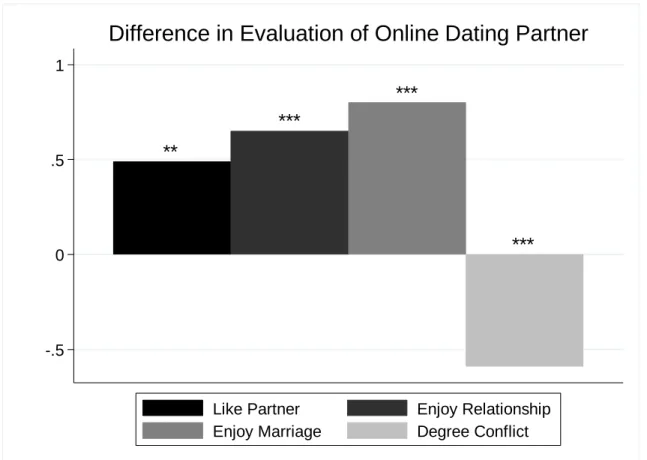
Figure 4: Difference in Evaluation of Online Dating Partner (Mean Similar
PID minus Mean Dissimilar PID) ... 53
Figure 5: Difference in Evaluation of Online Dating Partner (Mean Similar
Ideology minus Mean Dissimilar Ideology) ... 54
Figure 6: Difference in Emotional Reaction Experienced (Mean Similar
PID minus Mean Dissimilar PID) ... 55
Figure 7: Difference in Emotional Reaction Experienced (Mean Similar
Ideology minus Mean Dissimilar Ideology) ... 56
Figure 8: Theory Diagram – From Initial Attraction to Relationship Maintenance
Chapter One: The Role of Political Attitudinal Similarity in the Attraction Process Introduction
Conventional wisdom in the field of mass political behavior accepts that Americans
are not generally well-informed about politics, interested in political affairs, engaged in
political behavior, or constrained ideologically (Berelson, Lazarsfeld, and McPhee, 1954;
Campbell, Converse, Miller, and Stokes, 1960; Zaller, 1992; Converse, 1964). Also, because
of the potential for disagreement and offense, Americans do not frequently talk about
political issues (Huckfeldt, Mendez, and Osborn, 2004). Simply put, politics does not seem to
be even marginally important to most people most of the time.
However, married couples tend to be politically similar, which suggests a role for
political preferences in human mating behavior. Husbands and wives often share party
identification (Niemi, Hedges, and Jennings, 1977), they espouse similar positions on
political issues (Stoker and Jennings, 2005; Alford et al., 2011), they frequently vote for the
same candidates in elections (Stoker and Jennings, 2005), and they support similar political
ideologies. Several recent studies offer preliminary empirical evidence linking an individual’s political attitudes with his or her romantic relationship pursuits (Stoker and
Jennings, 2005; Alford et al., 2011; Klofstad, McDermott, and Hatemi, 2012; Huber and
Malhotra, 2013). However, political science currently lacks a coherent theoretical
explanation for why political similarity is linked to the formation of romantic relationships
and how this process occurs, despite the longstanding assumption that politics is unimportant
2
In this chapter, I address this apparent tension in the literature, by asking: why and
how do political attitudes shape romantic relationships when politics itself appears to play
such a minor role in the daily lives of most people? I advance our understanding of how
explicitly political phenomena influence the most intimate relationships humans pursue—
dating and marriage. I integrate several theories from cognitive and behavioral psychology to
explain why we should expect individuals to be more attracted to politically similar than
politically dissimilar others. Finally, using an experimental technique common in the field of
social psychology, I test hypotheses derived from my theory regarding the desirability of
dating or marrying a politically similar versus politically dissimilar partner.
Cognitive Consistency and Reinforcement
Psychologists have posited many different explanations for why individuals care
about the attitudes of other individuals and why they react emotionally to the discovery of
similar and dissimilar attitudes. Cognitive consistency theories predict couple similarity due
to an intrinsic need for balance in relationships, while reinforcement theories predict couple
similarity due to the reward-punishment aspects of social interaction.
Balance theory is a theory of cognitive consistency that posits that individuals are
driven to maintain congruence within interpersonal relationships (Heider, 1958). If a person
(P) likes an ‘other’ person (O), there is balance in the relationship if O reciprocates P’s feelings. In other words, if Paul likes Olivia and Olivia likes Paul then their relationship is
balanced. Imbalance results when P likes O, but O does not like P, or in other words, when
Paul likes Olivia but Olivia does not like Paul. Psychological imbalance can lead to cognitive
dissonance, which is a sense of intrapsychic discomfort that results from simultaneously
3
believing that Paul is a generally likeable person, yet Olivia does not like Paul for some
reason). People are assumed to possess a motivational drive to reduce such psychological
distress (Festinger, 1957). Using the example above, if P likes O, but O does not like P, the
relationship lacks balance and P is likely to feel dissonance that may lead P to change his or
her attitude toward O.
Balance theory can also be expanded to include attitude objects (situations, events,
ideas, or things) in addition to individuals (Heider, 1958; see also: Newcomb, 1956 “AB-X Theory of Social Psychology”). In an intimate relationship, an individual experiences a
balanced state when his or her attitude toward an object matches the attitude of his or her
relationship partner toward the same object. Imbalance results when romantic partners have
differing opinions on attitude objects (Newcomb, 1956). Expanding upon the example above,
if Paul likes Olivia, Olivia likes Paul, and both Paul and Olivia like living in North Carolina,
the relationship is balanced. However, if Paul and Olivia like each other but feel differently
about living in North Carolina, then the relationship lacks balance regarding the attitude
object. When balance is not achieved in a relationship, an individual is forced to reconsider
his or her feelings toward the relationship partner, the attitude object, or both.
Moving from cognitive consistency to reinforcement, learning theory uses the
concepts of reinforcement and punishment to help explain attitude similarity within
interpersonal relationships. In operant conditioning, reinforcement increases the likelihood of
a specific behavior while punishment decreases such future behavior (Skinner, 1974).
Positive reinforcement involves adding a stimulus to increase a certain response. Shared
attitudes are often positively reinforced within the relationship context while dissimilar
4
positive reinforcement. Repeated interactions with a similar partner will lead to the
strengthening of an individual’s attitudes over time. Positive punishment occurs when an
aversive stimulus is added to decrease a certain response. This form of operant conditioning
is used in relationships where partners disagree about important behaviors and attitudes
(Skinner, 1974).
Sometimes individuals are motivated to view their world accurately (see: Byrne, 1971, “Effectance Arousal Model”). To do this, individuals compare their beliefs, opinions,
and attitudes about the world to the beliefs, opinions, and attitudes of others (Festinger,
1954). Discovering similarity with others leads to a sense of consensual validation. Having another individual agree with your view of the world provides evidence of the “correctness”
of your beliefs, opinions, and/or attitudes. Being validated in this way leads to a positive
emotional response: the individual sees him- or her- self as intelligent, wise, and thoughtful.
This leads the individual to like the other person who was the cause of such good feelings
about the self.
Finally, the theory of enjoyable interactions posits that experiencing rewarding
interactions with another individual causes attraction toward that individual (Burleson and
Denton, 1992). Attitudinal similarity can facilitate enjoyable interactions. Thus, instead of
being attracted to similar others because they can validate an individual’s cognitions, this
theory expects that an individual will be attracted to similar others because he or she expects
that interacting with attitudinally similar others will be enjoyable.
Why We Should Expect Couples to Share Similar Political Attitudes
Clearly, social psychologists have spent a lot of time developing many different
5
share their attitudes on a variety of issues. By unifying these perspectives, I develop an
overarching theoretical framework regarding the importance of political similarity for
interpersonal attraction and then test hypotheses derived from my theory.
I argue that political attitudes are especially important to the interpersonal attraction process because political attitudes are “core” attitudes revealing information about an
individual’s general worldview (Conover, Searing, and Crewe, 2002). Political attitudes go
beyond an individual’s opinion of an object to the individual’s central identity. It is difficult
to compromise on or overlook “core” attitudinal discrepancies that have a moral component
to them, as many political attitude issues do (Haidt, 2012). Thus, going back to our
hypothetical individuals, Paul and Olivia, I assume that they will be more attracted to each
other if they are politically similar than if they are politically dissimilar, for three primary
reasons:
First, relationships with politically similar others exhibit balance, while relationships
with politically dissimilar others are imbalanced causing cognitive dissonance (i.e., Balance
Theory). If Paul likes Olivia, and Olivia likes Paul, and both individuals like the ideals and
principles of the Democratic Party, then Paul and Olivia will experience a balanced
relationship and will avoid experiencing cognitive dissonance. However, if Paul is a proud
Democrat while Olivia strongly supports the GOP, Paul and Olivia may find it difficult to
appreciate each other’s opinions and attitudes. Despite how much Paul likes Olivia, he may
never understand why she would support issue positions and candidates he vehemently
opposes, and vice versa. Since political attitudes often represent core values, Paul and Olivia
6
it is time to go to the ballot box, but when they are discussing many issues that involve their
general worldviews or identities.
Second, sharing political attitudes with another individual leads to consensual
validation and a positive view of the self (i.e., Learning Theory and the Effectance Arousal
Model). Like many other Americans, Paul and Olivia have heard various pundits arguing
about the potential costs and benefits of the Affordable Care Act (ACA) (i.e., Obamacare).
Olivia does not believe that the ACA will benefit her directly and she feels that it may even
prove harmful for the country as a whole, but she is not sure that she is well enough informed
on all aspects of the issue to really take a stand against it. During a casual conversation with
friends, Paul states that he thinks Obamacare is a horrible policy that will have devastating
effects on the American economy, and he goes on to develop an elaborate argument
explaining his position. Olivia finds herself nodding in agreement with Paul’s statements.
Although previously unsure of her position on the ACA, Olivia feels a sense of consensual
validation as a result of Paul’s remarks. She begins to believe that her initial suspicions
regarding Obamacare were correct and she experiences a positive emotional response –
seeing herself as an informed and thoughtful citizen. Since Paul is the cause of Olivia’s
positive self-regard, she begins to like Paul more than she previously did.
Finally, a third reason why Paul and Olivia are more likely to be attracted to each
other if they share political attitudes is because interacting with politically similar others is
more enjoyable than interacting with politically dissimilar others (i.e., the Theory of
Enjoyable Interactions). Paul remembers how painful Thanksgiving dinners were as a child
when his dad, an outspoken liberal, and his uncle, a staunch conservative, would inevitably
7
“debates” started out cordially enough, they quickly devolved into shouting matches and
name calling. As Paul began getting to know Olivia, he discovered that many of her political
attitudes were closely aligned with his own. Instead of political discourse leading to
bickering and hurt feelings, Paul begins to expect and engage in easy and enjoyable political
conversations with Olivia. These rewarding interactions lead Paul to be more attracted to
Olivia than he was before.
Discovering that they share politically similar attitudes, Paul and Olivia’s cognitions
are balanced. Their beliefs about the world are validated, leading toward positive self-affect.
Finally, they expect future interactions to be enjoyable, leading to positive feelings toward
the other person. Because of these positive aspects of shared political attitudes, I predict that
individuals actively seek to develop romantic relationships with politically similar others,
despite politics appearing to play a minor role in the daily lives of most people.
Based on my theory, I expect individuals to be more attracted to politically similar
than dissimilar others and to seek enduring relationships (e.g., dating and marriage) with
politically similar others. If my theory is correct, then active assortative mating is the initial
mechanism that explains couple political similarity. Assortative mating occurs when
individuals choose others as romantic partners based upon their degree of resemblance on
specific characteristics, like age, personality, or political views (Buss, 1984). Romantic
partners will be politically similar because individuals actively seek partners based upon their
degree of resemblance on specific characteristics (e.g., political views) (Alford et al., 2011). I
will test the following two hypotheses using an experimental technique popular in social
8
H1 Individuals will evaluate politically similar others more positively than they will
evaluate politically dissimilar others on a range of outcome variables, including
intelligence, morality, and knowledge of current events.
H2 Individuals will be more romantically attracted to politically similar than politically
dissimilar others. Operationally, this means that individuals will report greater interest
in dating and/or marrying politically similar rather than politically dissimilar others.
Research Design: “Bogus Strangers”
For the assortative mating hypothesis to be a viable explanation of romantic partner
political similarity, it is necessary to determine whether individuals are more attracted to
politically similar than dissimilar others. If individuals report greater attraction toward
politically similar than politically dissimilar others in a laboratory setting, it is likely that they
will seek out politically similar individuals in real-world romantic relationships. I test this using a common experiment from social psychology: the “bogus stranger” experiment.
What Does “Politically Similar” Mean?
During the summer of 2012, I pre-tested a battery of political attitude items using a
sample of undergraduate students at the University of North Carolina at Chapel Hill. My
original political attitude survey included 30 items pulled from the American National
Election Study (ANES), General Social Survey (GSS), and Election 2012 Presidential
websites. I asked students to indicate how frequently they discussed each item with
family/friends and how important each item was to them personally. I selected the top 17
9
‘Somewhat important’ to them personally (score of 3 or higher, on a 6-point scale). I created
and used a Political Attitude Survey (PAS) including these 17 political attitude items to
explore political similarity.
The “Bogus Stranger” Method
I tested the assortative mating hypothesis by adapting a social psychological
experimental technique to determine whether undergraduate students reported greater
attraction toward politically similar than politically dissimilar others. Participants were 371
undergraduate students at the University of North Carolina at Chapel Hill taking an
introductory Political Science course during the spring 2012 semester. They participated in
two phases of this study.
At time 1, participants completed the Political Attitude Survey (PAS) previously
described. Participants also answered a brief set of demographic questions.
At time 2, participants received a copy of the same PAS (allegedly completed by a
student in another section of their class) to review.1 Participants were told that they were
participating in a study of interpersonal prediction. Specifically, the instructions stated that:
The purpose of this study is to determine the extent to which one person can form valid
judgments about another person just by knowing a few of his or her attitudes. In reality, I
manipulated the PAS given to each participant to adhere to the matching percentage
information provided below in Table 1.
I used the Method of Constant Discrepancy (Byrne, 1971; Singh et al., 2008) to
simulate attitude similarity and dissimilarity. A similar attitude was an attitude on the same
1
10
side of the attitude item within one box from the participant’s own attitude. Like Singh et al.
(2008), I avoided using the most extreme responses (box 1 and box 6) when constructing
similar attitude items. For example, a question regarding participant attitudes toward the
death penalty looked like this:
Death Penalty
(1) In general, I strongly oppose the death penalty.
(2) In general, I moderately oppose the death penalty.
(3) In general, I slightly oppose the death penalty.
(4) In general, I slightly support the death penalty.
(5) In general, I moderately support the death penalty.
(6) In general, I strongly support the death penalty.
A participant marking “In general, I moderately oppose the death penalty” (box 2) received a
manipulated inventory with “In general, I slightly oppose the death penalty” (box 3) checked (instead of “In general, I strongly oppose the death penalty” [box 1]) to show attitude
similarity. This avoided complicating the process by introducing attitude extremity. A
dissimilar attitude was an attitude on the opposite side of the attitude item that is three boxes away from the participant’s own attitude. For dissimilar attitudes, introducing attitude
extremity was not avoided (Singh et al., 2008).2 For example, a participant marking “In
2
If “similar-extreme” profiles had been used, it would have been difficult to determine whether the results were being driven by similarity or extremism. It is thought that people generally like others on the same side as them, but not others on the same side who are thought to be extreme. Thus, “similar-extreme” profiles may have been viewed by
11
general, I slightly oppose the death penalty” (box 3) received a manipulated inventory with
“In general, I strongly support the death penalty” (box 6) checked.
Using random assignment, I divided participants into one of four experimental
conditions (see Table 1) based upon political similarity – Highly similar, Similar, Dissimilar,
and Highly dissimilar (100% match, 67% match, 33% match, and 0% match respectively).3
Students in each condition were given the following instructions (which have been modified
slightly from instructions given by Byrne [1971]):
Last semester we carried out other studies of this sort. Students wrote
down several sorts of information about themselves, all identifying information
was removed, and this information was given to other students. The task was to
form an opinion about the stranger's intelligence, knowledge of current events,
morality, and adjustment just on the basis of knowing a few bits of information
about the person's past and present life. We found that students could guess these
things with better than chance accuracy.
So, this study is an extension of the previous one, and a major change has
been introduced. Instead of receiving information about the other person's life, you
will be shown his or her attitudes on specific issues. You are about to receive the
attitude scale of another student. All I can guarantee is that this person is the
opposite sex as yourself, and to the best of our knowledge you do not know the
purpose was to induce participants to think of an individual whose political attitudes were different from their own – whether extreme or not.
3
While these values are extreme (100% similar, 0% similar), past research using this
12
person whose attitude scale you will receive, and it is not someone in the same
[political science recitation] as yourself.
Please read the person's answers carefully and try to form an opinion
about him or her. As soon as you have studied each of the attitudes, [click the
double arrows button at the bottom of the screen] to continue to the Interpersonal
Judgment Scale and indicate your best guess as to this person's intelligence,
knowledge of current events, morality, and adjustment. You will also be asked to
indicate how much you think you would like this person if you met him or her,
how much you think you would like to work with this person as partners in an
experiment, how much you think you would like to date this person, and how
much you think you would like this person as a spouse.
After forming an impression of the “bogus stranger,” participants completed Byrne’s
(1971) Interpersonal Judgment Scale (IJS), two additional items from Byrne’s (1971)
Computer Dating IJS, and two original items following the format of Byrne’s IJS to assess
the other student’s party identification and political ideology (labeled: Worldview; liberal -
conservative). Byrne’s (1971) IJS included six items: intelligence, knowledge of current
events, morality, adjustment, personal feelings, and working together on a project. The two items from Byrne’s (1971) Computer Dating IJS that I included were dating and marriage. I
also asked respondents to determine whether they thought the individual whose profile they
had viewed was a Democrat or Republican and a liberal or conservative. All evaluations
13 Results
The results of several ANOVA analyses show that individuals evaluate politically
similar others more positively than they evaluate politically dissimilar others across many different domains (e.g., intelligence, morality, desire to date, etc.). “Bogus stranger”
evaluations that include the potential for interaction with the individual described in the
profile show a linear relationship between the degree of political similarity between
respondent and the profile with which they were paired and desire for interaction. Key to my
study, individuals are romantically attracted to politically similar others while they are not
attracted to politically dissimilar others. Thus, I find strong support for both hypotheses one
and two.
In hypothesis one, I predicted that individuals would evaluate politically similar
others more positively than they evaluated politically dissimilar others. I conducted one-way
between subjects ANOVAs to compare the effect of the percent of political attitudes shared by the subject and the “bogus stranger” on the subject’s assessment of the “bogus stranger’s”
knowledge of current events, adjustment, intelligence, and morality, respectively. I found
statistically significantly different results between groups for each analysis as can be seen in
Figure 1 below (See Appendix C for tabular results).
A one-way between subjects ANOVA was conducted to compare the effect of the percent of political attitudes shared by the subject and “bogus stranger” on the subject’s
assessment of the “bogus stranger’s” knowledge of current events, in 100% matching, 67%
matching, 33% matching, and 0% matching conditions. Looking at respondents’ evaluation
of the “bogus stranger’s” knowledge of current events by level of political similarity, there
14
determined by one-way ANOVA, F(3,357) = 7.9, p < .001.4 Post hoc comparisons using the
Tukey-Kramer test 5 indicated that the mean score for the 100% match condition (M = 4.48,
SD = 1.18) was significantly different than the 0% match, 33% match, and 67% match
conditions (M = 3.77, SD = 1.14; M = 3.73, SD = 1.20; M = 4.01, SD = 1.17, respectively;
See Figure 1). However, the 0% match condition (M = 3.77, SD = 1.14) did not significantly
differ from the 33% match or the 67% match conditions (M = 3.73, SD = 1.20; M = 4.01, SD
= 1.17, respectively). Also, the 33% match condition (M = 3.73, SD = 1.20) did not
significantly differ from the 67% match condition (M = 4.01, SD = 1.17). Putting these
results together, individuals evaluate politically dissimilar strangers as less knowledgeable
about current events than politically similar strangers. Specifically, individuals evaluating the
profile of a stranger whose political attitudes were very similar to those of the participant,
saw the stranger as very knowledgeable of current events, while very dissimilar strangers
were evaluated as lacking in knowledge of current events. Individuals with moderately
similar political attitudes were not viewed as more or less knowledge of current events.
Running the same type of analysis for adjustment, there was a statistically significant
difference between groups for the four conditions as determined by one-way ANOVA,
F(3,354) = 23.21, p < .001. The mean score for the 0% match condition (M = 3.67, SD =
1.07) was significantly different than the 33% match, 66% match, and 100% match
conditions (M = 4.09, SD = 0.98; M = 4.23, SD = 1.16; M = 4.99, SD = 1.11, respectively;
4
The assumption of homogeneity of variance was slightly violated according to results from Bartlett’s test and Levene’s test. However, the ANOVA method is fairly robust to such violations, especially when the group sample sizes are fairly equal, as they were here. Additionally, violating the equal variance assumption is primarily a problem in small samples. Since the sample here is large with fairly equal sample sizes, I am not concerned that heterogeneity of variance has biased my results.
5
15
See Figure 1). The 33% match condition (M = 4.09, SD = 0.98) was significantly different
than the 100% match condition (M = 4.99, SD = 1.11). And the 67% match condition (M =
4.23, SD = 1.16) was significantly different than the 100% match condition (M = 4.99, SD =
1.11). However, the 33% match condition (M = 4.09, SD = 0.98) did not significantly differ
from the 67% match condition (M = 4.23, SD = 1.16). Putting these results together shows
that subjects evaluated politically similar strangers as being better adjusted than politically
dissimilar strangers. This result held across all comparison groups except for the two groups
who were moderately politically similar.
Again, using the ANOVA method to evaluate intelligence, I found a statistically
significant difference between groups for the four conditions as determined by one-way
ANOVA, F(3,357) = 13.88, p < .001. The mean score for the 0% match condition (M = 4.39,
SD = 1.10) was significantly different than the 67% match and 100% match conditions (M =
4.89, SD = 1.06; M = 5.24, SD = 0.85, respectively; See Figure 1). The mean score for the
33% match condition (M = 4.44, SD = 1.12) was significantly different than the 67% match
and 100% match conditions (M = 4.89, SD = 1.06; M = 5.24, SD = 0.85, respectively).
However, the 0% match condition (M = 4.39, SD = 1.10) did not significantly differ from the
33% match condition (M = 4.44, SD = 1.12) nor did the 67% match condition (M = 4.89, SD
= 1.06) significantly differ from the 100% match condition (M = 5.24, SD = 0.85). Taken
together, these results show that individuals evaluate politically similar strangers as more
intelligent than politically dissimilar strangers. Specifically, subjects evaluating a stranger
who shared less than half of their political attitudes viewed the stranger as relatively
unintelligent compared to subjects evaluating a stranger who shared more than half of their
16
Finally, using the same type of analysis to look at morality, there was a statistically
significant difference between groups for the four conditions as determined by one-way
ANOVA, F(3,356) = 15.17, p < .001. The mean score for the 0% match condition (M = 4.29,
SD = 1.23) was significantly different than the 66% match and 100% match conditions (M =
4.90, SD = 1.04; M = 5.31, SD = 1.00, respectively; See Figure 1). Also, the mean score for
the 33% match condition (M = 4.55, SD = 1.06) significantly differed from the 100% match
condition (M = 5.31, SD = 1.00). However, the 0% match condition (M = 4.29, SD = 1.23)
did not significantly differ from the 33% match condition (M = 4.55, SD = 1.06). The 33%
match condition (M = 4.55, SD = 1.06) did not significantly differ from the 67% match
condition (M = 4.90, SD = 1.04). And the 67% match condition (M = 4.90, SD = 1.04) did
not significantly differ from the 100% match condition (M = 5.31, SD = 1.00). Taken
together, these results show that participants evaluated politically similar strangers as more
moral than politically dissimilar strangers. Very politically dissimilar strangers were
evaluated as especially immoral compared to very politically similar strangers.
Taking these four sets of results together, let us consider the magnitude of the effect
of moving from being highly politically dissimilar to highly politically similar. All four
dependent variables were measured on a 1-7 scale. The mean ratings of highly similar “bogus strangers” were between 0.71 – 1.32 points higher than were the mean ratings of highly
dissimilar “bogus strangers”.
In addition to affecting assessments of the “bogus stranger’s” personal attributes, the
level of political similarity predicts participants’ personal feelings toward the “bogus
stranger” and participants’ feelings about working on a project with the “bogus stranger” as
17
between the percentage of political similarity shared by the participant and “bogus stranger”
and both personal feelings as well as feelings about working on a project together. Using the same method as before to look at the subject’s feelings about working
together on a project with the “bogus stranger,” I found a statistically significant difference
between groups for the four conditions as determined by one-way ANOVA, F(3,355) =
37.38, p < .001. The mean score for the 0% match condition (M = 3.15, SD = 1.19) was
significantly different than the 33% match, 66% match, and 100% match conditions (M =
3.75, SD = 1.28; M = 4.35, SD = 1.38; M = 5.05, SD = 1.21, respectively; See Figure 2). The
33% match condition (M = 3.75, SD = 1.28) was significantly different than the 67% match
and 100% match conditions (M = 4.35, SD = 1.38; M = 5.05, SD = 1.21). And the 67%
match condition (M = 4.35, SD = 1.38) was significantly different than the 100% match
condition (M = 5.05, SD = 1.21). Putting these results together, participants feel more
positively toward working on a project with a politically similar than politically dissimilar
stranger. This result held across all comparisons of different levels of political similarity. Again, using ANOVA to study the subject’s personal feelings regarding the “bogus
stranger,” there was a statistically significant difference between groups for the four
conditions as determined by one-way ANOVA, F(3,356) = 62.75, p < .001. The mean score
for the 0% match condition (M = 3.22, SD = 1.23) was significantly different than the 33%
match, 66% match, and 100% match conditions (M = 4.26, SD = 1.22; M = 4.95, SD = 1.23;
M = 5.51, SD = 1.01, respectively; See Figure 2). The 33% match condition (M = 4.26, SD =
1.22) was significantly different than the 67% match and 100% match conditions (M = 4.95,
SD = 1.23; M = 5.51, SD = 1.01). And the 67% match condition (M = 4.95, SD = 1.23) was
18
these results indicate that the level of political similarity between a participant and a stranger significantly affects the participant’s feelings toward the stranger. Participants are more
likely to report that they would like a politically similar stranger and dislike a politically
dissimilar stranger.
Compared to the previous set of results where participants were asked to evaluate characteristics of the “bogus stranger” (i.e., morality, intelligence, etc.), these two questions
asked participants to consider their general feelings toward the individual whose profile they
had just read and how they would feel interacting with that individual. These questions
require the participant to think about interacting with the individual described in the profile,
not simply evaluating them on various dimensions. In addition to finding a linear relationship between degree of political similarity and participants’ responses, the magnitude of the
results are larger than in the previous analysis. Again, both dependent variables were
measured on a 1-7 scale. For Working Together on a Project and Personal Feelings, the mean ratings of highly similar “bogus strangers” were 1.9 and 2.29 points higher than were the
mean ratings of highly dissimilar “bogus strangers”, respectively.
In hypothesis two, I predicted that individuals would be more romantically attracted
to politically similar rather than politically dissimilar others. Specifically, I expected
participants to express greater interest in dating and/or marrying politically similar rather
than politically dissimilar others. Again, I conducted one-way between subjects ANOVAs to compare the effect of the percent of political attitudes shared by the subject and the “bogus
stranger” on the subject’s attraction toward the “bogus stranger”. As with the earlier items
involving interaction with the “bogus stranger” (not just assessment of personal attributes), I
19
shared by the participant and “bogus stranger” and the participant’s desire to date or marry
the “bogus stranger” whose profile they read during the experiment. The results of my final
two analyses are presented below in Figure 3 below (See Appendix C for tabular results). Looking at the subject’s feelings about dating the “bogus stranger,” I found a
statistically significant difference between groups for the four conditions as determined by
one-way ANOVA, F(3,355) = 52.08, p < .001. The mean score for the 0% match condition
(M = 2.34, SD = 1.35) was significantly different than the 33% match, 66% match, and 100%
match conditions (M = 3.27, SD = 1.40; M = 3.96, SD = 1.67; M = 4.90, SD = 1.23,
respectively; See Figure 3). The 33% match condition (M = 3.27, SD = 1.40) was
significantly different than the 67% match and 100% match conditions (M = 3.96, SD = 1.67;
M = 4.90, SD = 1.23). And the 67% match condition (M = 3.96, SD = 1.67) was significantly
different than the 100% match condition (M = 4.90, SD = 1.23). Taken together, these results
show that participants are significantly more interested in dating someone who shares their
political attitudes than someone who does not share their political attitudes. Even small
changes in the level of political similarity (from 0% shared attitudes to 33% shared attitudes or from 67% shared attitudes to 100% shared attitudes) significantly increase participants’
interest in dating the stranger whose profile they have just read.
Finally, considering the subject’s feelings about marrying the “bogus stranger,” there
was a statistically significant difference between groups for the four conditions as determined
by one-way ANOVA, F(3,355) = 43.88, p < .001. The mean score for the 0% match
condition (M = 2.21, SD = 1.39) was significantly different than the 33% match, 66% match,
and 100% match conditions (M = 3.03, SD = 1.43; M = 3.67, SD = 1.78; M = 4.69, SD =
20
significantly different than the 67% match and 100% match conditions (M = 3.67, SD = 1.78;
M = 4.69, SD = 1.37). And the 67% match condition (M = 3.67, SD = 1.78) was significantly
different than the 100% match condition (M = 4.69, SD = 1.37). Combining these results
show that individuals see marriage with a politically similar other as significantly more
desirable than marriage with a politically dissimilar other. Moving from the lowest level of
political similarity to a moderate level of political similarity significantly increases an individual’s interest in marrying the stranger whose profile they have just evaluated.
Likewise, moving from a moderate level of political similarity to a high level of political similarity further increases an individual’s interest in marriage.
In comparison to the first two sets of results based upon hypothesis one, the
magnitude of the results here are even more pronounced. Unlike before where the participant
was asked to evaluate the personal attributes of a stranger or to consider briefly engaging
with the individual whose profile they had read, these two questions (dating and marriage)
required participants to consider committing to a serious, ongoing relationship with the
individual from the profile. This raised the stakes and increased the gap between most and
least similar evaluations. Again, both dependent variables were measured on a 1-7 scale. For Dating and Marriage, the mean ratings of highly similar “bogus strangers” were 2.56 and
2.48 points higher than were the mean ratings of highly dissimilar “bogus strangers,”
respectively.
Political Similarity Interpersonal Attraction
Results from this experiment provide clear support for predictions based on the
assortative mating hypothesis. Politically similar strangers were evaluated as more
21
were politically dissimilar strangers. Participants also indicated that they thought they would
generally like politically similar strangers more than they would generally like politically
dissimilar strangers, and that they would specifically enjoy working on a project with
politically similar strangers more than working on a project with politically dissimilar
strangers. Results from the analyses of these six items supported the assortative mating
mechanism generally, and hypothesis one from this paper specifically. Individuals evaluated
politically similar others more positively than they evaluated politically dissimilar others.
Additionally, two items from the Interpersonal Judgment Scale were used to assess
interpersonal romantic attraction: dating and marriage. Results from analyses of these two
items also supported the assortative mating mechanism: participants were more romantically
attracted to politically similar than politically dissimilar others. Participants were more
interested in dating and/or marrying politically similar rather than politically dissimilar
strangers. The effect of political similarity was stronger on these two items than it was for
any of the other six items. Far from being unimportant to participants, political attitudinal
similarity shaped their evaluation of potential romantic partners.
Let us revisit the original puzzle: Americans are not generally well-informed about
politics, interested in political affairs, engaged in political behavior, or constrained
ideologically, yet married couples tend to be politically similar. This study helps reconcile
the apparent tension by looking at the interpersonal attraction process. In situations like the
one in this experiment, political attitudes do matter to individuals because the outcomes are
tangible and personal. Who you work with, date, and/or marry can have major effects on
22
attitudes matter in the interpersonal context. Politics may not be even marginally important to
most people most of the time, but when an individual is evaluating the attributes of another
individual and/or imagining interacting with that individual, they strongly prefer political
similarity to dissimilarity.
Further research is needed to continue unpacking exactly why it is that political
attitudes matter in interpersonal relationships. Since political attitudes are core values,
holding different opinions in key domains would likely lead to conflict. Part of the answer is
likely that individuals want to avoid potential disagreements in their close relationships. In
addition to avoiding the negative implications of dating or marrying an individual with
dissimilar political attitudes, individuals may seek close relationships with politically similar
others because they expect their opinions to be reinforced and validated, instead of
challenged. Finally, individuals may also anticipate enjoyable interactions with politically
similar others, as opposed to politically dissimilar others. It is likely that all three of these
explanations play a role in explaining why individuals are more attracted to politically
similar others. Follow-up studies in this area should work to untangle the unique
contributions of these elements – both avoiding negatives (cognitive dissonance and conflict)
and gaining positives (belief reinforcement, validation, and enjoyable interactions).
This study demonstrates that political attitudes matter more to average Americans
than political scientists generally say they do. Political attitudes are not only important when
choosing who to vote for on Election Day or which political party to support. Individuals use
their political attitudes to evaluate the personal characteristics of individuals and the
likelihood of enjoying a relationship with such persons. Thus, political attitudes have
23
TABLES: BOGUS STRANGER Table 1: Conditions for “Bogus Stranger” Experiment
Level of Political Similarity Highly Similar
(100%)
Similar (67%)
Dissimilar (33%)
Highly dissimilar (0%)
N = 98 N = 93 N = 92 N = 88
24
FIGURES: BOGUS STRANGER
Figure 1: Participants’ Evaluation of the “Bogus Stranger’s” Knowledge of Current Events, Adjustment, Intelligence, and Morality by the Percent of Politically Similar Attitudes
Note: There is a statistically significant difference between groups at the p<.001 level for all four dependent variables.
1 2 3 4 5 6 7 Me a n Ev a lu a ti o n o f 'Bo g u s St ra n g e r'
0% 33% 67% 100%
Evaluation of 'Bogus Stranger' by degree Political Similarity
Knowledge of Current Events Adjustment
25
Figure 2: Participants’ Evaluation of how much they would Like Working with the “Bogus Stranger” on a Project and how much they would Like the “Bogus Stranger” as a person
Note: There is a statistically significant difference between groups at the p<.001 level for both dependent variables.
1
2
3
4
5
6
7
Me
a
n
Ev
a
lu
a
ti
o
n
o
f
'Bo
g
u
s
St
ra
n
g
e
r'
0% 33% 67% 100%
Evaluation of 'Bogus Stranger' by degree Political Similarity
26
Figure 3: Participants’ Evaluation of how much they would Like to Date the “Bogus Stranger” or would Enjoy Being Married to the “Bogus Stranger”
Note: There is a statistically significant difference between groups at the p<.001 level for both dependent variables.
1
2
3
4
5
6
7
Me
a
n
Ev
a
lu
a
ti
o
n
o
f
'Bo
g
u
s
St
ra
n
g
e
r'
0% 33% 67% 100%
Evaluation of 'Bogus Stranger' by degree Political Similarity
27
REFERENCES
Alford, John R., Carolyn L. Funk, and John R. Hibbing, 2005. “Are Political Orientations Genetically Transmitted?” American Political Science Review 99(2): 153-167.
Alford, John R., Hatemi, John R. Hibbing, Martin, and Eaves, 2011. “The Politics of Mate Choice.” The Journal of Politics 73(2): 362-379.
Berelson, Bernard, Paul Lazarsfeld & William McPhee. 1954. Voting. Chicago, IL: University of Chicago Press.
Burleson, Brant R., and Wayne H. Denton. 1992. “A New Look at Similarity and
Attraction in Marriage: Similarities in Social-Cognitive and Communication Skills as Predictors of Attraction and Satisfaction.” Communication Monographs 59(3): 268-287.
Buss, D. M. 1984. “Marital assortment for personality dispositions: Assessment with three different data sources.” Behavior Genetics 14: 111-123.
Byrne, Donn. 1971. The Attraction Paradigm. New York: Academic Press.
Campbell, Angus, Philip E. Converse, Warren E. Miller, and Donald E. Stokes. 1960. The American Voter. University of Chicago Press.
Conover, Pamela Johnston, Donald D. Searing, and Ivor M. Crewe. 2002. “The
Deliberative Potential of Political Discussion.” British Journal of Political Science 32(1): 21-62.
Converse, Philip. 1964. “The nature of belief systems in mass publics.” In Ideology and Discontent, David Apter (Ed.). The Free Press of Glencoe.
Festinger, Leon. 1957. A theory of cognitive dissonance. Oxford, England: Row, Peterson.
———. 1954. “A theory of social comparison processes.” Human Relations 7(2) 117-140.
Haidt, Jonathan. 2012. The righteous mind: Why good people are divided by politics and religion. New York: Pantheon Books.
Heider, F. 1958. The psychology of interpersonal relations. New York: Wiley.
Huber, Gregory, and Neil Malhotra. 2013. “Dimensions of Political Homophily: Isolating Choice Homophily along Political Characteristics.” Unpublished manuscript.
28
“Disagreement, Ambivalence, and Engagement: The Political Consequences of Heterogeneous Networks.” Political Psychology 25(1): 65-95.
Klofstad, Casey A., Rose McDermott, and Peter K. Hatemi. 2012. “Do Bedroom Eyes Wear Political Glasses?: The Role of Politics in Human Mate Attraction.” Evolution and Human Behavior 33 (2): 100-108.
Newcomb, Theodore M. 1956. “The Prediction of Interpersonal Attraction” American Psychologist 11:575-586.
Niemi, Richard G., Roman Hedges, and M. Kent Jennings. 1977. “The Similarity of Husbands’ and Wives’ Political Views.” American Politics Research 5: 133-148.
Singh, Ramadhar, Reuben Ng, Ee Lin Ong, and Patrick K.F. Lin. 2008. “Different
mediators for the age, sex, and attitude similarity effects in interpersonal attraction.” Basic and Applied Social Psychology 30 (1): 1-17.
Skinner, B.F. 1953. Science and Human Behavior. New York: Macmillan.
Stoker, Laura, and M. Kent Jennings. 2005. Political Similarity and Influence between Husbands and Wives. In Alan S. Zuckerman (Ed.), The Social Logic of Politics: Personal Networks as Contexts for Political Behavior (pp. 51-74). Philadelphia: Temple University Press.
Chapter Two: The Role of Political Identity Similarity in the Attraction Process Introduction
Over the past few decades, identity politics scholars have attempted to explain how
social identities affect political attitudes and behaviors. They have looked at the identity
formation process and asked how general social identities (gender, race, class, religion,
sexual orientation, etc.) become politicized, thereby, influencing our political views and
opinions. Rarely have scholars reversed the causal arrow and asked how explicitly political
identities might affect our social attitudes or behaviors. This is likely because conventional
wisdom in the field of mass political behavior asserts that Americans are generally
uninformed about politics, disinterested in political proceedings, disengaged from the
political process, and ideologically unconstrained (Berelson, Lazarsfeld, and McPhee, 1954;
Campbell, Converse, Miller, and Stokes, 1960; Zaller, 1992; Converse, 1964). In addition,
the average American does not spend much time talking about politics with others
(Huckfeldt, Mendez, and Osborn, 2004). Many people might have political identities based
on things like party identification, but politics is not very important for most people. The
implicit assumption of scholars appears to be that political identities will not be very
influential for individual’s non-political decision-making.
As I will explore in more detail below, many scholars assert that party identification
is a deeply held attachment to a political party that has the strength of a religious or racial
30
Schickler, 2002). Married couples tend to be politically similar, suggesting a role for politics in human mating behavior. Recent studies have begun linking an individual’s political
attitudes with his or her romantic relationship pursuits (Klofstad, McDermott, and Hatemi,
2012; Huber and Malhotra, 2013). Husbands and wives often espouse similar positions on
political issues (Stoker and Jennings, 2005; Alford et al., 2011), they frequently vote for the
same candidates in elections (Stoker and Jennings, 2005), and most relevant to this paper,
married couples often share party identification (Niemi, Hedges, and Jennings, 1977). Instead
of being irrelevant to the non-political behavior of mate choice, political identities seem to
matter in the process.
I argue that political identities are deeply held attachments to a group and, as such,
will be influential in both political and non-political decision-making. People use their
political identities as lenses through which to filter their worlds. These identities are similar
to other deeply held social identities such as religion and race (e.g. Green, Palmquist, and
Schickler, 2002). Given the degree of party polarization we are currently experiencing in
contemporary American society and the confrontational nature of political debate in the U.S.,
I expect that political identities are especially important in human mating behavior in the
current time period.
In this chapter, I explore whether political identities influence romantic relationships.
Using the social identity perspective, I advance our understanding of how explicitly political
phenomena can (and do) influence the most intimate relationships humans pursue—dating
and marriage. I use an original experimental design to test my hypothesis regarding the
desirability of dating or marrying a politically similar versus politically dissimilar partner. As
31
political identities (partisanship and/or ideology) than to others with dissimilar political
identities.
Partisanship and Ideology as Social Identities
Party identification has often been viewed as meaningful to citizens. Originally,
Campbell et al. (1960) described partisanship as a deeply held psychological attachment to a
political party. They argued that this political identification was formed primarily through the
early socialization process prior to adulthood. More recently, Green, Palmquist, and
Schickler (2002) took Campbell et al.’s (1960) description of partisanship and moved it away
from a purely psychological attachment to a social identity involving group processes. These
perspectives on partisanship differ from the revisionist view of party identification as a
running tally of evaluations that serves as a voting shortcut (e.g., Fiorina, 1981).
While ideological labels have been studied less frequently as social identities, I
suspect that a similar mechanism may be at work. Like other scholars, I do not view policy
preferences and self-identification on an ideological scale as the same thing (e.g., Carsey and
Layman, 2006). Stimson (2004) and others offer strong evidence that ideological labels are
not merely short-cuts for general policy preferences by showing that a large number of
individuals seem to identify with an ideological label that is inconsistent with the actual
policy views they hold. This finding suggests that the ideological labels that people identify
with have personal meaning separate from their policy preferences.
Although it is uncommon for scholars of party identification and ideology to explore
non-political outcomes, recently, Iyengar, Sood, and Lelkes (2012) used this approach to
look at polarization in the American mass public. They found that Democrats and
32
“negative traits to the rank-and-file of the out-party” (Iyengar, Sood, and Lelkes, 2012, 3).
Beyond policy-based polarization at the elite level, affective polarization appears to permeate
the behaviors of the masses in American society.
Moreover, Iyengar, Sood, and Lelkes (2012) looked at public opinion regarding
inter-party marriage in 1960, and again five decades later in 2008 and 2010. In 1960, America was
not nearly as polarized along partisan or ideological lines as it is today. At that time, few
Americans objected to their children marrying someone of the opposing party (only 5% of Republicans and 4% of Democrats said they would be “displeased” with such an occurrence)
(Iyengar, Sood, and Lelkes, 2012). By 2008, those figures had risen dramatically – 27% of
Republican and 20% of Democratic respondents indicated that they would be upset by
inter-party marriage. In 2010, 49% of Republicans and 33% of Democrats polled stated that they
would be unhappy with a son or daughter marrying someone from the opposite political party
(Iyengar, Sood, and Lelkes, 2012). Using a list experimental design, Phillips and Carsey (2013) looked at people’s feelings toward inter-ideology marriages, discovering that both
conservatives and liberals are upset by the prospect of a family member marrying someone
who does not share their political identity. It is clear that the political climate in America has
changed during the end of the 20th century. Party identification and ideology have become a
tangible identity for many Americans who are using it to shape not only their voting
decisions, but also their social attitudes, behaviors, and identities.
Balance, Conflict, and Social Identities
A social identity is “an awareness of one’s objective membership in the group and a
psychological sense of group attachment” (Huddy and Khatib, 2007; see also: Tajfel, 1981;
33
Intergroup behavior can be explained using the social identity concept as individuals
automatically categorize people in their social environments into groups (Transue, 2007). In the laboratory, experimental studies demonstrate that identifying with a group increases one’s
positive affect toward that group (Transue, 2007; see also: De Cremer and Van Vugt, 1999;
Gaertner and Dovidio, 2000; Kramer and Brewer, 1984). This is not surprising given work in
the field of cognitive consistency demonstrating that individuals have an intrinsic need for
balance.
Individuals are driven to maintain congruence (balance) within interpersonal
relationships (Heider, 1958). If a person (P) likes an ‘other’ person (O), the relationship is
balanced when O reciprocates P’s feelings. In other words, if Paul likes Olivia and Olivia
likes Paul then they have a balanced relationship. However, when P likes O, but O does not
like P, or in other words, when Paul likes Olivia but Olivia does not like Paul, the
relationship lacks balance. Psychological imbalance often produces cognitive dissonance, a
sense of intrapsychic discomfort, resulting from simultaneously holding inconsistent ideas (in
this situation, Paul feels pressure because Paul likes Olivia and Paul believes that Paul is a
generally likeable person, yet Olivia does not like Paul for some reason). It is assumed that
people possess a motivational drive to reduce such psychological distress (Festinger, 1957).
Using the example above, if P likes O, but O does not like P, the relationship is not balanced
and P is likely to feel dissonance that may lead P to change his or her attitude regarding O.
Expanding balance theory allows us to include attitude objects (situations, events,
ideas, or things) in addition to individuals (Heider, 1958; see also: Newcomb, 1956 “AB-X Theory of Social Psychology”). In a close relationship, individuals experience a balanced
34
attitude toward the same object. Imbalance occurs when romantic partners have different
opinions about attitude objects (Newcomb, 1956). Continuing the example above, if Paul
likes Olivia, Olivia likes Paul, and both Paul and Olivia identify with the Republican Party,
the relationship is balanced. However, if Paul and Olivia like each other but Paul identifies
with the Republican Party while Olivia identifies with the Democratic Party, then the
relationship lacks balance regarding the attitude object (political party).
Imbalanced relationships are likely to be conflictual relationships as both members of
the dyad must struggle to find common ground regarding the unshared attitude object(s). To
achieve balance in the relationship, compromise must occur. The individuals involved are
forced to reconsider their feelings toward the relationship partner, the attitude object, or both.
Disharmony often ensues as both members of the dyad are forced to decide whether the
relationship or the attitude objects are more valuable to their individual identities.
Some attitude objects are easier to reevaluate than others, due to their relevance to the individual’s self-concept, regardless of the importance of the interpersonal relationship.
Social identity theory (SIT) is a theory of intergroup behavior that uses perceived status,
legitimacy, and permeability of the intergroup environment to predict intergroup behaviors. The main idea of social identity theory is that one’s sense of self – of who he or she is as an
individual – depends on what groups he or she belongs to or identifies with (Sniderman,
Hagendoorn, and Prior, 2004). Most people desire to think positively of themselves. By
evaluating in-groups (groups with which one identifies) positively, and out-groups (groups
with which one does not identify) negatively, individuals are able to maintain a positive
35
Building upon our example above, Paul, a Republican derives a sense of self-identity
from his political party. By evaluating fellow Republicans positively and Democrats
negatively, he is able to maintain a positive self-image and cognitive consistency. If Paul
began feeling favorably toward some members of the Democratic Party, a political party he
does not identify with and even dislikes, his self-concept would likely suffer as he
experiences tension due to his identity as a Republican and his positive feelings toward Democrats. “People attempt to maintain or enhance their own self-esteem by comparing
other social groups—‘outgroups’—unfavorably to their own” (Kalkan, Layman, and Uslaner,
2009; see also: Tajfel and Turner, 1979). Identity salience is the basis for predicting the
extent of inter-group prejudice. The more salient a group affiliation to a member, the more biased the individual’s beliefs will be regarding in-group and out-group members (Tajfel and
Turner, 1979).
The Expected Impact of Political Identities on Interpersonal Attraction
The definitional test of social identity theory looks for positive sentiment regarding one’s own group and in-group members as well as negative sentiment toward opposed
groups and out-group members. I look at both types of sentiment in this study. Specifically, I
designed an experiment where participants were asked to evaluate the alleged online dating
profile of a student at their university to determine how much they liked the person described
in the dating profile. Some participants viewed profiles of students who shared their political
identity (partisanship or ideology), while other participants viewed profiles of students of the
opposing political identity. The rest of the information provided in the dating profile was
36
Given the centrality of partisanship and the apparent importance of ideology, I expect
that these identities will spill over into the non-political world. Individuals will desire
romantic relationships with politically similar others (in-group partisans or ideologues)
because such relationships will lead to an enhanced self-concept, harmonious cognitions, and
a lower level of conflict. Thus:
H1 People will like potential mates who share their political identity more than
they will like potential mates of the opposing political identity.
H2 People will prefer being in a relationship with potential mates who share their
political identity rather than being in a relationship with potential mates of the
opposite political identity.
H3 People will expect dating relationships with potential mates who share their
political identity to be more likely to lead to marriage than dating relationships
with potential mates of the opposing political identity.
H4 People will expect more conflict in relationships with potential mates who do
not share their political identity, than in relationships with potential mates of
the same political identity.
H5 People will feel more positive emotions and fewer negative emotions when
thinking about potential mates who share their political identity than they will
feel when thinking about potential mates who do not share their political
identity.
The Online Dating Experiment
I tested my hypotheses using an original experimental design to determine whether