RESEARCH PAPER
The content and context of physicians
’
communication with males about human
papillomavirus vaccination
Teri L. Maloa,b, Karla N. Alic, Steven K. Suttond, Rebecca B. Perkinse, Anna R. Giulianof,g,h, and Susan T. Vadaparampilc,g,h
aLineberger Comprehensive Cancer Center, University of North Carolina, Chapel Hill, NC, USA;bDepartment of Health Behavior, Gillings School of Global Pubic Health, University of North Carolina, Chapel Hill, NC, USA;cHealth Outcomes and Behavior Program, Moffitt Cancer Center, Tampa, FL, USA;dBiostatistics and Bioinformatics Department, Moffitt Cancer Center, Tampa, FL, USA;eDepartment of Obstetrics and Gynecology, Boston University School of Medicine/Boston Medical Center, Boston, MA, USA;fCancer Epidemiology Program, Moffitt Cancer Center, Tampa, FL, USA;gCenter for Infection Research in Cancer, Moffitt Cancer Center, Tampa, FL, USA;hDepartment of Oncologic Sciences, College of Medicine, University of South Florida, Tampa, FL, USA
ARTICLE HISTORY Received 2 October 2015 Revised 2 December 2015 Accepted 12 December 2015 ABSTRACT
A physician’s recommendation for human papillomavirus (HPV) vaccine is a key predictor of vaccine uptake; however, little is known about how physicians communicate about HPV vaccine with male patients. We sought to describe physicians’HPV vaccine communication practices with males who are of vaccine-eligible age (9-26 years). We surveyed representative samples of pediatric and family medicine physicians in Florida, and assessed whether physicians present HPV vaccine as optional or routine, and as a vaccine that prevents cancer. We also assessed the type of visit during which physicians discuss HPV vaccine with adolescent males and whether other healthcare providers in the practice discuss HPV vaccine or make the initial recommendation. We received 367 completed surveys (50.7% response rate). Few physicians (29.9%) reported they typically present HPV vaccine as routine to males ages 11-12 years, who constitute the target group for routine vaccination. When discussing HPV vaccination, many physicians reportedsomewhatorstronglyemphasizing cancer prevention (80.0%). Physicians most often discussed HPV vaccine when they saw patients for well-child visits (93.0%) and least often at acute care visits (15.3%). Over half reported that at least one other healthcare professional in their practice discusses (56.1%) or makes the initial recommendation for (54.9%) HPV vaccination. Many physicians in our sample are presenting HPV vaccine as optional rather than routine and are missing opportunities to communicate with males about the vaccine. Ourfindings identify areas for future interventions to improve physicians’ HPV vaccine communication and, ultimately, increase the use of this cancer-preventing vaccine.
KEYWORDS Florida; health communication; human papillomavirus vaccines; males; physicians; primary care; survey methods
Introduction
In 2011, the Advisory Committee on Immunization Practices (ACIP) recommended routine vaccination with quadrivalent human papillomavirus (HPV) vaccine for males ages 11-12 years in the United States (US).1 ACIP also recommends catch-up vaccination for unvaccinated or partially vaccinated males ages 13-21 years and vaccination up to age 26 for special populations, including immunocompromised males and men who have sex with men. Despite these recommendations, HPV vaccine coverage is low. In 2014, about 42% of males ages 13-17 in the US had received1 dose of the three-dose vaccine series, and only 22% had completed the series.2 Coverage in Florida is similarly low, which is concerning given that Florida is among the most populated US states, and has among the highest rates of HPV-associated anal cancer in males.3 Under-use of HPV vaccines leaves males vulnerable to unnecessary and life-threatening HPV-attributable anogenital cancers.4
Many vaccine-eligible adolescents do not receive HPV vac-cines during visits with healthcare providers during which
another vaccine was administered.5 If these missed
opportunities for HPV vaccination were eliminated, coverage with1 dose of HPV vaccine could be as high as 91.3% by age 13 for girls born in the year 2000.5Some research suggests there are similar missed opportunities to vaccinate boys against HPV during preventive care visits.6To minimize these missed oppor-tunities, it is critical that providers take advantage of every healthcare encounter to assess HPV vaccination status7 and recommend vaccination.
Leaders in public health and medical communities pro-vide suggestions regarding the content and context of HPV vaccine recommendation.4,8 With respect to content, the President’s Cancel Panel recommends that physicians frame HPV vaccine as a cancer-preventing vaccine, emphasize vaccine safety and efficacy, and underscore the importance of vaccinating at age 11 or 12 years.4 With respect to context, it is clear that opportunities for vacci-nation extend beyond routine preventive care visits7,8 and recommendations can be either supported or delivered by other healthcare team members (e.g., nurses, medical assis-tants) to introduce, recommend, and/or reinforce HPV vaccination to patients and parents.9,10
CONTACT Susan T. Vadaparampil, PhD susan.vadaparampil@moffitt.org Moffitt Cancer Center, 12902 Magnolia Drive, MRC-CANCONT, Tampa, FL 33612, USA. © 2016 Taylor & Francis
2016, VOL. 12, NO. 6, 1511–1518
Research conducted on the content and context of physician communication about HPV vaccine mostly has examined these components with female patients only,11,12without distinguish-ing patient sex,13,14or prior to vaccine licensure for males.15,16 We are aware of only two previous studies conducted with physicians that examined content of their communication with males after vaccine licensure.17,18Given that HPV vaccine cov-erage for males lags behind females and for other adolescent immunizations,2 understanding these aspects of vaccine com-munication, particularly in a state with low HPV vaccine uptake,2 is essential for supporting physicians’ HPV vaccine recommendations for males. To address this need, we assessed the content and context of HPV vaccine communication with male patients and their parents among a statewide sample of pediatricians and family medicine physicians in Florida.
Results
We randomly selected 770 pediatric and family medicine physicians based on their proportional representation in the Florida physician primary care workforce. After receiv-ing institutional review board approval, we began a six-wave mailing approach beginning with pre-notice
post-cards mailed in May 2014 and ending with a final
reminder to non-responders in August 2014. We received 367 completed surveys; after accounting for undeliverable surveys (n D 36) and ineligible respondents (n D 10), the overall response rate was 50.7%. For our current analyses, we excluded 12 participants who reported they did not see male patients ages 9-26, for an analytic sample size of 355.
Sample characteristics
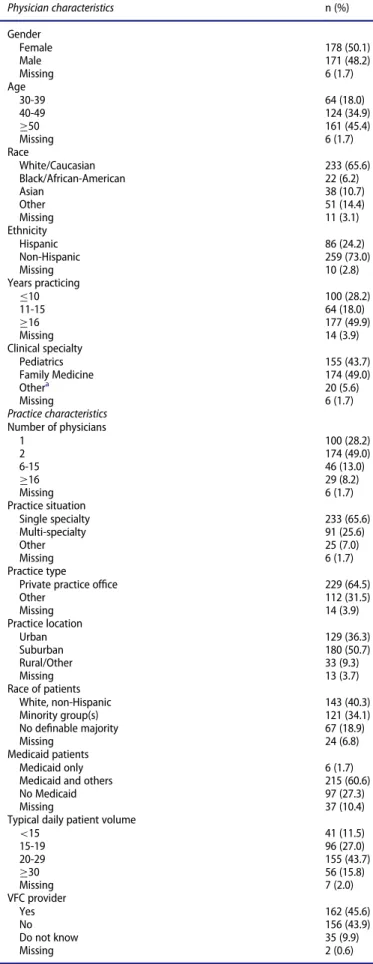
The sample was about equally comprised of female (50.1%) and male (48.2%) physicians (Table 1). Participants’ average age was 48.7 years (standard deviation [SD] D9.0), about 65.6% were White and 73.0% were non-Hispanic. Half (49.0%) spe-cialized in family medicine and 49.9% had been practicing for 16 or more years.
Regarding practice characteristics, the highest proportion (49.0%) of physicians reported their practice had two physi-cians. About two-thirds (65.6%) described their practice as single specialty, 64.5% worked in private practice, and 50.7% reported their practice was in a suburban location. Fewer than half (40.3%) reported seeing mostly White, non-Hispanic patients, and about 60.6% saw patients who used either Medicaid or another form of payment. Nearly half (45.6%) of surveyed physicians were a Vaccines for Children (VFC) provider.
The anonymous nature of the survey precludes examining the degree to which survey responders and non-responders were similar on demographic and practice characteristics. However, we were able to compare responding physicians to the population of physicians in Florida meeting our study eligi-bility criteria on characteristics including age, sex, and clinical specialty. We found no statistically significant difference in age for responding physicians (MD48.7, SDD9.0) compared to the larger population of Florida physicians (MD 48.8,SD D
10.0),t(410.67)D0.28,pD.78. A similar proportion of females
Table 1.Demographic and practice characteristics of physicians who participated in the survey (ND355).
Physician characteristics n (%)
Gender
Female 178 (50.1)
Male 171 (48.2)
Missing 6 (1.7)
Age
30-39 64 (18.0)
40-49 124 (34.9)
50 161 (45.4)
Missing 6 (1.7)
Race
White/Caucasian 233 (65.6)
Black/African-American 22 (6.2)
Asian 38 (10.7)
Other 51 (14.4)
Missing 11 (3.1)
Ethnicity
Hispanic 86 (24.2)
Non-Hispanic 259 (73.0)
Missing 10 (2.8)
Years practicing
10 100 (28.2)
11-15 64 (18.0)
16 177 (49.9)
Missing 14 (3.9)
Clinical specialty
Pediatrics 155 (43.7)
Family Medicine 174 (49.0)
Othera 20 (5.6)
Missing 6 (1.7)
Practice characteristics
Number of physicians
1 100 (28.2)
2 174 (49.0)
6-15 46 (13.0)
16 29 (8.2)
Missing 6 (1.7)
Practice situation
Single specialty 233 (65.6)
Multi-specialty 91 (25.6)
Other 25 (7.0)
Missing 6 (1.7)
Practice type
Private practice office 229 (64.5)
Other 112 (31.5)
Missing 14 (3.9)
Practice location
Urban 129 (36.3)
Suburban 180 (50.7)
Rural/Other 33 (9.3)
Missing 13 (3.7)
Race of patients
White, non-Hispanic 143 (40.3)
Minority group(s) 121 (34.1)
No definable majority 67 (18.9)
Missing 24 (6.8)
Medicaid patients
Medicaid only 6 (1.7)
Medicaid and others 215 (60.6)
No Medicaid 97 (27.3)
Missing 37 (10.4)
Typical daily patient volume
<15 41 (11.5)
15-19 96 (27.0)
20-29 155 (43.7)
30 56 (15.8)
Missing 7 (2.0)
VFC provider
Yes 162 (45.6)
No 156 (43.9)
Do not know 35 (9.9)
Missing 2 (0.6)
Notes. Abbreviation: VFC, Vaccines for Children program
aOther clinical specialty includes Urgent Care, Acute Care, Internal Medicine,
responded to our survey (51.3%) compared to the population of Florida physicians (46.7%),x2(1,N D6,907)D2.82,pD.09. Survey responders were similar to Florida physicians regarding pediatric specialty (43.3% responders vs. 37.2% in Florida) and family medicine specialty (50.3% responders vs. 56.8% in Flor-ida),x2(2,ND6,915)D6.10,pD.05.
Content of HPV vaccine communication
Optional versus routine HPV vaccination
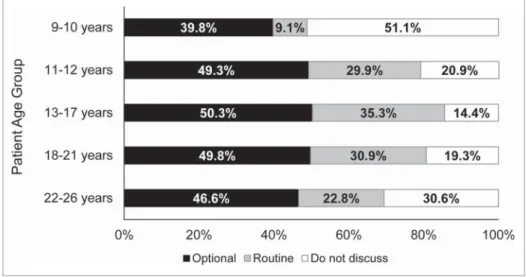
Physicians reported presenting HPV vaccination as routine most often (35.3%) to males ages 13-17, followed by males ages 18-21 (30.9%) (Fig. 1). Few physicians presented HPV vaccine as routine to males in the early vaccination group (ages 9-10; 9.1%) and for males in the age group for whom HPV vaccine is recommended only for special populations (ages 22-26; 22.8%). Less than one-third (29.9%) reported they typically present HPV vaccine as routine for 11-12 year old males; an additional 20.9% reported they do not discuss HPV vaccine with this age group. For all age groups, more physicians reported they pre-sented HPV vaccine as an optional, rather than routine, vaccine.
HPV vaccine relative to other adolescent immunizations
Among physicians who did not indicate they do not see 11- to 12-year-old males, more than half (57.3%) recommended HPV vaccine less strongly and 41.2% recommended HPV vaccine as strongly as tetanus, diphtheria, and pertussis (Tdap) vaccine (data not shown). Relative to meningococcal vaccine, about half (50.9%) recommended HPV vaccine less strongly, whereas 46.2% recommended HPV vaccine as strongly. Few physicians recommended HPV vaccine more strongly than Tdap (1.5%) and meningococcal vaccine (2.9%).
Emphasis during discussion
When discussing HPV vaccination with male patients and
their parents, many physicians reported somewhat or
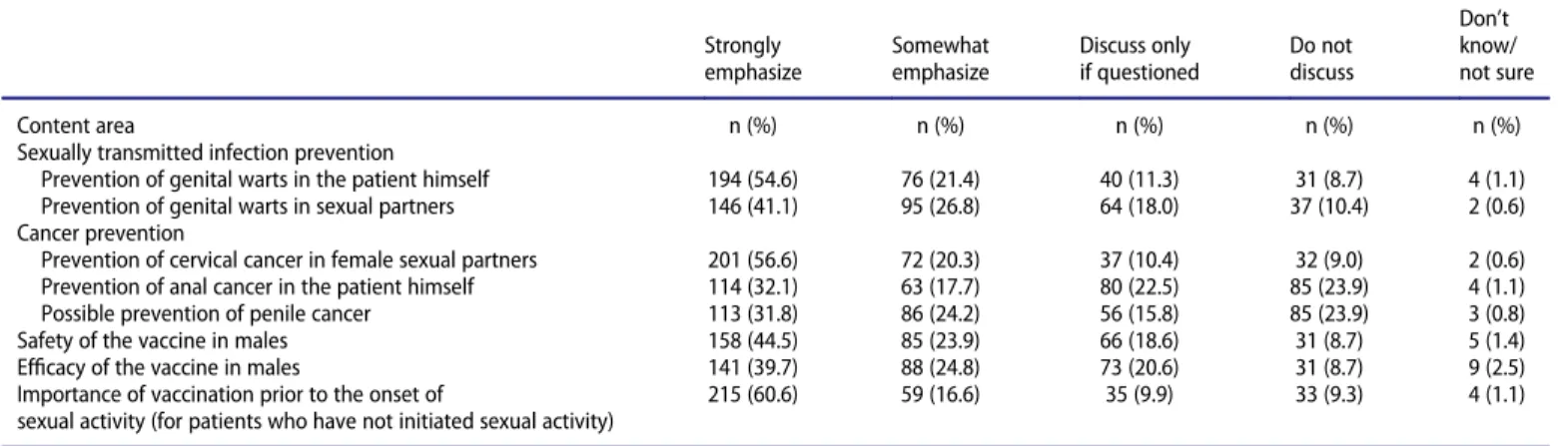
strongly emphasizing cancer prevention (80.0%), sexually transmitted infection (STI) prevention (77.8%), the impor-tance of vaccinating prior to the onset of sexual activity (77.2%), vaccine safety (68.5%), and vaccine efficacy (64.5%) (Table 2). Over half (57.8%) somewhat or strongly
emphasized all five aspects in their discussions, whereas 13.8% did not emphasize any of the aspects (data not shown). About three-quarters (76.1%) stressed both STI and cancer prevention in their discussions, whereas few empha-sized STI (1.4%) or cancer (3.9%) prevention without
emphasizing the other. Physicians who somewhat or
strongly emphasized cancer prevention tended to emphasize cervical cancer prevention in female sexual partners (76.9%); fewer emphasized prevention of anal cancer (49.8%) and possible prevention of penile cancer (56.0%) in the patient himself (Table 2).
We further explored whether physicians strongly empha-sized cancer and STI prevention in their discussions. Regarding cancer prevention generally, 22.5% of physicians strongly
emphasized prevention of cervical cancer in female sexual part-ners, prevention of anal cancer in the patient himself,and pos-sible prevention of penile cancer (data not shown). For STI prevention, 39.2% of physicians strongly emphasized preven-tion of genital warts in both the patient himself and in sexual partners. For the patient himself, about one-third of physicians
strongly emphasized prevention of anal (32.1%) or penile (31.8%) cancer and just over half (54.6%)stronglyemphasized prevention of genital warts (Table 2).
Context of HPV vaccine communication
Opportunities for communication
Similar numbers of physicians conveyed that they saw ado-lescent males who presented for school or college physicals (70.1%), acute care visits (68.2%), well-child visits (68.2%), and sports physicals (66.2%); fewer saw male patients for camp physicals (53.2%) and when the patient is in for other vaccines (42.5%) (Fig. 2). Among those who saw male patients for a particular type of visit, physicians most often
also discussed HPV vaccine at well-child visits (93.0%), fol-lowed by when the patient is in for other vaccines (82.1%), school or college physicals (81.1%), sports physicals (56.2%), camp physicals (54.5%), and acute care visits (15.3%) (data not shown).
Other healthcare professionals
Regarding other healthcare professionals’involvement in HPV vaccine discussion and recommendation, over half of physi-cians indicated that at least one other healthcare professional in their practice discusses (56.1%) or makes the initial recommen-dation for (54.9%) HPV vaccination. Physicians most often
reported that a nurse practitioner (30.7%) in their practice dis-cusses HPV vaccination with patients, followed by a medical assistant (24.2%), physician assistant (15.8%), and nurse (14.9%). Similar percentages of physicians reported that these healthcare professionals make the initial recommendation for HPV vaccination: nurse practitioner (29.9%), medical assistant (25.1%), physician assistant (16.6%), and nurse (16.6%).
Discussion
This study describes the content and context of physicians’ communication about HPV vaccine with male patients and their parents. We found that many primary care physicians in Table 2.Content of physicians’discussion about HPV vaccine with male patients and their parents.
Strongly emphasize
Somewhat emphasize
Discuss only if questioned
Do not discuss
Don’t know/ not sure
Content area n (%) n (%) n (%) n (%) n (%)
Sexually transmitted infection prevention
Prevention of genital warts in the patient himself 194 (54.6) 76 (21.4) 40 (11.3) 31 (8.7) 4 (1.1) Prevention of genital warts in sexual partners 146 (41.1) 95 (26.8) 64 (18.0) 37 (10.4) 2 (0.6) Cancer prevention
Prevention of cervical cancer in female sexual partners 201 (56.6) 72 (20.3) 37 (10.4) 32 (9.0) 2 (0.6) Prevention of anal cancer in the patient himself 114 (32.1) 63 (17.7) 80 (22.5) 85 (23.9) 4 (1.1) Possible prevention of penile cancer 113 (31.8) 86 (24.2) 56 (15.8) 85 (23.9) 3 (0.8) Safety of the vaccine in males 158 (44.5) 85 (23.9) 66 (18.6) 31 (8.7) 5 (1.4) Efficacy of the vaccine in males 141 (39.7) 88 (24.8) 73 (20.6) 31 (8.7) 9 (2.5) Importance of vaccination prior to the onset of
sexual activity (for patients who have not initiated sexual activity)
215 (60.6) 59 (16.6) 35 (9.9) 33 (9.3) 4 (1.1)
Note. Percentages account for missing data. Missing data for each item ranged from 9 to 13 participants.
our sample reported HPV vaccine communication practices that are inconsistent with national guidelines1 and evidence-based recommendations.4,8 The Centers for Disease Control and Prevention suggests that physicians recommend HPV vac-cine the same way as other adolescent vacvac-cines by stating that the child needs shots and then listing the ACIP-recommended vaccines for his or her age.19Although ACIP recommends rou-tine vaccination for males ages 11-12,1 only 29.9% present HPV vaccine as a routine at this age, which is a likely contribu-tor to low vaccination rates. Although a higher proportion of physicians reported presenting HPV vaccine as routine for older ages, far fewer older adolescents present for preventive care.20 Consequently, a large proportion of these patients may never receive a routine recommendation, even if it is the physi-cians’intent to recommend more strongly at an older age.
In our study, over half of physicians reported recommend-ing HPV vaccine less strongly than Tdap and menrecommend-ingococcal vaccines. Our findings echo other research conducted with a national sample of pediatricians and family physicians.14This research found significantly higher proportions of physicians endorse Tdap (95%) and meningococcal (87%) vaccines com-pared to HPV vaccine (73%). Moreover, physicians in that study reported that they perceived parents’ endorsement of Tdap (74%) and meningococcal (62%) vaccines as much higher than for HPV vaccine (13%). Thus, physicians may recom-mend Tdap and meningococcal vaccines more strongly than HPV vaccine because of their perceived support, and lower resistance, from parents. Physicians also may be more inclined to recommend Tdap and meningococcal vaccines more strongly than HPV vaccine because meningococcal meningitis, diphtheria, and pertussis are easily transmitted through casual contact,21-23whereas HPV is transmitted sexually.
Although not transmitted through casual contact, HPV infection is common and persistent infection can lead to can-cer;24as such, evidence-based approaches to vaccine communi-cation suggest emphasizing that HPV vaccine prevents cancer.4 In our study, about 80% of physicians somewhat or strongly emphasized some aspect of the vaccine’s cancer prevention benefits, but far fewer (22.5%) strongly emphasized cancer pre-vention for multiple cancers. Moreover, more physicians highlighted HPV vaccine’s cancer prevention benefits for female sexual partners than for the male patient himself, with only about one-third of physicians reporting they strongly emphasize that HPV vaccine can prevent anal cancer and pos-sibly prevent penile cancer. This behavior may reflect a limited understanding of HPV-related disease in and the vaccine’s can-cer prevention benefits for males.25 Alternatively, one study found that physicians may be aware of these benefits, but are uncomfortable discussing anal and penile cancers with male patients and their parents.17Some physicians in the study who acknowledged the cancer prevention benefits for males per-ceived this benefit as unimportant because of the low incidence of these cancers and, as a result, do not discuss these cancers when offering HPV vaccine to males. In our study, more physi-cians emphasized prevention of genital warts than cancer as a direct benefit of vaccination. What remains unclear is which message physicians used to lead their communication and the depth to which they discuss these messages, and whether these are important factors in parents’ subsequent agreement to
vaccinate their child. Also, it is important to recognize that potential variation in physicians’ interpretation of what it means tosomewhat orstrongly emphasize cancer or STI pre-vention limits our understanding of gradations in these discus-sions. At the same time, available recommendations for vaccine communication advise physicians in rather general terms, such as framing HPV vaccine as a vaccine that prevents cancer.4 Additional evidence is needed on what constitutes a strong emphasis to support best clinical practices and establish a benchmark for measuring those practices.
Nearly all physicians took advantage of well-child visits to discuss HPV vaccine, but are missing other opportunities to communicate with males about the vaccine, particularly sick visits. Thisfinding is consistent with previous research indicat-ing that fewer than half of physicians discuss adolescent vac-cines at sick visits; however, when they do, physicians more often discuss Tdap and meningococcal vaccine than HPV vac-cine.14Physicians who reported not discussing adolescent vac-cines during sick visits most often cited that vaccination is better suited for a well visit. Physicians’disinclination to discuss HPV vaccine outside of well-child visits is particularly worri-some because boys’ compliance with well-child visit recom-mendations declines after age 1226 and teenage boys usually visit a healthcare provider as a result of acute illness or injury.27 Thus, not taking advantage of every clinical encounter to dis-cuss HPV vaccine perpetuates the current problem of missing opportunities for vaccination and undermining HPV-related cancer prevention efforts.
Over half of physicians in our study indicated that other healthcare providers in their practice setting discuss and rec-ommend HPV vaccine. Given documented barriers related to physicians’time to discuss HPV vaccination,28,29non-physician healthcare providers can be instrumental in facilitating vaccine uptake. These professionals may have more frequent and extended contact with patients,30 allowing greater opportunity to discuss and recommend HPV vaccination. We are aware of few studies that have targeted this group directly as a means to reduce missed clinical opportunities for HPV vaccination. One intervention study found that a structured presentation was effective in increasing physicians’and non-physician healthcare workers’ knowledge about HPV vaccine.31 Although these results are promising, we recognize that changes in knowledge do not necessarily translate to changes in clinical practice behaviors. Additional research is needed on non-physician healthcare providers’role in and needs for effectively commu-nicating about HPV vaccination.
To our knowledge, our study is among thefirst to focus on both the content and context of physicians’HPV vaccine com-munication specifically with male adolescent patients and their parents. Study strengths include a statewide sample of primary care providers in Florida and an examination of multiple com-ponents of physicians’communication.
study design precludes our ability to examine whether physi-cian communication about HPV vaccine results in subsequent vaccine uptake. Fourth, the survey design did not allow us to differentiate communication content and context based on the adolescent’s age. Because some research shows that physicians’ communication is influenced by patient age,17 future research should further examine this relationship. Also, the survey did not assess physicians’discussion of oropharyngeal cancer pre-vention. Although HPV vaccine is not indicated for prevention of oropharyngeal cancers,32about 72% of oropharyngeal can-cers are probably caused by HPV.33Thus, some physicians may emphasize possible prevention of oropharyngeal cancers in their discussions. Finally, our survey did not include quantita-tive anchors to help standardize the distinction between
strongly emphasize and somewhat emphasize responses; thus, physicians’interpretation of these response options may vary.
Taken together, ourfindings identify areas for future inter-ventions to improve physicians’ HPV vaccine communication and, ultimately, increase the use of this cancer-preventing cine. These areas include helping physicians present HPV vac-cine as a routine part of the adolescent vaccination platform at ages 11-12 when males are still presenting routinely for well-child care, and as a vaccine that prevents cancer; to take advan-tage of all clinical encounters, particularly acute visits; and to maximize the use of support offered by non-physician health-care professionals in communicating about HPV vaccination with patients. Without such interventions to support physi-cians’communication, HPV vaccine may remain underused by males, leaving them susceptible to unnecessary and preventable cancers.
Methods
Recruitment
We obtained a full mailing list of Florida-based pediatricians and family medicine physicians from an American Medical Association (AMA) Physician Masterfile licensee. Exclusion criteria were: 1) trainee status (i.e., residents and fellows), 2) locum tenens, 3) non-patient care reported as their major pro-fessional activity, 4) age 65 years or older, given that the AMA Masterfile has shown a significant lag in posting physician retirements,34and 5) post office box listed as an address, which would preclude our ability to reach physicians using our FedEx mailing strategy. We randomly selected physicians from pediat-ric and family medicine specialties based on their proportional representation in the Florida physician primary care workforce (nD770). After receiving institutional review board approval, we mailed pre-notice postcards in May 2014. We mailed the first wave of surveys via FedEx in June 2014 and sent reminders to non-responders through August 2014. The first survey packet included an up-front $25 cash incentive to participate.
Instrument
Our anonymous survey assessed multiple components of the content of physicians’communication about HPV vaccine and the context in which it occurs. Survey items pertaining to con-tent and context were based in part on a previous survey on
physician recommendation for HPV vaccination of males.35To be clear, we asked physicians to respond to all items with regard to their male patients. We assessed the content of physicians’ discussions about HPV vaccine for three domains. First, the survey asked physicians,“How do you usually present the HPV vaccine to your male patients/parents of male patients, in the following age groups [9-10, 11-12, 13-17, 18-21, 22-26]?” Response options includedHPV vaccine is optional, HPV vac-cine is routine, I do not discuss HPV vacvac-cine with this age group, andI do not see male patients in this age group. Second, because ACIP guidelines recommend routine HPV vaccination for 11-12 year old males,36 we asked physicians two questions regarding the strength with which they recommend HPV vac-cine relative to other ACIP-recommended vacvac-cines on the 11-12 year old immunization platform. The survey asked,“For 11-12-year-old males, I recommend the HPV vaccine [less strongly than MCV4/Tdap, as strongly as MCV4/Tdap, more strongly than MCV4/Tdap].” MCV4 refers to meningococcal conjugate vaccine and Tdap refers to tetanus, diphtheria, and pertussis vaccine. Physicians also could indicate they do not see 11- to 12-year-old males.
Third, we assessed the content of physicians’discussions by asking,“When discussing HPV vaccination with male patients and their parents, how much emphasis do you place on the fol-lowing aspects of the vaccine?”Content areas included preven-tion of genital warts in the patient himself, prevenpreven-tion of genital warts in sexual partners, prevention of cervical cancer in female sexual partners, prevention of anal cancer in the patient himself, possible prevention of penile cancer, vaccine safety in males, vaccine efficacy in males, and importance of vaccination prior to the onset of sexual activity (for patients who have not initiated sexual activity). Response options includedstrongly emphasize, somewhat emphasize, discuss only if questioned, do not discuss, and don’t know/not sure. We reviewed these items individually, as well as examined emphasis on prevention of STIs and cancer on a broader scale. The two items pertaining to genital warts were collapsed to reflect dis-cussion about STI prevention such that asomewhat emphasize
orstrongly emphasizeresponse to at least one item constituted a discussion about STI prevention. The three items pertaining to cancer were similarly collapsed to reflect discussion about cancer prevention.
or BSN), nurse practitioner, physician assistant, other, ornone of the above.
Physician characteristics measured included sex, age, race, ethnicity, number of years in practice, and clinical specialty. Practice characteristics included the number of physicians in the practice, practice situation (single specialty, multispecialty, other), practice type (private, other), practice location (urban, suburban, rural, other), race/ethnic category of the majority of patients seen, whether the practice serves patients who use Medicaid (Medicaid patients only, Medicaid and privately insured patients, no Medicaid patients), typical daily patient load, and whether the physician is a VFC provider.
Data analysis
We calculated frequencies and percentages for all variables using the SASÒ 9.3 statistical software package (SAS Institute Inc., Cary, North Carolina).
Abbreviations
ACIP Advisory Committee on Immunization Practices
AMA American Medical Association
HPV human papillomavirus
MCV4 meningococcal conjugate vaccine STI sexually transmitted infection Tdap tetanus, diphtheria, pertussis
VFC Vaccines for Children program
US United States
Disclosure of potential conflicts of interest
A.R.G. has received grant funding from Merck and is a consultant for Merck. The remaining authors report no conflicts.
Funding
This research was supported by a grant from the Bankhead-Coley Cancer Research Program (4BB10). Dr. Teri Malo is supported by the UNC Line-berger Cancer Control Education Program (R25CA057726). This work also has been supported in part by the Biostatistics Core Facility at the H. Lee Moffitt Cancer Center & Research Institute, an NCI designated Com-prehensive Cancer Center (P30-CA076292).
References
[1] Centers for Disease Control and Prevention. Recommendations on the use of quadrivalent human papillomavirus vaccine in males– Advisory Committee on Immunization Practices (ACIP), 2011. MMWR Morb Mortal Wkly Rep 2011; 60:1705-8; PMID:22189893 [2] Reagan-Steiner S, Yankey D, Jeyarajah J, Elam-Evans LD, Singleton
JA, Curtis CR, MacNeil J, Markowitz LE, Stokley S. National, regional, state, and selected local area vaccination coverage among adolescents aged 13-17 years - United States, 2014. MMWR Morb Mortal Wkly Rep 2015; 64:784-92; PMID:26225476; http://dx.doi. org/10.15585/mmwr.mm6429a3
[3] Centers for Disease Control and Prevention. HPV-associated anal cancer rates by state [Internet]. 2014 [cited 2015 Sept 11]. Available from: http://www.cdc.gov/cancer/hpv/statistics/state/anal.htm [4] Accelerating HPV Vaccine Uptake: Urgency for Action to Prevent
Cancer. A Report to the President of the United States from the Pres-ident’s Cancer Panel. Bethesda, MD, 2014.
[5] Stokley S, Jeyarajah J, Yankey D, Cano M, Gee J, Roark J, Curtis RC, Markowitz L. Human papillomavirus vaccination coverage among adolescents, 2007-2013, and postlicensure vaccine safety monitoring, 2006-2014 - United States. MMWR Morb Mortal Wkly Rep 2014; 63:620-4; PMID:25055185
[6] Gilkey MB, Moss JL, McRee AL, Brewer NT. Do correlates of HPV vaccine initiation differ between adolescent boys and girls? Vaccine 2012; 30:5928-34; PMID:22841973; http://dx.doi.org/10.1016/j. vaccine.2012.07.045
[7] Centers for Disease Control and Prevention. Human papillomavirus vaccination coverage among adolescent girls, 2007-2012, and postli-censure vaccine safety monitoring, 2006-2013 - United States. MMWR Morb Mortal Wkly Rep 2013; 62:591-5; PMID:23884346 [8] National Foundation for Infectious Diseases. Call to Action: HPV
Vaccination as a Public Health Priority [Internet]. 2014 [cited 2015 Sept 21]. Available from: http://www.adolescentvaccination.org/pro fessional-resources/hpv-resource-center/hpv-call-to-action.pdf [9] Gonik B. Strategies for fostering HPV vaccine acceptance. Infect Dis
Obstet Gynecol 2006; 2006 Suppl:36797; PMID:16967911
[10] McKeever AE, Bloch JR, Marrell M. Human papillomavirus vaccina-tion uptake and complevaccina-tion as a preventive health measure among female adolescents. Nurs Outlook 2015; 63:341-8; PMID:25982773; http://dx.doi.org/10.1016/j.outlook.2014.08.011
[11] Goff SL, Mazor KM, Gagne SJ, Corey KC, Blake DR. Vaccine counseling: a content analysis of patient-physician discussions regarding human papilloma virus vaccine. Vaccine 2011; 29:7343-9; PMID:21839136; http://dx.doi.org/10.1016/j.vaccine.2011.07.082 [12] Hughes CC, Jones AL, Feemster KA, Fiks AG. HPV vaccine decision
making in pediatric primary care: a semi-structured interview study. BMC Pediatr 2011; 11:74; PMID:21878128; http://dx.doi.org/ 10.1186/1471-2431-11-74
[13] Gilkey MB, Malo TL, Shah PD, Hall ME, Brewer NT. Quality of physician communication about human papillomavirus vaccine:findings from a national survey. Cancer Epidemiol Biomarkers Prev 2015; 24:1673-9; PMID:26494764; http://dx.doi.org/10.1158/1055-9965.EPI-15-0326 [14] Gilkey MB, Moss JL, Coyne-Beasley T, Hall ME, Shah PD, Brewer
NT. Physician communication about adolescent vaccination: how is human papillomavirus vaccine different? Prev Med 2015; 77:181-5; PMID:26051197; http://dx.doi.org/10.1016/j.ypmed.2015.05.024 [15] Daley MF, Liddon N, Crane LA, Beaty BL, Barrow J, Babbel C,
Mar-kowitz LE, Dunne EF, Stokley S, Dickinson LM, et al. A national sur-vey of pediatrician knowledge and attitudes regarding human papillomavirus vaccination. Pediatrics 2006; 118:2280-9; PMID:17142510; http://dx.doi.org/10.1542/peds.2006-1946 [16] Jensen ME, Hartenbach E, McElroy JA, Faerber A, Havighurst T,
Kim KM, Bailey HH. Measuring the attitudes of health care profes-sionals in Dane County toward adolescent immunization with HPV vaccine. WMJ 2009; 108:203-5; PMID:19753828
[17] Alexander AB, Best C, Stupiansky N, Zimet GD. A model of health care provider decision making about HPV vaccination in adolescent males. Vaccine 2015; 33:4081-6; PMID:26143612; http://dx.doi.org/ 10.1016/j.vaccine.2015.06.085
[18] McRee AL, Gilkey MB, Dempsey AF. HPV vaccine hesitancy:fi nd-ings from a statewide survey of health care providers. J Pediatr Health Care 2014; 28:541-9; PMID:25017939; http://dx.doi.org/ 10.1016/j.pedhc.2014.05.003
[19] Centers for Disease Control and Prevention. Tips and time-savers for talking with parents about HPV vaccine [Internet]. 2013 [cited 2015 Jul 23]. Available from: http://www.cdc.gov/vaccines/who/teens/for-hcp-tipsheet-hpv.html
[20] Marcell AV, Klein JD, Fischer I, Allan MJ, Kokotailo PK. Male ado-lescent use of health care services: where are the boys? J Adolesc Health 2002; 30:35-43; PMID:11755799; http://dx.doi.org/10.1016/ S1054-139X(01)00319-6
[22] Centers for Disease Control and Prevention.Diphtheria: causes and transmission. [Internet]. 2015 [cited 2015 Nov 30]. Available from: http://www.cdc.gov/diphtheria/about/causes-transmission.html [23] Centers for Disease Control and Prevention. Pertussis (whooping
cough): causes and transmission. [Internet]. 2015 [cited 2015 Nov 30]. Available from: http://www.cdc.gov/pertussis/about/causes-trans mission.html
[24] National Cancer Institute. HPV and Cancer [Internet]. 2015 [cited 2015 Sept 22]. Available from: http://www.cancer.gov/about-cancer/ causes-prevention/risk/infectious-agents/hpv-fact-sheet
[25] Perkins RB, Clark JA. Providers’attitudes toward human papilloma-virus vaccination in young men: challenges for implementation of 2011 recommendations. Am J Mens Health 2012; 6:320-3; PMID:22398992; http://dx.doi.org/10.1177/1557988312438911 [26] Selden TM. Compliance with well-child visit recommendations:
evi-dence from the Medical Expenditure Panel Survey, 2000-2002. Pedi-atrics 2006; 118:e1766-78; PMID:17142499; http://dx.doi.org/ 10.1542/peds.2006-0286
[27] Westwood M, Pinzon J. Adolescent male health. Paediatr Child Health 2008; 13:31-6; PMID:19119350
[28] Vadaparampil ST, Malo TL, Kahn JA, Salmon DA, Lee JH, Quinn GP, Roetzheim RG, Bruder KL, Proveaux TM, Zhao X, et al. Physi-cians’human papillomavirus vaccine recommendations, 2009 and 2011. Am J Prev Med 2014; 46:80-4; PMID:24355675; http://dx.doi. org/10.1016/j.amepre.2013.07.009
[29] Daley MF, Crane LA, Markowitz LE, Black SR, Beaty BL, Barrow J, Babbel C, Gottlieb SL, Liddon N, Stokley S, et al. Human papilloma-virus vaccination practices: a survey of US physicians 18 months
after licensure. Pediatrics 2010; 126:425-33; PMID:20679306; http:// dx.doi.org/10.1542/peds.2009-3500
[30] DeLucia PR, Ott TE, Palmieri PA. Performance in nursing. Rev Hum Factors Ergonomics 2009; 5:1-40; http://dx.doi.org/10.1518/ 155723409X448008
[31] Berenson AB, Rahman M, Hirth JM, Rupp RE, Sarpong KO. A brief educational intervention increases providers’human papillomavirus vaccine knowledge. Hum Vaccin Immunother 2015; 11:1331-6; PMID:25945895; http://dx.doi.org/10.1080/21645515.2015.1022691 [32] US. Food and Drug Administration. Gardasil (human papillomavirus
quadrivalent [types 6, 11, 16 and 18]): Highlights of prescribing information [Internet]. 2010 [cited 2015 Oct 1]. Available from: http://www.fda.gov/downloads/biologicsbloodvaccines/vaccines/ approvedproducts/ucm111263.pdf
[33] Centers for Disease Control and Prevention. How many cancers are linked with HPV each year? [Internet]. 2014 [cited 2015 Oct 1]. Available from: http://www.cdc.gov/cancer/hpv/statistics/cases.htm [34] Kletke PR. Physician workforce data: when the best is not good
enough. Health Serv Res 2004; 39:1251-5; PMID:15333107; http://dx. doi.org/10.1111/j.1475-6773.2004.00288.x
[35] Allison MA, Dunne EF, Markowitz LE, O’Leary ST, Crane LA, Hur-ley LP, StokHur-ley S, Babbel CI, Brtnikova M, Beaty BL, et al. HPV vacci-nation of boys in primary care practices. Acad Pediatr 2013; 13:466-74; PMID:24011749; http://dx.doi.org/10.1016/j.acap.2013.03.006 [36] Markowitz LE, Dunne EF, Saraiya M, Chesson HW, Curtis CR, Gee