Glecaprevir and Pibrentasvir for 12
Weeks for Hepatitis C Virus Genotype 1
Infection and Prior Direct-Acting
Antiviral Treatment
Fred Poordad,1Franco Felizarta,2Armen Asatryan,3Mark S. Sulkowski,4Robert W. Reindollar,5Charles S. Landis,6
Stuart C. Gordon,7Steven L. Flamm,8Michael W. Fried,9David E. Bernstein,10Chih-Wei Lin,3Ran Liu,3Sandra S. Lovell,3
Teresa I. Ng,3Jens Kort,3and Federico J. Mensa3
Although direct-acting antiviral (DAA) therapies for chronic hepatitis C virus (HCV) infection have demonstrated high rates of sustained virologic response, virologic failure may still occur, potentially leading to the emergence of viral resis-tance, which can decrease the effectiveness of subsequent treatment. Treatment options for patients who failed previous DAA-containing regimens, particularly those with nonstructural protein 5A inhibitors, are limited and remain an area of unmet medical need. This phase 2, open-label study (MAGELLAN-1) evaluated the efficacy and safety of glecaprevir (GLE)1pibrentasvir (PIB)6ribavirin (RBV) in HCV genotype 1–infected patients with prior virologic failure to HCV DAA-containing therapy. A total of 50 patients without cirrhosis were randomized to three arms: 200 mg GLE180 mg PIB (arm A), 300 mg GLE1120 mg PIB with 800 mg once-daily RBV (arm B), or 300 mg GLE1120 mg PIB with-out RBV (arm C). By intent-to-treat analysis, sustained virologic response at posttreatment week 12 was achieved in 100% (6/6, 95% confidence interval 61-100), 95% (21/22, 95% confidence interval 78-99), and 86% (19/22, 95% confi-dence interval 67-95) of patients in arms A, B, and C, respectively. Virologic failure occurred in no patients in arm A and in 1 patient each in arms B and C (two patients were lost to follow-up in arm C). The majority of adverse events were mild in severity; no serious adverse events related to study drug and no relevant laboratory abnormalities in alanine amino-transferase, total bilirubin, or hemoglobin were observed.Conclusion:The combination of GLE and PIB was highly effica-cious and well tolerated in patients with HCV genotype 1 infection and prior failure of DAA-containing therapy; RBV coadministration did not improve efficacy. (HEPATOLOGY2017;66:389-397).
H
epatitis C virus (HCV) genotype (GT) 1 is the most common among HCV GTs glob-ally, accounting for approximately 46% of an estimated 185 million infections worldwide.(1,2) Although the treatment landscape for HCV has rapid-ly evolved with highrapid-ly effective and safe treatments for patients with GT1 infection,(3,4) as direct-acting anti-viral (DAA) agents are used extensively, the number of patients with virologic failure of DAA regimens contin-ues to grow.(5)Virologic failure of DAAs often results from baseline resistance-associated polymorphisms orresistance-associated substitutions that emerge during therapy.(4-8) Variants within the HCV nonstructural protein 5A (NS5A) region substantially increase the risk of virologic failure for many DAA-containing regi-mens,(9,10)and there are currently no treatments specifi-cally indicated for either NS5A or NS5B inhibitor– experienced patients.
DAA treatment failure is a growing concern given the long-term persistence of NS5A resistance-associated variants(11,12) and suboptimal treatment response rates in patients with resistance-associated
Abbreviations: CI, confidence interval; DAA, direct-acting antiviral; EC50, half-maximal effective concentration; GLE, glecaprevir; GT, genotype; HCV, hepatitis C virus; ITT, intent-to-treat; mITT, modified ITT; NS, nonstructural; PI, protease inhibitor; PIB, pibrentasvir; RBV, ribavirin; SVR12, sustained virologic response at posttreatment week 12.
Received October 25, 2016; accepted January 23, 2017.
Additional Supporting Information may be found atonlinelibrary.wiley.com/doi/10.1002/hep.29081/suppinfo.
baseline polymorphisms or treatment-emergent substi-tutions.(9,13,14) Retreatment strategies using 24 weeks of ledipasvir/sofosbuvir have demonstrated a 60% sus-tained virologic response at posttreatment week 12 (SVR12) rate among patients with baseline NS5A poly-morphisms and 33% in patients with NS5A Y93H/N polymorphisms.(14)Similarly, the combination regimen of elbasvir and grazoprevir has reduced efficacy (70%) in GT1a-infected patients with baseline NS5A resistance-associated polymorphisms at elbasvir-specific positions (e.g., M28, Q30, L31, Y93).(9,15)In addition, the com-bination of sofosbuvir/velpatasvir has reduced potency to HCV GT1a NS5A variants at position Y93, includ-ing the common Y93H variant, which confers a 609-fold increase in half-maximal effective concentration (EC50) to velpatasvir.(16) Therefore, treatments with a high barrier to viral resistance that maintain potency against viral variants, particularly for patients previously treated with HCV DAAs, are needed.
Current recommended retreatment strategies for patients with prior failure of NS3/4A protease inhibitor
(PI)–containing DAA regimens include the NS5B nucleotide analogue inhibitor sofosbuvir plus an NS5A inhibitor (ledipasvir, velpatasvir, or daclatasvir) for 12 weeks or the combination of the NS3/4A PI grazoprevir plus the NS5A inhibitor elbasvir with ribavirin (RBV) for 16 weeks.(16)Patients with baseline NS5A variants, either preexisting or the result of treatment emergence from prior exposure to an NS5A inhibitor, have proven more difficult to cure with approved DAA regimens; thus, longer treatment durations, addition of RBV, and the addition of a third or fourth DAA have been exam-ined to maximize SVR12 rates.(14,17-20)
Glecaprevir (GLE; formerly ABT-493; identified by AbbVie and Enanta) is an HCV NS3/4A PI that has potent pangenotypic antiviral activity. GLE does not inhibit human proteases, exhibits in vitro EC50 values5 nanomolar across all major HCV GTs, and demonstrates<5-fold loss of activity against common GT1 variants at key resistance-associated positions of R155 and D168 to currently available NS3/4A PIs.(6,21) Pibrentasvir (PIB; formerly ABT-530) is an
CopyrightVC2017 The Authors. HEPATOLOGYpublished by Wiley Periodicals, Inc., on behalf of the American Association for the Study of Liver Diseases. This is an open access article under the terms of the Creative Commons Attribution-NonCommercial-NoDerivs License, which permits use and distribution in any medium, provided the original work is properly cited, the use is noncommercial, and no modifications or adaptations are made.
View this article online at wileyonlinelibrary.com. DOI 10.1002/hep.29081
Potential conflict of interest: Dr. Reindollar is on the speakers’ bureau for AbbVie. Dr. Asatryan is employed by and owns stock in AbbVie. Dr. Kort is employed by and owns stock in AbbVie. Dr. Landis received grants from Gilead and AbbVie. Dr. Sulkowski consults, advises, and received grants from AbbVie, Gilead, and Merck. He consults and advises Janssen, Trek, and Cocrystal. Dr. Mensa is employed by and owns stock in AbbVie. Dr. Lovell is employed by and owns stock in AbbVie. Dr. Felizarta is on the speakers’ bureau and received grants from AbbVie, Gilead, Janssen, and Merck. Dr. Lin is employed by and owns stock in AbbVie. Dr. Liu is employed by and owns stock in AbbVie. Dr. Ng is employed by and owns stock in AbbVie. Dr. Fried consults and received grants from AbbVie, Bristol-Myers Squibb, Gilead, and Merck. He owns stock in Target. Dr. Bernstein consults and received grants from AbbVie. Dr. Flamm consults, advises, is on the speakers’ bureau, and received grants from AbbVie and Gilead. He consults, advises, and is on the speakers’ bureau for Merck. Dr. Poordad consults, advises, is on the speakers’ bureau, and received grants from Gilead, Merck, GlaxoSmithKline, and Vertex. He consults, advises, and received grants from AbbVie, Achillion, Anadys, Biolex, Boehringer-Ingelheim, Bristol-Myers Squibb, GlobeImmune, Idenix, and Novartis. He is on the speakers’ bureau and received grants from Genentech. He consults and advises Tibotec/Janssen and Theravance. He is on the speakers’ bureau for Kadmon, Onyx/Bayer, and Salix. He received grants from Idera, Intercept, Janssen, Medarex, Medtronic, Santaris, Scynexis, and ZymoGenetics. Dr. Gordon advises and received grants from AbbVie, Bristol-Myers Squibb, Intercept, Gilead, and Merck. He advises CVS Caremark. He received grants from Conatus, CymaBay, and Exalenz.
ARTICLE INFORMATION:
From the1Texas Liver Institute, University of Texas Health Science Center, San Antonio, TX;2Private Practice, Bakersfield, CA;3AbbVie
Inc., North Chicago, IL;4Johns Hopkins University School of Medicine, Baltimore, MD;5Piedmont Healthcare/Carolinas Center for
Liv-er Disease, Statesville, NC;6Division of Gastroenterology, University of Washington, Seattle, WA;7Henry Ford Health System, Detroit,
MI;8Northwestern Feinberg School of Medicine, Chicago, IL;9University of North Carolina, Chapel Hill, NC;10North Shore University
Hospital, Manhasset, NY.
ADDRESS CORRESPONDENCE AND REPRINT REQUESTS TO:
Fred Poordad, M.D. Texas Liver Institute
University of Texas Health Science Center 607 Camden St., Suite 101
HCV NS5A inhibitor with EC50 values5 picomolar across all major HCV GTs; it maintains high potency against common NS5A resistance-associated variants, including GT1a Y93H (6.7-fold increase in EC50),(22) which has been associated with reduced susceptibility to other NS5A inhibitors, such as ledi-pasvir (3,294-fold increase in EC50), daclatasvir (1,600-fold increase in EC50), and velpatasvir (609-fold increase in EC50).(23)
In part 1 of the MAGELLAN-1 study, we evaluat-ed the efficacy and safety of GLE1PIB for 12 weeks, with or without RBV, in patients with prior treatment failure of HCV regimens containing an NS5A tor and/or NS3/4A PI with or without NS5B inhibi-tors. The impacts of baseline polymorphisms and RBV coadministration on SVR12 rates were also assessed.
Materials and Methods
STUDY OVERVIEW AND
REGIMENS
The MAGELLAN-1 (NCT02446717) study was a phase 2, randomized, open-label, multicenter study that assessed the efficacy and safety of GLE1PIB in HCV GT1-infected patients with prior DAA treatment expe-rience. Patients were initially randomized 1:1:1 into three arms (A, B, and C; Fig. 1). Patients enrolled in arm A were treated for 12 weeks with GLE (200 mg once daily)
1PIB (80 mg once daily); however, a protocol amend-ment was impleamend-mented to halt enrollamend-ment (with 6 patients enrolled) to optimize doses of GLE and PIB for further development.(24) Subsequent to this protocol amendment, the remaining enrolled patients were ran-domized 1:1 into arm B or C for treatment with GLE (300 mg once daily) 1 PIB (120 mg once daily) with RBV (arm B; 800 mg once daily) or without RBV (arm C) for 12 weeks. Patients were stratified by HCV sub-type (1b or non-1b) and previous DAA class (NS5A inhibitor-experienced, NS3/4A PI-experienced but NS5A inhibitor-naive, or other). For the purpose of analysis, previous HCV treatment experience was deemed cumulative (i.e., a patient exposed to NS3/4A PI and subsequently to NS5A inhibitor was considered NS5A and NS3/4A PI-experienced). All patients signed informed consent, and the study was conducted in accor-dance with its protocol (designed and sponsored by Abb-Vie), the Good Clinical Practice Guidelines, and the ethical principles set forth in the Declaration of Helsinki, with independent ethics committee or institutional review board approval for all study sites.
PATIENT POPULATION,
CRITERIA, AND STUDY DESIGN
Patients were adults, 18-70 years, without cirrhosis but with chronic HCV GT1 infection and treatment-experienced with a prior DAA-containing regimen.
FIG. 1. MAGELLAN-1, part 1, clinical trial design schematic. In part 1 of the MAGELLAN-1 study, patients were randomized 1:1:1 into three treatment arms, stratified by HCV subtype (1b or non-1b) and previous DAA classification (NS5A inhibitor–experi-enced, NS3/4A PI–experienced but NS5A inhibitor-naive, or other). Enrollment in arm A was halted by protocol amendment after 6 patients were randomized to that arm (see Materials and Methods). In total, 50 patients were enrolled to receive GLE 1 PIB 6
RBV, once daily, for 12 weeks. The primary endpoint was the proportion of patients with SVR12.
Patients had to have completed past DAA treatment at least 1 month prior to screening visit, with the outcome of prior HCV treatment being either on-treatment viro-logic failure or posttreatment relapse. Plasma samples for HCV genotyping were collected at screening and assessed with the Versant HCV Genotype Inno LiPA Assay, version 2.0 or higher. The absence of cirrhosis (METAVIR score3, Ishak score4) was determined by one of the following: liver biopsy within 24 months prior to (or during) screening, transient elastography (FibroScan) result of<12.5 kPa within 6 months prior to (or during) screening, or a screening FibroTest score of0.48 with an aspartate aminotransferase to platelet ratio index <1. Patients coinfected with hepatitis B virus, human immunodeficiency virus, or more than one HCV GT at screening were excluded. Key eligibility criteria and definitions of prior treatment responses are provided in theSupporting Information.
EFFICACY, VIROLOGIC, AND
SAFETY ASSESSMENTS
Plasma samples for HCV RNA measurements were collected at screening; treatment days 1 and 3 and weeks 1, 2, 4, 6, 8, 10, and 12 (or early discontinuation); and posttreatment weeks 2, 4, 8, 12, and 24 (or early discon-tinuation) and assessed using the COBAS AmpliPrep/ COBAS TaqMan HCV Quantitative Test, version 2.0. The primary efficacy endpoint was the percentage of patients who achieved SVR12 (HCV RNA <15 IU/ mL) in the intent-to-treat (ITT) population, defined as all randomized patients who received at least one dose of study drug. A modified ITT (mITT) analysis was also conducted, excluding all nonvirologic failures (i.e., patients lost to follow-up or early discontinuation). Two-sided confidence intervals (CIs) were determined at a significance level of 0.05 using the Wilson score method for binomial proportions. Statistical summaries were performed using SAS software, version 9.3.
Viral sequences from the baseline plasma sample for each patient were analyzed by next-generation sequencing (Illumina MiSeq) to identify NS3 or NS5A polymor-phisms at detection thresholds of 2% and 15%. For patients who had virologic failure within the study, the first samples with HCV RNA1,000 IU/mL collected at or after the time of virologic failure were also analyzed by next-generation sequencing at the same thresholds. Sequences were compared to the corresponding baseline and reference sequences to identify amino acid substitu-tions that could be associated with resistance to compo-nents of the therapy. For HCV resistance analysis, a
polymorphism was defined as a baseline amino acid dif-ference relative to the appropriate subtype-specific refer-ence sequrefer-ence; despite DAA-experirefer-enced patients having had prior HCV antiviral therapy, a patient’s baseline ami-no acid variants in this study were considered polymor-phisms as the patient’s HCV amino acid sequences prior to all previous therapies are unknown. A substitution was defined as a treatment-emergent amino acid sequence dif-ferent from the patient’s baseline viral sequence. An ami-no acid variant was considered an amiami-no acid change due to a baseline polymorphism or treatment-emergent sub-stitution. Detailed information on the collection of plas-ma samples, HCV RNA measurement, virologic-failure criteria, and amino acid variants included in resistance analysis are available in theSupporting Information.
Safety assessments were based on the safety popula-tion (same as the ITT populapopula-tion). Safety and tolera-bility assessments were conducted at screening and throughout the study and included monitoring vital signs, physical examinations, adverse events, and clini-cal chemistry and hematology tests. Adverse events were recorded up to 30 days posttreatment.
Results
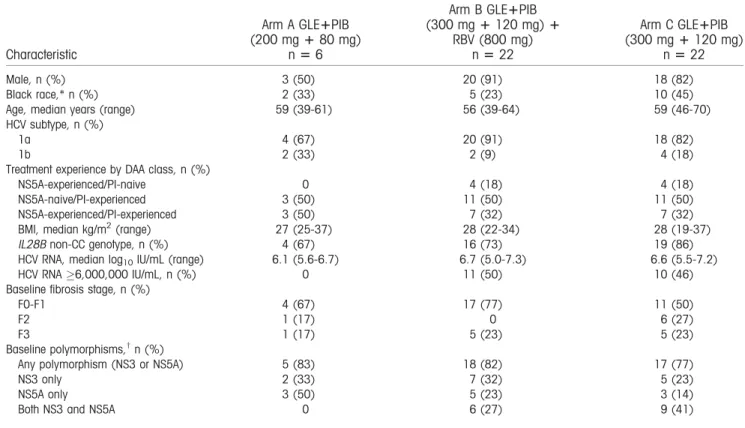
interferon-containing regimen or within other regi-mens. The type of prior DAA experience (NS3/4A PI only or NS5A inhibitor only or both) was well bal-anced across treatment groups (Table 1). Next-generation sequencing identified baseline polymor-phisms in NS3 and/or NS5A in 86% (43/50) of patients at a detection threshold of 2% and in 80% (40/50) of patients at a threshold of 15%. At a 15% detection threshold, the majority of patients had at least one baseline polymorphism across all treatment groups; although no patients in arm A had polymor-phisms in both NS3 and NS5A targets, 27%(6/22) and 41% (9/22) had polymorphisms in both targets in arms B and C, respectively (Table 1). In addition, baseline NS5A polymorphisms were detected in 50% (3/6), 50% (11/22), and 55% (12/22) of patients in arms A, B, and C, respectively, at a detection threshold of 15%. Although a detection threshold of 15% is commonly accepted as clinically relevant, lower thresh-olds of detection give greater insight into amino acid changes that may emerge in the majority of the popu-lation after prior therapy with DAA-containing regi-mens. At a more sensitive 2% detection threshold, the
most common polymorphisms in NS3 were at amino acid positions Q80 (n 5 23), R155 (n 5 4), D168 (n54), and I/V170 (n54); and those for NS5A were at positions Q30 (n514), Y93 (n58), L31 (n57), M28 (n56), Q54 (n56), and H/P58 (n55). Base-line amino acid polymorphisms detected at a threshold of 2% are shown inSupporting Table S2, and the prev-alence of specific polymorphisms detected at both 2% and 15% is summarized inSupporting Table S3.
Overall, by ITT analysis, SVR12 was achieved in 92% (46/50, 95% CI 81-97) of patients treated with GLE 1 PIB with or without RBV for 12 weeks. In the halted arm A, in which patients received the lower dose of 200 mg GLE and 80 mg PIB, 100% (6/6, 95% CI 61-100) of patients achieved SVR12. In arm B (300 mg GLE1120 mg PIB1800 mg RBV for 12 weeks) SVR12 was achieved in 95% (21/22, 95% CI 78-99) of patients, and among patients in arm C (300 mg GLE 1120 mg PIB for 12 weeks), 86% (19/22, 95% CI 67-95) of patients achieved SVR12 (Fig. 2). The rates of virologic failure were identical (1/22, 5%) with or without administration of RBV (arm B versus arm C). The two patients in arm C who did not
TABLE 1. Patient Demographics and Baseline Characteristics
Characteristic
Arm A GLE1PIB (200 mg180 mg)
n56
Arm B GLE1PIB (300 mg1120 mg)1
RBV (800 mg) n522
Arm C GLE1PIB (300 mg1120 mg)
n522
Male, n (%) 3 (50) 20 (91) 18 (82)
Black race,* n (%) 2 (33) 5 (23) 10 (45)
Age, median years (range) 59 (39-61) 56 (39-64) 59 (46-70)
HCV subtype, n (%)
1a 4 (67) 20 (91) 18 (82)
1b 2 (33) 2 (9) 4 (18)
Treatment experience by DAA class, n (%)
NS5A-experienced/PI-naive 0 4 (18) 4 (18)
NS5A-naive/PI-experienced 3 (50) 11 (50) 11 (50)
NS5A-experienced/PI-experienced 3 (50) 7 (32) 7 (32)
BMI, median kg/m2(range) 27 (25-37) 28 (22-34) 28 (19-37)
IL28Bnon-CC genotype, n (%) 4 (67) 16 (73) 19 (86)
HCV RNA, median log10IU/mL (range) 6.1 (5.6-6.7) 6.7 (5.0-7.3) 6.6 (5.5-7.2)
HCV RNA6,000,000 IU/mL, n (%) 0 11 (50) 10 (46)
Baseline fibrosis stage, n (%)
F0-F1 4 (67) 17 (77) 11 (50)
F2 1 (17) 0 6 (27)
F3 1 (17) 5 (23) 5 (23)
Baseline polymorphisms,†n (%)
Any polymorphism (NS3 or NS5A) 5 (83) 18 (82) 17 (77)
NS3 only 2 (33) 7 (32) 5 (23)
NS5A only 3 (50) 5 (23) 3 (14)
Both NS3 and NS5A 0 6 (27) 9 (41)
*Race was self-reported.
†Polymorphisms were detected at a 15% detection threshold with next-generation sequencing. “Only” indicates total number of
achieve SVR12 were lost to follow-up; however, both patients had undetectable HCV RNA at posttreatment week 8. By mITT analysis, excluding patients who failed to achieve SVR12 for nonvirologic reasons, SVR12 rates were 100%, 95%, and 95% for arms A, B, and C, respectively.
Two confirmed virologic failures were observed; both patients were compliant and had on-treatment drug levels of GLE and PIB that were consistent with those observed in other patients (Table 2). The patient in arm C (300 mg GLE 1 120 mg PIB) had on-treatment HCV breakthrough at week 8; using a 2% detection threshold, this patient had baseline polymor-phisms in both NS3 (Y56H and D168A/T) and NS5A (M28V, Q30R, and H58C). At the time of virologic failure, this patient had treatment-emergent substitutions of V36M in NS3 and M28G in NS5A. Of note, although GLE and PIB levels in this patient were within expected therapeutic ranges, the patient had Crohn’s disease, was receiving immunosuppressive therapy, and had a prior ileocolectomy. The other patient who had virologic failure was a posttreatment week 4 relapse in arm B (300 mg GLE1120 mg PIB 1 800 mg RBV) and had baseline NS5A polymor-phisms L31M and H58D, with no polymorpolymor-phisms in NS3. At the time of relapse, this patient had treatment-emergent substitutions of A156V in NS3 and Q30R in NS5A. Overall, in patients with baseline polymorphisms in NS3 only, NS5A only, or both NS3 and NS5A at a 15% detection threshold, SVR12 rates were 100% (14/14), 91% (10/11), and 93% (14/15), respectively; SVR12 was achieved by 100% (10/10) of patients with no baseline polymorphisms in NS3 or NS5A.
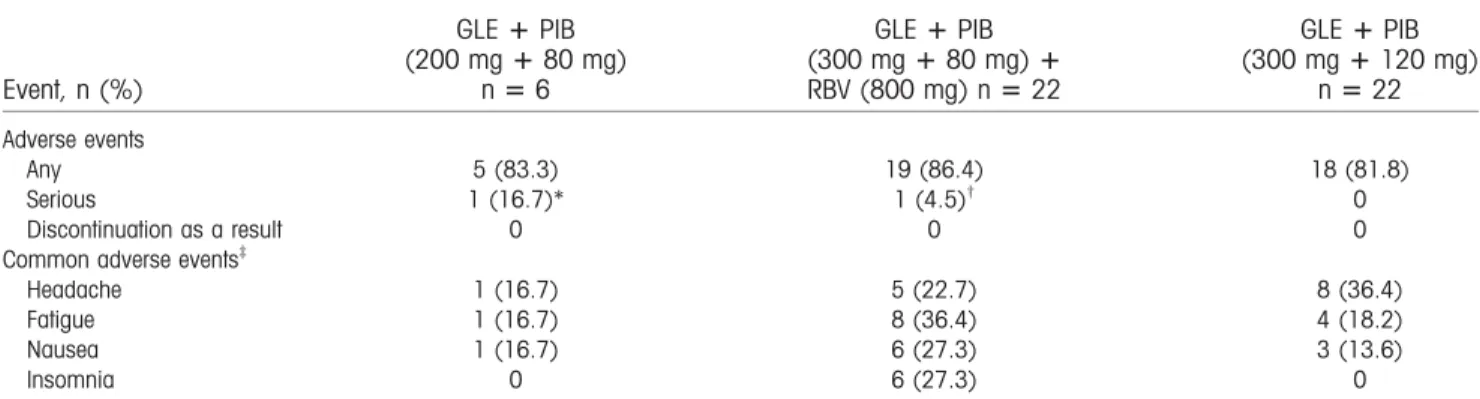
Adverse events were mostly mild in severity and reported in 84% of patients. Adverse events occurring in 10% of patients were headache, fatigue, nausea, and insomnia (Table 3); such events were more com-mon in the RBV-containing arm. Two treatment-emergent serious adverse events were reported, neither of which was deemed related to study drug by the investigator (fractured femur and breast cancer). No
FIG. 2. Sustained virologic response in the ITT and mITT pop-ulations. Individual SVR12 rates for arm A (blue), arm B (green), and arm C (gray-blue) are shown for the ITT and mITT popula-tions. The ITT population was all patients that received at least one dose of study drug (n 5 50), while the mITT population excluded all patients who did not achieve SVR for reasons other than virologic failure. Whiskers represent the 95% CI using the Wilson score method. Both patients lost to follow-up had nonde-tectable HCV RNA at posttreatment week 8. Abbreviation: LTFU, lost-to-follow-up.
TABLE 2. Characteristics of Patients with Virologic Breakthrough or Relapse
Subgenotype
Prior treatment
12-Week treatment
Reason for nonresponse
Time point
sequenced NS3 variants* NS5A variants*
1a DCV; GLE1PIB1RBV Relapse† Baseline None L31M, H58D (26%)
TVR1PR 300 mg1120 mg
1800 mg
PTW4 A156V (91%) Q30R, L31M, H58D
1a OBV1PTV/RTV1
DSV1RBV
GLE1PIB Breakthrough Baseline Y56H (5%), D168A/
T (94%/3%)
M28V (3%), Q30R (98%), H58C (99%)
300 mg1120 mg Week 8 V36M (6%), Y56H,
D168A
M28G, Q30R (99%), H58C
*Variants due to baseline polymorphisms or treatment-emergent substitutions.
†This patient had Crohn’s disease, was on immunosuppressant therapy, and had prior ileocolectomy.
Variants were detected at a 2% detection threshold with next-generation sequencing. Only variants with prevalence2% are listed; variants with prevalence>99% within a patient’s viral population do not have the prevalence listed.
patient prematurely discontinued treatment due to adverse events. Clinical chemistry and hematology revealed no significant on-treatment abnormalities in alanine aminotransferase (>3 3 upper limit of nor-mal), aspartate aminotransferase (>3 3upper limit of normal), hemoglobin (<10 g/dL), or total bilirubin (>33upper limit of normal).
Discussion
The once-daily regimen of GLE and PIB was well tolerated with no serious adverse events related to study drug, no discontinuations due to adverse events, and no relevant laboratory abnormalities. It also resulted in high rates of SVR with or without coad-ministration of RBV in patients with HCV GT1 infection and prior DAA therapy experience. Overall, the DAA-experienced population in the MAGELLAN-1 study had broad representation of baseline NS3 and NS5A polymorphisms, including polymorphisms at key NS5A positions M28, Q30, L31, H58, and Y93 that confer resistance to earlier-generation NS5A inhibitors. Additionally, all 8 patients previously treated with ledipasvir/sofosbuvir achieved SVR12 despite the presence of the NS5A resistance-associated Y93H/N polymorphism in 5 patients and multiple NS5A polymorphisms in 4 patients. This confirmsin vitrodata that variants at the Y93 position are susceptible to PIB(22) and suggests GLE plus PIB is an effective treatment for those with a baseline poly-morphism or treatment-emergent substitution at this position. Furthermore, 14 of 15 (93%) patients who failed a prior dual (NS3/4A PI plus NS5A inhibitor)
or triple (NS3/4A PI plus NS5A inhibitor plus NS5B polymerase inhibitor) DAA regimen achieved SVR12.
The addition of RBV to the GLE 1PIB regimen had no apparent impact on response as the rates of virologic failure were identical in arms B and arm C by mITT analysis. All 5 patients who modified RBV dose achieved SVR12, similar to findings with other DAA regimens.(25-27) However, this study did not have a large enough sample size for sufficient statistical power to confirm the impact of RBV on SVR. The patient with virologic relapse in the RBV-containing arm had prior treatment with two different therapeutic regi-mens: daclatasvir alone and telaprevir plus pegylated interferon with RBV. This patient had L31M and H58D in NS5A at baseline; at the time of virologic failure at posttreatment week 4, a Q30R substitution emerged in this patient in addition to L31M and H58D from baseline. The 1 other patient in this study with a baseline H58D mutation in NS5A also had baseline M28V and Q30R polymorphisms (instead of L31M) in the same target, with an additional Q80K polymorphism in NS3; and this patient achieved SVR12. The patient with virologic breakthrough was on immunosuppressive therapy for Crohn’s disease and had prior ileocolectomy; it is unclear whether this con-tributed to virologic failure. This patient had three NS5A baseline polymorphisms (M28V, Q30R, and H58C) and NS3 baseline polymorphisms at amino acid positions Y56 and D168 that were maintained until virologic failure. While 3 other patients with baseline D168 polymorphisms achieved SVR12, this was the only patient with a baseline Y56 polymor-phism. The NS3 V36M and NS5A M28G substitu-tions emerged in this patient after virologic failure.
TABLE 3. Adverse Events
Event, n (%)
GLE1PIB (200 mg180 mg)
n56
GLE1PIB (300 mg180 mg)1
RBV (800 mg) n522
GLE1PIB (300 mg1120 mg)
n522
Adverse events
Any 5 (83.3) 19 (86.4) 18 (81.8)
Serious 1 (16.7)* 1 (4.5)† 0
Discontinuation as a result 0 0 0
Common adverse events‡
Headache 1 (16.7) 5 (22.7) 8 (36.4)
Fatigue 1 (16.7) 8 (36.4) 4 (18.2)
Nausea 1 (16.7) 6 (27.3) 3 (13.6)
Insomnia 0 6 (27.3) 0
Serious adverse events were defined as events resulting in hospitalization or prolongation of hospitalization, persistent or clinically sig-nificant disability or incapacity, or death or that were life-threatening or required medical or surgical intervention to prevent a serious outcome.
*Breast cancer. †Fractured femur. ‡Occurring in
Both patients who had virologic failure were reported as compliant and had drug exposures similar to other patients.
No clinically significant laboratory abnormalities were reported in hemoglobin levels, including in the RBV-containing arm. Furthermore, no clinically sig-nificant chemistry values were observed, including on-treatment elevations in total bilirubin or alanine ami-notransferase>3 times the upper limit of normal after alanine aminotransferase normalization or nadir. Although no serious adverse events related to study drug were reported in either arm, the addition of RBV did not reduce the rate of virologic failure but did increase the rate of adverse events. One potential limi-tation of this study was that RBV coadministration was 800 mg daily, regardless of patient weight, i.e., below the conventional 1,000 or 1,200 mg weight-based RBV dosing. Because of this, it is unclear whether weight-based RBV coadministration could have increased the efficacy in arm B. By corollary, it is also likely that a conventional weight-based RBV dose would have resulted in a further increased rate of adverse events for these patients when compared to that seen with the lower dose of RBV in arm B as increasing side effects with higher RBV dose is well documented.(28) However, regardless of comparison between treatment arms, the low rate of virologic fail-ure in the RBV-sparing arm suggests that the response rate is already near maximal, and the addition of RBV may not impact this. The patient population enrolled here is considered inherently difficult to cure, owing to increased prevalence of baseline resistance-associated polymorphisms likely stemming from prior DAA fail-ure.(15,29-32) As such, additional study is required in this diverse patient population to further confirm effi-cacy of the regimen in GT1 patients with prior failure of DAA therapy, including patients with prior expo-sure to DAA-containing therapies and concomitant cirrhosis, who were excluded here.
In summary, the combination of GLE and PIB showed potent antiviral activity, regardless of the pres-ence of one or more baseline resistance-associated polymorphisms and irrespective of previous DAA-containing treatment regimens, resulting in high SVR12 rates in patients without cirrhosis but with HCV GT1 infection. This suggests that the combina-tion of GLE and PIB is highly effective in this popula-tion, which currently has limited treatment options. Based on these findings, larger and more diverse patient groups are being evaluated in phase 3 studies to confirm the safety and efficacy of the RBV-free
coformulation of GLE/PIB (300 mg/120 mg) in all six major HCV GTs, including patients with prior DAA experience and compensated cirrhosis.
Acknowledgment:We thank AbbVie employees Wei
Liu, Tami Pilot-Matias, Christine Collins, Rakesh Tripathi, Gretja Schnell, Preethi Krishnan, Jill M. Beyer, Thomas J. Reisch, Tanya Dekhtyar, and Michelle L. Irvin for assistance provided in the design and data analysis of the MAGELLAN-I study, as well as Douglas E. Dylla for scientific insights and critical review. AbbVie funded the study and participated in the collection, analysis, and inter-pretation of the data and in the writing, review, and approval of the manuscript. Medical writing was pro-vided by Ryan J. Bourgo of AbbVie. These persons received no compensation apart from usual salary for their contributions.
REFERENCES
1) Gower E, Estes C, Blach S, Razavi-Shearer K, Razavi H. Global epidemiology and genotype distribution of the hepatitis C virus infection. J Hepatol 2014;61(1 Suppl.):S45-S57.
2) Messina JP, Humphreys I, Flaxman A, Brown A, Cooke GS, Pybus OG, et al. Global distribution and prevalence of hepatitis C virus genotypes. HEPATOLOGY2015;61:77-87.
3) Asselah T, Boyer N, Saadoun D, Martinot-Peignoux M, Marcellin P. Direct-acting antivirals for the treatment of hepatitis C virus infection: optimizing current IFN-free treatment and future perspectives. Liver Int 2016;36(Suppl. 1):47-57.
4) Pawlotsky JM. New hepatitis C therapies: the toolbox, strategies, and challenges. Gastroenterology 2014;146:1176-1192.
5) Shah ND, Fried MW. Treatment options of patients with chronic hepatitis C who have failed prior therapy. Clin Liver Dis 2016;7:40-44.
6) Ahmed A, Felmlee DJ. Mechanisms of hepatitis C viral resis-tance to direct acting antivirals. Viruses 2015;7:6716-6729. 7) Horner SM, Naggie S. Successes and challenges on the road to
cure hepatitis C. PLoS Pathog 2015;11:e1004854.
8) Poveda E, Wyles DL, MenaA, Pedreira JD, Castro-Iglesias A, Cachay E. Update on hepatitis C virus resistance to direct-acting antiviral agents. Antiviral Res 2014;108:181-191.
9) Jacobson IM, Asante-Appiah E, Wong P, Black TA, Howe AY, Wahl J, et al. Prevalence and impact of baseline NS5A resistance-associated variants (RAVs) on the efficacy of elbasvir/ grazoprevir (EBR/GZR) against GT1a infection. HEPATOLOGY
2015;62:1393-1394A.
10) Sarrazin C, Dvory-Sobol H, Svarovskaia ES, Doehle B, Martin R, Zeuzem S, et al. The prevalence and the effect of HCV NS5A resistance associated variants in subjects with compensated cirrhosis treated with ledipasvir/sofosbuvir 6 RBV. J Hepatol 2015;62:S620.
12) Krishnan P, Tripathi R, Schnell G, Reisch T, Beyer J, Dekhtyar T, et al. Long-term follow-up of treatment-emergent resistance-associated variants in NS3, NS5A, and NS5B with paritaprevir/ r-, ombitasvir-, and dasabuvir-based regimens. J Hepatol 2015; 62:S220.
13) Zeuzem S, Ghalib R, Reddy KR, Pockros PJ, Ben Ari Z, Zhao Y, et al. Grazoprevir-elbasvir combination therapy for treatment-naive cirrhotic and noncirrhotic patients with chronic HCV genotype 1, 4, or 6 infection: a randomized trial. Ann Intern Med 2015;163:1-13.
14) Lawitz E, Flamm S, Yang JC, Pang PS, Zhu Y, Svarovskaia E, et al. Retreatment of patients who failed 8 or 12 weeks of ledi-pasvir/sofosbuvir-based regimens with ledipasvir/sofosbuvir for 24 weeks. J Hepatol 2015;62:S192.
15) ZEPATIER (elbasvir and grazoprevir) tablets, for oral use [pack-age insert]. Revised February 2017. Whitehouse Station, NJ: Merck & Co.
16) AASLD-IDSA. Recommendations for testing, managing, and treating hepatitis C. 2016. Available athttp://www.hcvguidelines. org. Accessed December 8, 2016.
17) Buti M, Gordon SC, Zuckerman E, Lawitz E, Calleja JL, Hofer H, et al. Grazoprevir, elbasvir, and ribavirin for chronic hepatitis C virus genotype 1 infection after failure of pegylated interferon and ribavirin with an earlier-generation protease inhibitor: final 24-week results from C-SALVAGE. Clin Infect Dis 2016;62: 32-36.
18) Gane E, Shiffman ML, Etzkorn K, Morelli G, Stedman CA, Davis MN, et al. Sofosbuvir/velpatasvir in combination with ribavirin for 24 weeks is effective retreatment for patients who failed prior NS5A containing DAA regimens: results of the GS-US-342–1553 study. J Hepatol 2016;64(Suppl.):S147-S148. 19) Lawitz E, Poordad F, Gutierrez JA, Wells JT, Landaverde CE,
Reiling JR, et al. C-SWIFT retreatment (part B): 12 weeks of elbasvir/grazoprevir with sofosbuvir and ribavirin successfully treated G1-infected subjects who failed short-duration all-oral therapy. Presented at: The Liver Meeting (AASLD) 2015. November 13-17, 2015; San Francisco, CA, USA.
20) Poordad F, Bennett M, Sepe TE, Cohen E, Reindollar RW, Everson GT, et al. QUARTZ-I: retreatment of HCV genotype 1 DAA-failures with ombitasvir/paritaprevir/r, dasabuvir, and sofosbuvir. Presented at: The Liver Meeting (AASLD) 2015. November 13-17, 2015; San Francisco, CA, USA.
21) Ng T, Reisch T, Middleton T, McDaniel K, Kempf D, Lu L, et al. ABT-493, a potent HCV NS3/4A protease inhibitor with broad genotype coverage. Poster #636 at: Twenty-first Annual Conference on Retroviruses and Opportunistic Infections (CROI), March 3-6, 2014; Boston, MA, USA.
22) Ng TI, Krishnan P, Pilot-Matias T, Kati W, Schnell G, Beyer J, et al. In vitro antiviral activity and resistance profile of the next
generation hepatitis C virus NS5A inhibitor pibrentasvir. Anti-microb Agents Chemother 2017 Feb 13. pii: AAC.02558-16. doi: 10.1128/AAC.02558-16. [Epub ahead of print]
23) Gao M. Antiviral activity and resistance of HCV NS5A replica-tion complex inhibitors. Curr Opin Virol 2013;3:514-520. 24) Gane E, Poordad F, Wang S, Asatryan A, Kwo PY, Lalezari J,
et al. High efficacy of ABT-493 and ABT-530 in patients with HCV genotype 1 or 3 infection and compensated cirrhosis. Gas-troenterology 2016;151:651-659.
25) Ferenci P, Bernstein D, Lalezari J, Cohen D, Luo Y, Cooper C, et al. ABT-450/r-Ombitasvir and Dasabuvir with or without Ribavirin for HCV. N Engl J Med 2014; 370:1983-1992. 26) Hassanein T, Vierling JM, Reddy KR, Cohen E, Morelli G,
Mantry PS, et al. RUBY-I, cohort 2: treatment of HCV geno-type 1 infection in patients with severe or end-stage renal disease, including patients with cirrhosis. Presented at Asian Pacific Association for the Study of the Liver (APASL) Meeting 2016. June 12, 2016; Kaohsiung, Taiwan.
27) Poordad F, Hezode C, Trinh R, Kowdley KV, Zeuzem S, Agarwal K, et al. ABT-450/r-ombitasvir and dasabuvir with riba-virin for hepatitis C with cirrhosis. N Engl J Med 2014;370: 1973-1982.
28) Lindahl K, Stahle L, Bruchfeld A, Schvarcz R. High-dose ribavi-rin in combination with standard dose peginterferon for treat-ment of patients with chronic hepatitis C. HEPATOLOGY2005;41: 275-279.
29) DAKLINZA (daclatasvir) tablets [package insert]. Revised Feb-ruary 2017. Princeton, NJ: Bristol-Meyers Squibb.
30) Fried MW, Buti M, Dore GJ, Flisiak R, Ferenci P, Jacobson I, et al. Once-daily simeprevir (TMC435) with pegylated interferon and ribavirin in treatment-naive genotype 1 hepatitis C: the ran-domized PILLAR study. HEPATOLOGY2013;58:1918-1929.
31) Wang G, Reeves J, Terrault N, Lim J, Morelli G, Kuo A, et al. Prevalence and impact of baseline resistance-associated variants (RAVs) on the efficacy of ledipasvir/sofosbuvir or simeprevir/ sofosbuvir against GT1 HCV infection: HCV-TARGET inter-im analysis. Presented at: The International Liver Congress (EASL) 2016. April 14-17; Barcelona, Spain.
32) Zeuzem S, Rockstroh JK, Kwo PY, Roth D, Lawitz E, Sulkowski MS, et al. Predictors of response to grazoprevir/elbas-vir among HCV genotype 1 (GT1)–infected patients: integrated analysis of phase 2-3 trials. HEPATOLOGY2015;62:554A.
Supporting Information
Additional Supporting Information may be found at