1
Acknowledgements
Many wonderful people have been a part of this project. I would first like to thank Dr. Maggie Cao. Her wit, scholarly example, and reassurance has been a guiding light throughout the thesis project and my time at UNC. I will never forget when she first encouraged me to search for questions rather than answers. I look forward to more conversations in years to come. Thanks to Dr. Bernie Herman’s special ability to pinpoint the kernels of any muddled truth. His synthesis of knowledge is contagious and I am lucky to have his mentorship. Special thanks is owed to Dr. Cary Levine, whose lectures make subtle appearances throughout this text. Special thanks to Professors Mark Hansen, Stanley Abe, and Daniel Anderson for reading earlier versions of this project. Their willingness to impart knowledge is a testament to mentorship. Unbeknownst to me, this thesis began when I wrote my first
research project in the art history department with Dr. Daniel Sherman. A paper on Carol Summer’s screenprint,Kill
for Peace, concretized both my interest in art history and my four-year search for holes. Dr. Sherman’s scholarly
mentorship, balanced critique, and encouragement had a profound impact on my college experience. I thank him for pushing me towards art history.
Thanks is also given to Josh Hockensmith, Alice Whitesell, and all of the library staff at the University of North Carolina. Countless other maintainers of information helped form this thesis throughout the country. The Winterthur Library, United States Postal Museum Library, the National American History Museum, Yale Libraries, and Harvard Libraries all were welcoming and gracious with my questions. Likewise, this projected was enriched by the John and June Alcott award. Thanks to the entire Art History department’s constant support for pushing my thinking. You all made my time at Carolina thoroughly enjoyable.
None of this would be possible without the people who shaped me. Thanks to my grandmothers, Alma and Joyce, whose persistent jabs, jeers, and threadedness made me the critically attuned person I am today. Thanks to my father who taught me spontaneity and perseverance. Thank you for being a balanced sounding board for so many of my ideas. Thanks for my mother, a fellow Tarheel, who taught me to be empathetic and keenly judgmental -- two of the most necessary skills for any art historian. To Noble and Zayla: I am expecting big things from both of you!
2
Introduction
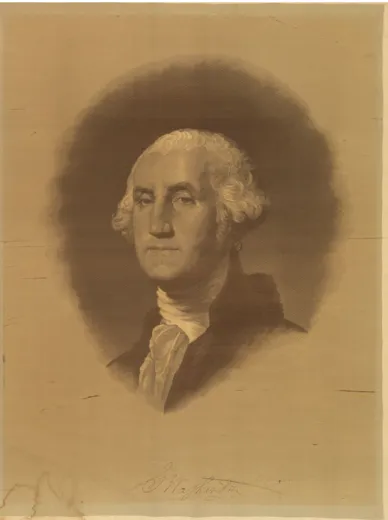
A jpeg of Gilbert Stuart’s famous George Washington portrait (Figure 0.1) has been dragged from Google
onto my desktop as “download.jpg.” (Figure 0.2) Clicking on the icon conjures a larger version in Apple’s Preview
program, which, beyond viewing the image’s dimension in pixels, allows me to edit the scale, color, and background
of Washington’s likeness. The digital image copied from the internet is mine to manipulate. When I open
download.jpg as a file in a text editor, however, the image completely dissolves from the screen. Instead, George
Washington’s likeness transforms into an indecipherable code; swaths of paint are substituted for lines of letters,
numbers, symbols, and punctuation. “ì‡Qú8Â7+E vrÛK ÀÎy߃ñ6VÌw¥iÕ«';aÊ| ˝Øk‚®öyïˇŸ c:1ågR,” anyone?
(Figure 0.3) . Whether made on the computer, uploaded, or scanned, digital images are stored and transmitted across 1
the world’s screens instantaneously. As download.jpg’s coded textuality makes clear, the viewing of digital images
does not require the perception of the many layers operating beyond the immediate interface. If anything, digital
images naturally instantiate themselves as completely indifferent to the code, labor, and various materials that lie
beneath their pixelated surfaces.
Images are traditionally phenomenological objects that can only be viewed through our sense of sight;
images exist only when the eye is able to perceive them. Digital images, as my example shows, exist in their totality
as sets of data, merely coordinate points free from a visual plane. Computer graphics exist, therefore, prior to their
instantiation in and as a given image. As media theorist Friedrich Kittler notes in his lectures on optical media, 2
“computers must calculate all optical or acoustic data on their own precisely because they are born dimensionless
and thus imageless. For this reason, images on computer monitors […] do not reproduce any extant things, surfaces,
or spaces at all. They emerge on the surface of the monitor through the application of mathematical systems of
equations.” While mimetically the same as images portrayed on tactile surfaces, computer graphics operate 3
differently than those of painting, printing, camera, and film. In simulating an image, the very material basis - that
1For a more radical use of this tooling, see, Hito Steyerl, “Medya: Autonomy of Images” in Duty Free Art. (New York: Verso, 2017)
2Jacob Gaboury, “Hidden Surface Problems: On the Digital Image as Material Object.”
Journal of Visual Culture 14, no. 1, (April 2015), 40–60.
3
which lies beneath the surface of the screen - is largely forgotten. Contrasting early philosophies that equated vision
and truth, digital images are the ultimate surface sham.
Digital images break the contract of empirical perspective through their virtual simulation. As William
Ivins describes in the Rationalization of Sight, perspective is merely a “means for securing a rigorous two-way, or
reciprocal, metrical relationship between the shapes of objects as definitely located in space and their
representations.” 4Download.jpg is thus simulated on my desktop much like Gilbert Stuart’s Washington is hung on
the walls of the Boston Athenaeum, but has a completely different ontological existence in space and time.
Download.jpg seems totally opposed to other tactile iterations of Stuart’s portrait. The surface effects of
download.jpg’s pictorial mechanisms - its virtual composition, coded textuality, and pictorial becoming - are hidden
from sensorial perception, completely removed from the human’s ability to see and know. Moreover, while we can
attest that the digital graphic was at one point a painting, the image exists entirely removed from earlier iterations.
The viewer cannot immediately tell what camera was used to scan the image, the labor it took to make the image,
nor the data necessary to keep it accessible on Google. The surface of digital images betrays perception and the
varied history of the image. Out of sight and out of mind, the digital image presents itself as an object for our use
without regarding its own history of making.
The operands surrounding the material making of download.jpg began long before computers were
actualized. Although there was no such thing as a computer image in the mid-nineteenth century, images could, in
fact, exist beyond their actualization on a tactile surface. No longer optical, they were digital representations. My
choice to download Gilbert Stuart’s Washington was intentional, for the beginning of these screen tactics and the
re-negotiation between surfaces and epistemic modes of knowing were brokered upon the making of a peculiar copy
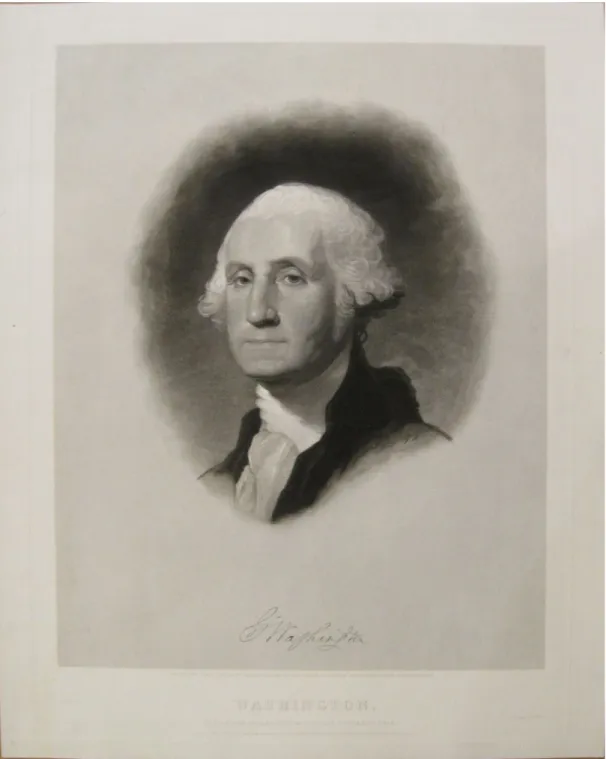
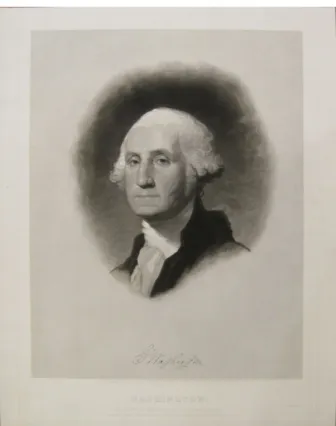
of the nation’s forefather. Created in 1851 by a Messrs. Ponson, Philippe, & Vilbert for an American ambassador,
the image (Figure 0.4) seems an almost near perfect copy of a print of Stuart’s Washington (Figure 0.5) or perhaps
even a Daguerreotype copy of the original painting. The object, however, is not made from paper or canvas or glass.
The image does not sit upon its material substrate; the image and object are one and the same. Not painted, not
printed, nor photographed -- the image is made of silk threads and was woven upon a Jacquard loom.
4
4
Invented sometime at the beginning of the nineteenth century by Joseph Marie Jacquard in Lyons, France,
the Jacquard Loom revolutionized weaving: simultaneously making the laborious process much faster as well as
enabling a new visual definition. The Jacquard loom, or, rather, the Jacquard harness, was a device that automated
the raising of warp threads of the loom between each passage of the horizontal weft thread. The automation of the
loom was controlled by a system of interlaced pasteboard punch cards. Holes were punched on each card
corresponding to a particular alignment of the warp rod, during a single passage of the horizontal shuttle. Once
energy was applied, the perforated cards were drawn along a constantly rotating metal box. The cards were bisected
and ‘read’ by needles connected to the rods controlling vertical warp threads. The needles that lined up with the
card’s punched holes would fall, shifting the corresponding rods and their threads to the “on” position. The other
rods, those whose needles bisected the part of the card without any perforation, remained in the “off” position. The 5
Jacquard loom was thus a machine for reading and translating optical data through the use of binary code.
Historians of the digital world have long acknowledged the Jacquard loom as the beginning of the
computer’s history. There is often, however, an impulse to reduce the importance of the Jacquard loom as one of the
plethora of technologies that were used to merely create the computer. As the accepted history proceeds, binary
punch cards of the loom inspired Ada Lovelace and Charles Babbage to dream up Analytical Engine, which would
algebraically “weave patterns as the Jacquard Loom weaves flowers and leaves.” Babbage’s Analytical Engine was 6
never built, but was eventually actualized by American Herman Hollerith for the census calculation machine and
then used throughout the twentieth century for the International Business Machine Corporation. Unlike the Jacquard
loom, these calculation machines crunched numerical data without any optical output. The computational image was
disregarded until cathode ray tubes were standardized for computer displays in the 1950s, thereby synthesizing
numerical data into an easily manipulatable optical image for screen display.
The empire of sight therefore continued its reign once calculation was able to simulate images in the late
twentieth century. As Lev Manovich writes, “before, the computer could read a row of numbers, outputting a
statistical result. Now it can read pixel values, blurring the image, adjusting its contrast, or checking whether it
5Stephen Monteiro,
The Fabric of Interface : Mobile Media, Design, and Gender, (Cambridge, Massachusetts: The MIT Press, 2017.)
5
contains an outline of an object [...] In a historical loop, the computer has returned to its origins. No longer just an
Analytical Engine, suitable only for crunching numbers, it has become Jacquard's loom - a media synthesizer and
manipulator.” Referring to the Jacquard Loom as a media synthesizer and manipulator is an accurate way to 7
describe its position in the production, transmission, and reception of images within the nineteenth-century media
ecology. Images during the nineteenth century, according to Foucault, “circulated rapidly between camera and easel,
between canvas and plate and paper… and came a new freedom of transposition, displacement, and transformation,
of resemblance and dissimulation, of reproduction, duplication, and trickery of effect.” As floating substances no 8
longer static due to the advent of the lithography and photography, pictures were transported, or, perhaps more
accurately, ‘copy-pasted,’ across flat surfaces in a never before seen scale. The copy-paste sentiment was explicated
best by the first philosopher of photography, Oliver Wendell Holmes. In his now infamous Atlantic Weekly
explication, Holmes announced that form was quickly becoming “divorced from matter.” Once natural forms had
been scaled from their surfaces, rendered cheap and transportable, matter was a burdensome bi-product meant to be
“pulled down and burned.” Yet, as we will see, images’ movements in and across different mediums was always 9
explicitly material.
It is no surprise that the woven image chosen was of America’s founding father. As one of America’s most
well known visual icons, Stuart’s Washington has been edited, copied, stored, and transmitted across many material
surfaces throughout its 200 year life. Painted for the explicit purpose of later reproductions, held safely in museums,
and now printed on every one dollar bill: Stuart’s Washington is an tactile picture that has remained a key image in
America’s visual lexicon since its creation. Simply put, it is the nation’s original copy. The woven iteration was first
copied into print by Thomas B. Welch with the help of a Southworth & Hawes Daguerreotype in 1851 (Figure 0.6).
Published by George W. Childs in 1852 and transported across the Atlantic ocean by a Philadelphian ambassador to
Lyon, France, the image was then translated into a binary code and woven by Messrs. Ponson, Philippe, & Vilbert in
1855. Finally, much like the historical loop of digital images referenced by Manovich, the image-object of
Washington woven in threads was returned home and given to the cities of Boston, Philadelphia, and New York.
7Lev Manovich,
The Language of New Media, (Cambridge, Mass.: MIT Press, 2001.)
8Michel Foucault, "Photogenic Painting," in Gilles Deleuze and Michel Foucault, Gerard Fromanger: Photogenic Painting,
(London: Black Dog Publishing, 1999.)
6
The Jacquard portrait of GeorgeWashington, a copy of a copy, exemplifies how the Jacquard loom was arguably the
most important image-synthesizer for the many methods of reproduction in the transatlantic media ecology of the
nineteenth century.
Unlike the digital image, however, the Jacquard woven portrait was subject to the inability of transporting
images synchronically. Although new communications technologies gestured towards an “annihilation of space”
fitting for our contemporary virtual world, images in the nineteenth century were manipulated through distinct
mechanical maneuvers, physically transmitted across vast expanses of land, and viewed within defined cultural
infrastructures. Form was becoming ‘divorced from matter’ due to the sheer amount of images produced, but still 10
beholden to the image’s materiality. For example, the telegraph had time-altering effects on language at
mid-century, yet images were resistant to the technologies that altered the emerging telecommunications network
between the transatlantic world. Paintings, photographs, prints, and Jacquard-woven portraits were resistant to the
codes that enabled safe passageway through cables and across oceans. Indeed, images were still bound to their
flattened picture planes as Holmes dreamed of pictures flying off into virtuality.
In tracing the history of a Jacquard-woven image of Stuart’s George Washington throughout transnational
borders and parallel modes of replication, this thesis illustrates how images in the nineteenth-century Atlantic world
could, in fact, exist precisely because of a codethat bellied their making. While the Jacquard loom’s
instrumentalization in engendering the digital world of binary computation has been accurately documented, the
discreet images produced and their legacy within art’s mediated history has largely been ignored. Woven images in
the nineteenth century are therefore an integral part of the historical epistemology of reproductive images precisely
for what their surface does not reveal: the method, history, and labor of their making. Much as download.jpgs’s
textuality is invisible to the human eye, viewers of the Jacquard-woven portrait processed the silken image without
acknowledging the various techniques of its production. Yet, the materiality of the silk ultimately delayed the
image’s own potential for synchronic transmission. In paying attention to each iteration of the image’s materiality,
maneuvers across surfaces, and physical transmission across land, the woven Washington’s unique history reveals
its own reliance upon and entrapment within the media ecology of nineteenth century. An object before its time, the
10
7
woven image presents itself as case study for understanding how media history and art history often exist in parallel
lines.
Each chapter illustrates how the Jacquard-woven portrait of Washington was reliant upon another mode of
mass reproduction for its making. Chapter 1 takes binary thinking as a methodological nexus for two seemingly
medium-specific reproductive processes, photography and weaving, to postulate that the negative was a reproductive
space for artisans and inventors interested in having images transcended stable definitions, practices, and materials.
Further, it was precisely the negative’s depraved status - as a non-image, or in-between image - which allowed its
frequent manipulation and application to a diverse set of reproductive making practices. This chapter therefore
operates between the space of binaries, while still asserting their epistemic potential and importance in the making
of images in the nineteenth-century media ecology. Chapter 2 traces the historic translation from an intaglio copper
engraving to a punch-card code, but stresses how this translation process visually afforded the displacement of craft
labor. What I suggest is key to understanding these divergent practices of reproduction, one engaged with pressing
ink and the other in weaving silk, is their respective reliance upon the cultural technique of the gridded matrix in the
preparation of the image for translation. Both processes relied upon the grid to visually structure and mechanically
reproduce George Washington’s likeness, but their respective manipulations are key to understanding how the
conflation between print and Jacquard-woven image ultimately fails. Chapter 3 analyzes the woven portrait’s
relationship to the cultural assumptions surrounding fabric in the nineteenth-century media ecology, while
simultaneously framing the object’s synchronic possibility and material recalcitrance. While the code-image of the
Washington could have altered space and time through the telegraph, it was ultimately belabored by its silkenness.
This antagonism, between fine silk and slow speed, reveals that the woven image was framed as a work of fine art
and not of mass reproduction.
Underlying my observation is a key reliance upon the interrelated, but all-too often forgotten, relationship
between the creation and alteration of surfaces of meaning through threads at the visual, material, symbolic, and
informatic level. If the nineteenth century ushered in Modernism’s fracturing of the signifier in communication, it
relied upon the material, metaphoric, and infrastructural dynamics provided by the thread. In the case of the
Jacquard loom, threaded intelligence was coupled with boolean logic to create a epistemic shift in both how images
8
object in threads not only gestures towards the software of the computer age but the hardware of the cables, wiring,
and circuitry of our current computerized systems. Beyond merely narrating a history of an object’s production,
transmission, and reception through varied modes of reproduction, I assert that the Jacquard loom was a media
9
Figures.
10
Figure 0.2. download.jpg
11
12
13
14
Chapter 1
In anticipation of the Paris Exhibition in 1900, a polish-born inventor, Herr Szczepanik, declared he was
able to weave, “silk pocket handkerchiefs in public.” In half an hour, so said the ‘Polish Edison,’ a patron would “be
able to walk away with a silk handkerchief with their own portrait woven into it.” To do so, Szczepanik was reliant 11
upon connecting a cameratic apparatus to the Jacquard loom itself -- a novel integration of two separate
reproductive methods for copying images. As this anecdote suggests, the turn of the century was fueled by an
uncanny desire to transform a bodily presence from photograph to silken image. Oddly akin to photography, whose
processes made it possible to chemically index reality, the Jacquard loom wove to index reality in threads. Despite
possessing seemingly divergent processes of making, the two mediums for reproduction had similar aims in the
nineteenth-century image ecology: to rapidly and accurately copy images of the self. It comes as no surprise, then,
that the two might possess a more reciprocal relationship than meets the eye. Szczepanik’s promise of a silk pocket
handkerchief woven in under 30 minutes, for instance, exemplifies how Jacquard weaving and photographic
practices were used to fascinate and quell anxieties concerned with processes of mechanical duplication, which
disrupted stable notions of originality, definitions of the self, and geographic boundaries.
Beyond photography and weaving sharing a common goal in visual reproduction, both processes relied
upon a binary logic - positive and negative, perforated or not-perforated - to create images. Writing at the end of the
1850s, Oliver Wendell Holmes, America’s foremost philosopher of photography, tied the act of copying Nature to
the photographic negative. Writing for the Atlantic Monthly Holmes exclaimed: “This negative is now to give birth
to a positive, this mass of contradictions to assert its hidden truth in a perfect harmonious affirmation of the realities
of Nature [...] Out of the perverse and totally depraved negative, where it might almost seem as if some magic and
diabolic power had wrenched all things from their propertie...is to come the true end of all this series of operations, a
copy of Nature in all her sweet gradations and harmonies and contrasts.” Holmes’ methodological explanation of 12
each step of the reproductive photographic processes, narrating a metamorphoses from the depraved negative to a
positive copy of Nature, exemplifies the necessity of the negative in the copying process. Although it was often seen
11 “Has a Magic Loom: Vienna Wizard Makes a Wonderful Discovery.”
15
as a state which preexisted a picture’s final form, all methods of ‘doings of the sunbeam,’ from Daguerreotype to
paper-based photography, relied on the depraved negative. 13
That Holmes referred to positives as “true pictures” is telling of how reproductive processes’ reliance upon
inversion and deception produced deep anxieties about the act and status of picturing in the nineteenth century. 14
Perverse to Holmes and surely to other nineteenth-century viewers, the negative was the seeming opposite of natural
order. Negatives were not images: they were merely a necessary, and, for Holmes, disgraceful, step in the process of
reproducing ‘true pictures.’ Holmes’ primitive tactics have seeped into the field of art history; negatives are either
ignored in the process of understanding positive photographs or simply framed as reproductive intermediaries. 15
Rather than extending the negative into further depravity, I want to suggest that the negative was a productive space
for artisans and craftspeople to create intermedial images. By intermedial, I mean moments where two different
mediums were used simultaneously to make an image which rejects a stable classification. The negative was a
productive space for images and their makers to escape the restraints of any specific medium, translate images
across surfaces and into other materials, and combine processes of reproduction in the nineteenth century. This
chapter therefore takes the negative as a nexus for two seemingly medium-specific reproductive processes and
postulates that the negative was a reproductive space for artisans and inventors interested in allowing images to
transcended stable definitions, practices, and materials. Further, I argue it was precisely the negative’s depraved
status - as a non-image, or in-between image - which allowed its frequent manipulation and application to a diverse
set of making practices. Methodologically operating between the space of binaries, this chapter asserts the
negative’s epistemic potential and importance in the making of images in the nineteenth-century media ecology.
Bridging the shift between the popularity of Daguerreotypes in the 1850s and the complete takeover of
photomechanical processes of the early 1900s are two distinct moments of intermedial interaction which reveal the
instability of seemingly separate media categories in the long nineteenth century: a Daguerreotype used to mobilize
an Gilbert Stuart’s George Washington for synthesis on the Jacquard loom, and later, the integration of photographic
processes into the Jacquard loom’s operating system. Though seemingly disparate in their chronology and use of the
13Oliver Wendell Holmes, “Doings of the Sunbeam.” Atlantic Monthly, July 12th, 1863, 1–15. 14
Holmes, “The Stereoscope and the Stereograph.” Atlantic Monthly, 1859.
15 One exception would be
16
photographic practice, each episode reveals the negative as a strategy for media integration in the nineteenth century.
In each of these narratives, the negative’s involvement in connecting the Jacquard loom and photographic processes
illustrates a historically grounded relationship between practices of photography and practices of weaving across
time and space within the nineteenth century. The negative, the inversion of the true picture, was therefore the
productive space for reproduction, translation, and transformation of images that allowed craftspeople to think
through broader implications of copying and dematerialization.
Photography is arguably the most manipulatable and accessible medium of making reproductive images in
the contemporary moment. The procedures of digital photography began with the productive interchanges of
reproductive media in the 1800s. The efforts of inventors in developing a working relationship between practices of
weaving and photography provides a historic precedent for today’s digital world where photography relies upon
threads of binary code quite literally woven together. Without collapsing the contemporary onto the nineteenth
century, the negotiation of the digital portrait today bears a strong resemblance to the desire to escape material
specificity in the nineteenth century. Portrait making lent itself to the introduction of intermedial technologies,
paving the way for the synthesis of new media for representation. Expanding the static historiographic
understanding of both photography and Jacquard weaving, I suggest we turn our attention to how the photographic
tooling and photographic aesthetics mediated through the negative simultaneously made their way into, out of, and
onto the Jacquard weaving processes in the nineteenth century. As we will see, the desire to make a portrait in silk
was the reason to combine forms of reproductive media through the logic of the negative.
Tilting Negatives
The origin of the woven portrait begins in Boston, where the Philadelphian engraver, Thomas B. Welch,
arrived at the Atheneum to copy Gilbert Stuart’s original painting of George Washington in 1851. By this moment in
American artistic production, the act of copying great American works of art was commonplace. Welch joined a
host of engravers, painters, and sculptors reproducing works of art for the masses. Copies of portraits relied upon
their materials and verbal framing devices to tether them to their original bodies, combining the making of an iconic
image to the making of many multiples. Welch was one of many engravers to join in a chain of replication and
17
production of the engraving (Figure 1.1), Welch “stood honestly and with permission in front of the only original
portrait by Gilbert Stuart in the Boston Athenaeum.” Copying from the original painting signaled a sense of 16
authenticity and artistic prowess to the print’s scattered potential consumers. The act of copying, or the feedback
loop between the copier’s hand and the original painting of GeorgeWashington, was crucial to the print’s returns on
the market. Note that the presence of the artist’s hand was equally important as the visual veracity of the copy itself:
the copy indexed originality by the engraver’s phenomenological presence with the portrait.
Despite their inscriptions, prints were deceptive of their sources in the nineteenth-century American image
economy. The stipple-engraved replica by Welch was, in fact, not copied from Stuart’s original painting. The print
patently lied to consumers. Welch certainly travelled to the Boston Athenaeum in 1851 to faithfully reproduce the
1786 painting, but rather than engaging faithfully, Welch used Daguerreotype copies of Stuart’s painting produced
by Boston photographers, Southworth & Hawes, as his guide to aid in reproduction. According to an article in the
December 16th, 1852 edition of the Boston Transcript, Welch utilized the uniquely reversed images of the
Daguerreotyped Washington. By using the Daguerreian "new apparatus for enlarging and tracing upon transparent
paper… a copy of the exact size of his intended picture" was procured for Welch’s purposes (Figure 1.2). 17
The act of copying a work of art through Daguerreotype, often used for portraits, was certainly uncommon.
Nevertheless, as Sarah Gillespie has argued succinctly, the use of the Daguerreotype for copying works of art
burgeoned among artistic circles in the 1850s. The beginning of this popular practice, which quite literally 18
removed the work of Art from its physical space, was often enacted upon sculpture. For instance, a Daguerreotype
of Hiram Powers’ Greek Slave (Figure 1.3)captures brilliantly the tones and shadows created by the material depth
of the sculpture itself. A quote in the Bulletin of the American Art Union makes it clear that fine art and the
Daguerreotype possessed a satisfactory working relationship: “There is one use of this discovery which strikes us as
being exceedingly valuable...its power of representing great objects of art.” Matthew Brady, a now famous figure 19
16
The print reads: “Engraved by Thomas B. Welch by permission from the only original portrait by Gilbert Stuart in the Athenaeum Boston, Washington, Published by George W. Childs Philadelphia, Entered according to the Act of Congress in the year 1852 by George W. Childs in the Clerk’s Office of the Eastern District of Pennsylvania.”
17Comment made by an Anonymous Reviewer in the Boston Evening Transcript, December 16th, 1852. Courtesy of Boston Athenaeum.
18 Sarah Kate Gillespie,
The Early American Daguerreotype : Cross-Currents in Art and Technology, (Cambridge,Massachusetts : MIT Press ; Washington, DC : The Lemelson Center, Smithsonian Institution, 2015.)
18
in American photography, echoed this sentiment: “In the Department arranged for Copying Engravings, Painting,
Statuary, the light and instruments have been expressly designed for this purpose.” The tonality of Daguerreotypes, 20
their ability to positively capture light and negatively illustrate shadow, instilled artworks for private, yet uniquely
technological, viewing experiences. As a medium for copying and recording pictures, the Daguerreotype enabled
America’s burgeoning populace to see previously static works of Art.
It is tempting to stop here. Daguerreotypes, however, aided in the proliferation of art objects through other
channels beyond their visual appeal. The act of translating a Daguerreotype to stipple engraving deserves attention
for it illustrates how negativity structured Welch’s reproduction process. There is a prevailing notion that
Daguerreotypes were somehow resistant to mechanical replication in the nineteenth century. For example, Alan
Trachtenberg postulates that the Daguerreotype had, “qualities of brilliance, vividness and presence... as a
one-of-a-kind image produced directly on the plate, without the mediation of a negative, the Daguerreotype defied
mass production; it possessed the aura of a unique thing.” The shift between between the Daguerreotype and 21
paper-based photographic practices relied upon the intermediary negative. This fact, however, does not mean
Daguerreotypes were separated from negativity. If anything, Daguerreotypes held the negative closer to their
material substrate and enforced its phenomenological presence within the culture of viewing during the
mid-nineteenth century. As one viewer described, from “the merest tilt of the plate, the actual image seems to flicker
away, then reappears in negatively reversed tones, making the portrayed sitter look literally like a shade or shadow
of himself or herself.” Negatives embedded within the Daguerreotypes’ doppelganger matrix of tonality therefore 22
challenged the stable status of a sitter’s own image, literally deceiving the perception of the self through a silvered
surface.
Trachenburg was right to assert that Daguerreotypes captivated audiences by indexically and materially
solidifying originality throughout the 1840s. Not only did Daguerreotypes possess an unquestionable general fidelity
to an original moment in time, but as uniquely reversed images without intermediary negatives, the only way to
20 Bulletin of the American Art-Union, 1, November, 1850. 45. Advertisement found in Sarah Kate Gillespie,
The Early American Daguerreotype. (2015).
21Alan Trachtenberg, “Photography: The Emergence of a Keyword,” in Photography in Nineteenth-Century America, ed. Martha Sandweiss (New York: Abrams, 1991), 17-45.
22 “The Inconstant Daguerreotype,”
19
properly reproduce them was to re-photograph their surfaces. The stringent, metallic materiality of each image
demanded a negative feedback loop between its own making process. The reproductive potential of the
Daguerreotype, however, was extended when photographers Southworth & Hawes began profiting off the
Daguerreotype’s unique ability to reverse images laterally. The Daguerreotype’s seeming negativity, its original
nature, was paradoxically the exact tooling used for its reproduction in different mediums.
Southworth & Hawes, the photographers of Gilbert Stuart’s George Washington, were one of the most
proactive practitioners using Daguerreotypes to aid in the reproduction of original works of art. As some of the first
professional photographers in the country, Southworth & Hawes are well known within the history of photography
for their artistic Daguerreotypes of mid-century Bostonians. Previous categorizations of Southworth & Hawes
highlight their involvement in a Daggeuroian mode associated with originality; instead, to bring attention to their
involvement with mechanical reproduction, I want to draw attention to their Daguerreotypes of artworks in the
Boston Athenaeum. Southworth & Hawes more than prided themselves on the faithful reproduction of original 23
artwork. The pair advertised to engravers that, “[they] can be of great service. We reduce pictures upon the
engraver’s copper or steel plate, at the same time furnishing an extant duplicate, and he cuts upon the lines made by
the Daguerreotype.” Directly applying development liquid onto the engraving plate allowed Southworth & Hawes 24
to transform Gilbert Stuart’s painting into a Daguerreotype set atop an copper engraving plate, thereby enabling
Thomas Welch to trace the Daguerreotype’s negative reversal with a burin. Indeed, Southworth & Hawes’
manipulation of the negative qualities of the Daguerreotype made it possible for Thomas Welch to more readily
copy Stuart’s Washington for a print-based life.
This process is exemplified in a now-lost book of engravings of Washington Allston’s paintings engraved
by John and Seth Wells Cheney. Southworth & Hawes described the process of reducing the size of portraits upon 25
an engraving block: “Where it was necessary to reduce the sizes of the sketches for engraving, the Daguerreotype
was used, by which the image was conveyed to the engraver’s plates, prepared for that purpose, and there fixed by
23 For information regarding the life of Southworth & Hawes, see: Odette M. Appel-Heyne, Charles R. Moore, and Robert A. Sobiesze, The Daguerreotypes of Southworth & Hawes. (New York: Dover Publications, 1980) and Grant B. Romer and Brian Wallis, Young America : The Daguerreotypes of Southworth & Hawes. (New York: George Eastman House, 2005).
24 Quote found in Charles Leroy Moore,
Two Partners in Boston: The Careers and Daguerian Artistry of Albert Southworth and Josiah Hawes. PhD Dissertation, University of Michigan, 1975.
20
tracing the line through the silver.” Southworth & Hawes made the Daguerreotype atop a copper engraving, and 26
then the Cheney Brothers engraved directly upon the chemical image, “from which impressions were subsequently
made.” While a news article details this practice as using, “a new apparatus for enlarging and tracing upon 27
transparent paper… a copy of the exact size of his intended picture," it was likely a Dallmeyer lens that enabled
Southworth & Hawes to rescale images through their Daguerreotypian apparatus. Writing before his death, Hawes 28
wrote: “The somewhat celebrated combination of lenses called the Dallmeyer lens, I made and used fifteen years
before it was known under its present name.” In the same letter Hawes confirmed that this re-scaling method was,
“used for copying Washington Allston’s sketches on copper plates sufficiently silvered and the paintings of Gilbert
Stuart.” The Dallmeyer lens, named for its inventor, British photographer Thomas Dallmeyer, was developed in 29
the later half of the nineteenth century. In a lecture describing his invention, which he referred to a ‘telephotographic
lens,’ Dallmeyer called attention, “to the scale in which objects are reproduced by ordinary photographic lenses, and
to show how this image may be subjected to direct enlargement...before it is received on the photographic plate.” 30
In sum, the Dallmeyer lens allowed Southworth & Hawes to scale down and laterally reverse Gilbert Stuart’s
Washington across the copper plate, eventually allowing Welch to engrave in a proportionally accurate scale. The
negative feedback loop of the Daguerreotype, that which made it so original in nature, was thus used for the
translation and reproduction of Stuart’s painting into Welch’s engraving.
Rejecting Positivity
Although this intermedial episode exemplifies how the Daguerreotype was used as a tool for reproduction,
the Daguerreotype was often considered of equal artistic value to paintings themselves. Daguerreotypes were 31
artistic originals and not degraded copies. Yet, when viewers of the print found that Welch was aided in his
26Josiah Johnson Hawes, “Stray Leaves from the Diary of the Oldest Professional Photographer in the World,”
Photo Era: The American Journal of Photography, 16:2, February, 1906. 104-107. Found in the Gary W. Ewer, ed., The Daguerreotype: an Archive of Source Texts, Graphics, and Ephemera, http://www.daguerreotypearchive.org.
27 Ibid
28Comment made by an Anonymous Reviewer in the Boston Evening Transcript, December 16th, 1852.
29Josiah Johnson Hawes, “Stray Leaves from the Diary of the Oldest Professional Photographer in the World,” 1906. 30Thomas Rudolphus Dallmeyer, Telephotography: an Elementary Treatise On the Construction And Application of the
Telephotographic Lens. (London: W. Heinemann, 1899.) 31 Comment made by an Anonymous Reviewer in the
21
reproductive processes, the originality of the print was retracted. An unnamed author in the Boston Transcript
chastised Thomas Welch and the publisher of the print, George W. Childs, stating, “It would have been an act of
justice, had the publishers of that engraving had appropriately recorded upon it some testimonial to Messrs.
Southworth and Hawes, for services which they could not otherwise have procured, for facilities of their own
invention, which could not have been elsewhere furnished, and which were earnestly and cheerfully bestowed
without money or price.” The print lacked fidelity not because it was a degraded copy of a copy, but because it did 32
not cite its source-image, or, in this case, its source-process. It was not that the Daguerreotype was used for easier
engraving that sourced concern; rather, concern arose when the viewer of Welch’s Washington print could not
acknowledge its image’s lived history. The visually illegible reversals, re-scalings, and reliance upon another
medium put a sour taste in the Boston Transcript reviewer’s mouth.
This masking of the Daguerreotype’s influence becomes further obscured when we note the choice to use
the method of stipple engraving. Michael Leja, in an analysis of the relationship between the Daguerreotype and
printmaking, has argued that mezzotint printmakers utilized Daguerreotypes as a fortification medium in their
copying practices. Mezzotint engravers found aesthetic resemblances between the matrix of presence and absence
within both mediums, creating prints which mimicked the Daguerreotypes’ unique material specificity of figuring
bodies emerging from darkness into light. Unlike a line engraving, which is dependent upon the interplay of 33
surface and depth through linear arrangement, both Daguerreotype and mezzotint share an independence from linear
arrangements. Using the Daguerreotype as a reproductive medium through mezzotint kept the tonal uniqueness : the
photographic qualities rather than qualities of a painting.
That the tonal matrix produced through the Daguerreotype-mezzotint relationship was not chosen to
translate the Southworth & Hawes Daguerreotype to print is further telling of Welch’s desire to disregard the
photographic qualities of Daguerreian substrate. Welch did not manipulate the tonal values afforded when engravers
turned a Daguerreotype into a mezzotint; rather, Welch's engraving registers the opposite of this effect because it is a
stipple engraving.34 Whereas both a mezzotint and Daguerreotype illustrate figures appearing from the dark into the
32 Ibid.
33Michael Leja, "Fortified Images for the Masses," Art Journal 70, no. 4 (Winter, 2011): 61-83.
34
22
light, the stipple engraving works by bringing figures from light into darkness. Echoing the choice to disregard
Southworth & Hawes from the credit line upon publication, Welch’s engraving of Washington visually rejects its
photographic origins. The uniqueness, originality, and positive presence of the Daguerreotype was ironically erased
through the method of stipple engraving. Rejecting the Daguerreotype’s material specificities, Welch chose stipple
engraving to highlight the paintedness of Stuart’s Washington.
The Daguerreotype therefore aided in the production of the print which circulated across the Atlantic to be
woven in Lyon, France. The translation of an image from painting to photograph to print was one that relied upon a
variety of choices structured by positive-negative relationships. While the merest tilt of George Washington’s image
could restructure the viewing of a Daguerreotype, originality was overturned by Welch’s choice to use, but not
acknowledge, the Daguerreotype image as a guide for eventual mechanical reproduction. The negative-positive
matrix, structured through the tonality of light and shadow, originality and reproducibility, was a productive space in
which images were translated across surfaces. A series of inversions and distortions took place through the deceptive
translation of the George Washington’s likeness. Each distinct iteration reveals a network of image makers
negotiating legibility and materiality in their attempt to disseminate images for further media synthesis. As this short
example illustrates, the Jacquard loom synthesized images by relying on the interaction of earlier media forms.
Operating somewhere between the interstitial status of original and copy, positive and negative, mechanic and
handmade, the Daguerreotype served as an intermediary object whose status as an original ironically led to easier
replication and mass reproduction.
Transmitting Negative.
A second, if not more influential intermingling of the Jacquard loom and photography, emerged in Britain
from a Polish inventor, Jan Herr Szczepanik, in the last decade of the nineteenth century. Szczepanik produced
inventions that, “by utilizing photography for weaving purposes, accomplished what it has taken the designer [of
Jacquard-woven images] months, or even years, to complete.” The process of designing the Jacquard image for 35
coding took a great amount of time and labor. For example, in the case of a large tapestry, the designer would, “fill
23
up millions of such little squares before it was possible to puncture the pasteboard cards.” Whereas Daguerreotypes 36
were integrated into the Jacquard process as a substrate for producing and circulating printed images, the advent of
new photomechanical technologies at the end of the nineteenth century drastically altered the photographic potential
of Jacquard loom. Particularly, Szczepanik’s inventions manipulated the positive-negative binary related to prolific
forms of mass image production to alter the translation of images into fabric.
In each of his inventions tied to the Jacquard loom - the electric punch card machine, the use of the “largest
camera in the world” to create raster gridded image, and, finally, the integration of a cameratic apparatus which
eliminated the use of punch cards altogether - Szczepanik attempted to innovate the method of image-to-punch card
translation. Described in tandem, these inventions illustrate the gradual shift from a desire concerned with
translating images across surfaces, and, later in the 1890s, a desire to transmit entire images through threads
themselves. Szczepanik was an inventor of transmission rather than of translation. Using the positive-negative
binary logic at each stage of his inventive career, Szczepanik synthesized photographic practices and Jacquard
weaving to transmit images across surfaces and into materials. As we will see, his inventions in fabric anticipate a
larger desire and inevitable transition to transmit images through threaded cables.
Szczepanik began a series of inventions integrating photographic logic into the Jacquard loom in 1888. To
decrease the time and skilled labor necessary to make a punched-card code, Szczepanik painted an image with
varnish on a large metallic plate which passed under a comb of electromagnetically-charged teeth (Figure 1.4).
When rolled under the teeth, the image signaled to the machine to “punch” or “not-punch” a coordinate point on a
pasteboard card. Szczepanik therefore created an apparatus which processed images in binary form. Whereas 37
photographs indexed light, the electromagnetic punch-card machine indexed the varnish’s ability to prevent electric
conduction. The invention of an automatic punch-card machine was akin to the Jacquard loom’s ability to read and
respond to a binary program. With his first invention, Szczepanik carried on the displacement of human hands began
by the Jacquard harness. The once-haptic punch card process had now become increasingly less human, and all the
more mechanic, through the application of a distinctly photographic binary logic.
36 Electricity: A Popular Electrical Journal, Volume 14, June 8,
1898, 347.
24
Szczepanik attempted to create “plate designs by photographic means instead of by hand painting” after the
inventing the card-cutting machine that ‘scanned’ its images into a code. To further obviate the hand, Szczepanik 38
desired images to be ‘readable’ through a cameratic apparatus alone. Before doing so, however, the inventor had to
expand images to proportional sizes for weaving. The same concerns of scale previously encountered in the
translation of Stuart’s image of George Washington into a Daguerreotype were still present in Szczepanik’s
weaving. In this case, the standard lens and camera needed to be expanded to correctly resize an image for
replication. To solve this issue of scale, Szczepanik decided to invent a gigantic camera and railtrack (Figures 1.5). 39
Many reporters commented on the size of the camera noting that it, “weighs about two tons, and its full stretch when
opened out on the wooden railroad that carries it is nearly twenty feet. The lens is five inches in diameter, and the
plates are four feet square, each one weighing sixty five pounds.” The camera would photograph a plate with 40
thousands of little square plates, or rasters, to be read by his punch card machines. The photographed images on the
plate were not only the correct size for weaving, but “naked with thousands, or maybe be millions, of dots grouped
in different orders so fitted together as to impart precise definition to the several portions of the woven figure or
design.” 41
Szczepanik therefore desired a way to create the necessary grid on top of all designs with the help of a
photographic process. One commenter stated in shock of the photographic stencil, “These plates are the most
wonderful in some respects of their kind. They are divided into over 800,000 little squares…[that correspond] to the
threads, shading, and bindings….with mathematical accuracy.” It is here where negative photographic practices 42
became tools themselves for making scannable images. A newspaper article described Szczepanik’s process as
follows: “having chosen the pattern, say a landscape, the web is to show, he attaches a picture of it to an upright
board. The next thing is to insert a suitable ruled screen immediately in front of the sensitive the silver bromide
paper.” Szczepanik would proceed to take negatives of every part of the pattern in succession, creating a layered
key of negative images to be woven. Each layer represented not only part of the image, but a part of its
dimensionality. For “the production of shaded work, selected plates are employed...these secure an accurate
38 Ibid. 39 Ibid. 40
Pearson's Magazine, Volume 8, 1899, 496.
41“The Production of Weaving Designs by Photography,” The Penrose Journal, 1-7.
25
graduation of tones perfectly in harmony with the photography from which they are derived.” Szczepanik was 43
creating an raster-gridded image that registered its own plausibility of being woven within its surface. The invention
is perhaps an analog representation of the raster grid used in contemporary computer graphics, which, as W.J.T
Mitchell points out, “has a limited spatial and tonal resolution...containing a fixed amount of information.” 44
Szczepanik used the binary logic of photography to create a pixelated programs for the production of images in silk.
As this example attests, the programmatic raster grid is a device grounded in the historical experimentation wagered
between photography and weaving.
This layering of negative plates gave way to Szczepanik’s ultimate mechanic intermingling of photography
and the Jacquard loom. Featured in news photograph (Figure 1.6), we see Szczepanik combined loom and camera
into one apparatus. The machine worked by means of a carbon process in a mode similar to zinc etching. Szczepanik
would transfer the design onto a thin sheet of metal, alleviating the need to make the Jacquard stencil on a silver
bromide paper as described above. Once the negative plate was prepared, a scanning device read the“light passing
through the negative of the design,” which, “[entered through] a pair of lenses, between which was fixed the small
metal plate of the proper shape for developing marks on the sensitized paper.” Finally, Szczepanik took the signals 45
from the charged plates, and, “with a similar contrivance attached, not to the punching machine, but to the Jacquard
loom, he set in motion not only the punching levers, but also the threads in the loom itself; in short he weaves direct
from the original design plate by means of electricity.” Although sources are slim for this incredible invention, the 46
photograph alone suggests that Szczepanik desired to transport the image through photographically aided threads.
By obviating the punch card through the literal combination of negatively preparing an image and attaching the
‘scanning device’ to the loom’s thread, Szczepanik removed punch cards entirely.
Szczepanik’s processes caused an avalanche of press responses. To some, the weaving industry would be
“revolutionized” once Szczepanik’s binary processes were able to weave photographic images automatically. 47
While it is unknown whether Szczepanik’s invention ever made it to the Paris exhibition of 1900, newspapers and
43 “The Production of Weaving Designs by Photography,” The Penrose Journal, 1-7
44 William J. Mitchell, The Reconfigured Eye: Visual Truth in the Post-Photographic Era (Cambridge, MA: MIT Press, 1994), 6.
45“The Production of Weaving Designs by Photography,”
The Penrose Journal, 1-7.
46 Ibid.
26
journals nevertheless wrote about the machine’s uncanny effects. One commentator made the machine into a
monster of sorts by stating, “It is as if the machine were endowed with thousands of eyes and thousands of fingers,
every part of the design being faithfully rendered.” That the description of Szczepanik’s machine becomes a 48
monster-human reveals an anxiety between the mechanically-aided replication of images. The fantasy embodied in
Szczepanik’s images also captured the fascination of Mark Twain, whose portrait was woven by the Polish Edison
(Figures 1.7 and 1.8).As these examples attest, Szczepanik’s devices were attempts to escape the burden of
translating reproductive images across space and through different materials. The inventor desired to capture and
transform likenesses in mere minutes. The threadedness of the loom would eventually inspire Szczepanik’s
telectroscope. An image printed in Pearson’s Magazine illustrates a man sitting in his living room watching a screen
of an Egyptian scene far away, merely connected by a thread-like wire (Figure 1.9). While perhaps more concerned 49
with the transmission of images across vast distances, the hypothetical telectroscope illustrates the natural evolution
from his experiments grounded in the manipulation of negativity in thread.
Negative Portraits
Friedrich Kittler writes in his Optical Media that,“the consequences of unlimited copying are clear: in a
series first of originals, second of negatives, and third of negatives of a negative, photograph became a mass
medium. For Hegel, the negation of a negation was supposed to be anything but a return to the first position, but
mass media are based on precisely this oscillation.” Despite its ability to lead to mass production as well as 50
foreclose Hegel’s dialectical wish, the negative was the logic for the intermedial making of images in the nineteenth
century. Whether through Daguerreotyping an engraving plate for limitless circulation or the attempt to combine
loom with camera, negatives were treated as the hinge that transcended medium specificity. Approaching the
Jacquard loom as an synthesizer of photography, visually and operationally, allows us to see how the negative was
the logic behind efforts to combine forms of media meant for the translation and eventual transmission of
reproductive images across material. Oddly enough, even without the connection to the Daguerreotype or
Szczepanik’s intermedial machines, the Jacquard woven image alwaysinhabits the photographic binary. When
48“The Production of Weaving Designs by Photography,”
The Penrose Journal, 1-7.
49' 'Seeing by Wire,”
Pearson's Magazine, 1899, Early Popular Visual Culture, 6: 3, 305 — 312
27
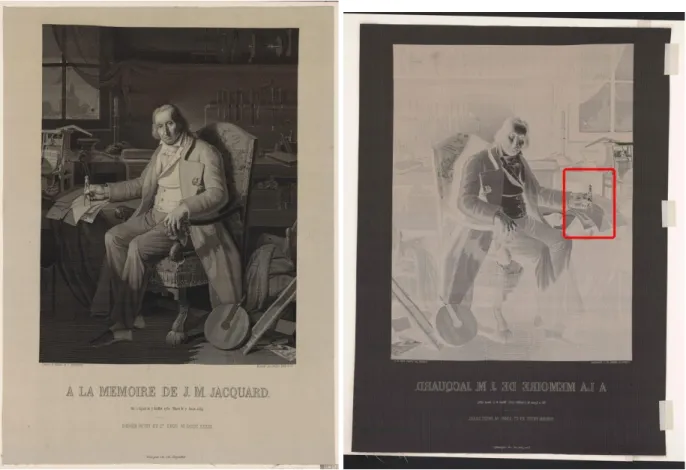
turning over a Jacquard-woven image, such as the one in Figure 1.10, a negative is clearly shown. By binding two
geometric grids of thread into an image with a positive and negative side, warp and weft weaving always produces a
laterally and tonally reversed image on its opposite side. Jacquard images are thus much like the Daguerreotype:
28
Figures:
29
Figure 1.2 Southworth & Hawes, Copy of Gilbert Stuart’s George Washington. Quarter-Plate Daguerreotype 1851.
30
31
Figure 1.5. Szczepanik’s Reproduction Camera. The Penrose Journal, 1903-1904.
32
Figures 1.7 and 1.8. Sketched and Woven Portraits of Mark Twain. The Penrose Journal, 1903-1904.
33
Figure 1.10. Front and Back View of À la mémoire de J.M. Jacquard / d’après le tableau de C. Bonnefond ; exécuté par Didier Petit et Cie. After a painting by Jean-Claude Bonnefond. Woven by François Michel-Marie Carquillat, [1839].
//hdl.loc.gov/loc.pnp/pga.05948
Chapter 2
In 1855, viewers of the woven Washington (Figure 2.1) contextualized the woven image via its indexical
relationship to the print medium: “the likeness is perfectly preserved; it is at least quite evident that the artist had a
power to preserve it as readily as if he were engraving it on copper.” If other viewers thought the, “(silk) pictures
resembled engravings in their delicacy and clearness,” a relationship between prints and Jacquard-woven images
existed within visual perception. Comparing the woven portrait to its printed ancestor, viewers contextualized the 51
new form of reproductive media within a pre-existing media logic, thereby perceiving the silken replica as a print
materially and visually. Washington was therefore reliant upon pre-existing forms of mechanical reproduction to
ensure its genesis in thread, such as the Daguerreotype (Figure 2.2) and stipple engraving ( Figure 2.3), and
34
contextualized by viewers within an already operating system of print-based perception. That print was the medium
viewers grappled with the eccentricity of Washington’s portrait comes as no surprise, for the silk portrait literally
emulates printed matter. Indeed, the flattened logic of geometric perception so popular in art of the nineteenth
century remediated the newly-made silken image.
This visual equivalence has a deeper resonance when we comparatively assess the processes of printing
with those of Jacquard weaving. Both reproductive methods strategically made the labor of image making invisible
in the nineteenth century. Invisible labor is work that contributes to the making of an object but is often obscured in
its finished form. For example, tasks such as cleaning tools, setting type, punching holes, and wiping plates are 52
necessary to print and weave images, but are seldom visually detectable. Although they required the application of
precise forms of craft knowledge, these instances of visual displacement are perhaps mirrored in the tendency to
reductively analyze each method of image-making’s contribution to large-scale economic systems, rather than
acknowledging the many intermediary steps taken to produce final images. It is certainly true that the printing press
rapidly altered access to text and image; the Jacquard loom, too, increased production through its reliance on the
systematic division of labor through nineteenth-century industrialization and automatization. Theseeconomic-based
approaches to each reproductive method, however true, overlook forms of knowledge already foreclosed by the
image itself. The final image and systemic analysis therefore share something in common: they continually make
forms of craft labor invisible, hard to detect, and often unknown. Rather than continue this dualdisplacement, this
chapter traces the variety of craft techniques necessary to translate the print of George Washington into a
Jacquard-woven image.
While the relationship between printing and weaving is seldom discussed, art historians have previously
interrogated the relationship encountered between copies of an image in different mediums. Stephen Bann, for
example, has explored “the discursive space opened up by the parallel practices of printmaking, painting and
photography, and their shared involvement in image reproduction.” By focusing on the craft techniques which 53
52 No labor is truly Invisible. I use the word displacement throughout the chapter, instead. See Jennifer Roberts, “On Mis-Expertise: Writing About Making.” Minding Making, accessed March 24th, 2019,
https://www.mindingmaking.org/project_misexpertise
35
enabled the translation of paper into fabric, skills unacknowledged in the nineteenth-century discourse surrounding
Jacquard looms, I hope to pry apart the discursive spacebetween the printed image and the Jacquard-woven image
of Stuart’s George Washington. As we learned in the first chapter, Welch’s Washington was a collapsed painting
and photograph, a copy of a copy. While the networked relations created through copying are worth highlighting, it
is important to acknowledge that unlike the painting, Daguerreotype, and print, the Jacquard-woven copy of
Washington relied on a completely different ontological form of illusion to appear before viewers. Whereas prints
have an indexical relationship to their reproductive plates, the Jacquard-woven image shreds this relational form of
perception entirely.
Dimensional fidelity was achieved on the top surface of the fabric image, but the symbolic code enabling
the woven image’s instantiation ultimately obscures the relational perception promised by prints. Viewers were able
to perceive the image of Washington as a print without acknowledging a binary code that existed beyond its surface.
With this in mind, I hope to compare and contrast print and woven image beyond their image relation, and, instead,
focus on how the many agents involved in the translation processes - human workers, machines, and materials -
interacted to materially and epistemically shift how images could exist from binary codes: a form of image which
betrays the representational logic common in the eighteenth and nineteenth centuries. This chapter therefore not only
traces the translation on an intaglio copper engraving to a punch-card code, but stresses how this translation process
visually afforded the displacement of craft labor. What I suggest is key to understanding these divergent practices of
reproduction, one engaged with pressing ink and the other in weaving silk, is their respective reliance upon the
cultural technique of the gridded matrix in the preparation of the image for translation. Both processes relied upon
the grid to visually structure and mechanically reproduce Washington’s likeness, but their respective manipulations
are key to understanding how the conflation between print and Jacquard-woven image ultimately fails to account for
their ontological differences.
The grid, so says Bernhard Siegert, is the cultural technique of modernity. For Siegert, the grid has tripartite
function: “First, it is an imaging technology that by means of a given algorithm enables us to project a
three-dimensional world onto a two-dimensional plane. That is to say, it is a type of representation that posits an
antecedent geometrical space in which objects are located and that submits the representation of objects to a theory
36
that can be implemented in the real as well as in the symbolic (grids may be two- or three-dimensional or 2D/3D
hybrids). Third, the grid serves to constitute a world of objects imagined by a subject...The grid, in short, is a
medium that operationalizes deixis.” Siegert’s tripartite functionality is concerned with spatial subjectivization 54
through modernity, but his idea has particular resonance when considering the grid as a tool for image production,
and, more importantly, the grid as a material technique which enabled the post-modern, digital landscape in which
we now deictically relate. As one of the oldest cultural techniques, the grid strategically links the techniques of
weaving to digital images. As Hannah Higgins has claimed, the Jacquard's punched cards served as, “the mechanism
of transition between the soft grids of textile technology and the hardware of the information age; it translated the
net from its physical expression in textiles to a modeling form that would tabulate, sort, and integrate.” 55
Following these scholars, I want to stress the fabric grid’s importance in altering our relationship to images.
This chapter interrogates how the many agents of producing woven images - material, machine, and human worker -
inhabited the form of the grid, and, in the process, enabled images to exist apart from their binary codes and the
labor necessary to make them. The grid served a material and metamorphic technique which structured the visual
displacement of craft labor within the translation from paper to woven interface. By understanding how grids
structured the non-visualization of labor in the Jacquard-woven image, we can better understand how digital images
visually obscure the labor necessary for their making.
Cracks in the Window
Long before George Washington’s physiognomy was woven in silk, an exquisite portrait was woven by
François Michel-Marie Carquilla t somewhere between 1834 and 1839 (Figure 2.4). Joseph-Marie Jacquard’s now
famous portrait, originally painted by Jean-Claude Bonnefond, was one of the first of its quality wrought upon the
Jacquard loom. Woven images existed as tapestries before the advent of the Jacquard harness, but the precise visual
definition featured in Carquillat’s portrait had everything to do with his ability to use the Jacquard loom. The portrait
illustrates the loom’s inventor in typical fashion. Sitting regally in an upholstered chair, an elderly Jacquard looks
out to the viewer with a tilted glance. Jacquard effortlessly handles his calipers, used to measure the holes in each
54 Bernhard Siegert and Geoffrey Winthrop-Young, “(Not) in Place: The grid, or, cultural techniques of ruling spaces,” Chap. 6 in