2066
Towards an argumentative content search engine using weak supervision
Ran Levy,∗ Ben Bogin∗, Shai Gretz∗, Ranit Aharonov, Noam Slonim IBM Research
{ranl,boginb,avishaig,ranita,noams}@il.ibm.com
Abstract
Searching for sentences containing claims in a large text corpus is a key component in devel-oping an argumentative content search engine. Previous works focused on detecting claims in a small set of documents or within documents enriched with argumentative content. However, pinpointing relevant claims in massive unstructured corpora, received little attention. A step in this direction was taken in (Levy et al., 2017), where the authors suggested using a weak signal to develop a relatively strict query for claim–sentence detection. Here, we leverage this work to define weak signals for training DNNs to obtain significantly greater performance. This ap-proach allows to relax the query and increase the potential coverage. Our results clearly indicate that the system is able to successfully generalize from the weak signal, outperforming previously reported results in terms of both precision and coverage. Finally, we adapt our system to solve a recent argument mining task of identifying argumentative sentences in Web texts retrieved from heterogeneous sources, and obtainF1scores comparable to the supervised baseline.
1 Introduction
The arguments raised during a decision making process, will often determine its outcome. A common component in all argument models (e.g., (Toulmin, 2003)) is theclaim, i.e. the assertion the argument aims to prove. The problem of automatically detecting claims supporting or contesting a given contro-versial topic1(Levy et al., 2014) is considered a fundamental task in the emerging field of computational argumentation (Lippi and Torroni, 2016; Palau and Moens, 2009). We refer to their definition of a Topic and a Claim;Topic- a short phrase that frames the discussion andContext Dependent Claim- a gen-eral, concise statement that directly supports or contests the given Topic (we henceforth use the term claim instead of Context Dependent Claim).
Previous works have focused on detecting claims within a small set of documents related to the topic (Levy et al., 2014), or within documents enriched with argumentative content (Stab and Gurevych, 2014). However, pinpointing relevant claims within massive unstructured corpora, received relatively little at-tention. While this problem is obviously more challenging, its potential value is also much higher. For a widely discussed topic, one should expect many relevant claims to be mentioned across a widespread set of articles in the given corpus. The remaining issue is to develop a technology to swiftly detect these claims and present the results to potential users, similarly to search engines that retrieve information in response to a query.
A step in this direction was taken in (Levy et al., 2017). They suggested a relatively strict sentence– level query (strict in the sense that it considerably limits the set of potential answers hence reduces the coverage). Their query combines three query parts that must appear in order, with possible gaps between them. The first part requires the sentence to contain the token‘that’as it is often a precursor for a claim (e.g. <someone>argued that<claim>). The second query part requires some restriction on the scope of topics the system can handle, and assumes that each topic deals with exactly one concept (denoted
This work is licensed under a Creative Commons Attribution 4.0 International License. License details: http://creativecommons.org/licenses/by/4.0/
∗
First three authors contributed equally.
MC – for main concept) and that this concept has a Wikipedia title (e.g. Affirmative Action). The second part of the query thus restricts the returned sentences to those in which the MC follows the word
‘that’(possibly with a gap). The third and final query part requires a token from a pre–specifiedclaim lexicon(CL) to appear after the MC (possibly with a gap). The CL lexicon aims to characterizeclaim sentences(CS) and the process of its creation did not involve any labeled data. Table 1 shows the fifty most indicative tokens from the lexicon. Relying on this formulation led to promising precision results in the challenging task of corpus wide claim detection, albeit with low recall . Specifically, while each of the sentences in Table 2 contains a valid and relevant claim, onlyS1satisfies their query; In contrast,
S2satisfies only the first part of the query (‘that’ preceding the MC);S3satisfies the second part of the query (CL token following the MC); andS4only mentions the MC. By construction, these latter three sentences, are out of the radar of Levy et al. (2017).
Claim Lexicon - partial
should, tuned, could, unconstitutional, violate, might, violated, violates, wrong, rather, valid, invalid, irrelevant, inherently, necessarily, cannot, prevail, justify, flawed, merely, corpus, ought, inevitably, cause, justifiable, unacceptable, untrue, abhor-rent, unless, harmful, punished, liable, incompatible, beneficial, justifying, undecided, skimmed, indefensible, impossible, undermine, necessary, flourish, meaningless, outweigh, substantiated, refute, jeopardized, incapable, irrational, heterosexual
Table 1: Fifty most indicative words in the Claim Lexicon (starting from the most indicative)
Example Id Sentence
S1 He believedthat nuclear powerwould becomeobsolete, to be replaced by clean energy sources.
S2 The author concludesthat wind energyhas the greatest potential for near-term expansion.
S3 As Buckley writes, “Ifatheismwasunacceptable, superstition and fanaticism were even more so”.
S4 Any form ofcorporal punishmentis barbaric and has no place in a civilized polity.
Table 2: CS examples for the topics ‘We should further exploit nuclear power’, ‘We should further exploit wind power’, ‘Atheism is the only way’ and ‘We should prohibit corporal punishment’. The query items ‘that’, MC and CL are highlighted in boldface.
The main contribution of the current work is to propose a more flexible approach for corpus wide claim detection, that significantly outperforms previous work, in terms of both precision and of coverage. We also release two data sets, one of≈1.5Msentences matching the topics in this study, and one of2,500
sentences predicted by our method, annotated for whether they contain a relevant claim or not2.
We use Deep Neural Networks (DNN) trained with weak supervision that stems from different parts of the aforementioned query. Considering the list of 100 MC used by Levy et al. (2017), we first construct two weakly supervised labeled data sets, each composed of two classes. In the first, the weakly–positive class includes all sentences that mention the MC preceded by ‘that’; while the weakly–negative class contains a similar number of sentences that mention the MCwithouta preceding ‘that’. Our underlying assumption is that the former set will be more enriched with CS (this we first noted in (Levy et al., 2014)). However, since these two classes are trivially distinguished via the (non) presence of ‘that’, we train the DNN on thesuffixesof the sentences in these data, where the suffix of a sentence is defined as the sentence part immediately following the MC.
Similarly, we construct another data set, in which the weakly–positive class includes all sentences that mention the MC followed by a token from CL; while the weakly–negative class contains a similar number of sentences that mention the MCwithouta following token from CL. Here as well, to avoid the trivial signal, we train the DNN on theprefixesof the sentences in these data, where the prefix of each sentence is defined as the part preceding the MC.
2The data sets can be downloaded from http://www.research.ibm.com/haifa/dept/vst/debating_
The priors for the two positive classes as well as the strict query were estimated in (Levy et al., 2017) by performing a small labeling experiment. We present their results in table 3 in order to demonstrate that the assumptions indeed hold.
Table 3: Estimated priors for different queries from (Levy et al., 2017).
Finally, we restrict both datasets to sentences in which the number of suffix (prefix) words is greater than 3. We assume this restriction mostly removes negative examples, and in any case will not convey a lot of information to theDN N in the learning process.
We test the performance of these DNNs over a distinct test set of 50 topics, also from (Levy et al., 2017). However, in contrast to this previous work, we consider a much more relaxed query that only requires the MC to be mentioned in the sentence. Our results clearly indicate that both DNNs were able to generalize and obtain promising precision results, that are further improved when their scores are averaged. That is, combining the predictions of a DNN trained over prefixes of sentences enriched with claims, with those by a DNN trained over suffixes of such sentences, results in a pincer–movement like approach, that successfully pinpoints a wide range of CS in a massive unstructured corpus, while using only weak supervision for training.
2 Related Work
Recently, Wachsmuth et al. (2017) suggested an argument search framework and a corresponding search engine prototype. However, the proposed system relies on arguments crawled from dedicated resources that suggest pre–written arguments for various topics, and hence, is only relevant for topics covered in these resources, and cannot be used directly over unstructured textual data. Stab et al. (2018) tackled the argument mining task in heterogeneous texts retrieved by Google search when queried with a con-troversial topic. They show that it is feasible to annotate the retrieved documents via crowd-sourcing and to use these labels in order to build a supervised learning system that finds arguments in the given documents. Similar to our work, sentences are treated in isolation (ignoring the document context). The only work we are aware of that tackles corpus wide claim detection, is the work by (Levy et al., 2017). Here, we demonstrate how this work can be leveraged to define weak signals for training DNNs to obtain significantly greater performance.
Several works used DNN to tackle a variety of computational argumentation tasks, such as argument mining (Eger et al., 2017), predicting argument convincingness (Habernal and Gurevych, 2016), detect-ing context dependent claims and evidence (Laha and Raykar, 2016) and attack and support relations be-tween arguments (Cocarascu and Toni, 2017). However, these works used the fully–supervised learning paradigm, which is inherently demanding, especially in the context of argument mining where obtaining labeled data is notoriously difficult (Aharoni et al., 2014). In addition, Al-Khatib et al. (2016) used a distant supervision approach trained over debate portals’ data, to develop a classifier for argumentative texts stored in these portals. To the best of our knowledge, the present work is the first to demonstrate the value of DNN trained solely with weak supervision (Hearst, 1992) in this challenging field.
3 Method
3.1 Setup and pre-processing
We follow the setup and pre-processing described in (Levy et al., 2017) – see appendix for details. We consider the same train3and test sets, consisting of100and50topics respectively. Next, we prepared a sentence–level index from the Wikipedia May 2017 dump, and used a simple Wikification tool (to be described in a separate publication)4 to focus our attention on sentences that mention the MC. Filtering out sentences that mention a location/person named entity using Stanford NER (Finkel et al., 2005), after the MC, results in an average of≈10Ksentences per MC.
3.2 Claim sentence queries and weak labels
The basic query we start with, denotedqM C, only requires that the MC will appear in the sentence. For
the150topics of this study, we retrieve a total of≈1.5M sentences matchingqM C(Table 4), which we
release as a data set to enhance future research. Next, we consider the queryqthat, which retrieves all
sentences in which the token ‘that’ precedes the MC (cf.S1andS2in table 2). There are≈1,100such sentences per topic (Table 4). Aiming to increase the prior of CS in the weak–positive set, for training the network, we focus on the subset of these sentences in which the token ‘that’ immediately precedes the MC. As a weak–negative set we consider a similar number of sentences, with similar length distribution, selected at random from theqM C sentences with the additional requirement ofnothaving ‘that’ before
the MC. As explained in section 1, the corresponding DNN, termedDN Nsuf f, is trained only on the
sentence suffixes.
Query Name Query # Sentences Per Topic
qM C MC 9,947
qthat that→MC 1,073
qCL MC→CL 793
qstrict that→MC→CL 164
Table 4: Queries used to construct weak labels. # Sentences Per Topic is averaged over the150topics used in this study.qstrictis added for reference and was not used in training the networks.
Similarly, we consider the queryqCL, which retrieves all sentences in which the MC is followed by
a token from CL, e.g., sentencesS1andS3in table 2. Again, these sentences as well are expected to be relatively enriched with claims. In Table 4 we see that on average we have≈790such sentences per topic. As a weak–negative set we consider a similar number of sentences, with similar length distribution, selected at random from theqM C sentences with the additional requirement ofnothaving a CL token
after the MC. Again, the corresponding DNN, denoted by DN Npref is trained only on the sentence
prefixes.
Table 5 lists examples of sentences in the weak–positive and weak–negative sets used to train the networks. The part “seen” by the relevant network appears in bold, where by an anecdotal examination it is indeed possible to identify a signal in the positive sets. Table 6 summarizes the characteristics of the two datasets used to train the networks.
3.3 DNN System
For both DN Nsuf f andDN Npref, we use a Bi-LSTM architecture with self-attention (Yang et al.,
2016). The networks were trained on sentences retrieved for70of the100train–set topics, where sen-tences retrieved from the other30train–set topics (heldout set) were used to optimize hyper-parameters. We used Adam optimizer (Kingma and Ba, 2014) over the cross-entropy loss. The best model was
3
The set of100topics was termeddev setin their work because there was no training involved.
4A Wikification tool allows retrieving sentences that mention the topic explicitly, as well as sentences which use a different
Network Positive/Negative Sentence
DN Nsuf f Positive There is no good evidence that organic foodtastes better than its non-organic counterparts.
DN Nsuf f Negative Today it is known for its remoteness, its somewhat “alternative”
atmo-sphere, organic foodproduction, and its pioneering use of wind power.
DN Npref Positive Fermi did not believe thatatomic bombs would deter nations from
start-ing wars, nor did he think that the time was ripe for world government.
DN Npref Negative In particular, fission products do not themselves undergo fission, and therefore cannot be used fornuclear weapons.
Table 5: Examples from the positive and negative sets ofDN Nsuf f andDN Npref for the topics
“Or-ganic Food” and “Nuclear weapon”. The respective prefix/suffix appears in bold.
Network Positive sentences Negative sentences Part of sentence used by the network
Size of data
DN Nsuf f that→MC MC without preceding ‘that’ following the MC 11,624
DN Npref MC→CL MC without a following CL token preceding the MC 132,856
Table 6: Characteristics of the two datasets used to train the networks. Note that the data for the suffix network is much smaller because of the restriction to sentences in which the token ‘that’ immediately precedes the MC.
trained with a dropout of 0.15, using a single dropout mask across all time-steps as proposed by (Gal and Ghahramani, 2016), one LSTM layer with a cell size of128, and an attention layer of size100. Words are represented using the300dimensional GloVe embeddings (Pennington et al., 2014). Inference is performed for anyqM Csentence by averaging theDN Nsuf fscore of its suffix with theDN Npref score
of its prefix.
We used the heldout set to determine early stopping and to optimize the following hyper–parameters (each parameter was optimized independently): Number of layers (1/2), LSTM cell size (64/128/256/512), attention FF size (50/100/200) and dropout rate
(0/0.05/0.1/0.15/0.2/0.25/0.3/0.35).
4 Data for evaluation
We labeled via crowd the top50predicted sentences for each of the50test-set topics, taking the majority vote of at least 10 workers. The guidelines are presented in figure 1. The inference is applied to all sentences containing the MC (matching qM C), and hence there are always50 predictions, that are all
released along with their manual evaluation. We also label in the same manner the predictions of the system described in (Levy et al., 2017)5. There, since all predictions must matchqstrict, for some topics
there are less than50predictions. In those cases, we label all predictions.
This paper focuses on retrieving claim sentences, however, we have found that it is easier for the crowd workers to label a sentence if the phrase suggested to be the claim is highlighted. For this reason, we used an internal boundary detection component and applied it to all system versions (including the re-implementation baseline of (Levy et al., 2017)). The rest of the labeling process was done similarly to (Levy et al., 2017). Each sentence was labeled by 10-15 crowd workers per row via the Figure–Eight platform 6. We used the MACE de–noising tool (Hovy et al., 2013) to filter labels before computing Cohen’s Kappa coefficient. We averaged the Kappa coefficient across all worker pairs with at least50
joint labeled instances. Using a threshold of0.9(i.e. keeping90%of the labels) the Kappa was0.58.
5
We re-implemented their system since since we used a more recent Wikipedia dump and a different Wikification tool. The results we obtained are very close to the reported results.
Figure 1: Labeling guidelines exactly as they appeared in the Figure–Eight platform. Note that for the sake of this work we ignore the stance labeling (pro/con answers).
5 Results
To evaluate the performance of the network, we employ two sets of experiments. In the first we use the test-set topics in a manner similar to (Levy et al., 2017). In the second, we test our network on the UKP Sentential Argument Mining Corpus released in (Stab et al., 2018). Note that the UKP data is more inline with our goal than other argument mining tasks as it separates between sentences that support/contest a given topic from sentences that don’t. A major difference between the UKP data and our test set is the source from which the sentences were taken – while we used Wikipedia, the UKP data comes from various sources, and hence it would test how well our approach generalizes to other text genres. Another important difference is in the definition of positive examples - we consider sentences containing relevant claims as positive, whereas they require that a sentence contain some supporting evidence or reasoning. The results on our test set are presented in subsection 5.1 and the results on the UKP data are presented in subsection 5.2.
5.1 Results on the Test Set
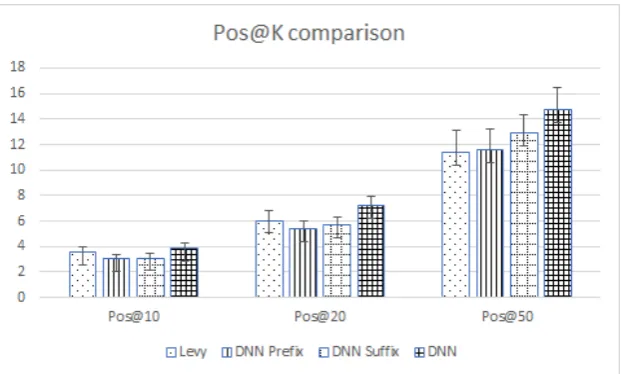
Figure 2 depicts the average number of CS (i.e., true positives) retrieved per the top K = 10,20,50
predictions. BothDN Npref andDN Nsuf f seem to generalize well from the weak signal and provide
comparable results to (Levy et al., 2017). More importantly, using the average score (DNN) yields the best performance, consistently outperforming (Levy et al., 2017) (with p-value<0.005forK = 20,50
based on a two-tailed Wilcoxon test). The gap is most prominent forK = 50, where the DNN yields
≈30%more CS compared to the the non–learning system that used a strict query with limited recall. A major question is whether the learned system is able to generalize from the weak labels and identify CS that do not match the weak queries we started with. By construction, all sentences retrieved by the (Levy et al., 2017) system, matchqstrict. From Table 7, we see that although the DNN system trained
Figure 2: Results for the50test-set topics.P os@K: The number of claim sentences (CS) out of the top
K predicted sentences per topic, averaged over all test topics. Bars denote the standard error. Levy – Results reproduced on current index using the system described in (Levy et al., 2017); DNN – using the average score ofDN Npref andDN Nsuf f.
to the precision achieved in the restricted, low–recall system of (Levy et al., 2017). These results suggest that the DNN captures some general characteristics of CS, that are not limited to sentences that satisfy the two weak–signal queries we started with, qthat andqCL. In addition, the precision on sentences
containing one or both of the weak signals is even higher. Specifically, the precision on the subset of sentences matchingqstrict is0.42, a factor of two compared to the precision of (Levy et al., 2017) on
this set of sentences. Thus, overall we were able to increase the potential recall from the restricted set of sentences matchingqstrictto the full set ofqM C sentences, while also increasing the precision of the
predictions from0.23to0.3(see the columnqM C).
Measure System qstrict qthat∗ q
∗
CL q
∗
M C qM C
Percent Levy 100 0 0 0 100
DNN 30 26 16 28 100
Precision Levy 0.23 NA NA NA 0.23
DNN 0.42 0.32 0.22 0.22 0.30
Table 7: Distribution and precision of predictions. q∗that: matchesqthatbut notqCL;q∗CL: matchesqCL
but notqthat;qM C∗ : matchesqM C, but not any of the other queries. Percent: out of the top50(or all if less
available) predicted sentences matching the query. Precision: Precision of the corresponding candidates, calculated per topic, and averaged over test topics.
5.2 Results on the UKP Sentential Argument Mining Corpus
The UKP Sentential Argument Mining Corpus (Stab et al., 2018) contains a total of 25,492 labeled sentences (11,139 argumentative, 14,353 non-argumentative), divided to train (70%), validation (10%), and test sets (20%). The sentences are associated with one of8controversial topics –abortion,cloning,
death penalty,gun control,marijuana legalization,minimum wage,nuclear energyandschool uniforms
Adapting to the UKP dataset
In order to evaluate our method on the UKP dataset we had to adapt it to sentences that do not necessarily contain the MC. In our formulation, the MC was used as a natural point to divide the sentence into its prefix and suffix, which were then used by the appropriate networks. To overcome this difference, we appliedDN Nsuf f (DN Npref) to all possible suffixes (prefixes) and used the maximal score.
For a sentenceScomprised ofnwords,w1, w2, ..., wn, we define,
DN Nsuf f0 (S) =max{i:1..n}DN Nsuf f(wi, ..., wn)
DN Npref0 (S) =max{i:0..n−1}DN Npref(w1, ..., wn−i)
The adapted scores may still be at a disadvantage because without the MC we don’t have a way to select sentences that are more related to the topic. For this reason we add a similarity scoreScorew2v
which is computed by taking the maximal word2vec (Mikolov et al., 2013) similarity of a word in the topic against all words in the sentence and then averaging across the words of the topic. More formally, for a topicT comprised ofkwords,t1, ..., tk,
Scorew2v(S) =avg{i:1..k}max{j:1..n}word2vec(ti, wj)
Finally, we define,
DN Nsuf f,w0 2v =avg(DN Nsuf f0 , Scorew2v)
DN Npref,w0 2v =avg(DN Npref0 , Scorew2v)
We employ the same setup that was used by (Stab et al., 2018) for the cross topic evaluation, in which the train set is comprised of the train part of all topics except for the tested topic. We use the training set only to tune the threshold from which we predict the positive class. To do so, we run the different DNN methods on the train set, compute theF1 over all sentences, and choose the score that maximizes the
F1. This score is then used in the test set as the threshold that determines whether the network predicts a positive or not. Overall, this tuning was done8times, one for each train set induced by the left-out test topic.
Evaluation
The results are shown in table 8. Interestingly, our system achieves comparable results to the state of the art in the Accuracy andF1 measures but without using human labels for training and without training on multiple text genres. These results also demonstrate the ability of the proposed method to generalize to topics that are not characterized by a single MC or that such a concept was not provided by the user. Note, the results reflect that our system and the baseline operate at different points on the precision/recall curve, choosing a different compromise between precision and recall. This is not surprising, given the choice of tuning theF1measure on the train set, however, it makes the comparison less obvious.
Method Accuracy F1 Precision Recall
U KP 0.69 0.66 0.75 0.52
DN Nsuf f0 0.57 0.65 0.51 0.90
DN Nsuf f,w0 2v 0.67 0.69 0.59 0.83
Table 8: Results of the cross topic evaluation on the UKP dataset (averaged across the8 topics). UKP method stands for the best supervised results reported in (Stab et al., 2018). From the networks combined withw2vtheDN Nsuf f,w0 2vperformed best and is the one presented here.
existence of a surrounding argument. Indeed, as mentioned in section 6.2, by sampling 50 false-positives we found that in 25% of the cases they contained relevant claims but with no evidence or reasoning.
6 Error Analysis
6.1 Test Set - 50 Topics
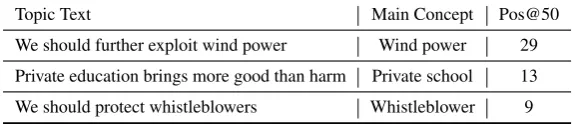
We analyzed the top 50 labeled predictions over three test topics for which the performance was above/near/below average (table 9).
Topic Text Main Concept Pos@50
We should further exploit wind power Wind power 29
Private education brings more good than harm Private school 13
We should protect whistleblowers Whistleblower 9
Table 9: Test topics chosen for error analysis.
Each sentence rejected by the labelers was assigned one of the following types: Factual– a sentence with no argumentative content, that merely states a fact; Different Topic – a sentence that contains a claim for a different topic; Other– an assortment of problems such as bad sentence split, missing context, etc; and finallyAccept – a sentence that should have been accepted by the labelers. The two main types of errors were Factual and Different topic, each accounting for35%of the analyzed errors. The Accept type accounted for18%of the rejected sentences, though this high number was mostly due to the Whistleblowers topic. We suspect that many such sentences were rejected because of bad claim boundary choices by the system7. Table 10 shows examples from the topic“Private education brings more good than harm”.
Error Type Sentence
Different Topic Changes in private school enrollment is not a likely contributor to any changes in schools segregation patterns during that time.
In 2014 Hunt proposed that private schools should be required to form “partnerships” with local state schools if they wanted to keep their charitable status.
Factual Before enrolling the children, however, Mr. Brar ensured that the total cost of private school tuition would not exceed$10,000.
The IRS announced in 1970 that private schools with racially discriminatory admissions policies would no longer receive tax exemptions
Accept Coaches were concerned that the private schools were winning a disproportionate amount of conference titles and had several unfair advantages.
Other* It is clear that affording private education is a mere fantasy for these families.
Table 10: Examples of sentences from the topic ‘Private education brings more good than harm’. The sentences are split according to their assigned error type. * The example for the Other type was rejected because of a missing context – it is hard to judge this example without resolving the reference to “these families”
6.2 Test Set - UKP Dataset
We analyzed 50 random sentences from the UKP test set labeled as non-argumentative, on which the score of the DN Nsuf f,w0 2v network was higher than0.9(the average threshold obtained by tuning F1 was 0.65). We add the following error type to the list above: No Reasoning– a sentence containing a claim with no supporting evidence or reasoning. The most frequent type of error was Factual, accounting
7We used a claim boundary component (Levy et al., 2014) on top of all systems in order to simplify the labeling task. This
for about33%of the errors. The No Reasoning type accounted for about25%of the errors, similar to the Different Topic type. Table 11 shows examples of No Reasoning sentences. These sentences contain text boundaries that are relevant claims, e.g., the boundarythe life in the womb is not humanin the first sentence, and thus are typical to sentences that our network was trained to find.
Topic Sentence
abortion A question for those who believe in abortion, and thatthe life in the womb is not human.
death penalty We need stricter laws and swift death penalty.
minimum wage Myth:Raising the minimum wage will only benefit teens.
marijuana legalization
A small share of opponents (7%) say that whilethe recreational use of marijuana should be illegal, they do not object to legalizing medical marijuana.
Table 11: Examples of sentences marked as No Reasoning from the UKP test set. The phrases marked in boldface are the suggested claim boundaries according to our analysis.
7 Discussion and Future Work
This work aims at making the first steps towards a search engine for argumentative content, by focus-ing on the problem of corpus wide claim detection. A variety of argument theories have been proposed throughout the years, which all agree on the importance of one argument component – the claim. Thus, properly addressing the problem of corpus wide claim detection seems like a key component in devel-oping a full fledged argument search engine. Such an engine could add massive amounts of data to argument networks such as the world wide argument web (Rahwan et al., 2007), and further enhance de-cision processes in various ways. Using a similar methodology for evidence detection would be a natural way to push the boundary of existing work, e.g., (Rinott et al., 2015) from considering a pre-selected list of articles to searching full corpora. To the best of our knowledge this is the first work using weak supervision to train DNNs for argument mining, demonstrating the potential of this coupling in the field. Two directions for future work could increase the precision and coverage of our system. For increasing precision, we intend to employ a supervised approach, using labels on top of predictions from the weak– supervision approach, as it may help reach a reasonable prior of positive examples before starting the labeling effort. For the coverage, we intend to explore the same approach on top of sentences which do not necessarily contain the MC. This direction is challenging since it requires integrating a method for identifying whether a sentence is related to the topic, and would need to score sentences in which the prior for a claim is even lower.
Appendix A Index and Preprocessing
We processed the Wikipedia dump from May 1st, 2017. We applied text cleaning and sentence splitting using OpenNlp Sentence Detector8and an internal Wikification tool to wikify each sentence9. Starting from 5.4M articles, the sentence level index contains approximately 102M sentences. The inverted index along with the support for queries that mix surface form tokens with Wiki concepts was implemented as in (Levy et al., 2017).
We annotated the sentences retrieved by all queries using Stanford NER (Finkel et al., 2005), and removed sentences with a person/location entity after the MC (e.g., the sentence“Yan warned Li that the Nationalist cause was doomed unless Li went to Guangdong”for the topic“Nationalism does more harm than good”would be removed). This filter is motivated by our goal of retrieving general claim sentences for the topic, assuming that claims about specific entities are less interesting for potential users.
Appendix B Topics and Folds
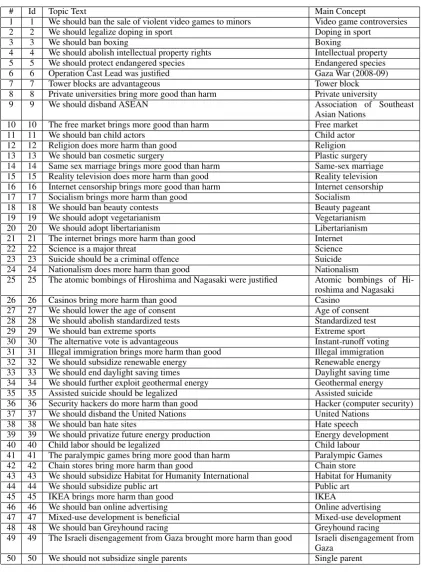
The list of150topics is taken from (Levy et al., 2017) and split to dev/test in the same manner. Since here we use a learning system, we further split the dev set into a train set of70topics and a heldout set of30topics which was used to decide when to stop the learning. Tables 12 and 13 show the train topics and tables 14 and 15 show the topics of the heldout and test sets respectively.
Appendix C Released Data
We release two datasets, one containing≈ 1.5M sentences matching the topics in this study based on theqM Cquery, and one containing2,500sentences predicted by our network and annotated for whether
they contain a relevant claim or not (top 50 predictions across the 50 topics in the test set)10. Theq
M C
dataset can be found in the attachedq mc train.csv,q mc heldout.csvandq mc test.csv
files, according to the topics split used in the learning/evaluation process. A detailed description of this dataset appears in thereadme mc queries.txt file. The system prediction dataset is in the
test set.csvfile with a corresponding description in thereadme test set.txtfile.
8
http://opennlp.apache.org/
9
To be described in a separate publication.
10The datasets can be downloaded from http://www.research.ibm.com/haifa/dept/vst/debating_
# Id Topic Text Main Concept
1 1 We should ban the sale of violent video games to minors Video game controversies
2 2 We should legalize doping in sport Doping in sport
3 3 We should ban boxing Boxing
4 4 We should abolish intellectual property rights Intellectual property
5 5 We should protect endangered species Endangered species
6 6 Operation Cast Lead was justified Gaza War (2008-09)
7 7 Tower blocks are advantageous Tower block
8 8 Private universities bring more good than harm Private university
9 9 We should disband ASEAN Association of Southeast
Asian Nations
10 10 The free market brings more good than harm Free market
11 11 We should ban child actors Child actor
12 12 Religion does more harm than good Religion
13 13 We should ban cosmetic surgery Plastic surgery
14 14 Same sex marriage brings more good than harm Same-sex marriage 15 15 Reality television does more harm than good Reality television 16 16 Internet censorship brings more good than harm Internet censorship
17 17 Socialism brings more harm than good Socialism
18 18 We should ban beauty contests Beauty pageant
19 19 We should adopt vegetarianism Vegetarianism
20 20 We should adopt libertarianism Libertarianism
21 21 The internet brings more harm than good Internet
22 22 Science is a major threat Science
23 23 Suicide should be a criminal offence Suicide
24 24 Nationalism does more harm than good Nationalism
25 25 The atomic bombings of Hiroshima and Nagasaki were justified Atomic bombings of Hi-roshima and Nagasaki
26 26 Casinos bring more harm than good Casino
27 27 We should lower the age of consent Age of consent
28 28 We should abolish standardized tests Standardized test
29 29 We should ban extreme sports Extreme sport
30 30 The alternative vote is advantageous Instant-runoff voting
31 31 Illegal immigration brings more harm than good Illegal immigration
32 32 We should subsidize renewable energy Renewable energy
33 33 We should end daylight saving times Daylight saving time
34 34 We should further exploit geothermal energy Geothermal energy
35 35 Assisted suicide should be legalized Assisted suicide
36 36 Security hackers do more harm than good Hacker (computer security)
37 37 We should disband the United Nations United Nations
38 38 We should ban hate sites Hate speech
39 39 We should privatize future energy production Energy development
40 40 Child labor should be legalized Child labour
41 41 The paralympic games bring more good than harm Paralympic Games
42 42 Chain stores bring more harm than good Chain store
43 43 We should subsidize Habitat for Humanity International Habitat for Humanity
44 44 We should subsidize public art Public art
45 45 IKEA brings more harm than good IKEA
46 46 We should ban online advertising Online advertising
47 47 Mixed-use development is beneficial Mixed-use development
48 48 We should ban Greyhound racing Greyhound racing
49 49 The Israeli disengagement from Gaza brought more harm than good Israeli disengagement from Gaza
50 50 We should not subsidize single parents Single parent
# Id Topic Text Main Concept
51 51 We should ban private military companies Private military company
52 52 Coaching brings more harm than good Coaching
53 53 We should abandon disposable diapers Diaper
54 54 PayPal brings more good than harm PayPal
55 55 The Internet archive brings more harm than good Internet Archive 56 56 The 2003 invasion of Iraq was justified 2003 invasion of Iraq 57 57 Virtual reality brings more harm than good Virtual reality
58 58 Internet cookies bring more harm than good HTTP cookie
59 59 Magnet schools bring more harm than good Magnet school
60 60 The right to strike brings more harm than good Strike action
61 61 We should subsidize student loans Student loan
62 62 We should abandon Youtube YouTube
63 63 Ecotourism brings more harm than good Ecotourism
64 64 Academic freedom is not absolute Academic freedom
65 65 Homeschooling should be banned Homeschooling
66 66 We should abolish the US Electoral College Electoral College (United States)
67 67 Generic drugs should be banned Generic drug
68 68 We should fight global warming Global warming
69 69 We should fight for Quebecan Independence Quebec sovereignty move-ment
70 70 We should subsidize newspapers Newspaper
Table 13: Train topics 51-70
# Id Topic Text Main Concept
1 71 The freedom of speech is not absolute Freedom of speech
2 72 We should criminalize blasphemy Blasphemy
3 73 Holocaust denial should be a criminal offence Holocaust denial
4 74 Television does more harm than good Television
5 75 We should subsidize higher education Higher education
6 76 We should ban organic food Organic food
7 77 Urbanization does more harm than good Urbanization
8 78 We should adopt direct democracy Direct democracy
9 79 We should ban lotteries Lottery
10 80 We should close the Guantanamo Bay detention camp Guantanamo Bay detention camp
11 81 We should abandon the insanity plea Insanity defense
12 82 We should protect coral reefs Coral reef
13 83 We should disband NASA NASA
14 84 We should abolish nuclear weapons Nuclear weapon
15 85 We should cancel the speed limit Speed limit
16 86 Randomized controlled trials bring more harm than good Randomized controlled trial
17 87 Anarchism brings more good than harm Anarchism
18 88 We should subsidize public service broadcasters Public broadcasting
19 89 We should ban labor organizations Trade union
20 90 Pride parades bring more harm than good Pride parade
21 91 Paternity leave brings more harm than good Parental leave
22 92 Tabloid journalism brings more harm than good Tabloid journalism
23 93 We should disband UNESCO UNESCO
24 94 We should disband the National Rifle Association National Rifle Association
25 95 Second Life brought more harm than good Second Life
26 96 Economic sanctions bring more harm than good Economic sanctions
27 97 Vietnam War was justified Vietnam War
28 98 Animal slaughter is not justified Animal slaughter
29 99 We should raise the corporate tax Corporate tax
30 100 Division of labor is a major threat Division of labour
# Id Topic Text Main Concept 1 101 Affirmative action brings more good than harm Affirmative action
2 102 We should ban gambling Gambling
3 103 We should abolish the monarchy Monarchy
4 104 Atheism is the only way Atheism
5 105 We should further exploit wind power Wind power
6 106 We should legalize polygamy Polygamy
7 107 We should further exploit hydroelectric dams Hydroelectricity
8 108 We should privatize water supply Water supply
9 109 We should legalize prostitution Prostitution
10 110 Zoos bring more harm than good Zoo
11 111 Private education brings more good than harm Private school
12 112 Recall elections are beneficial Recall election
13 113 We should further exploit nuclear power Nuclear power
14 114 We should abolish temporary employment Temporary work
15 115 Surrogacy should be banned Surrogacy
16 116 Progressive tax is beneficial Progressive tax
17 117 We should ban alcoholic beverages Alcoholic drink
18 118 We should ban abortions Abortion
19 119 Astrology brings more harm than good Astrology
20 120 Embryonic stem cell research brings more good than harm Embryonic stem cell
21 121 We should abolish the Olympic Games Olympic Games
22 122 We should end athletic scholarships Athletic scholarship
23 123 Social media does more harm than good Social media
24 124 We should disband the United Nations Security Council United Nations Security Council
25 125 We should legalize insider trading Insider trading
26 126 We should prohibit hydraulic fracturing Hydraulic fracturing
27 127 We should prohibit corporal punishment Corporal punishment
28 128 We should disband NATO NATO
29 129 We should abolish the two-party system Two-party system
30 130 Capital punishment brings more harm than good Capital punishment
31 131 We should abolish term limits Term limit
32 132 We should protect whistleblowers Whistleblower
33 133 Twitter brings more harm than good Twitter
34 134 ISO brings more harm than good International Organization
for Standardization
35 135 Conscientious objectors are justified Conscientious objector
36 136 The American Bar Association brings more harm than good American Bar Association 37 137 Digital rights management brings more harm than good Digital rights management
38 138 We should ban the Church of Scientology Church of Scientology
39 139 eBay brings more good than harm EBay
40 140 We should abolish the caste system in India Caste system in India
41 141 We should abolish infant baptism Infant baptism
42 142 EHRs bring more harm than good Electronic health record
43 143 Wildlife management brings more good than harm Wildlife management
44 144 We should tax plastic bags Plastic bag
45 145 The energy industry should be nationalized Energy industry
46 146 We should fight protectionism Protectionism
47 147 We should limit genetic testing Genetic testing
48 148 We should end manned spaceflights Human spaceflight
49 149 Extra-curricular activity should be mandatory Extracurricular activity
50 150 We should abolish homework Homework
References
Ehud Aharoni, Anatoly Polnarov, Tamar Lavee, Daniel Hershcovich, Ran Levy, Ruty Rinott, Dan Gutfreund, and Noam Slonim. 2014. A benchmark dataset for automatic detection of claims and evidence in the context of controversial topics. InProceedings of the First Workshop on Argumentation Mining, pages 64–68.
Khalid Al-Khatib, Henning Wachsmuth, Matthias Hagen, Jonas K¨ohler, and Benno Stein. 2016. Cross-domain mining of argumentative text through distant supervision. InProceedings of the 2016 Conference of the North American Chapter of the Association for Computational Linguistics: Human Language Technologies, pages 1395–1404, San Diego, California, June. Association for Computational Linguistics.
Oana Cocarascu and Francesca Toni. 2017. Identifying attack and support argumentative relations using deep learning. InProceedings of the 2017 Conference on Empirical Methods in Natural Language Processing, pages 1374–1379, Copenhagen, Denmark, September. Association for Computational Linguistics.
Steffen Eger, Johannes Daxenberger, and Iryna Gurevych. 2017. Neural end-to-end learning for computational argumentation mining. InProceedings of the 55th Annual Meeting of the Association for Computational Lin-guistics (Volume 1: Long Papers), pages 11–22, Vancouver, Canada, July. Association for Computational Lin-guistics.
Vanessa Wei Feng and Graeme Hirst. 2011. Classifying arguments by scheme. InProceedings of the 49th Annual Meeting of the Association for Computational Linguistics: Human Language Technologies-Volume 1, pages 987–996. Association for Computational Linguistics.
Jenny Rose Finkel, Trond Grenager, and Christopher Manning. 2005. Incorporating non-local information into information extraction systems by gibbs sampling. InProceedings of the 43rd Annual Meeting on Association for Computational Linguistics, ACL ’05, pages 363–370, Stroudsburg, PA, USA. Association for Computational Linguistics.
Yarin Gal and Zoubin Ghahramani. 2016. A theoretically grounded application of dropout in recurrent neural networks. InAdvances in neural information processing systems, pages 1019–1027.
Matthias Grabmair, Kevin D Ashley, Ran Chen, Preethi Sureshkumar, Chen Wang, Eric Nyberg, and Vern R Walker. 2015. Introducing luima: an experiment in legal conceptual retrieval of vaccine injury decisions using a uima type system and tools. InProceedings of the 15th International Conference on Artificial Intelligence and Law, pages 69–78. ACM.
Ivan Habernal and Iryna Gurevych. 2016. Which argument is more convincing? analyzing and predicting con-vincingness of web arguments using bidirectional lstm. InProceedings of the 54th Annual Meeting of the As-sociation for Computational Linguistics (Volume 1: Long Papers), pages 1589–1599, Berlin, Germany, August. Association for Computational Linguistics.
Marti A Hearst. 1992. Automatic acquisition of hyponyms from large text corpora. InProceedings of the 14th conference on Computational linguistics-Volume 2, pages 539–545. Association for Computational Linguistics.
Dirk Hovy, Taylor Berg-Kirkpatrick, Ashish Vaswani, and Eduard Hovy. 2013. Learning whom to trust with mace. In Proceedings of the 2013 Conference of the North American Chapter of the Association for Computational Linguistics: Human Language Technologies, pages 1120–1130.
Diederik P Kingma and Jimmy Ba. 2014. Adam: A method for stochastic optimization. arXiv preprint arXiv:1412.6980.
Anirban Laha and Vikas Raykar. 2016. An empirical evaluation of various deep learning architectures for bi-sequence classification tasks. InProceedings of COLING 2016, the 26th International Conference on Compu-tational Linguistics: Technical Papers, pages 2762–2773, Osaka, Japan, December. The COLING 2016 Orga-nizing Committee.
Ran Levy, Yonatan Bilu, Daniel Hershcovich, Ehud Aharoni, and Noam Slonim. 2014. Context dependent claim detection. In Proceedings of COLING 2014, the 25th International Conference on Computational Linguis-tics: Technical Papers, pages 1489–1500, Dublin, Ireland, August. Dublin City University and Association for Computational Linguistics.
Ran Levy, Shai Gretz, Benjamin Sznajder, Shay Hummel, Ranit Aharonov, and Noam Slonim. 2017. Unsuper-vised corpus–wide claim detection. In Proceedings of the 4th Workshop on Argument Mining, pages 79–84, Copenhagen, Denmark, September. Association for Computational Linguistics.
Tomas Mikolov, Kai Chen, Greg Corrado, and Jeffrey Dean. 2013. Efficient estimation of word representations in vector space. arXiv preprint arXiv:1301.3781.
Marie-Francine Moens, Erik Boiy, Raquel Mochales Palau, and Chris Reed. 2007. Automatic detection of argu-ments in legal texts. InArtificial intelligence and law, pages 225–230. ACM.
Raquel Mochales Palau and Marie-Francine Moens. 2009. Argumentation mining: the detection, classification and structure of arguments in text. InProceedings of the 12th international conference on artificial intelligence and law, pages 98–107. ACM.
Joonsuk Park and Claire Cardie. 2014. Identifying appropriate support for propositions in online user comments. In Workshop on Argumentation Mining, pages 29–38, Baltimore, Maryland, June. Association for Computa-tional Linguistics.
Jeffrey Pennington, Richard Socher, and Christopher Manning. 2014. Glove: Global vectors for word representa-tion. InProceedings of the 2014 Conference on Empirical Methods in Natural Language Processing (EMNLP), pages 1532–1543, Doha, Qatar, October. Association for Computational Linguistics.
Iyad Rahwan, Fouad Zablith, and Chris Reed. 2007. Laying the foundations for a world wide argument web.
Artificial intelligence, 171(10-15):897–921.
Ruty Rinott, Lena Dankin, Carlos Alzate Perez, Mitesh M. Khapra, Ehud Aharoni, and Noam Slonim. 2015. Show me your evidence - an automatic method for context dependent evidence detection. InProceedings of the 2015 Conference on Empirical Methods in Natural Language Processing, pages 440–450, Lisbon, Portugal, September. Association for Computational Linguistics.
Christian Stab and Iryna Gurevych. 2014. Identifying argumentative discourse structures in persuasive essays. In
Proceedings of the 2014 Conference on Empirical Methods in Natural Language Processing (EMNLP), pages 46–56, Doha, Qatar, October. Association for Computational Linguistics.
Christian Stab, Tristan Miller, and Iryna Gurevych. 2018. Cross-topic argument mining from heterogeneous sources using attention-based neural networks. arXiv preprint arXiv:1802.05758.
Stephen E Toulmin. 2003.The uses of argument. Cambridge university press.
Henning Wachsmuth, Martin Potthast, Khalid Al Khatib, Yamen Ajjour, Jana Puschmann, Jiani Qu, Jonas Dorsch, Viorel Morari, Janek Bevendorff, and Benno Stein. 2017. Building an argument search engine for the web. In Proceedings of the 4th Workshop on Argument Mining, pages 49–59, Copenhagen, Denmark, September. Association for Computational Linguistics.
Adam Wyner, Raquel Mochales-Palau, Marie-Francine Moens, and David Milward. 2010. Semantic processing of legal texts. chapter Approaches to Text Mining Arguments from Legal Cases, pages 60–79. Springer.