ISSN 2250-3153
Object Detection System of an Autonomous Mobile
Robot by using Artificial Neutral Network
Kyu Kyu Thin*,Dr. Nay Win Zaw**
*Lecturer, Electronics Engineering Department, West Yangon Technological University
DOI: 10.29322/IJSRP.9.03.2019.p8758
http://dx.doi.org/10.29322/IJSRP.9.03.2019.p8758
Abstract- This paper presents Object Detection System of an Autonomous mobile Robot by using Artificial Neutral Network. In this system, the autonomous mobile robot is applied to operate in the Electronics Department ,West Yangon Technological University..A camera is installed at the top of the robot to control the vision based of the robot. Firstly, the position of the obstacles objects is snapped. And to avoid the obstacles along the robot path, the robot must recognize the objects with an artificial neutral network training process. The system is to detect the objects images from the camera output and recognize the obstacles types. In detection system, the type of obstacles has to be classified by applying back propagation neutral network. The system is implemented by using Matlab image processing toolbox,Image processing and Neutral Network Toolbox.
Index Terms-Autonomous mobile Robot, Image Processing, Neural Network, Matlab programming, Object Detection.
1.INTRODUCTION
Generally, autonomous robotic systems with the ability of obstacle detection is relatively complicated, since extracting information from a stream of the site images consisting of the robot and the obstacles can be a very complex task to achieve real-time performance with as little computing processing as possible. The problem of moving a robot through unknown environment has attracted much attention over the past two decades. Although at first glance, the problem goal sounds simple like “Move the robot from a start position to a desired destination”, several difficulties and complexities are unobserved, besides the ambiguity of how this can be achieved. A robot may encounter obstacles of all forms that must be bypassed in an intelligent manner. Accordingly, a great deal of the research focuses on the use of computer vision to achieve a vision based autonomous mobile robotic system capable to be navigated within its environment through logically acting on the sensed data to avoid such obstacles.
Computer vision is the branch of artificial intelligence that focuses on providing computers with the functions typical of human vision. Currently, there are many computer vision based applications that have been produced in fields such as: industrial automation, robotics, and biomedicine and satellite observation of earth .Several applications in the field of robotic systems that can autonomously detect obstacles were developed and implemented such as a car-like wheeled robot, in which navigation is based on a distributed active-vision network-space approach using fuzzy logic. The implemented vision-based autonomous mobile robotic system can be applied in an industrial environment to move safely from one point to another by detecting and avoiding the stationary or movable obstacles existing in its path. Figure 1 shows the block diagram of the system. The camera in robot acquires the photos in its map, and then the image is preprocessed and applied to Neural Network. The images are identified or recognized obstacle type.
Image Acquisition
A. Image Processing Many researchers have tried various image processing methods, working in different environments; however, most of the work has been done indoors with controlled illumination and an adequate setup for the acquisition of high quality images. Image processing is a physical process used to convert an image signal into a physical image. The image signal can be either digital or analog. The actual output itself can be an actual physical image or the characteristics of an image.An image processing system consists of a light source of illuminate the scene, a sensor system (usually a CCD-camera) and an interface between the sensor system and the computer. Among other things, the interface converts analog information into digital data which the computer can understand. Image conversions between data classes and image types are a common requirement for imaging application.
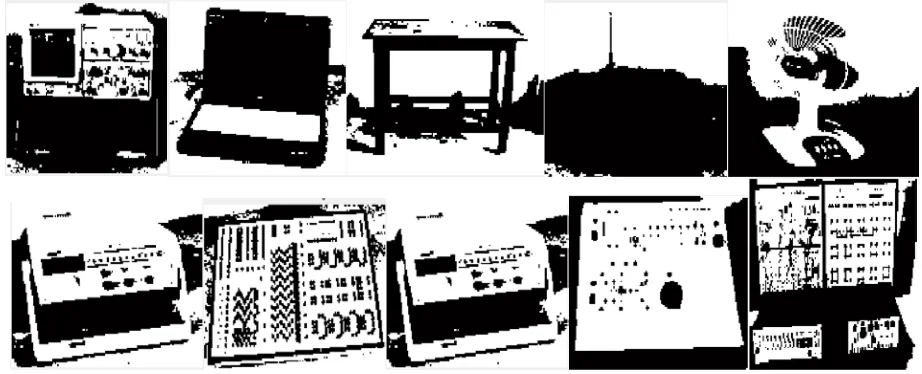
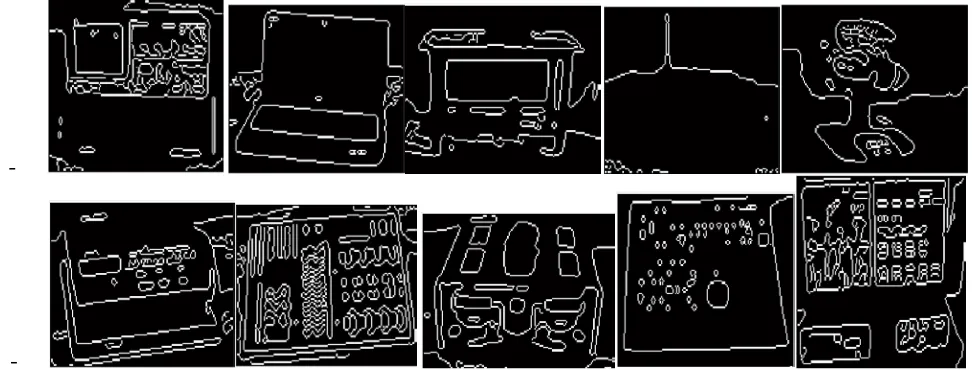
In image processing, segmentation is a fundamental method used in many areas. Segmentation is the process of separating an image into distinct regions. Image threshold and segmentation for feature extraction are the most common. For many features, threshold operations typically occur first to remove the background from the object of interest and then new thresholds are used to segment regions of interest from clear image areas. The images are threshold to convert the gray scale information to binary scale information. Edge detection is a fundamental tool used in most image processing applications to obtain information from the frames as a precursor step to feature extraction and object segmentation. This process detects outlines of an object and boundaries between objects and the background in the image. An edge-detection filter can also be used to improve the appearance of blurred or anti-aliased video streams. Edge detection is an important operation in a large number of image processing applications such as image segmentation, character recognition, and scene analysis
.
B. Artificial Neutral Network
The human brain is capable of computationally demanding perceptual acts (e.g. recognition of faces, speech) and control activities (e.g. body movements and body functions). The advantage of the brain is its effective use of massive parallelism, the highly parallel computing structure, and the imprecise information-processing capability. The human brain is a collection of more than 10 billion inter-connected neurons. Each neuron is a cell that uses biochemical reactions to receive, process, and transmit information.
Artificial neural networks (ANN) have been developed as generalizations of mathematical models of biological nervous systems. Basically, an artificial neural network is a system. A system is a structure that receives an input, process the data, and provides an output. Commonly, the input consists in a data array which can be anything such as data from an image file, a WAVE sound or any kind of data that can be represented in an array. Once an input is presented to the neural network, and a corresponding desired or target response is set at the output, an error is composed from the difference of the desired response and the real system output.
3.SOFTWARE IMPLEMENTATION
ISSN 2250-3153
Figure 2: Flow Chart of Object Detection System of an Autonomous Mobile Robot
3.1 Image Acquisition
In the first step, the images of obstacles type are acquired using a digital camera (Canon EOS 40D) with resolution of 4000 pixels×3000 pixels was used to record images. Another way is downloading from internet database. They are saved in computer hard disk as a database and kept for training and testing the software. The training database consists of 10 object mages in the department. The objects are Oscilloscope, laptop, table, TV, fan, Function Generator, Logic Trainer, Regulated DC Power Supply, SCR Trainer and Trainer Board in this test.
Figure 3: Images of Obstacles in Electronics Department
3.2 Image Preprocessing
[image:3.612.75.536.450.637.2]-Figure 5: Images of Obstacles after Edge Detection
3.4 Neural Network Creation
In this system, perceptron Neural Network is created for the reorganization purpose. The target vector is needed for supervised learning algorithm. It is the ones and zeros combination matrix, the result output positions have to replace the ones and other Newp function creates the new perceptron Neural Network with the minimum and maximum range as a parameter. The parameter n is the number of output neurons; here it is defined as 5 for each obstacle types. Epoch is the training loop count and goal is the target sum square error for the training parts. Then train function is applied to adjust the weight and bias of each neuron by applying input and target vector.
During training, the weights and biases of the network are iteratively adjusted to minimize the network sum square error value. The performance function for feed-forward network is sum square error, which has been used to calculate the differences between the target output and the network output. Several difference training algorithms for feed-forward network. All these algorithms use the gradient of the performance function to determine how to adjust the weights to minimize performance. The gradient is determined using a technique is called back propagation, which involves performing computation backward through the network. The basic back propagation algorithm adjust the weights in the steepest descent direction (negative of the gradient), the direction in which the performance function decreased most rapidly. The training parameters are as follows:
- Number of input neurons = 150 - Number of output neurons = 50
- Performance function = Mean square error - Performance goal = 0.01
- Maximum number of epochs to train = 30000 - Epochs between displays = 10
4. TEST and RESULT
[image:4.612.71.557.56.241.2]ISSN 2250-3153
(a) (b)
Figure 6: Result Box of Object Type Classification, “(a) Oscilloscope (b) Laptop”
(a) (b)
(a) (b)
Figure 8: Result Box of Object Type Classification, “(a) Fan (b) Function Generator”
(a) (b)
ISSN 2250-3153
(a) (b)
Figure10: Result Box of Object Type Classification, “(a) SCR Trainer (b) Trainer Board”
5.CONCLUSION
Matlab is used as the main implementation tool for detecting objects using Neural Networks. Matlab is a high performance language for technical computing. In this thesis, the autonomous mobile robot is supposed to work in the Electronic engineering department, West Yangon Technological University. Then, the robot moves in the department room avoiding the obstacles of TV, laptop computer, oscilloscope and table etc, by applying the developed program. The system is implemented by vision based system, for this reason, a camera is installed at top of the robot. Then the obstacle images are taken at the Electronic engineering department first. They are analyzed and trained by Neural Network. The recognition work is done 100% performance. If the mobile robot is desired to work in other places such as hospital, kitchen, industry, the system should be trained with other types of obstacles likes stethoscope, thermometer, plates, knife, shelves etc. By this way, the system can be extended in any other area.
REFERENCES
[1Arati Gopalakrishnan, Sheldon Greene, 2005, “Vision-based Mobile Robot Learning and Navigation” [2 Anonymous, “Autonomous Mobile Robot Group”, http://www.act-croatia.net'
[3 Anonymous, “Principal component Analysis”, http://en.wikipedia. org/wiki/PCA
[4] Anonymous, 2008, “Neural Network Toolbox User’s Guide”, http://www.mathworks.com/access/helpdesk/help/pdf_doc/nnet/nnet.pdf [5 Brian D. Hahn and Daniel T. Valentine, 2006, “Essential MATLAB for Engineer and Scientist
[6] Anonymous, 2010, “Backpropagation Neural: Soft Computing”, http://www.myreader,info [7] Ezio Malis, “Survey of vision-based robot control”
[8] Daniel Graupe, 1997, “Principles of Artificial Neural Networks
[9] Brian D. Hahn and Daniel T. Valentine, 2006, “Essential MATLAB for Engineer and Scientists
”
[10] A. Toumi, B. Hoelt Zener, A. Khenchaf, and B. France, “Using Watersheds segmentation on ISAR image for automatic target recognition,"Image (Rochester,N.Y),2007,pp.1-6.