Comparative studies of algorithms using Digital Image
Processing in Drug Industry
Huvaida Manzoor
*,Yogeshwar SinghRandhawa
***
ECE GIMET Amritsar
**
ECE Deptt. GIMET Amritsar
Abstract- Medicines have helped to make our lives easy. Drug
industry is developing industry in terms of production as well as consumption. Medication has become very important in everyone’s life as we are affected by many diseases.[1] But these medicines might be defected, tablets may be broken, there may be cracks and consumption of these drugs might be dangerous. This paper shows different methods of digital image processing technique to find the defects in tablets. In this article we use Morphology Operations, Template matching to detect the defected tablet packet.
Index Terms- Template matching, Morphology operation,
Dilation,opening,normalized cross correlation.
I. INTRODUCTION
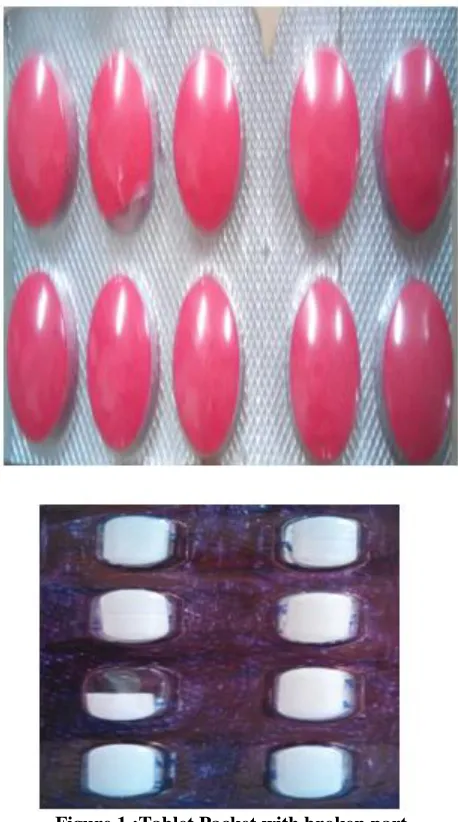
[image:1.612.329.558.194.605.2]igital image processing techniques and algorithms are applied on images in order to remove error. In this project I use digital image processing technique to detect the broken tablet. Such tablets are harmful to consume and may have many side effects. The inspection process is effective to detect the defects in tablets. Different methodology is used in this project that is by Morphology operation and Template Matching. Morphology operation is applied on binary images therefore for this image is first converted into gray. Then the segmentation process is applied on gray image. Image Segmentation is the process of partitioning a digital image into multiple segments (sets of pixels, also known as super pixels). The goal of segmentation is to simplify and/or change the representation of an image into something that is more meaningful and easier to analyze. Image segmentation is typically used to locate objects and boundaries (lines, curves, etc.) in images. More precisely, image segmentation is the process of assigning a label to every pixel in an image such that pixels with the same label share certain visual characteristics. The simplest method of image segmentation is called the thresholding method. This method is based on a clip-level (or a threshold value) to turn a gray-scale image into a binary image. Another digital image processing technique used is template matching.
Figure 1 :Tablet Packet with broken part
II. METHODOLOGY
In this paper we have used three methods to find the defects in drugs
Morphology operation
Template Matching
International Journal of Scientific and Research Publications, Volume 4, Issue 4, April 2014 2 ISSN 2250-3153
Morphology Operation
The binary image is then filtered in order to remove noise. Morphology operations are used to remove the noise. Morphological operations are affecting the form, structure or shape of an object. Applied on binary images (black & white images – Images with only 2 colors: black and white). They are used in pre or post processing (filtering, thinning, and pruning) or for getting a representation or description of the shape of objects/regions (boundaries, skeletons convex hulls).Morphology is a broad set of image processing operations that process images based on shapes. Morphological operations apply a structuring element to an input image, creating an output image of the same size. In a morphological operation, the value of each pixel in the output image is based on a comparison of the corresponding pixel in the input image with its neighbors. By choosing the size and shape of the neighborhood, you can construct a morphological operation that is sensitive to specific shapes in the input image[2][9].
Morphology is of following types:
Dilation: Dilation allows objects to expand, thus potentially filling in small holes and connecting disjoint objects.
Erosion: Erosion shrinks objects by etching away (eroding) their boundaries.
Opening: Morphological opening is used to remove small objects from an image while preserving the shape and size of larger objects in the image. Morphology opening is an erosion followed by dilation. The opening has the effect of removing objects that cannot completely contain the structuring element.
Closing: Closing is opening performed in reverse. It is defined simply as a dilation followed by an erosion. Erosion using the same structuring element for both operations.
Template Matching
Technique used in classifying objects. Template matching techniques compare portions of images against one another. Sample image may be used to recognize similar objects in source image. If standard deviation of the template image compared to the source image is small enough, template matching may be used. Templates are most often used to identify printed characters, numbers, and other small, simple objects. For example original image is of tablet packet containing ten tablets. Like morphology operation image is first converted into gray and then to binary. The binary image is then filtered in order to remove noise and edges are detected using canny edge detection. A template is selected and is compared with rest of the tablets In this way defected tablet can be found.
Figure 2: Template matching block in matlab
The Template Matching block finds the best match of a template within an input image. The block computes match metric values by shifting a template over a region of interest or the entire image, and then finds the best match location.
III. PROPOSED WORK
Steps for Morphological Method
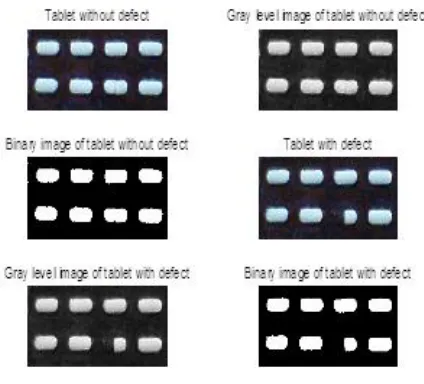
1. Capture an image of a tablet packet without any defect. 2. Convert this image into gray image.
3. Convert gray image into binary image
4. Apply morphology opening on binary image. Morphology opening will remove noise from the image. 5. Dilate the opened Image. Dilation will expand the
image and will make the image big. 6. Calculate the no. of pixels of binary image.
7. Now capture the same tablet packet with broken/missing part.
8. Apply the same process that is applied on tablet packet without any defect.
9. When defected packet is found,beep will be generated. 10. Subtract the two images
11. Missing part of tablet and position of defect is obtained. 12. Filter it by using morphology opening technique which
removes the noise.
Steps for Template Matching
1. Read an template image(defected or broken tablet). 2. Crop the image
3. Read the image of defected tablet packet. 4. Crop the image
5. Use normalized cross correlation to detect the position of defected tablet
International Journal of Scientific and Research Publications, Volume 4, Issue 4, April 2014 4 ISSN 2250-3153
IV. SIMULATION RESULTS
[image:4.612.65.277.103.295.2]Simulation Results for Morphology operation
[image:4.612.63.239.333.663.2]Figure 3a pre-processing of image
Figure 3c Defect found
Figure 3a shows the preprocessing of tablet packet. In pre-processing, first image is converted into gray image then gray image is converted into binary level image. This process is done with tablet packet with and without defect. Figure 3b shows the
Another method template matching is used to detect the defect in tablet packet.Figure 4a shows the rgb image for defected tablet packet.Figure 4b shows 3D view of tablet packet.In this method normalized cross correlation is used to detect the required template.Figure 4c shows that the required template is found and 4d shows position of defected tablet in tablet packet.
International Journal of Scientific and Research Publications, Volume 4, Issue 4, April 2014 6 ISSN 2250-3153
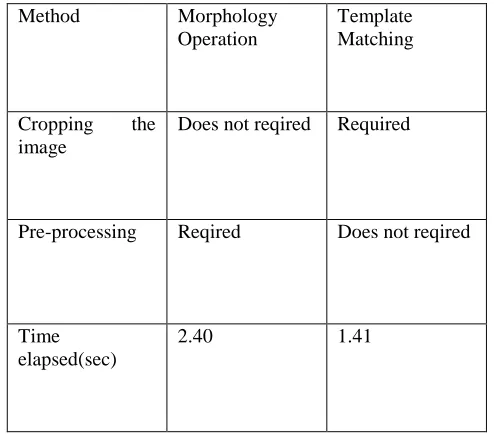
Method Morphology
Operation
Template Matching
Cropping the image
Does not reqired Required
Pre-processing Reqired Does not reqired
Time elapsed(sec)
[image:6.612.44.291.56.273.2]2.40 1.41
Table 1 shows the comparison between morphology Method and template Matching.
V. CONCLUSION
This project presents the application in drug industry using different techniques in digital image processing. This project is implemented on matlab10 software. This paper mentions two methods for detecting the anomalies in drugs that is by morphology operation and template matching. Among the morphology operation, morphology opening and dilation is used in this project. The two methods will be compared and best one will be chosen. Template matching is much simpler than morphology operation because in morphology operation, image pre-processing is done before morphology operation. In template matching, there is no pre-processing needed.
REFERENCES
[1] Abha Sharma1,Sugandha Arora “ Inspection and Classification of Defects in Pharmaceutical Capsules Using Neural Network” International Journal of Engineering Research and Development ISSN: 2278-067X, Volume 1, Issue 10 (June 2012), PP.41-45
[2] Ştefan Oprea, Ioan Liţă, Mariana Jurianu, Daniel Alexandru Vişan, Ion Bogdan Cioc, “Digital Image Processing Applied in Drugs Industry for
Detection of Broken Aspirin Tablets” Electronics, Communications and Computers Department, University of Pitesti Str.Targul din Vale Nr. 1 Pitesti, Romania,2008
[3] F Anthony C.karleff, Neil E.Scott & Robert Muscedure, Flexible Design for a cost effective,high throughput Inspection system for pharmaceutical capsules. IEEE, 2008
[4] Dong-Su Kim, Wang-Heon Lee , In-So Kweon, “Automatic edge detection using 3x3 ideal binary pixel patterns and fuzzy-based edge thresholding,” in Pattern Recognition Letters in 2004
[5] El-Khamy,S.E., Lotfy,M., El-Yamany,N.A.,“A Modified Fuzzy Sobel Edge Detector”,17. National Radio Science Conference, Feb.22-24 2000, Minufiya University, Egypt
[6] Miosso, C.J., Bauchspiess, A., “Fuzzy Inference System Applied to Edge Detection in Digital Images”, Proceeding of the Brazilian Conference on Neural Networks, pp. 481-486, 2001
[7] Hardeep Kaur and Er.Nidhi Garg, “Inspection of Defective Pharmaceutical Capsules using Harris Algorithm”, International Journal of Advances in Electronics Engineering,2009
[8] R.Thilepa “A Paper On Automatic Fabrics Fault Processing Using Image Processing Technique in Matlab”, Signal & Image Processing : An International Journal(SIPIJ) Vol.1, No.2, December 2010.
[9] Peng Zhao and Shutao Li “Tablets Vision Inspection Approach Using Fourier Descriptors and Support Vector Machines” The 9th International Conference for Young Computer Scientists,2008.
[9] Ramya.S,,Suchitra.J,Nadesh R.K” Detection of Broken Pharmaceutical Drugs using Enhanced Feature Extraction Technique”
[10] Nain, Neeta, et al. "Morphological Edge Detection and Corner Detection Algorithm Using Chain Encoding." IPCV 6 (2006): 520-525.
[11] Tizhoosh H.R.,“Fast fuzzy edge detection”, Proceedings of Fuzzy Information Processing Society, 2002, pp. 239-242.
[12] Abdallah A. Alshennawy, And Ayman A. Aly, "Edge Detection In Digital Images Using Fuzzy Logic Technique", In proceedings of World Academy of Science Engineering and Technology, Vol.51 , pp.178-186, 2009. [13] Kaur, Er Kiranpreet, Er Vikram Mutenja, and Er Inderjeet Singh Gill.
"Fuzzy Logic Based Image Edge Detection Algorithm in MATLAB." International Journal of Computer Applications 1.22 (2010): 55-58. [14] Baig, Hasan, Jeong-A. Lee, and Jieun Lee. "Performance evaluation of
CPU-GPU and CPU-only algorithms for detecting defective tablets through morphological imaging techniques." Information Systems and Technologies (CISTI), 2012 7th Iberian Conference on. IEEE, 2012.
AUTHORS