Prolonging Life of Heterogeneous Wireless Sensor
Network using Clustering Algorithm
Vishal V. Lukhi
*, Harikrishna B. Jethva
***
Information Technology, L.D. College of Engineering **
Computer Engineering, L.D. College of Engineering
Abstract- The Wireless Sensor Network(WSN) is a network consist of many number of distributed sensor nodes. They are the main entity to be consider. WSN is used to provide many real world solution to certain problems. There are many applications in various fields like home, medical, military, etc. Sensor nodes sense the events for particular area and pass the information to base station from where human can get the data. Sensor nodes of WSN have limited capabilities in terms of battery life as well as data storage. In designing wireless sensor network the main issue is energy dissipation. Many routing protocols have been developed to decrease the power consumption of sensor node so that the life time of whole WSN can be increased. And now a days its become most important task to balance the energy of sensor nodes and manage it in proper way so that its could be beneficial for whole network. There are many hierarchical and location based routing protocols. Here in this paper, we have proposed one cluster based algorithm to prolong the lifetime of heterogeneous wireless sensor network. This cluster based algorithm become effective because clustering in wireless sensor network has been proven as a effective thing for energy consumption and power management. Here we use MATALAB for simulations and compares the results of simulations with LEACH protocol which is first clustering protocol for wireless sensor network to minimize energy consumption in network.
Index Terms- Wireless Sensor Network(WSN), Sensor Nodes, LEACH, Leader Nodes, Clustering, Network Lifetime.
I. INTRODUCTION
ver a years, many research have been carried out for wireless sensor network to solve the issue of energy dissipation in network. WSN consists of hundreds or thousands of sensor nodes. This sensor nodes have sensing, processing, communication capabilities [9]. Sensor nodes have characteristics like limited battery life, mobility, heterogeneity, etc. Out of this battery life of sensor nodes is important one because together the battery life of every sensor nodes decides the lifetime of whole sensor network for which a network remain live and works normally.
Most of the techniques or work in area of wireless sensor network to increase the lifetime assumes that the whole network has homogeneous nature. Means all the sensor nodes have the same energy level during the working of network. But in real world during the working of network it has heterogeneous nature in terms of energy level. Homogeneous network hardly exist in nature. It is possible that energy of all sensor nodes is equal at
time of deployment of whole sensor network. Sensor nodes are equipped with irreplaceable batteries with limited power capacities. They can be deployed manually or be randomly dropped. They are containing one or more sensors, self configuring, with wireless communications and data processing components. The use of wireless sensor networks is increasing everyday but the problem is limited battery life. The main application domain of WSNs is in:
Home control [7] Medical monitoring [8] Military environment [1]
[image:1.612.324.560.276.491.2] Biological and radiological events [1] etc.
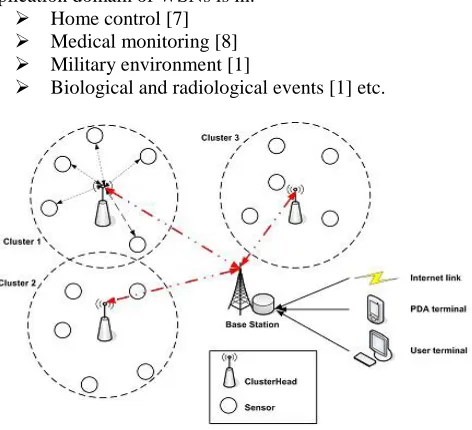
Figure 1: Wireless sensor network with clustering
The main most hard thing in designing network is to make whole network energy efficient [13]. So that it works as long time as possible. It is proven that doing clustering of sensor nodes in the network is more energy efficient technique instead of having normal sensor network without clustering. Clustering just grouping of sensor nodes and gathering data from sensor nodes and passes it to base station. However it is also important to use the better clustering techniques in proper way. It is not good to rely on some probability type functions. Also good clustering provides less communication overhead to BS, minimize energy consumption, less number of active node at a time.
Also after applying clustering the selection of cluster heads and the path of information flow is critical one that helps in prolonging life of whole network.
The remaining of the research paper contains the following things: In section 2 we describes the related work. In section 3
ISSN 2250-3153
we introduce our proposed algorithm. In section 4 we shows simulation setup and experimental results. And section 5 provides the conclusion of our work.
II. RELATED WORK
The very first clustering technique proposed for clustering in wireless sensor network is LEACH(Low Energy Adaptive Clustering Hierarchy) protocol [1]. It is a single level cluster based routing protocol. In this protocol clustering task is performed in every round of data transmission. And cluster head is select that transfer the final data fusion of its own cluster to the base station directly. The whole network is divided into number of clusters. The protocol works with two phases. One is set up phase. In this phase cluster and associated cluster heads are elected. Each nodes chooses a number between 0 to 1 and one probability function is used to decides the cluster heads nodes. Probability function is as follows:
(1)
Where, p is the cluster head probability, r is the number of current round and G is the set of nodes that have not been cluster-heads in last 1/p rounds.
After becoming cluster heads they make TDMA schedule and transmit it to all the nodes in its cluster. Clusters are created based on signal strength of advertisement received by all none cluster head nodes.
Second phase is a steady state phase in which cluster head nodes stay turn on during whole round and assumes that it had data to receive from normal sensor nodes of its own cluster. Normal sensor nodes collect the data and send it to the cluster head during its own time frame and after that it goes down [11]. The problem with LEACH protocol is that it assumes homogeneous nature of wireless sensor network. It also uses probability function in deciding CH so that there may be chance of not having CH nodes in some particular round [12].
From the analysis of wireless sensor networks it is concluded that there mainly two types of sensor nodes. One is said to be powerful nodes and other is said to be normal nodes [10]. The powerful nodes are also know to be as cluster head nodes which have more energy level compare to other nodes. The normal nodes have lesser energy level compare to powerful nodes.
There are also some other cluster based routing protocols like EEMC [2], BCDCP [3], LEACH-C [4], HEED [5], etc that all assumes homogeneous wireless sensor networks. Also PEGASIS [15], TEEN [14], etc are some clustering algorithms.
We proposed one different algorithm with different clustering technique and with leader node concept. It increases the lifetime
III. PROPOSED SYSTEM
The proposed system comprises three phases.
1. Cluster creation phase 2. Leader selection phase 3. Data transmission phase
In cluster creation phase, clusters are made by using k-mean clustering technique. After applying k-mean to whole network sensor node having highest energy than all other nodes in cluster is selected as cluster head node.
In leader selection phase, Euclidean Distance formula is used in deciding the leader node out of the existing cluster head nodes. The role of leader node is to perform final delivery of aggregated data of all sensor network to base station. The leader node have the closest distance to the base station. Once leader node gets down it means all other nodes including cluster head nodes already dead and whole sensor network become dead.
In data transmission phase, the route of data flow is describes.
The steps of proposed system is as follows:
1. Cluster creation phase:
a) Initially BS requests node position and energy level from each nodes.
b) BS will arbitrarily chooses k nodes as initial cluster centers having maximum energy and closer to the node.
c) Repeat.
d) (Re)assign each node to the cluster with the nearest cluster center.
e) Calculate the mean value of the Cluster. f) Until no change.
g) After making clusters BS will assigns cluster head role having maximum energy level in each clusters.
2. Leader selection phase:
a) Find the distance of all cluster head nodes from BS using Euclidean distance formula. b) Now, find the mean value(centroid) for all distance values of all cluster head nodes, which is obtain in step a).
c) Select the cluster head node as leader node which is closer to the centroid obtained in step b).
3. Data transmission phase:
a) In this phase data is pass from normal node to its cluster head node in each clusters. b) Than each cluster head node passes the data
IV. SIMULATION SETUP AND PERFORMANCE EVALUATION
In this part we introduce the implementation result of proposed system, energy model used for implementation and parameters taken as input during simulation.
A. Energy Consumption Model
Here we have taken first order radio energy model for simulating proposed system. The equations for transmitting and receiving l-bit data messages from a given distance d is as follows:
(2)
(3)
The following described parameters are used:
: Energy dissipations per bit by the transmitter or receiver electronics
: Energy dissipations per bit by the transmitter amplifier
: Energy consumption for transmitting data : Energy dissipation by receiving data : Free space fading energy
[image:3.612.294.566.57.274.2]EDA: Data aggregation energy a: Pass loss exponent
Figure 2: Energy consumption model [6]
B. Simulation Parameters
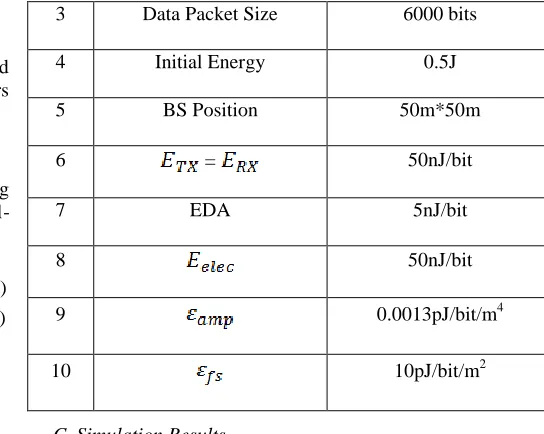
[image:3.612.323.564.329.495.2]The following Table I shows the different parameters with values that we have used in implementation of proposed system.
TABLE I: Simulation parameters
No. of Items
Parameters Value
1 Network Size 200m*200m
2 Number of Nodes 500
3 Data Packet Size 6000 bits
4 Initial Energy 0.5J
5 BS Position 50m*50m
6 = 50nJ/bit
7 EDA 5nJ/bit
8 50nJ/bit
9 0.0013pJ/bit/m4
10 10pJ/bit/m2
C. Simulation Results
Figure 3 shows the heterogeneous wireless sensor network after deployment of sensor nodes. Figure 4 shows heterogeneous wireless sensor network having all sensor nodes become dead.
Figure 3: Heterogeneous wireless sensor network
[image:3.612.37.271.385.516.2] [image:3.612.328.562.528.688.2]ISSN 2250-3153
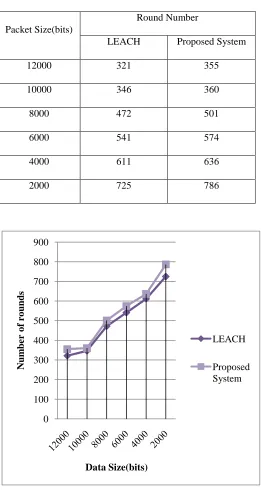
[image:4.612.38.299.151.641.2]We have simulated the proposed system by taking different message size. And from that we determined the lifetime of network. The following TABLE II shows the results obtained for proposed system and compare it with LEACH protocol. Figure 5 shows comparison chart between proposed system and LEACH protocol.
TABLE II: Network lifetime
Packet Size(bits)
Round Number
LEACH Proposed System
12000 321 355
10000 346 360
8000 472 501
6000 541 574
4000 611 636
2000 725 786
0 100 200 300 400 500 600 700 800 900 N um be r o f ro unds Data Size(bits) LEACH Proposed System
Figure 5: Network lifetime with varying message size
V. Conclusions
Here in this research paper, we have proposed system that uses k-mean clustering algorithm and also uses Euclidean distance
network. Because we does not use any probability function proposed system gives better results compare to LEACH protocol. We also implement proposed system under various message sizes. The results of simulation shows that proposed system prolongs the lifetime of network more than LEACH protocol.
ACKNOWLEDGMENT
We would like to thank all people who inspire us to do this work and support us by giving their guidance. We also like to thank all the sources of materials related to our research. And at last thank to all friends who help somewhere in research.
REFERENCES
[1] Rajesh Patel, Sunil Pariyani, Vijay Ukani, "Energy and throughput analysis of hierarchical routing protocol (LEACH) for wireless sensor network," International Journal of Computer Applications (0975 – 8887) Volume 20– No.4, April 2011.
[2] Yan Jin, Ling Wang, Yoohwan Kim, Xiaozong Yang, "EEMC: An energy-efficient multi-level clustering algorithm for large-scale wireless sensor networks," Science Direct, Computer Networks 52, 2008.
[3] Qiu, M., Xue, C., Shao, Z., Zhuge, Q., Liu, M., Sha Edwin, H.M., "Efficent algorithm of energy minimization for heterogeneous wireless sensor network," In: Sha, E., Han, S.- K., Xu, C.-Z., Kim, M.H., Yang, L.T., Xiao, B. (eds.) EUC 2006. LNCS, vol. 4096, pp. 25–34. Springer, Heidelberg (2006).
[4] W. R. Heinzelman, A. Chandrakasan, and H. Balakrishnan, “Energy efficient communication protocol for wireless micro sensor networks," Proceedings of IEEE HICSS, Jan 2000.
[5] Ossama Younis and Sonia Fahmy, "Distributed clustering in ad-hoc sensor networks: a hybrid, energy-efficient approach," September 2002.
[6] Sanjeev Saini, Ram Sewak Singh & V.K.Gupta, “Analysis of energy efficient routing protocols in wireless sensor networks communication,” IJCSC Vol. 1, No. 1, January-June 2010, pp. 113-118.
[7] Kazem Sohraby, Daniel Minoli, Taieb Znati, "Wireless sensor networks technology, protocols, and applications," John Wiley, New York, 2007. [8] Charka Panditharathne and Soumya Jyoti Sen, "Energy efficient
communication protocols for wireless sensor networks," a thesis for the degree of bachelor of technology in Electronics and Instrumentation Engineering, National Institute of Technology, Rourkela Orissa May-2009. [9] Akyildiz I., Su W., Sankarasubramaniam Y., Cayirci E., "A survey on
sensor networks," in IEEE Communication Magazine, 2002.
[10] Lee, H.Y., Seah, W.K.G., Sun, P., "Energy implications of clustering in heterogeneous wireless sensor networks- an analytical view," In: The 17th Annual IEEE International Symposium on Personal, Indoor and Mobile Radio Communications, pp. 1–5 (2006).
[11] V. Rodoplu, T.H. Ming, “Minimum energy mobile wireless networks,” IEEE Journal of Selected Areas in Communications, Vol. 17, No. 8, 1999. [12] Neda Enami, Reza Askari Moghadam, "Energy based clustering self
organizing map protocol for extending wireless sensor networks lifetime and coverage," Canadian Journal on Multimedia and Wireless Networks Vol. 1, No. 4, August 2010.
[13] S.Taruna, Sakshi Shringi, "A cluster based routing protocol for prolonging network lifetime in heterogeneous wireless sensor networks," International Journal of Advanced Research in Computer Science and Software Engineering, Volume 3, Issue 4, April 2013.
[14] A. Manjeshwar and D. Agrawal, “TEEN: a routing protocol for enhanced efficiency in wireless sensor networks,” Proceedings of 15th International Parallel and Distributed Processing Symposium (IPDPS’01), San Francisco, CA, pp. 2009-2015, April 2001.
www.ijsrp.org AUTHORS
First Author – Vishal V. Lukhi, L.D. College of Engineering, Ahmedabad. Email: [email protected]