Performance Comparison of Blind Equalization
Algorithms for Wireless Communication
K Suthendran
Department of Electronics and Communication Engineering,
Kalasalingam Academy of Research and Education Krishnankoil-626 126, India.
T Arivoli
Department of Electronics and Communication Engineering,
Vickram college of Engineering, Enathi-630 561, India.
ABSTRACT
Adaptive equalization is an accepted method to mitigate the Inter-Symbol Interference (ISI) in wireless communication. Frequently, adaptive algorithm must needs transmission of well-known training sequence to track the time varying characteristics of the channel and hence make the most of superfluous bandwidth. It is also not viable to have training sequences in all types of transmissions (e.g. non-cooperative environment). Blind algorithm is a concept used to track the time varying characteristics of the channel in the deficiency of training sequence. Nevertheless, it leads to slow convergence. In this paper, the performance of Sato algorithm and Godard based blind algorithm is compared for PAM signal.
Keywords
Blind Equalization, Convergence, Godard algorithm, Sato algorithm.
1.
INTRODUCTION
In the trendy electronic communication, plenty of effort has been dedicated to utilize the accessible channel bandwidth expeditiously. Intersymbol Interference (ISI) and Thermal noise are the two main factors that are limiting the performance of information transmission systems. In essence, the ISI is generated by dispersion within the transmit filter, the transmission medium, and receive filter. Within the band-limited (frequency selective) time dispersive channel, the ISI is caused by multipath propagation. The result is that the modulated pulses are unfolded in time into adjacent symbols, and it distorts the transmitted signals inflicting information errors at the receiver. Thermal noise is generated at the face of the receiver. For bandwidth-limited channels, the ISI has been recognized as the major downside in high speed information transmission over wireless channels. The standard band restricted filters fail to recover the information once the received symbol contains ISI and in-band noise. The Intersymbol Interference will be removed by victimization equalization techniques. Sato has proposed 0.0006 to be the optimum step size value for blind equalization having a PAM signal [1]. But our experimental results show that α of 0.0006 is simply too low and thus leads to slow convergence. Whereas α value of 0.06 is the optimum one that supports quicker convergence and beyond this value it does not converge for any PAM symbol. In section IV we have compared the performance of Sato and Godard based blind equalization algorithms for a PAM input signal.
2.
ADAPTIVE EQUALIZER
Generally, the term equalization is employed to explain any signal process operation that minimizes the ISI [8]. Digital signal processing based equalizer systems become more essential in various applications including information, voice, and video communications. The equalizer may be a digital filter, placed between sampler circuit
and decision algorithm within the band restricted communication model. An equalizer inside the receiver compensates for average range of expected channel amplitude and delay characteristics. Equalizer algorithmic program, equalizer structure and the rate of amendment of the multipath radio channel are three main factors that have an effect on the time spread over that an equalizer converges. Two important issues in equalizer design and implementation are its complexness and its training. For frequency selective channel, the equalizer enhances the frequency parts with tiny amplitudes and attenuates the robust frequencies within the received frequency response and for a time-varying channel.
An equalizer corrects the channel frequency response variation and cancels the multipath weakening effects. They're specifically designed for multipath correction and are therefore usually termed as echo-cancellers or deghosters [9]. For this it's going to need considerably longer filter length than that of easy spectral equalizers; however the principles of operation are basically constant. These filters have an equalized impulse response having zero ISI and zero channel distortion. This implies that convolution of the channel and the equalizer impulse responses should be equal, having one at the centre tap and nulls at the opposite sample points inside the filter span [7], [9] and [10].
Automatic synthesis and adaptation are the two strategies, used to estimate the filter coefficients. In automatic synthesis methodology, the equalizer generally compares a received time-domain reference signal thereto of an ingenuous training signal. This is often holding on within the receiver and a time-domain error signal is decided. The calculated error signal is employed to estimate the inverse filter coefficient. In an adaptation filter synthesis methodology, the equalizer calculates the error signal supported the distinction between the output of the equalizer and therefore the calculable transmitted signal that is generated by a decision device. The filter coefficient values are changed for every iteration corresponding to the error signal value and, they're optimized with zero error. The main disadvantage during this automatic synthesis equalization methodology is that whereas sending a training signal the overhead related to it, ought to at least have the length of the filter tap. This needs training, in serving to the filter to converge at the startup that could be a part of the initialization overhead.
response therefore on estimate the error signal required for adaptive method. In apply; the better-known signal may be generated at the receiver facet in 2 ways. In first technique, the transmitted training sequence is retrieved by the reproduction of the better-known response that is keep within the receiver. The synchronization ought to be done between transmitted training sequence and better-known response that is keep within the receiver. With a better-known training sequence, the adaptive filtering formula used to modify the equalizer coefficients, which corresponds mathematically to finding out the distinctive minimum quadratic error performance surface. The second technique may be a decision directed technique, in which, rather than the better-known training sequence, a sequence of information symbols are calculable from the equalizer may be used. This calculable output is also unreliable; therefore this might not permit the tap weight coefficients to be optimized.In general, the computation of error estimation is completed with the aid of the input vector and desired response, and it's accustomed create the control over the adjustable filter coefficients values. Depending on the filter structure chosen, the adjustable coefficients are also in style of tap weight reflection coefficients, or rotation parameters. However, the elemental distinction between the assorted applications of adaptive filtering arises within the manner during which the required response is extracted.
Training and tracking are the two general operational modes of an adaptive equalizer. First, a legendary training sequence -pseudorandom binary signal of fixed length is shipped by the transmitter. With this, the equalizer at the receiver facet could adapt to a correct weight for minimum bit error rate (BER) detection. Following this training sequence, original information is shipped and adaptive equalizer utilizes the recursive formula to gauge the channel, and therefore estimates the filter coefficients to compensate the distortion created by multipath within the channel. Equalizers need periodic preparation so as to keep up effective ISI cancellation. In digital communication systems, user information is generally segmented into short time blocks or time slots. Time division multiple access (TDMA) wireless systems are notably compatible for equalizers. Owing to time variable nature of wireless channels, training signals should be sent often and this occupies additional information measure. In several applications legendary training sequence is needed to adapt the equalizers by minimizing the mean square error [MSE], however this being impractical and expensive once long training sequence is important [7]. As an example, in step with 900MHz GSM customary, twenty six bits out of each 148 bit frame are used as training signals [3] and [11].
3.
BLIND EQUALIZER
Even though trained strategies have many disadvantages, they're typically adequate. The throughput of the system drops owing to the time slots occupied by the training signal. Another disadvantage is that the training signal isn't forever familiar at the receiver, e.g., in an exceedingly non cooperative (surveillance) surroundings. Finally, the quicker time variable channel needs training sequence a more often to train the equalizer. This results in more reduction within the throughput of the system.
The Blind algorithms are ready to exploit characteristics of the transmitted signals and don't need training sequences. They’re called so because they supply equalizer convergence without burdening the transmitter with training overhead. These fashionable algorithms are able to acquire equalization through property restoral techniques of the transmitted signal. In general, even once the initial error rate is massive, blind equalization technique directs the coefficient adaptation method towards the optimum filter parameters. A Blind Equalizer is in a position to compensate amplitude and delay distortions of a communication channel using solely the channel output samples and also the data of the basic statistical properties of the information symbols. the key advantage of blind equalizers is that there's no training sequence to calculate the tap weight coefficients; thus no bandwidth is wasted by its transmission. Blind equalization is effective for a high-speed digital radio, digital mobile communication systems, multi-point networks, cable TV, and digital terrestrial TV broadcasting [6], [10] and [15].
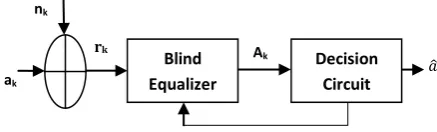
[image:2.595.321.540.501.567.2]The major downside is that the equalizer can usually take an extended time to converge as compared to a trained equalizer. The necessity for blind equalizers within the field of information communications is greatly mentioned by Godard [2], within the context of multipoint networks. Blind joint equalization and carrier recovery might realize application in digital communication system over multipath weakening channels. Moreover, it's applied in extremely non-stationary digital mobile communications, wherever it's impractical to use training sequences. These techniques embrace algorithms like the SATO algorithm and Constant modulus algorithm (CMA).
Fig. 1. General block diagram for Blind equalizer
nk
ak
Ak rk
Decision Circuit Blind
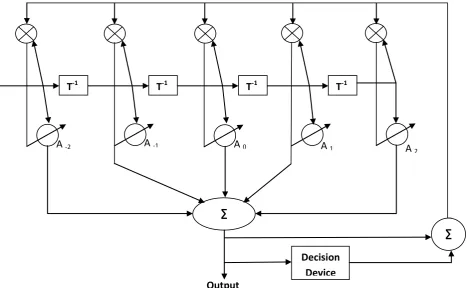
Fig.2. The Sato based Blind equalizer with 5 taps
3.1
Sato Blind Algorithm
Sato was the one who first introduced the concept of blind equalization in 1975 for multilevel pulse amplitude modulation, wherever there's no reference sequence accessible and afterward Godard combined Sato’s idea with a decision Directed (DD) algorithm and acquire a replacement blind equalization scheme for QAM data transmission. Since blind equalization has attracted significant scientific interest due to its potentials in terms of overhead reduction and simplification of point to multipoint communication. Sato proposed algorithm that was designed just for real valued signal and PAM [1]. However, its advanced valued extension is simple, that was derived by Godard [2] and [12]. The cost function proposed by SATO is given in (1)
)} ) γ.sign(y E{(y
(A)
J k k 2
sato
(1)
Where,
k
y
= output of the equalizer
1,y 0
0 y 1, )
sign(y k
k
k (2)
| ) (a | E
) E(a γ
k 2 k
(3)
Sign denotes the usual signum function of a real scalar. γ referred as scaling factor and ak denotes the input data
[image:3.595.68.275.557.686.2]sequence.
Fig. 1 shows the general block diagram of the Blind Equalizer. It seems that Sato’s proposal appears to be developed over LMS algorithm that uses steepest decent criteria for convergence process. Mathematically, if we tend to differentiate any equation and equate it to zero, then this
provides the minimum; substituting it to the steepest-descent criteria, we get the tap weight coefficients for the equalizer. If we tend to differentiate (1) and substitute it to the steepest-descent criteria, we are going to be obtaining (4) as shown. The algorithm of SATO’s blind equalization relies on (4), that is employed for training the output sequences,
)] γ.sign(y [y
α.r A
Ak 1 k k k k
(4) Where,
Ak = Weight used for training
α = Tap-adjusting coefficient yk = Output sequence
rk = Input sequence
and
1 k i
i
k a .x
r
(5)
Since this algorithm works under iteration basis, at every iteration it tries to adapt its output sequence to the self realized input sequence. Thus, it is also known as self-learning equalizer. The convergence rate and precision to output sequence are the two main design considerations in Ssto’s blind equalization. To get the best result from Sato’s algorithm, the design considerations should be optimized on the basis of its parameters, in order that it will converge in no time with a high precision output sequence. This can be more or less guided by tap-adjusting coefficient ‘α’, because the remaining parameters are not variable according to [4].
r
A
2A
1A
0A
-1A
-2Output
T
-1T
-1T
-1T
-1∑
∑
3.2
Godard Blind Algorithm
After Sato’s initiation, in 1975, the race on blind equalization algorithm took positive impetus. Godard was one among them, who came on first row. His introduction for dual carrier blind equalization was not solely a new milestone, however practically feasible and conceptually simple blind algorithm. It absolutely was accepted globally. Godard was developed Sato’s cost function in such a fashion that Sato’s cost function became one particular case of Godard cost function. In fact, Godard has introduced substantially generalized cost function. The cost function proposed by D.N.Godard in 1980 is given in equation (6), below
] ) R (1/2p)E[(y (C)
JGod p p 2 (6)
Where,
]
]/E[a
E[a
R
p
k2p kpp=dispersion constant and
p=1, 2, 3, 4....
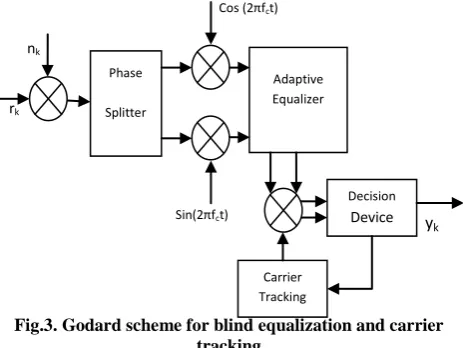
The block diagrammatic view of dual carrier communication channel using the blind equalization filter is as shown in figure 3.
[image:4.595.52.284.348.522.2]
Fig.3. Godard scheme for blind equalization and carrier tracking
As like Sato’s algorithm, Godard proposal was additionally the development version of LMS algorithm and it utilizes the beautiful concept of mathematics, mentioned above. Besides the major algorithm, it also provides additional another algorithm for carrier recovery, which was not enclosed in Sato’s algorithm. If we differentiate (6) with respect to some constant and applied to the steepest descent algorithm, it offers the most prominent result as shown (7) and (8).
)]
R
|
y
(|
|
y
|
y
µr
W
W
p p k 2 p k k k k 1k
(7) )] H j exp( z λIm[a H
Hk 1 k k k k
(8)
Where,
W=Weight used for training rk=Input sequence
yk=Output sequence
Rp=Constant scalar
ak=Decision output
zk=Input to the decision circuit
4.
SIMULATION RESULTS
We have conducted simulations in finding out the performance of Sato algorithm and Godard based Blind algorithm. For performance analysis, we have a tendency to contemplate the transmission of PAM symbols having ISI with five reflections and AWGN as noise being given as input to the equalizer
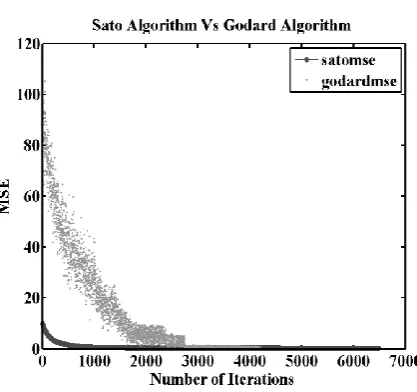
In this approach, the input data sequence was assumed to be independent and drawn from PAM signaling sources. The equalizers are implemented by a linear transversal filter with a five complex tap circuitry shown in Figure 2. The waveforms shown in Figure 4, Figure 5, Figure 6 and Figure 7 are the results of simulations for received symbol 1 (with ISI and Noise), reconstructed symbol 1 by using Sato approach, reconstructed symbol 1 by using Godard based Blind approach and MSE comparison between Sato and Godard Blind approaches respectively. In this figure.5 and figure.6 seems identical because both are reconstructed with same SNR 25dB however number of iterations differs. Table 1 shows the quantity of iterations taken by Sato algorithm, with completely different SNR value for the reconstruction of symbol 1, 2 , 3, 4 and 5 using step size parameter µ = 0.0006 [1].
Table 1. Comparison of SNR vs. Iterations for SATO based Blind Equalizer with Step Size Parameter α = .0006 SNR
in dB
Number of Iterations Symbol 1 Symbol 2 Symbol 3 Symbol 4 Symbol 5
10 141 69 152 19 62
15 497 376 1280 691 465
20 1122 1940 2868 2288 2182
25 6689 6006 5141 2885 7889
Table 2. Comparison of SNR vs. Iterations for SATO based Blind Equalizer with Step Size Parameter α = .06
SNR in dB
Number of Iterations Symbol 1 Symbol 2 Symbol 3 Symbol 4 Symbol 5
10 2 1 2 1 1
15 5 4 14 7 5
20 12 23 34 17 41
25 53 56 65 27 100
rk nk yk Phase Splitter Adaptive Equalizer Decision Device Carrier Tracking Cos (2πfct)
[image:4.595.311.548.377.553.2]Table 3. Comparison of SNR vs. Iterations for Godard based Blind Equalizer with Step Size Parameter µ = .59 SNR
in dB
Number of Iterations Symbol
1
Symbol 2
Symbol 3
Symbol 4
Symbol 5
10 1536 1675 1100 1392 1486
15 1890 1857 1426 1681 2032
20 3037 2347 1588 1738 2122
25 4197 2799 1592 1961 2544
In this paper, we've used the tap adjusting coefficient value (α = 0.6x10⁻³
), as projected by SATO to reconstruct the PAM signal that is shown in table 1. For a value of α=0.06, we get better convergence as shown in table 2. But, whereas further increasing the value of α (> 0.06) ends up in unsuccessful reconstruction of original PAM symbols. The Simulation results show that Sato’s Blind algorithm with optimum α value has quicker convergence rate compared to that of Sato algorithm with α = 0.6x10⁻³
and Godard algorithm with optimum step size 0.59 as shown in table 3. That is, the quantity of iterations to obtain the same output SNR for identical symbol is much lesser in the Sato based blind approach with α = 0.06.Godard algorithm with step size 0.6x10⁻³ is taking more number of iterations (that is not even
at the comparable values).
[image:5.595.49.289.93.217.2]Fig.4. The received symbol with ISI and noise
[image:5.595.322.533.307.496.2]Fig.5. Reconstructed Symbol 1 using Sato algorithm with α =0.0006 and SNR = 25dB (6682 iterations)
Fig.6. Reconstructed Symbol 1 Godard Blind algorithm with α =0.59 and SNR = 25dB (4197 iterations)
[image:5.595.62.270.392.564.2] [image:5.595.323.532.528.724.2]5.
CONCLUSION
In this paper, the performance of Sato blind equalizer and Godard based blind equalizer. Observations from table 2 and table 3 show that, the specified SNR will be obtained with less number of iterations in SATO based mostly blind equalizers by selecting best α value. Increase in the tap adjusting coefficient value of Sato algorithm (e.g., α=0.06) provides a much quicker convergence. When α=0.07 some symbols have converged quickly, but some symbols do not converge (due to misadjustment). Similarly for higher values (α > 0.07), converge for all PAM symbols does not take place.
Godard based blind algorithm with same step size as proposed by Sato for PAM symbols (0.6x10⁻³) taking more number of iterations and increase in the step size provides a faster convergence. When µ=0.6 only few symbols have converged quickly. Likewise for higher values (µ > 0.6), convergence for all PAM symbols does not takes place.
So, if the optimum value for α and µ may be calculable, the convergence are going to be quick. Rather than a fixed α and µ (this should be unbroken adequately little to create certain stability under all likely operative conditions) value, variable α and µ value for iteration basis will be used to speed up the convergence and minimize the misadjustment [13] and [14]. The solely limitation of Sato’s formula is that it recover only single carrier, whereas in practice the most sophisticated communication system employs dual carrier modulation systems, like quadrature amplitude modulation. This limitation is overcome by Godard proposal [2]. By using variable step size value the convergence of Godard can also be improved.
6.
REFERENCES
[1] Yoichi Sato, “A Method of Self-Recovering Equalization for Multilevel Amplitude-Modulation Systems”, IEEE Transactions on Communications, pp. 679-682, 1975. [2] Dominique N. Godard, “Self-Recovering Equalization
and Carrier Tracking in Two Dimensional Data Communication Systems”, IEEE Transactions on Communications,vol.com-28, No.11, pp. 1867-1875, 1980.
[3] M. Hodges, ”The GSM Radio Interface”, British Telecom Technological Journal, vol. 8, no. 1, pp. 31-43, 1990.
[4] S. Guo Yecai, He Longqing and Zhang Yanping, “Design and Implementation of Adaptive Equalizer
Based on FPGA”, The Eighth International Conference on Electronic Measurement and Instruments (ICEMI,) pp. 790-794, 2007.
[5] Rappaport Theodore S. Wireless communications: principles and practice, 2nd ed., Pearson Education, India, 2010.
[6] Kil Nam Oh and Jae Hong Park, “Property Restoral Approach to Blind Equalization of Digital Transmission Channels”, IEEE Transactions on Consumer Electronics, vol.43, no.3, August 1997.
[7] Ye Li and Zhi Ding, “Convergence Analysis of Finite Length Blind Adaptive Equalizers” IEEE Transactions on Signal Processing, vol. 43, no. 9, pp. 2120-2129, September 1995.
[8] S.U.H.Qureshi, “Adaptive Equalization”, in proc. IEEE , vol. 73, pp. 1349-1387, September1985.
[9] David Smalley,” Equalization Concepts: A Tutorial”, Application Report, Atlanta Regional Technology Centre, SPRA140, October 1994.
[10]A. Benveniste and M. Goursat, "Blind equalizer." IEEE Transactions on Communications,vol. COM-32, pp.871-883, Aug. 1984.
[11]K. Suthendran, V.R.S.Mani, and V.Vijayarengan, “Design of Blind Equalizer,” in Proc. NATCON’06, paper 43, Pp. 206-212, 2006.
[12]David Falconer, “History of equalization 1860-1980” IEEE Communications magazine, Pp 42-50, October 2011.
[13] Xue Wei, Yang Xiaoniu and Zhang Zhaoyang, “ A Variable step size Blind equalization algorithm for QAM signals”, in Proc. IEEE ICMMT,Pp.1801-1804, 2010. [14]Yuan Gao and Xinyun Qiu, “A new variable step size
CMA blind equalization algorithm” ,24th
IEEE Chinese control and decision conference, Pp.315-317, 2012. [15]K.Suthendran, T.Arivoli, “Performance comparison of