http://dx.doi.org/10.4236/ojbm.2014.23021
Top 10 Key Risk Factors of GZA Project
Implementation Are Identified with Analytic
Hierarchy Process
Jiangping Wan, Guangwei Pan
School of Business Administration, South China University of Technology, Guangzhou, China Email: [email protected], [email protected]
Received 28 April 2014; revised 4 June 2014; accepted 25 June 2014
Copyright © 2014 by authors and Scientific Research Publishing Inc.
This work is licensed under the Creative Commons Attribution International License (CC BY).
http://creativecommons.org/licenses/by/4.0/
Abstract
This paper has established the implementation process of government investment project-GZA with Wuli-Shili-Renli methodology. The risk factors of three levels in GZA project implementation process are identified with literature survey and expert investigation method. The risk factors evaluation model based on Analytic Hierarchy Process to evaluate the risk factors of GZA project is also established. The conclusion is that the most important primary risk factor is the forming tar- get stage. The secondary risk factor is the decision risks. The top 10 key risk factors are in the fol- lowing: scientificity, policy supporting, design quality, supervisory mechanism, drawing, costing, budget control, organization structure, personnel quality, democratic participation. The study at- tempts to facilitate designing the specific strategy to avoid risk in order to improve the GZA pro- ject implementation.
Keywords
GZA Project, Risk Factors, Analytic Hierarchy Process, Wuli-Shili-Renli Methodology
1. Introduction
which is a large sea-crossing passage linking Hongkong, Zhuhai and Macao. The project has characters of diffi- cult construction, complex cooperation, sensitive environment of construction religion, high social attention etc. So it requires more effective risk management than the general projects, and the risk factor analysis is the basis of risk assessment as well as the subsequent risk management.
This paper is organized in the following: Section 2 is literature review, including Wuli-Shili-Renli (WSR) system methodology and project risk management. Section 3 is the research of key risk factors of GZA project implementation. Finally it is conclusions and acknowledgement.
2. Literature Review
2.1. WSR System Methodology
In 1994, on the basis of systematic research, China system scientist Professor Gu Jifa and Dr. Zhu Zhichang, combined with the research results of Tsien Hsueshen, Xu Guozhi, Song Jian, and proposed WSR that “Wuli- Shili-Renli methodology” at HULL University, which was how effectively use the configuration to a system to solve the problem of methodology [1]. The general process of WSR is divided into seven steps: 1) Understand- ing intention; 2) Forming target; 3) Investing and analyzing; 4) Building strategy; 5) Choosing program; 6) Rea- lizing construction; 7) Coordinating relations. In order to effectively solve the basic engineering “Wuli” prob- lems, we must establish effective “Shili” system to manage and improve management efficiency, it must be people-oriented, build harmonious “people management” system to coordinate the “Renli” system [2].
2.2. Project Risk Management
Since the mid-1980s, various foreign risk management theories were applied to project management, especially the large civil engineering projects with the continuous development of our economy. For example, the Shang- hai subway project in the implementation process has been successfully applied in project risk management me- thod [3].
Zh. Y. Zhao, Y. Sh. Liu and H. Ch. Yang introduced the fault tree analysis method of the engineering reliabil- ity theory to the risk management of construction projects. The diagram deductive method was proposed to create the project risk fault tree. The project risk made identification and the risk factor quantification was ap- proached. The minimal cut set method for detecting project’s weakness was provided. Based on the binary sys- tem and the probability theory, the project successful degree was calculated and the minimizing of the costs to reduce the project sick was studied [4].
P. Guo and P. G. Shi proposed the grey clustering theory which could be used to obtain the index grey statis- tics and structure the project risk fuzzy subjection matrix and establish the comprehensive risk evaluation me- thod of combing grey evaluation with fuzzy evaluation [5].
3. Research of Key Risk Factors of GZA Project Implementation
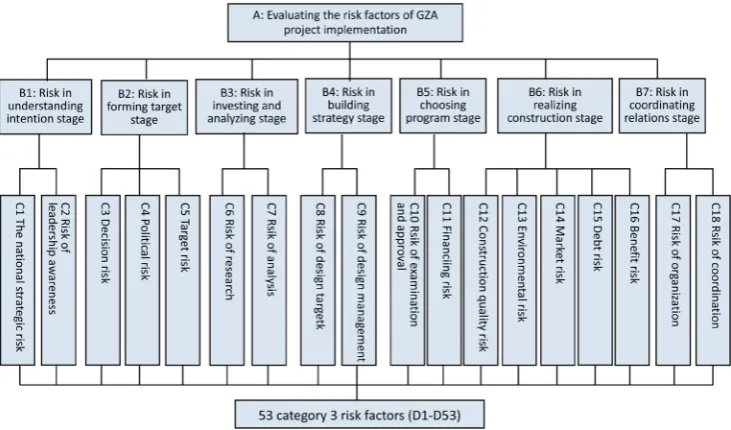
3.1. Building Risk Factors Evaluation Model of GZA Project Implementation with AHP
Based on WSR system methodology, we divide the working process of GZA project into 7 stages as 7 primary risk factors, including understanding intention, forming target, investing and analyzing, building strategy, choosing program, realizing construction, and coordinating relations. Through literature survey and expert in- vestigation method, we refer to information department bulletin, some report of government investment project, industry association, the government policy, Chinese Journal Full-Text Database etc. 20 secondary risk factors and 82 category 3 risk factors of GZA project are recognized with comprehensive induction. We interview with management experts, government leaders, HD design company, GL Construction Company, HG supervision company, JC consulting firms and other senior experts. By repeatedly talking, constantly adjusting the revision, finally, we establish the indicator system of risk factors and build the Analytic Hierarchy Process (AHP) eval- uation model, including 7 primary risk factors, 18 secondary risk factors and 53 category 3 risk factors (Fig- ure 1).Figure 1. Evaluation model for GZA project implementation risk factors. D1-National development strategy; D2-National macro-control; D3-Government’s intention; D4-Blind investment; D5-scienticify; D6-Demo- cratic participation; D7-Supervision mechanism; D8-Cadres’ rent-seeking behavior; D9-Policy supporting; D10- Government’s administrative efficiency; D11-General framework; D12-Necessity; D13-Feasibility; D14-Object; and content D15-Statistical information; D16-Data analysis; D17-Data prediction; D18-Time; D19-Costing; D20-Design quality; D21-Subcontracting; D22-alteration; D23-Policy; D24-Approval process; D25-Appro- val supervision; D26-Financing scale; D27-Financial market; D28-Approval Management; D29-Legal system; D30-Drawing; D31-Construction technology; D32-Personnel quality; D33-Building Materials; D34-Policy; D35-Macro-economic; D36-Force majeure; D37-Market price; D38-Market information; D39-Into market timing; D40-Market demand outlook; D41-Lending rates; D42-Budget control; D43-Investment; D44-Debt control mechanism; D45-Market acceptance; D46-Operating expenses; D47-Financial Support; D48-Organi- zation structure; D49-Organizational personnel; D50-Resources and environment; D51-Organizational pro- cesses; D52-External coordination; D53-Internal coordination.
3.2. Weight Calculation and Consistency Check on Risk Factors of GZA Project
Implementation
8 experts are invited to judge and give scores to the importance of each indicator of criterion relative to the higher criterion layer based on the 1 - 9 scale of AHP method. Thereby judgment matrixes is established, and consistency check on is taken.
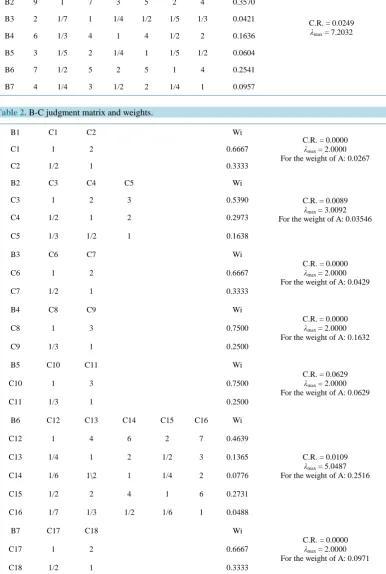
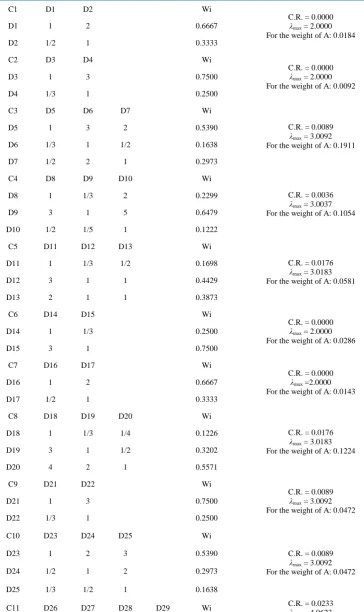
We deal with the sores from 8 experts, the original data of judgment matrixes of each layer is got. We get the relative weight of each risk factor in risk factors evaluation model through calculating. Judgment matrixes and calculation results are illustrated in Tables 1-3.
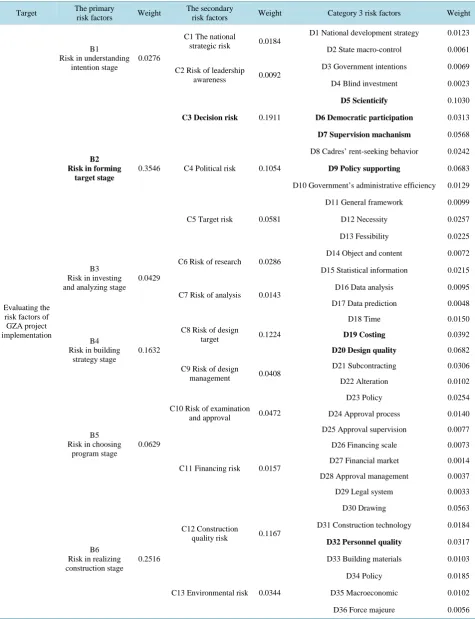
In the view of the calculation results, we can see the C.R. values of all judgment matrixes are less than 0.1. Therefore, all judgment matrixes pass the consistency check and the results are proved reliable. Based on the relative weight of each layer of risk factors, calculated the synthetic weights of various risk factors (Table 4). Performing a consistency test on total sorts by the Yaahp software, random consistency ratio C.R. of total sorts at all levels is less than 0.1, so the results of total sorts at all levels are satisfactory consistency, the evaluation result is acceptable.
It can be drawn from the results: the most important primary risk factor is the forming target stage, and the secondary risk factor is the decision risks. The top 10 key risk factors are as follows: scientificity, policy sup- porting, design quality, supervisory mechanism, drawing, costing, budget control, organization structure, per- sonnel quality, and democratic participation.
4. Conclusions
Table 1. A-B judgment matrix and weights.
A B1 B2 B3 B4 B5 B6 B7 Wi
C.R. = 0.0249 λmax = 7.2032 B1 1 1/9 1/2 1/6 1/3 1/7 1/4 0.0271
B2 9 1 7 3 5 2 4 0.3570
B3 2 1/7 1 1/4 1/2 1/5 1/3 0.0421
B4 6 1/3 4 1 4 1/2 2 0.1636
B5 3 1/5 2 1/4 1 1/5 1/2 0.0604
B6 7 1/2 5 2 5 1 4 0.2541
[image:4.595.103.490.142.717.2]B7 4 1/4 3 1/2 2 1/4 1 0.0957
Table 2. B-C judgment matrix and weights.
B1 C1 C2 Wi
C.R. = 0.0000 λmax = 2.0000 For the weight of A: 0.0267
C1 1 2 0.6667
C2 1/2 1 0.3333
B2 C3 C4 C5 Wi
C.R. = 0.0089 λmax = 3.0092 For the weight of A: 0.03546
C3 1 2 3 0.5390
C4 1/2 1 2 0.2973
C5 1/3 1/2 1 0.1638
B3 C6 C7 Wi
C.R. = 0.0000 λmax = 2.0000 For the weight of A: 0.0429
C6 1 2 0.6667
C7 1/2 1 0.3333
B4 C8 C9 Wi
C.R. = 0.0000 λmax = 2.0000 For the weight of A: 0.1632
C8 1 3 0.7500
C9 1/3 1 0.2500
B5 C10 C11 Wi
C.R. = 0.0629 λmax = 2.0000 For the weight of A: 0.0629
C10 1 3 0.7500
C11 1/3 1 0.2500
B6 C12 C13 C14 C15 C16 Wi
C.R. = 0.0109 λmax = 5.0487 For the weight of A: 0.2516
C12 1 4 6 2 7 0.4639
C13 1/4 1 2 1/2 3 0.1365
C14 1/6 1\2 1 1/4 2 0.0776
C15 1/2 2 4 1 6 0.2731
C16 1/7 1/3 1/2 1/6 1 0.0488
B7 C17 C18 Wi
C.R. = 0.0000 λmax = 2.0000 For the weight of A: 0.0971
C17 1 2 0.6667
Table 3. C-D judgment matrix and weights.
C1 D1 D2 Wi
C.R. = 0.0000 λmax = 2.0000 For the weight of A: 0.0184
D1 1 2 0.6667
D2 1/2 1 0.3333
C2 D3 D4 Wi
C.R. = 0.0000 λmax = 2.0000 For the weight of A: 0.0092
D3 1 3 0.7500
D4 1/3 1 0.2500
C3 D5 D6 D7 Wi
C.R. = 0.0089 λmax = 3.0092 For the weight of A: 0.1911
D5 1 3 2 0.5390
D6 1/3 1 1/2 0.1638
D7 1/2 2 1 0.2973
C4 D8 D9 D10 Wi
C.R. = 0.0036 λmax = 3.0037 For the weight of A: 0.1054
D8 1 1/3 2 0.2299
D9 3 1 5 0.6479
D10 1/2 1/5 1 0.1222
C5 D11 D12 D13 Wi
C.R. = 0.0176 λmax = 3.0183 For the weight of A: 0.0581
D11 1 1/3 1/2 0.1698
D12 3 1 1 0.4429
D13 2 1 1 0.3873
C6 D14 D15 Wi
C.R. = 0.0000 λmax = 2.0000 For the weight of A: 0.0286
D14 1 1/3 0.2500
D15 3 1 0.7500
C7 D16 D17 Wi
C.R. = 0.0000 λmax =2.0000 For the weight of A: 0.0143
D16 1 2 0.6667
D17 1/2 1 0.3333
C8 D18 D19 D20 Wi
C.R. = 0.0176 λmax = 3.0183 For the weight of A: 0.1224
D18 1 1/3 1/4 0.1226
D19 3 1 1/2 0.3202
D20 4 2 1 0.5571
C9 D21 D22 Wi
C.R. = 0.0089 λmax = 3.0092 For the weight of A: 0.0472
D21 1 3 0.7500
D22 1/3 1 0.2500
C10 D23 D24 D25 Wi
C.R. = 0.0089 λmax = 3.0092 For the weight of A: 0.0472
D23 1 2 3 0.5390
D24 1/2 1 2 0.2973
D25 1/3 1/2 1 0.1638
C11 D26 D27 D28 D29 Wi C.R. = 0.0233 λ
Continued
D26 1 4 2 3 0.4669
D27 1/4 1 1/3 1/3 0.0876
D28 1/2 3 1 1 0.2327
D29 1/3 3 1 1 0.2127
C12 D30 D31 D32 D33 Wi
C.R. = 0.0054 λmax = 4.0145 For the weight of A: 0.1167
D30 1 3 2 5 0.4824
D31 1/3 1 1/2 2 0.2718
D32 1/2 2 1 3 0.1575
D33 1/5 1/2 1/3 1 0.0883
C13 D34 D35 D36 Wi
C.R. = 0.0089 λmax = 3.0092 For the weight of A: 0.0344
D34 1 2 3 0.5390
D35 1/2 1 2 0.2973
D36 1/3 1/2 1 0.1638
C14 D37 D38 D39 D40 Wi
C.R. = 0.0054 λmax = 4.0145 For the weight of A: 0.0195
D37 1 2 3 5 0.4824
D38 1/2 1 2 3 0.2718
D39 1/3 1/2 1 2 0.1575
D40 1/5 1/3 1/2 1 0.0883
C15 D41 D42 D43 D44 Wi
C.R. = 0.0054 λmax = 4.0145 For the weight of A: 0.0687
D41 1 1/5 1/3 1/2 0.0883
D42 5 1 2 3 0.4824
D43 3 1/2 1 2 0.2718
D44 2 1/3 1/2 1 0.1575
C16 D45 D46 D47 Wi
C.R. = 0.0036 λmax = 3.0037 For the weight of A: 0.0123
D45 1 1/3 1/5 0.1096
D46 3 1 1/2 0.3092
D47 5 2 1 0.5813
C17 D48 D49 D50 D51 Wi
C.R. = 0.0127 λmax = 4.0340 For the weight of A: 0.0647
D48 1 2 4 6 0.4967
D49 1/2 1 3 5 0.3135
D50 1/4 1/3 1 2 0.1213
D51 1/6 1/5 1/2 1 0.0685
C18 D52 D53 Wi
C.R. = 0.0000 λmax = 2.0000 For the weight of A: 0.0324
D52 1 3 0.7500
Table 4. The weight of risk factors.
Target The primary
risk factors Weight
The secondary
risk factors Weight Category 3 risk factors Weight
Evaluating the risk factors of GZA project implementation
B1
Risk in understanding intention stage
0.0276
C1 The national
strategic risk 0.0184
D1 National development strategy 0.0123
D2 State macro-control 0.0061
C2 Risk of leadership awareness 0.0092
D3 Government intentions 0.0069
D4 Blind investment 0.0023
B2 Risk in forming
target stage
0.3546
C3 Decision risk 0.1911
D5 Scienticify 0.1030
D6 Democratic participation 0.0313
D7 Supervision machanism 0.0568
C4 Political risk 0.1054
D8 Cadres’ rent-seeking behavior 0.0242
D9 Policy supporting 0.0683
D10 Government’s administrative efficiency 0.0129
C5 Target risk 0.0581
D11 General framework 0.0099
D12 Necessity 0.0257
D13 Fessibility 0.0225
B3 Risk in investing and analyzing stage
0.0429
C6 Risk of research 0.0286
D14 Object and content 0.0072
D15 Statistical information 0.0215
C7 Risk of analysis 0.0143
D16 Data analysis 0.0095
D17 Data prediction 0.0048
B4 Risk in building
strategy stage
0.1632
C8 Risk of design
target 0.1224
D18 Time 0.0150
D19 Costing 0.0392
D20 Design quality 0.0682
C9 Risk of design
management 0.0408
D21 Subcontracting 0.0306
D22 Alteration 0.0102
B5 Risk in choosing
program stage
0.0629
C10 Risk of examination and approval 0.0472
D23 Policy 0.0254
D24 Approval process 0.0140
D25 Approval supervision 0.0077
C11 Financing risk 0.0157
D26 Financing scale 0.0073
D27 Financial market 0.0014
D28 Approval management 0.0037
D29 Legal system 0.0033
B6 Risk in realizing construction stage
0.2516
C12 Construction
quality risk 0.1167
D30 Drawing 0.0563
D31 Construction technology 0.0184
D32 Personnel quality 0.0317
D33 Building materials 0.0103
C13 Environmental risk 0.0344
D34 Policy 0.0185
D35 Macroeconomic 0.0102
Continued
C14 Market risk 0.0195
D37 Market price 0.0094
D38 Market information 0.0053
D39 Into market timing 0.0031
D40 Market demand 0.0017
C15 Debt risk 0.0687
D41 Lending rates 0.0061
D42 Budget control 0.0332
D43 Investment 0.0187
D44 Debt control mechanism 0.0108
C16 Benefit risk 0.0123
D45 Market acceptance 0.0013
D46 Operating expenses 0.0038
D47 Financial support 0.0071
B7 Risk in coordinating
relations stage
0.0971
C17 Risk of organization 0.0647
D48 Organization structure 0.0322
D49 Organizational personnel 0.0203
D50 Resources and environment 0.0079
D51 Organizational processes 0.0044
C18 Risk of coordination 0.0324
D52 External coordination 0.0243
D53 Internal coordination 0.0081
sults are in the following: Currently the most important primary risk factors of GZA project implementation is in the forming target stage, which is consistent with the current situation of government investment projects diffi- cult approval. In the secondary risk factors, decision risk is the most important. For government investment projects, the decisions on the phase of project approval have the most significant impact for the entire project. In category 3 risk factors the top 10 key risk factors are scientificity (D5, 0.1030), policy supporting (D9, 0.0683), design quality (D20, 0.0682), supervisory mechanism (D7, 0.0568), drawing (D30, 0.0563), costing (D19, 0.0392), budget control (D42, 0.0332), organization structure (D48, 0.0322), personnel quality (D32, 0.0317), democratic participation (D6, 0.0313). The top 10 risk factors focus on the forming target stage, realizing con- struction stage and building strategy stage. Therefore, GZA projects need to strengthen risk awareness in the three stages, take the rationalization of management measures.
In the future, we will apply the interpretive structural model to analyze the 10 key risk factors to identify the structure relationship between risk factors and the root of the risk factors in order to design the specific strategy to avoid risk and improve GZA project implementation.
Acknowledgements
Thanks for helpful discussion with Mr. Jing Xia, and Mr. Guoping Zhang etc.
References
[1] Gu, J.F. and Gao, F. (1998) To See Wuli-Shili-Renli Systems Approach from the View of Management Science. Sys- tems Engineering Theory and Practice, 18, 1-5.
[2] Sheng, Zh.H., You, Q.Zh. and Li, Q. (2008) Methodology and Method of Large Scale Complex Engineering Manage- ment: Meta-Synthesis Management. Science & Technology Progress and Policy, 25, 193-197.
[3] 233 Network School (2008) The Classification and Characteristics of Engineering Project Risk Management and Countermeasures. http://www.233.com/jzs1/xmgl/fudao/20080922/085417974.html
[4] Zhao, Zh.Y., Liu, Y.Sh. and Yang, H.Ch. (2002) Application of Fault Tree Analyzing Method to Risk Management of a Construction Project. Modern Electric Power, 19, 95-99.
currently publishing more than 200 open access, online, peer-reviewed journals covering a wide range of academic disciplines. SCIRP serves the worldwide academic communities and contributes to the progress and application of science with its publication.
Other selected journals from SCIRP are listed as below. Submit your manuscript to us via either