A Context-based Approach to Semantic Correctness
Priso Essawe-Ndedi
Higher Teacher’s Training College University of Yaounde 1 - CameroonMarcel Fouda-Ndjodo
Higher Teacher’s Training College University of Yaounde 1 - CameroonABSTRACT
Ly, Rinderle and Dadam [13] have worked on process semantic cor-rectness and introduced the concept of semantic contraints (mutual exclusion and dependency) in order to introduce semantic concerns in process modeling. In this paper, we attempt to refine their work by proposing a solution to two kinds of problems generated by se-mantic constraints as they initially defined it: how to maintain the constraints set when a new task is introduced in a model? How to allow mutual exclusive tasks to coexist in the same process via the desactivation of the cause of the mutual exclusion by a third party. Our solution takes advantage of a context-based business process modeling approach presented in [11].
Keywords:
Business Process, Semantic correctness, Conflict, Dependency
1. INTRODUCTION
Research on business processes modeling has extensively studied the structural aspects of business processes. Most business pro-cess modeling languages are graph-based (Workflow nets, EPC, BPMN), and emphasis has been put on structural concerns such as verifying if all jobs terminate properly, if tasks are properly syn-chronized or if there are subprocedures that are never used[1]. Petri nets, and more precisely the sub-type called Workflow nets have been instrumental in getting these results, at least for the formal as-pects. There is an extensive literature about the structural and the dynamic properties of business process models, particularly based on Petri nets. This sum of knowledge on Petri nets is in turn used to formally assess the properties of some other languages which are more connected to the industry (EPC[3], BPMN[9]).
However, less has been done to evaluate the semantic correctness of business processes. An attempt has been made by Ly et al [13], based on semantic constraints (mutual exclusion and dependency). Their work has made possible the expression of global constraints, overcoming the barrier imposed on Petri-net based token languages [7] by the locality principle which states that the firing of a tran-sition only affects the status of its neighbor trantran-sitions. From this principle, it appears that if two non adjacent tasks of a process are in mutual exclusion, Petri-net techniques are ill-suited to model such a situation. As a solution to this problem, Ly et al. propose the ex-plicit definition of the set of constraints involved in the process, a kind of constraint layer, which can serve for verification, process-ing and documentation purposes.
Another unsolved issue related to the semantics of business process tasks, is that of the definition of the role of a task in a business
pro-cess. In [6], Davenport and Short defined a business process as a set of logically related tasks performed to achieve a defined business outcome that we call the goal of the business process. While this definition can be found consensual, the different business process modeling languages that have been designed later did not offer any means to specify the actual role of a task in a process. Does it di-rectly contribute to the assigned goal? If yes, then what is exactly its action? If no, does it contribute indirectly by making possible the execution of another task? Without the answer to these ques-tions, it is difficult to reliably replace a task by another, because the consequences of such a change are unpredictable.
In this paper, we use a context-based business process modeling approach (see [11] for details) to improve the concept of business process semantic correctness. We refine the notion of mutual exclu-sion expressed in [13] by proposing three kinds of such situations: conflict, incompatibility, and antagonism. Each of these properties reveals a special kind of mutual exclusion. The contribution of this paper is three-fold: we propose a simple mechanism to express se-mantic constraints where constraints are not hard-coded, and hence are more suitable for change handling. The second important con-tribution is the ability to use in the same process, two mutual exclu-sive tasks, provided that there exists a third task in-between which lifts the incompatibility, and so allows the second task to execute. Finally, we refine the dependency relations between tasks by offer-ing a means to express what is precisely the contribution of a taskt for the execution of a subsequent tasktkor for the satisfaction of a goalginstead of merely stating thattkdepends ont.
This paper is organized as follows: in section two, the notion of se-mantic correctness is recalled. In section 3, the context-based mod-eling approach we used is presented, and it is shown how it handles semantic contraints. In section 4, we present how this model im-proves the management of semantic constraints. The related works in section 5 are followed by the conclusion.
2. SEMANTIC CORRECTNESS
2.1 Semantic constraints
In this paper, we focus on the definition of semantic correctness proposed by Ly et al. in [13]. They propose a context-based ap-proach to semantic correctness. In order to express semantic cor-rectness, each task is associated with constraints. A constraint can be of type mutual exclusion or dependency.
Formally,Abeing a set of activities, a semantic constraintcis de-fined as a tuple(type, source, target, position, userDef ined)
whereas:
–type∈Exclusion, Dependency –source, target∈A,source6=target –position∈pre, post, notSpecif ied –userDef inedis a user-defined parameter
The parametertypedenotes whether the semantic constraint is a mutual exclusion constraint or a dependency constraint. The second parametersourcedenotes the source activity the constraint refers to. The parametertargetdenotes the target activity related to the source activity. Parameterpositionspecifies the order the source and target activity are to be related to each other within the pro-cess (e.g., the surgery depends on the preparation of blood bottles and the bottles have to be prepared before (pre) the surgery). The last parameteruserDef inedcan be used for several purposes, for instance for additionally describing the constraint.
In a medical context, we can express the fact that two drugs, Aspirin and M arcumar are incompatible with the following constraint:
(Exclusion, T akeAspirin, T akeM arcumar, notSpecif ied,”Sample1”)
This constraint expresses the fact that a patient who has been ad-ministeredAspirinshould not be givenM arcumar. This con-straint is not linked to the order in which those drugs are taken, reason why the position is set tonotSpecif ied.
The second type of constraint is a dependency constraint. For exam-ple, before a surgery is performed, it may be necessary to prepare blood bottles. We get the following constraint:
(Dependency, P erf ormSurgery, P repareBloodBottles, post,”Sample2”)
With this constraint, a process trace with the task P erf ormSurgery without being preceded by the taskP repareBloodBottlesis semantically incorrect.
A business process is said to be semantically correct if all the con-straints defined in the model are respected. Any time a change is enforced, the constraints should be verified to guarantee that the new process is still semantically correct. With the definition of con-straints, it is possible to automatically check the semantic correct-ness of a process. In a semi-automated mode, it is also possible to warn the user of the possibility of a semantic problem.
2.2 Raised issues
The semantic constraints as described above contribute to the im-provement of processes at the semantic level. Semantic constraints are no longer implicit in the mind of the designer, but explicit, doc-umented and verifiable. Nevertheless, there are still some issues not solved by these semantic constraints as they are defined.
2.2.1 Hard-coded constraints. According to Ly et al., a con-straint is established between two well-identified tasks. The rea-son why two tasks are mutually exclusive or dependent is not known with the given constraint presentation. As a consequence, deduction operation are very hazardous. A taskt1is in mutual
ex-clusion with a taskt2, andt2 is in mutual exclusion witht3. Is
is possible to deduce something aboutt1 and t3? We are afraid
the answer is no. We do not know anything about the reason
un-derlying these exclusions. A human expertise is always neces-sary to create constraints. Even if two tasksT akeM arcumarand T akeP henprocoumonare identical (M arcumarbeing the com-mercial name ofP henprocoumon), a computer system cannot as-sist in replicating the constraints involving one task on the other. When adding a new task to the process, the elicitation of the con-straints caused by the new task is very complex. It causes the whole process to be re-inspected. Each time a new task is to be added, all the pre-existing tasks should be inspected in order to verify if the new task is in mutual exclusion with another task. This has to be done manually according to the knowledge we have on the tasks of the process. It makes any change process very sensitive and very exhausting.
2.2.2 Impossibility to interleave mutual exclusion and dependency. According to Ly et al., when a mutual exclusion constraint is de-fined, the two tasks involved in the constraint should not appear together in an excution trace. Although it may seem normal, it can also appear in some situations as too restrictive. Let us consider their own example of drug incompatibility. A drug called Marcumar is not compatible with another drug called Aspirin. The mutual exclusion constraint fits well for this situation. Let us assume that another drug called AntiMar annihilates the effect of Marcumar which makes it incompatible with Aspirin. In such a case, it is safe to take Marcumar, then AntiMar, and finally Aspirin. Hence, the path Marcumar-AntiMar-Aspirin becomes semantically correct. However, according to the model proposed by Ly et al., this last option remains semantically incorrect, because any trace which contains Marcumar should not contain Aspirin.
3. A CONTEXT-BASED BUSINESS PROCESS MODEL
A business process modeling approach has been proposed in [11]. The essential feature of this approach is context-awarenes. We will use this model to propose a refinement of the notion of seman-tic correctness. The term context-awareness was initially coined by Schilit and Theimer [17] to describe the ability of applications to discover and react to changes in the environment they are situated in. Context is either paraphrased in the literature by means of syn-onyms, such as environment or situation [8].
The model we use is built around the notion of environment. The environment is defined in this model as a set of context variables. As it is not possible to capture the entire context of an organization [21], we restrict ourselves to the part of the real world that is of interest for the business processes to design. Every characteristic of the real word which is relevant for the processes to design is captured through context variables in the form of boolean objects that we call observers.
The environment provides us with a platform where all of the task components in a process model must share information with each other and work together in order to achieve the objective of the process [18].
DEFINITION 1. Environments
An environmentξis a tuple< θ, S, val >where:
-θis a non empty set whose elements are called observers; -Sis a non empty set whose elements are called states(θ∩S=∅); -val:θ → (S →Bool)is a function which gives the values of observers in the different states.
over a set of observers is satisfied or not. An observation therefore has a positive part and a negative part. The positive part of an ob-servation is the set of the observers whose value is expected to be true, while the negative part is the set of observers whose value is expected to bef alse.
The environment depicts the whole context. At a given moment in time, we are focused on a subset of the environment. We make an observation which only concerns a few observers. On these few observers, we expect some to betrueand some others to bef alse. The observation is satisfied if our expectations are met. Formally, we get the following definition:
DEFINITION 2. Observations
Letξ=< θ, S, val >be an environment. An observation onξis a couple< A, B >where :A⊆θ, B⊆θandA∩B=∅.
Ais the set of observers required to betrue, andBis the set of observers required to bef alse. The observationobs=< A, B > is satisfied in a statesiff(∀o∈A, s(o))and (∀o∈B,¬s(o)).
Letobs=< A, B >be an observation,A(resp.B), also denoted P(obs)(resp.M(obs)), is called the positive part (resp. negative part) ofobs.
The environment constitutes the context, but this context is not static. It is in constant mutations, and we need processors to en-force these mutations. This role is played in our model by tasks. Tasks are the entities which have the capacity of modifying the con-text. A task modifies the value of one or many observers. The action of a task is explicit, and is limited to the observers it modifies. But for a task to act, its precondition has to satisfied first. In short, we define a task as an atomic unit of work which can be triggered un-der specific requirements (pre-condition) to produce a predictible result (post-condition).
DEFINITION 3. Tasks
Letξ =< θ, S, val >be an environment. A task onξ is a triple < t, ec, action >wheretis the name or identifier of the task, ecis an observation specifying its pre-condition, andactionis an observation specifying its post-condition.
In the remainder of this paper, the execution condition (resp. post-condition) of the task< t, ec, action >is denotedec(t) (resp. action(t)). In the same vein,P(action(t))(resp.M(action(t))) is denotedP(t)(resp.M(t)).
The execution oftin the statesmoves the environmentξinto the states0such that:
( ∀o∈P(t), s0(o)
∀o∈M(t),¬s0(o)
∀o∈θ\(P(t))∪M(t)), s0(o) =s(o)
In a business process, tasks are not isolated. According to Daven-port and Short , a business process is as a set of logically-related tasks performed to achieve a defined business outcome.
DEFINITION 4. Business process
Given an environmentξ, a Business Process is a tupleBP =< θ, T, tinit, f, g >where:
-θis a set of observers overξ, -T is a set of tasks onξ, -tinitis the initial task,
-gis a distinguished observation called the goal of the process, -f :T →2T is a function which, for every task, gives the names
of the tasks that can be executed right after it.
Our definition of a business process is conform to the idea of Dav-enport and Short, but it also context-oriented. The outcome of the business process (the goal) is an observation over the environment. In other words, we can observe on the environment if the business outcome is satisfied. The tasks are ordered by the follow functionf, starting by the special tasktinit. For each task, the follow function indicates which tasks can follow.
4. OUR IMPLEMENTATION OF SEMANTIC CONSTRAINTS
The model developped in [11] and presented above fits well with the semantic correctness defined by Ly et al[13]. In the following lines, we show how we use it to capture the different constraints proposed by Ly et al., and we propose some refinements to each type of constraint (mutual exclusion and dependency).
4.1 Mutual exclusion
A mutual exclusion constraint concerning two tasks t1 and t2
means that no execution trace should contain botht1andt2. This
can happen for several reasons. Both tasks may act on the same sub-ject, but differently. For example,t1switches the light on, whilet2
switches it off. We call this kind of mutual exclusion conflict. It can also happen thatt1needs the light to be on for its execution, while
t2needs the same light to be off. We will say thatt1andt2are
in-compatible. A third case is the situation wheret1switches the light
on, whilet2requires that light to be off. In this case, we say thatt1
andt2are antagonist.
From the model described above, we derive a formalization of these three types of mutual exclusion.
Conflict. Two taskst1andt2are in conflict if there is an observer
osuch that belongs to the positive part of the action oft1, and to
the negative part of the action oft2. Formally,o∈P(t1)∩M(t2).
In such a situation, t1 and t2 are in mutual exclusion on o. t1
switchesototruewhilet2switches the same observerotof alse.
If for exampleotells if a loan is accepted,t1will sayyeswhilet2
saysno.
Incompatibility. Two taskst1andt2are incompatible if there is an
observerosuch thato∈P(ec(t1))∩M(ec(t2)).
In such a situation,t1andt2are in mutual exclusion ono.t1
re-quiresoto betruewhile the sameois required to bef alsebyt2.
If for exampleotells if a loan is accepted,t1 requires the loan to
be accepted, whilet2requires the loan not to be accepted.
Antagonism. Two taskst1andt2 are antagonist if there is an
ob-serverosuch thato∈P(t1)∩M(ec(t2)).
In such a situation,t1andt2are in mutual exclusion ono.t1 sets
ototruewhile the sameois required to bef alsebyt2. If for
exampleotells if a loan is accepted,t1 says that the loan to be
accepted, whilet2requires the loan not to be accepted.
4.2 Dependency
A dependency constraint concerning two tasks means that one task requires the other. For this constraint, we make a difference be-tween two situations. A taskt1may require anothert2 in order to
have its execution condition satisfied. The action oft2contribute to
the activation oft1. This is a none side dependency, because in this
case,t2 does not depend ont1. We call it an execution condition
dependency becauset1needst2to be executed in other to have its
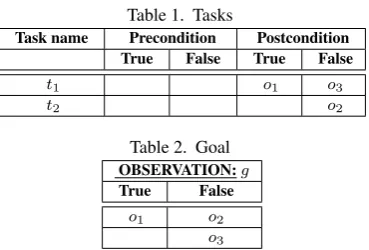
Table 1. Tasks
Task name Precondition Postcondition True False True False
t1 o1 o3
t2 o2
Table 2. Goal OBSERVATION:g
True False
o1 o2
o3
A taskt1may also require another taskt2in other to achieve a goal
gtogether, each task achieving just a part of the goal. In this second case, it is a mutual dependency. It would even be more accurate to say that the goal depends ont1andt2. We call this dependency a
goal satisfaction dependency.
Execution condition dependency. If two taskst1 andt2 are such
that there is an observerosuch thato∈P(ec(t1))∩P(t2), theno
belongs to the execution condition oft1, and it also belongs to the
action oft2. In other words, the action oft2 makes it possible to
executet1.
In such conditions, there is an execution condition dependency be-tweent1andt2.t2activatesofort1, and allowst1to be executed,
because ifois not set totrue, thent1will not be able to execute.
In this situation, it is obvious that in an execution trace (or in a path),t1 should appear aftert2. So according to Ly et al.
termi-nology,t1will be the source,t2the target, with the positionpost,
because in this case,t1appears aftert2.
Goal satisfaction dependency. If a goal is such that no task can satisfy it alone, each task satisfying just a part of the goal, then we say that the tasks contributing to the satisfaction of the goal have mutual dependency constraints for the satisfaction of the goal. Let us consider two taskst1andt2such thatt1sets an observero1
totrueand another observero3tof alse, whilet2sets an observer
o2tof alse. The pre-condition of both tasks is void (see table 1).
We need to achieve a goalgwhich requires the observero1to be
trueand the observerso2ando3to bef alse(see table 2).
We see that neithert1nort2can satisfy the goalg.t1depends on
t2just liket2depends ont1for the satisfaction of the goalg.
According to Ly et al. terminology,t1depends ont2with the
po-sitionN otSpecif ied, because in this case,t1 may appear either
before or aftert2.
5. IMPROVEMENTS ON THE NOTION OF SEMANTIC CORRECTNESS
We have shown in the lines above that our model captures the no-tion of semantic constraint as defined in [13]. A process model is said to be semantically correct if all the semantic constraints are respected. In this section, we will show that mutual exclusion and dependency, as defined in [13], fail to capture some particular, but likely situations. Moreover, the constraints are ill-suited for change because they are hard-coded. Any change introduced in the model will require a complete re-inspection of the model to make sure it is still semantically correct.
5.1 Avoiding Hard-coded constraints
According to Ly et al., a constraint is established between two well-identified tasks, and existing constraints can merely be used to
de-duce new ones. With our model, the constraints are expressed us-ing observers which are context variables. For each task, we de-fine what it expects from the environment and what it produces on the environment. When a task is added or removed, its impact can be automatically calculated. Thus, the change process can be effi-ciently computer-assisted.
To illustrate this situation, let us consider a medical environment where a restricted set of drugs is used. The different constraints between those drugs are documented using Ly et al. constraints. When adding a new drug to this set, the interactions between the new drug and each of the existing ones must be carefully and man-ually investigated. Our knowledge of each existing drug should be used to decide if it is compatible with the new one. The result of this process is the definition of a new set of dependencies. With our model, this investigation can be automated. A part of our knowledge on each drug is already documented in the form of preconditions and actions. Let us assume, for the sake of sim-plicity, that the new drug’s effect is to increase the blood pres-sure. The action of the new drug will be setting an observer lowBloodP ressuretof alse. We can automatically look for in-compatibilities by searching for any existing drug, which in its pre-condition requireslowBloodP ressureto betrue.
Formally,{lowBloodP ressure} ∈M(takeN ewDrug), and the tasktakeN ewDrugis incompatible with any tasktsuch that the {lowBloodP ressure} ∈P(ec(t)).
Given that the precondition and the action of all the tasks are com-pletly defined, the updated set of constraints can be automatically obtained after a change by checking the execution condition and the action of all existing tasks against that of the new task.
5.2 Interleaving mutual exclusion and dependency constraints
According to Ly et al., when a mutual exclusion constraint is de-fined, the two tasks involved in the constraint should not appear together in an excution trace. This definition of mutual exclusion causes some correct processes to be marked as incorrect. Let us consider again the Marcumar and Aspirin incompatibility exam-ple. Let us assume that another drug called AntiMar annihilates the effect of Marcumar which makes it incompatible with Aspirin. In such a case, it is safe to take Marcumar, then AntiMar, and finally Aspirin. Hence, the path Marcumar-AntiMar-Aspirin becomes se-mantically correct. However, according to the model proposed by Ly et al., this last option remains semantically incorrect, because any trace which contains Marcumar should not contain Aspirin. With our model, this limitation is lifted. Marcumar and Aspirin are antagonist (a particular form of mutual exclusion as explained above). Once Marcumar is taken, an observerois settrue, and that same observer is required to bef alsebefore being allowed to take Aspirin (ois part of the execution condition of taking As-pirin). In this configuration, it is not possible to take Aspirin af-ter Marcumar. But taking the drug AntiMar sets the observeroto f alse, making it possible again to take Aspirin. Our model clearly exhibits that the sequenceM arcumar−Aspirinis wrong, while M arcumar−AntiM ar−Aspirinis correct.
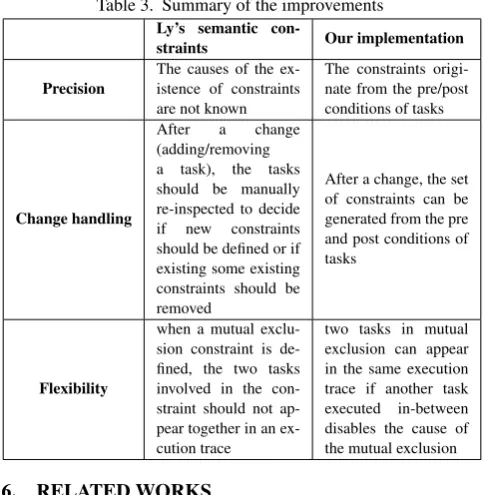
5.3 Summary of the improvements
Table 3. Summary of the improvements Ly’s semantic
con-straints Our implementation
Precision
The causes of the ex-istence of constraints are not known
The constraints origi-nate from the pre/post conditions of tasks
Change handling
After a change (adding/removing a task), the tasks should be manually re-inspected to decide if new constraints should be defined or if existing some existing constraints should be removed
After a change, the set of constraints can be generated from the pre and post conditions of tasks
Flexibility
when a mutual exclu-sion constraint is de-fined, the two tasks involved in the con-straint should not ap-pear together in an ex-cution trace
two tasks in mutual exclusion can appear in the same execution trace if another task executed in-between disables the cause of the mutual exclusion
6. RELATED WORKS
This paper is fundamentally based on two previous ones: [11]where the formal model we use here has been defined, and [13] where we picked the notion of semantic correctness.
In [11], a formal business process model is defined. This model in-corporates the notion of environment which was first used for the definition of business processes in [5]. It refines it by proposing a more computable task model. While in [5] a task was any opera-tor that changed the state of the environment, in [11], it is required in the definition of a task to indicate on which observers the task actually has an effect. As a consequence, the action of a task is predictible, regardless of the state of the environment. The model-ing driver for both [5] and [11] is the emphasis put on context. The term context-awareness was initially coined by Schilit and Theimer [17] to describe the ability of applications to discover and react to changes in the environment they are situated in. Context is either paraphrased by means of synonyms, such as environment or sit-uation [8]. The term environment has been used in [5] and kept in [11]. The emphasis on context can be very helpful to handle change situations. In [15], Regev et al. defined business process flexibility as “the capability to implement changes in the business process type and instances by changing only those parts that need to be changed and keeping other parts stable”[15]. This understanding implies that business processes are aware of the environment they are designed for, i.e. it has to be known what parts of the process have to be changed and which parts are to be kept stable, and it has to be noticed when a change is necessary. This in turn suggests taking the environment, where a change occurs, into account when designing business processes [12].
The second milestone of this paper is the work of Ly et al.[13] who proposed a system of semantic constraints for a business pro-cess model. As we mentionned in the above sections, they propose two types of constraints: mutual exclusion and dependency con-straints. A process is said to be semantically correct if all the listed constraints are respected. This constitutes an improvement on pre-vious business process modeling approaches where constraints are implicit, and if enforced, difficult to maintain. The term semantic correctness is also used in [4] to denote the notion of soundness as
defined in [1], by opposition to syntactic correctness. Syntactic er-rors are all erer-rors that can be detected without any knowledge of the application domain, i.e. all constructs violating universal, domain independent requirements. A process is said to be sound if it has no deadlocks and terminates properly. Proper termination means that the state is reached with a single token in the sink place and after termination there are no dangling references [2]. This defini-tion of semantic correctness associated to soundness has different goal than ours, and the term semantic correctness used in this paper is not linked to their definition, but to Ly’s one. In [14], semantic correctness is also studied. Semantic concerns are added on top of workflow nets to obtain semantic workflow nets. A process is said to be semantically conformant to a process specification if the pre-condition of the process is always fullled in the prepre-condition of the specification, if the effect of the process fulfills the effect of the specification, and if each activity in the process is actually invok-able when it can be invoked. Schaffner et al.[16] also confirm the link between semantic correctness and the satisfaction of precondi-tions. They add that each task of the process should be relevant (its outputs is consumed by a successor operation) and should not be redundant. These needs are explicitly captured in our model with observers that are set by a task in a value required later in the pre-condition of another task.
7. CONCLUSION
This work has been an attempt to refine the notion of semantic cor-rectness defined by Ly, Rinderle and Dadam[13], using the business process modeling approach defined in [11], where tasks are defined by their effect on the environment (defined as a set of boolean con-text variables called observers). A process is said to be semanti-cally correct if all the mutual exclusion constraints and dependency constraints are satisfied. We introduced three kinds of mutual ex-clusions: conflict, incompatibility, and antagonism. Two tasks are conflicting if they produce different effect on the same observer. They are incompatible if for their execution, they require opposite values from the same observer. They are antagonist if the action of one task sets an observer to a value opposed to what is required by the other.
As a result of our approach, we have been able to express con-straints on the environment, rather than expresing them directly be-tween tasks. By so-doing, we have shown that the constraint set can be automatically updated after a change (adding, modifying or deleting a task). Another result is the possibility to use in the same process, two mutual exclusive tasks, provided that there exists a third task in-between which lifts the incompatibility, and so allows the second task to execute.
The results obtained in this paper can be used to improve the change handling process and move towards systems which can automati-cally adapt to changes.
8. REFERENCES
[1] W.M.P. van der Aalst, The application of Petri nets to work-flow management, The Journal of Circuits, Systems and Com-puters (1998), pp. 21-66
[2] van der Aalst, W. M., & Jablonski, S. (2000). Dealing with workflow change: identification of issues and solutions. Com-puter systems science and engineering, 15(5), 267-276 [3] W.M.P. van der Aalst and J. Desel and E. Kindler, On the
semantics of EPCs: A vicious circle (2002)
Preserv-ing correctness durPreserv-ing business process model configuration, Formal Aspects of Computing (2010), pp. 459-482
[5] R. Atsa-Etoundi, A domain engineering approach for multiperspectives Workflow modelling, University of Yaounde I -Cameroon (2004)
[6] T. Davenport and J.E. Short. The new industrial engineering: information technology and business process redesign. Sloan Management Review, 31(4), pp.11–27, 1990
[7] J. Desel and G. Juhs, “What Is a Petri Net?” Informal An-swers for the Informed Reader, In Unifying Petri Nets pp. 1-25, Springer Berlin Heidelberg, 2001
[8] A.K. Dey, Understanding and using context. Personal and ubiquitous computing, 5(1), 4-7, 2001
[9] R. Dijkman and M. Dumas and C. Ouyang, Semantics and analysis of business process models in BPMN, Information and Software Technology (2008), pp. 1281-1294
[10] S. Evangelista, High level petri nets analysis with Helena, In Applications and Theory of Petri Nets 2005, pp. 455-464, Springer Berlin Heidelberg, 2005
[11] M. Fouda-Ndjodo, P. Essawe-Ndedi, R. Atsa-Etoundi, An Interperspective-Oriented Business Process Modeling Ap-proach, LNBIP 50, Springer Heidelberg, 2010, pp. 145–156 [12] I. Krschel (2010). On the Notion of Context for Business
Pro-cess Use. In ISSS/BPSC (pp. 288-297).
[13] L.T. Ly and S. Rinderle and P. Dadam, Semantic correctness in adaptive process management systems, Lecture Notes in Computer Science (2006), pp. 193-208
[14] H. Meyer, Calculating the semantic conformance of pro-cesses., In : Business Process Management Workshops. Springer Berlin Heidelberg, 2008. pp. 473-483.
[15] Regev, G.; Soffer, P.; Schmidt, R.: Taxonomy of flexibility in business processes. In: Proc. Seventh Workshop on Business Process Modeling, Development,and Support (BPMDS). Re-quirements for flexibility and the ways to achieve it. Luxem-burg, 2006
[16] J. Schaffner, H. Meyer and M. Weske . A formal model for mixed initiative service composition. In IEEE International Conference on Services Computing, 2007. SCC 2007. (pp. 443-450). IEEE.
[17] Schilit, B., Theimer, M.: Disseminating active map informa-tion to mobile hosts. IEEE Network8(5):22-32, 1994 [18] J.J. Shi and D. Lee and E. Kuruku, Task-based modeling
method for construction business process modeling and au-tomation, Automation in Construction (2008), pp. 633-640 [19] Soffer, P.:Onthe notion of flexibility in business processes.
Proceedings of the CAiSE’05 Workshop, 2005; pp. 35-42 [20] H.M.W. Verbeek and T. Basten and W.M.P. van der Aalst,
Diagnosing workflowprocesses using woflan, The Computer Journal (2001), pp. 246-279
[21] F.B. Vernadat, Enterprise Modeling And Integration (EMI): Current Status And Research Perspectives, Annual Reviews in Control (2002), pp. 15-25