Comparative Study on Mobile Ad-hoc Network
Routing Protocols
Prof Bhavika A Tailor1
1Computer Engineering Department, Vadodara Institute of Engineering
Abstract- The Mobile Adhoc Networks consist of a collection of wireless nodes that communicate over a common wireless medium without an infrastructure, such as base station, wired access point, etc. The organization of the networks must be in a distributed and decentralized manner. It is a great challenge in selection of routing protocol in Mobile Adhoc Network due to frequent changes in topology, routing overhead, link instability and mobility of node. There are various routing protocols available for Mobile Adhoc Network. This paper involves study of routing protocols. These protocols are divided into three categories: proactive, reactive and hybrid routing protocols. In this paper study of these existing routing protocols is done and comparison analysis of protocols is performed.
Keywords: Mobile Adhoc Network, DSDV, DSR, AODV, ZRP.
I. INTRODUCTION
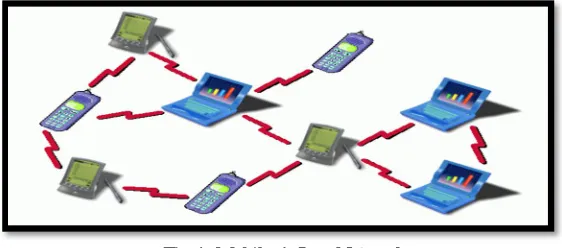
[image:2.612.164.445.482.606.2]A Mobile Adhoc network is a collection of wireless mobile nodes dynamically forming a temporary network without the aid of any established infrastructure or centralized administration. Mobile Adhoc networks are self-configuring, dynamic networks in which nodes are free to move. Wireless networks lack the complexities of infrastructure setup and administration, enabling devices to create and join networks "on the fly" – anywhere, anytime. Wireless transceiver is equipped with nodes. They don’t require any infrastructure, such as base station or wired access point, etc. Therefore, each node does play the role of an end system and also acts as a router that sends packets to destination nodes. Fig 1 shows the Mobile Adhoc network. Mobile Adhoc network is feasible to use in military, law enforcement, emergency response efforts, electronic classroom, convention centers and construction Sites etc because it is quick and easy to deploy. It is a great challenge in selection of routing protocol in Mobile Adhoc due to frequently changes in topology, routing overhead, link instability and mobility of node. Routing protocol plays an important role in any network. It specifies how routes communicate with each other, disseminating information to select routes between any two nodes on a network. There is various kind of routing protocol present for Adhoc network and these can be categorized in three schemes: proactive, reactive and hybrid routing protocols.
Fig 1. Mobile Adhoc Network
II. ROUTING PROTOCOLS.
A. Proactive Routing
Proactive are also called as table driven routing protocols. In table driven routing, every node keeps one or more tables representing the overall topology of the network. These tables are updated frequently in order to maintain up-to-date routing information from each node to every other node [1]. In routing table records for all available destinations, number of hops required to reach at each destination are stored. One of the main advantages of this protocol is that whenever routes are needed they are available and ready to use. The major disadvantage of proactive routing protocols includes the overhead of flooding route. There are various proactive routing protocols example DSDV(Destination Sequence Distance Vector) etc.
B. Reactive Routing Protocols (On Demand Driven)
Reactive routing protocols are On-demand protocols. Reactive protocols determine the proper route only when required, that is, when a packet needs to be forwarded [3].Distance vector routing algorithm is use by reactive routing protocols and find out the route to given destination only by initiating route discovery process. This protocols work on route discovery and route maintenance mechanism. Reactive routing protocols have drawback of delay in finding routes to new destination [2].There are various reactive routing protocols examples DSR(Dynamic source routing), AODV(Adhoc On Demand Distance Vector Routing )etc.
C. Hybrid Routing Protocols
It is a network routing protocol that combines Distance Vector Routing Protocol (DVRP) and Link State Routing Protocol (LSRP)
features. This type of protocol combines the advantages of proactive and reactive routing protocols. Initially the routing is
established using route specified in proactive routing table and then using reactive flooding techniques determine the proper route for additionally activated nodes. These protocols exploit the hierarchical network architecture and allow the nodes with close proximity to work together to form some sort of backbone, thus increasing scalability andreducing route discovery [3]. There are various hybrid routing protocols example ZRP (Zone Routing Protocol).
III. DSDV (DESTINATION SEQUENCE DISTANCE VECTOR)
The DSDV routing protocol is a proactive routing protocol based on the Bellman-Ford routing algorithm that provides solution for shortest path between two nodes. Each mobile node in the network has routing table. Each routing table has records of available destinations and numbers of hops to each. It introduces new feature i.e. for each routing table its provided sequence number to avoid routing loop. The tables are exchanged information at regular interval to maintain updates of the routing tables. If there is any new significant change in the routing information, the updates are transmitted immediately from the respective nodes. So, the routing information updated may either be event driven or periodic. DSDV protocol requires each mobile node in the network to broadcast it s own routing table to its current neighbors which is either done by broadcasting or by multicasting [1]. In order to reduce the amount of information carried during the broadcasting the routing information packets, two types of message are defined.One carry all the available routing information is called full dump and other types i.e. incremental dump carries information that has changed since the last full dump [4]. The full routing table is sent to the neighbor in case of full dump, and only those entries which require changes are sent in case of incremental dump. In this protocol the updates lead to high control overhead during high mobility due to broken links. Another drawback is that node has to wait for a table update message initiated by the same destination node in order to obtain information about a particular destination node [2].
IV. DSR (DYNAMIC SOURCE ROUTING)
DSR is a reactive protocol based on source routing concept that requires each packet to carry the full address from source to
Routing Protocols
are required to maintain in this protocol. If any new route is identified then route cache is updated. When source node wants to send packets to destination node, firstly we have to check route cache to determine whether route is already available in route cache or not. If any entry exits, the source node uses this route to send the packet to the destination node. If route doesn’t exist, then it broadcast the route request. This broadcast request consists following entries: destination address, source address and distinct identification number. Each intermediate node checks whether it known about the destination node or not. If it doesn’t know about the destination node, it again forwards the packet and repeat the process until it doesn’t reach to the destination node. A route reply is generated by the destination node or by any of the intermediate nodes when it knows about how to reach the destination node. DSR enables multiple routes to be learnt for a particular destination. DSR does not require any periodic update messages, thus avoiding wastage of bandwidth [3].
V. AODV (ADHOC ON DEMAND DISTANCE VECTOR ROUTING)
AODV protocol is both an on-demand and a table-driven protocol. It adopts flat routing tables, one entry per destination. It is in difference to DSR, which can maintain multiple route cache entries for every one destination. The packet size in AODV is uniform unlike DSR. Unlike DSDV, there is no need for system-wide broadcasts due to local changes. AODV supports multicasting and unicasting within a uniform framework. AODV builds routes using a route request /route reply cycle. Each route has a lifetime after which the route expires if it is not used. A route is maintained only when it is used and hence old and expired routes are never used. Unlike DSR, AODV maintains only one route between a source-destination pair. AODV attempts to improve on DSR by maintaining routing tables at the nodes, so that data packets do not have to contain routes. AODV retains the desirable feature of DSR that routes are maintained only between nodes which need to communicate. To determine freshness of routing information and to prevent routing loops, AODV uses sequence numbers maintained at each destination. Sequence number for both destination and source are used. These sequence numbers are carried by all routing packets. In AODV routing, upon receipt of a broadcast query (RREQ), nodes record the address of the node sending the query in their routing table .This procedure of recording its previous hop is called backward learning. Upon arriving at the destination, a reply packet (RREP) is then sent through the complete path obtained from backward learning to the source. At each stop of the path, the node would record its previous hop, thus establishing the forward path from the source. The flooding of query and sending of reply establish a full duplex path. After the path has been established, it is maintained as long as the source uses it. When the next-hop link breaks nodes are notified with RERR packets. Each predecessor node, forwards the RERR to its own set of predecessors, thus effectively erasing all routes using the broken link. Route error propagation in AODV can be visualized conceptually as a tree whose root is the node at the point of failure and all sources using the failed link as the leave [4]. It is loop free, self starting, and scales to large numbers of mobile nodes.
VI. ZRP (ZONE ROUTING PROTOCOL)
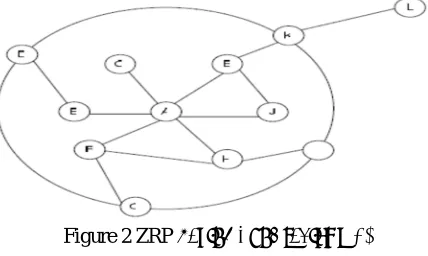
[image:4.612.197.411.570.698.2]ZRP is appropriate for those networks which are having large span and various mobility patterns. According to application using ZRP we can take advantage of both table driven and on demand driven protocol.. In the ZRP protocol, each node proactively maintains routes inside a local region, which is known as routing zone. Route establishment is done by using a query-reply method .These local neighborhoods are called zones (hence the name) each node may be within multiple overlapping zones, and each zone may be of a different size [1]. The “size” of a zone is not determined by geographical measurement, as one might expect, but is given by a radius of length α where α is the number of hops to the perimeter of the zone.
Figure 2 ZRP having Zone radius α =2
it between such zones in reactive way A, E, F, H, J, C are interior node and D, G, I, k are border nodes communication between B and K is done through proactive way and L is located outside the zone. ZRP consist of three parts IARP proactive part, IERP reactive part of it and BRP used with IERP to reduce the query traffic [6].
VII. CONCLUSION
This paper presents the comparative study of various routing protocols in Mobile Adhoc Network. On basis of mobility rates of nodes, periodic exchange of information and movement speed, it is observed that AODV performed well compared to other routing protocols. Mechanisms like route discovery, route maintenance and elimination of periodic broadcasting are used by AODV which is better than DSDV. Because of table driven approach performance of DSDV is degraded. With large number of nodes, performance of AODV is better compared to DSDV. Hence for real time traffic AODV is preferred rather than DSR and DSDV. For less number of nodes and mobility, DSDV’s performance is best than AODV and DSR. In high mobility and higher number of nodes ZRP performs better.
REFERENCES
[1] Gulhane, Rajshree S., and Aditya P. Bakshi. "STUDY OF VARIOUS ROUTING PROTOCOL FOR VANET." International Journal of Research In Science & Engineering Volume: 1 Special Issue: 1
[2] Tuteja, Asma, Rajneesh Gujral, and Sunil Thalia. "Comparative performance analysis of DSDV, AODV and DSR routing protocols in MANET using NS2." Advances in Computer Engineering (ACE), 2010 International Conference on. IEEE, 201
[3] Kachal, Ritika, and Shrutika Suri. "Comparative Study and Analysis of DSR, DSDVAND ZRP in Mobile Ad-Hoc Networks." International Journal of Computer Sciences and Engineering ,Volume-2, Issue-5(2014): 148-152
[4] Shivahare, Basu Dev, Charu Wahi, and Shalini Shivhare. "Comparison of proactive and reactive routing protocols in mobile adhoc network using routing protocol property." International Journal of Emerging Technology and Advanced Engineering 2.3 (2012): 356-359
[5] Dipobagio, Martinus. "An Overview on Ad Hoc Networks." Institute of Computer Science (ICS), Freie Universitat Ber (2008)\